MARKET INSIGHTS
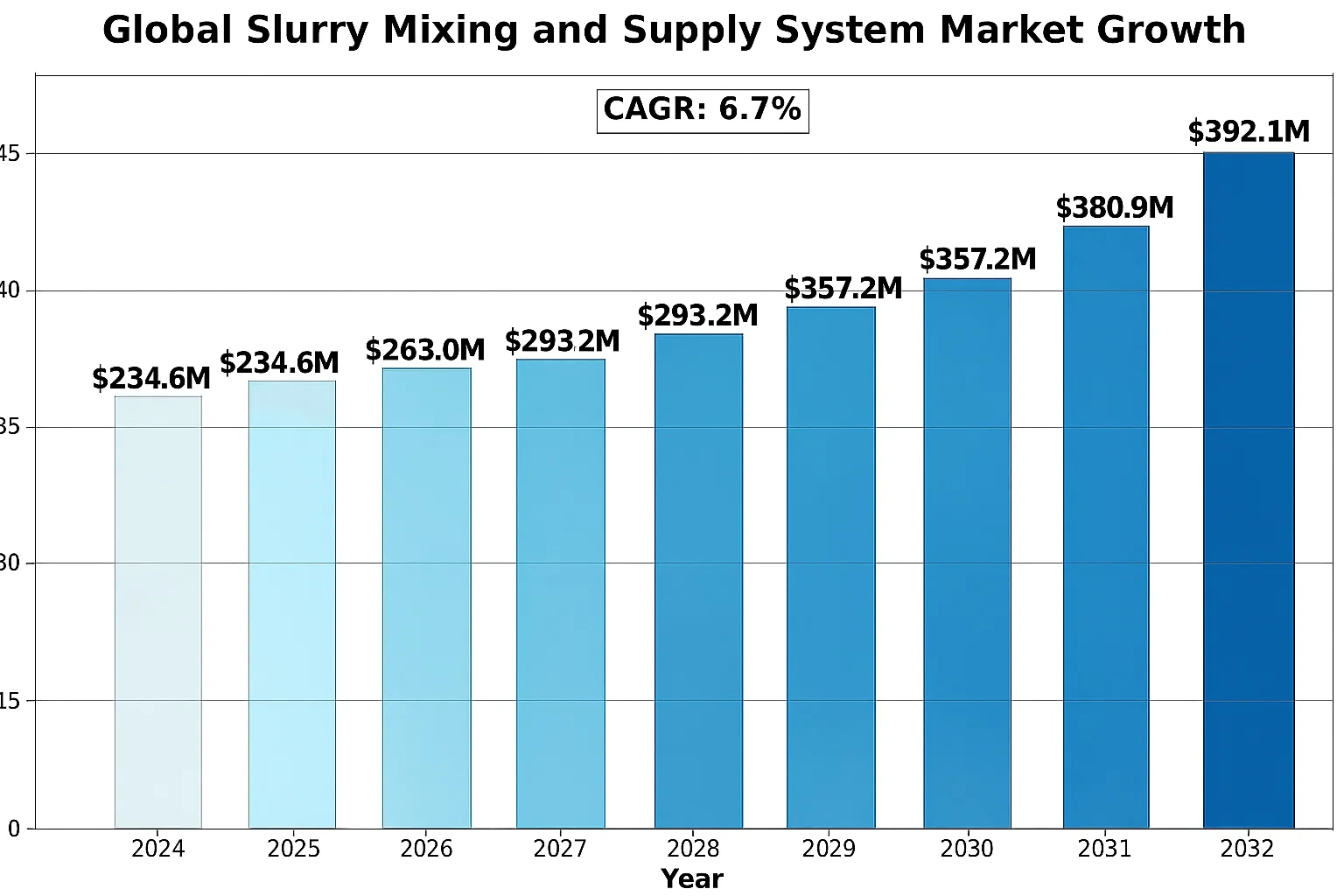
The global Slurry Mixing and Supply System Market size was valued at US$ 234.6 million in 2024 and is projected to reach US$ 392.1 million by 2032, at a CAGR of 6.7% during the forecast period 2025-2032.
Slurry Mixing and Supply Systems are specialized industrial solutions designed for precise blending and transportation of slurry – a critical mixture of solid particles and liquid used in semiconductor manufacturing, mining, and wastewater treatment. These systems ensure homogenous slurry composition through advanced agitation technologies while maintaining consistent flow rates via pressurized or pumped delivery mechanisms. Key configurations include vessel-type (N2 pressurization) and tank-type (pump supply) systems.
The market growth is driven by expanding semiconductor fabrication facilities, particularly for SiC and Si wafer production, where slurry uniformity directly impacts Chemical Mechanical Planarization (CMP) process yields. Environmental regulations in mining operations and increasing adoption of automated slurry handling in wastewater treatment further contribute to demand. Major players like Mitsubishi Chemical Corporation and Merck KGaA are investing in IoT-enabled slurry systems with real-time viscosity monitoring, addressing the industry’s shift toward Industry 4.0 standards.
MARKET DYNAMICS
MARKET DRIVERS
Expanding Semiconductor Manufacturing to Fuel Demand for Slurry Mixing Systems
The global semiconductor industry’s exponential growth is creating robust demand for slurry mixing and supply systems. With semiconductor foundries expanding production capacity to meet the needs of 5G, AI, and IoT applications, chemical mechanical planarization (CMP) processes require increasingly sophisticated slurry handling solutions. The semiconductor capital equipment market is projected to grow at over 7% annually through 2030, directly driving investments in ancillary systems like slurry handling. Manufacturers are transitioning to larger 300mm wafer production, where precise slurry management becomes even more critical for maintaining yield rates above 90%.
Stringent Environmental Regulations Accelerating System Upgrades
Environmental regulations worldwide are pushing manufacturers to adopt advanced slurry management solutions. The semiconductor industry faces increasing pressure to reduce chemical waste and improve recycling efficiency. Modern slurry mixing systems can reduce chemical consumption by up to 30% through precision dosing and closed-loop recycling capabilities. Recent regulations in Asia-Pacific manufacturing hubs now mandate real-time monitoring of slurry composition, creating demand for smart systems with integrated sensors and IoT connectivity.
Other Key Drivers
The mining industry’s automation initiatives are generating strong demand for large-scale slurry handling solutions as operators seek to improve mineral recovery rates while reducing water consumption. Meanwhile, wastewater treatment plants are adopting modular slurry systems to handle increasingly diverse industrial effluents.
MARKET RESTRAINTS
High Capital Costs Limiting Adoption in Developing Markets
While slurry mixing systems offer long-term operational benefits, their substantial upfront costs create adoption barriers in price-sensitive markets. Advanced CMP slurry systems for semiconductor fabs typically require investments exceeding $500,000 per unit, putting them out of reach for smaller manufacturers. The total cost of ownership calculation becomes particularly challenging in regions with unreliable infrastructure, where maintenance and energy costs can be unpredictable.
Other Restraints
Technical Complexity
System integration challenges frequently delay deployments, as slurry systems must interface with diverse production equipment while meeting strict purity requirements. The semiconductor industry’s transition to next-generation materials like cobalt and ruthenium for advanced nodes creates additional compatibility issues that require customized solutions.
Supply Chain Vulnerabilities
Specialized components for high-precision slurry systems often come from single-source suppliers, creating potential bottlenecks. The average lead time for critical slurry pumps and valves has increased by 40% since 2022 due to semiconductor supply chain disruptions.
MARKET OPPORTUNITIES
Emerging Markets Present Untapped Potential for Modular Solutions
Developing economies in Southeast Asia and Africa are creating substantial opportunities for slurry system providers. Local manufacturers transitioning to automated production processes require cost-effective solutions that can scale with their growth. Compact, modular slurry systems that can be deployed quickly without extensive facility modifications are gaining particular traction, with demand growing at 12% annually in these regions.
Other Opportunities
The advanced materials sector offers promising applications for next-generation slurry systems, particularly in battery manufacturing and ceramic production. Meanwhile, digitalization trends are driving demand for smart monitoring features that can predict maintenance needs and optimize slurry composition in real-time.
SLURRY MIXING AND SUPPLY SYSTEM MARKET TRENDS
Semiconductor Industry Expansion Driving Market Growth
The global slurry mixing and supply system market is experiencing robust growth, primarily driven by increasing demand from the semiconductor industry. As chip manufacturers push toward smaller node sizes (with 3nm and below technologies gaining traction), the need for precise chemical mechanical planarization (CMP) processes has intensified. The market, valued at $X million in 2024, is projected to reach $Y million by 2032, growing at a CAGR of Z%. This surge is attributed to expanding wafer fabrication plants globally, with leading chipmakers investing over $100 billion annually in new production facilities. Slurry supply systems have become critical in ensuring uniform particle distribution and minimizing defects during polishing operations.
Other Trends
Automation and Smart Control Integration
Modern slurry mixing systems are increasingly incorporating IoT-enabled sensors and AI-driven process control to optimize mixture consistency and reduce waste. Advanced systems now feature real-time viscosity monitoring, automated dilution controls, and predictive maintenance capabilities, achieving up to 30% improvement in operational efficiency. This technological shift is particularly crucial as semiconductor fabs transition to 200mm and 300mm wafer processing, where even minor slurry inconsistencies can significantly impact yield rates. Furthermore, the integration of Industry 4.0 standards allows for remote diagnostics and regulatory compliance tracking across global production networks.
Sustainability and Waste Reduction Initiatives
Environmental regulations and cost pressures are accelerating the adoption of closed-loop slurry recovery systems. Leading manufacturers now offer solutions that filter and reuse up to 85% of spent slurry, dramatically reducing both chemical consumption and hazardous waste generation. This trend aligns with global sustainability targets in electronics manufacturing, where water recycling rates in fabs have improved from 40% to over 70% in the past decade. The development of biodegradable slurry components and low-PH formulations further supports the industry’s shift toward greener alternatives, particularly in regions with stringent environmental policies like the EU and California.
COMPETITIVE LANDSCAPE
Key Industry Players
Market Leaders Focus on Innovation to Address Diverse Industrial Needs
The global Slurry Mixing and Supply System market is highly competitive, with a mix of established multinational corporations and specialized regional players. Mitsubishi Chemical Corporation and Merck KGaA dominate the landscape through their comprehensive solutions for semiconductor fabrication and chemical processing applications. These companies leverage their strong R&D capabilities to develop precision systems that meet stringent industry requirements.
While TAZMO and Axus Technology command significant market share in Asia-Pacific, their growth stems from strategic partnerships with semiconductor manufacturers and continuous improvements in slurry homogeneity control. Recent capacity expansions in South Korea and Taiwan have further strengthened their competitive position.
However, mid-sized players like Levitronix and CI Systems are gaining traction through specialized offerings. Their focus on modular, scalable systems allows for easier integration in existing production lines – a key differentiator for small-to-medium enterprises facing budget constraints.
The market also sees increasing consolidation, with Air Liquide acquiring several slurry technology providers in 2022-2023 to enhance its chemical handling solutions portfolio. Such moves indicate the growing importance of end-to-end solutions in this space.
List of Key Slurry Mixing and Supply System Companies Profiled
- Mitsubishi Chemical Corporation (Japan)
- Merck KGaA (Germany)
- TAZMO Co., Ltd. (Japan)
- Axus Technology (U.S.)
- Air Liquide (France)
- Edwards Vacuum (U.K.)
- Sumitomo Chemical Engineering (Japan)
- Levitronix (Switzerland)
- CI Systems (Israel)
- PLUS TECH Co., Ltd. (Japan)
- S3 Alliance (U.S.)
- CSY Co., Ltd (South Korea)
Segment Analysis:
By Type
Vessel Type (N2 Pressurization) Segment Holds Major Share Due to Efficient Slurry Handling for High-Precision Applications
The global slurry mixing and supply system market is segmented based on type into:
- Vessel Type (N2 Pressurization)
- Subtypes: Automated pressure control systems, semi-automated systems
- Tank Type (Pump Supply)
- Subtypes: Centrifugal pump systems, diaphragm pump systems
- Integrated Mixing and Supply Systems
- Modular Slurry Handling Units
By Application
Semiconductor Manufacturing Dominates Due to Critical CMP Process Requirements
The market is segmented based on application into:
- Semiconductor Manufacturing
- Sub-applications: Si CMP slurry, SIC CMP slurry
- Mining and Mineral Processing
- Wastewater Treatment
- Chemical Processing
- Pharmaceutical Production
By End-User Industry
Electronics Industry Leads Adoption for Precision Manufacturing Needs
The market is segmented based on end-user industry into:
- Electronics and Semiconductor
- Mining
- Environmental
- Chemicals
- Pharmaceuticals
Regional Analysis: Slurry Mixing and Supply System Market
North America
The North American slurry mixing and supply system market is driven by advanced semiconductor manufacturing and stringent regulatory standards across industries like mining and wastewater treatment. The U.S. dominates regional demand, supported by substantial R&D investments in Chemical Mechanical Planarization (CMP) technologies, which account for over 40% of the global semiconductor slurry systems market. Key players such as Air Liquide and Merck KGaA leverage precision engineering to meet the needs of high-volume fabrication plants, particularly in Texas and Arizona. Environmental regulations, including EPA guidelines for slurry disposal, further necessitate advanced closed-loop systems to minimize waste. However, high operational costs and the need for specialized maintenance pose challenges for small-scale adopters.
Europe
Europe’s market thrives on innovation, with Germany and France leading in automated slurry handling solutions for industrial and pharmaceutical applications. The region prioritizes energy-efficient pumps and smart monitoring systems, with the EU’s Circular Economy Action Plan pushing for reduced slurry waste in mining operations. Partnerships between manufacturers like Fäth Group and research institutes have accelerated advancements in abrasion-resistant mixing vessels, particularly for the ceramics and chemicals sectors. However, slower adoption in Eastern Europe due to fragmented infrastructure limits overall growth. The demand for tank-type (pump supply) systems remains high, especially in Scandinavia’s pulp and paper industry, where slurry reuse aligns with sustainability targets.
Asia-Pacific
As the fastest-growing region, Asia-Pacific benefits from China’s semiconductor boom and India’s expanding wastewater treatment sector. China alone contributes ~50% of global slurry system sales, with companies like TAZMO and AsiaICMP catering to massive CMP slurry demand in fab clusters like Shenzhen. Japan focuses on high-precision N2-pressurized vessel-type systems for electronics manufacturing, while Southeast Asia sees rising demand for mining slurry systems in Indonesia and Vietnam. Cost sensitivity, however, delays the shift from manual to automated systems in emerging markets. Government initiatives, such as India’s National Mineral Policy, aim to modernize slurry handling in mining, creating long-term opportunities.
South America
The market here is niche but growing, driven by Brazil’s mining sector and Chile’s copper industry, which relies on slurry pipelines for ore transport. Economic instability and reliance on imported systems hinder large-scale deployments, though local players like Technomate are gaining traction with modular, low-maintenance designs. Argentina’s agriculture sector also fuels demand for fertilizer slurry systems, but currency fluctuations disrupt supply chains. The lack of standardized environmental policies results in uneven adoption, with most advanced systems limited to multinational-operated sites.
Middle East & Africa
The region shows potential in oilfield drilling fluids and desalination plant sludge handling, with the UAE and Saudi Arabia investing in smart slurry systems for industrial wastewater. Africa’s mining hubs, like South Africa, gradually adopt mechanized mixing solutions, but funding gaps and unreliable electricity delay projects. Partnerships with European suppliers, such as Puerstinger, aim to localize production, though the market remains nascent. The focus on durability over automation reflects harsh operating conditions and budget constraints.
Report Scope
This market research report provides a comprehensive analysis of the global and regional Slurry Mixing and Supply System markets, covering the forecast period 2025–2032. It offers detailed insights into market dynamics, technological advancements, competitive landscape, and key trends shaping the industry.
Key focus areas of the report include:
- Market Size & Forecast: Historical data and future projections for revenue, unit shipments, and market value across major regions and segments. The global Slurry Mixing and Supply System market was valued at US$ 234.6 million in 2024 and is projected to reach US$ 392.1 million by 2032, growing at a CAGR of 6.7%.
- Segmentation Analysis: Detailed breakdown by product type (Vessel Type (N2 Pressurization) and Tank Type (Pump Supply)), application (Si CMP Slurry, SIC CMP Slurry, Others), and end-user industry to identify high-growth segments and investment opportunities.
- Regional Outlook: Insights into market performance across North America, Europe, Asia-Pacific, Latin America, and the Middle East & Africa, including country-level analysis where relevant. Asia-Pacific dominates with over 45% market share due to semiconductor industry growth.
- Competitive Landscape: Profiles of leading market participants including Toyoko Kagaku, Mitsubishi Chemical Corporation, Merck KGaA, and 20+ others, covering their product offerings, R&D focus, manufacturing capacity, pricing strategies, and recent developments.
- Technology Trends & Innovation: Assessment of emerging technologies including automated slurry handling systems, IoT integration for real-time monitoring, and advanced filtration techniques.
- Market Drivers & Restraints: Evaluation of factors driving market growth (semiconductor industry expansion, CMP process adoption) along with challenges (high maintenance costs, technical complexities).
- Stakeholder Analysis: Insights for equipment manufacturers, semiconductor fabs, chemical suppliers, investors, and policymakers regarding the evolving ecosystem and strategic opportunities.
Primary and secondary research methods are employed, including interviews with industry experts, data from verified sources, and real-time market intelligence to ensure the accuracy and reliability of the insights presented.
FREQUENTLY ASKED QUESTIONS:
What is the current market size of Global Slurry Mixing and Supply System Market?
-> The global Slurry Mixing and Supply System Market size was valued at US$ 234.6 million in 2024 and is projected to reach US$ 392.1 million by 2032, at a CAGR of 6.7% during the forecast period 2025-2032.
Which key companies operate in Global Slurry Mixing and Supply System Market?
-> Key players include Toyoko Kagaku, Mitsubishi Chemical Corporation, Merck KGaA, Air Liquide, Edwards Vacuum, and Sumitomo Chemical Engineering, among others.
What are the key growth drivers?
-> Key growth drivers include semiconductor industry expansion, increasing CMP process adoption, and demand for precision slurry handling in advanced chip manufacturing.
Which region dominates the market?
-> Asia-Pacific dominates the market with over 45% share, driven by semiconductor manufacturing growth in China, Taiwan, South Korea, and Japan.
What are the emerging trends?
-> Emerging trends include automation in slurry handling, IoT-enabled monitoring systems, and development of eco-friendly slurry formulations.

Get Sample Report PDF for Exclusive Insights
Report Sample Includes
- Table of Contents
- List of Tables & Figures
- Charts, Research Methodology, and more...
 Download Sample Report PDF