Skin Temperature (Contact) NTC Thermistor Market Insights
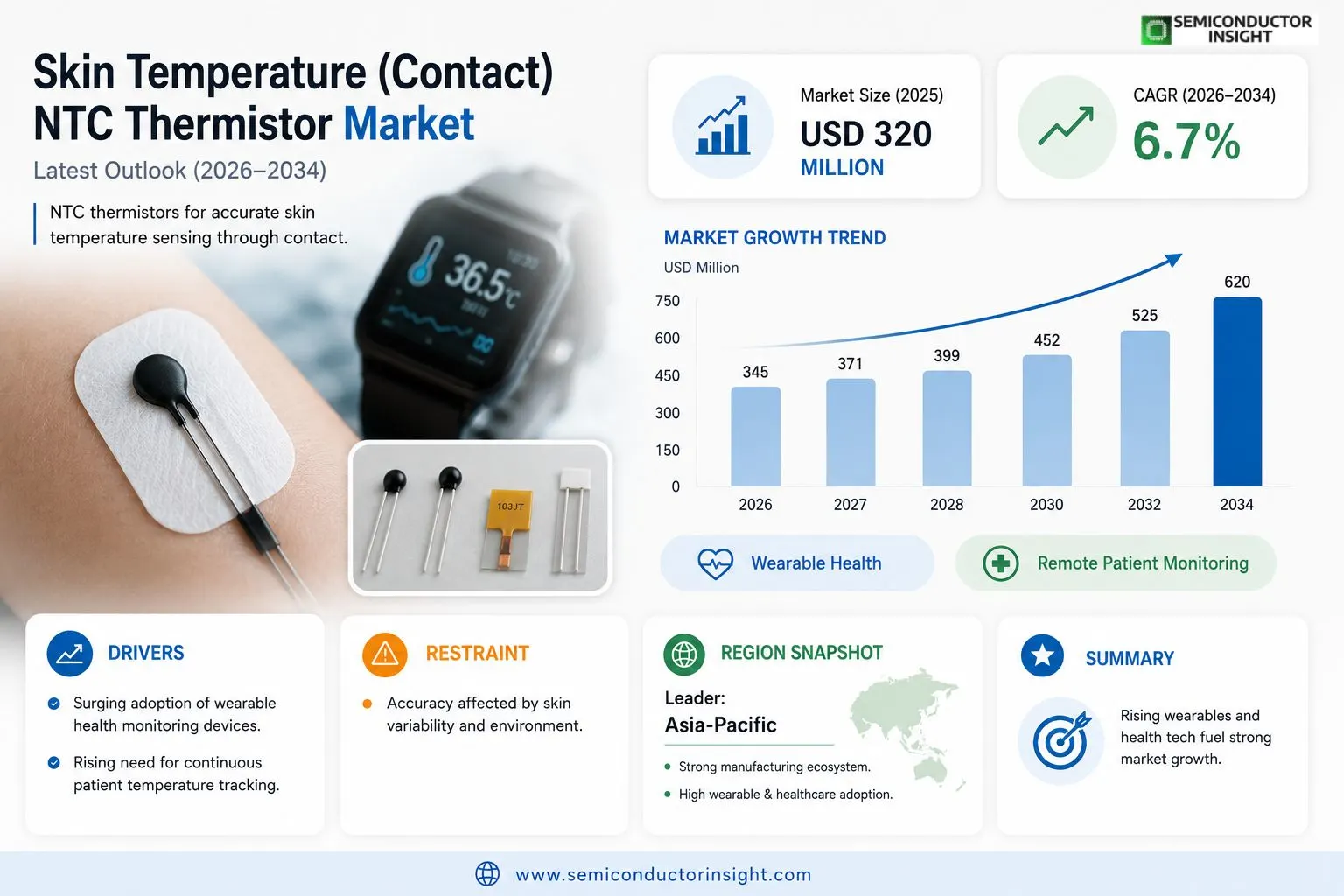
Global Skin Temperature (Contact) NTC Thermistor market size was valued at USD 320 million in 2025. The market is projected to grow from USD 345 million in 2026 to USD 620 million by 2034, exhibiting a CAGR of 6.7% during the forecast period.
Skin temperature (contact) NTC thermistors are precision temperature-sensing components designed to measure surface body temperature through direct skin contact. NTC, or Negative Temperature Coefficient, thermistors function by decreasing electrical resistance as temperature rises, enabling highly accurate and responsive thermal readings. These sensors are widely integrated into wearable health monitors, medical patches, smart textiles, fitness tracking devices, and clinical diagnostic equipment, making them essential components in both consumer electronics and healthcare applications.
The market is witnessing steady growth driven by the expanding adoption of wearable health monitoring devices, the rising prevalence of chronic conditions requiring continuous temperature surveillance, and the growing integration of biosensing technologies in consumer electronics. Furthermore, advancements in flexible and miniaturized thermistor designs have broadened their applicability in next-generation wearables. Key players operating in this space include Murata Manufacturing Co., Ltd., TE Connectivity, and Semitec Corporation, each offering broad product portfolios tailored to medical-grade and consumer-grade skin contact temperature sensing applications.
MARKET DRIVERS
Rising Demand for Wearable Health Monitoring Devices
The growing adoption of wearable health monitoring devices has emerged as a significant driver for Skin Temperature (Contact) NTC Thermistor Market. As consumers and healthcare providers increasingly prioritize continuous, non-invasive physiological monitoring, contact-based NTC thermistors have become essential sensing components embedded in smartwatches, fitness bands, and medical-grade wearables. These thermistors offer high sensitivity and rapid response times, making them well-suited for tracking subtle changes in skin temperature that can indicate fever onset, cardiovascular stress, or metabolic changes. The convergence of consumer electronics and preventive healthcare is directly amplifying demand across this market.
Expansion of Remote Patient Monitoring and Telehealth Infrastructure
Global expansion of telehealth platforms and remote patient monitoring (RPM) programs has created a sustained demand environment for skin-contact NTC thermistor components. Healthcare systems worldwide are deploying connected monitoring patches, smart bandages, and ambulatory diagnostic devices that rely on precision skin temperature sensing to track patient recovery, detect early infection signs, and manage chronic conditions such as diabetes and peripheral vascular disease. Skin Temperature (Contact) NTC Thermistor Market benefits directly from this structural shift in healthcare delivery, as accurate, low-power thermistor arrays are required for battery-operated, long-duration monitoring applications.
➤ The integration of NTC thermistors within next-generation remote monitoring patches and smart wound care dressings reflects a broader industry transition toward continuous, data-driven patient care , positioning contact thermistor manufacturers at the center of this healthcare transformation.
Additionally, post-pandemic healthcare infrastructure investments in developed and emerging economies have accelerated procurement of temperature monitoring solutions across hospitals, clinics, and home care settings. This sustained institutional demand further reinforces the growth trajectory of Skin Temperature (Contact) NTC Thermistor Market, with manufacturers scaling production capacities to meet both high-volume consumer and precision medical-grade requirements.
MARKET CHALLENGES
Accuracy Limitations from Skin Surface Variability and Environmental Interference
One of the primary challenges facing Skin Temperature (Contact) NTC Thermistor Market is the inherent variability of skin surface temperature caused by factors such as ambient temperature fluctuations, perspiration, physical activity, and inconsistent sensor-to-skin contact pressure. Unlike core body temperature measurement, skin temperature readings are highly susceptible to external environmental conditions, which can introduce measurement errors that undermine clinical reliability. Manufacturers must invest in advanced calibration algorithms, thermal insulation packaging, and multi-sensor fusion techniques to mitigate these limitations , adding to development complexity and product cost.
Other Challenges
Miniaturization and Flexible Substrate Integration
As wearable device form factors become increasingly compact and conform to body contours, integrating rigid NTC thermistor components onto flexible printed circuit boards or stretchable substrates presents significant engineering challenges. Ensuring consistent electrical performance, long-term mechanical durability, and adhesion stability under repeated bending and stretching cycles requires specialized manufacturing processes that many mid-tier suppliers currently lack the capability to deliver at scale.
Regulatory and Standardization Complexity
Medical-grade skin temperature contact devices incorporating NTC thermistors must comply with stringent regulatory frameworks including FDA 510(k) clearance, CE marking under EU MDR, and regional medical device standards across Asia-Pacific markets. Navigating these overlapping and evolving regulatory requirements increases time-to-market and compliance costs, particularly for smaller thermistor manufacturers seeking to enter the medical wearables segment of Skin Temperature (Contact) NTC Thermistor Market.
MARKET RESTRAINTS
Price Pressure from Competing Non-Contact and Alternative Sensing Technologies
Skin Temperature (Contact) NTC Thermistor Market faces notable restraint from the increasing commercial availability of infrared (IR) thermopile sensors and non-contact temperature measurement technologies. As IR sensor costs have declined considerably with mass production, certain applications that previously relied on contact NTC thermistors are transitioning toward non-contact alternatives, particularly in consumer-facing applications where convenience and hygiene are prioritized. This competitive substitution effect limits the addressable market growth rate for contact thermistor suppliers, especially in segments where clinical-grade accuracy requirements are not mandated.
Raw Material Supply Chain Constraints and Component Availability
The production of high-precision NTC thermistors relies on specialized metal oxide ceramic materials including manganese, nickel, cobalt, and copper oxides, the consistent sourcing of which has been subject to supply chain disruptions arising from geopolitical tensions, logistics bottlenecks, and concentrated supplier geography. These raw material supply vulnerabilities can lead to production delays, increased input costs, and constrained output capacity , directly impacting the ability of Skin Temperature (Contact) NTC Thermistor Market participants to fulfill growing demand from medical device OEMs and consumer electronics manufacturers on time and within agreed pricing frameworks.
MARKET OPPORTUNITIES
Growing Integration in Next-Generation Smart Textile and Continuous Health Monitoring Platforms
A compelling opportunity for Skin Temperature (Contact) NTC Thermistor Market lies in the rapid development of smart textiles and e-skin platforms that embed flexible sensing elements directly into clothing, bandages, and adhesive patches. Advances in printed electronics and conductive fiber technologies are enabling the seamless integration of miniaturized NTC thermistor arrays into everyday garments designed for athlete performance monitoring, neonatal care, burn patient management, and occupational health surveillance. This emerging application domain represents a high-growth frontier for thermistor manufacturers capable of developing flexible, biocompatible sensor solutions.
Expanding Applications in Women’s Health, Fertility Monitoring, and Chronic Disease Management
Skin Temperature (Contact) NTC Thermistor Market stands to benefit substantially from expanding clinical and consumer applications in women’s health, where continuous basal body temperature tracking through skin-contact thermistors enables fertility monitoring, ovulation prediction, and hormonal cycle analysis. Similarly, in chronic disease management , particularly for diabetic peripheral neuropathy monitoring and cardiovascular risk assessment , continuous skin temperature data collected via contact NTC thermistors provides clinicians with actionable physiological insights. As healthcare systems globally shift toward personalized, data-driven care pathways, demand for high-accuracy, low-power skin temperature sensing components is expected to grow consistently, offering long-term revenue expansion opportunities for established and emerging market participants alike.
Skin Temperature (Contact) NTC Thermistor Market Trends
Rising Adoption of Wearable Health Monitoring Devices Driving Market Expansion
Skin Temperature (Contact) NTC Thermistor Market is experiencing consistent growth, primarily fueled by the rapid expansion of wearable health monitoring technologies. As consumers and healthcare providers increasingly rely on continuous, real-time physiological data, contact NTC thermistors have become indispensable sensing components embedded in smartwatches, fitness bands, medical patches, and remote patient monitoring systems. Their core operating principle , decreasing electrical resistance as temperature rises , enables highly responsive and accurate surface body temperature readings, making them well-suited for both consumer and clinical applications. The growing prevalence of chronic conditions such as diabetes, cardiovascular disease, and autoimmune disorders, which necessitate continuous temperature surveillance, has further accelerated demand across the healthcare segment.
Other Trends
Miniaturization and Flexible Thermistor Design Innovation
One of the most transformative trends reshaping Skin Temperature (Contact) NTC Thermistor Market is the advancement in flexible and miniaturized thermistor architectures. Leading manufacturers including Murata Manufacturing Co., Ltd., TE Connectivity, and Semitec Corporation are investing in next-generation designs that conform seamlessly to skin surfaces, enabling comfortable long-term wear without compromising sensing accuracy. These innovations are particularly critical for smart textile integration, where ultra-thin, flexible NTC thermistors are woven directly into garments to enable passive, non-intrusive temperature monitoring. As wearable form factors become sleeker and more ergonomic, the demand for compact, skin-conformable thermistor solutions is expected to intensify.
Integration of Biosensing Technologies in Consumer Electronics
The convergence of biosensing capabilities within mainstream consumer electronics represents another significant trend in Skin Temperature (Contact) NTC Thermistor Market. Smartphone manufacturers and consumer device brands are increasingly embedding contact temperature sensors into flagship products, normalizing health-tracking functionality for a broader audience. This integration signals a shift from thermistors being purely medical-grade components to becoming standard features in everyday personal devices, substantially expanding the addressable market beyond traditional healthcare channels.
Medical-Grade Applications and Clinical Diagnostics Sustaining Demand
Clinical diagnostic equipment continues to represent a foundational demand segment for skin temperature contact NTC thermistors. Hospitals, outpatient clinics, and telehealth platforms rely on precision-grade thermistor sensors for accurate surface temperature measurement in patient monitoring applications. The push toward remote patient management and home-based care models has reinforced the need for reliable, cost-effective thermistor components that meet stringent medical performance standards. As healthcare systems globally prioritize preventive and continuous care strategies, Skin Temperature (Contact) NTC Thermistor Market is well-positioned to sustain its upward trajectory through the forecast period.
COMPETITIVE LANDSCAPE
Key Industry Players
Skin Temperature (Contact) NTC Thermistor Market , Competitive Dynamics and Leading Manufacturer Profiles
Global Skin Temperature (Contact) NTC Thermistor market is characterized by the presence of several well-established electronic component manufacturers alongside specialized thermistor producers. Murata Manufacturing Co., Ltd. holds a prominent position in this market, leveraging its extensive R&D capabilities, broad product portfolio, and global distribution network to serve both medical-grade and consumer-grade skin contact temperature sensing applications. The company’s investment in miniaturized and flexible NTC thermistor designs has reinforced its competitive edge as demand accelerates from wearable health monitors, smart patches, and clinical diagnostic equipment. TE Connectivity similarly commands significant market share through its diversified sensor solutions and strong partnerships with OEMs in the healthcare and consumer electronics sectors, enabling the company to address the growing need for continuous, non-invasive skin temperature monitoring.
Beyond the dominant players, the market features a number of niche yet strategically significant manufacturers that contribute to competitive intensity. Semitec Corporation, a Japan-based specialist in NTC thermistors, has built a reputation for high-precision, medical-grade components suited to wearable biosensing platforms. Companies such as Vishay Intertechnology, TDK Corporation, and Amphenol Advanced Sensors have also carved out meaningful positions by offering thermistors with enhanced flexibility, biocompatibility, and fast thermal response times , attributes particularly critical for next-generation skin contact applications. Emerging players and regional manufacturers in Asia-Pacific, including Shibaura Electronics and Thinking Electronic Industrial Co., continue to gain traction by offering cost-competitive alternatives without significant compromise in sensing accuracy, further intensifying price-based competition across the value chain.
List of Key Skin Temperature (Contact) NTC Thermistor Companies Profiled
- Murata Manufacturing Co., Ltd.
- TE Connectivity
- Semitec Corporation
- Vishay Intertechnology
- TDK Corporation
- Amphenol Advanced Sensors
- Shibaura Electronics Co., Ltd.
- Thinking Electronic Industrial Co., Ltd.
- Mitsubishi Materials Corporation
- Panasonic Corporation
- Lattron Co., Ltd.
- EPCOS AG (TDK Group)
- Wavelength Electronics
- US Sensor Corp.
- Ampire Electronic Co., Ltd.
Segment Analysis:
| Segment Category | Sub-Segments | Key Insights |
| By Type |
|
Chip Type NTC Thermistors represent the leading segment within this category, owing to their compact form factor and compatibility with surface-mount technology used extensively in modern wearable and medical devices.
|
| By Application |
|
Wearable Health Monitors lead the application segment, driven by the surging consumer and clinical demand for non-invasive, real-time physiological surveillance solutions.
|
| By End User |
|
Consumer Electronics Manufacturers emerge as the dominant end user segment, reflecting the extraordinary scale at which wearable devices are being produced and distributed globally.
|
| By Form Factor |
|
Flexible & Stretchable Thermistors represent the fastest evolving and increasingly dominant form factor segment, propelled by the broad industry shift toward conformable, skin-friendly sensing technologies.
|
| By Grade |
|
Medical-Grade NTC Thermistors command a strategically significant position within the market, distinguished by their compliance with stringent regulatory and biocompatibility standards required for clinical applications.
|
Regional Analysis: Skin Temperature (Contact) NTC Thermistor Market
Asia-Pacific
Asia-Pacific’s deeply entrenched electronics manufacturing ecosystem provides an unmatched competitive advantage in Skin Temperature (Contact) NTC Thermistor Market. The region’s vertically integrated supply chains , spanning raw material sourcing, precision fabrication, and finished sensor assembly , enable manufacturers to deliver high-quality NTC thermistor components at scale while maintaining stringent quality benchmarks aligned with global medical device standards.
The region is witnessing accelerated adoption of wearable health monitoring platforms incorporating contact NTC thermistors for real-time skin temperature tracking. Consumer electronics giants headquartered in Japan, South Korea, and China are embedding advanced thermistor-based sensing modules into smartwatches, fitness bands, and medical-grade health patches, fueling sustained demand across Skin Temperature (Contact) NTC Thermistor Market landscape.
Proactive government policies promoting smart healthcare infrastructure across China, India, and Southeast Asian nations are creating a fertile environment for NTC thermistor deployment in clinical and home-care settings. National digital health programs incentivize the integration of contact skin temperature monitoring solutions into telemedicine platforms and patient monitoring systems, generating robust institutional demand within Skin Temperature (Contact) NTC Thermistor Market.
Asia-Pacific continues to attract substantial research and development investment directed at advancing NTC thermistor performance in skin-contact applications. Leading regional universities and corporate R&D centers are pioneering improvements in thermistor biocompatibility, response time, and ultra-thin form factors suitable for flexible electronics, positioning the region as a primary innovation hub for Global Skin Temperature (Contact) NTC Thermistor Market.
North America
North America represents a highly significant market for Skin Temperature (Contact) NTC Thermistor solutions, underpinned by a well-established medical device industry, strong regulatory frameworks, and advanced healthcare infrastructure. The United States, in particular, demonstrates consistent demand driven by widespread adoption of remote patient monitoring systems, connected health platforms, and precision clinical diagnostics. The region’s culture of early technology adoption encourages healthcare providers and consumers alike to integrate contact skin temperature monitoring into routine health management practices. Leading medical device companies and wearable technology firms headquartered across the United States and Canada are actively advancing thermistor-integrated products with a focus on accuracy, miniaturization, and seamless connectivity. Regulatory clarity from the FDA regarding skin-contact sensor technologies further facilitates product development timelines, supporting sustained market expansion through 2034.
Europe
Europe holds a mature and steadily growing position in Skin Temperature (Contact) NTC Thermistor Market, characterized by stringent medical device quality standards, a strong emphasis on patient safety, and a well-developed healthcare system. Germany, France, the United Kingdom, and the Netherlands serve as key centers of innovation and demand for precision NTC thermistor applications across clinical diagnostics, sports medicine, and wearable health monitoring. The European Union’s regulatory environment under the Medical Device Regulation framework ensures high product quality thresholds, which encourages innovation among sensor manufacturers operating within the region. Growing awareness of preventive healthcare and the expansion of home-based health monitoring solutions are generating new demand channels for contact skin temperature sensing technologies. Additionally, Europe’s aging demographic profile is reinforcing long-term demand for reliable, non-invasive continuous temperature monitoring tools across both institutional and consumer settings.
South America
South America presents an emerging opportunity within Skin Temperature (Contact) NTC Thermistor Market, as healthcare modernization efforts across Brazil, Argentina, Colombia, and Chile gradually elevate the adoption of advanced sensor technologies. Brazil dominates the regional landscape, supported by a growing healthcare infrastructure investment and an expanding consumer electronics market that increasingly incorporates health monitoring capabilities. While affordability constraints and import dependency on thermistor components present challenges, rising awareness of wearable health technologies and improving access to digital health platforms are gradually reshaping demand dynamics. The region’s medical tourism industry and growing telemedicine sector also contribute to incremental adoption of contact skin temperature monitoring solutions, creating a foundation for measured but consistent market development through the forecast period.
Middle East & Africa
The Middle East and Africa region occupies a nascent but evolving position in Skin Temperature (Contact) NTC Thermistor Market. Gulf Cooperation Council nations, particularly the United Arab Emirates and Saudi Arabia, are investing heavily in healthcare infrastructure modernization and smart hospital initiatives, creating selective demand for advanced patient monitoring solutions that incorporate contact NTC thermistor technologies. Africa’s market remains in an early developmental stage, though increasing mobile health adoption and international healthcare development programs are gradually introducing temperature sensing technologies into underserved medical settings. South Africa serves as a regional hub for medical technology distribution, facilitating access to NTC thermistor-integrated devices. The broader region’s long-term growth potential in Skin Temperature (Contact) NTC Thermistor Market is closely linked to ongoing healthcare investment, digital health literacy improvements, and expanding access to affordable wearable sensing platforms.
Report Scope
This market research report provides a comprehensive analysis of the Skin Temperature (Contact) NTC Thermistor Market , covering the forecast period 2026–2034. It offers detailed insights into market dynamics, technological advancements, competitive landscape, and key trends shaping the industry.
Key focus areas of the report include:
- Market Overview: The report begins with an overview outlining its current market scenario, key growth indicators, and industry transformation drivers. It discusses macroeconomic factors, demand–supply balance, regulatory landscape, and the strategic role of semiconductors in powering advancements across industries such as automotive, telecommunications, consumer electronics, and industrial automation.
- Market Size & Forecast: Historical data and future projections for revenue, unit shipments, and market value across major regions and segments.
- Segmentation Analysis: Detailed breakdown by product type, technology, application, and end-user industry to identify high-growth segments and investment opportunities.
- Regional Insights: Insights into market performance across North America, Europe, Asia-Pacific, Latin America, and the Middle East & Africa, including country-level analysis where relevant.
- Competitive Landscape: Profiles of leading market participants, including their product offerings, R&D focus, manufacturing capacity, pricing strategies, and recent developments such as mergers, acquisitions, and partnerships.
- Technology Trends & Innovation: Assessment of emerging technologies, integration of AI/IoT, semiconductor design trends, fabrication techniques, and evolving industry standards.
- Market Drivers & Restraints: Evaluation of factors driving market growth along with challenges, supply chain constraints, regulatory issues, and market-entry barriers.
- Stakeholder Insights: Insights for component suppliers, OEMs, system integrators, investors, and policymakers regarding the evolving ecosystem and strategic opportunities.
Primary and secondary research methods are employed, including interviews with industry experts, data from verified sources, and real-time market intelligence to ensure the accuracy and reliability of the insights presented.
FREQUENTLY ASKED QUESTIONS:
What is the current market size of Skin Temperature (Contact) NTC Thermistor Market?
-> Global Skin Temperature (Contact) NTC Thermistor Market was valued at USD 320 million in 2025 and is expected to reach USD 620 million by 2034, growing at a CAGR of 6.7% during the forecast period from 2026 to 2034.
Which key companies operate in Skin Temperature (Contact) NTC Thermistor Market?
-> Key players include Murata Manufacturing Co., Ltd., TE Connectivity, and Semitec Corporation, among others, each offering broad product portfolios tailored to medical-grade and consumer-grade skin contact temperature sensing applications.
What are the key growth drivers?
-> Key growth drivers include expanding adoption of wearable health monitoring devices, rising prevalence of chronic conditions requiring continuous temperature surveillance, and growing integration of biosensing technologies in consumer electronics. Additionally, advancements in flexible and miniaturized thermistor designs have broadened their applicability in next-generation wearables.
Which region dominates the market?
-> Asia-Pacific is the fastest-growing region, driven by rapid expansion in consumer electronics manufacturing and healthcare infrastructure, while North America remains a significant market owing to strong demand for medical-grade wearable devices.
What are the emerging trends?
-> Emerging trends include flexible and miniaturized thermistor designs, integration into smart textiles and medical patches, and the growing use of NTC thermistors in fitness tracking devices and clinical diagnostic equipment as biosensing technologies continue to advance.

Get Sample Report PDF for Exclusive Insights
Report Sample Includes
- Table of Contents
- List of Tables & Figures
- Charts, Research Methodology, and more...
 Download Sample Report PDF