Key Statistics
Key Takeaways
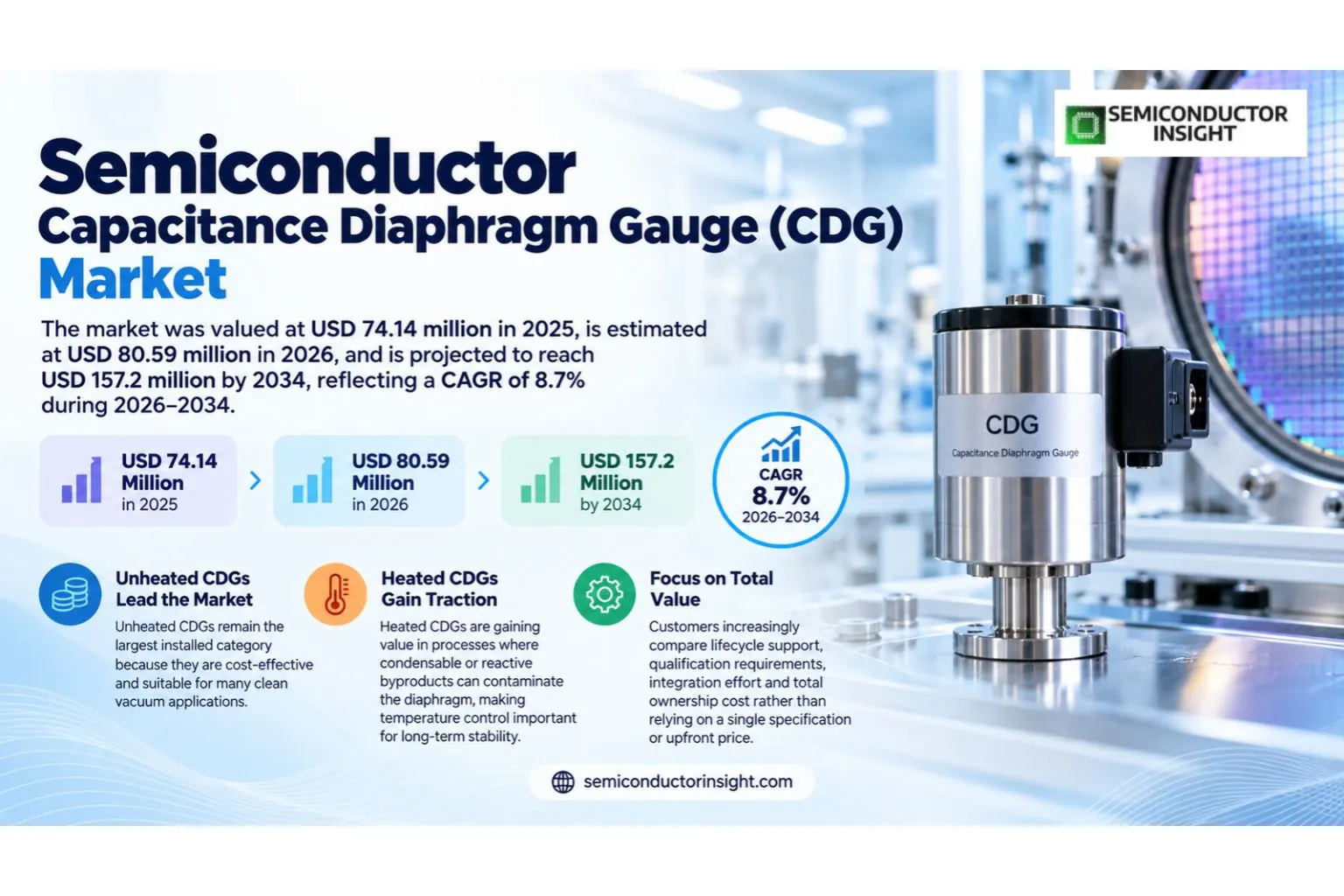
- The market is valued at USD 74.14 million in 2025 and is projected to reach USD 157.2 million by 2034, representing a 8.7% CAGR over 2026–2034.
- Unheated Type is a major product segment, while adjacent variants are expanding as performance, integration and cost requirements evolve.
- Deposition is a leading application area, supported by demand across Etching & Cleaning, Ion Implantation.
- Asia Pacific is the largest market in 2025 based on current demand, manufacturing concentration and ecosystem maturity.
Semiconductor Capacitance Diaphragm Gauge (CDG) Market Overview
Semiconductor Capacitance Diaphragm Gauge (CDG) devices measure absolute vacuum pressure by detecting minute diaphragm deflection as a capacitance change. Unlike thermal vacuum gauges, the reading is largely independent of gas composition, making CDGs valuable wherever semiconductor tools must control chamber pressure accurately across changing process gases. Commercial adoption of Semiconductor Capacitance Diaphragm Gauge (CDG) products therefore depends on system-level productivity, integration requirements, reliability expectations and the economics of replacing established alternatives in real operating environments.
The market is being driven by tighter process windows in ALD, CVD, etch and advanced packaging. Heated sensors, corrosion-resistant materials and digital communications extend gauge life and diagnostic capability in harsh chambers. Because pressure stability directly affects film thickness, etch rate and repeatability, fabs increasingly treat high-performance CDGs as process-control components rather than generic vacuum accessories.
Segment Analysis: By Type
Unheated CDGs remain the largest installed category because they are cost-effective and suitable for many clean vacuum applications. Heated CDGs are gaining value in processes where condensable or reactive byproducts can contaminate the diaphragm, making temperature control important for long-term stability. Within this segment, customers increasingly compare lifecycle support, qualification requirements, integration effort and total ownership cost rather than relying on a single specification or upfront price.
| Type | Market relevance |
|---|---|
| Unheated Type | Largest installed base and broad process compatibility. |
| Heated Type | Improved contamination control for difficult processes. |
Segment Analysis: By Application
Deposition is the strongest application because ALD, CVD and PVD require stable absolute pressure measurement independent of gas species. Etching and cleaning also demand repeatable vacuum control, while ion implantation uses CDGs in specialized process and beamline environments. Within this segment, customers increasingly compare lifecycle support, qualification requirements, integration effort and total ownership cost rather than relying on a single specification or upfront price.
| Application | Market relevance |
|---|---|
| Deposition | ALD, CVD and PVD pressure control. |
| Etching & Cleaning | Reactive process and chamber-clean monitoring. |
| Ion Implantation | Specialized high-vacuum process measurement. |
| Others | Epitaxy, metrology and research uses. |
Segment Analysis: By End User
Foundries represent the largest end-user segment because advanced fabs operate large fleets of deposition and etch chambers, while IDMs add memory and specialty-process demand. Research laboratories use lower volumes but often require calibration-grade performance and wide measurement ranges. Within this segment, customers increasingly compare lifecycle support, qualification requirements, integration effort and total ownership cost rather than relying on a single specification or upfront price.
| End User | Market relevance |
|---|---|
| Semiconductor Foundries | Largest installed gauge fleets. |
| Integrated Device Manufacturers | Memory and specialty process demand. |
| Research Labs & Academia | Calibration and experimental use. |
| Others | Equipment OEM and specialty users. |
Segment Analysis: By Interface
Analog outputs remain widely installed, but digital and EtherCAT-enabled gauges are growing as fabs move toward faster diagnostics and smart-equipment integration. Digital interfaces can simplify health monitoring, zeroing and system-level data collection without changing the core gas-independent measurement principle. Within this segment, customers increasingly compare lifecycle support, qualification requirements, integration effort and total ownership cost rather than relying on a single specification or upfront price.
| Interface | Market relevance |
|---|---|
| Analog | Mature 0–10V and related control architectures. |
| Digital / EtherCAT / Fieldbus | Smart factory, diagnostics and deterministic networking. |
Regional Analysis
Asia Pacific dominates because Taiwan, South Korea, China and Japan host the largest concentration of semiconductor fabs and vacuum-equipment manufacturing. North America remains a technology leader in high-performance gauges, while Europe contributes major vacuum-instrument suppliers and specialty fabs. Regional share also reflects supplier depth, engineering support, manufacturing concentration and the speed at which new Semiconductor Capacitance Diaphragm Gauge (CDG) designs can move from evaluation into repeat deployment.
| Region | 2025 Position | Growth Outlook | Demand Profile |
|---|---|---|---|
| Asia Pacific | Largest | Very strong | Foundry, memory and equipment manufacturing led |
| North America | High-value technology market | Strong | Advanced fabs and instrument suppliers led |
| Europe | Strong specialist market | Moderate-strong | Vacuum technology and specialty semiconductor led |
| South America | Emerging | Selective | Research and limited fab activity led |
| Middle East & Africa | Developing | Selective | Israel semiconductor and future investment led |
Detailed Regional Blocks
Why is Asia Pacific important to this market?
Asia Pacific leads because advanced foundry and memory production requires large installed fleets of capacitance manometers. China is adding new fab capacity, while Taiwan, South Korea and Japan continue upgrading existing process tools with higher-precision vacuum measurement. In Asia Pacific, procurement decisions also depend on service coverage, qualification resources, logistics and long-term availability, so ecosystem maturity can materially influence adoption even when core technology performance is similar.
| Country / Subregion | Role | Market Context |
|---|---|---|
| Taiwan | Leading foundry market | Advanced logic fabs require dense CDG deployment. |
| South Korea | Memory hub | DRAM and NAND process chambers support recurring demand. |
| Japan | Instrument and equipment hub | ULVAC and Canon Anelva support regional technology. |
| China | Fast expansion market | New fabs increase first-fit demand. |
- The report page identifies Asia Pacific as the leading regional market for semiconductor CDGs.
- MKS Baratron manometers provide gas-independent pressure measurement using corrosion-resistant nickel-based alloys.
- Heated gauges become more valuable as advanced processes use condensable or aggressive precursors.
Why is North America important to this market?
North America is a high-value market because leading U.S. fabs, equipment OEMs and MKS Instruments support advanced process control. New fab investment creates first-fit demand, while installed fabs generate replacement and calibration requirements. In North America, procurement decisions also depend on service coverage, qualification resources, logistics and long-term availability, so ecosystem maturity can materially influence adoption even when core technology performance is similar.
| Country / Subregion | Role | Market Context |
|---|---|---|
| United States | Largest regional market | Advanced fabs and vacuum-equipment suppliers drive demand. |
| Canada | Research and specialty niche | Scientific and quantum systems add smaller demand. |
- MKS Baratron gauges are designed for direct gas-independent absolute pressure measurement and are widely integrated with process tools.
- Fully welded sensor designs and corrosion-resistant alloys improve containment and durability in aggressive service.
- Digital interfaces are increasingly valued for predictive maintenance and tool diagnostics.
Why is Europe important to this market?
Europe combines major vacuum technology suppliers with automotive, power-semiconductor and research fabs. Germany and Switzerland are important instrument hubs, while new European fab projects create incremental demand. In Europe, procurement decisions also depend on service coverage, qualification resources, logistics and long-term availability, so ecosystem maturity can materially influence adoption even when core technology performance is similar.
| Country / Subregion | Role | Market Context |
|---|---|---|
| Germany | Vacuum and semiconductor equipment hub | Pfeiffer and Leybold ecosystems support demand. |
| Switzerland | Instrumentation hub | INFICON provides precision vacuum measurement. |
| France | Fab expansion market | Logic and specialty manufacturing support growth. |
- INFICON CDGs use ceramic-sensor technology and digital electronics for stable pressure measurement.
- European customers emphasize calibration traceability and serviceability over long tool lifecycles.
- Heated designs reduce deposition on sensing surfaces in contamination-prone applications.
Why is South America important to this market?
South America is a small direct market because front-end semiconductor manufacturing is limited. Brazil provides the clearest opportunity through research and selected specialty manufacturing, with most gauges imported. In South America, procurement decisions also depend on service coverage, qualification resources, logistics and long-term availability, so ecosystem maturity can materially influence adoption even when core technology performance is similar.
| Country / Subregion | Role | Market Context |
|---|---|---|
| Brazil | Largest regional base | Research and specialty production create selective demand. |
| Argentina | Academic niche | Direct commercial demand remains limited. |
- Research labs value gas-independent measurement across changing experimental gases.
- Local calibration support can be a purchasing differentiator.
- Most high-performance CDGs are imported from global suppliers.
Why is Middle East & Africa important to this market?
Middle East and Africa demand is concentrated in Israel’s semiconductor base and selected research facilities, while Gulf investment could create longer-term fab opportunities. Current direct gauge volumes remain modest. In Middle East & Africa, procurement decisions also depend on service coverage, qualification resources, logistics and long-term availability, so ecosystem maturity can materially influence adoption even when core technology performance is similar.
| Country / Subregion | Role | Market Context |
|---|---|---|
| Israel | Established semiconductor manufacturing | Fabs and R&D use precision vacuum gauges. |
| United Arab Emirates | Future technology opportunity | Potential semiconductor projects could add demand. |
| South Africa | Research niche | Scientific vacuum systems use small volumes. |
- New fabs require calibrated pressure measurement across many process chambers.
- Service logistics matter because gauge drift can affect process repeatability.
- Regional demand is mainly supplied through global vacuum-instrument vendors.
Competitive Landscape
MKS Instruments, INFICON, Pfeiffer Vacuum, Atlas Copco/Leybold, Setra Systems, Canon Anelva, Brooks Instrument and ULVAC compete through accuracy, temperature stability, corrosion resistance, communications, calibration support and process-tool qualification.
| Company | Position | Relevant capability |
|---|---|---|
| MKS Instruments | Key participant | Baratron capacitance manometers are a reference platform for gas-independent semiconductor pressure measurement. |
| INFICON | Key participant | Ceramic CDG portfolio focused on repeatability, stability and harsh process environments. |
| Pfeiffer Vacuum | Key participant | Broad vacuum-measurement portfolio serving semiconductor and industrial systems. |
| Atlas Copco / Leybold | Key participant | Competes through product breadth, integration capability, qualification and customer support. |
| Setra Systems | Key participant | Competes through product breadth, integration capability, qualification and customer support. |
| Canon Anelva | Key participant | Competes through product breadth, integration capability, qualification and customer support. |
| Brooks Instrument | Key participant | Competes through product breadth, integration capability, qualification and customer support. |
| ULVAC | Key participant | Competes through product breadth, integration capability, qualification and customer support. |
| Azbil | Key participant | Competes through product breadth, integration capability, qualification and customer support. |
| Agilent | Key participant | Competes through product breadth, integration capability, qualification and customer support. |
Production Capacity Analysis
CDG capacity depends on precision diaphragm fabrication, ceramic or metal sensor assembly, clean welding, electronics calibration and pressure-reference testing. Output volumes are modest compared with mainstream sensors, but semiconductor-grade accuracy and long-term stability require tight manufacturing control. Scaling output without degrading consistency requires stable upstream materials, disciplined process control and final testing that catches performance drift before products reach high-value customer systems.
Effective capacity also includes regional calibration laboratories and service. Fabs rely on periodic verification and replacement, so suppliers with local calibration capability can reduce downtime and logistics compared with vendors shipping every gauge back to a distant factory. Second-source planning and regional technical support therefore become increasingly important as deployments expand and buyers seek supply continuity without repeating lengthy qualification work.
Market Dynamics
The market is becoming more digital without changing its fundamental measurement principle. Fabs increasingly want gauges that provide diagnostic data, deterministic networking and simpler zero or health checks in addition to the primary pressure signal. This is changing competitive behavior because vendors increasingly sell system-level value, workflow integration and lifecycle economics rather than an isolated component specification.
Process chemistry is also raising specification intensity. ALD and etch environments can expose gauges to corrosive or condensable materials, increasing demand for heated sensors, corrosion-resistant alloys and contamination-resistant designs that maintain zero stability over longer service intervals. Buyers consequently evaluate total ownership cost, qualification effort and roadmap stability across the life of a program instead of focusing only on initial purchase price.
Market Drivers
| Factor | Analyst Interpretation |
|---|---|
| Advanced deposition | ALD and CVD need stable gas-independent pressure control. |
| Fab construction | New process chambers require first-fit vacuum gauges. |
| Smarter equipment | Digital interfaces support diagnostics and factory automation. |
| Tighter process windows | Advanced nodes demand more repeatable chamber conditions. |
Market Restraints
| Factor | Analyst Interpretation |
|---|---|
| High precision cost | Semiconductor-grade gauges are more expensive than generic vacuum sensors. |
| Calibration requirements | Accuracy must be maintained through periodic verification. |
| Process contamination | Deposits and corrosive gases can shift sensor behavior. |
| Qualification barriers | Tool OEMs and fabs are reluctant to change validated gauge platforms. |
Market Opportunities
| Factor | Analyst Interpretation |
|---|---|
| EtherCAT CDGs | Deterministic digital interfaces can simplify smart-tool integration. |
| Heated gauges | Contamination-prone ALD and etch chambers need better thermal control. |
| Advanced packaging | Wafer bonding and deposition add precision vacuum requirements. |
| Calibration services | Recurring verification can create service revenue around installed gauges. |
Supply Chain Analysis
The value chain combines precision diaphragms, electrodes, ceramic or metal sensor bodies, electronics, calibration references and tool integration. Accuracy depends on mechanical stability, temperature control and electronics as much as raw sensor geometry. Traceability and coordination between component suppliers, integrators and end users are important because failures found late in the chain can be far more expensive than the underlying part itself.
| Supply Chain Stage | Role in the Market |
|---|---|
| Sensor fabrication | Diaphragms and electrodes form the capacitance measurement cell. |
| Gauge assembly | Sensor bodies, heaters and electronics are integrated and leak-tested. |
| Calibration | Each gauge is referenced across its pressure range and temperature conditions. |
| Tool integration | CDGs connect to chamber controls, pressure loops and fab automation networks. |
Recent Developments
| Date | Development | Source |
|---|---|---|
| 2026 | MKS continues its Baratron capacitance-manometer portfolio for gas-independent, high-accuracy pressure measurement across semiconductor process tools. | MKS Instruments |
| 2026 | MKS current product resources include EtherCAT selection guidance for capacitance manometers, reflecting digital-interface adoption in semiconductor equipment. | MKS Instruments |
| 2026 | INFICON continues CDG platforms based on corrosion-resistant ceramic sensing for precision vacuum applications. | INFICON |
Report Scope & Segmentation
| Scope Item | Coverage |
|---|---|
| Base Year | 2025 |
| Estimated Year | 2026 |
| Forecast Period | 2026–2034 |
| 2025 Market Size | USD 74.14 million |
| 2026 Estimated Size | USD 80.59 million |
| 2034 Forecast Size | USD 157.2 million |
| CAGR (2026–2034) | 8.7% |
| Largest Market in 2025 | Asia Pacific |
| Category | Vacuum Measurement / Semiconductor Process Control / Capacitance Manometers |
| By Type | Unheated Type, Heated Type |
| By Application | Deposition, Etching & Cleaning, Ion Implantation, Others |
| By End User | Semiconductor Foundries, Integrated Device Manufacturers, Research Labs & Academia, Others |
| By Interface | Analog, Digital / EtherCAT / Fieldbus |
Frequently Asked Questions
What is the 2025 market size of the Semiconductor Capacitance Diaphragm Gauge (CDG) market?
The market is valued at USD 74.14 million in 2025.
What is the projected 2034 market size of the Semiconductor Capacitance Diaphragm Gauge (CDG) market?
The market is projected to reach USD 157.2 million by 2034.
What is the CAGR of the Semiconductor Capacitance Diaphragm Gauge (CDG) market from 2026 to 2034?
The market is expected to expand at a CAGR of 8.7% during 2026–2034.
Which region leads the Semiconductor Capacitance Diaphragm Gauge (CDG) market?
Asia Pacific is the largest market in 2025 based on the current demand, manufacturing and deployment structure.
Which type segment is important in the Semiconductor Capacitance Diaphragm Gauge (CDG) market?
Unheated Type is a major segment, while adjacent product variants are gaining share as performance and integration requirements evolve.
What is the main application for Semiconductor Capacitance Diaphragm Gauge (CDG) products?
Deposition is a leading application, with additional growth coming from Etching & Cleaning, Ion Implantation.
What drives growth in the Semiconductor Capacitance Diaphragm Gauge (CDG) market?
ALD and CVD need stable gas-independent pressure control.
What is a key restraint for the Semiconductor Capacitance Diaphragm Gauge (CDG) market?
Semiconductor-grade gauges are more expensive than generic vacuum sensors.
Which companies participate in the Semiconductor Capacitance Diaphragm Gauge (CDG) market?
Key participants include MKS Instruments, INFICON, Pfeiffer Vacuum, Atlas Copco / Leybold, Setra Systems, alongside other specialized suppliers and system companies.
What technology trend is shaping the Semiconductor Capacitance Diaphragm Gauge (CDG) market?
Deterministic digital interfaces can simplify smart-tool integration.
Research Sources & Evidence Base
Get Sample Report PDF for Exclusive Insights
Report Sample Includes
- Table of Contents
- List of Tables & Figures
- Charts, Research Methodology, and more...
 Download Sample Report PDF