Key Statistics
Key Takeaways
- GPU is the leading source-defined type because parallel compute remains central to robotic perception, multimodal inference and simulation-derived models, while ASICs and dedicated NPUs gain share where power, determinism and cost justify workload-specific acceleration.
- Industrial robots are the leading application in the source scope, reflecting the installed base in welding, assembly and material handling. Service robots, AMRs and humanoids create the fastest-moving design requirements because they need richer perception, higher local AI throughput and tighter power envelopes.
- Asia Pacific is the largest region, supported by the world’s highest industrial robot deployment, electronics manufacturing density and semiconductor production. The International Federation of Robotics reported that Asia accounted for 74% of new industrial robot installations in 2024.
- The central technology driver is edge physical AI. New robotics platforms increasingly combine CPU, GPU, NPU, sensor interfaces and deterministic control so perception, reasoning and action can occur locally without continuous cloud round trips.
- The main restraint is system complexity. A powerful processor does not create a deployable robot by itself; customers must integrate sensors, real-time control, safety, power delivery, memory, thermal management, software frameworks and long product support.
- The commercial opportunity is moving from chips to robotics platforms. Vendors that provide reference designs, model deployment tools, real-time software and partner ecosystems can shorten prototype-to-production cycles and defend higher strategic value than a stand-alone silicon sale.
Robot Chip Market Overview
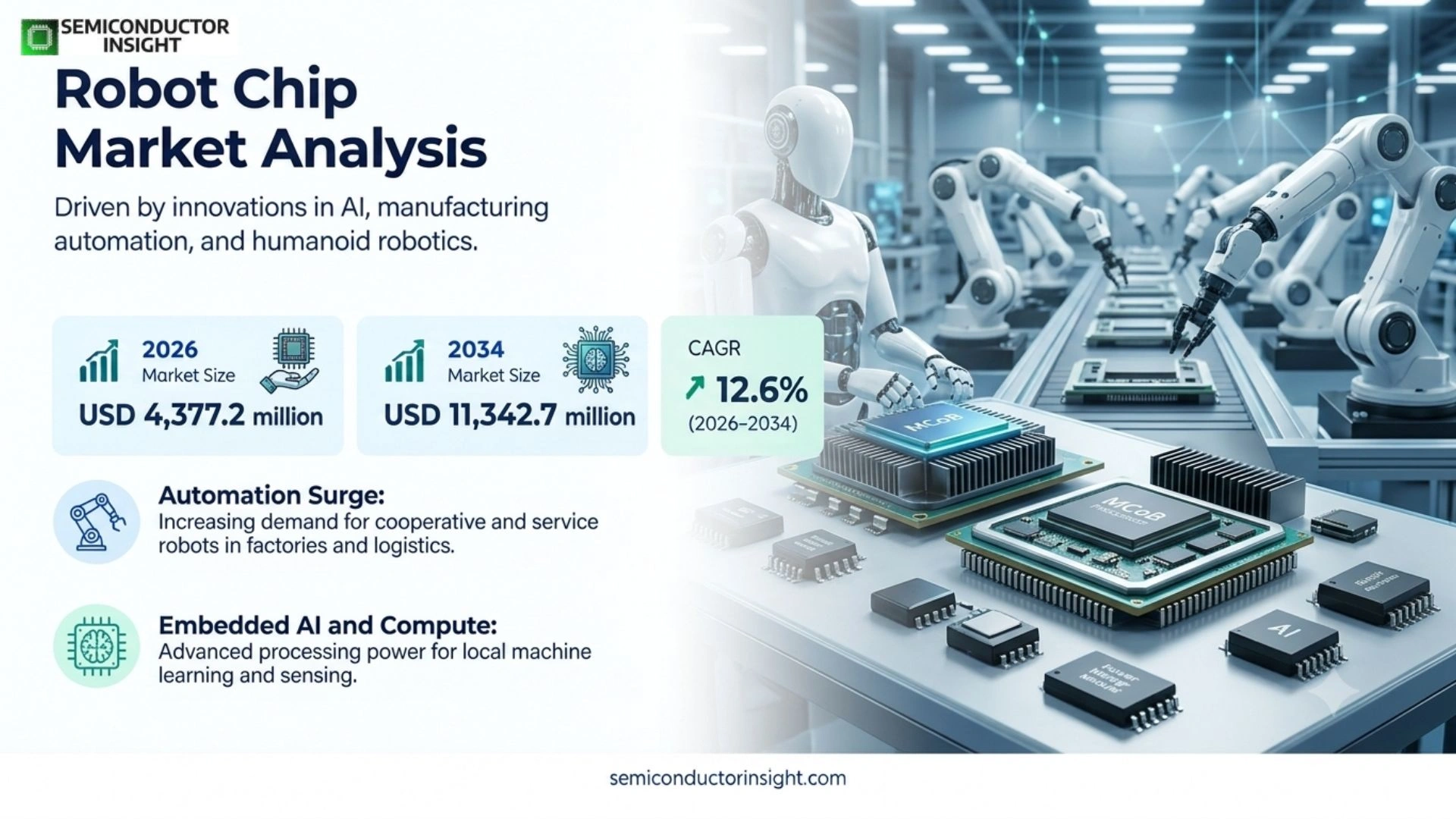
Robot Chip Market was valued at USD 3,886.1 million in 2025, is estimated at USD 4,377.2 million in 2026, and is projected to reach USD 11,342.7 million by 2034, representing an anchor-derived CAGR of 12.6% during 2026–2034. Asia Pacific is the largest regional market in 2025 on the controlling report scope, while the commercial growth mechanism is increasingly shaped by physical AI, edge inference, industrial automation, humanoids and the migration of perception and planning workloads from cloud to on-robot compute.
Robot chips are semiconductor processors used to execute perception, planning, control, communications and AI inference inside robotic systems. The category spans GPUs, ASICs, FPGAs, brain-like or neuromorphic processors and other compute devices used across industrial robots, special-purpose robots, service robots and consumer robots. In modern platforms, the ‘robot chip’ is increasingly a heterogeneous compute subsystem rather than a single general-purpose processor.
The commercial requirement differs from cloud AI accelerators. Robots operate under tight power and thermal limits, must react to sensor data with predictable latency, and often need safety-critical motor or actuator control alongside high-level AI. That creates a market for architectures that combine high-throughput inference with deterministic real-time processing, secure connectivity, camera and lidar interfaces, and software stacks that let OEMs deploy models without rebuilding the entire control system.
Independent demand evidence is strong. The International Federation of Robotics reported 542,000 industrial robots installed worldwide in 2024, with 4.664 million units in operational use. Asia accounted for 74% of new installations. At the same time, semiconductor vendors are expanding dedicated robotics roadmaps: NVIDIA brought Jetson Thor to general availability in 2025, while Qualcomm launched the Dragonwing IQ10 robotics processor and a broader robotics platform architecture in 2026.
The market therefore grows through both unit expansion and rising silicon content per robot. A basic factory arm may need deterministic motion control and machine vision, while an advanced AMR or humanoid can require multi-camera perception, large on-device models, high-bandwidth memory and sophisticated safety functions. As robots become more autonomous, the value of compute, memory and AI acceleration per system rises even when mechanical hardware volumes grow at a slower rate.
Segment Analysis: By Type
By type, the source segments the market into GPU, ASIC, FPGA, Brain-like Chip and Others. GPU is the leading category because robotic vision and AI inference benefit from parallel processing and mature software ecosystems. ASICs gain traction where a manufacturer can trade flexibility for lower power or higher determinism, while FPGAs remain valuable for adaptable sensor, control and interface workloads. Brain-like chips are strategically important but earlier in commercialization.
| Type | Technical role | Market position |
|---|---|---|
| GPU | Graphics processors provide high parallel throughput for vision, neural-network inference, simulation-derived models and sensor-fusion workloads. In robotics they are commonly paired with CPUs, microcontrollers and dedicated safety processors rather than used alone. Their commercial strength comes from mature AI frameworks and developer ecosystems that reduce the time required to move trained models from data-center development into deployed robotic systems. | Leading source-defined type. GPUs dominate high-performance perception and physical-AI workloads, especially in advanced AMRs, autonomous machines and humanoid platforms. The main trade-offs are power, thermal design and cost. Vendors increasingly package GPU-class compute with NPUs, CPUs and rich I/O so robotics OEMs can buy a complete edge-compute platform rather than assemble discrete processors. |
| ASIC | Application-specific ICs optimize a defined workload such as neural inference, motor control, sensor processing or vision acceleration. Compared with a general GPU they can achieve better performance per watt and lower recurring unit cost at sufficient volume, but they require higher non-recurring engineering investment and are less flexible when AI models or robotic architectures change rapidly. | ASIC demand grows as robotic product families mature and volumes become predictable. Industrial and consumer platforms with repeatable workloads can justify custom acceleration, while early humanoid or general-purpose robot programs often prefer programmable hardware. The strategic opportunity is strongest for semi-custom SoCs that combine configurable interfaces with dedicated AI and control blocks. |
| FPGA | FPGAs provide reconfigurable logic for deterministic pipelines, industrial interfaces, custom sensor timing and low-latency control. They are particularly useful during development or in specialized robots where standards and algorithms evolve faster than a custom ASIC cycle. Their ability to run parallel hardware pipelines also supports image preprocessing and safety-adjacent functions that must operate predictably. | A durable specialist segment. FPGAs rarely replace GPU or NPU acceleration for the largest AI models, but they remain valuable where customers need field reconfiguration, precise timing or unusual I/O. Commercial demand is stronger in industrial, aerospace, defense and research robots where product volumes are lower and long lifecycle support is more important than minimum silicon cost. |
| Brain-like Chip | Brain-like chips include neuromorphic and other architectures designed to process sparse events, temporal information or adaptive learning with very low power. Their appeal is strongest for always-on sensing and robotics workloads where conventional dense compute wastes energy. However, software tools, programming models and ecosystem maturity remain less standardized than mainstream CPU/GPU development environments. | An emerging high-upside segment rather than today’s volume leader. Adoption depends on whether vendors can demonstrate robust application benefits and developer accessibility. Event-based vision, tactile sensing and low-power autonomous systems are credible entry points, but broad commercialization requires integration with conventional robotics software, safety systems and production-grade toolchains. |
| Others | The source-defined Others category captures microprocessors, microcontrollers, NPUs, DSPs and mixed compute devices not placed in the named groups. In practice, these devices are essential because many robots use a heterogeneous architecture: an application processor handles Linux and AI, a microcontroller executes real-time motion control, and dedicated accelerators process perception or communications. | This category is structurally important and may expand as vendors integrate more heterogeneous functions into a single robotics SoC. The boundary between GPU, ASIC and ‘other’ becomes less meaningful when one package contains CPU, GPU, NPU, DSP, safety island and networking. Commercial differentiation increasingly moves to the complete system architecture and software stack. |
Heterogeneous compute is becoming the default robot architecture
The fastest-growing robot designs rarely use one processor class in isolation. Perception benefits from GPU or NPU acceleration, motion control needs deterministic timing, communications require secure networking and many systems need a separate functional-safety domain. This pushes vendors toward heterogeneous SoCs and reference platforms. The practical buying criterion is therefore how well the silicon, drivers, runtime, model tools and real-time subsystems work together under a defined power budget.
Segment Analysis: By Application
By application, the source segments the market into Industrial Robot, Special Robot, Service Robot, Consumer Robot and Others. Industrial robots remain the largest installed base because manufacturing automation has long used semiconductor control and machine vision. Service robots and humanoid platforms create the strongest new compute intensity because they operate in less structured environments and require richer perception, navigation and local AI reasoning.
| Application | Demand characteristics |
|---|---|
| Industrial Robot | Largest application. Assembly, welding, painting, machine tending and material handling require reliable motion control, safety integration and increasingly computer vision. The purchasing trigger is productivity: manufacturers deploy robots when throughput, quality, labor availability or process consistency justify automation. Chip suppliers win by providing long lifecycle support, industrial interfaces, deterministic control and an AI roadmap that can improve existing equipment without forcing total redesign. |
| Special Robot | Medical, defense, inspection, space and other specialized robots often operate under extreme reliability or environmental requirements. Volumes can be lower than factory automation, but semiconductor value per unit is high because these systems combine advanced sensing, secure communications, specialized compute and extensive validation. Qualification, export controls and lifecycle support can matter more than raw chip price. |
| Service Robot | Service robots include logistics AMRs, hospitality systems, delivery platforms and commercial cleaning or inspection robots. The market is moving from rule-based navigation toward richer scene understanding and local AI. Buyers value efficient edge compute because cloud dependence introduces latency, connectivity and privacy risks. Platform vendors that provide perception models, fleet tools and reference hardware can shorten deployment time for service-robot OEMs. |
| Consumer Robot | Consumer robots operate under strict cost, acoustic, thermal and power constraints. Vacuum robots, lawn-care systems, companion devices and emerging home assistants need efficient vision, mapping and connectivity rather than data-center-class compute. The commercial opportunity is large-volume integration: highly integrated SoCs can reduce board count and cost while enabling increasingly sophisticated on-device AI features. |
| Others | Other applications include education, agriculture, mining, infrastructure inspection and custom autonomous equipment. These markets are fragmented, so flexible platforms with scalable performance tiers are attractive. A vendor can serve multiple niches by reusing one software stack across different compute SKUs, reducing customer development cost and increasing the probability that prototypes remain on the same silicon family when they move into production. |
End-user demand broadens beyond conventional manufacturing
The source’s end-user segmentation includes Manufacturing, Healthcare, Automotive, Electronics and Others. Manufacturing remains the largest because industrial automation has the deepest installed base, but healthcare, logistics and general-purpose robotics are increasing semiconductor intensity per unit. Automotive expertise also transfers into robotics: safety architectures, camera pipelines, high-bandwidth interfaces and power-efficient edge AI developed for vehicles can be reused in AMRs and autonomous machines.
Regional Analysis
Asia Pacific is the largest robot chip market because it combines the world’s largest industrial robot deployment base with electronics manufacturing and semiconductor production. IFR’s 2025 data show Asia represented 74% of global industrial robot installations in 2024, with China alone accounting for 54% of worldwide installations. North America remains a leading innovation center for AI processors and robotics software, while Europe is strongest in industrial automation and high-reliability machine systems.
Why do robot-chip regional shares follow both robot deployment and semiconductor innovation?
Robot chips sit at the intersection of two ecosystems. Demand is created where robots are manufactured and deployed, while technology leadership can be located where processors, AI models and software platforms are designed. Asia therefore leads volume through robot installations and electronics production, North America exerts outsized influence through AI compute and platform software, and Europe shapes requirements through industrial automation, machinery and safety-focused deployment.
| Region | Position | Growth outlook | Demand profile | What decides supplier selection |
|---|---|---|---|---|
| Asia Pacific | Largest | Highest volume growth | Industrial robots + electronics manufacturing | Performance/watt, cost, local ecosystem, supply continuity and software support |
| North America | Innovation leader | High | AI platforms + AMRs + logistics + research | Developer ecosystem, model support, edge performance and long roadmap |
| Europe | Industrial automation stronghold | Moderate-high | Machinery + automotive + safety-critical robotics | Determinism, lifecycle, functional safety, industrial interfaces and energy efficiency |
| South America | Emerging | Moderate from low base | Agriculture + mining + automotive automation | Cost, ruggedness, integrator support and imported platform availability |
| Middle East & Africa | Project-led | Selective high-growth niches | Logistics + smart infrastructure + oil/gas | Turnkey platforms, thermal robustness, localization and systems partnerships |
Competitive Landscape
The source profiles Intel, NVIDIA, Qualcomm, Renesas, NXP, Microchip, STMicroelectronics, Infineon, HiSilicon, AMICRO, Actions Technology, NextVPU and Rockchip. Competition spans several processor classes, so no single benchmark determines leadership. Vendors differentiate through AI performance per watt, deterministic control, camera and sensor interfaces, software ecosystems, lifecycle support, security and the ability to scale from prototype modules to production SoCs.
NVIDIA is strongest where developers value a mature GPU-centric AI and robotics software ecosystem, while Qualcomm is pushing a heterogeneous edge-AI architecture designed for efficient autonomous machines and humanoids. Intel has broad CPU, accelerator and edge-computing capabilities. Renesas, NXP, Microchip, STMicroelectronics and Infineon bring deep industrial and automotive expertise, including real-time control, safety, long product lifecycles and embedded connectivity.
Chinese vendors such as HiSilicon, Rockchip, AMICRO, Actions Technology and NextVPU compete in a market where local robotics production and supply-chain autonomy are strategic priorities. Their opportunity is strongest in cost-sensitive vision, service and consumer robots, but domestic vendors are also moving toward higher AI throughput. Software compatibility and model tooling remain critical because a silicon advantage is difficult to monetize if developers cannot deploy mainstream AI frameworks efficiently.
The industry is moving toward platform lock-in. A robotics OEM that builds perception pipelines, simulation workflows, model optimization and device-management tools around one vendor’s stack faces meaningful switching costs. This gives software ecosystems and developer kits strategic value and explains why chip suppliers invest in reference designs, SDKs, model zoos and partnerships with robot OEMs rather than compete only on semiconductor specifications.
At the same time, customers increasingly want heterogeneous architectures. A high-end robot may combine an application processor from one vendor with safety microcontrollers, motor-control MCUs, FPGAs and dedicated sensor processors from others. That limits winner-take-all concentration and creates opportunities for specialist suppliers that solve a narrow function extremely well while supporting standardized interfaces and industrial networking.
| Competitive tier | Representative companies | Commercial basis |
|---|---|---|
| High-performance physical AI platforms | NVIDIA; Qualcomm; Intel | Compete on edge AI throughput, developer ecosystems, simulation/model tools, reference systems and ability to support advanced AMRs or humanoids. |
| Industrial and automotive embedded leaders | Renesas; NXP; Microchip; STMicroelectronics; Infineon | Compete on deterministic real-time control, safety, industrial interfaces, lifecycle availability, cybersecurity and power efficiency. |
| Regional / specialized AI and vision suppliers | HiSilicon; AMICRO; Actions Technology; NextVPU; Rockchip | Compete on cost, localized software, edge vision, consumer/service-robot integration and proximity to Asian robotics OEMs. |
Companies profiled in the source scope
Intel Corporation, NVIDIA Corporation, Qualcomm Technologies, Renesas Electronics Corporation, NXP Semiconductors, Microchip Technology, STMicroelectronics, Infineon Technologies, HiSilicon, AMICRO, Actions Technology, NextVPU, Rockchip.
Production Capacity Analysis
Robot-chip production capacity is globally distributed between fabless design centers, integrated device manufacturers and foundries. The most advanced AI processors depend on leading-edge wafer fabrication and advanced packaging concentrated in Asia, while many industrial MCUs and control chips use mature process nodes with broader geographic supply. Capacity risk therefore varies sharply by chip type: a high-end physical-AI module and a motor-control MCU do not share the same manufacturing bottleneck.
Leading-edge robot AI processors require advanced logic nodes, high-bandwidth memory interfaces and sophisticated packaging. Those capabilities are concentrated among a small number of foundries and OSAT ecosystems, particularly in Taiwan and South Korea, which creates geopolitical and allocation risk. By contrast, industrial controllers, analog interfaces and microcontrollers can often be manufactured on mature nodes across Japan, Europe, the U.S. and Asia.
Advanced robotics also increases memory and package demand. Multi-camera perception, large on-device models and sensor fusion require high memory bandwidth and dense interconnects. A vendor can therefore secure wafer capacity yet still face package, memory or module constraints. Platform suppliers that pre-qualify memory, power management and carrier boards can reduce the integration burden on robot OEMs and improve the predictability of volume ramps.
Lifecycle requirements complicate capacity planning. Industrial robots may remain in service for a decade or more, so customers expect semiconductor availability well beyond consumer electronics cycles. Suppliers with mature-node fabs or formal longevity programs can have an advantage even when their peak AI performance is lower. This creates a two-speed market: leading-edge compute refreshes rapidly, while deterministic control and safety components prioritize continuity.
| Capacity layer | Where it concentrates | Commercial constraint |
|---|---|---|
| Leading-edge AI logic | Taiwan, South Korea and selected U.S./Asian foundry capacity | Advanced-node wafer availability, packaging, HBM and allocation are key constraints for high-end robotics processors. |
| Industrial MCU / control silicon | Japan, Europe, U.S. and Asia on mature nodes | Long lifecycle, automotive/industrial quality and predictable supply matter more than leading-edge transistor density. |
| Advanced packaging and modules | Asia-Pacific with growing U.S. capability | Thermal design, memory integration, board-level power delivery and high-speed I/O determine whether a processor can become a deployable robotics module. |
| Developer/reference systems | U.S., Europe, Japan, China and global design centers | Software releases, BSP quality, model optimization and certification support can gate production even when silicon capacity is available. |
Market Dynamics
The robot-chip market expands because robots are becoming more numerous and more computationally intensive. Factory automation grows the installed base, while physical AI increases processor value per system through multimodal perception, local reasoning and autonomous navigation. Growth is constrained by power, safety, software fragmentation and the long engineering cycle required to turn high-performance silicon into a reliable robot that can operate continuously around people and machinery.
Market Drivers
| Factor | Directional impact | Why it matters |
|---|---|---|
| Industrial robot installations | High | A large and growing global installed base creates recurring demand for control, vision and AI processors across factory automation. |
| Physical AI and humanoids | High | General-purpose robots require much more local inference, memory bandwidth and sensor fusion than traditional scripted machines. |
| Edge autonomy | High | Local processing reduces cloud latency and connectivity dependence for safety-critical perception and control. |
| Integrated platform ecosystems | Medium-High | Reference designs and software stacks shorten development cycles and increase silicon content per deployed robot. |
Factory automation provides the volume foundation
IFR reported more than half a million industrial robot installations in 2024 and 4.664 million units in operational use. Each deployment requires embedded control and many newer systems add machine vision, connectivity and AI inference. Even modest compute upgrades across a large installed base create significant semiconductor demand, particularly in China, Japan, South Korea, the U.S. and Germany.
Physical AI raises compute content per robot
Humanoids and advanced AMRs need simultaneous perception, localization, language or vision-language reasoning and motion planning. These workloads require substantially more compute and memory than a conventional fixed industrial arm. The commercial response is higher-value SoCs and modules that integrate CPU, GPU/NPU, sensor interfaces and real-time subsystems within a manageable power envelope.
On-device inference solves latency and privacy constraints
A robot cannot always wait for a cloud service before stopping, steering or grasping. Local inference provides predictable latency, supports offline operation and keeps sensitive factory or healthcare data on-site. Qualcomm’s 2026 industrial demonstrations explicitly show foundation-model inference controlling robots locally at the edge, highlighting a practical reason robotics customers are purchasing more capable embedded AI processors.
Platform tools accelerate prototype-to-production
Robotics software complexity can consume more engineering time than board design. Vendors that offer simulation, model optimization, SDKs, device management and validated reference hardware reduce integration risk. NVIDIA and Qualcomm are both expanding this platform layer, making ecosystem breadth a growth driver because it lowers the threshold for smaller OEMs to deploy sophisticated AI capabilities.
Market Restraints
| Factor | Directional impact | Why it matters |
|---|---|---|
| Power and thermal limits | High | Robots have finite battery capacity or enclosure cooling, so peak AI performance cannot be evaluated independently from energy efficiency. |
| Safety and deterministic control | High | AI decisions must coexist with predictable low-latency control and safety functions, complicating architecture and certification. |
| Software fragmentation | Medium-High | Different robot middleware, AI frameworks and hardware runtimes increase porting cost and can delay product qualification. |
| Leading-edge supply concentration | Medium-High | Advanced AI chips depend on concentrated foundry, packaging and memory capacity, exposing high-end platforms to allocation and geopolitical risk. |
Performance per watt is more important than peak TOPS
A warehouse AMR or humanoid may run on battery power for hours while carrying sensors, actuators and compute in a compact chassis. A processor that delivers excellent benchmark performance but requires excessive cooling or shortens operating time can lose commercially. This forces vendors to optimize heterogeneous compute, memory movement and model efficiency rather than simply add more accelerator cores.
Safety separates robotics from ordinary edge AI
Robotic systems physically interact with people and equipment, so high-level AI must be separated from or coordinated with deterministic safety functions. Mixed-criticality architecture, watchdogs, real-time controllers and certified software increase engineering complexity. A vendor may have strong AI silicon yet struggle to enter industrial or medical robotics if it cannot support the required safety case and long lifecycle.
The software stack can become the switching barrier and the bottleneck
Developers must integrate perception models, middleware, drivers, motor control, mapping, security and fleet management. Porting this stack to new silicon can take months. That creates customer stickiness for incumbents but also slows adoption of technically superior new entrants. Compatibility with ROS, mainstream AI frameworks and established development tools is therefore a commercial requirement, not an optional feature.
Advanced-node concentration creates supply risk
High-performance robotics processors often share foundry and packaging resources with data-center AI and premium consumer chips. During tight capacity periods, robotics volumes may have less purchasing leverage than hyperscale customers. OEMs can mitigate the risk by using scalable platform families, but architecture changes require software revalidation and may conflict with long industrial product lifecycles.
Market Opportunities
Humanoid and general-purpose robot compute
Humanoids require dense sensor fusion, multimodal AI, high-speed control and energy-efficient inference, creating one of the highest semiconductor-content opportunities in robotics. The market is still early, so suppliers that secure design wins can influence software and hardware standards before architectures stabilize. Partnerships with leading humanoid OEMs are therefore strategically valuable even before unit volumes become large.
Industrial AI retrofits
Millions of installed robots and machines operate with limited perception or intelligence. Edge-compute modules can add vision inspection, adaptive process control, predictive maintenance and natural-language interfaces without replacing the mechanical asset. This retrofit opportunity favors compact modules and scalable SoCs with industrial connectivity because customers can capture productivity improvements while preserving existing automation investments.
Service robots and autonomous mobile platforms
Warehousing, hospitals, retail and commercial facilities require navigation, object detection and fleet coordination. These robots need lower power than data-center AI but more autonomy than simple embedded systems. Vendors can create reusable robotics platforms spanning several price tiers, allowing one software stack to serve premium AMRs, smaller delivery robots and consumer-adjacent devices.
Regional ecosystem development
Qualcomm’s Japan robotics initiative and growing partnerships between semiconductor vendors and robot manufacturers show that local co-development centers can accelerate adoption. Similar models can be replicated in Europe, China, India and other manufacturing hubs. A chip supplier that embeds engineers with OEMs can convert platform capability into repeatable production design wins rather than one-off development-kit sales.
Supply Chain Analysis
Processor design and IP. Value capture begins with heterogeneous architecture and software compatibility. Robot processors must balance AI throughput, real-time control, sensor bandwidth, security and power. Vendors with reusable CPU, GPU, NPU and connectivity IP can create multiple robotics SKUs from one platform, spreading development cost and giving customers a consistent software base across product tiers.
Foundry and packaging. Leading-edge robotics compute relies on advanced fabs, high-density packaging and fast memory, while industrial controllers use mature nodes. The supply chain is therefore split. High-end products face concentration risk and shorter technology cycles, whereas control MCUs prioritize long-term availability. Robot OEMs often need both classes in one system, making multi-supplier qualification important.
Modules and software. Many robotics companies do not buy bare chips initially. They use system-on-modules or developer kits that include memory, power management, storage and validated software. This stage captures significant value because it converts complex silicon into an accessible development platform. Vendors that later provide production modules can retain the design as the customer’s volumes increase.
OEM integration and lifecycle support. The final stage combines compute with cameras, lidar, motor drives, batteries and mechanical systems. Integration feedback often reveals power, thermal or latency issues that were not visible in benchmarks. Long field lifecycles also require security updates and component continuity. Semiconductor suppliers that support deployed fleets over many years can build deeper relationships than vendors focused on initial silicon shipment.
Recent Developments in the Robot Chip Market
Developments tracked to September 2026. Entries are dated to the official publication date where available.
- 25 August 2026 Regional ecosystem
Qualcomm announced a long-term robotics investment initiative in Japan and plans for a new Qualcomm Japan Robotics Center. The center is intended to support applied R&D, ecosystem collaboration, workforce enablement and commercialization across Japan’s robotics industry, strengthening the connection between processor platforms and one of the world’s largest robot-manufacturing ecosystems. Source - 13 July 2026 Edge AI demonstration
Qualcomm described an agentic-AI system controlling a factory robotic arm locally at the edge, using a foundation model and Dragonwing-class compute to translate natural-language instructions into robot actions without a cloud round trip. The example illustrates how semiconductor value is moving from basic control toward multimodal local reasoning and orchestration. Source - 1 June 2026 Reference platform
Qualcomm introduced the Dragonwing IQ10 Robotics Reference Design, combining compute, sensing, networking and software in a deployment-oriented system designed for industrial, autonomous mobile and humanoid robots. The reference design highlights the competitive shift from individual chips to validated platform architectures. Source - 9 March 2026 Strategic collaboration
NEURA Robotics and Qualcomm announced a long-term collaboration on physical AI and cognitive robotics, including ‘Brain + Nervous System’ reference architectures that combine perception and reasoning with ultra-low-latency control. The collaboration is a direct example of robot OEM and chip supplier co-design. Source - 25 August 2025 High-performance module
NVIDIA made Jetson AGX Thor developer kits and production modules generally available. The platform targets physical AI and robotics and significantly increases local AI compute and energy efficiency versus Jetson Orin, raising the performance available to advanced autonomous systems at the edge. Source
Report Scope & Segmentation
| Attribute | Coverage |
|---|---|
| Report title | Robot Chip Market, Trends, Business Strategies 2026-2034 |
| Base / estimate / forecast | 2025 base year; 2026 estimated year; 2034 forecast end year; CAGR measured for 2026–2034. |
| By Type | GPU (Integrated, Discrete); ASIC (Full Custom, Semi-Custom); FPGA; Brain-like Chip (Neuromorphic, Quantum-inspired); Others. |
| By Application | Industrial Robot (Assembly, Welding, Material Handling); Special Robot (Medical, Defense, Space Exploration); Service Robot; Consumer Robot; Others. |
| By End User | Manufacturing; Healthcare; Automotive; Electronics; Others. |
| Regions | North America, Europe, Asia-Pacific, South America, and Middle East & Africa, with country-level analysis where relevant to the source scope. |
| Companies | Intel Corporation, NVIDIA Corporation, Qualcomm Technologies, Renesas Electronics Corporation, NXP Semiconductors, Microchip Technology, STMicroelectronics, Infineon Technologies, HiSilicon, AMICRO, Actions Technology, NextVPU, Rockchip |
| Customization Scope | Free report customization (equivalent to up to 4 analyst working days) with purchase. Addition or alteration to country, regional and segment scope. |
Frequently Asked Questions
What is the size of the robot chip market?
Using the controlling source page’s published USD 3.45 billion value for 2024 and USD 8.94 billion endpoint for 2032, the internally consistent path gives a rebased market size of about USD 3,886.1 million in 2025, an estimated USD 4,377.2 million in 2026 and approximately USD 11,342.7 million by 2034. The resulting anchor-derived CAGR is 12.6% during 2026–2034.
What is a robot chip?
A robot chip is a semiconductor processor used to execute perception, AI inference, motion control, sensor fusion, communications or other compute functions inside robotic systems. The term covers GPUs, ASICs, FPGAs, neuromorphic processors, CPUs, NPUs and related devices. Modern robots typically use a heterogeneous architecture in which high-level AI compute works alongside deterministic microcontrollers or safety processors.
Which chip type leads the market?
GPU is the leading source-defined type because robotic vision, neural inference and multimodal perception benefit from parallel processing and mature AI software ecosystems. However, the market is not purely GPU-led at the system level. ASICs, NPUs, FPGAs and microcontrollers are essential for power efficiency, real-time control, safety and specialized sensor pipelines, so heterogeneous platforms are becoming standard.
Which application is largest for robot chips?
Industrial robots are the largest application in the controlling source, covering assembly, welding and material handling. Their long-installed base creates stable demand for control and vision semiconductors. Service robots, AMRs and humanoids are strategically important growth areas because they require richer local perception, navigation and reasoning, increasing compute and memory content per robot.
Which region leads the robot chip market?
Asia Pacific leads because it combines the largest robot deployment base with electronics and semiconductor manufacturing. IFR reported that Asia accounted for 74% of global industrial robot installations in 2024 and China alone represented 54%. North America remains a major innovation hub for high-performance AI processors and robotics software, while Europe is strong in industrial automation and machinery.
How is physical AI changing semiconductor demand?
Physical AI moves more perception, planning and reasoning onto the robot itself. That increases demand for high-throughput NPUs and GPUs, high-bandwidth memory, camera and lidar interfaces, secure connectivity and deterministic control in one platform. Semiconductor vendors are therefore selling complete robotics architectures, reference designs and software stacks rather than relying only on general-purpose processors.
What are the main restraints on robot-chip growth?
The key restraints are power and thermal limits, safety requirements, software fragmentation, long integration cycles and advanced-node supply concentration. A high-performance chip must still fit a robot’s battery or cooling budget, work with real-time controls and sensors, support the required middleware, and remain available for industrial lifecycles. Those requirements can slow adoption even when AI capability improves rapidly.
Why do reference designs matter in robotics?
Reference designs combine the processor with memory, power management, sensor interfaces, networking and validated software. Robotics companies can therefore prototype and move toward production without engineering every subsystem from scratch. This is commercially important because many robotics startups have stronger expertise in mechanical systems or AI applications than in high-speed board design, safety partitioning and low-level driver development.
Who are the key companies in the source scope?
The source profiles Intel, NVIDIA, Qualcomm, Renesas, NXP, Microchip, STMicroelectronics, Infineon, HiSilicon, AMICRO, Actions Technology, NextVPU and Rockchip. They compete across different layers: some lead in high-performance AI compute, others in industrial or automotive control, and several Asian vendors focus on cost-effective edge vision and integrated SoCs for local robotics manufacturers.
What technology shift matters most through 2034?
The most important shift is the move from isolated AI accelerators toward heterogeneous, deployment-ready physical-AI platforms that combine perception, reasoning, deterministic control, security and connectivity. The winning vendors are likely to be those that deliver strong performance per watt together with developer tools, long-term support and reference architectures that let robot OEMs scale one software base across multiple product generations.
Research Sources & Evidence Base
Get Sample Report PDF for Exclusive Insights
Report Sample Includes
- Table of Contents
- List of Tables & Figures
- Charts, Research Methodology, and more...
 Download Sample Report PDF