Market Insights
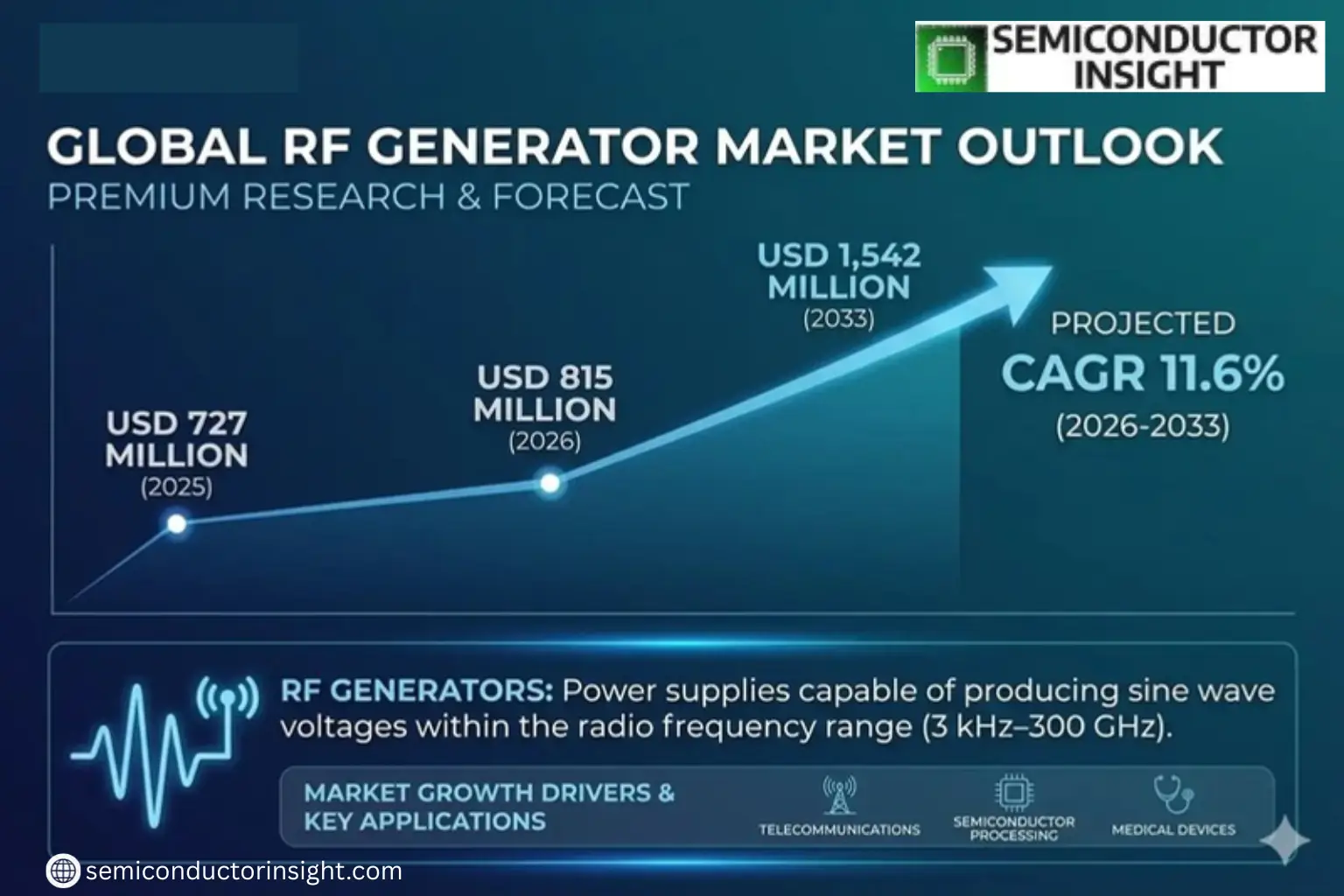
Global RF Generator Market size was valued at USD 727 million in 2025 and is projected to grow from USD 815 million in 2026 to USD 1,542 million by 2033, exhibiting a CAGR of 11.6% during the forecast period.
RF generators are power supplies capable of producing sine wave voltages within the radio frequency range (3 kHz–300 GHz). These devices typically operate at power levels between 0.3 kW and 15 kW, with common frequencies including 2 MHz, 4 MHz, 13.56 MHz, 27.12 MHz, and 40.68 MHz. They are critical components in applications such as semiconductor manufacturing, medical equipment, and industrial plasma processing.
The market is driven by increasing demand from the semiconductor industry, where advanced chip architectures require high-frequency RF power systems for processes like plasma etching and deposition. Additionally, the expansion of minimally invasive medical procedures and advancements in solid-state RF technology are contributing to growth. However, challenges such as high costs for advanced generators and supply chain disruptions may impact adoption rates among smaller manufacturers.
MARKET DRIVERS
Increasing Demand for Wireless Communication Technologies
RF Generator Market is experiencing significant growth due to the rapid adoption of 5G networks and IoT devices. Telecommunications companies are investing heavily in infrastructure development, requiring high-performance RF generators for signal testing and transmission. Global rollout of 5G alone is expected to drive a 12% annual growth in demand for precision RF equipment by 2026.
Advancements in Semiconductor Manufacturing
Semiconductor fabrication requires precise RF power for plasma generation during chip production. As chip manufacturers move to smaller nanometer processes, the need for stable, high-frequency RF generators has intensified. The semiconductor RF generator segment grew by 8.7% in the last fiscal year.
Military and aerospace applications also contribute substantially, with defense budgets allocating nearly USD 2.4 billion annually for RF testing equipment worldwide.
MARKET CHALLENGES
High Initial Investment Costs
Advanced RF generators with multi-frequency capabilities often carry price tags exceeding USD 50,000 per unit, creating barrier to entry for small and medium enterprises. Maintenance costs add approximately 15-20% annually to the total cost of ownership.
Other Challenges
Technical Complexity in High-Frequency Ranges
Operating above 6GHz requires specialized expertise that many end-users lack, leading to longer deployment cycles and increased training expenditures. Nearly 40% of users report difficulties optimizing RF generator performance at millimeter-wave frequencies.
MARKET RESTRAINTS
Supply Chain Disruptions in Critical Components
RF Generator Market faces constraints from semiconductor shortages affecting power amplifier production. Lead times for gallium nitride (GaN) components have extended to 26 weeks in some cases, directly impacting product availability. This has slowed market growth by an estimated 3-4% in recent quarters.
MARKET OPPORTUNITIES
Emerging Applications in Medical Technology
RF generators are finding new applications in medical equipment such as tumor ablation systems and cosmetic devices. The healthcare sector’s RF generator demand is projected to grow at 9.3% CAGR through 2027, representing a USD 780 million incremental opportunity. Precision medical applications particularly favor modular RF generator designs with real-time power adjustment capabilities.
RF Generator Market Trends
Robust Market Growth Driven by Semiconductor and Medical Industries
Global RF Generator market, valued at USD 727 million in 2025, is projected to reach USD 1542 million by 2033, growing at an 11.6% CAGR. This expansion is primarily fueled by semiconductor manufacturing advancements and increasing medical applications. Japan leads production with a 24% market share, while key players like MKS Instruments and Advanced Energy dominate over 56% of the global market.
Other Trends
Frequency-Specific Market Segmentation
The 13.56MHz RF generators hold the largest product segment share (31%), widely used in PECVD applications which account for 40% of market demand. The 27.12MHz and 40.68MHz segments are gaining traction due to their precision in advanced semiconductor fabrication processes.
Technological Advancements Reshaping the Industry
Solid-state RF generators are replacing traditional models due to superior efficiency (15-20% higher power conversion), extended lifespan (30% longer than tube-based systems), and precise process control. These improvements directly enhance semiconductor yield rates while reducing defect ratios by up to 18% in PVD applications.
Other Trends
Supply Chain and Cost Challenges
High-end RF generators with integrated matching networks face adoption barriers with small-scale fabs due to 35-50% higher costs than legacy systems. Recent supply chain disruptions have caused 12-15 week lead time extensions for critical components, particularly affecting tier-2 manufacturers in Asia-Pacific regions.
Regional Market Dynamics
North America shows strongest growth potential (13.2% CAGR) owing to semiconductor fab expansions, while Europe leads in medical applications with 28% of RF generators deployed in healthcare systems. Emerging markets in Southeast Asia demonstrate 9% annual growth, driven by increasing electronics manufacturing investments.
COMPETITIVE LANDSCAPE
Key Industry Players
Global RF Generator Market Dominated by Specialized Technology Providers
RF Generator Market remains highly concentrated among established players, with MKS Instruments and Advanced Energy collectively controlling over 30% market share. Japanese manufacturers like DAIHEN Corporation maintain strong production capabilities, accounting for 24% of global output. The industry shows vertical integration trends with key players developing proprietary matching networks and solid-state technologies to serve semiconductor fabrication and medical applications. MKS Instruments’ 2023 acquisition of Atotech significantly strengthened its position in advanced PCB manufacturing solutions.
Specialized regional players demonstrate robust growth in niche segments – Beijing BBEF dominates China’s PECVD equipment market while European firms like SAIREM lead in industrial heating applications. Emerging manufacturers such as New Power Plasma and Adtec focus on cost-competitive 13.56MHz systems for emerging Asian markets. The competitive landscape faces disruption from novel solid-state architectures, with Trumpf and Comet Plasma Control investing heavily in >27MHz generators featuring real-time impedance matching.
List of Key RF Generator Companies Profiled
- MKS Instruments
- Advanced Energy
- DAIHEN Corporation
- XP Power (Comdel)
- Trumpf
- Comet Plasma Control Technol
- Kyosan Electric Manufacturing
- Beijing BBEF Science&Technology
- ULVAC
- JEOL
- Adtec Plasma Technology
- New Power Plasma
- DKK
- Plasma Technology
- Pearl Kogyo
Segment Analysis:
| Segment Category | Sub-Segments | Key Insights |
| By Type |
|
13.56 MHz dominates the RF Generator Market due to several key factors:
|
| By Application |
|
PECVD represents the largest application segment with significant growth potential:
|
| By End User |
|
Semiconductor Manufacturers lead in RF generator adoption:
|
| By Technology |
|
Solid-State RF Generators are gaining significant market traction:
|
| By Power Range |
|
Medium Power (1-5 kW) generators show strongest demand:
|
Regional Analysis: RF Generator Market
North America
U.S. manufacturing plants extensively use RF generators for plastic welding and semiconductor processing, supported by Industry 4.0 adoption and reshoring initiatives that boost equipment upgrades.
Pentagon contracts and private aerospace investments drive specialized RF generator development for radar systems and electronic warfare applications, with stringent military-grade reliability requirements.
5G rollout and satellite communication expansions necessitate advanced RF test equipment, with U.S. telecom giants leading procurement of high-frequency generators for network infrastructure testing.
Concentration of medical device manufacturers in Minnesota and Massachusetts creates demand for precision RF generators used in diagnostic imaging and minimally invasive surgical equipment.
Europe
Europe maintains significant RF Generator Market share through its automotive electronics and renewable energy sectors. German engineering firms lead in developing energy-efficient RF systems for industrial heating applications, while French aerospace companies demand specialized generators for avionics testing. The EU’s push for semiconductor sovereignty and strict EMC regulations necessitate advanced RF testing equipment. Medical research centers in Switzerland and Sweden drive innovation in therapeutic RF applications, particularly in oncology treatment devices.
Asia-Pacific
Asia-Pacific showcases the fastest RF Generator Market growth, powered by expanding electronics manufacturing in China and South Korea. Semiconductor foundries in Taiwan require high-volume RF generation solutions, while Japanese automation giants integrate RF systems into smart factory setups. India’s telecom infrastructure expansion and increasing defense budgets create new demand, though market fragmentation persists across developing Southeast Asian nations with varying technology adoption levels.
Middle East & Africa
The region demonstrates niche opportunities in oilfield applications where RF generators assist in material testing and downhole sensing. Gulf Cooperation Council countries invest in telecommunications infrastructure, while South Africa’s mining sector utilizes RF technology for mineral processing. Limited local manufacturing capacity leads to reliance on imports, though economic diversification initiatives may stimulate market growth.
South America
Brazil dominates the regional RF Generator Market through its aerospace and medical sectors, with Argentina showing promise in research applications. Political and economic volatility constrains infrastructure investments, but increasing focus on renewable energy projects creates opportunities for RF-based monitoring systems. Local maintenance and service providers play crucial roles given import dependency.
Report Scope
This market research report provides a comprehensive analysis of the RF Generator Market , covering the forecast period 2026–2033. It offers detailed insights into market dynamics, technological advancements, competitive landscape, and key trends shaping the industry.
Key focus areas of the report include:
- Market Overview: The report begins with an overview outlining its current market scenario, key growth indicators, and industry transformation drivers. It discusses macroeconomic factors, demand–supply balance, regulatory landscape, and the strategic role of semiconductors in powering advancements across industries such as automotive, telecommunications, consumer electronics, and industrial automation.
- Market Size & Forecast: Historical data and future projections for revenue, unit shipments, and market value across major regions and segments.
- Segmentation Analysis: Detailed breakdown by product type, technology, application, and end-user industry to identify high-growth segments and investment opportunities.
- Regional Insights: Insights into market performance across North America, Europe, Asia-Pacific, Latin America, and the Middle East & Africa, including country-level analysis where relevant.
- Competitive Landscape: Profiles of leading market participants, including their product offerings, R&D focus, manufacturing capacity, pricing strategies, and recent developments such as mergers, acquisitions, and partnerships.
- Technology Trends & Innovation: Assessment of emerging technologies, integration of AI/IoT, semiconductor design trends, fabrication techniques, and evolving industry standards.
- Market Drivers & Restraints: Evaluation of factors driving market growth along with challenges, supply chain constraints, regulatory issues, and market-entry barriers.
- Stakeholder Insights: Insights for component suppliers, OEMs, system integrators, investors, and policymakers regarding the evolving ecosystem and strategic opportunities.
Primary and secondary research methods are employed, including interviews with industry experts, data from verified sources, and real-time market intelligence to ensure the accuracy and reliability of the insights presented.
FREQUENTLY ASKED QUESTIONS:
What is the current market size of RF Generator Market?
-> RF Generator Market size was valued at USD 727 million in 2025 and is projected to grow from USD 815 million in 2026 to USD 1,542 million by 2033, exhibiting a CAGR of 11.6% during the forecast period
Which key companies operate in RF Generator Market?
-> Key players include MKS Instruments, Advanced Energy, DAIHEN Corporation, XP Power (Comdel), Trumpf, Comet Plasma Control Technol, and Kyosan Electric Manufacturing, among others. Global top five manufacturers hold a share over 56%.
What are the key growth drivers?
-> Key growth drivers include growth in semiconductor industry, expansion of medical applications, and advancements in solid-state technology.
Which region dominates the market?
-> Japan is the largest producer of RF generators with a share over 24%, while Asia shows significant growth potential.
What are the emerging trends?
-> Emerging trends include higher efficiency solid-state RF generators, integration with AI/IoT, and increasing adoption in PECVD applications (which holds over 40% market share).

Get Sample Report PDF for Exclusive Insights
Report Sample Includes
- Table of Contents
- List of Tables & Figures
- Charts, Research Methodology, and more...
 Download Sample Report PDF