Key Statistics
Key Takeaways
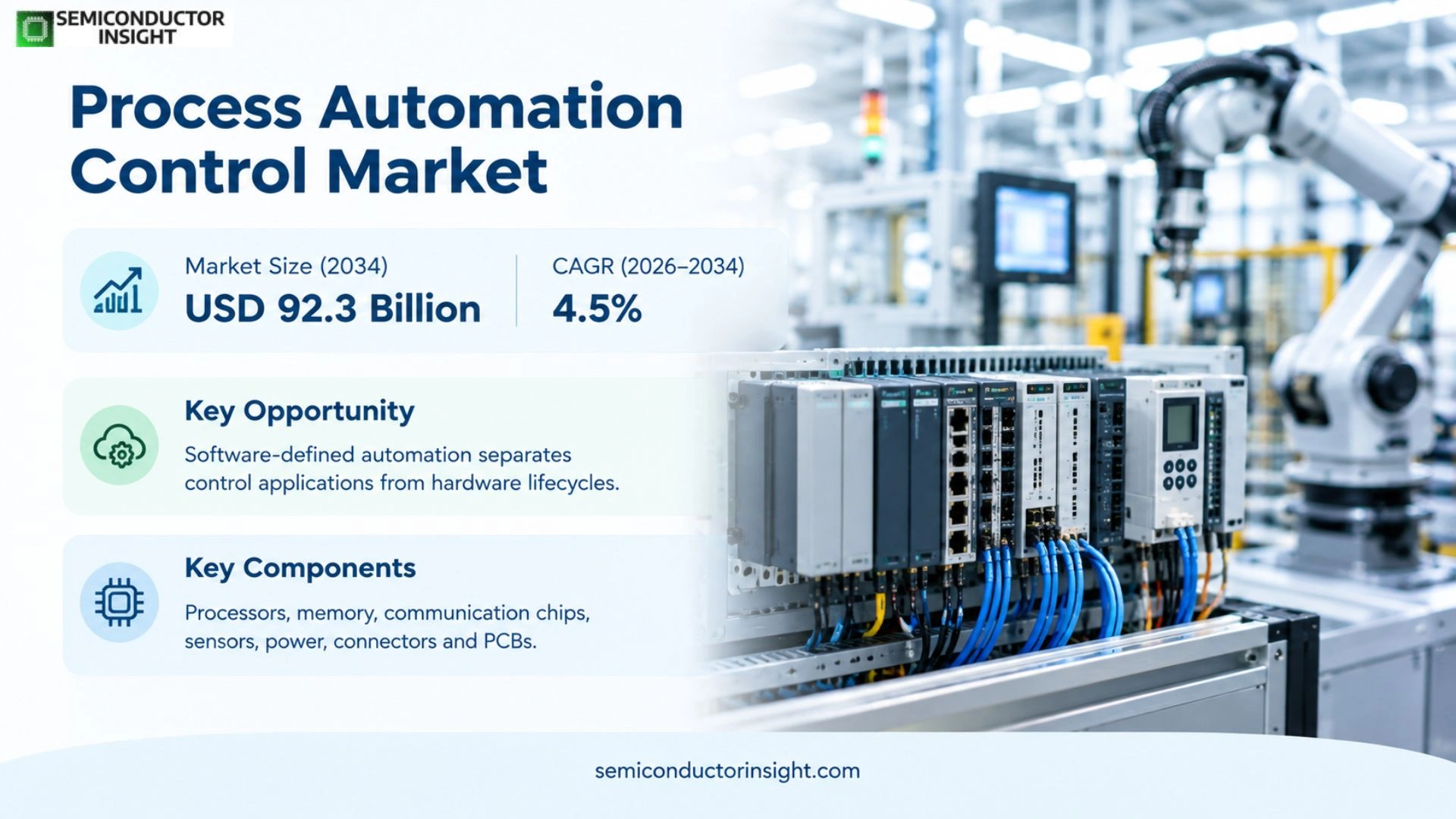
- Process Automation Control Market was valued at USD 62.5 billion in 2025 and is projected to reach USD 92.3 billion by 2034. Those two published anchors imply approximately 4.4% compound annual growth over nine annual intervals, broadly consistent with the controlling page’s displayed 4.5% rate. Demand is led by installed process industries that must improve throughput, quality, safety, energy efficiency and asset reliability without destabilizing continuous operations or abandoning decades of field instrumentation.
- Modernization is increasingly software-defined rather than a simple controller replacement cycle. ABB’s February 2026 System 800xA 7.0 release emphasizes long-term support and phased modernization, Schneider Electric introduced software-defined Foxboro DCS capabilities in 2026, and Emerson’s 2025 DeltaV releases expanded edge, PROFINET redundancy and simulation. These changes allow plants to separate lifecycle upgrades from full control-system replacement, reducing shutdown risk and widening the commercial opportunity around services, software subscriptions and staged migration.
- Cybersecurity is now a purchase criterion rather than a secondary engineering feature. ISA published ANSI/ISA-62443-2-1-2024 in January 2025 and added ISA-TR62443-2-2-2025 in December 2025, while CISA continued issuing industrial-control advisories covering Siemens, Rockwell Automation, ABB and other vendors. Asset owners increasingly require lifecycle patching, segmentation, secure remote access, identity control and documented security processes, so vendors with credible security governance can defend installed-base relationships even when hardware performance is comparable.
- Manufacturing activity provides the economic base for automation demand. UNIDO reported global manufacturing production rose 1.3% quarter over quarter in Q1 2025 and remained positive through the year, with medium-high and high-technology industries among the strongest categories. Each capacity addition, brownfield debottlenecking project or quality-improvement program creates demand for PLC, DCS, SCADA, safety, historian and optimization functions, but project timing remains sensitive to energy prices, interest rates and the capital budgets of chemicals, refining and other process industries.
Process Automation Control Market Overview
Process automation control comprises the hardware, software and engineering layers used to monitor and regulate industrial processes. The controlling scope covers Programmable Logic Controllers, Distributed Control Systems, SCADA and Edge-enabled Controllers; Batch Processing, Continuous Flow, Hybrid Operations and Others by application; Chemicals, Oil & Gas, Pharmaceuticals and Food & Beverage by end user; On-Premise, Cloud-Based and Hybrid deployment; and Safety Systems, Process Optimization and Energy Management by functional focus. This structure captures both plant-floor control and the expanding software layer around it.
The market’s economic logic differs from discrete factory automation because many end users operate continuous or batch processes where a control failure can create safety, environmental or product-quality consequences. A DCS or safety system can remain in service for decades, so customers value migration paths, controller redundancy, spare-parts support, validated software versions and integration with existing field devices. This installed-base structure creates high switching costs and recurring service revenue, but it also slows adoption when a new architecture requires substantial requalification or shutdown time.
Edge computing and cloud connectivity are changing the architecture without moving critical closed-loop control entirely offsite. Emerson’s DeltaV Edge Environment 2.0 supports contextualized batch data for analytics and AI while preserving plant control, and hybrid deployments in the controlling segmentation reflect the same pattern. The commercial opportunity is therefore strongest in architectures that keep deterministic and safety-critical logic locally while exposing selected operational data to enterprise analytics, digital twins and remote support under controlled cybersecurity policies.
Segment Analysis: By Type
| Type | Market interpretation |
|---|---|
| Programmable Logic Controllers (PLCs) | PLCs remain foundational in skid systems, utilities, packaging, material handling and hybrid process facilities because they provide deterministic logic, broad I/O support and a large engineering ecosystem. Modern PLC platforms increasingly include integrated safety, motion, Ethernet networking and edge connectivity, enabling brownfield sites to add analytics without replacing every control layer. Competition centers on installed base, programming tools, cybersecurity lifecycle, I/O density, redundancy and integration with HMI or SCADA software. |
| Distributed Control Systems (DCS) | DCS platforms are central to large continuous and batch plants in chemicals, refining, pharmaceuticals, power and other complex processes. Their advantage is integrated control, alarms, historian, operator interface, redundancy and lifecycle engineering across thousands of loops. ABB System 800xA, Emerson DeltaV, Yokogawa CENTUM and Honeywell Experion demonstrate the segment’s installed-base strength. Growth comes from modernization, software-defined architectures, advanced process control and safer migration rather than greenfield hardware volume alone. |
| Supervisory Control and Data Acquisition (SCADA) | SCADA is essential where assets are geographically distributed, including pipelines, water networks, upstream oil and gas, utilities and remote infrastructure. Cloud-enabled and SaaS architectures are expanding the segment by reducing on-premise infrastructure and improving mobile visibility, while edge gateways preserve connectivity during communications interruptions. Emerson’s 2025 DeltaV SaaS SCADA Edge Connect illustrates this direction. Supplier selection emphasizes protocol breadth, alarm management, historian capability, cybersecurity, remote connectivity and integration with RTUs and field devices. |
| Edge-enabled Controllers | Edge-enabled controllers combine deterministic control with local computing for analytics, protocol conversion, AI inference and enterprise connectivity. They are gaining relevance because plants want to process high-frequency data near equipment while limiting bandwidth and cybersecurity exposure. The segment is commercially attractive for retrofits because edge functions can be inserted alongside existing PLC or DCS infrastructure. Success depends on containerized applications, secure update mechanisms, real-time performance and compatibility with industrial protocols rather than general-purpose computing power alone. |
Segment Analysis: By Application
| Application | Demand characteristics |
|---|---|
| Batch Processing | Batch processing is important in pharmaceuticals, specialty chemicals, food and beverage and other recipe-driven industries. Automation must manage phases, material genealogy, cleaning, recipe changes and electronic records while preserving flexibility between product campaigns. Emerson’s 2025 life-sciences software releases illustrate growing demand for connected development-to-production workflows. Control suppliers compete through batch standards support, validated change management, recipe portability, historian integration and operator training tools that reduce technology-transfer time. |
| Continuous Flow | Continuous-flow operations in refining, petrochemicals, bulk chemicals and utilities require stable multivariable control because small deviations can affect energy use, yield, emissions and safety across large production volumes. DCS and advanced process control are especially important here. Modernization spending is justified by improved availability and optimization rather than labor replacement alone. Vendors with strong process models, alarm management, safety integration and control-loop performance services have an advantage in these long-life plants. |
| Hybrid Operations | Hybrid facilities combine continuous process units with batch, packaging, utility or discrete operations, creating demand for architectures that bridge DCS and PLC domains. Food production, life sciences and specialty materials commonly fit this model. Customers prioritize common engineering tools, shared data models and integrated cybersecurity because separate automation islands increase support cost. Hybrid deployment also aligns with staged modernization, where old controllers can remain while new edge and analytics layers are introduced. |
| Others | Other applications include water and wastewater, mining, pulp and paper, energy transition facilities and specialized infrastructure. These operations vary widely, but they share a need for reliable data acquisition, remote visibility and safe control under constrained staffing. Modular SCADA, edge controllers and cloud-connected asset monitoring can lower lifecycle costs for distributed sites. Vendor opportunities are strongest where solutions can be deployed incrementally and supported through regional integrators rather than requiring large centralized engineering teams. |
Regional Analysis
North America is assessed as the largest 2025 market because the region combines a large installed base in chemicals, refining, food, pharmaceuticals, water and energy with headquarters or major operations of Rockwell Automation, Honeywell, Emerson and Aspen Technology. Europe is a major modernization and standards market led by Siemens, ABB, Schneider Electric and B&R, while Asia Pacific is the fastest-growing deployment region as manufacturing and process capacity expands. South America and Middle East & Africa remain project-driven, with oil, gas, mining and infrastructure creating concentrated automation opportunities.
| Region | Position | Evidence-led demand basis |
|---|---|---|
| North America | Largest | Large installed process-industry base, mature cybersecurity requirements, substantial brownfield modernization and strong vendor ecosystem. |
| Europe | High-value modernization market | Industrial energy efficiency, IEC/ISA standards, chemicals, food, pharmaceuticals and advanced manufacturing support sustained DCS and PLC upgrades. |
| Asia Pacific | Fastest-growing | UNIDO reported strong manufacturing performance in China and Asia during 2025, while new chemicals, electronics, water and infrastructure capacity increases automation density. |
| South America | Project-led growth | Mining, oil and gas, pulp and paper, food processing and water infrastructure create selective SCADA and control-system demand. |
| Middle East & Africa | Energy and infrastructure market | Large oil, gas, petrochemical, water and new industrial projects create demand for high-availability DCS, safety and remote operations. |
North America
North America leads because its large installed base of refineries, chemical plants, pharmaceutical sites, food processors, utilities and water systems creates continuous lifecycle spending. U.S. operators often modernize in phases to avoid shutdown risk, retaining field instruments and portions of existing I/O while upgrading controllers, servers and cybersecurity. ISA 62443 adoption and recurring CISA advisories also make secure lifecycle support a procurement requirement, reinforcing demand for supported software, network segmentation, vulnerability management and migration engineering.
| Country / subregion | Commercial logic |
|---|---|
| United States | Largest national market; refining, chemicals, pharmaceuticals, food, water and energy support DCS, PLC, SCADA and lifecycle service demand. |
| Canada | Oil and gas, mining, pulp and paper, food and utilities favor robust remote operations and control architectures. |
| Mexico | Industrial growth, food processing and manufacturing create demand for scalable PLC, SCADA and hybrid-control systems. |
Dated market instances
Europe
Europe is a technology and modernization center because many global automation vendors are headquartered in the region and process industries face strong energy-efficiency, safety and cybersecurity requirements. Customers typically prioritize long-term support, standards compliance and low-disruption migration. ABB’s 2026 System 800xA 7.0 release and Schneider Electric’s software-defined Foxboro direction illustrate a competitive shift toward architectures that let users add analytics, virtualization and AI gradually while preserving critical control reliability and existing plant investments.
| Country / subregion | Commercial logic |
|---|---|
| Germany | Siemens and major chemicals, food, pharmaceutical and industrial facilities create a broad automation base. |
| France | Schneider Electric and large energy, food and pharmaceutical operations support control modernization. |
| United Kingdom / Benelux | Refining, chemicals, pharmaceuticals and utilities favor lifecycle service, cybersecurity and emissions monitoring. |
Dated market instances
Asia Pacific
Asia Pacific is the fastest-growing deployment region because new industrial capacity is being added while older plants simultaneously modernize. UNIDO reported strong manufacturing performance in China and the rest of Asia during 2025, and the region hosts major chemicals, refining, electronics, pharmaceuticals, food and water projects. Japan contributes Yokogawa and Mitsubishi Electric, while China, India and Southeast Asia provide greenfield growth. Vendors need premium platforms for complex plants and cost-effective modular offerings for rapidly industrializing markets.
| Country / subregion | Commercial logic |
|---|---|
| China | Large chemicals, refining, water and manufacturing investments support DCS, PLC and SCADA adoption. |
| Japan | Mature installed base and domestic suppliers emphasize reliability, quality and long platform lifecycles. |
| India & Southeast Asia | Greenfield chemicals, pharmaceuticals, food, energy and water projects create high incremental automation demand. |
Dated market instances
South America
South America’s demand is concentrated in mining, oil and gas, pulp and paper, food processing and infrastructure. Brazil is the largest industrial market, while Chile and Peru create strong mining-related SCADA and process-control opportunities. Capital cycles can be volatile, so brownfield upgrades, remote monitoring and energy optimization often receive priority over full platform replacement. Vendors with strong local integrators, spare-parts support and staged deployment options can outperform competitors that rely mainly on centralized engineering resources.
| Country / subregion | Commercial logic |
|---|---|
| Brazil | Chemicals, oil and gas, pulp and paper, food and water support modernization and lifecycle service. |
| Chile & Peru | Mining operations favor remote SCADA, process control and asset monitoring. |
| Argentina | Oil and gas, food and industrial processing create selective project demand. |
Dated market instances
Middle East & Africa
Middle East & Africa demand is driven by oil and gas, petrochemicals, refining, desalination, mining and infrastructure. Gulf states operate large continuous-process assets where DCS and safety systems are mission critical, while Africa adds mining, water and energy projects requiring remote SCADA. New industrial-diversification programs create greenfield opportunities, but customers also require long lifecycle support because plants are expected to operate for decades. Secure remote operations and centralized supervision are becoming increasingly important across geographically dispersed assets.
| Country / subregion | Commercial logic |
|---|---|
| Saudi Arabia | Refining, petrochemicals, water and industrial diversification support high-value DCS, safety and optimization systems. |
| United Arab Emirates | Energy, utilities and infrastructure favor integrated control, analytics and centralized operations. |
| South Africa | Mining, power, water and process industries support PLC and SCADA demand. |
Dated market instances
Key Process Automation Control Manufacturers and Competitive Landscape
The competitive landscape is dominated by multinational automation vendors with large installed bases and extensive system-integration ecosystems. Siemens, ABB, Rockwell Automation, Schneider Electric, Honeywell, Yokogawa and Emerson compete across control hardware, operator software, safety, historians and lifecycle services. Beckhoff and B&R are strong in open and machine-oriented control architectures, while Inductive Automation differentiates through the Ignition software ecosystem. Aspen Technology competes from the optimization and industrial-software layer, increasingly overlapping with traditional control vendors as analytics becomes more tightly integrated with operations.
Installed base is the primary moat. A process plant may have thousands of I/O points, custom graphics, interlocks and validated operating procedures built around one control platform. Migration risk, workforce familiarity and spare-parts availability therefore matter as much as nominal controller performance. Vendors defend accounts with long-term support, migration tools, backward compatibility and engineering services. New software-defined architectures can lower switching friction over time, but only if customers can preserve deterministic performance, safety certification and cybersecurity controls during the transition.
| Competitive group | Companies |
|---|---|
| Integrated automation leaders | Siemens AG; ABB Ltd.; Rockwell Automation; Schneider Electric; Honeywell International; Yokogawa Electric; Emerson Electric. |
| Control and engineering specialists | Mitsubishi Electric; Beckhoff Automation; B&R Automation; Inductive Automation. |
| Optimization software specialist | Aspen Technology, whose process modeling, optimization and data software increasingly connects with operational control environments. |
Companies covered in the report
- Siemens AG
- ABB Ltd.
- Rockwell Automation
- Schneider Electric
- Honeywell International
- Mitsubishi Electric
- Yokogawa Electric
- Emerson Electric
- Beckhoff Automation
- B&R Automation
- Inductive Automation
- Aspen Technology
The complete controlling company set is retained for competitive profiling. Evaluation distinguishes installed-base DCS and PLC leaders, open-control specialists, SCADA providers and optimization-software participants by migration capability, cybersecurity lifecycle, engineering coverage, interoperability and industry certification. The twelve companies are not treated as interchangeable because their platforms address different control layers, process industries, project sizes and service models across brownfield and greenfield investments.
Control-System Modernization, Engineering Capacity and Lifecycle Readiness Analysis
For process automation, supply-side capacity is measured less by factory nameplate output than by the ability to deliver controllers, I/O, networking hardware, industrial PCs, safety components and trained engineering resources at project scale. Electronics shortages during earlier semiconductor cycles demonstrated that a missing processor or power component can delay entire control-system shipments. Large vendors mitigate this through multisite manufacturing, standardized product families and regional inventory, but customized cabinets, certification, software configuration and factory acceptance testing still create project-specific bottlenecks.
Engineering capacity is equally important because DCS and SCADA projects require control strategy design, graphics, safety reviews, cybersecurity configuration, database migration and commissioning. A vendor may have hardware available but insufficient experienced engineers for simultaneous refinery, pharmaceutical and water projects. This creates opportunities for certified system integrators and regional partners. Software-defined and virtualized architectures can reduce some hardware dependency, but they increase demand for IT/OT skills, network design and lifecycle change management, shifting rather than eliminating the supply constraint.
Process Automation Control Market Dynamics: Drivers, Restraints and Opportunities
The market is defined by brownfield modernization rather than wholesale replacement. Plants frequently retain field instruments, wiring and portions of I/O while migrating controllers, servers and operator stations in phases. Vendors that provide drop-in or low-disruption migration can convert installed-base relationships into recurring revenue. At the same time, open architectures and software-defined control aim to reduce proprietary lock-in, creating tension between customer demand for interoperability and vendor incentives to preserve ecosystem control. This dynamic will shape pricing and platform strategy throughout the forecast period.
AI is entering process automation primarily through advisory and optimization layers. Predictive maintenance, anomaly detection, advanced process control and operator assistance can use historical and real-time data without placing machine-learning models directly in every safety-critical loop. Honeywell’s 2025 TotalEnergies pilot and Siemens’ industrial AI initiatives illustrate this progression. Adoption depends on data quality, explainability and cybersecurity, so near-term value is greatest in bounded use cases where operators can verify recommendations and maintain conventional safety protections.
MARKET DRIVERS
| Factor | Directional CAGR impact | Most exposed market | Time horizon |
|---|---|---|---|
| Brownfield control modernization | +1.1 to +1.7 percentage points | DCS and PLC installed bases | Immediate to medium term |
| Cybersecurity and compliance upgrades | +0.7 to +1.2 percentage points | Critical process industries | Medium term |
| Edge analytics and AI-assisted operations | +0.6 to +1.0 percentage points | Large continuous plants | Medium term |
Digital transformation is the strongest driver because process industries need more output from existing assets while controlling energy, emissions and maintenance costs. Connected DCS, SCADA and edge architectures make plant data usable for optimization, condition monitoring and enterprise planning. UNIDO’s 2025 manufacturing data showed continued global output growth, particularly in higher-technology industries, supporting capital spending on modern production systems. Every new capacity project creates initial automation demand, while every aging plant creates a parallel lifecycle-upgrade opportunity.
Safety, compliance and cybersecurity create a second durable driver. Updated ISA/IEC 62443 guidance in 2025 formalized organization-wide security program requirements and protection-scheme practices for industrial automation and control systems. Process plants also face environmental, product-quality and functional-safety requirements that depend on reliable instrumentation and control. Modern systems improve audit trails, alarm management, access control and change documentation, giving customers a compliance-based justification for investment even when basic production can continue on legacy equipment.
MARKET RESTRAINTS
| Factor | Directional CAGR impact | Most exposed market | Time horizon |
|---|---|---|---|
| Shutdown and migration cost | -1.0 to -1.6 percentage points | Legacy process plants | Immediate |
| OT cybersecurity approval | -0.7 to -1.2 percentage points | Connected architectures | Medium term |
| Control-engineering skills shortage | -0.5 to -0.9 percentage points | Complex multi-site projects | Medium term |
High migration cost is the largest restraint because automation upgrades can require shutdowns, validation, operator retraining and re-engineering of custom logic built over decades. The hardware purchase may represent only part of total project cost; engineering, testing and lost production can be larger. This creates cautious investment behavior, especially in mid-sized plants. Suppliers that can preserve existing I/O, graphics and control strategies while modernizing servers and networks have a commercial advantage because they reduce the economic penalty of change.
Cyber risk and skills shortages can also slow adoption of connected architectures. Moving plant data toward enterprise or cloud systems expands the attack surface, and CISA’s continuing ICS advisories show that vulnerabilities affect products across major vendors. At the same time, experienced control engineers are scarce and many facilities operate mixtures of legacy and modern technology. Customers may therefore delay advanced analytics or cloud projects until security governance, network segmentation and workforce capabilities are mature enough to support them safely.
MARKET OPPORTUNITIES
Software-defined automation creates a major opportunity because it separates control applications from specific hardware lifecycles. ABB and Schneider Electric are both advancing architectures that allow customers to add analytics, AI and newer software capabilities without replacing stable control layers at the same pace. This can shorten upgrade cycles for software while extending hardware utilization. Vendors that provide validated virtualization, orchestration and cybersecurity can create recurring subscription revenue while reducing the customer’s dependence on disruptive full-system migrations.
Autonomous operations and advanced optimization create another opportunity. AI-assisted operator tools, dynamic simulation, digital twins and model-predictive control can reduce variability and help smaller teams manage complex plants. Emerson’s DeltaV Mimic 6.LTS and Honeywell’s AI-assisted control-room pilot illustrate how simulation and machine intelligence are moving closer to daily operations. The strongest commercial use cases will be those with measurable reductions in energy, downtime, off-spec production or operator workload rather than broad AI features without process-domain validation.
Process Automation Architecture, Integration and Lifecycle-Service Ecosystem Analysis
The automation supply chain starts with semiconductor processors, memory, industrial communication chips, sensors, power supplies, connectors and printed circuit boards used inside PLCs, controllers, I/O and industrial computers. Vendors assemble these into certified hardware platforms, add firmware and operating software, and distribute products through regional channels. System integrators then configure control logic, cabinets, networks and operator interfaces before site commissioning. Because projects combine standardized products with custom engineering, disruptions can arise from both electronic component shortages and shortages of qualified engineering labor.
Downstream value is captured through lifecycle services. Once a control system is installed, customers purchase spare parts, support contracts, software upgrades, cybersecurity updates, training, migration engineering and optimization services over many years. Cloud and SaaS offerings add recurring software revenue but also require secure connectivity and data governance. The most resilient vendors therefore combine hardware supply, local technical support, integrator certification and long software-support periods, giving asset owners confidence that a platform will remain maintainable across the operating life of the plant.
Recent Developments in the Process Automation Control Market
Developments tracked to September 2026. Entries follow official company or industry publications.
- February 2026: ABB released System 800xA 7.0 as a long-term-support distributed control system version focused on secure modernization. ABB positions the release as a bridge that lets operators introduce monitoring, analytics and AI capabilities gradually while preserving critical control reliability. The development directly addresses a major brownfield barrier: customers want new digital functionality but cannot accept an unstable migration path for core process control. Source.
- November 2025: Honeywell and TotalEnergies announced an AI-assisted control-room pilot at the Port Arthur platform in Southeast Texas using Honeywell Experion Operations Assistant. The project is designed to support operators with AI-based recommendations while retaining human oversight of safe operations. It provides a concrete example of how AI is entering process control through decision support and workflow improvement rather than immediately replacing conventional regulatory and safety loops. Source.
- March 2025: Emerson released DeltaV Version 15 Feature Pack 3, adding PROFINET S2 redundancy, improved change tracking and validation reporting, and support infrastructure for its software-defined IQ Controller architecture. The update strengthens the trend toward resilient Ethernet field connectivity and more software-defined control while preserving lifecycle support for existing DeltaV users. It also shows how vendors are adding capability through frequent software releases between major platform generations. Source.
- January 2025: ISA announced ANSI/ISA-62443-2-1-2024, updating organization-wide cybersecurity requirements for industrial automation and control systems. The standard introduces revised security-program elements and a maturity model intended to help asset owners implement and continually improve security. This is directly relevant to automation purchasing because cybersecurity governance now affects product selection, integration architecture, remote-access design and vendor lifecycle support across chemicals, oil and gas, utilities and critical infrastructure. Source.
REPORT SCOPE & SEGMENTATION
| Scope dimension | Coverage |
|---|---|
| Market window | 2025 base year and 2026–2034 forecast. Published anchors are USD 62.5 billion in 2025 and USD 92.3 billion in 2034, implying approximately 4.4% CAGR. |
| By Type | Programmable Logic Controllers (PLCs); Distributed Control Systems (DCS); Supervisory Control and Data Acquisition (SCADA); Edge-enabled Controllers. |
| By Application | Batch Processing; Continuous Flow; Hybrid Operations; Others. |
| By End User | Chemicals; Oil & Gas; Pharmaceuticals; Food & Beverage. |
| By Deployment Model | On-Premise; Cloud-Based; Hybrid. |
| By Functional Focus | Safety Systems; Process Optimization; Energy Management. |
| Companies | Siemens AG; ABB Ltd.; Rockwell Automation; Schneider Electric; Honeywell International; Mitsubishi Electric; Yokogawa Electric; Emerson Electric; Beckhoff Automation; B&R Automation; Inductive Automation; Aspen Technology |
Forecast reconciliation confirms USD 92.3 billion, 4.4% as the controlling rebased metrics for the 2025–2034 planning window. The calculation preserves the published endpoint relationship and applies compound growth consistently across elapsed annual periods. This validation note is provided so readers can reproduce the arithmetic, compare it with the source anchors and avoid relying on a headline percentage that may be rounded or internally inconsistent.
Frequently Asked Questions
What is the Process Automation Control Market size in 2025?
The global Process Automation Control Market is valued at USD 62.5 billion in 2025 in the controlling scope. The value covers PLC, DCS, SCADA and edge-enabled controller hardware and associated automation software used across batch, continuous and hybrid processes. It spans chemicals, oil and gas, pharmaceuticals and food and beverage end users as well as on-premise, cloud-based and hybrid deployment models.
What is the projected market size by 2034?
The controlling endpoint is USD 92.3 billion in 2034. Comparing that endpoint with the USD 62.5 billion 2025 base produces approximately 4.4% compound annual growth. Growth is supported by brownfield modernization, digital data integration, cybersecurity upgrades, advanced process control and new industrial capacity, while the rate remains moderate because many DCS and PLC platforms have long service lives and are replaced incrementally.
Which region is largest?
North America is assessed as the largest 2025 regional market because it combines a large installed base in chemicals, refining, pharmaceuticals, food, water and energy with major automation suppliers and mature lifecycle-service spending. The region also has strong cybersecurity and compliance requirements, which increase demand for supported software versions, secure remote access, migration projects and plantwide modernization beyond the initial controller hardware purchase.
Which product type has the strongest installed-base moat?
Distributed Control Systems have one of the strongest installed-base moats because large process plants may depend on thousands of loops, operator graphics, interlocks and historical databases built around a single platform. Replacing the DCS can require shutdowns, validation and retraining. As a result, vendors such as ABB, Emerson, Yokogawa, Honeywell and Siemens compete heavily through migration tools, long-term support and staged modernization.
How are cloud systems used in process automation?
Cloud systems are generally used for analytics, fleet monitoring, data management, engineering collaboration and enterprise visibility rather than for every millisecond-scale control loop. Critical control and safety logic normally remain local because deterministic performance and availability are essential. Hybrid architectures send contextualized operational data to cloud or enterprise applications while edge controllers and DCS platforms preserve local operation during communications loss or cybersecurity isolation.
Why is cybersecurity a major growth driver?
Industrial systems are more connected than in the past, creating exposure to vulnerabilities in controllers, engineering workstations, gateways and remote-access systems. ISA updated the 62443 series in 2025, and CISA continues to publish industrial-control advisories across multiple major vendors. Asset owners therefore spend on supported products, segmentation, identity management, secure remote access, patch processes and monitoring as part of routine automation lifecycle management.
Which end users are covered?
The controlling end-user segmentation covers Chemicals, Oil & Gas, Pharmaceuticals and Food & Beverage. Chemicals and oil and gas emphasize continuous control, safety and emissions; pharmaceuticals emphasize batch records, validation and technology transfer; food and beverage combines batch, continuous and packaging operations. These differences affect the preferred controller architecture, software modules, validation burden and value of cloud or edge analytics.
Which companies are profiled?
The report profiles Siemens AG, ABB Ltd., Rockwell Automation, Schneider Electric, Honeywell International, Mitsubishi Electric, Yokogawa Electric, Emerson Electric, Beckhoff Automation, B&R Automation, Inductive Automation and Aspen Technology. The list includes integrated control vendors, open-control and SCADA specialists and an industrial optimization software company, reflecting convergence between control hardware and higher-level operational software.
What are the main restraints?
The main restraints are migration cost, shutdown risk, cybersecurity exposure and shortages of experienced control engineers. Plants often run custom logic and field infrastructure for decades, so even technically superior systems can be difficult to justify if replacement requires prolonged downtime or revalidation. Customers therefore favor phased migration, backward compatibility and architectures that add analytics without destabilizing proven control and safety functions.
Where are the strongest opportunities?
The strongest opportunities are software-defined automation, edge-enabled modernization, AI-assisted operations, dynamic simulation, cybersecurity lifecycle services and energy optimization. These areas let vendors add value around existing installed systems instead of relying only on greenfield controller sales. Solutions with measurable reductions in downtime, energy use, operator workload or off-spec production are likely to receive faster approval than broad digital-transformation projects without clear operating economics.
Get Sample Report PDF for Exclusive Insights
Report Sample Includes
- Table of Contents
- List of Tables & Figures
- Charts, Research Methodology, and more...
 Download Sample Report PDF