PM Fiber Array Market Insights
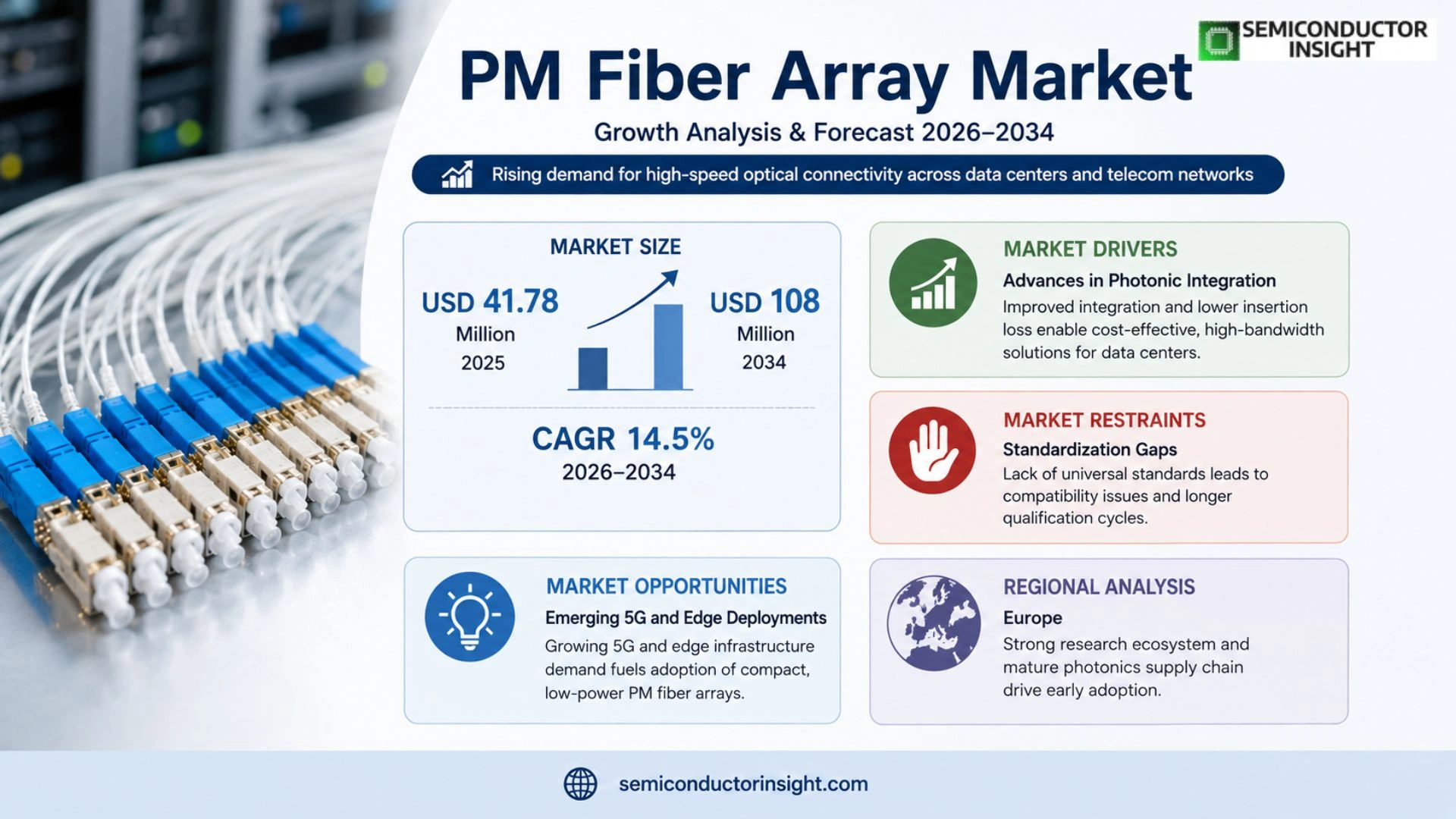
PM Fiber Array market size was valued at USD 41.78 million in 2025 and will grow to USD 108 million by 2034, reflecting a CAGR of 14.5% over the forecast period.
A PM Fiber Array is a specialized optical‑fiber array device built from polarization‑maintaining (PM) fibers. The design incorporates orderly fiber spacing, high‑precision positioning, curing, and meticulous end‑face polishing, which together preserve the polarization state while minimizing crosstalk and mode coupling. Production in 2025 reached roughly 5,865 K units with an average price of about USD 7.8 per unit, underscoring its role in high‑consistency parallel transmission for multiple polarized light channels.
MARKET DRIVERS
Advances in Photonic Integration
PM Fiber Array market is being reshaped by the convergence of silicon photonics and specialty glass platforms. Engineers are achieving lower insertion loss and higher bandwidth density, which translates into cost‑effective solutions for data‑center interconnects. As manufacturers simplify assembly steps, the total cost of ownership drops, prompting OEMs to replace legacy copper bundles with photonic modules.
Demand from High‑Performance Computing
Data‑intensive workloads such as AI training and real‑time analytics stress existing link capacities. Companies are therefore sourcing PM fiber arrays that can sustain multi‑terabit per second throughput without compromising signal integrity. This shift is less about raw volume and more about the strategic need to future‑proof infrastructure, a factor that fuels forward‑looking procurement cycles.
➤ Clients are prioritizing architectures that combine low‑latency fiber routing with modular scalability, accelerating adoption of next‑gen PM fiber products.
Regulatory incentives that reward energy‑efficient networking further tip the balance toward optical solutions. Operators that align with these policies can claim lower operational expenditures, creating a competitive edge that reinforces the upward momentum of PM Fiber Array market.
MARKET CHALLENGES
Manufacturing Yield Constraints
Producing high‑precision fiber pitch and alignment over large wafer areas remains a technical bottleneck. Even modest variations can cause excess loss, forcing manufacturers to implement costly post‑process inspection regimes. The resulting lead times deter some mid‑size integrators from committing to large orders.
Other Challenges
Supply‑Chain Volatility
Fluctuations in raw glass availability and semiconductor fab capacity create periods of material scarcity, which in turn elevate unit costs and compress margins for downstream assemblers.
MARKET RESTRAINTS
Standardization Gaps
The absence of universally accepted mechanical and optical standards for PM fiber arrays hampers cross‑vendor compatibility. End users often face lengthy qualification cycles, which delay deployments and lower the attractiveness of new product introductions.
MARKET OPPORTUNITIES
Emerging 5G and Edge Deployments
As telecom operators densify networks to support 5G and edge computing, the need for compact, high‑performance optical interconnects grows. PM fiber arrays that combine small form factor with reduced power consumption are positioned to capture a sizable share of this expanding spend.
PM Fiber Array Market Trends
Surging Demand from Coherent Optical Systems
PM Fiber Array market recorded a production volume of roughly 5,865 K units in 2025, with an average unit price near US$7.8, delivering a market value of US$41.78 million. Rapid uptake of quantum‑secure links, high‑resolution LiDAR platforms, and next‑generation coherent transceiver modules has stretched the demand curve well beyond traditional telecom applications. Manufacturers report that the influx of high‑performance customers such as NVIDIA, Huawei and Broadcom is prompting design revisions that prioritize ultra‑low loss and extinction ratios above 30 dB. Forecasts indicate the market will climb to approximately US$108 million by 2034, reflecting the cumulative effect of expanding silicon‑photonic integration and the growing need for stable polarization states in densely packed optical engines.
Other Trends
Regional Supply Chain Dynamics
Asia‑Pacific now commands close to half of global shipments, with a 48 % share in 2025 that is expected to edge past the 50 % threshold by 2034. The region’s advantage stems from a vertically integrated ecosystem that couples high‑volume glass and silicon substrate suppliers with advanced V‑groove fabrication lines. Meanwhile, North America retains a niche in high‑specification aerospace and defense programs, leveraging deep R&D resources to sustain a premium segment. Europe’s stringent standards continue to lock in defense contracts, ensuring a steady flow of customized, low‑crosstalk arrays for inertial navigation and specialized power‑sector sensing. These geographic nuances shape pricing pressure and dictate where firms allocate capital for capacity expansion.
Margin Expansion Through Automation
Industry gross margins sit between 30 % and 45 %, a range that reflects varying degrees of process automation and material sourcing efficiency. Plants that have integrated precision pick‑and‑place robots alongside closed‑loop curing ovens report margin uplift of roughly five percentage points compared with legacy manual lines. Cost discipline is further reinforced by strategic negotiations with core fiber suppliers such as Heraeus and Momentive, allowing manufacturers to lock in raw‑material rates despite modest price volatility. As the product portfolio shifts toward higher‑density configurations,four to eight channels for most telecom customers and beyond sixteen for quantum modules,automation becomes a decisive factor in preserving profitability while meeting tightening delivery windows.
COMPETITIVE LANDSCAPE
Key Industry Players
PM Fiber Array Market Competitive Overview
Corning continues to shape the upper tier of PM Fiber Array market through a portfolio of patents that protect ultra‑high‑precision fabrication methods required for aerospace and defense applications. Its ability to integrate glass‑based V‑groove substrates with proprietary curing processes gives it a pricing premium and entrenches long‑term relationships with tier‑one OEMs such as NVIDIA and Huawei. The company’s global production footprint, anchored in North America and Europe, supports a supply chain that can satisfy low‑failure‑rate contracts for coherent optical communication systems, which in turn forces newer entrants to either license the technology or focus on cost‑effective, mid‑range offerings.
Beyond the flagship players, a dense cohort of regional firms,Sumitomo Electric, TFC Communication, Kohoku Kogyo, Zesum, Orbray, and a growing number of Chinese specialists such as Shijia Photons Technology and PHIX,are leveraging localized supply chains to deliver customized arrays at competitive margins. These companies often pair ceramic or silicon substrates with high‑volume adhesive bonding, enabling rapid response to the expanding quantum‑communication and LiDAR segments in the Asia‑Pacific. Their flexible engineering services and aggressive pricing are eroding market share from legacy suppliers in the civilian and mid‑tier segments, while their incremental investments in automation are narrowing the performance gap with the industry’s high‑end tier.
List of Key PM Fiber Array Companies Profiled
- Corning
- Sumitomo Electric Industries
- TFC Communication
- Kohoku Kogyo
- Zesum
- Orbray
- Shijia Photons Technology
- PHIX
- HYC
- SENKO Advanced Components
- EverProX Technologies
- Molex
- Browave Corporation
- Vlink optics (Advanced Fiber Resources)
- Yilut Technology
Segment Analysis:
| Segment Category | Sub-Segments | Key Insights |
| By Type |
|
1D Fiber Array
|
| By Application |
|
Coherent Optical Communication
|
| By End User |
|
Telecommunications Equipment Makers
|
| By Material |
|
Silicon‑based Substrates
|
| By Performance |
|
High Extinction Ratio
|
Regional Analysis: PM Fiber Array Market
Europe
Europe’s PM Fiber Array segment benefits from a steady pipeline of telecom and automotive projects, delivering modest double‑digit compound growth. The region’s emphasis on integration efficiency amplifies demand for compact, high‑precision arrays across multiple verticals.
Harmonized EU directives on optical component safety and environmental impact streamline certification, lowering entry barriers for innovators. These policies also compel suppliers to adopt greener manufacturing practices, influencing product design decisions.
Data‑center interconnects, autonomous‑vehicle lidar, and high‑resolution medical imaging dominate usage patterns. Each segment values the array’s ability to maintain polarization fidelity over long distances, driving bespoke engineering solutions.
Leading European firms combine legacy optics expertise with aggressive acquisition of niche start‑ups, creating a layered value chain that rivals find difficult to replicate without local partnerships.
North America
North American activity centers on large‑scale telecom roll‑outs and defense contracts that prioritize ultra‑low loss and high‑throughput solutions. The market’s dynamism is fueled by venture capital backing for photonic integration startups, fostering rapid iteration cycles. Companies are increasingly partnering with silicon‑photonic foundries to embed PM Fiber Arrays into chip‑scale platforms, accelerating time‑to‑market for data‑center and 5G infrastructure. The competitive pressure encourages consolidation, as larger players acquire niche innovators to broaden portfolio depth.
Asia‑Pacific
Asia‑Pacific’s growth trajectory stems from massive investments in smart‑city infrastructure and consumer electronics manufacturing. Governments in China, Japan, and South Korea are issuing grants for high‑precision optical components, prompting local firms to upscale production capabilities. The region’s cost‑competitive labor base enables rapid scaling of assembly lines, yet quality assurance remains a differentiator. As Asian OEMs chase performance parity with western counterparts, collaborations with European research labs are becoming commonplace, reshaping the supply network for PM Fiber Array market.
South America
South American markets are still emerging, with demand driven primarily by expanding broadband initiatives and nascent defense projects. While capital allocation is modest compared to other regions, the focus on cost‑effective deployment has spurred interest in modular PM Fiber Array solutions that can be retrofitted into existing infrastructure. Local distributors are beginning to offer value‑added services such as on‑site calibration, addressing a gap in technical expertise and creating new revenue streams for global manufacturers.
Middle East & Africa
In the Middle East and Africa, satellite‑ground station upgrades and oil‑ &‑gas sensing applications dominate the narrative. The strategic importance of secure, high‑bandwidth links for remote‑operated facilities drives procurement of resilient PM Fiber Arrays. Limited domestic production capacity forces import reliance, but regional trade agreements are easing tariff burdens, encouraging a gradual shift toward localized assembly hubs that can serve both civil and military customers.
Report Scope
This market research report provides a comprehensive analysis of the PM Fiber Array Market , covering the forecast period 2026–2034. It offers detailed insights into market dynamics, technological advancements, competitive landscape, and key trends shaping the industry.
Key focus areas of the report include:
- Market Overview: The report begins with an overview outlining its current market scenario, key growth indicators, and industry transformation drivers. It discusses macroeconomic factors, demand–supply balance, regulatory landscape, and the strategic role of semiconductors in powering advancements across industries such as automotive, telecommunications, consumer electronics, and industrial automation.
- Market Size & Forecast: Historical data and future projections for revenue, unit shipments, and market value across major regions and segments.
- Segmentation Analysis: Detailed breakdown by product type, technology, application, and end-user industry to identify high-growth segments and investment opportunities.
- Regional Insights: Insights into market performance across North America, Europe, Asia-Pacific, Latin America, and the Middle East & Africa, including country-level analysis where relevant.
- Competitive Landscape: Profiles of leading market participants, including their product offerings, R&D focus, manufacturing capacity, pricing strategies, and recent developments such as mergers, acquisitions, and partnerships.
- Technology Trends & Innovation: Assessment of emerging technologies, integration of AI/IoT, semiconductor design trends, fabrication techniques, and evolving industry standards.
- Market Drivers & Restraints: Evaluation of factors driving market growth along with challenges, supply chain constraints, regulatory issues, and market-entry barriers.
- Stakeholder Insights: Insights for component suppliers, OEMs, system integrators, investors, and policymakers regarding the evolving ecosystem and strategic opportunities.
Primary and secondary research methods are employed, including interviews with industry experts, data from verified sources, and real-time market intelligence to ensure the accuracy and reliability of the insights presented.
FREQUENTLY ASKED QUESTIONS:
What is the current market size of PM Fiber Array Market?
-> PM Fiber Array market size will grow to USD 108 million by 2034, reflecting a CAGR of 14.5%
Which key companies operate in PM Fiber Array Market?
-> Key players include Corning, Sumitomo Electric Industries, TFC Communication, Kohoku Kogyo, Zesum, Orbray, Shijia Photons Technology, PHIX, HYC, SENKO Advanced Components, EverProX Technologies, Molex, Browave Corporation.
What are the key growth drivers?
-> Key growth drivers include advancements in coherent optical communication, expanding adoption of fiber‑optic gyroscopes, rapid deployment of quantum‑secured communication, growth of high‑end laser sensing applications, and increasing demand from quantum communication, LiDAR, and optoelectronic computing sectors.
Which region dominates the market?
-> Asia‑Pacific accounts for roughly 48% of market share in 2025 and is projected to reach 52% by 2034 with an approximate CAGR of 15%, making it the fastest‑growing and dominant region.
What are the emerging trends?
-> Emerging trends include higher integration density, ultra‑low loss designs, ultra‑high extinction ratios, enhanced reliability across wide temperature ranges, and ongoing automation of precision manufacturing processes.

Get Sample Report PDF for Exclusive Insights
Report Sample Includes
- Table of Contents
- List of Tables & Figures
- Charts, Research Methodology, and more...
 Download Sample Report PDF