Coherent optical transceiver for LEO laser crosslink terminal Market Insights
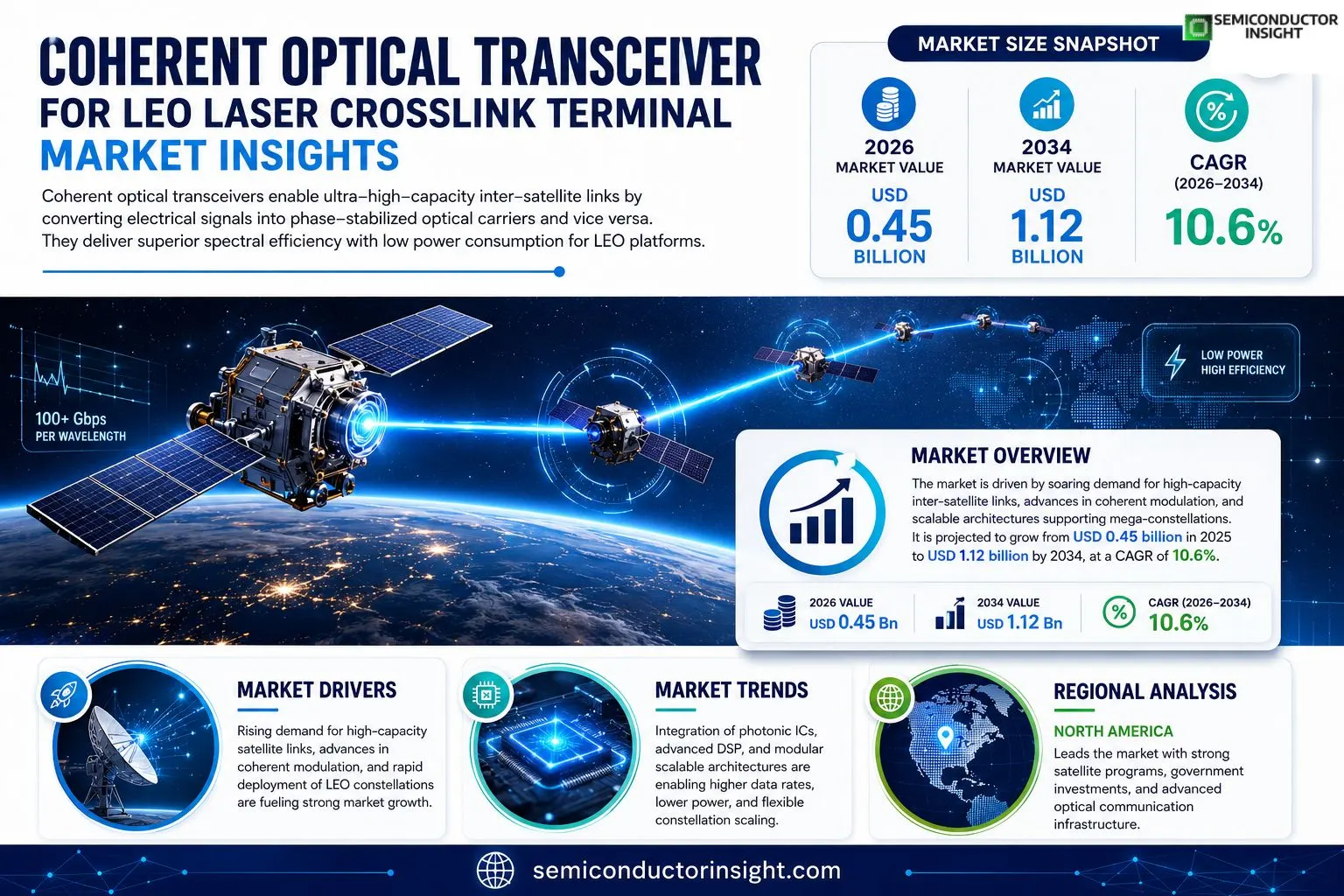
Coherent optical transceiver for LEO laser crosslink terminal market size was valued at USD 0.45 billion in 2025. The market is projected to grow from USD 0.45 billion in 2025 to USD 1.12 billion by 2034, exhibiting a CAGR of 10.6% during the forecast period.
A Coherent optical transceiver designed for low‑Earth‑orbit (LEO) laser cross‑link terminals enables high‑capacity inter‑satellite communication by converting electrical signals into phase‑stabilized optical carriers and vice versa.
These units integrate narrow‑linewidth lasers, advanced photonic integrated circuits, and digital signal processing algorithms that compensate for Doppler shift and atmospheric turbulence.
Because they operate on Coherent detection principles, they achieve superior spectral efficiencyoften exceeding 100 Gbps per wavelengthwhile maintaining low power consumption critical for space platforms.
Furthermore, the modular architecture allows seamless scaling from small constellations to mega‑constellations, supporting emerging services such as broadband internet, Earth observation data relay, and secure tactical links.
MARKET DRIVERS
Increasing Demand for High‑Capacity Satellite Links
The rapid growth of broadband services for remote and maritime users is driving operators to adopt LEO constellations equipped with Coherent optical transceivers. Higher data rates and lower latency are essential, and the market is responding with multiple megaconstellation projects slated for launch by 2028.
Advancements in Coherent Modulation Technologies
Recent progress in digital signal processing enables Coherent detection at lower power budgets, making it viable for space‑borne terminals. These improvements reduce the size, weight, and cost of transceivers, directly supporting the expansion of Coherent optical transceiver for LEO laser crosslink terminal Market.
➤ Industry forecasts suggest that the total addressable market for space‑based optical links could exceed $12 billion by 2032.
Combined, these drivers create a robust growth engine, encouraging satellite manufacturers and component suppliers to invest heavily in next‑generation optical payloads.
MARKET CHALLENGES
Thermal Management and Power Constraints
Coherent optical transceivers require precise temperature control to maintain signal integrity. In the harsh LEO environment, thermal fluctuations and limited power availability pose significant design challenges that can delay product qualification.
Other Challenges
Supply‑Chain Vulnerabilities
The specialized photonic components used in Coherent systems are sourced from a limited number of manufacturers. Recent geopolitical tensions have highlighted supply‑chain risks, potentially increasing lead times and costs for Coherent optical transceiver for LEO laser crosslink terminal Market.
MARKET RESTRAINTS
Regulatory and Frequency Allocation Barriers
International coordination of optical frequencies is still evolving, and regulatory uncertainties can restrict the deployment of cross‑link networks in certain regions, limiting market penetration.Moreover, the certification processes for space‑qualified optical hardware are lengthy, creating time‑to‑market delays that can deter smaller entrants from participating.These restraints collectively moderate the pace at which Coherent optical transceiver for LEO laser crosslink terminal Market can achieve full global coverage.
MARKET OPPORTUNITIES
Emerging Government and Defense Contracts
National security agencies are investing in resilient, low‑latency communication layers for tactical operations. Coherent optical transceivers offer encrypted, jam‑resistant links, opening a lucrative niche for suppliers.In addition, the rise of in‑orbit servicing missions creates demand for plug‑and‑play optical modules that can be upgraded or repaired, further expanding the addressable market.Strategic partnerships between satellite operators and photonics firms are expected to accelerate technology adoption, positioning Coherent optical transceiver for LEO laser crosslink terminal Market for sustained growth through 2035.
Coherent optical transceiver for LEO laser crosslink terminal Market Trends
Rising Demand for High‑Capacity Inter‑Satellite Links
The global Coherent optical transceiver for LEO laser crosslink terminal Market was valued at USD 0.45 billion in 2025 and is projected to reach USD 1.12 billion by 2034, reflecting a compound annual growth rate of approximately 10.6 %. This expansion is driven by the need for higher spectral efficiency in satellite constellations, where Coherent detection enables throughput that often exceeds 100 Gbps per wavelength while keeping power consumption low enough for space‑borne platforms. Operators are increasingly adopting these transceivers to support broadband internet services, rapid Earth‑observation data relay, and secure tactical communications, all of which require reliable, high‑speed inter‑satellite links.
Other Trends
Integration of Photonic Integrated Circuits
Photonic integrated circuits (PICs) are becoming the core building blocks of modern transceiver designs. By embedding narrow‑linewidth lasers, modulators, and photodetectors on a single silicon‑based substrate, manufacturers achieve reduced form factor, lower mass, and enhanced thermal stability. The shift to PICs also shortens production cycles and lowers unit costs, making the technology accessible to both regional constellations and large‑scale mega‑constellations. As a result, the market sees a steady influx of next‑generation devices that can be rapidly re‑programmed via software‑defined radio techniques to adapt to evolving link budgets and orbital dynamics.
Shift Toward Modular Scalable Architectures
Modularity is a defining trend that supports flexible scaling from a handful of satellites to thousands. Modern transceivers feature interchangeable modules for laser sources, digital signal processing, and thermal management, allowing operators to customize configurations for specific mission profiles. This architecture simplifies upgrades, as newer laser sources or DSP algorithms can be inserted without redesigning the entire payload. Consequently, satellite manufacturers can respond more quickly to market pressures for higher data rates while maintaining a consistent power envelope, a critical factor for extending on‑orbit lifespan.
COMPETITIVE LANDSCAPE
Key Industry Players
Coherent Optical Transceiver Market for LEO Laser Cross‑Link Terminals – Competitive Overview
The Coherent optical transceiver segment is dominated by a handful of vertically integrated photonics manufacturers that have leveraged decades of expertise in narrow‑linewidth lasers, photonic integrated circuits (PICs) and space‑qualified packaging. Lumentum Holdings, Inc. leads the market with a robust portfolio of high‑power, low‑noise lasers and a proven track record supplying defense and satellite constellations. II‑VI Incorporated, after acquiring Finisar’s Coherent‑technology assets, occupies a strategic position by offering full‑stack solutions that combine PICs, digital signal processing (DSP) ASICs and radiation‑hardened modules. Tesat‑Spacecom GmbH, a long‑standing space‑optics supplier, differentiates through its heritage in German satellite programs and its ability to deliver turnkey transceiver assemblies that meet the strict mass‑power envelope of LEO platforms. These three firms control the majority of volume shipments, set de‑facto standards for interface specifications, and benefit from deep partnerships with satellite manufacturers, creating a high barrier to entry for newcomers.Beyond the tier‑one leaders, a diverse set of niche players is expanding the technology envelope and targeting specialized market niches. Mynaric AG and OQ Technology focus on ultra‑lightweight, high‑efficiency modules optimized for mega‑constellation deployments, often collaborating with launch providers to integrate transceivers directly into satellite payloads. Thales Alenia Space and Airbus Defence and Space bring system‑level expertise, embedding Coherent transceivers into broader cross‑link architectures and securing large government contracts. Northrop Grumman Corporation, Raytheon Technologies and BAE Systems contribute proprietary DSP algorithms and secure‑communication capabilities, positioning themselves for defense‑focused services. NeoPhotonics Corporation supplies custom PIC designs for early‑stage pilots, while emerging start‑ups are exploring novel materials such as silicon‑nitride and heterogeneous integration to push data rates beyond 200 Gbps per wavelength.
List of Key Coherent Optical Transceiver for LEO Laser Crosslink Terminal Companies Profiled
- Lumentum Holdings, Inc.
- II‑VI Incorporated
- Finisar (Marvell Technology Group)
- Tesat‑Spacecom GmbH
- Mynaric AG
- OQ Technology
- Thales Alenia Space
- Airbus Defence and Space
- Northrop Grumman Corporation
- Raytheon Technologies
- BAE Systems
- NeoPhotonics Corporation
Segment Analysis:
| Segment Category | Sub-Segments | Key Insights |
| By Type |
|
Integrated Photonic Chip
|
| By Application |
|
Inter‑satellite backbone
|
| By End User |
|
Satellite operators
|
| By Architecture |
|
Coherent detection with digital signal processing
|
| By Service Offering |
|
Broadband internet backhaul
|
Regional Analysis: North America
North America
Government funding and strategic policies are playing a crucial role in fostering the development and deployment of LEO satellite constellations, directly impacting the demand for Coherent optical transceivers. These initiatives prioritize national security, research advancements, and the expansion of broadband access.
Significant investments in research and development activities are driving innovation in Coherent optical transceiver technology, leading to improved performance, reduced costs, and enhanced reliability for LEO laser crosslink terminals.
The burgeoning commercial space sector, with its increasing number of satellite operators, is creating a substantial market opportunity for Coherent optical transceivers to support the growing data demands of LEO constellations.
The defense and security sectors are key drivers, requiring secure and reliable communication links for military operations and intelligence gathering, bolstering the demand for advanced Coherent optical solutions.
Europe
Europe exhibits steady growth in Coherent optical transceiver for LEO laser crosslink terminal Market, driven by a strong focus on space-based communication for scientific exploration, infrastructure monitoring, and telecommunications. Several European nations have ambitious space programs and are actively investing in LEO satellite constellations. The region’s commitment to technological advancement and collaboration among space agencies further supports market expansion. Key areas of focus include enhancing data throughput and reducing latency for various applications. The emphasis on secure communication and the development of resilient satellite networks are also contributing to market dynamics.
Asia-Pacific
Asia-Pacific is emerging as a high-growth region, fueled by rapid expansion in satellite communications, increasing demand for high-speed data, and significant government investments in space technology. The region hosts a large and growing number of satellite operators and is witnessing the deployment of numerous LEO constellations. The robust telecommunications infrastructure and supportive government policies are further propelling market growth. Applications span across various sectors, including telecommunications, remote sensing, and maritime communications. The increasing adoption of advanced Coherent optical transceivers is crucial for enabling high-bandwidth and low-latency data transmission from LEO satellites.
South America
South America represents a developing market with potential for growth in the Coherent optical transceiver for LEO laser crosslink terminal sector. The increasing deployment of LEO satellite constellations to enhance broadband access in underserved areas and support remote sensing applications is driving demand. Government initiatives focused on digital inclusion and infrastructure development are also contributing to market expansion. The region’s growing focus on telecommunications and its increasing adoption of satellite-based services present opportunities for market players.
Middle East & Africa
The Middle East & Africa region is witnessing increasing interest in LEO satellite constellations for various applications, including telecommunications, defense, and scientific research. Government investments in space technology and growing demand for high-speed data are driving the adoption of Coherent optical transceivers. The region’s strategic location and increasing focus on connectivity are key factors contributing to market growth. The expansion of satellite-based services and the development of regional communication networks are expected to further boost market demand.
Report Scope
This market research report provides a comprehensive analysis of the Coherent optical transceiver for LEO laser crosslink terminal Market , covering the forecast period 2026–2034. It offers detailed insights into market dynamics, technological advancements, competitive landscape, and key trends shaping the industry.
Key focus areas of the report include:
- Market Overview: The report begins with an overview outlining its current market scenario, key growth indicators, and industry transformation drivers. It discusses macroeconomic factors, demand–supply balance, regulatory landscape, and the strategic role of semiconductors in powering advancements across industries such as automotive, telecommunications, consumer electronics, and industrial automation.
- Market Size & Forecast: Historical data and future projections for revenue, unit shipments, and market value across major regions and segments.
- Segmentation Analysis: Detailed breakdown by product type, technology, application, and end-user industry to identify high-growth segments and investment opportunities.
- Regional Insights: Insights into market performance across North America, Europe, Asia-Pacific, Latin America, and the Middle East & Africa, including country-level analysis where relevant.
- Competitive Landscape: Profiles of leading market participants, including their product offerings, R&D focus, manufacturing capacity, pricing strategies, and recent developments such as mergers, acquisitions, and partnerships.
- Technology Trends & Innovation: Assessment of emerging technologies, integration of AI/IoT, semiconductor design trends, fabrication techniques, and evolving industry standards.
- Market Drivers & Restraints: Evaluation of factors driving market growth along with challenges, supply chain constraints, regulatory issues, and market-entry barriers.
- Stakeholder Insights: Insights for component suppliers, OEMs, system integrators, investors, and policymakers regarding the evolving ecosystem and strategic opportunities.
Primary and secondary research methods are employed, including interviews with industry experts, data from verified sources, and real-time market intelligence to ensure the accuracy and reliability of the insights presented.
FREQUENTLY ASKED QUESTIONS:
What is the current market size of Coherent optical transceiver for LEO laser crosslink terminal Market?
-> Coherent optical transceiver for LEO laser crosslink terminal Market was valued at USD 0.45 billion in 2025 and is expected to reach USD 1.12 billion by 2034, exhibiting a CAGR of 10.6% during the forecast period.
Which key companies operate in Coherent optical transceiver for LEO laser crosslink terminal Market?
-> Key players are not specified in the provided information.
What are the key growth drivers?
-> Growth is driven by the expanding demand for high‑capacity inter‑satellite links, the rapid deployment of LEO constellations, and the need for low‑power, high‑spectral‑efficiency Coherent transceiver solutions.
Which region dominates the market?
-> Region-specific dominance details were not disclosed in the source material.
What are the emerging trends?
-> Emerging trends include the integration of photonic integrated circuits, advanced digital signal processing for Doppler and turbulence compensation, and modular architectures that facilitate scaling from small constellations to mega‑constellations.
Get Sample Report PDF for Exclusive Insights
Report Sample Includes
- Table of Contents
- List of Tables & Figures
- Charts, Research Methodology, and more...
 Download Sample Report PDF