Fiber Bragg Grating (FBG) Cavity Reflectors Market Insights
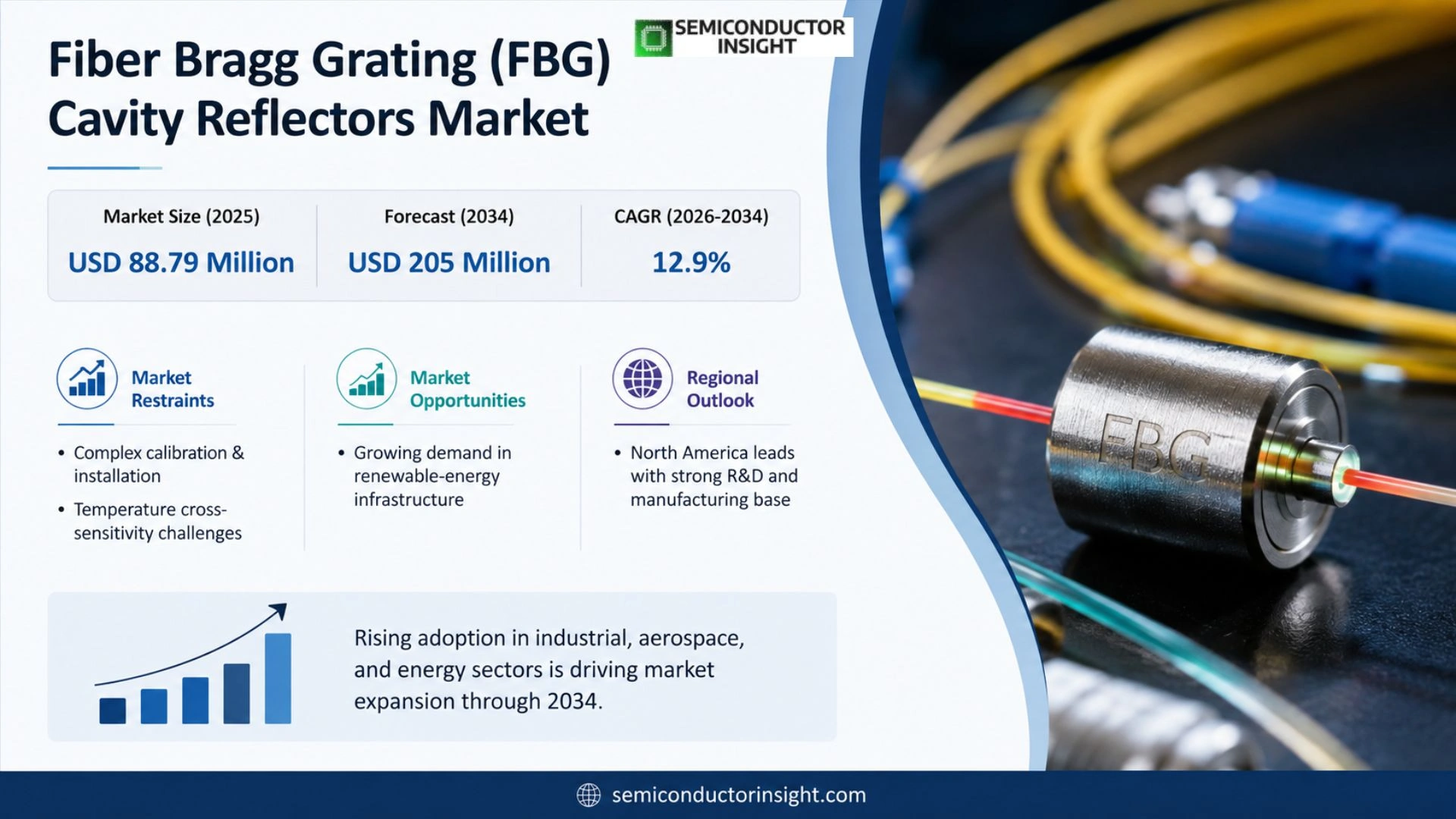
Global Fiber Bragg Grating (FBG) Cavity Reflectors market size was valued at USD 88.79 million in 2025 and is projected to reach USD 205 million by 2034, exhibiting a CAGR of 12.9% during the forecast period.
FBG cavity reflectors are narrow‑band reflective components created by inscribing Bragg gratings directly into single‑mode, double‑clad or specialty fibers. They are typically supplied as matched pairs,a high reflector (HR) and an output coupler (OC),and serve as the core passive element in all‑fiber laser resonators. By eliminating free‑space mirrors, these devices address alignment challenges, reduce system footprint and improve vibration resistance while delivering precise wavelength locking, low thermal drift and high power‑handling capability.
The market momentum stems from expanding demand for high‑power continuous‑wave and pulsed fiber lasers in industrial processing, rising adoption of MOPA architectures, and growing interest in medical and specialty light sources operating at 1 µm, 1.5 µm and 2 µm bands. Suppliers increasingly offer customized HR/OC pairs compatible with double‑clad or polarization‑maintaining fibers, heat‑dissipative packaging and multi‑kilowatt power ratings, driving premiumization and higher per‑unit values across the supply chain.
MARKET DRIVERS
Rising Demand for High‑Precision Sensing Solutions
The surge in safety‑critical applications,particularly in aerospace, oil & gas, and rail transportation,requires sensors that can deliver sub‑nanometer resolution over long distances. Fiber Bragg Grating (FBG) Cavity Reflectors meet this requirement by offering stable wavelength references that are immune to electromagnetic interference, thereby attracting system integrators who value reliability over cost‑driven alternatives.
Integration with Emerging Photonic Platforms
Silicon photonics and integrated‑laser modules are moving from laboratory prototypes to mass‑produced components. The compatibility of cavity reflectors with these platforms enables designers to shrink footprint while preserving signal integrity, a combination that fuels adoption in next‑generation LiDAR and distributed‑temperature‑monitoring networks.
➤ “The convergence of miniaturized photonic chips and the intrinsic stability of FBG cavity reflectors creates a value chain that is difficult for conventional bulk optics to replicate.”
Adoption is further reinforced by government‑backed research programs that subsidize pilot deployments in smart‑grid infrastructure, compelling vendors to prioritize cavity‑reflector technology in their product roadmaps.
MARKET CHALLENGES
Cost Pressures from Low‑Margin End‑Markets
While high‑end sectors are willing to pay a premium for performance, commodity‑driven segments such as building‑automation systems demand low‑cost alternatives. This mismatch forces manufacturers to balance bill‑of‑materials expenses against margin expectations, often leading to constrained R&D budgets for incremental improvements.
Other Challenges
Supply‑Chain Volatility
Fluctuations in specialty glass fiber availability and the limited number of suppliers capable of producing uniform grating periods inject uncertainty into production schedules, delaying time‑to‑market for new designs.
MARKET RESTRAINTS
Complexity of Calibration and Installation
Installing cavity reflectors in field environments often demands specialized alignment tools and skilled technicians. The learning curve discourages smaller system integrators, limiting market penetration to firms that already possess in‑house expertise.
Furthermore, temperature cross‑sensitivity remains a technical hurdle; without adequate compensation algorithms, measurement drift can erode confidence in long‑term deployments, prompting end users to opt for more familiar, albeit less precise, sensing technologies.
MARKET OPPORTUNITIES
Expansion into Renewable‑Energy Infrastructure
The growing portfolio of offshore wind farms and solar‑field monitoring projects calls for robust, low‑maintenance sensing networks. Fiber Bragg Grating (FBG) Cavity Reflectors can withstand harsh marine climates while delivering accurate strain and temperature data, positioning them as a preferred choice for asset‑management platforms seeking predictive‑maintenance capabilities.
Simultaneously, the advent of edge‑computing analytics creates a demand for real‑time, high‑resolution data streams. Vendors that bundle cavity reflectors with integrated data‑processing modules stand to capture a sizeable share of the emerging smart‑infrastructure market.
Fiber Bragg Grating (FBG) Cavity Reflectors Market Trends
Escalating Demand from High‑Power Industrial Lasers
Fiber Bragg Grating (FBG) Cavity Reflectors Market recorded a valuation of approximately $88.8 million in 2025. Industry forecasts indicate a rise to roughly $205 million by 2034, translating into an average annual growth rate near 12.9 percent. This upward trajectory is anchored in the expanding requirement for stable, high‑power continuous‑wave and pulsed fiber laser systems operating around the 1 µm band. Manufacturers of industrial processing equipment increasingly select all‑fiber resonators because they eliminate free‑space alignment challenges and deliver superior vibration resistance. Consequently, OEMs are willing to allocate a larger portion of system budgets to customized reflector pairs that guarantee tight wavelength matching and low thermal drift, reinforcing the market’s revenue expansion.
Other Trends
Broadening Wavelength Portfolio and Specialty‑Fiber Compatibility
A noticeable shift is occurring toward 1.5 µm and 2 µm product families, driven by medical‑laser manufacturers and emerging specialty‑light sources. Providers are adapting inscription processes to accommodate double‑clad and polarization‑maintaining fibers, while also offering heat‑dissipative packaging capable of handling multi‑kilowatt power levels. This diversification reduces reliance on a single wavelength band and opens new revenue streams, prompting suppliers to develop modular designs that can be quickly re‑engineered for distinct applications. Such flexibility elevates the per‑unit value of each reflector set, as customers pay premiums for bespoke thermal management and extended lifetime specifications.
Geographic Concentration and Competitive Barriers
The competitive landscape remains tightly clustered in North America, Western Europe, Japan, and China, where a handful of firms possess the combined expertise in grating inscription, batch consistency, and high‑power packaging. Because qualifying a supplier involves extensive reliability testing and system‑level integration, entry barriers stay high, limiting new entrants. This environment rewards incumbents that can sustain rigorous quality controls and offer joint development programs. For downstream laser manufacturers, the strategic implication is clear: securing a long‑term partnership with a proven reflector supplier mitigates supply‑chain risk and contributes to overall system cost‑of‑ownership reduction, a factor that increasingly influences purchasing decisions across the global Fiber Bragg Grating (FBG) Cavity Reflectors Market.
COMPETITIVE LANDSCAPE
Key Industry Players
Fiber Bragg Grating (FBG) Cavity Reflectors Market Overview
ITF Technologies leads the global arena, leveraging a vertically integrated production line that couples high‑precision UV‑laser inscription with advanced thermal‑management packaging. This capability allows the company to supply matched‑pair reflectors for multi‑kilowatt all‑fiber lasers, a segment where tolerances on wavelength drift and reflectivity balance are unforgiving. By offering both catalog items and co‑development programs, ITF has entrenched itself as the preferred supplier for major OEMs in the industrial CW high‑power and pulsed laser markets. The firm’s extensive footprint across North America and Europe also grants it proximity to key system integrators, reinforcing a supply chain that values reliability over price alone.
Beyond the market leader, a cohort of specialized firms fuels innovation in niche corridors. Indie Semiconductor, Inc. and Exail focus on polarization‑maintaining fiber solutions, catering to medical‑laser manufacturers that demand tight bandwidth control. Lightel Corporation and Raysung Photonics, Inc. have built reputations around customized recoated packages for the 1.5 µm and 2 µm bands, expanding the addressable market into specialty light sources. Asian players such as Yangtze Optical Fibre and Cable Joint Stock Limited Company, Connet Laser Technology Co., Ltd., and GKER Photonics Co., Ltd. provide cost‑effective volume production while gradually moving up the value chain through joint R&D with European laser system builders. These firms collectively create a competitive ecosystem where technical depth, geographic reach, and the ability to tailor packages to end‑user specifications dictate market share.
List of Key Fiber Bragg Grating (FBG) Cavity Reflectors Companies Profiled
- ITF Technologies
- Indie Semiconductor, Inc.
- Exail
- TATSUTA Electric Wire & Cable Co., Ltd.
- Lightel Corporation
- Yangtze Optical Fibre and Cable Joint Stock Limited Company
- Raysung Photonics, Inc.
- AtGrating Technologies
- Connet Laser Technology Co., Ltd.
- GKER Photonics Co., Ltd.
- NKT Photonics
- Finisar (Photonics Group)
- Hüls Photonics
- Furukawa Electric Co., Ltd.
Segment Analysis:
| Segment Category | Sub-Segments | Key Insights |
| By Type |
|
High‑Reflector (HR) Gratings
|
| By Application |
|
Industrial Continuous‑Wave High‑Power Lasers
|
| By End User |
|
Fiber Laser OEMs
|
| By Wavelength Band |
|
1.0 µm Band
|
| By Packaging & Power Handling |
|
Heat‑Dissipative Enclosures
|
Regional Analysis: Fiber Bragg Grating (FBG) Cavity Reflectors Market
North America
The sector’s shift toward predictive maintenance amplifies the need for resilient wavelength references. Cavity reflectors, with their narrow linewidths, enable high‑resolution strain sensing on robotic arms and conveyor systems, reducing unplanned downtime and supporting lean manufacturing initiatives across the Midwest.
Carrier upgrades to 400G and beyond create pressure for stable, low‑loss optical filters. Cavity‑based FBG devices fulfill this role, offering temperature‑insensitive performance that aligns with the aggressive latency targets of data‑center interconnects along the West Coast corridors.
High‑altitude testing demands reflectors that resist vibration and thermal shock. Defense programs in the United States prioritize cavity designs that maintain spectral integrity under extreme conditions, reinforcing supplier relationships with niche defense primes.
Emerging optical biopsy tools and non‑invasive glucose monitors rely on ultra‑stable wavelength references. Cavity reflectors enable clinicians to achieve repeatable measurements, a prerequisite for regulatory approval and broader hospital adoption in the Northeast corridor.
Europe
European manufacturers are capitalising on the region’s strong standards ecosystem, where stringent optical‑component certifications drive adoption of cavity‑based reflectors. Countries such as Germany and the United Kingdom blend legacy photonic foundries with cutting‑edge university research, fostering collaborations that translate into bespoke solutions for high‑speed rail signaling and offshore wind monitoring. The regulatory climate, particularly the EU’s focus on sustainability, encourages suppliers to demonstrate low‑power, long‑life components, positioning Fiber Bragg Grating (FBG) Cavity Reflectors Market for steady growth in the continent’s diversified industrial base.
Asia‑Pacific
Asia‑Pacific’s rapid urbanisation and aggressive broadband expansion generate a fertile backdrop for cavity reflector usage. China’s investment in smart‑city initiatives and Japan’s emphasis on high‑precision manufacturing accelerate demand for wavelength‑stable sensors. Meanwhile, India’s emerging telecom sector is beginning to source advanced optical components, creating a nascent but fast‑moving market segment. The region’s cost‑competitive production capabilities, combined with a surge in local R&D, are reshaping supply dynamics and presenting opportunities for global vendors willing to navigate diverse regulatory landscapes.
South America
In South America, Brazil and Chile lead the modest yet evolving adoption of fiber‑optic sensing. Infrastructure upgrades in mining and agritech sectors require robust, temperature‑tolerant reflectors, prompting local distributors to partner with North American firms for technology transfer. Limited domestic manufacturing means the market leans heavily on imports, but government incentives for digital transformation are encouraging investments that could broaden the application base over the next decade.
Middle East & Africa
The Middle East’s focus on oil‑field monitoring and renewable‑energy projects fuels a niche demand for high‑reliability optical sensors. Nations such as the UAE and Saudi Arabia are establishing photonics research hubs, inviting collaborations that integrate cavity reflectors into smart‑grid and desert‑environment monitoring solutions. In Africa, South Africa’s telecommunications upgrades introduce modest demand, but the overall market remains early‑stage, hinging on broader connectivity initiatives and capacity‑building efforts.
Report Scope
This market research report provides a comprehensive analysis of the Fiber Bragg Grating (FBG) Cavity Reflectors Market , covering the forecast period 2026–2034. It offers detailed insights into market dynamics, technological advancements, competitive landscape, and key trends shaping the industry.
Key focus areas of the report include:
- Market Overview: The report begins with an overview outlining its current market scenario, key growth indicators, and industry transformation drivers. It discusses macroeconomic factors, demand–supply balance, regulatory landscape, and the strategic role of semiconductors in powering advancements across industries such as automotive, telecommunications, consumer electronics, and industrial automation.
- Market Size & Forecast: Historical data and future projections for revenue, unit shipments, and market value across major regions and segments.
- Segmentation Analysis: Detailed breakdown by product type, technology, application, and end-user industry to identify high-growth segments and investment opportunities.
- Regional Insights: Insights into market performance across North America, Europe, Asia-Pacific, Latin America, and the Middle East & Africa, including country-level analysis where relevant.
- Competitive Landscape: Profiles of leading market participants, including their product offerings, R&D focus, manufacturing capacity, pricing strategies, and recent developments such as mergers, acquisitions, and partnerships.
- Technology Trends & Innovation: Assessment of emerging technologies, integration of AI/IoT, semiconductor design trends, fabrication techniques, and evolving industry standards.
- Market Drivers & Restraints: Evaluation of factors driving market growth along with challenges, supply chain constraints, regulatory issues, and market-entry barriers.
- Stakeholder Insights: Insights for component suppliers, OEMs, system integrators, investors, and policymakers regarding the evolving ecosystem and strategic opportunities.
Primary and secondary research methods are employed, including interviews with industry experts, data from verified sources, and real-time market intelligence to ensure the accuracy and reliability of the insights presented.
FREQUENTLY ASKED QUESTIONS:
What is the current market size of Fiber Bragg Grating (FBG) Cavity Reflectors Market?
-> Fiber Bragg Grating (FBG) Cavity Reflectors market is projected to reach USD 205 million by 2034, exhibiting a CAGR of 12.9% during the forecast period.
Which key companies operate in Fiber Bragg Grating (FBG) Cavity Reflectors Market?
-> Key players include ITF Technologies, indie Semiconductor, Inc., Exail, TATSUTA Electric Wire & Cable Co., Ltd., Lightel Corporation, Yangtze Optical Fibre and Cable Joint Stock Limited Company, Raysung Photonics, Inc., AtGrating Technologies, Connet Laser Technology Co., Ltd., and GKER Photonics Co., Ltd.
What are the key growth drivers?
-> Key growth drivers include rising demand for high‑power continuous‑wave and pulsed fiber lasers in industrial processing, expanding medical laser applications, need for higher power‑handling capability and wavelength stability, development of 1.5 µm and 2 µm product lines, and the push toward multi‑kilowatt systems with high‑reliability packaging.
Which region dominates the market?
-> North America currently holds the largest market share, while Europe and Asia‑Pacific (particularly China and Japan) are fast‑growing regions driven by strong fiber‑laser manufacturing ecosystems.
What are the emerging trends?
-> Emerging trends include development of 2 kW‑3 kW and higher power FBG cavity reflectors, expansion into 1.5 µm and 2 µm wavelength bands, customized co‑development for specialty fibers, premiumization of high‑reliability packaged solutions, and increased emphasis on thermal‑management designs for multi‑kilowatt laser systems.

Get Sample Report PDF for Exclusive Insights
Report Sample Includes
- Table of Contents
- List of Tables & Figures
- Charts, Research Methodology, and more...
 Download Sample Report PDF