Receiver Optical Sub Assembly (ROSA) Market Insights
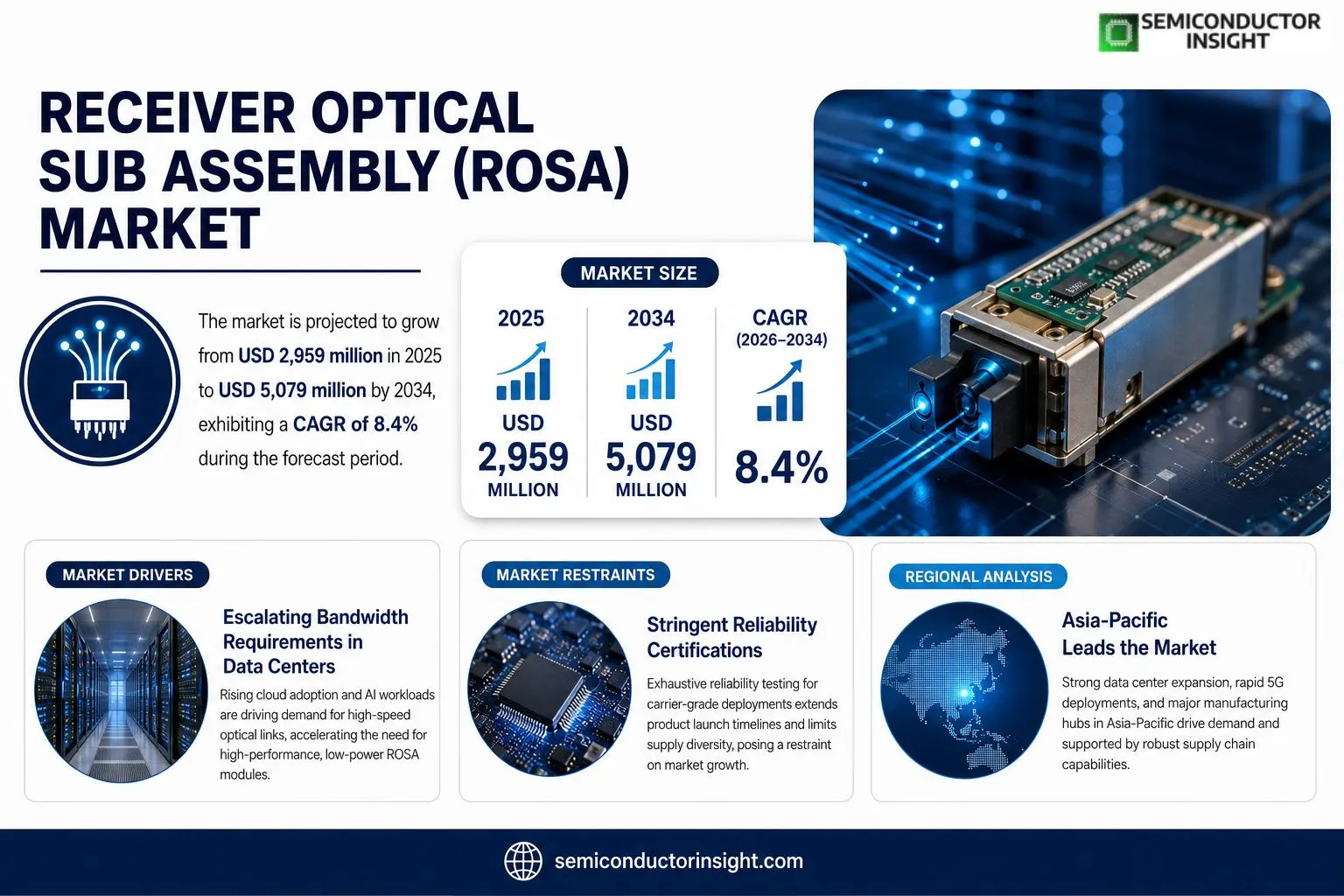
Receiver Optical Sub Assembly (ROSA) market size was valued at USD 2959 million in 2025. The market is projected to grow from USD 2959 million in 2025 to USD 5079 million by 2034, exhibiting a CAGR of 8.4% during the forecast period.
The Optical Receiver Subassembly (ROSA) functions as the front‑end converter in optical communication links, turning light pulses carried by fiber into electrical signals. It typically integrates a photodiode paired with a transimpedance amplifier, delivering high sensitivity and bandwidth essential for modern optical modules.The expansion is fueled by surging data‑center traffic, accelerated deployment of 5G back‑haul networks, and advances in silicon‑photonic integration that enable multi‑channel arrays. Downstream demand from cloud service providers and telecom operators pushes manufacturers toward higher‑speed (>400 Gb/s), lower‑power designs while emphasizing supply‑chain stability.
MARKET DRIVERS
Escalating Bandwidth Requirements in Data Centers
The surge in cloud‑based services and hyperscale computing forces operators to upgrade interconnects to cope with multi‑terabit traffic. Receiver Optical Sub Assembly (ROSA) Market suppliers that can deliver low‑loss, high‑density modules are seeing immediate uptake, because every extra gigabit per second translates into revenue for the host facilities. This pressure creates a clear incentive for manufacturers to push integration levels and shrink form factors.
Shift Toward Disaggregated Telecom Architectures
Telecom operators are moving away from monolithic optical gear toward modular, plug‑and‑play components that simplify network upgrades. In such architectures, ROSA units serve as the critical interface between transceivers and fiber distribution panels, enabling rapid re‑configuration of wavelengths without major overhauls. The flexibility demanded by 5G roll‑outs and edge‑computing nodes fuels this trend.
➤ Customers now prioritize optical assemblies that combine low insertion loss with robust mechanical tolerance, because deployment cycles have compressed from months to weeks.
Beyond pure performance, cost efficiency drives procurement decisions. Vendors that leverage standardized silicon photonics platforms can amortize design expenses across multiple product lines, passing savings to end‑users. This economic rationale reinforces the upward momentum of the ROSA market.
MARKET CHALLENGES
Complexity of Multi‑Standard Integration
Network operators often require ROSA solutions that support a mix of ITU‑T, OIF, and proprietary standards within a single chassis. Engineering teams must reconcile divergent wavelength grids, power budgets, and connector types, which inflates development timelines and raises the risk of cross‑compatibility issues.
Other Challenges
Supply‑Chain Volatility
The semiconductor and passive‑optics supply chains experience periodic shortages, especially for high‑purity glass and precision‑polished fibers. When component lead times extend, system integrators face project delays and may be forced to source from higher‑cost, less‑qualified vendors.
MARKET RESTRAINTS
Stringent Reliability Certifications
ROSA units destined for submarine or carrier‑grade deployments must pass exhaustive reliability testing, including temperature‑cycling and vibration endurance. The certification process can add six to twelve months to product launch schedules, discouraging smaller players from entering the market and limiting overall supply diversity.
MARKET OPPORTUNITIES
Emergence of Integrated Photonic Platforms
Advances in silicon‑photonic foundries enable ROSA manufacturers to embed lasers, modulators, and detectors directly onto a single chip. This integration slashes assembly steps, reduces footprint, and opens new pricing tiers for metro‑edge deployments. Companies that master this technology stand to capture a sizable share of the upcoming demand wave.Verticals such as autonomous‑vehicle back‑haul and high‑frequency trading are beginning to explore dedicated optical links for deterministic latency. Tailoring ROSA designs to these niche requirementsultra‑low jitter and deterministic temperature managementpresents a lucrative, less‑crowded market segment.Finally, the growing emphasis on sustainability in network design encourages the adoption of environmentally‑qualified optical components. ROSA suppliers that can certify RoHS compliance and offer recyclable packaging will align with operator ESG goals, creating an additional lever for market differentiation.
Receiver Optical Sub Assembly (ROSA) Market Trends
Escalating Bandwidth Demands in Data Centers
The proliferation of cloud services, AI workloads, and real‑time analytics has forced data‑center operators to replace legacy 100 Gb/s links with 400 Gb/s and higher solutions. Each step up in line rate pushes the optical receiver to deliver wider electrical bandwidth while keeping power draw below a few milliwatts per channel. As a result, designers of Receiver Optical Sub Assembly (ROSA) are incorporating larger photodiode arrays and more sophisticated transimpedance amplifiers to meet the throughput ceiling. This shift is not merely technical; it reshapes procurement strategies, because customers now favour suppliers that can guarantee a stable supply of high‑performance chips and modular packaging that fits the tighter form factors of modern optical modules. The net effect is a tangible acceleration in unit shipments and a reallocation of R&D budgets toward integration rather than incremental speed tweaks.
Other Trends
Integration of Silicon Photonics
Silicon photonics has moved from prototype to volume production, offering a monolithic platform where the photodiode, waveguide coupler, and transimpedance amplifier coexist on a single die. This architecture slashes interconnect parasitics, improves thermal uniformity, and lowers the bill of materials by consolidating components that previously required separate packages. Manufacturers that master silicon‑on‑insulator processes can produce multi‑channel ROSA variants at scale, driving down per‑unit cost and enabling higher yield in automated test. For downstream optical module makers, the promise of a consistent silicon substrate translates into a more predictable supply chain, which is crucial when building large‑scale data‑center fabrics that cannot tolerate component shortages.
Supply Chain Consolidation and Margin Management
Competitive pressure is nudging the industry toward a modest concentration of players that own both chip‑design IP and advanced packaging lines. Companies that combine photodiode fabrication with TIA expertise achieve gross margins in the high‑30 % range, while pure‑play assemblers see tighter spreads. This disparity incentivizes vertical integration, especially as end‑users demand tighter specification control and lower variability across large production runs. The resulting entry barrierrequiring deep expertise in semiconductor processing and precision opticsfilters out smaller entrants, reshaping the competitive landscape. For investors, the trend signals a market where profitability hinges on scale, technology ownership, and the ability to adapt quickly to evolving bandwidth requirements.
COMPETITIVE LANDSCAPE
Key Industry Players
Receiver Optical Sub Assembly (ROSA) Market Competitive Overview
The ROSA segment is increasingly dominated by a handful of vertically integrated firms that combine silicon‑photonic ASIC design with advanced TIA packaging. Lumentum Holdings and Broadcom (Avago) command the largest share of shipments, leveraging deep semiconductor expertise and proprietary coupling technologies to satisfy the high‑volume demands of data‑center module assemblers. Their ability to secure long‑term wafer supply, run high‑mix low‑volume pilot lines, and guarantee tighter power‑budget envelopes has turned them into preferred sources for 400‑G and beyond optical modules. The concentration around these two players has forced smaller suppliers to specialize either in niche speed grades or in region‑specific packaging services, reinforcing a tiered supply‑chain where design leadership and economies of scale are the primary differentiators.Beyond the top tier, a diverse cluster of niche innovators sustains the market’s breadth. Companies such as Coherent, Semtech, and NTT Electronics excel in bespoke photodiode architectures that address emerging APD‑TIA requirements for metro‑edge deployments. Mitsubishi Electric and Sumitomo Electric contribute high‑reliability packaging platforms tailored to telecom backbone applications, while II‑VI Incorporated and NeoPhotonics (Cohere) focus on multi‑channel array integration that lowers per‑bit cost for hyperscale operators. Intel’s silicon‑photonic roadmap and ZTE’s in‑house module line add further competitive pressure, especially in the 5G transport arena, by offering integrated photonic‑electronic solutions that compress form factor and power consumption.
List of Key Receiver Optical Sub Assembly Companies Profiled
- Lumentum Holdings Inc.
- Broadcom Inc. (Avago)
- Coherent Inc.
- Semtech Corporation
- NTT Electronics Corporation
- Mitsubishi Electric Corp.
- Sumitomo Electric Industries, Ltd.
- II‑VI Incorporated
- Intel Corporation
- NeoPhotonics (Cohere Technologies)
- ZTE Corporation
- Vitec LLC
Segment Analysis:
| Segment Category | Sub-Segments | Key Insights |
| By Type |
|
PIN‑TIA ROSA
|
| By Application |
|
Data center optical modules
|
| By End User |
|
Cloud service providers
|
| By Speed |
|
100 Gbps and above
|
| By Detector |
|
APD photodiodes
|
Regional Analysis: Receiver Optical Sub Assembly (ROSA) Market
North America
In recent years, a handful of North American firms have absorbed smaller niche players, streamlining component sourcing for ROSA assemblies. This consolidation reduces lead times and improves pricing predictability, allowing network operators to schedule rollouts with greater confidence.
Industry consortia are converging around a limited set of mechanical and optical interfaces, which simplifies integration for OEMs. The resulting interoperability lowers engineering overhead and speeds up deployment of heterogeneous network equipment.
Universities and research labs in the region generate a steady pipeline of photonics experts. Their proximity to major silicon‑photonic fabs fuels rapid prototyping of next‑gen ROSA designs that push bandwidth limits while keeping footprints minimal.
Federal programs that subsidize fiber‑to‑the‑home projects indirectly elevate ROSA demand, as service providers seek cost‑effective ways to extend reach without overhauling existing infrastructure.
Europe
European operators are concentrating on cross‑border fiber initiatives that require consistent ROSA performance across diverse regulatory regimes. Countries such as Germany and the United Kingdom prioritize modularity, prompting suppliers to offer interchangeable sub‑assemblies that can be re‑qualified quickly. Sustainability mandates drive a shift toward recyclable housing materials, influencing design choices at the component level. Meanwhile, the rise of private‑capex data‑center corridors in the Nordics creates pockets of high‑density demand, encouraging manufacturers to tailor ROSA specifications for low‑temperature environments.
Asia‑Pacific
The Asia‑Pacific corridor blends rapid urbanization with legacy network retrofits, generating a unique demand profile for Receiver Optical Sub Assembly (ROSA) solutions. In markets like India and Indonesia, operators favor ruggedized modules that tolerate harsher climate conditions, whereas Japan’s mature metro networks seek ultra‑low‑latency parts for high‑frequency trading applications. Competitive pricing pressures push local assemblers to optimize packaging efficiency, often leveraging vertical integration with silicon photonics foundries. Government‑led broadband expansion schemes further stimulate interest in compact ROSA units that can be deployed in constrained conduit spaces.
South America
South American telecom carriers are navigating a dual challenge: extending fiber into underserved regions while modernizing backbone links in major metros. The strategic emphasis on cost‑controlled expansion leads to a preference for off‑the‑shelf ROSA kits that require minimal customization. Brazil’s emerging 5G backhaul deployments have highlighted the need for high‑precision alignment tools, nudging suppliers to provide comprehensive integration support. Economic volatility also encourages operators to adopt modular architectures, allowing incremental upgrades without wholesale equipment replacement.
Middle East & Africa
In the Middle East, large‑scale sovereign projects drive demand for high‑capacity ROSA components that can support sprawling smart‑city infrastructures. Operators in the Gulf Cooperation Council nations value thermal resilience, prompting manufacturers to reinforce heat‑dissipation features within the sub‑assembly. Across Africa, the focus shifts to affordable, rugged ROSA units that can survive power‑fluctuation scenarios common in remote installations. Partnerships between multinational vendors and regional integrators are fostering knowledge transfer, gradually elevating local design capabilities and reducing reliance on imported kits.
Report Scope
This market research report provides a comprehensive analysis of the Receiver Optical Sub Assembly (ROSA) Market , covering the forecast period 2026–2034. It offers detailed insights into market dynamics, technological advancements, competitive landscape, and key trends shaping the industry.
Key focus areas of the report include:
- Market Overview: The report begins with an overview outlining its current market scenario, key growth indicators, and industry transformation drivers. It discusses macroeconomic factors, demand–supply balance, regulatory landscape, and the strategic role of semiconductors in powering advancements across industries such as automotive, telecommunications, consumer electronics, and industrial automation.
- Market Size & Forecast: Historical data and future projections for revenue, unit shipments, and market value across major regions and segments.
- Segmentation Analysis: Detailed breakdown by product type, technology, application, and end-user industry to identify high-growth segments and investment opportunities.
- Regional Insights: Insights into market performance across North America, Europe, Asia-Pacific, Latin America, and the Middle East & Africa, including country-level analysis where relevant.
- Competitive Landscape: Profiles of leading market participants, including their product offerings, R&D focus, manufacturing capacity, pricing strategies, and recent developments such as mergers, acquisitions, and partnerships.
- Technology Trends & Innovation: Assessment of emerging technologies, integration of AI/IoT, semiconductor design trends, fabrication techniques, and evolving industry standards.
- Market Drivers & Restraints: Evaluation of factors driving market growth along with challenges, supply chain constraints, regulatory issues, and market-entry barriers.
- Stakeholder Insights: Insights for component suppliers, OEMs, system integrators, investors, and policymakers regarding the evolving ecosystem and strategic opportunities.
Primary and secondary research methods are employed, including interviews with industry experts, data from verified sources, and real-time market intelligence to ensure the accuracy and reliability of the insights presented.
FREQUENTLY ASKED QUESTIONS:
What is the current market size of Receiver Optical Sub Assembly (ROSA) Market?
-> Receiver Optical Sub Assembly (ROSA) Market was valued at USD 2,959 million in 2025 and is expected to reach USD 5,079 million by 2034, growing at a CAGR of 8.4% during the forecast period.
Which key companies operate in Receiver Optical Sub Assembly (ROSA) Market?
-> Key players include Coherent, Semtech, Liverage, Henkel, Wooriro, NTT Electronics Corporation, Mitsubishi Electric, SUMITOMO ELECTRIC, Lumentum, Vitex LLC, EZconn GmbH, Huber+Suhner, COTSWORKS, Broadcom (Avago), Zhongji Innolight, Eoptolink, Wuhan Siyou Photoelectric Technology, Broadex Technology.
What are the key growth drivers?
-> Key growth drivers include explosive data center traffic, rollout of 5G and next‑generation networks, demand for higher bandwidth, lower power consumption, silicon photonics integration, and policy support for digital economy and communication infrastructure upgrades.
Which region dominates the market?
-> Asia-Pacific leads the market due to strong data‑center expansion, rapid 5G deployments, and major manufacturing bases in China, Japan, and South Korea.
What are the emerging trends?
-> Emerging trends include silicon photonics integration, multi‑channel parallel reception, array‑based ROSA architectures, and increasing focus on integrating high‑speed, low‑power modules for AI‑driven workloads.
Get Sample Report PDF for Exclusive Insights
Report Sample Includes
- Table of Contents
- List of Tables & Figures
- Charts, Research Methodology, and more...
 Download Sample Report PDF