MARKET INSIGHTS
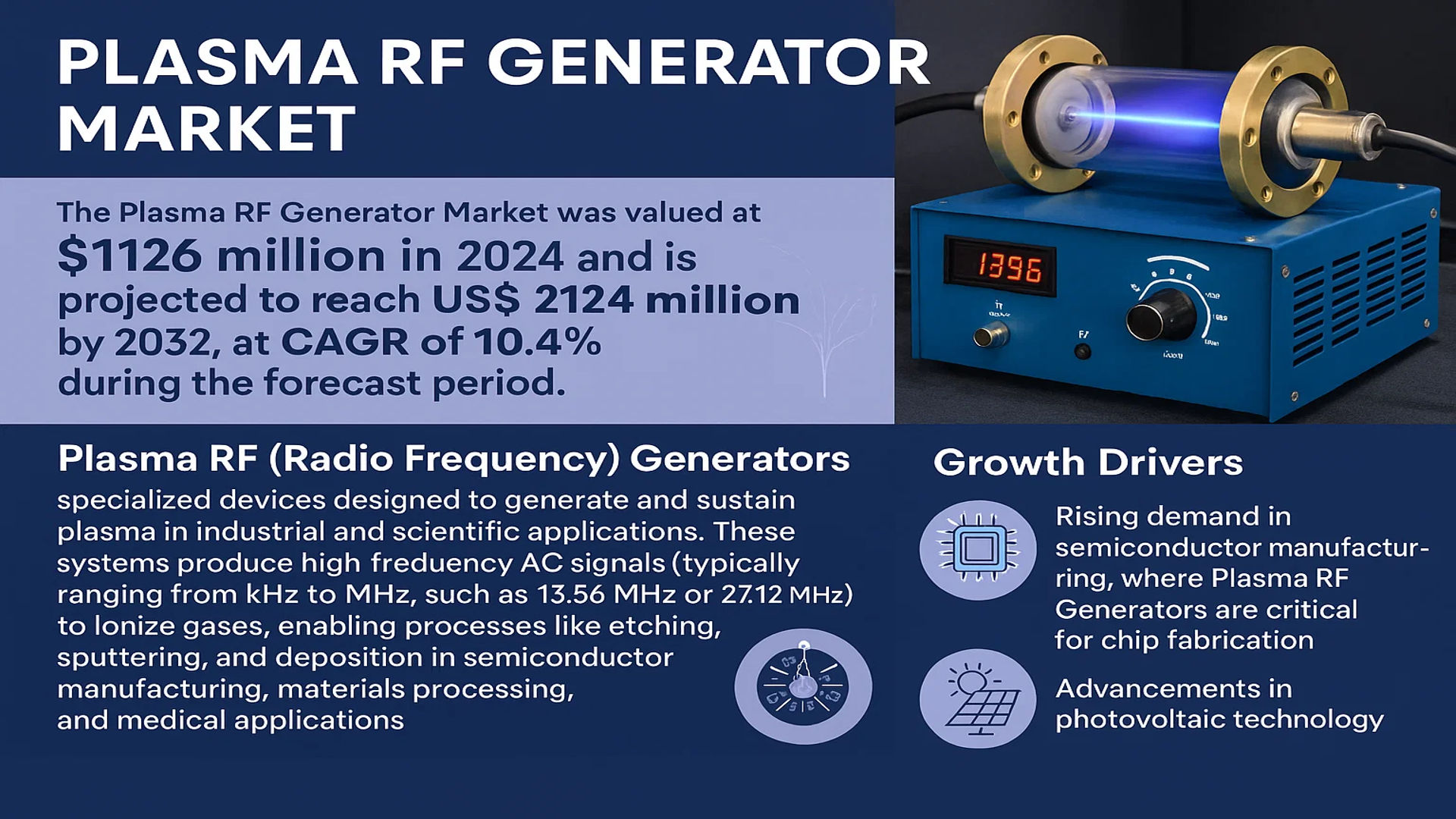
The global Plasma RF Generator Market was valued at 1126 million in 2024 and is projected to reach US$ 2124 million by 2032, at a CAGR of 10.4% during the forecast period.
Plasma RF (Radio Frequency) Generators are specialized devices designed to generate and sustain plasma in industrial and scientific applications. These systems produce high-frequency AC signals (typically ranging from kHz to MHz, such as 13.56 MHz or 27.12 MHz) to ionize gases, enabling processes like etching, sputtering, and deposition in semiconductor manufacturing, materials processing, and medical applications.
The market is experiencing significant growth due to rising demand in semiconductor manufacturing, where Plasma RF Generators are critical for chip fabrication. Furthermore, advancements in photovoltaic technology and increasing adoption in medical device sterilization are contributing to market expansion. Key players such as Advanced Energy, MKS Instruments, and Comet Group dominate the market, collectively holding a significant revenue share. For instance, in early 2024, MKS Instruments expanded its RF power portfolio with a new high-efficiency generator for advanced semiconductor applications.
MARKET DYNAMICS
MARKET DRIVERS
Growing Semiconductor Industry to Propel Plasma RF Generator Demand
The global semiconductor industry, valued at over $600 billion, continues to expand rapidly due to increasing adoption of electronics, IoT devices, and AI technologies. Plasma RF generators play a critical role in semiconductor manufacturing processes such as plasma etching and thin film deposition. As chip manufacturers ramp up production to meet demand, investments in advanced fabrication equipment incorporating plasma technology have surged by nearly 18% annually. Major semiconductor foundries are expanding capacity, with over 50 new fabrication plants projected to begin operation worldwide by 2025, creating substantial demand for high-performance RF plasma systems.
Advances in Medical Plasma Applications Driving Market Growth
Medical applications of plasma technology are experiencing rapid adoption, with the global medical plasma market projected to exceed $2.5 billion by 2027. RF plasma generators enable innovative treatments including wound healing, cancer therapy, and sterilization processes. Recent developments in cold atmospheric plasma (CAP) systems, which utilize precisely controlled RF generators, have shown remarkable efficacy in antimicrobial applications with over 99.9% pathogen elimination rates. This expanding therapeutic potential, combined with growing healthcare expenditures in developed nations, is significantly boosting demand for medical-grade plasma RF systems.
Furthermore, government initiatives supporting advanced medical technologies and increased R&D investment by major healthcare companies are accelerating market adoption. The FDA has cleared multiple plasma-based medical devices in recent years, validating the technology’s clinical potential.
Renewable Energy Sector Creates New Growth Opportunities
The photovoltaic industry’s expansion is driving demand for plasma RF generators used in solar panel manufacturing. With global solar capacity expected to triple by 2030, manufacturers are investing heavily in plasma-enhanced chemical vapor deposition (PECVD) systems to improve panel efficiency. Advanced RF plasma technologies now enable production of next-generation tandem solar cells with conversion efficiencies exceeding 30%. This technological leap, combined with government renewable energy mandates worldwide, is creating robust demand for high-performance plasma generation systems tailored to photovoltaic applications.
MARKET RESTRAINTS
High Initial Costs and Maintenance Requirements Limit Adoption
Plasma RF generator systems represent significant capital investments, with industrial-scale units often costing over $500,000. The specialized components required for stable high-frequency operation, including precision-matched RF amplifiers and impedance matching networks, contribute to the substantial price point. Additionally, these systems demand regular maintenance by trained technicians, with annual servicing costs averaging 10-15% of the initial purchase price. This financial barrier makes adoption challenging for small and medium enterprises, particularly in developing markets where capital budgets are constrained.
Technical Complexity Creates Operational Challenges
Operating plasma RF generators requires specialized expertise in RF engineering and plasma physics. The systems must maintain precise frequency stability (typically ±0.1% for industrial applications) while compensating for dynamic plasma impedance changes. Many manufacturers report difficulty finding qualified personnel, with the global shortage of plasma processing technicians estimated to exceed 30,000 positions. This skills gap can lead to suboptimal system performance, increased downtime, and in some cases, equipment damage from improper operation – issues that collectively restrain market expansion.
Furthermore, integrating plasma systems with existing production lines presents technical hurdles. The electromagnetic interference generated by high-power RF systems often requires costly shielding solutions and can disrupt sensitive measurement equipment in adjacent processes.
MARKET OPPORTUNITIES
Emerging Applications in Flexible Electronics Manufacturing
The flexible electronics market, projected to reach $87 billion by 2027, presents significant growth opportunities for plasma RF generator manufacturers. Advanced plasma processing enables the deposition and patterning of conductive and dielectric materials on flexible substrates at low temperatures. Recent developments in roll-to-roll plasma systems, combining multiple RF generators for sequential processing, are revolutionizing production of flexible displays, wearable electronics, and printed sensors. Several industry leaders have announced collaborations with display manufacturers to develop specialized plasma systems for next-generation OLED and microLED production lines.
Expansion of Plasma Waste Treatment Technologies
Plasma-assisted waste treatment systems are gaining traction as sustainable alternatives to traditional incineration, with the potential to process hazardous materials while generating syngas for energy recovery. RF plasma torches, offering superior control and efficiency compared to DC systems, are being adopted for medical waste treatment and chemical weapon destruction. Government environmental regulations promoting advanced waste solutions are creating favorable conditions for market expansion, particularly in Europe and North America where over 50 plasma waste projects are currently in development.
Additionally, the growing emphasis on circular economy principles is driving investment in plasma-based material recovery systems capable of separating and purifying components from complex waste streams. This emerging application sector could account for over 15% of the plasma RF generator market by 2030.
MARKET CHALLENGES
Supply Chain Vulnerabilities Impacting Critical Components
The plasma RF generator industry faces ongoing challenges from global supply chain disruptions affecting key components. High-power RF transistors, particularly GaN and LDMOS devices, have experienced lead times exceeding 12 months due to semiconductor shortages. These components, essential for reliable high-frequency operation, account for 40-60% of system production costs. Manufacturers report that supply instability has delayed project timelines and increased component costs by up to 35% over the past two years, creating significant pricing pressure across the market.
Other Challenges
Energy Efficiency Requirements
As energy costs rise globally, industrial users are demanding more efficient plasma systems. Meeting these expectations while maintaining process performance requires substantial R&D investment in advanced power delivery architectures and impedance matching technologies, with development cycles often exceeding 18 months for new product introductions.
Intellectual Property Protection
The competitive landscape has intensified patent disputes over RF plasma innovations, particularly in frequency control algorithms and plasma stability enhancements. Legal costs associated with defending IP rights have become a significant burden for smaller manufacturers, potentially stifling innovation in the sector.
PLASMA RF GENERATOR MARKET TRENDS
Semiconductor Industry Expansion Driving Demand for Plasma RF Generators
The global semiconductor industry’s rapid expansion is significantly boosting the demand for Plasma RF Generators, particularly in fabrication processes such as etching, deposition, and cleaning. The increasing production of advanced semiconductor nodes (5nm and below) requires highly precise plasma technologies, with RF generators playing a pivotal role in maintaining process stability and efficiency. As semiconductor manufacturers continue to invest in next-generation chips for AI, 5G, and IoT applications, the market is projected to grow at a CAGR of 10.4%, reaching $2.12 billion by 2032. The 13.56 MHz segment remains dominant due to its widespread adoption in semiconductor and photovoltaic applications.
Other Trends
Shift Toward High-Precision Medical Applications
The medical sector is increasingly utilizing plasma RF generators in applications such as plasma sterilization and surgical coagulation. With the rise of minimally invasive procedures and advanced surgical techniques, demand for high-frequency RF systems (40 MHz and above) is growing. This trend is further supported by increasing healthcare expenditures, particularly in North America and Europe, where regulatory approvals for advanced medical devices continue to drive innovation.
Technological Advancements in RF Power Delivery Systems
Recent innovations in solid-state RF technology have led to more efficient, compact, and reliable plasma generators. Manufacturers like Advanced Energy and MKS Instruments are introducing systems with improved impedance matching and adaptive frequency tuning, enabling better plasma process control. Additionally, the integration of IoT and AI-based predictive maintenance in RF power systems is gaining traction, reducing downtime and operational costs in industrial applications. These advancements are particularly crucial for emerging markets in Asia-Pacific, where semiconductor and photovoltaic manufacturing capacities are expanding rapidly.
COMPETITIVE LANDSCAPE
Key Industry Players
Leading Manufacturers Focus on Innovation to Dominate the Plasma RF Generator Market
The global plasma RF generator market features a semi-consolidated competitive landscape, dominated by established players with strong technical expertise in RF power delivery and plasma applications. Advanced Energy and MKS Instruments collectively hold a significant market share, driven by their broad product portfolios spanning multiple frequency ranges (13.56 MHz to 60 MHz) and power outputs tailored for semiconductor and industrial applications.
Comet AG, a Swiss-based technology leader, has strengthened its position through recent innovations in solid-state RF generators, particularly for plasma etching and coating applications. Meanwhile, Japanese firms like DAIHEN Corporation and Pearl Kogyo maintain strong regional dominance in Asia-Pacific, benefiting from local semiconductor manufacturing growth.
The market sees continuous technological evolution with companies investing heavily in R&D to develop more energy-efficient, compact generators. Notably, XP Power launched a new series of 13.56 MHz generators in Q4 2023 featuring enhanced power stability for precision plasma processes, while New Power Plasma expanded its production capacity in South Korea to meet growing demand from display panel manufacturers.
Strategic partnerships are shaping the competitive dynamics, with TruPlasma recently collaborating with a major European research institute to develop next-generation RF plasma sources for medical applications. Additionally, ULVAC‘s acquisition of a smaller RF technology firm in 2023 strengthened its position in the photovoltaic equipment segment.
List of Key Plasma RF Generator Manufacturers
- Advanced Energy Industries, Inc. (U.S.)
- MKS Instruments (U.S.)
- Comet AG (Switzerland)
- DAIHEN Corporation (Japan)
- Pearl Kogyo Co., Ltd. (Japan)
- XP Power (Singapore)
- New Power Plasma (South Korea)
- YOUNGSIN-RF Co., Ltd (South Korea)
- KYOSAN Electric Manufacturing (Japan)
- ULVAC Technologies (Japan)
Segment Analysis:
By Type
13.56 MHz Segment Dominates Owing to High Adoption in Semiconductor and Medical Applications
The market is segmented based on frequency types into:
- 13.56 MHz
- 400 KHz, 2 MHz, and 27.12 MHz
- 40 MHz and 60 MHz
- Others
By Application
Semiconductor Segment Leads with Extensive Use in Thin Film Deposition and Etching Processes
The market is segmented based on application into:
- Semiconductor
- Sub-applications: Etching, Sputtering, Deposition
- Photovoltaic
- Other
- Sub-applications: Medical, Research, Display Manufacturing
By Power Output
Medium Power Segment (1-10 kW) Gains Traction Due to Versatility Across Industries
The market is segmented based on power output into:
- Low Power (Below 1 kW)
- Medium Power (1-10 kW)
- High Power (Above 10 kW)
By End User
Equipment Manufacturers Dominate as Primary Consumers of Plasma RF Generators
The market is segmented based on end users into:
- Semiconductor Equipment Manufacturers
- Medical Device Manufacturers
- Research Laboratories
- Others
- Subtypes: Aerospace, Automotive, Display Panel Makers
Regional Analysis: Plasma RF Generator Market
Asia-Pacific
The Asia-Pacific region dominates the Plasma RF Generator market, driven by China, Japan, and South Korea’s robust semiconductor and electronics manufacturing sectors. China alone accounts for over 35% of global demand, supported by government initiatives like the “Made in China 2025” plan, which prioritizes advanced manufacturing technologies. The 13.56 MHz segment leads in adoption due to its widespread use in semiconductor etching and thin-film deposition. Key players such as Comet, KYOSAN, and DAIHEN Corporation have expanded production facilities in the region to meet escalating demand. While cost competitiveness remains critical, the shift toward next-gen fabrication processes is accelerating investments in high-frequency RF generators.
North America
North America is a innovation hub for Plasma RF Generators, with the U.S. leading due to its semiconductor R&D and medical technology applications. The region’s focus on miniaturization and high-precision manufacturing drives demand for 40 MHz and 60 MHz generators, particularly in MEMS and photovoltaics. Companies like Advanced Energy and MKS Instrument dominate, leveraging partnerships with research institutions. Strict FCC regulations ensure compliance with electromagnetic standards, while defense and aerospace applications further bolster market growth. Canada and Mexico are emerging as secondary markets, benefiting from cross-border semiconductor supply chains.
Europe
Europe’s market thrives on sustainability and precision engineering, with Germany and France at the forefront. The region’s stringent CE and RoHS directives push manufacturers toward energy-efficient RF generators, with the 27.12 MHz frequency seeing high adoption for photovoltaic cell production. ULVAC and Adtec Plasma Technology are key suppliers, supported by EU-funded projects like Horizon Europe for advanced materials research. Challenges include high operational costs, but niche applications in medical device coatings and renewable energy offer growth avenues. Eastern Europe shows potential with increasing FDI in electronics manufacturing.
South America
The market in South America is nascent but growing, led by Brazil’s electronics assembly sector. Limited local production forces reliance on imports, primarily from U.S. and Asian suppliers. The 400 KHz–2 MHz range is popular for cost-sensitive industrial applications like surface treatment. Economic instability and underdeveloped semiconductor infrastructure hinder rapid adoption, though initiatives to modernize manufacturing under the Brazilian Innovation Policy signal long-term promise. Argentina and Chile are piloting small-scale RF plasma applications in materials science.
Middle East & Africa
This region is in early development, with Israel and the UAE leading in research-focused applications, including plasma medicine and nanotechnology. Saudi Arabia’s Vision 2030 aims to diversify into high-tech manufacturing, creating demand for RF generators in pilot semiconductor plants. However, limitedindustrialization and reliance on oil economies slow market penetration. International players like XP Power are exploring partnerships to establish localized service networks. The 13.56 MHz segment remains preferred for its versatility in emerging applications.
Report Scope
This market research report provides a comprehensive analysis of the global Plasma RF Generator market, covering the forecast period 2024–2032. It offers detailed insights into market dynamics, technological advancements, competitive landscape, and key trends shaping the industry.
Key focus areas of the report include:
- Market Size & Forecast: Historical data and future projections for revenue, unit shipments, and market value across major regions and segments. The global market was valued at USD 1,126 million in 2024 and is projected to reach USD 2,124 million by 2032, growing at a CAGR of 10.4%.
- Segmentation Analysis: Detailed breakdown by frequency (13.56 MHz, 400 KHz, 2 MHz, 27.12 MHz, 40 MHz, 60 MHz), application (semiconductor, photovoltaic, others), and end-user industry to identify high-growth segments.
- Regional Outlook: Insights into market performance across North America, Europe, Asia-Pacific, Latin America, and Middle East & Africa. The U.S. and China are key markets, with Asia-Pacific showing significant growth potential.
- Competitive Landscape: Profiles of leading market participants including Comet, Advanced Energy, MKS Instrument, DAIHEN Corporation, and KYOSAN, covering their product portfolios, market shares, and strategic developments.
- Technology Trends & Innovation: Analysis of advancements in plasma generation technologies, integration with Industry 4.0, and emerging applications in semiconductor fabrication and materials processing.
- Market Drivers & Restraints: Evaluation of factors such as semiconductor industry growth, demand for miniaturized electronics, and challenges related to high equipment costs and technical complexities.
- Stakeholder Analysis: Strategic insights for equipment manufacturers, semiconductor fabs, research institutions, and investors regarding market opportunities and competitive positioning.
The research employs both primary and secondary methodologies, including interviews with industry experts and analysis of verified market data, to ensure accuracy and reliability.
FREQUENTLY ASKED QUESTIONS:
What is the current market size of Global Plasma RF Generator Market?
->Plasma RF Generator Market was valued at 1126 million in 2024 and is projected to reach US$ 2124 million by 2032, at a CAGR of 10.4% during the forecast period.
Which key companies operate in Global Plasma RF Generator Market?
-> Key players include Comet, Advanced Energy, MKS Instrument, DAIHEN Corporation, KYOSAN, XP Power, Pearl Kogyo, and New Power Plasma, among others.
What are the key growth drivers?
-> Growth is driven by expansion in semiconductor manufacturing, increasing demand for advanced electronic devices, and technological advancements in plasma processing.
Which region dominates the market?
-> Asia-Pacific leads the market due to concentration of semiconductor fabs, while North America remains strong in technological innovation.
What are the emerging trends?
-> Emerging trends include development of higher frequency generators, integration with smart manufacturing systems, and growing adoption in renewable energy applications.

Get Sample Report PDF for Exclusive Insights
Report Sample Includes
- Table of Contents
- List of Tables & Figures
- Charts, Research Methodology, and more...
 Download Sample Report PDF