Piezoelectric Sensor (PVDF, PZT) for Vibration Market Insights
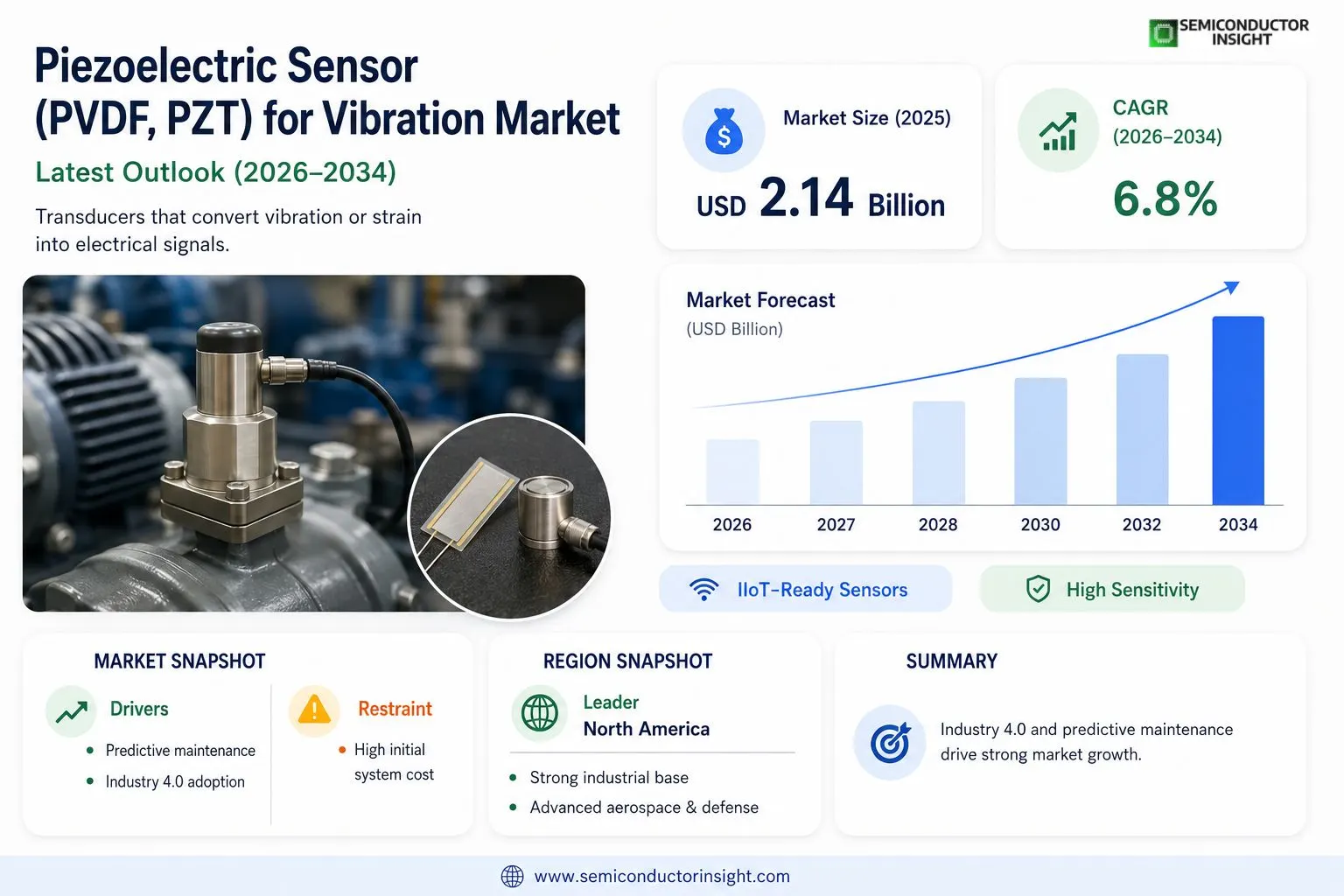
Global Piezoelectric Sensor (PVDF, PZT) for Vibration Market size was valued at USD 2.14 billion in 2025. The market is projected to grow from USD 2.31 billion in 2026 to USD 4.18 billion by 2034, exhibiting a CAGR of 6.8% during the forecast period.
Piezoelectric sensors based on Polyvinylidene Fluoride (PVDF) and Lead Zirconate Titanate (PZT) are advanced transducer devices that convert mechanical vibration, strain, or pressure into measurable electrical signals , and vice versa. PVDF sensors are prized for their flexibility, lightweight construction, and suitability for dynamic strain measurement, while PZT-based sensors offer superior sensitivity and a broader frequency response range, making them ideal for high-precision vibration monitoring across demanding industrial environments. Together, these technologies serve critical functions in condition monitoring, structural health monitoring, and predictive maintenance applications.
The market is witnessing robust expansion driven by the accelerating adoption of Industry 4.0 practices, rising demand for predictive maintenance solutions in manufacturing and energy sectors, and the growing integration of piezoelectric sensors in consumer electronics and automotive systems. Furthermore, increasing investments in aerospace structural monitoring and the proliferation of IoT-enabled sensor networks are amplifying demand considerably. Key industry participants such as TE Connectivity Ltd., PCB Piezotronics (MTS Systems Corporation), Honeywell International Inc., Kistler Group, and Meggitt PLC operate in this market with comprehensive and diversified product portfolios catering to a wide range of vibration sensing applications.
MARKET DRIVERS
Rising Demand for Condition Monitoring and Predictive Maintenance Across Industrial Sectors
The growing emphasis on predictive maintenance and real-time condition monitoring across manufacturing, aerospace, and energy industries has significantly accelerated adoption of Piezoelectric Sensor (PVDF, PZT) for Vibration Market. Industrial operators are increasingly deploying vibration sensing solutions to monitor rotating machinery, detect early-stage mechanical faults, and minimize unplanned downtime. PZT-based piezoelectric sensors are particularly favored in these applications due to their high sensitivity, wide frequency response, and robust performance under harsh operating environments. This shift from reactive to proactive maintenance strategies continues to serve as one of the most compelling market drivers.
Expansion of Industrial IoT and Smart Manufacturing Ecosystems
The rapid proliferation of Industrial Internet of Things (IIoT) platforms has created a strong demand environment for PVDF and PZT piezoelectric vibration sensors. These sensors serve as critical data acquisition nodes within smart factory architectures, enabling continuous vibration monitoring of assets such as compressors, turbines, pumps, and conveyors. The integration of piezoelectric vibration sensors with edge computing and wireless sensor network (WSN) technologies has further enhanced their utility in connected industrial ecosystems. As Industry 4.0 adoption deepens globally, particularly across North America, Europe, and Asia-Pacific, the Piezoelectric Sensor for Vibration Market is positioned to benefit from sustained structural demand.
➤ PVDF-based piezoelectric sensors are increasingly preferred in wearable health monitoring and structural health monitoring (SHM) applications due to their mechanical flexibility, lightweight properties, and biocompatibility , characteristics that PZT ceramics do not readily offer.
Government-backed infrastructure modernization programs and growing investments in smart grid and renewable energy infrastructure are also contributing positively to vibration sensing demand. Wind turbine condition monitoring, for example, relies heavily on piezoelectric vibration sensors to detect rotor imbalances and bearing degradation in real time. Similarly, expanding investments in rail transport and civil structural health monitoring are broadening the end-use base for both PVDF and PZT sensor technologies within the vibration monitoring segment.
MARKET CHALLENGES
Technical Complexity in Signal Conditioning and Integration with Legacy Systems
Despite the clear performance advantages of piezoelectric vibration sensors, their deployment is not without technical barriers. PZT and PVDF sensors generate charge-mode output that requires low-noise charge amplifiers or voltage amplifiers for accurate signal conditioning , a requirement that adds system complexity and cost, particularly in retrofit scenarios involving legacy industrial infrastructure. Ensuring electromagnetic compatibility (EMC) and minimizing signal noise in electrically noisy industrial environments remains a persistent engineering challenge. These technical demands can slow adoption, especially among small and medium enterprises with limited in-house instrumentation expertise.
Other Challenges
Temperature Sensitivity and Material Limitations
Both PVDF and PZT piezoelectric materials exhibit performance degradation under extreme temperature conditions. PZT ceramics are susceptible to depolarization when exposed to temperatures approaching their Curie point, which can compromise long-term sensor reliability in high-temperature industrial applications such as furnace monitoring or engine testing. PVDF, while more flexible, demonstrates reduced piezoelectric coefficients at elevated temperatures. These material-specific constraints necessitate careful sensor selection and application engineering, adding friction to the procurement and deployment process.
Competition from Alternative Vibration Sensing Technologies
Piezoelectric Sensor (PVDF, PZT) for Vibration Market faces competitive pressure from MEMS-based accelerometers and capacitive vibration sensors, which have seen significant cost reductions and performance improvements over recent years. In certain low-frequency and low-amplitude vibration applications, MEMS accelerometers offer a cost-effective alternative that is easier to integrate with standard digital interfaces. Market participants must continuously differentiate piezoelectric solutions on the basis of bandwidth, sensitivity, and durability to retain their competitive positioning.
MARKET RESTRAINTS
High Initial Cost of Precision Piezoelectric Vibration Sensing Systems
One of the primary restraints affecting Piezoelectric Sensor (PVDF, PZT) for Vibration Market is the relatively high upfront cost associated with precision-grade piezoelectric sensing systems. High-performance PZT accelerometers and PVDF vibration sensors designed for aerospace, defense, or precision industrial applications carry significant per-unit costs, particularly when integrated with signal conditioning electronics, enclosures, and calibration services. For cost-sensitive end users in developing economies or price-competitive manufacturing sectors, this cost burden can delay purchasing decisions and extend sales cycles.
Supply Chain Vulnerabilities and Raw Material Sourcing Constraints
The production of PZT piezoelectric ceramics relies on lead zirconate titanate , a lead-containing compound subject to increasing regulatory scrutiny under environmental directives such as the EU’s RoHS (Restriction of Hazardous Substances) framework. While exemptions currently exist for certain industrial and scientific applications, the long-term regulatory trajectory toward lead-free piezoelectric materials introduces uncertainty for manufacturers and end users alike. The development of lead-free alternatives, including potassium sodium niobate (KNN) and bismuth ferrite (BFO) based compositions, remains an active area of research but has yet to achieve the performance parity with PZT required for demanding vibration sensing applications. This transition uncertainty acts as a structural restraint on market investment and long-term planning.
MARKET OPPORTUNITIES
Emerging Applications in Structural Health Monitoring and Civil Infrastructure
Growing global investment in infrastructure rehabilitation and the deployment of smart monitoring systems across bridges, tunnels, dams, and high-rise buildings represents a significant opportunity for Piezoelectric Sensor (PVDF, PZT) for Vibration Market. PVDF-based piezoelectric sensors, owing to their flexibility and ability to conform to curved surfaces, are well-suited for embedding within structural elements to continuously monitor vibration signatures indicative of fatigue, stress, or damage accumulation. Government infrastructure spending programs across the United States, European Union, China, and India are expected to drive sustained procurement of structural vibration monitoring systems through the forecast period.
Integration with Energy Harvesting Systems and Self-Powered Sensor Networks
The dual functionality of piezoelectric materials , capable of both sensing vibrations and harvesting mechanical energy , opens a compelling opportunity for the development of self-powered PVDF and PZT vibration sensor nodes. In remote or hard-to-access industrial locations where battery replacement is impractical, energy-harvesting piezoelectric sensors can power themselves from ambient structural vibrations, enabling perpetual wireless monitoring without maintenance intervention. This convergence of vibration sensing and energy harvesting is attracting research investment and commercial interest from aerospace, oil and gas, and civil infrastructure end users, and is expected to unlock a new category of high-value applications within the broader Piezoelectric Sensor for Vibration Market.
Accelerating Adoption in Automotive and Electric Vehicle Testing Platforms
Global automotive industry’s transition toward electric vehicles (EVs) and advanced driver-assistance systems (ADAS) is generating new demand for high-precision vibration characterization during vehicle development and quality assurance testing. PZT piezoelectric accelerometers and PVDF vibration sensors are increasingly utilized in EV powertrain NVH (noise, vibration, and harshness) testing, battery module vibration assessment, and structural durability validation. As OEMs and Tier-1 suppliers scale up EV production and intensify test and validation activities, the automotive segment is expected to become an increasingly important growth contributor to Piezoelectric Sensor (PVDF, PZT) for Vibration Market through the coming years.
Piezoelectric Sensor (PVDF, PZT) for Vibration Market Trends
Industry 4.0 Adoption Accelerating Demand for Piezoelectric Vibration Sensors
Piezoelectric Sensor (PVDF, PZT) for Vibration Market is experiencing strong momentum as industrial operators worldwide accelerate their transition toward Industry 4.0 frameworks. Manufacturers across automotive, energy, and heavy machinery sectors are integrating PVDF and PZT-based vibration sensors into automated production lines to enable real-time condition monitoring and reduce unplanned downtime. The shift from reactive to predictive maintenance strategies has fundamentally repositioned piezoelectric sensors as mission-critical components in modern industrial infrastructure. PZT sensors, valued for their superior sensitivity and broad frequency response, are increasingly deployed in high-precision environments where early fault detection is essential to operational continuity.
Other Trends
Expansion of IoT-Enabled Sensor Networks
The proliferation of Internet of Things (IoT) platforms is reshaping how piezoelectric vibration sensors are deployed and managed. PVDF sensors, recognized for their flexibility and lightweight properties, are being embedded into wireless sensor nodes that transmit continuous vibration data to centralized monitoring systems. This trend is particularly prominent in remote asset monitoring for oil and gas pipelines, wind turbines, and smart manufacturing facilities, where wired infrastructure is impractical. Leading market participants such as TE Connectivity Ltd. and Kistler Group have expanded their IoT-compatible sensor portfolios to address this growing demand.
Rising Integration in Aerospace Structural Health Monitoring
Aerospace applications represent one of the most technically demanding segments for Piezoelectric Sensor (PVDF, PZT) for Vibration Market. Increasing investments in structural health monitoring systems for both commercial and defense aircraft are driving adoption of high-performance PZT sensors capable of detecting micro-level vibrations and stress fractures in airframes. Companies such as Meggitt PLC and PCB Piezotronics (MTS Systems Corporation) are actively developing ruggedized piezoelectric sensor solutions engineered to withstand extreme temperature and pressure conditions typical of aerospace environments.
Growing Adoption in Consumer Electronics and Automotive Systems
Beyond industrial and aerospace applications, Piezoelectric Sensor (PVDF, PZT) for Vibration Market is benefiting from rising demand in consumer electronics and next-generation automotive platforms. PVDF-based sensors are being incorporated into haptic feedback mechanisms, wearable health devices, and advanced driver-assistance systems (ADAS) to enhance user interaction and vehicle safety. Automotive OEMs are leveraging PZT vibration sensors for engine knock detection, active noise cancellation, and chassis monitoring. Honeywell International Inc. and other key industry participants continue to invest in miniaturized piezoelectric sensor technologies to meet the precise spatial and performance requirements of these high-growth application segments.
COMPETITIVE LANDSCAPE
Key Industry Players
Piezoelectric Sensor (PVDF, PZT) for Vibration Market , Competitive Intelligence & Leading Manufacturer Analysis
Global Piezoelectric Sensor (PVDF, PZT) for Vibration Market, valued at USD 2.14 billion in 2025 and projected to reach USD 4.18 billion by 2034 at a CAGR of 6.8%, is characterized by a moderately consolidated competitive environment with a mix of established multinational corporations and specialized sensor manufacturers. TE Connectivity Ltd. and PCB Piezotronics (a subsidiary of MTS Systems Corporation) collectively command significant market share owing to their expansive product portfolios, global distribution networks, and sustained investment in research and development. PCB Piezotronics, in particular, has cemented its position as a reference brand for high-precision PZT-based vibration sensors widely used in aerospace, defense, and industrial condition monitoring applications. Honeywell International Inc. and Kistler Group further strengthen the competitive tier through their diversified sensing solutions, leveraging advanced PVDF and PZT technologies to address predictive maintenance requirements across automotive, energy, and heavy manufacturing sectors. Meggitt PLC, with its aerospace-focused sensor systems, continues to be a formidable force in structural health monitoring and high-temperature vibration sensing environments.
Beyond the dominant players, the market features a robust ecosystem of specialized and regionally influential companies that cater to niche vibration sensing applications. Amphenol Corporation and Dytran Instruments have carved out competitive positions through high-bandwidth accelerometers and custom piezoelectric sensor configurations for dynamic measurement. Physik Instrumente (PI) GmbH and APC International (a subsidiary of Piezo Technologies) are recognized for their precision PZT actuator and sensor components, serving research, semiconductor, and medical instrumentation markets. Mide Technology and Measurement Specialties (a TE Connectivity brand) contribute significantly to the PVDF-based flexible sensor segment, which is gaining strong traction in wearable technology and structural monitoring for civil infrastructure. With Industry 4.0 adoption accelerating and IoT-enabled sensor networks proliferating globally, competition is intensifying around miniaturization, wireless integration, and extended frequency response capabilities, compelling manufacturers to continuously innovate their PVDF and PZT sensor platforms.
List of Key Piezoelectric Sensor (PVDF, PZT) for Vibration Companies Profiled
- TE Connectivity Ltd.
- PCB Piezotronics (MTS Systems Corporation)
- Honeywell International Inc.
- Kistler Group
- Meggitt PLC
- Amphenol Corporation
- Dytran Instruments, Inc.
- Physik Instrumente (PI) GmbH & Co. KG
- APC International Ltd. (Piezo Technologies)
- Mide Technology Corporation
- Measurement Specialties, Inc.
- Brüel & Kjær (HBK , Hottinger Brüel & Kjær)
- Ceramic Solutions Ltd.
- CeramTec GmbH
- Murata Manufacturing Co., Ltd.
Segment Analysis:
| Segment Category | Sub-Segments | Key Insights |
| By Type |
|
PZT Sensors dominate the vibration sensing landscape owing to their exceptional piezoelectric sensitivity and broad operational frequency range, making them the preferred choice for high-precision industrial and aerospace monitoring environments.
|
| By Application |
|
Condition Monitoring & Predictive Maintenance stands as the leading application segment, propelled by Global shift toward Industry 4.0 and the widespread deployment of IoT-enabled sensor networks across manufacturing and energy industries.
|
| By End User |
|
Industrial Manufacturing represents the dominant end-user segment, underpinned by the accelerating adoption of automated production lines and smart factory initiatives that rely heavily on continuous vibration monitoring to ensure equipment reliability and process consistency.
|
| By Connectivity |
|
Wireless Piezoelectric Sensors are rapidly emerging as the leading connectivity segment, driven by the proliferation of IoT-enabled industrial networks and the growing need for flexible, infrastructure-light deployment in hard-to-reach or hazardous monitoring environments.
|
| By Form Factor |
|
Embedded / Integrated Sensors are gaining significant momentum as the preferred form factor, particularly across automotive, consumer electronics, and aerospace applications where space constraints and system-level integration demands necessitate compact, conformal sensor designs.
|
Regional Analysis: Piezoelectric Sensor (PVDF, PZT) for Vibration Market
North America
North America’s extensive heavy manufacturing corridor has emerged as a primary consumption hub for PVDF and PZT vibration sensors. Facilities operating large-scale rotating machinery and high-precision equipment are increasingly integrating piezoelectric sensor arrays into predictive maintenance programs, reducing operational disruptions and enhancing asset reliability across automotive, aerospace, and energy production environments.
The United States defense establishment represents a high-value demand segment for piezoelectric vibration sensing technologies. Structural health monitoring of military aircraft, naval vessels, and launch vehicle systems increasingly relies on ruggedized PVDF and PZT sensor configurations. Ongoing modernization programs within the Department of Defense are directing substantial procurement budgets toward advanced sensing and diagnostics platforms.
The rapid proliferation of Industrial IoT ecosystems across North American facilities has created fertile ground for piezoelectric sensor deployment. Connected vibration monitoring nodes powered by PVDF and PZT elements are being embedded into smart factory architectures, enabling real-time analytics, remote diagnostics, and data-driven maintenance scheduling that align with broader Industry 4.0 transformation strategies.
North America hosts a concentration of piezoelectric material research initiatives spanning universities, federal research agencies, and corporate innovation centers. This ecosystem continuously advances PVDF polymer formulations and PZT ceramic compositions, yielding sensors with superior sensitivity, broader frequency response, and enhanced thermal stability, thereby expanding addressable application domains across the vibration sensing market.
Europe
Europe represents a strategically significant market for Piezoelectric Sensor (PVDF, PZT) for Vibration Market, underpinned by the region’s strong engineering heritage, rigorous industrial standards, and proactive adoption of predictive maintenance practices. Germany, as the continent’s manufacturing powerhouse, leads regional demand through its thriving automotive and mechanical engineering sectors, where vibration analysis plays a critical role in quality assurance and equipment health monitoring. The European Union’s emphasis on energy efficiency and sustainability has further catalyzed the integration of PVDF and PZT vibration sensors within wind turbine condition monitoring systems, a sector experiencing considerable expansion across Northern and Western Europe. The presence of globally recognized sensor manufacturers and a well-developed distribution network ensures that end-users across the region have reliable access to cutting-edge piezoelectric sensing solutions. Furthermore, stringent occupational health and safety regulations across European markets are compelling industrial operators to invest in advanced vibration monitoring infrastructure, reinforcing consistent demand throughout the forecast period spanning 2026 to 2034.
Asia-Pacific
Asia-Pacific is emerging as the fastest-evolving region in Global Piezoelectric Sensor (PVDF, PZT) for Vibration Market, propelled by accelerating industrialization, large-scale infrastructure investment, and a pronounced shift toward smart manufacturing across economies such as China, Japan, South Korea, and India. China’s position as the world’s largest manufacturing nation creates enormous baseline demand for vibration sensing technologies, particularly within electronics assembly, automotive production, and heavy machinery sectors. Japan and South Korea contribute advanced technological capabilities, with domestic sensor manufacturers actively developing next-generation PVDF and PZT solutions tailored for precision robotics, semiconductor fabrication, and consumer electronics applications. India’s expanding industrial base and growing adoption of IIoT-driven factory automation are rapidly broadening the regional addressable market. Government-backed initiatives promoting domestic manufacturing competitiveness and infrastructure modernization across multiple Asia-Pacific nations are expected to sustain elevated demand for piezoelectric vibration sensors across the forecast horizon.
South America
South America represents a developing but progressively important market within Piezoelectric Sensor (PVDF, PZT) for Vibration Market landscape. Brazil anchors regional demand, supported by its substantial oil and gas extraction industry, mining operations, and growing automotive manufacturing base, all of which require reliable vibration monitoring to ensure equipment integrity and operational continuity. Argentina and Chile contribute additional demand through their mining and energy sectors, where harsh operating environments place premium value on durable and accurate PVDF and PZT sensing solutions. While infrastructure constraints and economic variability have historically tempered market expansion in certain sub-regions, increasing foreign direct investment in South American industrial sectors and the gradual adoption of predictive maintenance philosophies are cultivating a more favorable growth environment. As regional industries mature and operational efficiency demands intensify, the appetite for advanced piezoelectric vibration sensing technology is expected to strengthen progressively through 2034.
Middle East & Africa
The Middle East & Africa region occupies a nascent yet increasingly noteworthy position in Global Piezoelectric Sensor (PVDF, PZT) for Vibration Market. The Middle East’s hydrocarbon-centric economies, particularly those of Saudi Arabia, the UAE, and Kuwait, represent core demand centers, as upstream and downstream oil and gas operations rely on vibration monitoring to safeguard critical rotating equipment such as compressors, pumps, and turbines. Ambitious economic diversification programs across Gulf Cooperation Council nations are simultaneously driving investment in manufacturing, renewable energy, and smart city infrastructure, each presenting new application avenues for PVDF and PZT vibration sensors. In Africa, growing mining activity and the gradual development of industrial capacity in select economies are beginning to generate meaningful demand for cost-effective vibration sensing solutions. Although market penetration remains comparatively limited relative to other global regions, the Middle East & Africa market is poised for progressive development as industrial modernization initiatives gather momentum across the forecast period.
Report Scope
This market research report provides a comprehensive analysis of the Piezoelectric Sensor (PVDF, PZT) for Vibration Market , covering the forecast period 2026–2034. It offers detailed insights into market dynamics, technological advancements, competitive landscape, and key trends shaping the industry.
Key focus areas of the report include:
- Market Overview: The report begins with an overview outlining its current market scenario, key growth indicators, and industry transformation drivers. It discusses macroeconomic factors, demand–supply balance, regulatory landscape, and the strategic role of semiconductors in powering advancements across industries such as automotive, telecommunications, consumer electronics, and industrial automation.
- Market Size & Forecast: Historical data and future projections for revenue, unit shipments, and market value across major regions and segments.
- Segmentation Analysis: Detailed breakdown by product type, technology, application, and end-user industry to identify high-growth segments and investment opportunities.
- Regional Insights: Insights into market performance across North America, Europe, Asia-Pacific, Latin America, and the Middle East & Africa, including country-level analysis where relevant.
- Competitive Landscape: Profiles of leading market participants, including their product offerings, R&D focus, manufacturing capacity, pricing strategies, and recent developments such as mergers, acquisitions, and partnerships.
- Technology Trends & Innovation: Assessment of emerging technologies, integration of AI/IoT, semiconductor design trends, fabrication techniques, and evolving industry standards.
- Market Drivers & Restraints: Evaluation of factors driving market growth along with challenges, supply chain constraints, regulatory issues, and market-entry barriers.
- Stakeholder Insights: Insights for component suppliers, OEMs, system integrators, investors, and policymakers regarding the evolving ecosystem and strategic opportunities.
Primary and secondary research methods are employed, including interviews with industry experts, data from verified sources, and real-time market intelligence to ensure the accuracy and reliability of the insights presented.
FREQUENTLY ASKED QUESTIONS:
What is the current market size of Piezoelectric Sensor (PVDF, PZT) for Vibration Market?
-> Global Piezoelectric Sensor (PVDF, PZT) for Vibration Market size was valued at USD 2.14 billion in 2025. The market is projected to grow from USD 2.31 billion in 2026 to USD 4.18 billion by 2034, exhibiting a CAGR of 6.8% during the forecast period.
Which key companies operate in Piezoelectric Sensor (PVDF, PZT) for Vibration Market?
-> Key players include TE Connectivity Ltd., PCB Piezotronics (MTS Systems Corporation), Honeywell International Inc., Kistler Group, and Meggitt PLC, among others.
What are the key growth drivers?
-> Key growth drivers include the accelerating adoption of Industry 4.0 practices, rising demand for predictive maintenance solutions in manufacturing and energy sectors, growing integration of piezoelectric sensors in consumer electronics and automotive systems, increasing investments in aerospace structural monitoring, and the proliferation of IoT-enabled sensor networks.
Which region dominates the market?
-> Asia-Pacific is the fastest-growing region, driven by rapid industrialization and expanding manufacturing activities, while North America and Europe remain significant markets owing to strong demand for condition monitoring and structural health monitoring solutions.
What are the emerging trends?
-> Emerging trends include the integration of PVDF and PZT sensors in IoT-enabled sensor networks, adoption of Industry 4.0 and smart manufacturing practices, advancements in structural health monitoring for aerospace applications, and growing use of piezoelectric sensors in condition monitoring and predictive maintenance across industrial environments.

Get Sample Report PDF for Exclusive Insights
Report Sample Includes
- Table of Contents
- List of Tables & Figures
- Charts, Research Methodology, and more...