MARKET INSIGHTS
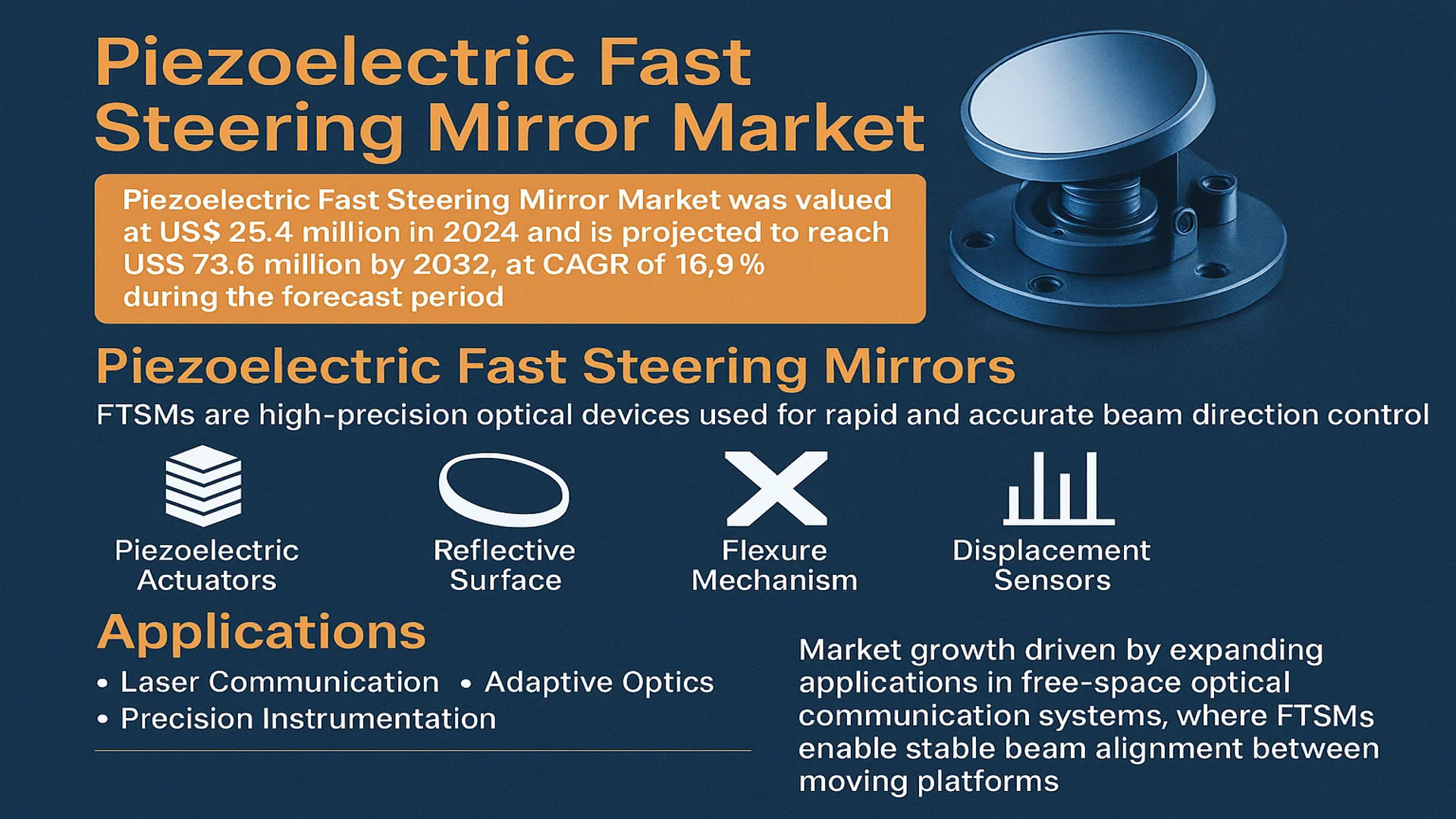
The global Piezoelectric Fast Steering Mirror Market was valued at 25.4 million in 2024 and is projected to reach US$ 73.6 million by 2032, at a CAGR of 16.9% during the forecast period.
Piezoelectric Fast Steering Mirrors (FTSMs) are high-precision optical devices used for rapid and accurate beam direction control. These systems utilize the inverse piezoelectric effect to achieve micro-radian-level deflection, enabling ultra-fast response times and nanometer-scale positioning accuracy. The core components include piezoelectric actuators, reflective surfaces, flexure mechanisms, and displacement sensors, all integrated into a compact form factor. FTSMs play a critical role in applications requiring dynamic optical path correction, such as laser communication, adaptive optics, and precision instrumentation.
The market growth is driven by expanding applications in free-space optical communication systems, where FTSMs enable stable beam alignment between moving platforms. The defense sector’s increasing adoption of laser-based systems and the growing demand for high-resolution imaging in astronomical telescopes further contribute to market expansion. While the technology offers exceptional performance, challenges include the need for sophisticated control algorithms and the high cost of precision manufacturing. Recent advancements in piezoelectric materials and miniaturized designs are expected to open new opportunities in biomedical imaging and industrial laser processing applications.
MARKET DYNAMICS
MARKET DRIVERS
Growing Demand for High-Precision Optical Systems Drives Market Expansion
The global piezoelectric fast steering mirror market is experiencing robust growth, primarily driven by the escalating demand for high-precision optical systems across multiple industries. Laser communication systems, particularly in space applications, require micron-level accuracy for beam alignment, where piezoelectric FTSMs offer unparalleled performance. The aerospace and defense sector alone accounts for over 40% of the current market demand, with satellite communications driving significant adoption. Recent technological advancements have enabled these mirrors to achieve angular resolutions below 5 microradians, making them indispensable for critical applications like free-space optical communication and laser weapon systems.
Advancements in Laser Technology Accelerate Adoption Rates
Piezoelectric fast steering mirrors are becoming increasingly vital as laser technologies evolve toward higher power and precision requirements. The industrial laser market, projected to maintain a 7-9% annual growth rate, creates substantial opportunities for FTSM integration in applications ranging from material processing to medical lasers. These mirrors enable real-time beam stabilization with response times under 1 millisecond, a critical capability for emerging applications like laser micromachining and ophthalmological surgery systems. Furthermore, the development of compact, high-speed piezoelectric actuators has expanded their use in portable laser systems, broadening the technology’s accessibility across diverse sectors.
Emerging Space Communication Infrastructure Creates New Demand
The ongoing expansion of satellite constellations and space-based communication networks represents a significant growth driver for piezoelectric FTSMs. With over 5,000 new satellites expected to be launched in the next five years for next-generation communication systems, the need for precise intersatellite laser links has never been greater. Piezoelectric steering mirrors provide the necessary combination of speed, accuracy, and reliability for these applications, with current systems demonstrating pointing stability better than 0.1 arcseconds. This capability becomes particularly crucial as space agencies and private companies deploy optical communication systems that require maintenance of stable laser links across thousands of kilometers in space.
MARKET CHALLENGES
Complex Manufacturing Processes Present Significant Barriers
While piezoelectric FTSMs offer exceptional performance, their production involves highly specialized manufacturing techniques that create substantial industry barriers. The precision grinding of piezoelectric ceramics and ultra-fine polishing of optical surfaces require advanced equipment and skilled technicians, with typical production yields below 80% for high-performance units. Assembly tolerances often measure in single-digit micrometers, demanding cleanroom environments and specialized calibration equipment that significantly increase production costs. These factors contribute to price points that remain prohibitive for many potential applications, particularly in cost-sensitive commercial markets.
Other Challenges
Thermal Sensitivity Issues
Piezoelectric materials exhibit temperature-dependent performance characteristics that can affect mirror stability in varying operational environments. Temperature fluctuations as small as 5°C can introduce measurable drift in mirror positioning, requiring sophisticated compensation systems that add complexity and cost to end products.
Limited Standardization
The absence of industry-wide standards for performance metrics creates integration challenges for system designers. Differing specifications for angular range, frequency response, and resolution among manufacturers complicate the selection process and increase development times for end-use applications.
MARKET RESTRAINTS
Material Limitations Constrain Performance Enhancements
The piezoelectric fast steering mirror market faces inherent limitations imposed by current material technologies. Traditional lead zirconate titanate (PZT) ceramics, while offering excellent piezoelectric properties, suffer from hysteresis effects that degrade positioning repeatability. New materials like PMN-PT single crystals provide improved performance but at substantially higher costs (typically 3-5 times PZT pricing). Furthermore, these advanced materials present significant manufacturing challenges, with yield rates for high-quality crystals remaining below 30% in commercial production. These material constraints directly impact the ability to produce high-performance mirrors at economically viable price points.
Integration Complexity Slows Adoption in Emerging Applications
Deploying piezoelectric FTSMs in new application areas often requires extensive system integration work that acts as a adoption barrier. The need for specialized drive electronics, thermal compensation systems, and custom control algorithms significantly increases development timelines and costs. Many potential users lacking in-house expertise must rely on mirror manufacturers for integration support, creating bottlenecks in deployment. This challenge becomes particularly acute in industries like consumer electronics where rapid development cycles conflict with the typically longer integration times required for piezoelectric mirror systems.
MARKET OPPORTUNITIES
Emerging LiDAR Applications Present Significant Growth Potential
The rapid evolution of automotive and industrial LiDAR systems creates substantial opportunities for piezoelectric FTSM manufacturers. Current projections indicate the LiDAR market could require over 2 million steering mirror units annually by 2026, with autonomous vehicles and robotic systems driving demand. Piezoelectric solutions offer distinct advantages in these applications, combining the high-speed beam steering required for real-time object detection with the compact form factors needed for vehicle integration. Recent developments in MEMS-based piezoelectric actuators are particularly promising, potentially reducing production costs by up to 40% while maintaining the precision required for safety-critical applications.
Medical Laser Systems Offer New Application Frontiers
The expanding field of medical laser treatments represents another high-growth opportunity for piezoelectric FTSMs. Ophthalmology applications alone are projected to drive demand for over 50,000 precision steering systems annually as laser-based vision correction procedures become more prevalent. The ability to deliver sub-micron positioning accuracy makes piezoelectric mirrors ideal for delicate medical procedures where tissue preservation is critical. Emerging applications in dermatology, dentistry, and minimally invasive surgery are creating numerous niche markets that together could add significant revenue streams for manufacturers able to meet stringent medical device requirements.
Smart Manufacturing Initiatives Drive Industrial Automation Demand
Industry 4.0 initiatives are creating substantial opportunities in industrial automation, where piezoelectric FTSMs enable precise laser material processing and quality inspection. The ability to achieve positioning repeatability below 0.1 microns supports emerging applications in microelectronics manufacturing and precision engineering. Current market trends show particular strength in semiconductor manufacturing equipment, where laser-based patterning and trimming processes increasingly require the speed and accuracy of piezoelectric beam steering. As smart factories expand globally, the integration of these high-performance mirrors in automated production systems is expected to accelerate significantly.
PIEZOELECTRIC FAST STEERING MIRROR MARKET TRENDS
Increasing Adoption in Laser Communication to Drive Market Growth
The global piezoelectric fast steering mirror (FTSM) market is witnessing robust growth, primarily driven by the rising demand for high-precision beam control in laser communication systems. With the rapid expansion of 5G networks and satellite communication, piezoelectric FTSMs are increasingly deployed to ensure ultra-fast and accurate beam alignment in free-space optical communication. The ability of these mirrors to achieve micro-radian-level deflection with response times in microseconds makes them indispensable for maintaining stable laser links in challenging environments. Recent advancements in adaptive optics and quantum communication are further expanding the application scope of these devices, particularly in defense and space exploration.
Other Trends
Miniaturization and Smart Integration
A significant trend shaping the market is the shift toward compact and intelligent FTSMs that integrate seamlessly with automation systems. Advanced piezoelectric fast steering mirrors now incorporate real-time feedback mechanisms and AI-driven calibration to enhance precision in applications like LiDAR, medical imaging, and industrial automation. As industries push for smaller, more efficient optical systems, manufacturers are focusing on reducing the size while maintaining or improving performance metrics such as resolution and stability. This trend is particularly evident in emerging sectors like autonomous vehicles and UAVs, where lightweight, high-response optics are critical.
Technological Advancements in Multi-Axis Control Systems
Innovation in multi-axis piezoelectric fast steering mirrors is accelerating market expansion, with two-dimensional systems currently dominating 83.55% of global demand. These systems are preferred for applications requiring complex beam manipulation, such as laser marking and optical coherence tomography. Meanwhile, three-dimensional FTSMs, though constituting only 5.82% of the market, are gaining traction in aerospace and defense for their ability to compensate for platform vibrations. The development of hybrid actuators combining piezoelectric and electromagnetic technologies promises to deliver enhanced bandwidth and stroke capabilities, opening new possibilities in high-energy laser systems and astronomy. Moreover, improvements in material science have led to more durable ceramic actuators capable of operating in extreme conditions, from deep-space missions to high-power industrial lasers.
Growing Demand in Optical Research and Precision Manufacturing
The surge in advanced optical research and ultra-precision manufacturing processes is creating substantial opportunities for piezoelectric FTSM adoption. In semiconductor lithography and microfabrication, these mirrors enable nanoscale positioning accuracy critical for next-generation chip production. Research institutions increasingly utilize them in adaptive optics systems for telescopes and microscopy, where sub-micron stability is paramount. The market is also benefiting from cross-industry collaborations, with optical component manufacturers partnering with defense contractors and automotive LiDAR developers to co-engineer application-specific solutions. As industries globally invest more in photonics and laser-based technologies, the need for reliable, high-performance beam steering solutions will continue rising steadily across diverse sectors.
COMPETITIVE LANDSCAPE
Key Industry Players
Innovation and Technological Advancements Drive Market Competition
The competitive landscape of the global piezoelectric fast steering mirror (FTSM) market is moderately consolidated, with a mix of established manufacturers and emerging technology-focused companies competing for market share. Physik Instrumente (PI), a Germany-based leader in precision motion control solutions, dominates the market due to its extensive expertise in piezoelectric actuators and high-performance positioning systems. PI’s FTSMs are widely recognized for their ultra-fast response times (sub-millisecond) and nanometer-level precision, making them indispensable in applications such as adaptive optics and laser communication.
CoreMorrow (China) and Piezosystem Jena (Germany) also hold strong positions, particularly in Asia-Pacific and Europe, respectively. Their growth is driven by continuous R&D investments in piezoelectric materials and compact mirror designs tailored for space-constrained applications. CoreMorrow, for instance, has gained traction with its low-power, high-resolution FTSMs optimized for LiDAR applications in autonomous vehicles.
Industry competition is further intensified by the strategic moves of DH Science & Technologies (China) and Cedrat Technologies (France). These players emphasize customization, offering application-specific FTSMs for aerospace, medical imaging, and industrial laser processing. Recent advancements, such as AI-integrated closed-loop control systems, have enabled faster beam stabilization, giving early adopters a competitive edge.
Smaller firms like NanoMotions and Longway Technology are carving out niches with specialized solutions—NanoMotions focuses on ultra-compact designs for OEM integration, while Longway excels in high-load-capacity mirrors for heavy-duty laser cutting applications. However, these companies face challenges scaling production to meet rising demand, given the complexities of manufacturing piezoelectric ceramics and precision optical components.
Market leaders are actively expanding their geographic footprints through partnerships with regional distributors and collaborations with research institutions. PI, for example, recently strengthened its North American presence with a dedicated FTSM production facility, while Piezosystem Jena partnered with a Japanese firm to penetrate Asia’s growing photonics market.
List of Key Piezoelectric Fast Steering Mirror Manufacturers
- Physik Instrumente (PI) (Germany)
- CoreMorrow (China)
- Piezosystem Jena (Germany)
- DH Science & Technologies (China)
- Cedrat Technologies (France)
- NanoMotions (Israel)
- Longway Technology (China)
Segment Analysis:
By Type
Two-Dimensional Fast Steering Mirrors Dominate Due to Versatile Beam Control Capabilities
The market is segmented based on type into:
- One-dimensional
- Subtypes: X-axis deflection only
- Two-dimensional
- Subtypes: X-Y axis deflection models
- Three-dimensional
- Subtypes: X-Y-Z axis motion control systems
By Application
Laser Communication Segment Leads Due to Critical Beam Pointing Requirements
The market is segmented based on application into:
- Laser communication
- Optical devices and scientific research
- Adaptive optics systems
- Laser beam stabilization
- Other precision optical applications
By End-User Industry
Aerospace and Defense Sector Shows Strong Adoption for Advanced Optical Systems
The market is segmented based on end-user industry into:
- Aerospace and defense
- Telecommunications
- Scientific research institutions
- Industrial manufacturing
- Medical and life sciences
By Technology
Piezoelectric Ceramic Actuators Remain Core Technology for High-Precision Systems
The market is segmented based on technology into:
- Piezoelectric ceramic actuators
- Capacitive position sensors
- Resistive strain gauge sensors
- Digital control interface systems
Regional Analysis: Piezoelectric Fast Steering Mirror Market
North America
The North American market for piezoelectric fast steering mirrors (FTSMs) is one of the most technologically advanced globally, driven by substantial investments in laser communication, defense, and aerospace sectors. With the U.S. leading in research and development, the demand for high-precision beam steering solutions is continuously growing. The U.S. Department of Defense and NASA are key end-users, utilizing FTSMs for satellite communications and adaptive optics in astronomical research. Additionally, the presence of established players like Physik Instrumente and increasing adoption of LiDAR in autonomous vehicles further enhances market growth. However, high production costs and stringent regulatory standards for export-controlled technologies pose challenges for manufacturers in this region.
Europe
Europe stands out for its strong focus on research-driven applications of piezoelectric FTSMs, particularly in laser-based medical devices, photonics, and scientific instrumentation. Countries like Germany, France, and the UK are major contributors, supported by advanced optical research institutions and robust government funding. Piezosystem Jena and Cedrat Technologies are prominent regional players, supplying high-end FTSMs for industrial automation and space applications. The European Space Agency (ESA) leverages these mirrors for precision optical alignment in space missions. Despite the region’s technological edge, market expansion is partly restricted by slow commercialization of emerging applications compared to North America and Asia-Pacific.
Asia-Pacific
Asia-Pacific is the fastest-growing market for piezoelectric FTSMs, propelled by rapid industrialization and increasing adoption of optical technologies in consumer electronics, automotive LiDAR, and telecommunications. China dominates the regional market due to strong government initiatives in space exploration and 5G infrastructure development. Companies like CoreMorrow and Longway Technology are expanding their production capabilities to meet escalating demand. India and Japan are also emerging as key players, with rising investments in defense and photonics. However, market growth is somewhat hampered by intense competition and the prevalence of low-cost alternatives, which challenge premium-quality FTSM manufacturers.
South America
The South American market for FTSMs remains nascent but shows gradual growth, primarily driven by academic research and niche industrial applications. Brazil leads the region with limited but increasing adoption in astronomical observatories and laser-based manufacturing processes. Local demand is constrained by economic volatility and limited technological infrastructure, making the region reliant on imports from North America and Europe. Nonetheless, ongoing collaborations with international research organizations present long-term opportunities for market development.
Middle East & Africa
The Middle East & Africa region exhibits moderate demand for piezoelectric FTSMs, largely concentrated in defense and oil & gas applications. Countries like Israel and Saudi Arabia are key contributors, leveraging FTSMs for surveillance and sensing technologies. However, market penetration is limited due to insufficient local manufacturing capabilities and reliance on foreign suppliers. While investments in smart city projects and renewable energy could stimulate demand, the region’s growth remains inconsistent compared to more developed markets.
Report Scope
This market research report provides a comprehensive analysis of the Global Piezoelectric Fast Steering Mirror Market, covering the forecast period 2024–2032. It offers detailed insights into market dynamics, technological advancements, competitive landscape, and key trends shaping the industry.
Key focus areas of the report include:
- Market Size & Forecast: Historical data and future projections for revenue, unit shipments, and market value across major regions and segments. The market was valued at USD 25.4 million in 2024 and is projected to reach USD 73.6 million by 2032 at a CAGR of 16.9%.
- Segmentation Analysis: Detailed breakdown by type (one-dimensional, two-dimensional, three-dimensional), application (laser communication, optical devices & scientific research, others), and end-user industries to identify high-growth segments.
- Regional Outlook: Insights into market performance across North America, Europe, Asia-Pacific, Latin America, and Middle East & Africa, including country-level analysis. In 2024, Asia-Pacific led the market with 42% share, followed by North America (28%) and Europe (22%).
- Competitive Landscape: Profiles of leading market participants including Physik Instrumente, CoreMorrow, DH Science & Technologies, their product portfolios, R&D investments, and strategic developments.
- Technology Trends: Assessment of emerging innovations in piezoelectric materials, miniaturization, smart FTSM integration with AI/automation systems, and precision control advancements.
- Market Drivers & Restraints: Evaluation of growth drivers like increasing demand for laser communication systems (especially in space applications) and challenges such as high manufacturing costs of 3D mirrors.
- Stakeholder Analysis: Strategic insights for component suppliers, OEMs, research institutions, and investors regarding market opportunities and technological evolution.
Primary research includes interviews with key industry players and domain experts, while secondary research incorporates verified data from industry reports, company filings, and trade publications to ensure accuracy.
FREQUENTLY ASKED QUESTIONS:
What is the current market size of Global Piezoelectric Fast Steering Mirror Market?
-> Piezoelectric Fast Steering Mirror Market was valued at 25.4 million in 2024 and is projected to reach US$ 73.6 million by 2032, at a CAGR of 16.9% during the forecast period.
Which key companies operate in this market?
-> Major players include Physik Instrumente, CoreMorrow, DH Science & Technologies, Piezosystem Jena, Cedrat Technologies, NanoMotions, and Longway Technology.
What are the key growth drivers?
-> Growth is driven by rising demand in laser communication systems (especially space applications), advancements in adaptive optics, and increasing precision requirements in scientific research.
Which segment dominates the market?
-> Two-dimensional FTSMs hold 83.55% market share (2024) due to widespread use in lidar and optical communication systems.
What are the emerging trends?
-> Key trends include miniaturization for portable devices, integration with AI for real-time beam control, and development of low-power consumption models for space applications.

Get Sample Report PDF for Exclusive Insights
Report Sample Includes
- Table of Contents
- List of Tables & Figures
- Charts, Research Methodology, and more...