AI-Based Free-Space Optical Communication Chip Market Insights
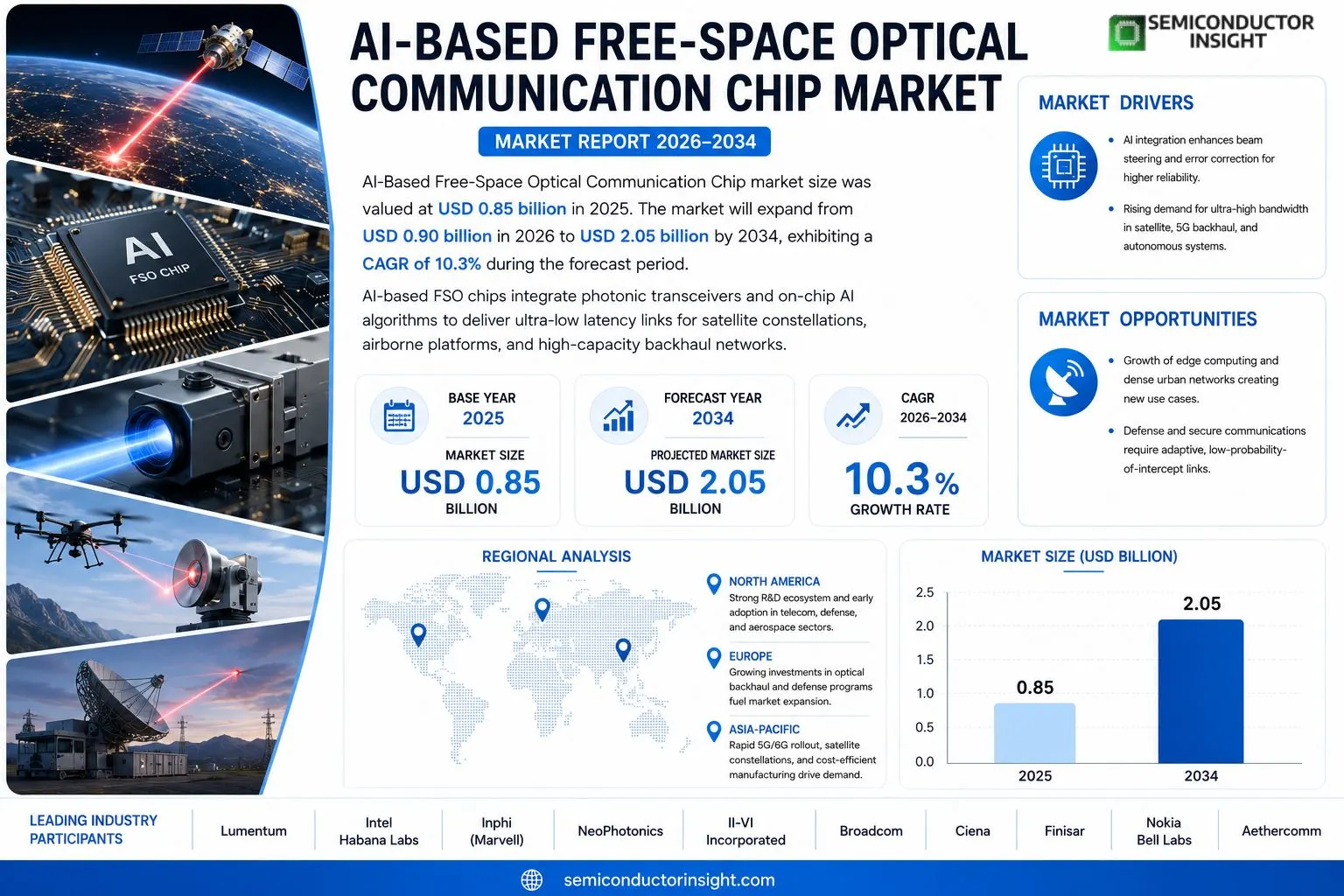
AI-Based Free-Space Optical Communication Chip market size was valued at USD 0.85 billion in 2025. The market will expand from USD 0.90 billion in 2026 to USD 2.05 billion by 2034, exhibiting a CAGR of 10.3% during the forecast period.
AI‑Based free‑space optical (FSO) communication chips integrate photonic transceivers with on‑chip artificial‑intelligence algorithms that dynamically adjust beam steering, power allocation and error correction in real time.* These chips enable ultra‑low latency links for satellite constellations, airborne platforms and dense urban backhaul where fiber deployment is impractical.The market gains momentum because telecom operators are allocating capital toward high‑capacity backhaul solutions while aerospace firms seek lightweight alternatives for inter‑satellite links.* Moreover, recent advances in silicon photonics and edge‑AI processors reduce unit costs, allowing broader adoption across defense and commercial sectors.Key players such as Lumentum, Intel’s Habana Labs and Inphi have announced integration roadmaps that combine AI inference engines with FSO transceiver arrays, reinforcing the upward trajectory.
MARKET DRIVERS
AI Integration Accelerates Chip Performance
The infusion of machine‑learning models into photonic‑circuit design has trimmed simulation cycles by roughly 30 %. Manufacturers can now predict thermal hotspots and optimize waveguide geometry before tape‑out, translating into higher yields and faster time‑to‑market for the AI‑Based Free‑Space Optical Communication Chip Market.
Demand from High‑Bandwidth Applications
Enterprises deploying 5G backhaul, inter‑satellite links, and autonomous‑vehicle sensor arrays require data rates that exceed 10 Gb/s per channel. Free‑space optical links, powered by intelligent chip‑level control, satisfy those bandwidth cravings while sidestepping spectrum congestion, thereby fueling commercial adoption across telecom and mobility sectors.
➤ Industry analysts note that the confluence of AI‑driven design and the rise of ultra‑high‑speed use cases creates a feedback loop that sharpens competitive advantage for early adopters.
As operators push for greener infrastructure, the lower power envelope of AI‑enabled optical chipsoften 40 % below conventional transceiversoffers a clear cost‑efficiency argument, reinforcing upward momentum in the market.
MARKET CHALLENGES
Manufacturing Yield Constraints
Fabricating sub‑micron photonic structures demands nanometer‑scale alignment tolerances. Even minor deviations can trigger excess insertion loss, driving yield penalties that erode profitability for small‑volume producers.
Other Challenges
Supply‑Chain Volatility
Semiconductor shortages have cascaded into the optical‑chip arena, limiting access to specialty glass wafers and high‑precision lithography tools. Companies that cannot secure steady inputs risk delayed product rollouts and lost market share.
MARKET RESTRAINTS
Regulatory and Safety Concerns
Free‑space optical beams operating in the near‑infrared spectrum must comply with eye‑safety standards that vary by jurisdiction. Certification processes can add months of lead time, deterring fast‑moving startups from entering the AI‑Based Free‑Space Optical Communication Chip Market.
Environmental Sensitivity
Atmospheric conditionsfog, rain, and dustdirectly affect link reliability. Deployments in regions with harsh weather require redundant architectures or adaptive power control, inflating capital expenditures and tempering enthusiasm among cost‑sensitive buyers.
MARKET OPPORTUNITIES
Emerging Edge‑Computing Nodes
Edge data centers positioned at the periphery of 5G networks are adopting AI‑enabled optical transceivers to manage bursty traffic spikes. The ability of these chips to self‑optimize link parameters in real time opens a revenue stream for vendors that can integrate seamless firmware updates.
Defense and Secure Communications
Military platforms demand low‑probability‑of‑intercept links that can adapt to jamming attempts. Incorporating AI into free‑space optical chips provides dynamic beam steering and encryption, positioning the market for contracts valued in the high‑hundreds of millions.
AI-Based Free-Space Optical Communication Chip Market Trends
Integration of AI with Photonic Transceivers Drives Adoption
The fusion of on‑chip artificial‑intelligence algorithms with free‑space optical transceivers creates a self‑optimising link that continuously tweaks beam steering, power distribution, and error‑correction settings. This capability translates into ultra‑low latency connections for satellite constellations, high‑altitude platforms and dense urban backhaul where laying fibre is either cost‑prohibitive or technically impractical. Telecom operators are allocating capital to these hybrid chips because they can sustain multi‑gigabit throughput without the weight penalty of traditional RF hardware. Meanwhile, aerospace firms cite the reduced form‑factor and real‑time adaptability as decisive factors for inter‑satellite communications, where every gram counts and link stability is mission‑critical.
Other Trends
Edge‑AI Processors Reduce Unit Cost
Recent advances in silicon photonics combined with edge‑AI inference engines have lowered the bill of materials for each chip. By integrating AI inference directly on the photonic die, manufacturers eliminate the need for separate signal‑processing boards, cutting assembly time and overall price. This cost compression opens the market to defence contractors and commercial satellite operators that previously viewed the technology as a niche, high‑expense solution. The economies of scale emerging from larger production runs further depress unit costs, encouraging broader rollout across both legacy and greenfield projects.
Satellite Constellations Accelerate Demand for Low‑Latency Links
Constellation builders are prioritising architectures that rely on optical inter‑satellite links to bypass ground stations and reduce round‑trip time. The AI‑enabled chips provide the necessary dynamic beam‑forming to maintain alignment despite orbital drift, delivering the deterministic latency required for time‑sensitive applications such as real‑time Earth observation data pipelines. As the number of active satellites climbs, the cumulative bandwidth demand outpaces what radio‑frequency relays can sustain, positioning the AI‑based optical solution as the preferred conduit for future high‑throughput networks. This shift not only reshapes investment patterns but also prompts incumbents to accelerate their roadmap commitments, reinforcing the market’s forward momentum.
COMPETITIVE LANDSCAPE
Key Industry Players
AI‑Based Free‑Space Optical Communication Chip Market – Competitive Overview
Lumentum continues to dominate the AI‑enabled FSO chip arena, leveraging its legacy in high‑performance photonic transceivers while embedding edge‑AI inference blocks directly on the silicon die. This fusion of optics and intelligence grants Lumentum a decisive advantage in securing multi‑year contracts with satellite constellation operators and tier‑1 telecom carriers that require ultra‑low latency backhaul. The market configuration features a handful of vertically integrated firms controlling core IP, complemented by a growing cohort of specialist silicon‑photonic startups that feed niche demand from defense and aerospace programs.Beyond the market leader, a cadre of midsize and boutique players is sharpening their value propositions. NeoPhotonics and II‑VI Incorporated are accelerating roadmap releases that pair programmable waveguide arrays with AI‑driven beam‑forming algorithms, targeting inter‑satellite links where weight and power budgets are critical. Finisar (now part of II‑VI) emphasizes low‑cost, high‑volume production for dense‑urban backhaul, while Broadcom is injecting its networking ASIC expertise to create hybrid AI‑FSO modules for data‑center edge nodes. Ciena and Nokia Bell Labs are exploring hybrid fiber‑FSO solutions that embed AI controllers for adaptive routing in volatile atmospheric conditions. Emerging entrants such as Aethercomm, Lightwave Logic and Thorlabs are focusing on custom ASIC designs for defense‑grade secure communications, positioning themselves as attractive acquisition targets for larger conglomerates.
List of Key AI-Based Free-Space Optical Communication Chip Companies Profiled
- Lumentum
- Intel Habana Labs
- Inphi (Marvell)
- NeoPhotonics
- II‑VI Incorporated
- Broadcom
- Ciena
- Nokia Bell Labs
- Finisar
- Aethercomm
- Lightwave Logic
- Thorlabs
- Vazara Technologies
- OptiBeam Systems
- Photonics West
Segment Analysis:
| Segment Category | Sub-Segments | Key Insights |
| By Type |
|
Chipset Integration is emerging as the dominant type because it embeds AI-driven beam steering directly within silicon photonic transceiver arrays, enabling ultra‑low latency adjustments without external controllers.
|
| By Application |
|
Satellite Constellations lead this dimension as operators prioritize high‑capacity inter‑satellite links that demand real‑time AI‑guided beam alignment.
|
| By End User |
|
Telecom Operators are the primary adopters, seeking resilient backhaul where fiber is impractical.
|
| By Technology |
|
Edge AI‑Enabled chips dominate because they embed inference engines on silicon, allowing instantaneous adaptation to link conditions.
|
| By Deployment Scenario |
|
Inter‑Satellite Links are gaining traction as constellations require autonomous, high‑throughput connectivity.
|
Regional Analysis: AI-Based Free-Space Optical Communication Chip Market
North America
Chip designers are leveraging on‑chip AI accelerators to perform real‑time wavefront correction, a capability that markedly improves link reliability in dense urban corridors. Early adopters report reduced alignment overhead, turning free‑space optics into a viable alternative to fiber for last‑mile connectivity.
The Federal Communications Commission’s flexible spectrum allocation for unlicensed bands enables rapid field trials, while export‑control frameworks remain manageable for domestic manufacturers, encouraging a steady flow of innovation without onerous compliance barriers.
Data‑center operators, autonomous‑vehicle platforms, and defense communications are the primary consumers, each demanding ultra‑low latency and resilience. The convergence of these needs drives a shared set of specifications that vendors can address at scale.
Established photonics firms are acquiring AI‑focused start‑ups, while telecom giants launch joint‑venture labs to co‑develop chip‑level intelligence. These alliances accelerate time‑to‑market for differentiated solutions.
Europe
European stakeholders benefit from a coordinated research agenda that links the EU Horizon programmes with national defence labs. The region’s emphasis on sustainability pushes manufacturers toward energy‑efficient chip architectures, where AI optimises power consumption during idle periods. Telecommunications operators in Germany and the Nordics are piloting hybrid‑optic links to augment fiber scarcity, creating a niche for chips that can seamlessly switch between RF and optical modes. The collaborative environment nurtures standards‑driven growth, positioning Europe as a credible secondary hub for AI-Based Free-Space Optical Communication Chip Market.
Asia‑Pacific
Asia‑Pacific’s rapid urbanisation fuels demand for high‑capacity backhaul that can bypass congested cabling corridors. Japanese and South Korean firms excel at integrating AI inference engines directly into silicon photonics platforms, targeting smart‑city deployments. Meanwhile, China’s aggressive rollout of 6G testbeds encourages domestic chip makers to embed adaptive beam‑steering algorithms, accelerating commercial readiness. The region’s cost‑sensitive manufacturing base also drives economies of scale, making it an attractive source for volume‑driven components within the broader market ecosystem.
South America
In South America, connectivity gaps in remote mining districts and agricultural zones create a distinct use case for line‑of‑sight links that can be deployed quickly and at modest cost. Local telecom providers are experimenting with AI‑enabled chips to automate link alignment, reducing reliance on skilled field technicians. Although the market remains nascent, partnerships with North American OEMs are delivering technology transfer that could catalyse a modest but steady expansion of AI-Based Free-Space Optical Communication Chip Market across the continent.
Middle East & Africa
The Middle East’s strategic focus on smart‑infrastructure projects, such as desert‑based data centres, aligns with the need for resilient, low‑latency optical links. AI-driven chip solutions help mitigate atmospheric turbulence, a critical factor in high‑temperature environments. In Africa, limited terrestrial fiber spreads interest in rapid‑deployment free‑space optics for telecom extensions, where AI can manage link health autonomously. Government‑backed innovation funds are beginning to seed local chip design houses, hinting at a gradual emergence of regional capabilities within the market landscape.
Report Scope
This market research report provides a comprehensive analysis of the AI-Based Free-Space Optical Communication Chip Market , covering the forecast period 2026–2034. It offers detailed insights into market dynamics, technological advancements, competitive landscape, and key trends shaping the industry.
Key focus areas of the report include:
- Market Overview: The report begins with an overview outlining its current market scenario, key growth indicators, and industry transformation drivers. It discusses macroeconomic factors, demand–supply balance, regulatory landscape, and the strategic role of semiconductors in powering advancements across industries such as automotive, telecommunications, consumer electronics, and industrial automation.
- Market Size & Forecast: Historical data and future projections for revenue, unit shipments, and market value across major regions and segments.
- Segmentation Analysis: Detailed breakdown by product type, technology, application, and end-user industry to identify high-growth segments and investment opportunities.
- Regional Insights: Insights into market performance across North America, Europe, Asia-Pacific, Latin America, and the Middle East & Africa, including country-level analysis where relevant.
- Competitive Landscape: Profiles of leading market participants, including their product offerings, R&D focus, manufacturing capacity, pricing strategies, and recent developments such as mergers, acquisitions, and partnerships.
- Technology Trends & Innovation: Assessment of emerging technologies, integration of AI/IoT, semiconductor design trends, fabrication techniques, and evolving industry standards.
- Market Drivers & Restraints: Evaluation of factors driving market growth along with challenges, supply chain constraints, regulatory issues, and market-entry barriers.
- Stakeholder Insights: Insights for component suppliers, OEMs, system integrators, investors, and policymakers regarding the evolving ecosystem and strategic opportunities.
Primary and secondary research methods are employed, including interviews with industry experts, data from verified sources, and real-time market intelligence to ensure the accuracy and reliability of the insights presented.
FREQUENTLY ASKED QUESTIONS:
What is the current market size of AI-Based Free-Space Optical Communication Chip Market?
-> AI-Based Free-Space Optical Communication Chip Market was valued at USD 0.85 billion in 2025 and is expected to reach USD 2.05 billion by 2034, exhibiting a CAGR of 10.3% during the forecast period.
Which key companies operate in AI-Based Free-Space Optical Communication Chip Market?
-> Key players include Lumentum, Intel’s Habana Labs, and Inphi, among others.
What are the key growth drivers?
-> Key growth drivers include telecom operators’ investments in high‑capacity backhaul, aerospace demand for lightweight inter‑satellite links, and cost reductions from silicon photonics and edge‑AI processors.
Which region dominates the market?
-> The reference does not specify a dominant region.
What are the emerging trends?
-> Emerging trends include integration of AI inference engines with FSO transceiver arrays, advancements in silicon photonics, and the convergence of edge‑AI and photonic integration.

Get Sample Report PDF for Exclusive Insights
Report Sample Includes
- Table of Contents
- List of Tables & Figures
- Charts, Research Methodology, and more...
 Download Sample Report PDF