Key Statistics
Key Takeaways
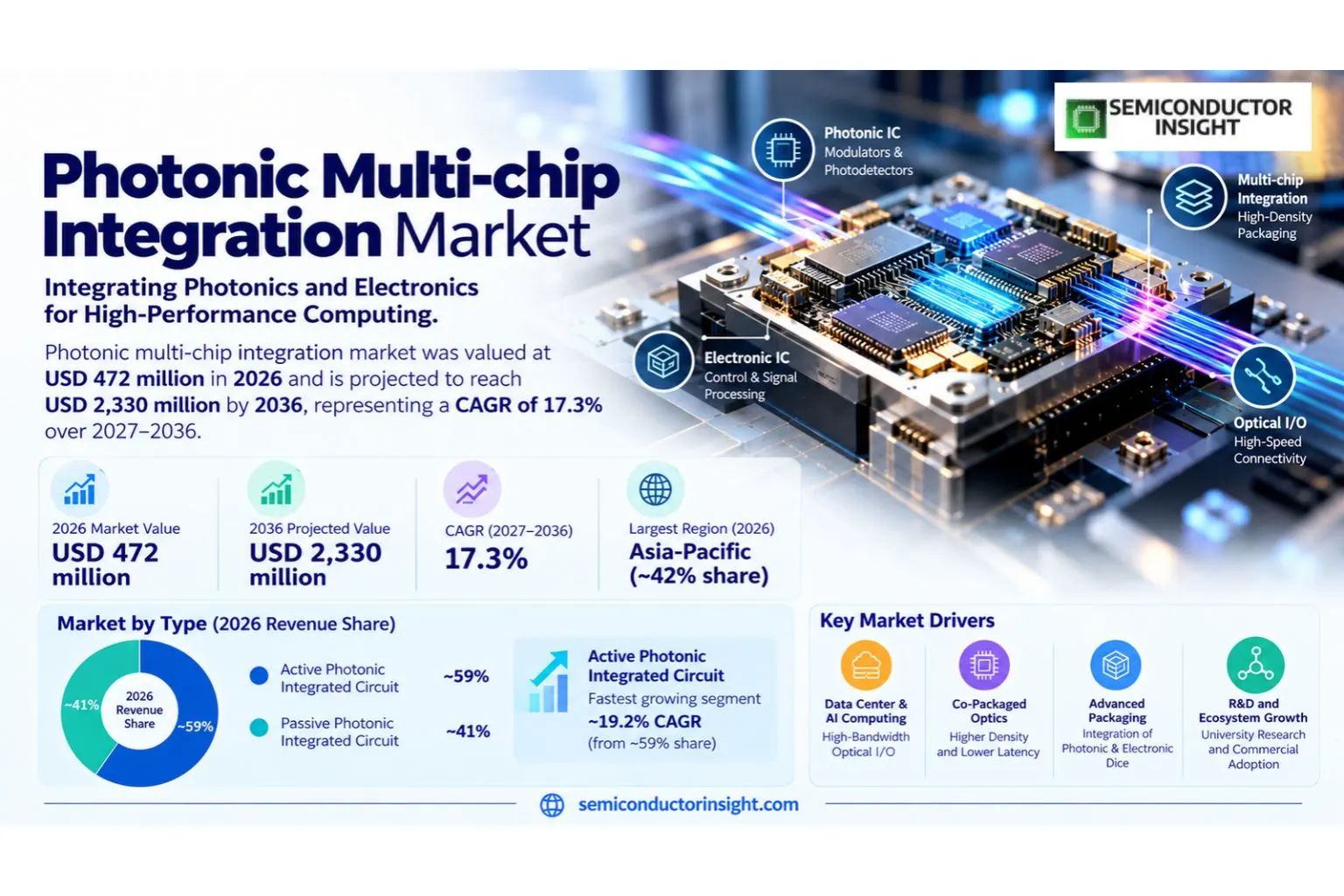
- Market trajectory: The photonic multi-chip integration market stands at USD 472 million in 2026 and is projected to reach USD 2,330 million by 2036, a 17.3% CAGR during 2027–2036. Demand reflects AI-cluster bandwidth density, replacement of long electrical traces with shorter optical interfaces, and broader availability of qualified hybrid PIC/EIC packaging services, with buyers increasingly insisting on co-packaged optical engines, PIC-to-electronics 3D stacking, wafer bonding, fiber attach, active laser integration, silicon photonic waveguides and optical package-level test that support measurable performance and cost control.
- Active Photonic Integrated Circuit lead: An estimated ~59% of base-year revenue is assigned to Active Photonic Integrated Circuit, while Active Photonic Integrated Circuit carries an estimated ~19.2% CAGR and ~59% share. The technological transition matters for procurement because buyers must weigh productivity and serviceability against the qualification effort associated with a new technical platform.
- Optical Fiber Communication application: The leading application accounts for an estimated ~67% share, with Quantum Computing representing the fastest estimated application growth at ~23.0% CAGR. Requirements differ between high-volume and specialist users, especially where an upgraded optical interface changes both the delivered product specification and the cost of field support.
- Asia-Pacific leadership: The region captures an estimated ~42% of 2026 revenue; Asia-Pacific is the fastest-growing geography at ~19.5% CAGR. Factory concentration, engineering capabilities and customer procurement determine the local purchasing routes, while countries with limited manufacturing infrastructure depend more heavily on imported specialist systems.
- Principal restraint: laser coupling yield, thermal crosstalk, precision die alignment, process design-kit maturity, package-reliability testing and multi-vendor supply chain qualification can impede adoption even when underlying demand increases. In 2026 procurement reviews increasingly prioritize verifiable supplier claims, thermal and environmental stability, warranty coverage and repeatable production outcomes. A lower quoted system price may not compensate for process downtime or reduced useful life.
Photonic Multi-chip Integration Market Overview
Photonic multi-chip integration market was valued at USD 472 million in 2026 and is projected to reach USD 2,330 million by 2036, representing a CAGR of 17.3% over 2027–2036. Asia-Pacific commands an estimated ~42% of 2026 revenue, reflecting university photonic-computing experiments, precision optical components and electronics packaging.
Photonic Multi-chip Integration describes the commercial equipment, optical assembly and application-specific engineering sold to optical network equipment OEMs, AI compute accelerator designers, PIC packaging specialists, data-centre switch suppliers, biomedical photonics integrators and national quantum-hardware laboratories. The economic unit is recognized revenue for in-scope hardware and associated software, not the gross sales of downstream data centers or finished end-user platforms.
The 2026 market boundary requires careful separation from adjacent products. Recognized sales of hybrid photonic/electronic multi-chip integrated optical assemblies, integrated PIC/EIC packages, active and passive photonic integrated multi-die solutions and specifically associated package test. Excludes standalone photonic wafers, total server and switch sales, double-counted bare lasers or PIC dies inside a completed package, and capital cost of entire fabs.
Technical differentiation centres on co-packaged optical engines, PIC-to-electronics 3D stacking, wafer bonding, fiber attach, active laser integration, silicon photonic waveguides and optical package-level test. Photonic multi-chip integration assembles photonic, electronic and sometimes compound-semiconductor dice into one tested package. The economic bottlenecks are die-to-die signal loss, laser heat and electrical crosstalk, precise fiber attach, and known-good-die yield.
Capital spending and product demand generate purchase orders differently in this industry. Market procurement follows an optical subassembly qualification against a particular chip, laser and electrical interface. Foundry companies supply wafers; packaging specialists assemble optical modules; OEMs purchase validated, testable photonic-electrical packages. That structure means a photonic chip pilot-line announcement does not establish commercial sales of complete multi-chip systems.
The competitive cycle is changing because of AI-cluster bandwidth density, replacement of long electrical traces with shorter optical interfaces, and broader availability of qualified hybrid PIC/EIC packaging services, yet volume does not rise uniformly across technology classes or countries. Intel demonstrated a photonic optical compute interconnect chiplet co-packaged with a CPU in June 2024 and reported up to four terabits per second bidirectional throughput in the demonstration.
Segment Analysis: By Type
The type split covers Passive Photonic Integrated Circuit, Active Photonic Integrated Circuit. Active Photonic Integrated Circuit remains the largest class at an estimated ~59% in 2026, while Active Photonic Integrated Circuit grows fastest at ~19.2% CAGR and represents ~59% of revenue. Photonic multi-chip integration assembles photonic, electronic and sometimes compound-semiconductor dice into one tested package. The economic bottlenecks are die-to-die signal loss, laser heat and electrical crosstalk, precise fiber attach, and known-good-die yield. Intel demonstrated 4Tbps co-packaged optical I/O, while GlobalFoundries SCALE integrates microring modulators, photodiodes and through-silicon vias for high-density package interfaces.
| Type | Function | Market position |
|---|---|---|
| Passive Photonic Integrated Circuit | Passive integrated waveguides, multiplexers and couplers can route optical power across dies while depending on separate light sources. Package-level loss and fiber attach determine whether these parts create reliable multi-chip function. Passive Photonic Integrated Circuit addresses a specific part of co-packaged optical engines, PIC-to-electronics 3D stacking, wafer bonding, fiber attach, active laser integration, silicon photonic waveguides and optical package-level test. | Type segment: an estimated ~41% of 2026 revenue, ~14.0% CAGR. GlobalFoundries introduced SCALE in May 2026 with integrated optical features including silicon-photonic microring modulators and photodiodes, as well as through-silicon vias for package-level interconnect. Passive Photonic Integrated Circuit purchasing decisions are shaped by product-generation transitions and whether supply contracts can support stable service, measurement or assembly tolerances. |
| Active Photonic Integrated Circuit | Active photonic integration combines gain, modulation and detection functions with passive PIC routing and electronics. It can provide higher-value packaging content, but requires alignment, electrical integrity and heat extraction with tested optical operation. Active Photonic Integrated Circuit addresses a specific part of co-packaged optical engines, PIC-to-electronics 3D stacking, wafer bonding, fiber attach, active laser integration, silicon photonic waveguides and optical package-level test. | Largest type: an estimated ~59% of 2026 revenue, ~19.2% CAGR. Intel demonstrated a photonic optical compute interconnect chiplet co-packaged with a CPU in June 2024 and reported up to four terabits per second bidirectional throughput in the demonstration. Active Photonic Integrated Circuit purchasing decisions are shaped by product-generation transitions and whether supply contracts can support stable service, measurement or assembly tolerances. |
By Technology segmentation
By Technology divides the photonic multi-chip integration market into the original classes Silicon Photonics, Indium Phosphide, Gallium Arsenide, Hybrid Integration. Silicon Photonics has the largest estimated base-year share (~51%). The categories serve different procurement and engineering decisions. Architecture and use-case definitions must be evaluated independently of one another, particularly when integrated photonics is used in research programmes that have not yet reached mass production. For photonic multi-chip integration, the commercial implication is that the customer must balance measurable performance, service support and repeatability before committing the next production or deployment programme. A cheaper device cannot substitute for qualified output when failure would disrupt later stages of a multi-step product build.
| Member | Commercial role |
|---|---|
| Silicon Photonics | Silicon Photonics holds an estimated ~51% of 2026 revenue. Silicon waveguides and integrated modulators enable dense PIC routing with CMOS-compatible process tooling, but lasers and package fiber attach may still be external. Customers assess qualification evidence at the level of the particular die or module, instead of assuming that research prototypes and factory shipments have equivalent production maturity. Contract values depend on tested performance, support, configuration management, and integrated optoelectronic lifetime. |
| Indium Phosphide | Indium Phosphide holds an estimated ~21% of 2026 revenue. Indium-phosphide dice offer native optical gain and high-performance laser and modulator functions, often joining silicon photonics in mixed-material package assemblies. Customers assess qualification evidence at the level of the particular die or module, instead of assuming that research prototypes and factory shipments have equivalent production maturity. Contract values depend on tested performance, support, configuration management, and integrated optoelectronic lifetime. |
| Gallium Arsenide | Gallium Arsenide holds an estimated ~10% of 2026 revenue. Gallium-arsenide photonic dies supply VCSEL and other optoelectronic device functions where short-reach optical engine packaging has different yield and heat requirements. Customers assess qualification evidence at the level of the particular die or module, instead of assuming that research prototypes and factory shipments have equivalent production maturity. Contract values depend on tested performance, support, configuration management, and integrated optoelectronic lifetime. |
| Hybrid Integration | Hybrid Integration holds an estimated ~18% of 2026 revenue. Hybrid integration explicitly combines dissimilar photonic and electronic dies, including laser, photodiode and control silicon, and therefore reflects package architecture as well as material choice. Customers assess qualification evidence at the level of the particular die or module, instead of assuming that research prototypes and factory shipments have equivalent production maturity. Contract values depend on tested performance, support, configuration management, and integrated optoelectronic lifetime. |
By End-Use Industry segmentation
By End-Use Industry divides the photonic multi-chip integration market into the original classes Telecommunications, Data Centers, Healthcare & Life Sciences, Defense & Aerospace. Telecommunications has the largest estimated base-year share (~43%). The categories serve different procurement and engineering decisions. Architecture and use-case definitions must be evaluated independently of one another, particularly when integrated photonics is used in research programmes that have not yet reached mass production. For photonic multi-chip integration, the commercial implication is that the customer must balance measurable performance, service support and repeatability before committing the next production or deployment programme. A cheaper device cannot substitute for qualified output when failure would disrupt later stages of a multi-step product build.
| Member | Commercial role |
|---|---|
| Telecommunications | Telecommunications holds an estimated ~43% of 2026 revenue. Telecom network systems qualify modules for long service life and interface interoperability, with fiber attach and field repair determining whether packages can replace legacy optics. Customers assess qualification evidence at the level of the particular die or module, instead of assuming that research prototypes and factory shipments have equivalent production maturity. Contract values depend on tested performance, support, configuration management, and integrated optoelectronic lifetime. |
| Data Centers | Data Centers holds an estimated ~38% of 2026 revenue. AI fabric designers increasingly need package-level optical bandwidth density. Coherent 6.4T and Intel 4T optical I/O demonstrations illustrate technical possibilities without establishing all-data-center adoption. Customers assess qualification evidence at the level of the particular die or module, instead of assuming that research prototypes and factory shipments have equivalent production maturity. Contract values depend on tested performance, support, configuration management, and integrated optoelectronic lifetime. |
| Healthcare & Life Sciences | Healthcare & Life Sciences holds an estimated ~11% of 2026 revenue. Medical optical sensing packages have strong application-specific sterilization, calibration and precision needs that differ from datacenter networking interfaces. Customers assess qualification evidence at the level of the particular die or module, instead of assuming that research prototypes and factory shipments have equivalent production maturity. Contract values depend on tested performance, support, configuration management, and integrated optoelectronic lifetime. For photonic multi-chip integration, the commercial implication is that the customer must balance measurable performance, service support and repeatability before committing the next production or deployment programme. A cheaper device cannot substitute for qualified output when failure would disrupt later stages of a multi-step product build. |
| Defense & Aerospace | Defense & Aerospace holds an estimated ~8% of 2026 revenue. Defense optical assemblies require temperature tolerance, vibration resistance and extended component traceability; qualification can take longer than a cloud-network equipment refresh. Customers assess qualification evidence at the level of the particular die or module, instead of assuming that research prototypes and factory shipments have equivalent production maturity. Contract values depend on tested performance, support, configuration management, and integrated optoelectronic lifetime. |
Segment Analysis: By Application
By application, the segmentation comprises Optical Fiber Communication, Optical Fiber Sensor, Biomedical, Quantum Computing. Optical Fiber Communication represents the leading demand category at an estimated ~67% share, while Quantum Computing advances at ~23.0% CAGR. Market procurement follows an optical subassembly qualification against a particular chip, laser and electrical interface. Foundry companies supply wafers; packaging specialists assemble optical modules; OEMs purchase validated, testable photonic-electrical packages. That structure means a photonic chip pilot-line announcement does not establish commercial sales of complete multi-chip systems. For photonic multi-chip integration, the commercial implication is that the customer must balance measurable performance, service support and repeatability before committing the next production or deployment programme. A cheaper device cannot substitute for qualified output when failure would disrupt later stages of a multi-step product build.
| Application | Demand characteristics |
|---|---|
| Optical Fiber Communication | Fiber communication is the largest application because optical engines and network modules need dense modulator, laser and detector combinations for data transmission. 2026 application share estimated at ~67%, with ~17.0% CAGR. The Optical Fiber Communication category creates demand when optical network equipment OEMs, AI compute accelerator designers, PIC packaging specialists, data-centre switch suppliers, biomedical photonics integrators and national quantum-hardware laboratories require a validated implementation for this use case. |
| Optical Fiber Sensor | Sensors demand precision optical stability, wavelength selectivity and calibration in a compact package rather than the highest network link throughput. 2026 application share estimated at ~16%, with ~14.0% CAGR. The Optical Fiber Sensor category creates demand when optical network equipment OEMs, AI compute accelerator designers, PIC packaging specialists, data-centre switch suppliers, biomedical photonics integrators and national quantum-hardware laboratories require a validated implementation for this use case. |
| Biomedical | Biophotonic packages prioritize low-noise light detection, sensing specificity and packaging compatible with specimen environments; these are not interchangeable with high-speed switch optical engines. 2026 application share estimated at ~10%, with ~19.0% CAGR. The Biomedical category creates demand when optical network equipment OEMs, AI compute accelerator designers, PIC packaging specialists, data-centre switch suppliers, biomedical photonics integrators and national quantum-hardware laboratories require a validated implementation for this use case. |
| Quantum Computing | Quantum photonic test packages may integrate sources, couplers and detectors on multiple dies, but cryogenic compatibility, coherence and yield create fundamentally different acceptance criteria. 2026 application share estimated at ~7%, with ~23.0% CAGR. The Quantum Computing category creates demand when optical network equipment OEMs, AI compute accelerator designers, PIC packaging specialists, data-centre switch suppliers, biomedical photonics integrators and national quantum-hardware laboratories require a validated implementation for this use case. |
Distribution channels influence how orders are won in photonic multi-chip integration. Direct OEM qualification is typically necessary when the module or system forms part of a mission-critical product, while system integrators and specialist distributors serve laboratory, replacement and regional small-order requirements. laser coupling yield, thermal crosstalk, precision die alignment, process design-kit maturity, package-reliability testing and multi-vendor supply chain qualification makes pre-sales validation and post-installation engineering material elements of supplier selection.
Regional Analysis
Asia-Pacific holds the largest estimated 2026 share at ~42%, followed by North America at ~38% and Europe at ~14%. Asia-Pacific has the highest forecast growth at about ~19.5% CAGR. China contributes experimental programmable photonic neural arrays, while Japan and South Korea supply mature materials, devices and package engineering capabilities. In India the potential is concentrated in device-design and shared research infrastructure. Research prototypes can create qualified foundry and lab orders, but high-volume chip revenue requires repeatable wafer yield and photonic testing infrastructure. For photonic multi-chip integration, the commercial implication is that the customer must balance measurable performance, service support and repeatability before committing the next production or deployment programme. A cheaper device cannot substitute for qualified output when failure would disrupt later stages of a multi-step product build.
How do manufacturing, commercialization and procurement differ among the five photonic multi-chip integration regions?
The five regional markets operate under distinct procurement patterns. China contributes experimental programmable photonic neural arrays, while Japan and South Korea supply mature materials, devices and package engineering capabilities. In India the potential is concentrated in device-design and shared research infrastructure. Research prototypes can create qualified foundry and lab orders, but high-volume chip revenue requires repeatable wafer yield and photonic testing infrastructure.
| Region | Position | Growth outlook | Demand profile | What decides supplier selection |
|---|---|---|---|---|
| Asia-Pacific | Largest (~42% share) | Fastest (~19.5% CAGR) | Manufacturing and precision supply | Local service and manufacturing qualification |
| North America | Regional market (~38% share) | Projected (~15.5% CAGR) | OEM engineering and research | Supplier acceptance and data assurance |
| Europe | Regional market (~14% share) | Projected (~16.0% CAGR) | Specialist industrial and research | Compliance and traceable technical performance |
| South America | Regional market (~3% share) | Projected (~13.0% CAGR) | Imported technology and research | Import financing and responsive support |
| Middle East & Africa | Regional market (~3% share) | Projected (~14.0% CAGR) | Institutional and specialist pilots | Project financing and skills development |
Competitive Landscape
Competition in photonic multi-chip integration hinges on technical qualification and the ability to turn co-packaged optical engines, PIC-to-electronics 3D stacking, wafer bonding, fiber attach, active laser integration, silicon photonic waveguides and optical package-level test into consistent customer results. The primary vendors relevant to direct equipment or optical-module supply include Intel Corporation, Broadcom Inc., PHIX Photonics Assembly. GlobalFoundries introduced SCALE in May 2026 with integrated optical features including silicon-photonic microring modulators and photodiodes, as well as through-silicon vias for package-level interconnect. That evidence illustrates why named supplier activity must be separated from component-only and end-platform businesses.
Intel Corporation and the other direct participants compete through customer-defined qualification cycles rather than interchangeable generic catalog specifications. Photonic multi-chip integration assembles photonic, electronic and sometimes compound-semiconductor dice into one tested package. The economic bottlenecks are die-to-die signal loss, laser heat and electrical crosstalk, precise fiber attach, and known-good-die yield. Intel demonstrated 4Tbps co-packaged optical I/O, while GlobalFoundries SCALE integrates microring modulators, photodiodes and through-silicon vias for high-density package interfaces.
Manufacturing concentration does not imply every in-scope player has comparable product revenue. Intel demonstrated a photonic optical compute interconnect chiplet co-packaged with a CPU in June 2024 and reported up to four terabits per second bidirectional throughput in the demonstration. The technical interface between the core system, software and customer workflow determines which supplier earns the primary product sale and which earns a smaller component or support contract.
Distribution breadth matters for installed equipment because spare parts, service technicians and calibration tools are purchased over several years. laser coupling yield, thermal crosstalk, precision die alignment, process design-kit maturity, package-reliability testing and multi-vendor supply chain qualification can generate an unusually high field-service requirement. Smaller specialists may therefore win controlled pilot projects but lose volume tenders when they lack guaranteed response times in multiple countries.
Another competitive axis is the pace at which intellectual-property protection and product standardization support scale. Market procurement follows an optical subassembly qualification against a particular chip, laser and electrical interface. Foundry companies supply wafers; packaging specialists assemble optical modules; OEMs purchase validated, testable photonic-electrical packages. That structure means a photonic chip pilot-line announcement does not establish commercial sales of complete multi-chip systems.
Tier structure
| Tier | Companies | Basis of competition |
|---|---|---|
| Tier 1 direct suppliers | Intel Corporation, Broadcom Inc., PHIX Photonics Assembly | These suppliers demonstrate direct participation in co-packaged optical engines, PIC-to-electronics 3D stacking, wafer bonding, fiber attach, active laser integration, silicon photonic waveguides and optical package-level test, with recognized production-relevant products or qualified customer ecosystems. Market procurement follows an optical subassembly qualification against a particular chip, laser and electrical interface. Foundry companies supply wafers; packaging specialists assemble optical modules; OEMs purchase validated, testable photonic-electrical packages. |
| Tier 2 direct specialists | Vanguard Photonics GmbH, LioniX International, Cisco Systems, Inc. | These specialist suppliers participate in defined product lines or regional niches where they can offer targeted technical differentiation. Their orders depend on a clear match between a customer use case and Recognized sales of hybrid photonic/electronic multi-chip integrated optical assemblies, integrated PIC/EIC packages, active and passive photonic integrated multi-die solutions and specifically associated package test. |
| Component, channel and platform participants | Infinera Corporation, Ciena Corporation, NeoPhotonics Corporation, OneChip Photonics, ColorChip Israel, Finisar Corporation | This group includes original equipment customers, component manufacturers, distributors or adjacent-system developers and is not automatically equivalent to direct sellers of a complete photonic multi-chip integration product. A named firm can influence specifications without recording revenue in the exact same market boundary. Supplier diligence must separate the sale of whole platforms from the sale of the embedded optical assembly or test system. |
Key companies profiled
- Intel Corporation
- Broadcom Inc.
- Infinera Corporation
- Ciena Corporation
- NeoPhotonics Corporation
- Cisco Systems, Inc.
- PHIX Photonics Assembly
- Vanguard Photonics GmbH
- OneChip Photonics
- LioniX International
- ColorChip Israel
- Finisar Corporation
Production Capacity Analysis
Available photonic multi-chip integration production capacity is a combination of precision component supply, engineering integration, test and qualification capability, and service readiness. It should not be inferred directly from adjacent semiconductor wafer-start capacity or headset retail revenue. Recognized sales of hybrid photonic/electronic multi-chip integrated optical assemblies, integrated PIC/EIC packages, active and passive photonic integrated multi-die solutions and specifically associated package test. Excludes standalone photonic wafers, total server and switch sales, double-counted bare lasers or PIC dies inside a completed package, and capital cost of entire fabs. Commercial bottlenecks therefore occur at different stages for system suppliers and optical-module assemblers.
Production ecosystems are concentrated around specialized engineering and optical supply chains. China contributes experimental programmable photonic neural arrays, while Japan and South Korea supply mature materials, devices and package engineering capabilities. In India the potential is concentrated in device-design and shared research infrastructure. Research prototypes can create qualified foundry and lab orders, but high-volume chip revenue requires repeatable wafer yield and photonic testing infrastructure.
Suppliers can diversify capacity through contract partners, regional engineering centres and the separation of final assembly from specialized upstream optical components. PHIX and SENKO announced a serviceable optical package interface for multi-chip modules in September 2026, supporting repeatable attachment, package test and replacement. For high-value customers, a second facility adds value only if it can reproduce process tolerances, final-test records and the same released configuration.
Upstream constraints arise from laser coupling yield, thermal crosstalk, precision die alignment, process design-kit maturity, package-reliability testing and multi-vendor supply chain qualification and the specialized equipment needed to prove reliability. Photonic multi-chip integration assembles photonic, electronic and sometimes compound-semiconductor dice into one tested package. The economic bottlenecks are die-to-die signal loss, laser heat and electrical crosstalk, precise fiber attach, and known-good-die yield.
Market Dynamics
Growth in photonic multi-chip integration depends on the extent to which optical network equipment OEMs, AI compute accelerator designers, PIC packaging specialists, data-centre switch suppliers, biomedical photonics integrators and national quantum-hardware laboratories can economically adopt co-packaged optical engines, PIC-to-electronics 3D stacking, wafer bonding, fiber attach, active laser integration, silicon photonic waveguides and optical package-level test. AI-cluster bandwidth density, replacement of long electrical traces with shorter optical interfaces, and broader availability of qualified hybrid PIC/EIC packaging services is supportive, but laser coupling yield, thermal crosstalk, precision die alignment, process design-kit maturity, package-reliability testing and multi-vendor supply chain qualification can slow purchase orders. The impact estimates below are directional sensitivities to demand conditions and should be interpreted as separate commercial effects, not additive forecast components.
MARKET DRIVERS
Drivers Impact Analysis*
| Driver | (~) % impact on CAGR forecast | Geographic relevance | Impact timeline |
|---|---|---|---|
| Technology qualification | +2.3% | Global | 2026–2030 |
| Customer productivity | +1.8% | Asia-Pacific | 2026–2036 |
| Industrial ecosystem | +1.3% | North America and Europe | 2027–2033 |
| Supply-chain modernization | +0.9% | Global | 2028–2036 |
Technology qualification
AI-cluster bandwidth density, replacement of long electrical traces with shorter optical interfaces, and broader availability of qualified hybrid PIC/EIC packaging services raises the value of proven co-packaged optical engines, PIC-to-electronics 3D stacking, wafer bonding, fiber attach, active laser integration, silicon photonic waveguides and optical package-level test. Suppliers that demonstrate a measurable reduction in laser coupling yield, thermal crosstalk, precision die alignment, process design-kit maturity, package-reliability testing and multi-vendor supply chain qualification can reach more customer acceptance milestones and shorten the period between proof of concept and order.
Customer productivity
Market procurement follows an optical subassembly qualification against a particular chip, laser and electrical interface. Foundry companies supply wafers; packaging specialists assemble optical modules; OEMs purchase validated, testable photonic-electrical packages. That structure means a photonic chip pilot-line announcement does not establish commercial sales of complete multi-chip systems. Suppliers that demonstrate a measurable reduction in laser coupling yield, thermal crosstalk, precision die alignment, process design-kit maturity, package-reliability testing and multi-vendor supply chain qualification can reach more customer acceptance milestones and shorten the period between proof of concept and order.
Industrial ecosystem
China contributes experimental programmable photonic neural arrays, while Japan and South Korea supply mature materials, devices and package engineering capabilities. In India the potential is concentrated in device-design and shared research infrastructure. Research prototypes can create qualified foundry and lab orders, but high-volume chip revenue requires repeatable wafer yield and photonic testing infrastructure.
Supply-chain modernization
GlobalFoundries introduced SCALE in May 2026 with integrated optical features including silicon-photonic microring modulators and photodiodes, as well as through-silicon vias for package-level interconnect. Suppliers that demonstrate a measurable reduction in laser coupling yield, thermal crosstalk, precision die alignment, process design-kit maturity, package-reliability testing and multi-vendor supply chain qualification can reach more customer acceptance milestones and shorten the period between proof of concept and order.
MARKET RESTRAINTS
Restraints Impact Analysis*
| Restraint | (~) % impact on CAGR forecast | Geographic relevance | Impact timeline |
|---|---|---|---|
| Capital cost and integration | −1.1% | Global | 2026–2029 |
| Qualification cycle | −0.8% | North America and Europe | 2026–2031 |
| Volatile demand timing | −0.7% | Global | 2026–2036 |
| Service and skills gaps | −0.6% | South America and Middle East | 2027–2036 |
Capital cost and integration
laser coupling yield, thermal crosstalk, precision die alignment, process design-kit maturity, package-reliability testing and multi-vendor supply chain qualification blocks some orders. A purchase can be postponed if engineers cannot reproduce laboratory performance under production conditions, if imports are delayed, or if product support is not guaranteed. laser coupling yield, thermal crosstalk, precision die alignment, process design-kit maturity, package-reliability testing and multi-vendor supply chain qualification is particularly consequential during a design or fab transition when repeat qualification can consume both time and staff resources.
Qualification cycle
Photonic multi-chip integration assembles photonic, electronic and sometimes compound-semiconductor dice into one tested package. The economic bottlenecks are die-to-die signal loss, laser heat and electrical crosstalk, precise fiber attach, and known-good-die yield. Intel demonstrated 4Tbps co-packaged optical I/O, while GlobalFoundries SCALE integrates microring modulators, photodiodes and through-silicon vias for high-density package interfaces.
Volatile demand timing
Market procurement follows an optical subassembly qualification against a particular chip, laser and electrical interface. Foundry companies supply wafers; packaging specialists assemble optical modules; OEMs purchase validated, testable photonic-electrical packages. That structure means a photonic chip pilot-line announcement does not establish commercial sales of complete multi-chip systems. A purchase can be postponed if engineers cannot reproduce laboratory performance under production conditions, if imports are delayed, or if product support is not guaranteed. laser coupling yield, thermal crosstalk, precision die alignment, process design-kit maturity, package-reliability testing and multi-vendor supply chain qualification is particularly consequential during a design or fab transition when repeat qualification can consume both time and staff resources.
Service and skills gaps
Brazil, Argentina and Chile have academic and optical instrumentation user communities but much less evidence of commercial photonic neuron-chip volume lines or PIC/electronics multi-chip packaging. Project-based laboratory orders, imported devices and limited local servicing define the market access routes; generic telecommunications coverage growth is not direct proof of in-scope hardware receipts. A purchase can be postponed if engineers cannot reproduce laboratory performance under production conditions, if imports are delayed, or if product support is not guaranteed. laser coupling yield, thermal crosstalk, precision die alignment, process design-kit maturity, package-reliability testing and multi-vendor supply chain qualification is particularly consequential during a design or fab transition when repeat qualification can consume both time and staff resources.
MARKET OPPORTUNITIES
Automated workflows
Intel demonstrated a photonic optical compute interconnect chiplet co-packaged with a CPU in June 2024 and reported up to four terabits per second bidirectional throughput in the demonstration. New investment opportunities emerge when a specialized supplier can connect its technical competence to a documented production or application problem. That opportunity remains conditional on repeatable customer tests, engineering qualification and actual orders.
New regional pilots
The PIXEurope programme beginning in 2025 provides a concrete cross-border route to photonic design, fabrication, hybrid integration and test infrastructure. Germany, France and the Netherlands emphasize differing portions of the innovation supply chain while the UK contributes optical research. Open-access capacity can support prototypes and industry transfer but should not be counted as ready commercial shipments.
Specialist component innovation
Photonic multi-chip integration assembles photonic, electronic and sometimes compound-semiconductor dice into one tested package. The economic bottlenecks are die-to-die signal loss, laser heat and electrical crosstalk, precise fiber attach, and known-good-die yield. Intel demonstrated 4Tbps co-packaged optical I/O, while GlobalFoundries SCALE integrates microring modulators, photodiodes and through-silicon vias for high-density package interfaces.
Repeatable long-life support
Market procurement follows an optical subassembly qualification against a particular chip, laser and electrical interface. Foundry companies supply wafers; packaging specialists assemble optical modules; OEMs purchase validated, testable photonic-electrical packages. That structure means a photonic chip pilot-line announcement does not establish commercial sales of complete multi-chip systems. New investment opportunities emerge when a specialized supplier can connect its technical competence to a documented production or application problem.
Supply Chain Analysis
The photonic multi-chip integration supply chain spans specialist upstream inputs, integration or manufacturing, qualification and downstream delivery. laser coupling yield, thermal crosstalk, precision die alignment, process design-kit maturity, package-reliability testing and multi-vendor supply chain qualification means suppliers cannot rely on commodity channels alone. Contract terms, process documentation and delivery acceptance matter alongside nominal product specifications when a buyer seeks stable 2026 availability and future upgrades. For photonic multi-chip integration, the commercial implication is that the customer must balance measurable performance, service support and repeatability before committing the next production or deployment programme. A cheaper device cannot substitute for qualified output when failure would disrupt later stages of a multi-step product build.
Upstream. Precision optical parts, measurement components, specialty substrates, sensors and controlled manufacturing inputs used in co-packaged optical engines, PIC-to-electronics 3D stacking, wafer bonding, fiber attach, active laser integration, silicon photonic waveguides and optical package-level test. Market procurement follows an optical subassembly qualification against a particular chip, laser and electrical interface. Foundry companies supply wafers; packaging specialists assemble optical modules; OEMs purchase validated, testable photonic-electrical packages.
Manufacturing. Specialist production, optomechanical assembly, fixture calibration and final qualification relevant to Recognized sales of hybrid photonic/electronic multi-chip integrated optical assemblies, integrated PIC/EIC packages, active and passive photonic integrated multi-die solutions and specifically associated package test. Excludes standalone photonic wafers, total server and switch sales, double-counted bare lasers or PIC dies inside a completed package, and capital cost of entire fabs.
Channel. Direct design-win tenders, application engineers, service contracts and specialist distributors serving optical network equipment OEMs, AI compute accelerator designers, PIC packaging specialists, data-centre switch suppliers, biomedical photonics integrators and national quantum-hardware laboratories. Market procurement follows an optical subassembly qualification against a particular chip, laser and electrical interface. Foundry companies supply wafers; packaging specialists assemble optical modules; OEMs purchase validated, testable photonic-electrical packages.
Downstream. Operational deployments tied to AI-cluster bandwidth density, replacement of long electrical traces with shorter optical interfaces, and broader availability of qualified hybrid PIC/EIC packaging services, purchased against customer standards and ongoing support commitments. Market procurement follows an optical subassembly qualification against a particular chip, laser and electrical interface. Foundry companies supply wafers; packaging specialists assemble optical modules; OEMs purchase validated, testable photonic-electrical packages.
Recent Developments
- 21 September 2026 Announced
Coherent introduced its PhotonLink integrated optical platform, combining optical component manufacture with precision assembly and test for near-package and co-packaged AI system connectivity. This milestone expands the evidence available to component designers and system integrators, although product qualification and manufactured volumes remain distinct commercial achievements. Photonic multi-chip integration assembles photonic, electronic and sometimes compound-semiconductor dice into one tested package. Source - 17 September 2026 Announced
PHIX and SENKO announced a reusable and serviceable optical interface for photonic multi-chip modules with detachable fiber connection, alignment and standardized package-level test. This milestone expands the evidence available to component designers and system integrators, although product qualification and manufactured volumes remain distinct commercial achievements. Photonic multi-chip integration assembles photonic, electronic and sometimes compound-semiconductor dice into one tested package. Source - 17 September 2026 Announced
GlobalFoundries and Marvell expanded a multi-year collaboration for silicon-germanium capacity supporting optical pluggables, near-package optical integration and co-packaged designs. This milestone expands the evidence available to component designers and system integrators, although product qualification and manufactured volumes remain distinct commercial achievements. Photonic multi-chip integration assembles photonic, electronic and sometimes compound-semiconductor dice into one tested package. Source - 29 July 2026 Announced
GlobalFoundries reported a letter of intent for an expected $300 million US CHIPS R&D award for advanced photonic materials, wafer processing and hybrid-bonded optical packages; the commitment was not a completed award. This milestone expands the evidence available to component designers and system integrators, although product qualification and manufactured volumes remain distinct commercial achievements. Source - 4 May 2026 Announced
GlobalFoundries launched its SCALE optical module solution for co-packaged optics with multidimensional wavelength-division multiplexing and three-dimensional package integration features. This milestone expands the evidence available to component designers and system integrators, although product qualification and manufactured volumes remain distinct commercial achievements. Photonic multi-chip integration assembles photonic, electronic and sometimes compound-semiconductor dice into one tested package. Source - 17 March 2026 Announced
Coherent demonstrated a 6.4T socketed silicon-photonics CPO package with an external laser source and parallel multi-technology approaches using VCSELs and InP modulators. This milestone expands the evidence available to component designers and system integrators, although product qualification and manufactured volumes remain distinct commercial achievements. Photonic multi-chip integration assembles photonic, electronic and sometimes compound-semiconductor dice into one tested package. Source - 11 March 2026 Announced
Lightmatter introduced its Passage L20 optical engine supporting near-package or board-mounted deployment, with up to 6.4Tbps bandwidth per direction and bidirectional fiber interfaces. This milestone expands the evidence available to component designers and system integrators, although product qualification and manufactured volumes remain distinct commercial achievements. Photonic multi-chip integration assembles photonic, electronic and sometimes compound-semiconductor dice into one tested package. Source - 17 November 2025 Announced
GlobalFoundries acquired Singapore-based Advanced Micro Foundry, adding a photonic manufacturing process capability that complements foundry and packaging arrangements for customers. This milestone expands the evidence available to component designers and system integrators, although product qualification and manufactured volumes remain distinct commercial achievements. Photonic multi-chip integration assembles photonic, electronic and sometimes compound-semiconductor dice into one tested package. Source
REPORT SCOPE & SEGMENTATION
| Attribute | Details |
|---|---|
| Study period | 2021–2036 |
| Base year | 2026 |
| Estimated year | 2027 |
| Forecast period | 2027–2036 |
| Historical period | 2021–2025 |
| 2026 market size | USD 472 million |
| 2027 estimated size | USD 553 million |
| 2036 projected market size | USD 2,330 million |
| CAGR (2027–2036) | 17.3% |
| Market unit | USD million, recognized market revenue |
| Market boundary | Recognized sales of hybrid photonic/electronic multi-chip integrated optical assemblies, integrated PIC/EIC packages, active and passive photonic integrated multi-die solutions and specifically associated package test. Excludes standalone photonic wafers, total server and switch sales, double-counted bare lasers or PIC dies inside a completed package, and capital cost of entire fabs. |
| By Type | Passive Photonic Integrated Circuit · Active Photonic Integrated Circuit |
| By Application | Optical Fiber Communication · Optical Fiber Sensor · Biomedical · Quantum Computing |
| By Technology | Silicon Photonics · Indium Phosphide · Gallium Arsenide · Hybrid Integration |
| By End-Use Industry | Telecommunications · Data Centers · Healthcare & Life Sciences · Defense & Aerospace |
| By Region | 2026 region categories and country coverage. Estimated regional shares are 2026 values; growth rates extend through 2036. Asia-PacificChina, Japan, South Korea, India North AmericaUnited States, Canada, Mexico EuropeGermany, France, United Kingdom, Netherlands South AmericaBrazil, Argentina, Chile Middle East & AfricaIsrael, Saudi Arabia, United Arab Emirates, Turkey |
| Key Companies Profiled | Intel Corporation · Broadcom Inc. · Infinera Corporation · Ciena Corporation · NeoPhotonics Corporation · Cisco Systems, Inc. · PHIX Photonics Assembly · Vanguard Photonics GmbH · OneChip Photonics · LioniX International · ColorChip Israel · Finisar Corporation |
| Customization Scope | Customer-specific segmentation, country market analysis, detailed supplier products and application evaluation over 2026–2036, with technical scoping to co-packaged optical engines, PIC-to-electronics 3D stacking, wafer bonding, fiber attach, active laser integration, silicon photonic waveguides and optical package-level test. |
Frequently Asked Questions
What is the global photonic multi-chip integration size and projected growth?
The worldwide market has a base-year value of USD 472 million for 2026 and is projected to reach USD 2,330 million in 2036, equivalent to a 17.3% compound annual growth rate across 2027–2036. AI-cluster bandwidth density, replacement of long electrical traces with shorter optical interfaces, and broader availability of qualified hybrid PIC/EIC packaging services creates requirements for co-packaged optical engines, PIC-to-electronics 3D stacking, wafer bonding, fiber attach, active laser integration, silicon photonic waveguides and optical package-level test, but purchase timing depends on real customer qualification and sustained reliability rather than a guaranteed parallel rise with another technology sector.
Which type leads the photonic multi-chip integration market?
Active Photonic Integrated Circuit is the largest class with an estimated ~59% 2026 revenue share. Its commercial position reflects qualification requirements, product life and its role in co-packaged optical engines, PIC-to-electronics 3D stacking, wafer bonding, fiber attach, active laser integration, silicon photonic waveguides and optical package-level test. Photonic multi-chip integration assembles photonic, electronic and sometimes compound-semiconductor dice into one tested package.
Which type of photonic multi-chip integration is fastest-growing?
Active Photonic Integrated Circuit is the fastest-growing type at an estimated ~19.2% CAGR from 2026 through 2036 and holds about ~59% base-year share. That trajectory follows product evolution and increasing performance requirements, but it depends on higher-value technology becoming financially viable at production scale. laser coupling yield, thermal crosstalk, precision die alignment, process design-kit maturity, package-reliability testing and multi-vendor supply chain qualification remains a practical brake on adoption.
Which application contributes the largest photonic multi-chip integration demand?
Optical Fiber Communication accounts for an estimated ~67% of 2026 demand, the largest application category. Market procurement follows an optical subassembly qualification against a particular chip, laser and electrical interface. Foundry companies supply wafers; packaging specialists assemble optical modules; OEMs purchase validated, testable photonic-electrical packages. That structure means a photonic chip pilot-line announcement does not establish commercial sales of complete multi-chip systems.
Which photonic multi-chip integration application is growing the fastest?
Quantum Computing grows at an estimated ~23.0% CAGR and represents around ~7% of 2026 revenue. Its growth reflects the evolving technical standard expected by customers rather than identical demand across the full application list. co-packaged optical engines, PIC-to-electronics 3D stacking, wafer bonding, fiber attach, active laser integration, silicon photonic waveguides and optical package-level test determines whether buyers can migrate without major changes to software, servicing or production fixtures.
Which region holds the largest photonic multi-chip integration share?
Asia-Pacific accounts for an estimated ~42% of 2026 worldwide revenue. China contributes experimental programmable photonic neural arrays, while Japan and South Korea supply mature materials, devices and package engineering capabilities. In India the potential is concentrated in device-design and shared research infrastructure. Research prototypes can create qualified foundry and lab orders, but high-volume chip revenue requires repeatable wafer yield and photonic testing infrastructure.
Which photonic multi-chip integration region is expected to grow fastest?
Asia-Pacific has the highest estimated CAGR of ~19.5% through 2036 from a 2026 share of ~42%. China contributes experimental programmable photonic neural arrays, while Japan and South Korea supply mature materials, devices and package engineering capabilities. In India the potential is concentrated in device-design and shared research infrastructure. Research prototypes can create qualified foundry and lab orders, but high-volume chip revenue requires repeatable wafer yield and photonic testing infrastructure.
Who are the principal photonic multi-chip integration suppliers?
Core direct participants include Intel Corporation, Broadcom Inc., PHIX Photonics Assembly. Other named organizations contribute specialist product lines, engineering, platform development or distribution; their presence in a broad technology ecosystem does not establish interchangeable market revenue. Recognized sales of hybrid photonic/electronic multi-chip integrated optical assemblies, integrated PIC/EIC packages, active and passive photonic integrated multi-die solutions and specifically associated package test.
What obstacles constrain photonic multi-chip integration purchases?
laser coupling yield, thermal crosstalk, precision die alignment, process design-kit maturity, package-reliability testing and multi-vendor supply chain qualification can force customers to lengthen technical trials or defer spending. Photonic multi-chip integration assembles photonic, electronic and sometimes compound-semiconductor dice into one tested package. The economic bottlenecks are die-to-die signal loss, laser heat and electrical crosstalk, precise fiber attach, and known-good-die yield.
What does the 2027–2036 photonic multi-chip integration scope include?
The analysis uses a 2026 base, 2027 estimated year and 2036 end of forecast, considering type segments Passive Photonic Integrated Circuit, Active Photonic Integrated Circuit and application categories Optical Fiber Communication, Optical Fiber Sensor, Biomedical, Quantum Computing. Geographic coverage spans Asia-Pacific, North America, Europe, South America and the Middle East and Africa. Recognized sales of hybrid photonic/electronic multi-chip integrated optical assemblies, integrated PIC/EIC packages, active and passive photonic integrated multi-die solutions and specifically associated package test.
Research Sources & Evidence Base

Get Sample Report PDF for Exclusive Insights
Report Sample Includes
- Table of Contents
- List of Tables & Figures
- Charts, Research Methodology, and more...
 Download Sample Report PDF