Key Statistics
Key Takeaways
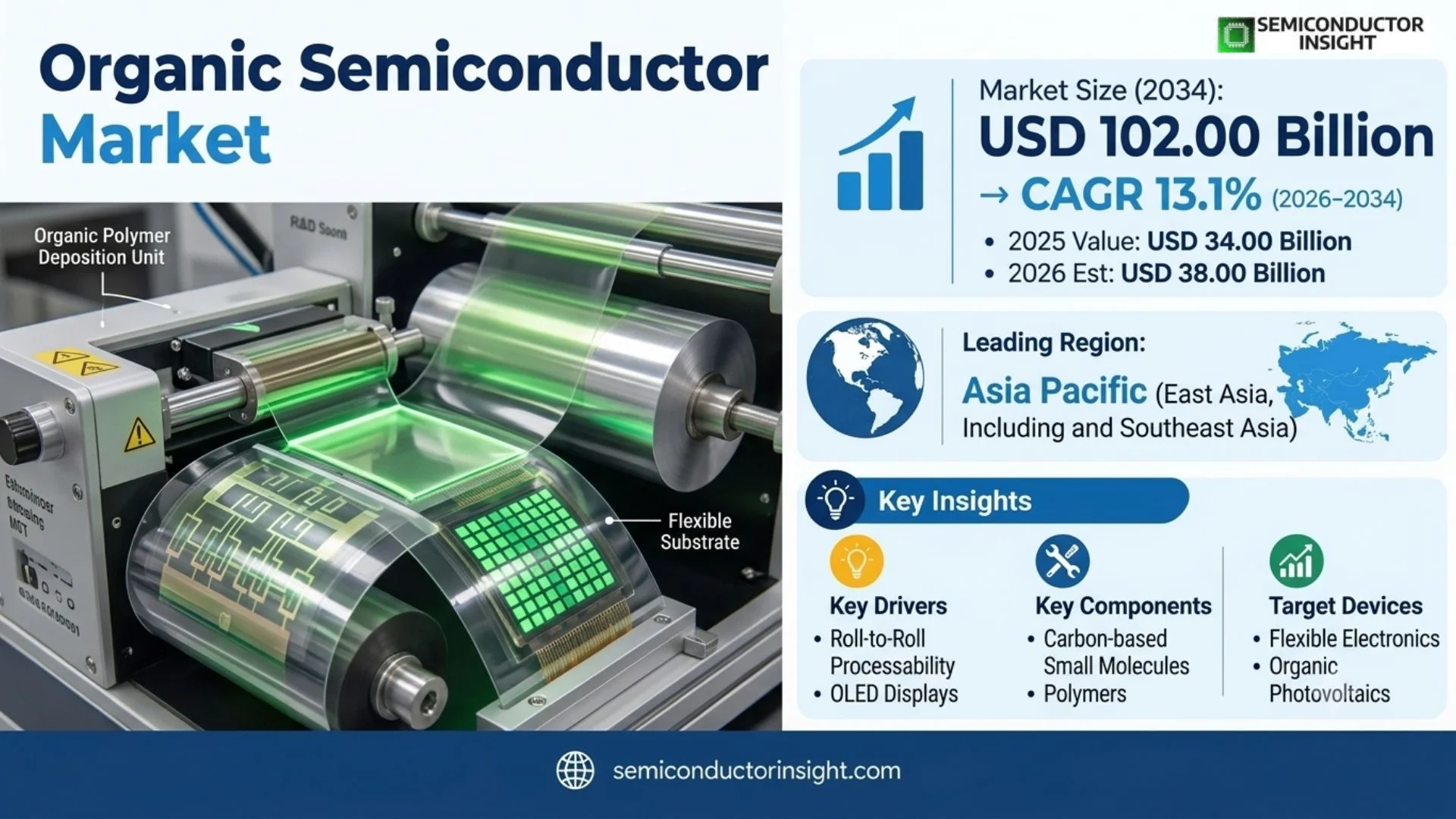
- Market size and growth: the market is estimated at USD 38.0 billion in 2026 and is projected to reach USD 102.0 billion by 2034, representing a 13.1% CAGR during 2026–2034.
- OLED-related materials and devices form the largest commercial base because organic emissive and charge-transport layers are already used at scale across smartphones, televisions, wearables, tablets and automotive displays.
- Asia Pacific is the largest regional market through the concentration of OLED panel manufacturing, consumer-electronics production and chemical-material suppliers in South Korea, China, Japan and Taiwan.
- Organic photovoltaics and printed electronics offer faster emerging growth from a smaller base because solution processing, flexibility and low weight enable applications that are difficult for rigid inorganic devices.
- Material performance remains the critical bottleneck: lifetime, moisture sensitivity, encapsulation and charge mobility determine whether organic devices can move from specialty applications into long-life industrial and outdoor markets.
Organic Semiconductor Market Overview
Organic Semiconductor Market was valued at USD 34.00 billion in 2025 and is estimated at USD 38.00 billion in 2026. The market is projected to reach USD 102.00 billion by 2034, representing a CAGR of 13.1% during 2026–2034. Asia Pacific is the largest regional market, supported by the strongest concentration of manufacturing, end-use demand and supplier infrastructure.
Base year: 2025 · Estimated year: 2026 · Forecast period: 2026–2034 · Values in USD million unless otherwise stated
Organic semiconductors are carbon-based small molecules or polymers whose molecular structures allow controlled charge transport and, in some cases, efficient light emission or absorption. They form active layers in OLEDs, organic photovoltaic cells, organic field-effect transistors, printed sensors and related flexible-electronics devices. Their core advantage is processability: organic materials can be deposited as thin films on glass, plastic or other substrates and can support lightweight, flexible or large-area electronics that are difficult to achieve with conventional crystalline semiconductor architectures.
The current commercial base is anchored by OLED displays. Universal Display Corporation reported USD 353 million of OLED material sales for 2025 and describes OLED adoption across smartphones, televisions, monitors, wearables, tablets, notebooks, automotive displays and emerging AR/VR applications. That figure represents one supplier and one layer of the value chain rather than the market total, but it demonstrates that high-purity organic semiconductor materials already operate at industrial scale with recurring demand tied to large display-production ecosystems.
Growth beyond displays comes from organic photovoltaics, printed sensors and thin-film transistors. These technologies can use low-temperature and additive manufacturing on flexible substrates, lowering weight and enabling form factors that are difficult for rigid electronics. The challenge is that organic materials are generally more sensitive to oxygen, moisture, heat and photochemical degradation than many inorganic semiconductors. Commercial success therefore depends on improving intrinsic material stability, device architecture, encapsulation and high-volume manufacturing yield at the same time.
Segment Analysis: By Type
The market is segmented into small-molecule organic semiconductors and polymer semiconductors. Small molecules dominate many vacuum-deposited OLED stacks because high-purity materials can be precisely layered and tuned for emission, charge transport and blocking functions. Polymer semiconductors are attractive for solution processing, printed electronics and flexible devices because they can be formulated as inks and deposited over large areas using lower-temperature methods and potentially scalable coating processes.
| Type | Market role | Commercial outlook |
|---|---|---|
| Small-Molecule Organic Semiconductors | Used extensively in OLED emissive, transport and blocking layers and selected organic transistor or photovoltaic structures. | Largest commercial value base through mature OLED production and specialty materials. |
| Polymer Semiconductors | Solution-processable materials for printed transistors, sensors, photovoltaics and flexible electronics. | Strong emerging growth where additive manufacturing and mechanical flexibility matter. |
Segment Analysis: By Application
Applications include OLED displays and lighting, organic photovoltaics, organic transistors and printed electronics, sensors and other emerging devices. OLEDs provide the largest current commercial base because they are already produced at high volume. OPV, sensors and printed transistors grow from smaller bases where flexibility, low weight, conformability and large-area processing create product designs that conventional silicon or rigid optoelectronics cannot serve economically.
| Application | Demand characteristics |
|---|---|
| OLED Displays & Lighting | Largest application, driven by smartphones, TVs, wearables, automotive displays, monitors and other premium formats. |
| Organic Photovoltaics | Flexible and lightweight solar films for building-integrated, portable and low-load applications. |
| Organic Transistors & Printed Electronics | OFETs, logic, RFID and flexible circuitry where low-temperature printing is valuable. |
| Sensors | Chemical, biological, pressure and flexible sensing platforms using tunable organic materials. |
| Others | Research devices, specialty photonics and emerging organic electronic architectures. |
Segment Analysis: By Device Type
Device type separates organic semiconductors by the physical function they perform. OLEDs convert electrical current to light and have the strongest manufacturing scale, OPV devices convert light to electricity, OFETs control current in flexible or printed circuits, and organic sensors exploit the chemical tunability of organic materials. The economics differ sharply because OLEDs are established high-volume products while OPV and OFET applications remain earlier in their industrial adoption cycles.
| Device Type | Commercial position |
|---|---|
| OLED | Largest commercial device class with established high-volume manufacturing. |
| OPV | Fast-emerging flexible-energy technology with strong form-factor advantages. |
| OFET | Niche-to-emerging printed and flexible switching platform. |
| Organic Sensors | Growing specialty use in healthcare, wearables and distributed sensing. |
Segment Analysis: By End-Use Industry
End-use demand is led by consumer electronics because OLED displays are common in premium smartphones, televisions, wearables and other devices. Automotive is growing as OLEDs and flexible displays move into instrument panels and interior interfaces. Energy applications support OPV, while healthcare and wearables benefit from lightweight, conformable sensors. Industrial demand remains more selective and depends on whether organic devices can meet lifetime, temperature and environmental reliability requirements.
| End-Use Industry | Demand logic |
|---|---|
| Consumer Electronics | OLED displays, wearables, tablets, TVs and emerging flexible devices. |
| Automotive | Displays, interior lighting and future flexible sensing surfaces. |
| Energy | Organic photovoltaic modules and lightweight power generation. |
| Healthcare & Wearables | Flexible sensors, patches and conformable electronics. |
| Industrial | Printed sensors, tags and specialty flexible electronics where reliability requirements can be met. |
Regional Analysis
Asia Pacific is the largest regional market because South Korea, China, Japan and Taiwan contain the majority of OLED panel manufacturing, consumer-electronics assembly and specialty organic-material supply. North America and Europe remain important for materials innovation, intellectual property, equipment and emerging printed-electronics applications. Regional value capture therefore spans both manufacturing scale and high-margin material, process and technology positions across the global supply chain.
The organic semiconductor value chain is geographically concentrated. Asia Pacific captures most volume manufacturing in OLED displays and a large share of electronics assembly, while the United States and Europe hold important material, patent, equipment and research positions. This creates a cross-border supply chain in which a molecule may be developed in one region, synthesized or purified in another and then deposited into a display, sensor or flexible device in a major Asian manufacturing hub.
| Region | Position | Growth profile | Demand mechanism | Supplier selection |
|---|---|---|---|---|
| Asia Pacific | Largest | High | OLED manufacturing and electronics | Material quality, cost and scale |
| North America | Innovation hub | High-value growth | Materials, IP and emerging devices | IP, performance and partnerships |
| Europe | Innovation + specialty | Steady | OPV, materials and automotive electronics | Reliability and sustainability |
| South America | Small | Selective | Imported devices and research | Cost and availability |
| Middle East & Africa | Emerging | Selective | Research, solar and imported electronics | Project economics and durability |
Competitive Landscape
Competition is fragmented across material suppliers, OLED intellectual-property companies, panel manufacturers and emerging organic-electronics specialists. Unlike conventional silicon semiconductor markets, organic devices distribute value across chemical formulation, deposition know-how, encapsulation, device design and manufacturing scale. A supplier can hold a powerful position with a narrow emitter, host or transport material if that molecule is qualified in a high-volume display stack, creating durable positions despite relatively small physical material volumes.
Universal Display Corporation is a major OLED materials and intellectual-property participant and reported USD 353 million in OLED material sales during 2025. Merck, DuPont, Idemitsu Kosan, Sumitomo Chemical and other specialty-chemical companies compete across emitter, transport, host and solution-processable materials, while Samsung Display, LG Display and Chinese panel manufacturers drive high-volume device manufacturing. The competitive map therefore extends from chemical synthesis to panel integration rather than fitting a single conventional semiconductor supplier hierarchy.
Competitive advantage depends on purity, lifetime and customer qualification. A change in OLED material can affect color point, efficiency, operating voltage and device lifetime, so panel manufacturers conduct extensive validation before switching suppliers. This gives successful material companies durable positions but also creates long development cycles. In printed electronics and OPV, process compatibility and encapsulation can matter as much as intrinsic semiconductor mobility or absorption because manufacturing yield ultimately determines commercial economics.
Emerging organic electronics create opportunities for smaller technology companies because many applications do not require the capital intensity of a silicon wafer fab. Roll-to-roll coating, printing and low-temperature deposition can support flexible devices at moderate scale, but commercial success still requires stable materials and reliable barrier layers. The market therefore supports both very large display ecosystems and smaller specialized companies focused on energy, sensing, flexible circuitry or application-specific materials.
| Competitive tier | Representative companies | How they compete |
|---|---|---|
| OLED material and IP leaders | Universal Display Corporation, Merck, Idemitsu Kosan, DuPont, Sumitomo Chemical | High-purity materials, patents and long customer qualification. |
| Large device / panel manufacturers | Samsung Display, LG Display, BOE, TCL CSOT | High-volume OLED manufacturing and integration into consumer and automotive products. |
| Emerging organic-electronics specialists | Heliatek and printed-electronics developers | Flexible energy, printed devices and application-specific organic semiconductor platforms. |
Key Participants
The profiled competitive set includes Universal Display Corporation, Merck KGaA, DuPont, Idemitsu Kosan, Sumitomo Chemical, Samsung Display, LG Display, BOE Technology, TCL CSOT, Heliatek, Sony, BASF. Market participation varies by product depth, geography, qualification history and application specialization. The strongest suppliers combine technical engineering with dependable production, field support and customer-specific validation, while regional specialists can remain competitive where they possess unique design wins, process expertise or cost structures suited to a particular end-use segment.
Production Capacity Analysis
Production capacity in the organic semiconductor market depends on more than nominal factory throughput. Suppliers must combine qualified inputs, controlled assembly or processing, final inspection and customer-specific validation before output becomes commercially interchangeable. The practical bottleneck is therefore qualified capacity rather than installed machinery alone. This distinction is important in markets serving semiconductor, automotive or industrial customers because a new line may require months of process stabilization and customer approval before it can support high-volume programs.
Geographic capacity also affects commercial resilience. Customers increasingly prefer suppliers that can support major production clusters with local inventory, technical engineering and rapid replacement or failure-analysis capability. A diversified manufacturing footprint lowers disruption risk, but moving production between sites is not automatic when materials, tooling and process controls are tied to an approved specification. Leading companies consequently invest in both manufacturing scale and duplicate qualification capability rather than relying on a single centralized plant.
Upstream availability of high-purity organic molecules, semiconductor polymers, dopants and barrier materials can constrain finished-product growth even when downstream assembly capacity is adequate. Long lead-time inputs, specialized materials and application-specific components create exposure to supply shocks and price volatility. Buyers respond through dual sourcing, strategic inventory and earlier design qualification. Suppliers that secure critical inputs and maintain transparent lifecycle planning can convert supply assurance into a competitive advantage, particularly for programs expected to remain in production for several years.
| Capacity / supply factor | Market implication |
|---|---|
| High-Purity Organic Molecules, Semiconductor Polymers, Dopants And Barrier Materials | Availability and qualification of critical inputs determine how quickly finished capacity can expand. |
| Qualified manufacturing | Process control and customer approval define usable output rather than nominal equipment capacity. |
| Regional support | Local inventory and engineering reduce downtime, logistics risk and launch delays. |
| Lifecycle continuity | Long-term component and material planning protects customers from forced redesigns. |
Market Dynamics
Growth is driven by OLED penetration, flexible electronics, new organic photovoltaic applications and continuous improvements in material efficiency and lifetime. Restraints include moisture and oxygen sensitivity, device degradation, encapsulation cost and the challenge of matching inorganic semiconductor mobility or long-term stability in harsh environments. The strongest opportunities occur where flexibility, low weight, emissive performance or large-area printing provide a clear system advantage rather than simply attempting to replace silicon on unit cost.
MARKET DRIVERS
| Driver | Impact on growth | Commercial mechanism |
|---|---|---|
| OLED penetration | High | Expands high-volume demand for organic emitters and transport materials. |
| Flexible form factors | High | Creates device shapes that rigid inorganic electronics cannot easily serve. |
| Material efficiency improvements | Medium-High | Higher efficiency and lifetime broaden viable commercial applications. |
OLED penetration
Universal Display’s 2025 filing describes OLED adoption across mobile phones, televisions, monitors, wearables, tablets, notebooks, PCs, automotive and AR/VR applications. This broad application base gives organic semiconductor materials an established revenue stream and supports continued investment in emitters, hosts and transport materials that improve efficiency, color and lifetime. Larger display areas and more device categories increase material consumption even as layer thickness remains extremely small.
Flexible form factors
Organic materials can be deposited on thin glass or polymer substrates and can operate in mechanically flexible structures. This enables curved or foldable displays, conformable sensors and lightweight photovoltaic films that are difficult to produce with rigid crystalline devices. The advantage is strongest where form factor itself creates product value rather than merely replacing an inorganic semiconductor on cost, giving organic electronics a defensible application-specific growth path.
Material efficiency improvements
Organic semiconductor performance continues to improve through molecular design, device architecture and better encapsulation. Higher-efficiency emitters reduce power consumption, while more stable host and transport layers extend operating life. Each improvement broadens the range of products that can use organic electronics and lowers the system penalties historically associated with degradation and moisture sensitivity, supporting adoption in automotive, wearable and other demanding environments.
MARKET RESTRAINTS
| Restraint | Impact on growth | Commercial mechanism |
|---|---|---|
| Moisture and oxygen sensitivity | High | Requires barrier layers and encapsulation that add cost and complexity. |
| Material degradation | High | Lifetime can limit outdoor, high-temperature and continuous-operation applications. |
| Qualification time | Medium-High | Changing organic materials can alter efficiency, color and reliability. |
Moisture and oxygen sensitivity
Many organic semiconductor layers degrade when exposed to moisture or oxygen, so commercial devices need encapsulation and barrier films. Flexible products are especially challenging because the barrier must remain effective while bending. Packaging can therefore represent a large share of device complexity and offset some of the low-temperature or solution-processing advantages of the active organic layer, especially in long-life outdoor or industrial products.
Material degradation
OLED displays have reached mainstream consumer products, but other organic devices can face stability limits under sunlight, heat or continuous electrical stress. Industrial, automotive and outdoor applications demand long lifetimes across wide temperature ranges. If an organic device cannot maintain performance over the required service period, customers may prefer inorganic alternatives even when flexibility or lower weight is attractive.
Qualification time
OLED stacks contain interacting emissive, host, blocking and transport layers. Changing one material can shift efficiency, color, voltage and lifetime, so panel manufacturers perform extensive testing before adopting a new formulation. This protects incumbent suppliers but slows commercialization of new materials and makes it difficult for smaller chemical companies to convert laboratory performance into high-volume sales without a strong device-manufacturer partnership.
MARKET OPPORTUNITIES
High-efficiency OLED materials
New emitter and host chemistries can reduce display power consumption and improve lifetime, creating premium material value across smartphones, televisions and automotive displays. Suppliers that achieve measurable lifetime or efficiency gains can earn durable qualification positions because material substitutions require extensive customer testing.
Flexible and foldable electronics
Organic thin films are naturally suited to flexible substrates, supporting new device shapes, wearable interfaces and conformable sensing. Continued improvements in barrier layers and flexible backplanes can expand these products beyond premium displays into broader consumer, automotive and healthcare applications.
Organic photovoltaics
Lightweight solar films can serve building surfaces, portable power and low-load applications where conventional rigid modules are impractical. The opportunity depends on improving efficiency, outdoor durability and manufacturing yield while preserving the low-weight and flexible advantages that distinguish OPV from crystalline silicon.
Printed sensors and healthcare devices
Low-temperature printing enables disposable or conformable sensors for wearables, medical patches and distributed monitoring. Organic materials can be chemically tuned for specific sensing functions, creating application-specific opportunities where flexibility and large-area coverage matter more than the highest possible electronic mobility.
Supply Chain Analysis
Specialty organic molecule and polymer synthesis
Purification, formulation and functional-layer materials
Device deposition, printing and encapsulation
Display, energy, sensor and electronics integration
Upstream suppliers synthesize small molecules, polymers, dopants and functional materials with very high purity. Molecular structure controls energy levels, mobility, emission color and stability, while trace contamination can reduce device lifetime or yield. Purification and analytical characterization are therefore essential manufacturing steps, and successful formulations become tightly controlled intellectual property. Supply continuity matters because a replacement molecule can require extensive device-stack requalification rather than a simple chemical substitution.
Device manufacturers deposit organic layers through vacuum evaporation, solution coating or printing depending on the application. OLED displays often use sophisticated vacuum deposition and patterned backplanes, while OPV and printed electronics can use lower-temperature coating methods. Encapsulation follows deposition to protect sensitive organic layers from oxygen and moisture, making barrier technology a critical part of practical manufacturing and a major determinant of lifetime, yield and flexible-device reliability.
Downstream integration places organic devices into smartphones, televisions, automobiles, wearables, solar products and sensors. The final customer usually purchases a display panel, sensor or photovoltaic module rather than raw organic semiconductor material, so material suppliers must work closely with device manufacturers to qualify performance inside complete stacks. This collaboration makes the supply chain technically sticky and creates long product cycles in which a successful material can remain designed into a platform for several generations.
Recent Developments
19 Feb 2026 – Universal Display reports 2025 OLED material sales
Universal Display Corporation reported USD 352.974 million of OLED material sales for 2025 and described continuing OLED adoption across consumer, automotive and emerging display applications, demonstrating the industrial scale of organic semiconductor materials. Source
2026 – OLED use continues broadening across device categories
Universal Display’s 2025 filing describes OLED penetration across smartphones, televisions, monitors, wearables, tablets, notebooks, PCs, automotive, AR and VR, broadening the end-use base for organic semiconductor materials. Source
2026 – Organic photovoltaics remain a flexible-energy development area
Research programs continue advancing organic photovoltaic materials and device structures as lightweight, flexible alternatives for applications that are difficult to serve with conventional rigid solar modules. Source
REPORT SCOPE & SEGMENTATION
| Base Year | 2025 |
| Estimated Year | 2026 |
| Forecast Year | 2034 |
| 2025 Market Size | USD 34.00 billion |
| 2026 Market Size | USD 38.00 billion |
| 2034 Market Size | USD 102.00 billion |
| CAGR | 13.1% during 2026–2034 |
| Largest Market | Asia Pacific |
| By Type | Small-Molecule Organic Semiconductors; Polymer Semiconductors |
| By Application | OLED Displays & Lighting; Organic Photovoltaics; Organic Transistors & Printed Electronics; Sensors; Others |
| By Device Type | OLED; OPV; OFET; Organic Sensors |
| By End-Use Industry | Consumer Electronics; Automotive; Energy; Healthcare & Wearables; Industrial |
Frequently Asked Questions
What is the organic semiconductor market size?
The market is estimated at USD 38.0 billion in 2026 and is projected to reach USD 102.0 billion by 2034, representing a 13.1% CAGR during 2026–2034. The 2025 market size is estimated at USD 34.0 billion.
What are organic semiconductors?
Organic semiconductors are carbon-based small molecules or polymers that transport electrical charge and can be engineered to emit or absorb light. They are used in OLEDs, organic photovoltaics, organic transistors, printed electronics and flexible sensors.
Which application is largest?
OLED displays and related emissive devices form the largest commercial application because organic materials are already produced at high volume for smartphones, televisions, wearables, automotive displays and other consumer electronics.
Which region leads the market?
Asia Pacific leads because South Korea, China, Japan and Taiwan contain the largest concentration of OLED panel manufacturing, electronics assembly and organic-material supply chains.
What are the key growth opportunities?
High-efficiency OLED materials, flexible electronics, organic photovoltaics, printed sensors and healthcare wearables offer strong opportunities where low weight, flexibility and large-area processing create clear advantages.
What are the main constraints?
Moisture sensitivity, oxygen degradation, lifetime, encapsulation cost, qualification time and competition from inorganic semiconductors remain primary barriers to broader adoption.
Research Sources & Evidence Base
Get Sample Report PDF for Exclusive Insights
Report Sample Includes
- Table of Contents
- List of Tables & Figures
- Charts, Research Methodology, and more...
 Download Sample Report PDF