
Flexible Sensor Semiconductor Market Insights
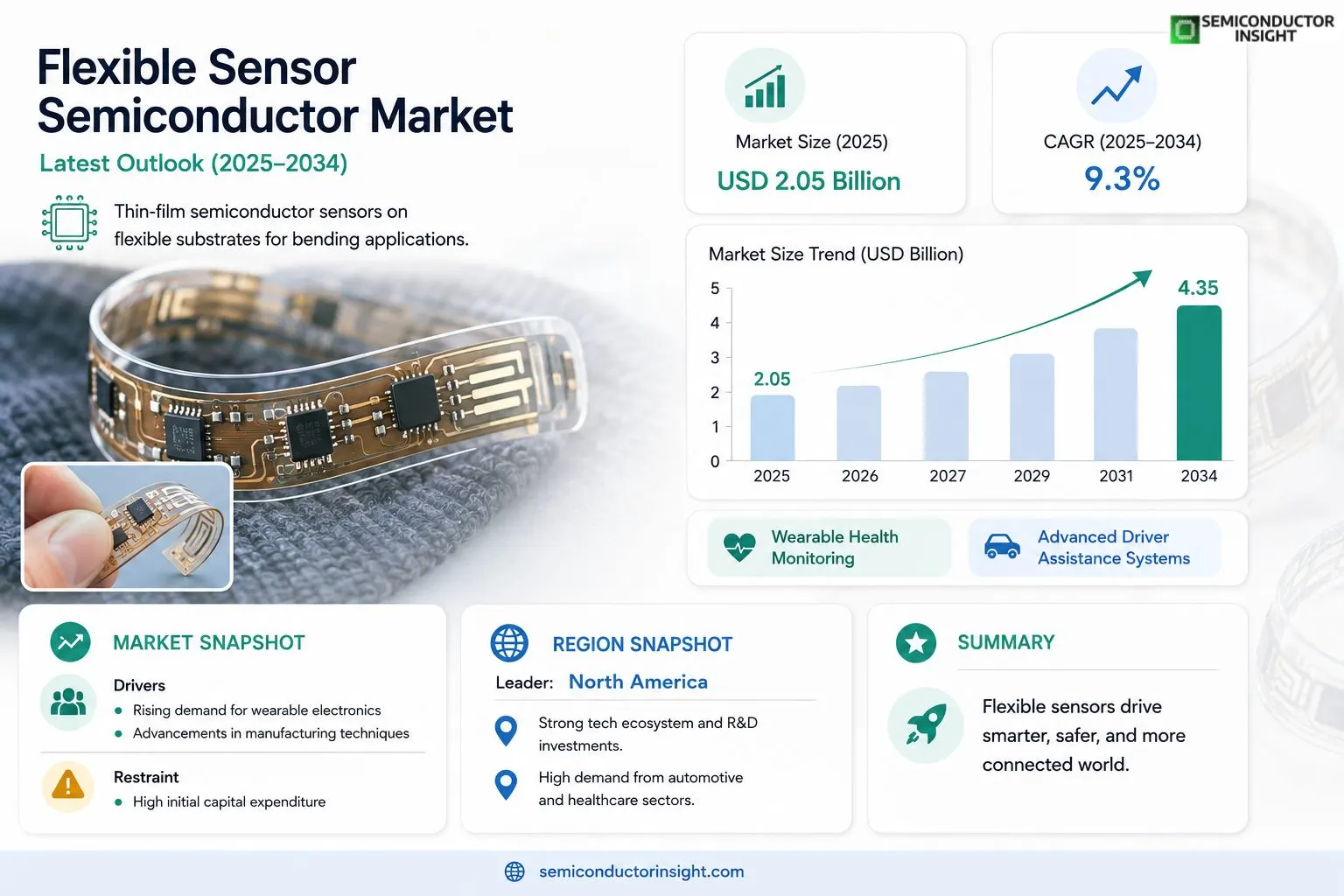
Global flexible sensor semiconductor market size was valued at USD 2.05 billion in 2025. The market is projected to grow from USD 2.12 billion in 2026 to USD 4.35 billion by 2034, exhibiting a CAGR of 9.3% during the forecast period.
Flexible sensor semiconductors are thin‑film electronic components mounted on bendable substrates such as polyimide or PET that can detect pressure, strain, temperature or chemical changes while maintaining electrical performance under mechanical deformation.The market is experiencing rapid growth because of expanding demand for wearable health monitors, smart textiles, and advanced driver‑assistance systems that require lightweight and conformable sensing solutions. Furthermore, rising investment in Internet‑of‑Things (IoT) platforms and the push for miniaturized medical diagnostics are accelerating adoption. Key players,including Samsung Electro‑Mechanics, Texas Instruments, STMicroelectronics and Bosch Sensortec,are actively launching new product families and forming strategic partnerships to capture this momentum.
MARKET DRIVERS
Rising Demand for Wearable Electronics
Flexible Sensor Semiconductor Market is being propelled by an accelerating adoption of wearable health‑monitoring devices. Consumers increasingly expect devices that conform to body contours, creating a need for thin, bendable semiconductors capable of high‑resolution sensing.
Advancements in Manufacturing Techniques
Innovations such as roll‑to‑roll printing and laser‑directed patterning have lowered production costs by roughly 20%, enabling larger scale deployment of flexible sensor chips across automotive and IoT applications.
➤ Industry analysts project a CAGR of about 12% for Flexible Sensor Semiconductor Market through 2030, driven primarily by health‑tech and smart‑city initiatives.
Regulatory support for low‑power, flexible electronics in medical diagnostics further strengthens market momentum, making the sector attractive for both incumbents and start‑ups.
MARKET CHALLENGES
Material Reliability and Longevity
Despite rapid progress, many polymer substrates still exhibit degradation under repetitive bending, which can compromise sensor accuracy over time. This reliability issue raises concerns for automotive safety systems that demand long‑term stability.
Other Challenges
Supply Chain Constraints
The limited number of high‑purity, flexible wafer suppliers creates bottlenecks, driving up component lead times and pricing for end‑users.
MARKET RESTRAINTS
High Initial Capital Expenditure
Establishing dedicated roll‑to‑roll production lines requires substantial upfront investment, often exceeding $150 million, which deters smaller firms from entering Flexible Sensor Semiconductor Market.Additionally, the lack of standardized testing protocols hampers cross‑industry adoption, as manufacturers must conduct proprietary validation, further inflating development costs.
MARKET OPPORTUNITIES
Emerging Applications in Soft Robotics
Soft‑robotic platforms require sensors that can conform to complex, moving surfaces without sacrificing performance. Flexible semiconductors offer a unique solution, opening a high‑growth niche for the market.Furthermore, the integration of 5G‑enabled flexible sensors into smart‑city infrastructure,such as flexible environmental monitors on public transit,presents a multi‑billion‑dollar revenue avenue over the next decade.
Flexible Sensor Semiconductor Market Trends
Rise of Wearable Health Monitoring
Flexible Sensor Semiconductor Market is being reshaped by the rapid expansion of wearable health devices. Devices such as continuous glucose monitors, cardiac rhythm trackers, and motion‑analysis bands rely on thin‑film semiconductors that can flex with the human body while delivering accurate electrical signals. Manufacturers are prioritizing low‑power consumption and biocompatible substrates to meet stringent medical standards, resulting in a surge of new product introductions. This trend is supported by growing consumer awareness of preventive health care and increasing reimbursement pathways for remote patient monitoring, which together drive higher unit shipments and broader geographic adoption.
Other Trends
Smart Textile Integration
Another significant development within Flexible Sensor Semiconductor Market is the integration of sensors directly into fabrics. Textile‑based platforms enable continuous monitoring of posture, temperature, and strain without the need for separate devices. Recent collaborations between semiconductor firms and apparel manufacturers have produced conductive yarns and laminated polymer layers that retain sensor functionality after repeated washing cycles. These innovations open new revenue streams in sports performance gear, military uniforms, and everyday clothing, where real‑time data can enhance safety, comfort, and productivity. The convergence of textile engineering and semiconductor technology is creating a scalable path toward mass‑market adoption.
Automotive ADAS Sensor Adoption
Automotive manufacturers are embedding flexible sensor semiconductors into advanced driver‑assistance systems (ADAS) to improve occupant safety and vehicle dynamics. The ability of these components to conform to curved surfaces,such as dashboards, steering wheels, and door panels,allows designers to place pressure and vibration sensors in locations previously unavailable with rigid devices. As electric and autonomous vehicle platforms evolve, the demand for lightweight, reliable sensing solutions grows, prompting major players to accelerate development cycles and secure strategic supply agreements. This shift not only strengthens the market’s industrial foothold but also diversifies its application portfolio beyond consumer electronics.
COMPETITIVE LANDSCAPEKey Industry Players
Flexible Sensor Semiconductor Market: Competitive Landscape Overview
Flexible Sensor Semiconductor Market is dominated by a handful of vertically‑integrated technology leaders that combine thin‑film process expertise with deep relationships in wearables, automotive and IoT sectors. Samsung Electro‑Mechanics leverages its advanced packaging platform to deliver high‑density, bendable pressure and temperature arrays, while Texas Instruments capitalizes on its analog front‑end portfolio to enable low‑power strain‑gauge solutions for smart textiles. STMicroelectronics and Bosch Sensortec complement these capabilities by offering modular sensor families that integrate MEMS sensing with flexible interconnects, positioning them as primary suppliers for automotive driver‑assistance systems and next‑generation health‑monitoring devices. Collectively, these firms shape market structure through extensive R&D investment, strategic OEM partnerships, and aggressive product roadmaps that drive the projected 9.3% CAGR through 2034.Beyond the major tier‑1 players, a diverse set of niche innovators contributes critical differentiated technologies that expand the application envelope of flexible semiconductors. Analog Devices focuses on high‑precision piezoresistive chips for biomedical diagnostics, while ams AG specializes in organic photodetectors for skin‑contact optical sensing. Infineon and NXP Semiconductors accelerate automotive adoption by integrating flexible pressure sensors into cockpit control panels. Murata Manufacturing, Melexis, TDK, Sensirion, and ROHM Semiconductor each supply specialized form‑factor modules,ranging from humidity‑sensitive polymer layers to capacitive touch sensors,that enable rapid OEM integration. This breadth of specialized suppliers fuels a competitive ecosystem where innovation, customization and supply‑chain agility are paramount.
List of Key Flexible Sensor Semiconductor Companies Profiled
- Samsung Electro‑Mechanics
- Texas Instruments
- STMicroelectronics
- Bosch Sensortec
- Analog Devices
- ams AG
- Infineon Technologies
- NXP Semiconductors
- Murata Manufacturing
- Melexis
- TDK Corporation
- Sensirion
- ROHM Semiconductor
- Vishay Intertechnology
- Cypress Semiconductor (Infineon)
Segment Analysis:
| Segment Category | Sub-Segments | Key Insights |
| By Type |
|
Pressure sensors are emerging as the dominant type because they readily adapt to curvilinear surfaces and maintain signal fidelity under repeated bending.
|
| By Application |
|
Wearable health monitoring drives the application landscape as designers seek ultra‑thin, conformable sensors to capture physiological signals in real time.
|
| By End User |
|
Consumer electronics lead the end‑user segment because manufacturers prioritize sleek, flexible interfaces for next‑generation smartphones, tablets, and AR/VR headsets.
|
| By Technology |
|
Thin‑film deposition dominates because it delivers uniform semiconductor layers on polymer substrates while preserving mechanical compliance.
|
| By Deployment |
|
On‑device integration is the preferred deployment model as designers embed sensors directly into flexible circuits, reducing latency and power consumption.
|
Regional Analysis: North America
North America
The consumer electronics segment represents a significant driver for flexible sensor semiconductors in North America. The demand for innovative wearables with integrated health monitoring capabilities and flexible displays is fueling market expansion.
The automotive sector is increasingly adopting flexible sensors for applications such as driver monitoring systems, in-cabin comfort controls, and advanced driver-assistance systems (ADAS). The need for lightweight, conformable sensors is a key advantage in automotive applications.
The healthcare industry is witnessing growing interest in flexible sensors for continuous patient monitoring, wearable medical devices, and minimally invasive diagnostic tools. The biocompatibility and conformability of flexible sensors are critical advantages in this sector.
Flexible sensor semiconductors are finding applications in industrial automation, asset tracking, and Internet of Things (IoT) devices. Their durability and ability to withstand harsh environments make them suitable for industrial use.
Europe
Europe presents a strong and steadily growing market for Flexible Sensor Semiconductor Market. Driven by a focus on sustainable technologies, the region is witnessing increased adoption of flexible sensors in various sectors. The automotive and healthcare industries are key drivers, with a growing emphasis on electric vehicles and personalized healthcare solutions. Government initiatives supporting innovation and digitalization are further boosting market growth.
Asia-Pacific
Asia-Pacific is anticipated to be the fastest-growing market for Flexible Sensor Semiconductor Market. The region’s large consumer base, rapid industrialization, and increasing investments in technology are contributing to strong demand. China, Japan, and South Korea are key markets, with significant opportunities in consumer electronics, automotive, and healthcare.
South America
South America represents an emerging market for Flexible Sensor Semiconductor Market. The growing adoption of smartphones, wearables, and industrial automation is creating demand for flexible sensors. The region’s focus on infrastructure development and increasing investments in technology are expected to drive market growth in the coming years.
Middle East & Africa
The Middle East & Africa region is expected to witness moderate growth in Flexible Sensor Semiconductor Market. The increasing investments in healthcare, automotive, and industrial sectors are contributing to demand. The region’s growing focus on smart cities and urbanization is also expected to drive market growth.
Report Scope
This market research report provides a comprehensive analysis of the Flexible Sensor Semiconductor Market , covering the forecast period 2026–2034. It offers detailed insights into market dynamics, technological advancements, competitive landscape, and key trends shaping the industry.
Key focus areas of the report include:
- Market Overview: The report begins with an overview outlining its current market scenario, key growth indicators, and industry transformation drivers. It discusses macroeconomic factors, demand–supply balance, regulatory landscape, and the strategic role of semiconductors in powering advancements across industries such as automotive, telecommunications, consumer electronics, and industrial automation.
- Market Size & Forecast: Historical data and future projections for revenue, unit shipments, and market value across major regions and segments.
- Segmentation Analysis: Detailed breakdown by product type, technology, application, and end-user industry to identify high-growth segments and investment opportunities.
- Regional Insights: Insights into market performance across North America, Europe, Asia-Pacific, Latin America, and the Middle East & Africa, including country-level analysis where relevant.
- Competitive Landscape: Profiles of leading market participants, including their product offerings, R&D focus, manufacturing capacity, pricing strategies, and recent developments such as mergers, acquisitions, and partnerships.
- Technology Trends & Innovation: Assessment of emerging technologies, integration of AI/IoT, semiconductor design trends, fabrication techniques, and evolving industry standards.
- Market Drivers & Restraints: Evaluation of factors driving market growth along with challenges, supply chain constraints, regulatory issues, and market-entry barriers.
- Stakeholder Insights: Insights for component suppliers, OEMs, system integrators, investors, and policymakers regarding the evolving ecosystem and strategic opportunities.
Primary and secondary research methods are employed, including interviews with industry experts, data from verified sources, and real-time market intelligence to ensure the accuracy and reliability of the insights presented.
FREQUENTLY ASKED QUESTIONS:
What is the current market size of Flexible Sensor Semiconductor Market?
-> Flexible Sensor Semiconductor Market was valued at USD 2.05 billion in 2025 and is expected to reach USD 4.35 billion by 2034.
Which key companies operate in Flexible Sensor Semiconductor Market?
-> Key players include Samsung Electro‑Mechanics, Texas Instruments, STMicroelectronics, and Bosch Sensortec, among others.
What are the key growth drivers?
-> Key growth drivers include wearable health monitors, smart textiles, advanced driver‑assistance systems, Internet‑of‑Things platforms, and miniaturized medical diagnostics.
Which region dominates the market?
-> The reference does not specify a dominant region.
What are the emerging trends?
-> Emerging trends include wearable health monitoring solutions, smart textile integration, advanced driver‑assistance system sensors, IoT‑enabled sensing, and miniaturized medical diagnostic devices.

Get Sample Report PDF for Exclusive Insights
Report Sample Includes
- Table of Contents
- List of Tables & Figures
- Charts, Research Methodology, and more...
 Download Sample Report PDF


