NVDIMM (Non-Volatile DIMM) Market Insights
NVDIMM (Non-Volatile DIMM) Market size was valued at USD 1.87 billion in 2025. The market is projected to grow from USD 2.09 billion in 2026 to USD 5.14 billion by 2034, exhibiting a CAGR of 10.6% during the forecast period.
NVDIMMs, or Non-Volatile Dual Inline Memory Modules, are a class of hybrid memory technology that combines the speed of DRAM with the data persistence of non-volatile storage , most commonly NAND flash. Unlike conventional DRAM, NVDIMMs retain data even in the event of a sudden power loss, making them especially critical in enterprise computing, financial transaction processing, and mission-critical server environments. The technology spans several form factors, including NVDIMM-N, which pairs DRAM and flash on a single module, NVDIMM-F, which offers flash-only storage in a DIMM form factor, and NVDIMM-P, a newer standard designed for higher capacity and mixed-mode operation.
The market is experiencing robust growth driven by the escalating demand for high-speed, reliable memory solutions in data centers, cloud computing infrastructure, and artificial intelligence workloads. Furthermore, the rapid proliferation of edge computing deployments and the growing adoption of in-memory databases have significantly amplified the need for persistent memory technologies. Key industry players such as Micron Technology, Inc., SK Hynix Inc., and Samsung Electronics Co., Ltd. continue to expand their NVDIMM portfolios, reinforcing competitive dynamics and accelerating technological advancement across the global market.
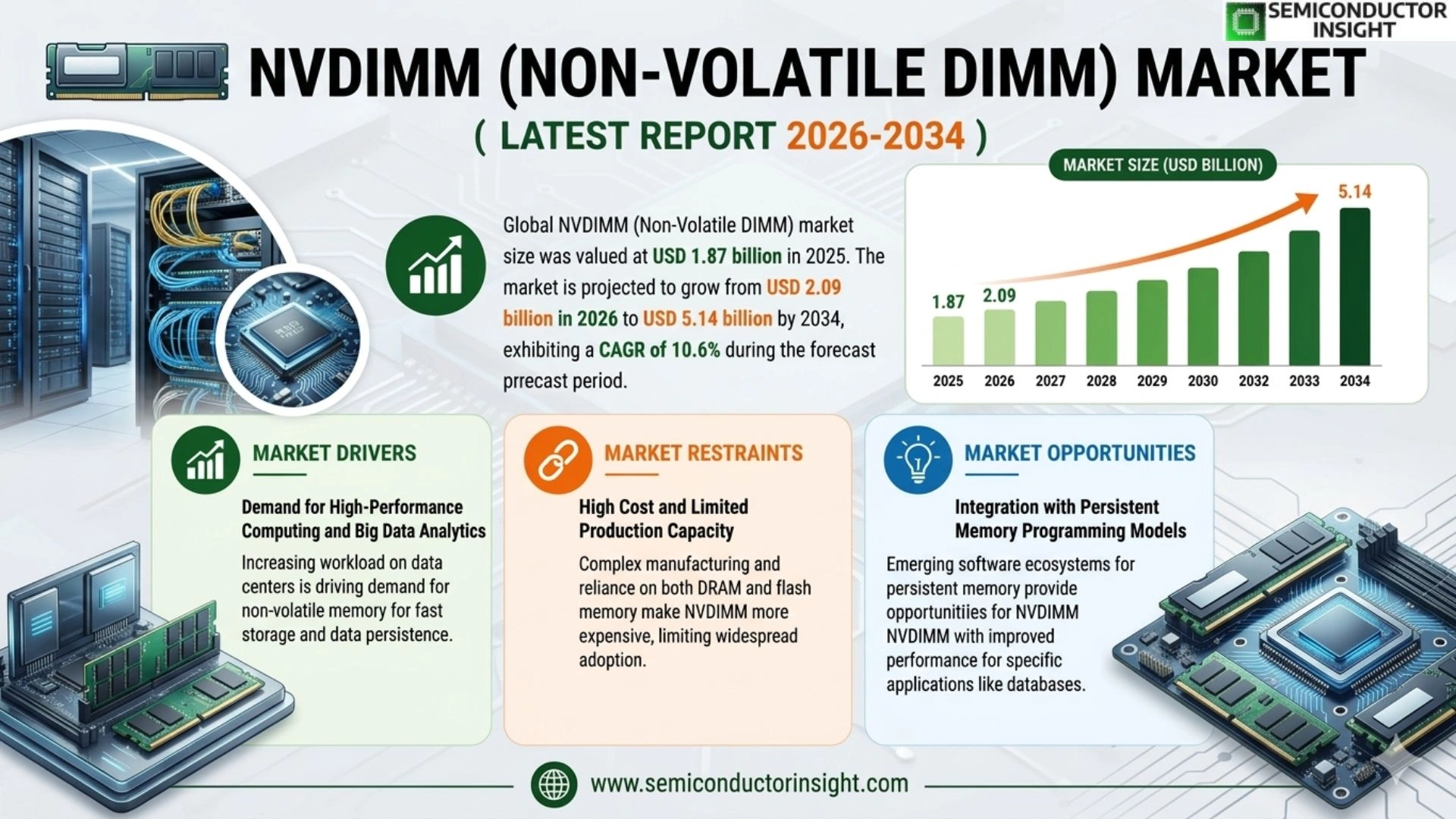
MARKET DRIVERS
Surging Demand for High-Performance Data Persistence in Enterprise Computing
NVDIMM (Non-Volatile DIMM) Market is experiencing robust growth, driven primarily by the accelerating need for ultra-low latency data persistence in enterprise server environments. As data center operators seek to bridge the performance gap between volatile DRAM and traditional NAND flash storage, NVDIMM technology has emerged as a compelling solution that delivers byte-addressable, persistent memory at near-DRAM speeds. Industries such as financial services, telecommunications, and high-frequency trading platforms are increasingly integrating NVDIMMs into their infrastructure to ensure data integrity during power failures while maintaining the throughput demands of mission-critical workloads.
Exponential Growth in Big Data Analytics and Real-Time Processing Requirements
The proliferation of big data analytics platforms and in-memory databases is a significant catalyst propelling NVDIMM (Non-Volatile DIMM) Market forward. Enterprises deploying workloads such as SAP HANA, Redis, and other in-memory computing frameworks benefit substantially from persistent memory modules that eliminate the time-consuming process of reloading datasets into DRAM after system restarts. This capability translates directly into reduced recovery time objectives (RTOs) and operational cost savings. As real-time analytics becomes a competitive necessity across retail, healthcare, and manufacturing sectors, the adoption curve for NVDIMM solutions is expected to steepen considerably through the forecast period.
➤ The integration of NVDIMM technology within hyperscale data centers represents one of the most decisive inflection points in persistent memory adoption, fundamentally redefining the boundary between storage and memory hierarchies in modern server architecture.
Server platform advancements from leading OEMs, including support for JEDEC-standardized NVDIMM-N, NVDIMM-F, and NVDIMM-P form factors, are further lowering barriers to deployment. As processor architectures natively accommodate persistent memory controllers and operating systems expand support for memory-mapped file access via technologies such as DAX (Direct Access), the ecosystem surrounding NVDIMM (Non-Volatile DIMM) Market is maturing rapidly, making large-scale enterprise deployment increasingly straightforward and cost-effective.
MARKET CHALLENGES
High Unit Cost and Total Cost of Ownership Constraints Limiting Broad Adoption
Despite its compelling technical advantages, NVDIMM (Non-Volatile DIMM) Market faces a persistent challenge in the form of elevated unit pricing relative to conventional DRAM and NAND-based storage alternatives. The hybrid architecture of NVDIMMs , combining DRAM, NAND flash, and supercapacitor or battery backup components , inherently increases bill-of-materials costs. For small and medium-sized enterprises operating under constrained IT budgets, the total cost of ownership associated with deploying NVDIMM-equipped servers can be prohibitive, slowing penetration beyond hyperscale and large enterprise segments. Demonstrating a clear return on investment in use cases outside of financial services and high-performance computing remains an ongoing challenge for vendors and channel partners.
Other Challenges
Application Ecosystem Fragmentation and Software Compatibility Gaps
A meaningful impediment to widespread NVDIMM adoption is the fragmented state of software support across operating systems, hypervisors, and application stacks. While Linux-based environments have advanced persistent memory programming models through the PMDK (Persistent Memory Development Kit), enterprise Windows and VMware ecosystems have lagged in delivering seamless, native NVDIMM utilization. Developers must often rewrite or significantly refactor applications to take full advantage of persistent memory semantics, increasing deployment complexity and extending time-to-value cycles for organizations evaluating NVDIMM (Non-Volatile DIMM) Market opportunity.
Supply Chain Constraints and Component Availability
NVDIMM (Non-Volatile DIMM) Market is also susceptible to supply chain volatility affecting key components, particularly NAND flash memory and specialized power management integrated circuits. Fluctuations in NAND pricing and periodic shortages of supercapacitor components can disrupt production schedules and compress vendor margins. Geopolitical tensions affecting semiconductor supply chains add an additional layer of uncertainty for NVDIMM manufacturers seeking to scale production in alignment with enterprise demand growth.
MARKET RESTRAINTS
Competitive Pressure from Emerging Persistent Memory and Storage-Class Memory Alternatives
NVDIMM (Non-Volatile DIMM) Market faces a notable restraint from competing persistent memory technologies that offer overlapping capabilities at different price and performance points. Intel’s Optane Persistent Memory (3D XPoint-based), though now discontinued as a product line, demonstrated that alternative architectures could address similar use cases and disrupted vendor roadmaps during its commercial availability. The emergence of CXL (Compute Express Link)-attached memory pooling solutions and advanced storage-class memory devices presents an evolving competitive landscape in which NVDIMMs must continuously demonstrate differentiated value, particularly in latency-sensitive applications where byte-addressable access remains the primary performance lever.
Limited Awareness and Technical Expertise Among Potential End-User Segments
Beyond hyperscale cloud providers and Tier-1 financial institutions, awareness of the operational and architectural benefits of NVDIMM technology remains relatively low. Many IT decision-makers in mid-market enterprises are unfamiliar with persistent memory programming models, the SNIA (Storage Networking Industry Association) NVM Programming Model, or the practical implications of memory-semantic storage for their specific workloads. This knowledge gap restrains market expansion by extending sales cycles and increasing the need for vendor-led education and proof-of-concept investments. Until persistent memory literacy improves across a broader base of IT professionals, NVDIMM (Non-Volatile DIMM) Market will continue to face headwinds in penetrating non-specialized vertical markets.
MARKET OPPORTUNITIES
Accelerating AI and Machine Learning Infrastructure Investment Creating New Use Cases
The rapid expansion of artificial intelligence and machine learning infrastructure presents a compelling growth opportunity for NVDIMM (Non-Volatile DIMM) Market. AI training pipelines and inference workloads generate and consume vast intermediate datasets that benefit from persistent, high-bandwidth memory capable of surviving power interruptions without data loss. As GPU clusters and AI accelerators are deployed at scale within hyperscale and enterprise data centers, complementary persistent memory solutions including NVDIMMs are increasingly specified as part of optimized memory hierarchies. Vendors that successfully position NVDIMM products within AI infrastructure reference architectures stand to capture meaningful incremental revenue as global AI hardware spending continues its upward trajectory.
Edge Computing Deployment and Industrial IoT Expansion Opening Adjacent Market Segments
Edge computing represents a strategically important adjacent opportunity for NVDIMM (Non-Volatile DIMM) Market, particularly in industrial IoT, autonomous systems, and telecommunications network edge deployments. Edge nodes operating in environments with unreliable power supplies , such as remote industrial facilities, autonomous vehicles, and 5G multi-access edge computing (MEC) servers , require memory subsystems that guarantee data persistence without relying on uninterruptible power supplies. The compact form factor and ruggedized variants of NVDIMM modules align well with the space, power, and reliability constraints of edge deployments. As global edge infrastructure investment intensifies, NVDIMM suppliers have a tangible opportunity to diversify their customer base beyond traditional data center accounts and establish footholds in high-growth industrial and telecommunications segments.
Trends
Rising Demand from Data Centers and Cloud Infrastructure Drives NVDIMM (Non-Volatile DIMM) Market Growth
NVDIMM (Non-Volatile DIMM) Market is witnessing accelerating momentum as enterprises and hyperscale data center operators increasingly prioritize memory solutions that combine high-speed data access with persistent storage capabilities. NVDIMMs, which integrate DRAM speed with the data retention properties of NAND flash, have become indispensable in environments where data integrity during power interruptions is non-negotiable. As cloud computing infrastructure scales globally, the deployment of NVDIMM modules across server architectures has become a strategic priority for organizations managing vast, latency-sensitive workloads. This trend is expected to sustain strong market expansion through the forecast period.
Other Trends
Artificial Intelligence and In-Memory Database Adoption
The rapid proliferation of artificial intelligence workloads and the growing reliance on in-memory databases have significantly amplified demand withNVDIMM (Non-Volatile DIMM) Market. AI training and inference pipelines require memory subsystems that can deliver both speed and persistence, positioning NVDIMMs as a preferred technology in high-performance computing environments. Enterprises deploying real-time analytics platforms and transactional databases increasingly rely on persistent memory modules to reduce latency and protect against data loss, reinforcing the market’s upward trajectory.
Expansion of NVDIMM Form Factors and Standards
Technological evolution across NVDIMM standards , including NVDIMM-N, NVDIMM-F, and the newer NVDIMM-P , is broadening the addressable use cases within the market. NVDIMM-P, designed for higher capacity and mixed-mode operation, is gaining particular attention for next-generation server deployments. Leading industry players such as Micron Technology, Inc., SK Hynix Inc., and Samsung Electronics Co., Ltd. continue to expand their NVDIMM product portfolios, intensifying competitive dynamics and accelerating innovation across the global landscape.
Edge Computing Deployments Emerge as a Key Growth Avenue
Beyond traditional data centers, NVDIMM (Non-Volatile DIMM) Market is benefiting from the rapid proliferation of edge computing deployments. Edge nodes operating in environments with unreliable power supplies require memory solutions that guarantee data persistence, making NVDIMMs a technically compelling choice. As industries including manufacturing, telecommunications, and autonomous systems expand their edge infrastructure, demand for reliable, high-performance persistent memory modules is expected to represent a meaningful incremental growth driver for the market in the years ahead.
COMPETITIVE LANDSCAPE
Key Industry Players
NVDIMM (Non-Volatile DIMM) Market: Competitive Dynamics and Leading Manufacturers Shaping the Global Landscape
Global NVDIMM (Non-Volatile DIMM) Market is characterized by a moderately consolidated competitive landscape, with a handful of dominant semiconductor and memory technology giants commanding significant market share. Micron Technology, Inc. stands out as a frontrunner, leveraging its extensive DRAM and NAND flash expertise to deliver robust NVDIMM-N and NVDIMM-P solutions tailored for enterprise server and data center environments. Samsung Electronics Co., Ltd. and SK Hynix Inc. similarly maintain formidable positions, continuously expanding their persistent memory portfolios to address the surging demand from cloud computing operators, artificial intelligence infrastructure deployments, and high-frequency financial transaction processing systems. These tier-one players invest heavily in R&D, enabling them to push capacity thresholds and improve read/write latency benchmarks, thereby setting the pace for global technological advancement in non-volatile memory.
Beyond the leading incumbent,several specialized and emerging players contribute meaningfully to the NVDIMM competitive ecosystem. Companies such as Viking Technology and Netlist, Inc. have carved out notable niches by offering application specific NVDIMM modules optimized for mission-critical and ruggedized computing environments. AgigA Tech, a subsidiary of Cypress Semiconductor, has been recognized for its power-protected NVDIMM solutions targeting enterprise storage and server platforms. Intel Corporation, through its Optane persistent memory technology, has also influenced NVDIMM architecture standards, particularly in the NVDIMM-P segment. Meanwhile, SMART Modular Technologies and Virtium continue to serve defense, industrial, and embedded computing segments with highly reliable non-volatile memory modules. The competitive intensity is further amplified by ongoing standardization efforts under JEDEC, which facilitate broader interoperability and encourage new entrants to develop compatible NVDIMM solutions across diverse form factors including NVDIMM-N,NVDIMM-F and NVDIMM-P.
List of Key NVDIMM (Non-Volatile DIMM) Companies Profiled
- Micron Technology, Inc.
- Samsung Electronics Co., Ltd.
- SK Hynix Inc.
- Intel Corporation
- Viking Technology
- Netlist, Inc.
- AgigA Tech (Cypress Semiconductor)
- SMART Modular Technologies
- Virtium
- Hewlett Packard Enterprise (HPE)
- Dell Technologies
- Lenovo Group Limited
- Supermicro (Super Micro Computer, Inc.)
- Montage Technology
Segment Analysis:
| Segment Category | Sub-Segments | Key Insights |
| By Type |
|
NVDIMM-N continues to hold the leading position in the NVDIMM market, owing to its well-established architecture that integrates DRAM and NAND flash on a single module with an onboard energy source.
|
| By Application |
|
Data Centers & Cloud Computing represents the most prominent application segment driving demand across the NVDIMM market globally.
|
| By End User |
|
Banking, Financial Services & Insurance (BFSI) leads as the dominant end user segment in the NVDIMM market, driven by the sector’s uncompromising demands for data resilience and ultra-fast transactional throughput.
|
| By Deployment Mode |
|
On-Premises deployment continues to dominate the NVDIMM market, particularly among large enterprises and government entities that mandate stringent control over sensitive data and computing infrastructure.
|
| By Form Factor |
|
Standard DIMM form factor holds the leading share within this segment, as it is the predominant module format used across enterprise-grade servers and high-performance computing platforms worldwide.
|
Regional Analysis: NVDIMM (Non-Volatile DIMM) Market
North America
North America’s extensive network of hyperscale and colocation data centers represents one of the strongest demand drivers for NVDIMM (Non-Volatile DIMM) Market. As workloads grow increasingly complex and latency-sensitive, operators are prioritizing persistent memory architectures that deliver rapid data access while ensuring durability during power interruptions. This infrastructure momentum shows no signs of abating through the forecast horizon.
The financial sector across North America is a prominent adopter of NVDIMM solutions, leveraging non-volatile memory to support real-time transaction processing, risk analytics, and algorithmic trading platforms. The need for zero data-loss environments and near-instant recovery capabilities aligns perfectly with NVDIMM’s core value proposition, making banking and capital markets a key vertical sustaining regional market momentum.
A robust domestic semiconductor ecosystem, comprising memory chip designers, module manufacturers, and system integrators, gives North America a structural advantage NVDIMM (Non-Volatile DIMM) Market. Ongoing investment in domestic chip fabrication, supported by policy initiatives, is reducing supply chain vulnerabilities and enabling faster product innovation cycles that reinforce the region’s technology leadership position.
The rapid proliferation of artificial intelligence and high-performance computing initiatives across North American enterprises and research institutions is generating substantial demand for NVDIMM-based memory solutions. These workloads require persistent, high-bandwidth memory to manage large in-memory datasets efficiently, and NVDIMM technology delivers the combination of speed and resilience that modern AI infrastructure demands.
Europe
Europe represents a significant and steadily maturing market for NVDIMM (Non-Volatile DIMM) solutions, shaped by the region’s strong emphasis on data sovereignty, digital infrastructure modernization, and enterprise-grade computing reliability. Germany, the United Kingdom, and France lead regional adoption, with their advanced manufacturing sectors and financial institutions recognizing the value of non-volatile memory in ensuring business continuity and operational resilience. The European Union’s push toward digital transformation and cloud-native infrastructure across both public and private sectors is creating consistent demand for persistent memory technologies. Additionally, stringent data protection regulations such as GDPR are prompting organizations to invest in storage architectures that minimize data loss risks, a requirement that NVDIMM solutions address directly. Research collaborations between European universities and technology firms are also contributing to the development of next-generation NVDIMM applications, ensuring that the region remains a competitive and innovation-oriented participant in the global market through 2034.
Asia-Pacific
Asia-Pacific is emerging as one of the fastest-growing regions NVDIMM (Non-Volatile DIMM) Market, underpinned by rapid data center construction, booming cloud service adoption, and aggressive government-backed semiconductor development programs. China, Japan, South Korea, and Taiwan are at the forefront of this regional expansion, each bringing distinct strengths ranging from large-scale manufacturing capacity to cutting-edge memory chip research. The explosive growth of e-commerce, digital payments, and streaming media platforms across the region is generating extraordinary volumes of data that demand high-performance, persistent memory solutions. Japan’s heritage in precision electronics and South Korea’s dominance in DRAM manufacturing provide a strong industrial foundation for NVDIMM ecosystem development. As regional cloud providers scale their infrastructure and enterprises modernize legacy IT environments, Asia-Pacific is poised to narrow the gap with North America in overall NVDIMM market contribution over the forecast period.
South America
South America occupies an emerging position in Global NVDIMM (Non-Volatile DIMM) Market, with growth prospects tied closely to the region’s expanding digital economy and gradual modernization of enterprise IT infrastructure. Brazil stands out as the primary demand center, driven by its large financial services sector, growing cloud adoption among local enterprises, and increasing awareness of data resilience requirements. While the region currently represents a relatively modest share of global NVDIMM consumption, the trajectory is positive as multinational technology vendors expand their presence and local data center operators invest in higher-performance storage and memory architectures. Economic constraints and import dependencies on advanced semiconductor components remain challenges, but regional free trade agreements and improving digital infrastructure are progressively enabling broader access to NVDIMM technology. South America’s long-term outlook for non-volatile memory adoption remains constructive as enterprise digitalization deepens.
Middle East & Africa
The Middle East and Africa region represents an early-stage but strategically important frontier for NVDIMM (Non-Volatile DIMM) Market, with growth concentrated primarily in the Gulf Cooperation Council countries and select African technology hubs. The UAE and Saudi Arabia are spearheading data center investment as part of broader national digital transformation agendas, creating a foundation for future NVDIMM adoption in cloud and enterprise computing environments. Smart city initiatives, financial sector modernization, and expanding telecommunications infrastructure are key demand catalysts across the Middle East. In Africa, South Africa leads regional technology adoption, with growing interest in resilient memory architectures among financial institutions and telecoms operators. While the overall penetration of NVDIMM solutions remains limited relative to other global regions, increasing foreign direct investment in digital infrastructure and a young, technology-oriented population signal a promising long-term growth trajectory for NVDIMM (Non-Volatile DIMM) Market across Middle East and Africa through 2034.
Report Scope
This market research report provides a comprehensive analysis of the NVDIMM (Non-Volatile DIMM) Market , covering the forecast period 2026–2034. It offers detailed insights into market dynamics, technological advancements, competitive landscape, and key trends shaping the industry.
Key focus areas of the report include:
- Market Overview: The report begins with an overview outlining its current market scenario, key growth indicators, and industry transformation drivers. It discusses macroeconomic factors, demand–supply balance, regulatory landscape, and the strategic role of semiconductors in powering advancements across industries such as automotive, telecommunications, consumer electronics, and industrial automation.
- Market Size & Forecast: Historical data and future projections for revenue, unit shipments, and market value across major regions and segments.
- Segmentation Analysis: Detailed breakdown by product type, technology, application, and end-user industry to identify high-growth segments and investment opportunities.
- Regional Insights: Insights into market performance across North America, Europe, Asia-Pacific, Latin America, and the Middle East & Africa, including country-level analysis where relevant.
- Competitive Landscape: Profiles of leading market participants, including their product offerings, R&D focus, manufacturing capacity, pricing strategies, and recent developments such as mergers, acquisitions, and partnerships.
- Technology Trends & Innovation: Assessment of emerging technologies, integration of AI/IoT, semiconductor design trends, fabrication techniques, and evolving industry standards.
- Market Drivers & Restraints: Evaluation of factors driving market growth along with challenges, supply chain constraints, regulatory issues, and market-entry barriers.
- Stakeholder Insights: Insights for component suppliers, OEMs, system integrators, investors, and policymakers regarding the evolving ecosystem and strategic opportunities.
Primary and secondary research methods are employed, including interviews with industry experts, data from verified sources, and real-time market intelligence to ensure the accuracy and reliability of the insights presented.
FREQUENTLY ASKED QUESTIONS:
What is the current market size of NVDIMM (Non-Volatile DIMM) Market?
-> NVDIMM (Non-Volatile DIMM) Market was valued at USD 1.87 billion in 2025 and is projected to grow from USD 2.09 billion in 2026 to USD 5.14 billion by 2034, exhibiting a CAGR of 10.6% during the forecast period.
Which key companies operate NVDIMM (Non-Volatile DIMM) Market?
-> Key players include Micron Technology, Inc., SK Hynix Inc., and Samsung Electronics Co., Ltd., among others, who continue to expand their NVDIMM portfolios and accelerate technological advancement across the global market.
What are the key growth drivers?
-> Key growth drivers include escalating demand for high-speed and reliable memory solutions in data centers, cloud computing infrastructure, artificial intelligence workloads, edge computing deployments, and the growing adoption of in-memory databases.
Which region dominates the market?
-> Asia-Pacific is the fastest-growing region, driven by rapid expansion in cloud and data center infrastructure, while North America remains a dominant market owing to strong enterprise computing and AI adoption.
What are the emerging trends?
-> Emerging trends include NVDIMM-P adoption for higher capacity mixed-mode operation, integration of persistent memory in AI and machine learning workloads, expansion of edge computing deployments, and increasing use of in-memory databases requiring non-volatile memory solutions.

Get Sample Report PDF for Exclusive Insights
Report Sample Includes
- Table of Contents
- List of Tables & Figures
- Charts, Research Methodology, and more...
 Download Sample Report PDF