NOR Flash for Communication Base Stations Market Insights
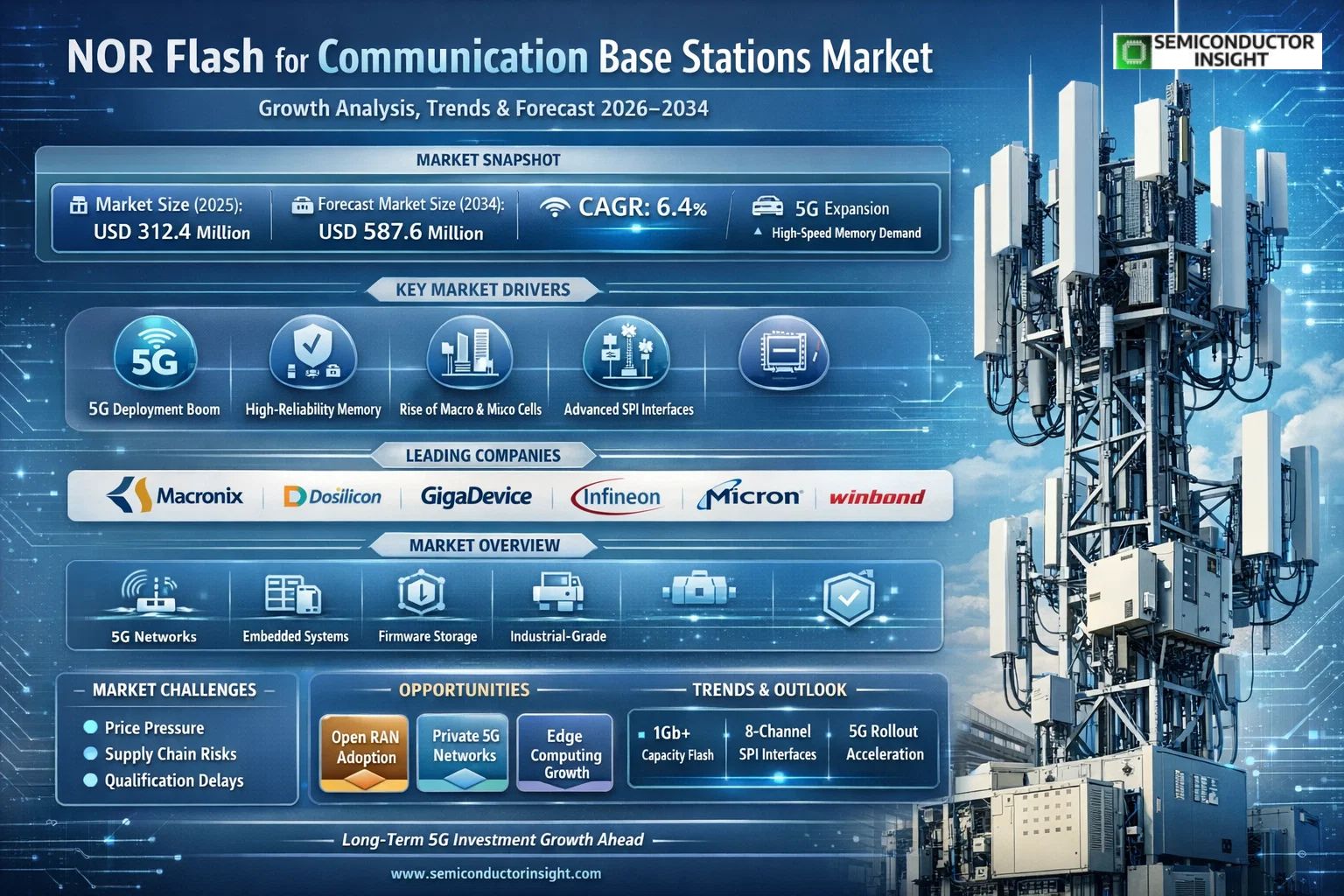
Global NOR Flash for Communication Base Stations market size was valued at USD 312.4 million in 2025. The market is projected to grow from USD 336.8 million in 2026 to USD 587.6 million by 2034, exhibiting a CAGR of 6.4% during the forecast period.
NOR Flash is a type of non-volatile memory widely used in embedded systems and communication infrastructure. Unlike NAND Flash, NOR Flash offers faster read speeds, lower read latency, and superior random access performance, making it particularly well-suited for code storage and execution in communication base stations. For deployment in 5G base stations specifically, NOR Flash solutions with a capacity of 1Gb or higher are typically required, featuring support for at least 4-channel SPI interfaces , with 8-channel SPI interfaces increasingly preferred , along with compliance with industrial temperature ranges to ensure reliable operation in demanding field environments.
The market is witnessing steady growth driven by the accelerating global rollout of 5G infrastructure, rising demand for high-reliability memory solutions in macro and micro base stations, and increasing investments by telecom operators in next-generation network upgrades. The transition from 4G LTE to 5G architecture has significantly elevated the performance requirements for embedded memory components, positioning NOR Flash as a critical enabler of base station functionality. Macronix, Dosilicon Co., Ltd., GigaDevice, Infineon Technologies, Micron, and Winbond are among the key manufacturers shaping the competitive landscape of this market with diversified product portfolios tailored for communication applications.
MARKET DRIVERS
Surging 5G Infrastructure Rollout Fueling Demand for NOR Flash in Communication Base Stations
Global expansion of 5G networks represents one of the most significant catalysts accelerating adoption of NOR Flash memory in communication base stations. As telecom operators invest heavily in next-generation radio access network (RAN) infrastructure, base station architectures increasingly require reliable, high-endurance non-volatile memory solutions for code storage and boot operations. NOR Flash memory, with its execute-in-place (XiP) capability and byte-level random access, is uniquely suited for firmware storage in base transceiver stations (BTS), remote radio units (RRUs), and baseband units (BBUs). The transition from 4G LTE to 5G New Radio (NR) architectures demands more sophisticated firmware management, directly expanding the addressable market for NOR Flash components in communication infrastructure.
Growing Complexity of Base Station Firmware Elevating NOR Flash Requirements
Modern communication base stations are no longer simple signal relay nodes , they are sophisticated computing platforms running complex real-time operating systems, beamforming algorithms, and multi-band radio management software. This growing firmware complexity has substantially increased the code storage requirements per base station unit, driving demand for higher-density NOR Flash solutions. Manufacturers are increasingly deploying multi-chip NOR Flash configurations within a single base station to accommodate expanding software stacks associated with Massive MIMO, Open RAN (O-RAN), and cloud-RAN (C-RAN) deployments. NOR Flash for Communication Base Stations market benefits directly from this trend as telecom OEMs prioritize memory components capable of handling frequent firmware-over-the-air (FOTA) updates with high reliability and data integrity.
➤ The proliferation of small cells, macro base stations, and distributed antenna systems (DAS) in dense urban 5G deployments is creating sustained, long-term demand for NOR Flash memory components, as each node requires dedicated non-volatile storage for boot code and critical system firmware.
Beyond 5G, the ongoing densification of communication networks through heterogeneous network (HetNet) architectures is further amplifying the volume of base station installations globally. Each incremental base station node , whether a macro cell, micro cell, or picocell , incorporates NOR Flash for firmware storage, multiplying unit consumption across carrier networks. Telecom operators in Asia-Pacific, North America, and Europe are simultaneously deploying infrastructure, creating concurrent demand spikes that reinforce the growth trajectory of NOR Flash for Communication Base Stations market across multiple geographies.
MARKET CHALLENGES
Intense Price Competition and Commoditization Pressures Creating Margin Headwinds for NOR Flash Suppliers
Despite robust end-market demand, suppliers operating in the NOR Flash for communication base stations segment face persistent pricing pressures driven by competition among established memory manufacturers. The consolidation of NOR Flash production among a relatively small number of global suppliers has not fully insulated the market from aggressive pricing dynamics, particularly as telecom OEMs and EMS providers negotiate volume contracts for large-scale base station deployments. Average selling price (ASP) erosion remains a structural challenge, compressing gross margins for NOR Flash vendors even as unit shipment volumes grow. This dynamic necessitates continuous investment in process node transitions and product differentiation to maintain profitability in the communication base station segment.
Other Challenges
Supply Chain Vulnerabilities and Geopolitical Disruptions
The NOR Flash supply chain for communication base stations is exposed to geopolitical tensions, particularly given the concentration of advanced semiconductor fabrication capacity in specific regions. Trade restrictions, export controls, and shifting procurement policies among major telecom infrastructure vendors have introduced sourcing uncertainty. Base station OEMs are increasingly required to qualify multiple NOR Flash suppliers to mitigate single-source risk, adding qualification time and engineering resources to product development cycles.
Extended Product Qualification and Certification Timelines
Communication base station applications demand stringent reliability standards, including operation across wide temperature ranges and compliance with telecom-grade quality certifications such as AEC-Q100 and JEDEC standards. The extensive qualification process required before a NOR Flash component can be designed into a base station platform significantly lengthens the design cycle. For NOR Flash manufacturers, this creates a delayed revenue recognition challenge, as engineering investments precede commercial shipments by 18 to 36 months in many cases.
MARKET RESTRAINTS
Limited Density Scaling and Technological Constraints of NOR Flash Architecture
One of the fundamental restraints affecting NOR Flash for Communication Base Stations market is the inherent architectural limitation of NOR Flash technology in achieving the density scaling that NAND Flash and emerging memory technologies have demonstrated. The cell structure of NOR Flash, while optimized for fast random read access and execute-in-place functionality, is less amenable to aggressive bit-density improvements through process node shrinkage. This constrains the maximum storage capacity available per die, limiting NOR Flash applicability in base station applications where larger software stacks may eventually require storage solutions beyond what traditional NOR Flash can economically provide. As base station firmware continues to grow in complexity, this density ceiling poses a medium-to-long-term competitive challenge for NOR Flash suppliers serving the communication infrastructure segment.
Emergence of Alternative Memory Technologies Challenging NOR Flash Incumbency
The communication base station memory landscape is increasingly scrutinized for potential substitution by alternative non-volatile memory technologies. Emerging solutions such as QSPI-interfaced NAND Flash with XiP emulation layers, as well as developments in MRAM and ReRAM, are being evaluated by base station platform designers seeking higher density, lower power consumption, or improved endurance characteristics. While NOR Flash retains significant incumbency advantages due to its proven reliability record and established ecosystem support in telecom applications, the growing maturity of alternative technologies represents a restraint on the long-term market expansion of NOR Flash in next-generation base station designs. Vendors must actively demonstrate the total cost of ownership and reliability advantages of NOR Flash to defend design-in positions against these emerging alternatives.
MARKET OPPORTUNITIES
Open RAN Architecture Proliferation Opening New NOR Flash Design-In Opportunities
The accelerating global adoption of Open RAN (O-RAN) frameworks presents a compelling growth opportunity for NOR Flash for Communication Base Stations market. O-RAN disaggregates traditional base station hardware, enabling a broader ecosystem of hardware vendors to participate in network deployments. This disaggregation increases the total number of discrete hardware platforms requiring NOR Flash for firmware storage, as each O-RAN component , including O-RU, O-DU, and O-CU units , independently incorporates non-volatile memory for boot and configuration storage. The democratization of base station hardware through O-RAN standards is expected to expand the addressable market for NOR Flash memory suppliers as new entrants in the telecom hardware space adopt standardized, commercially available memory components.
Expansion of Private 5G Networks and Edge Computing Infrastructure Creating Incremental Demand
The rapid deployment of private 5G networks across industrial, enterprise, and critical infrastructure verticals represents an emerging demand vector for NOR Flash in communication base stations beyond traditional public carrier deployments. Private 5G base stations serving manufacturing facilities, ports, airports, and smart campuses each incorporate NOR Flash for system firmware management, collectively adding meaningful incremental unit volumes to the overall market. Simultaneously, the convergence of base station infrastructure with mobile edge computing (MEC) platforms is increasing the firmware storage requirements per node, as edge compute functions are integrated into base station hardware. This trend creates opportunities for NOR Flash suppliers to position higher-density and higher-endurance product variants specifically optimized for the communication base station and private network segments, supporting margin improvement alongside volume growth in NOR Flash for Communication Base Stations market.
Trends
Rising 5G Infrastructure Deployment Driving Demand for NOR Flash in Communication Base Stations
NOR Flash for Communication Base Stations market is experiencing significant momentum, largely driven by the accelerating global rollout of 5G networks. As telecom operators expand their macro and micro base station infrastructure, the demand for reliable, high-performance non-volatile memory solutions has intensified. NOR Flash stands out in this landscape due to its superior random access performance, faster read speeds, and lower read latency compared to NAND Flash , characteristics that are critical for boot code storage and real-time operations in base station equipment. The shift toward 5G has prompted equipment manufacturers to specify higher-capacity NOR Flash solutions, generally 1Gb or above, with support for 8-channel SPI interfaces and compliance with industrial temperature ranges to ensure operational reliability in demanding outdoor environments.
Other Trends
Growing Preference for Higher Voltage and Interface Standards
Within NOR Flash for Communication Base Stations market, product segmentation by voltage , primarily 3.3V and 1.8V , reflects evolving design priorities among base station manufacturers. The 3.3V segment continues to hold a notable share of adoption, particularly in legacy and macro base station platforms where power architecture supports higher voltage operation. Meanwhile, 1.8V NOR Flash variants are gaining traction in newer, energy-efficient micro base station designs, where low power consumption is a key engineering requirement. The industry is also moving toward wider interface support, with 4-channel and 8-channel SPI configurations becoming increasingly standard to meet the higher data throughput demands of modern 5G radio units and baseband processing modules.
Competitive Landscape and Key Manufacturer Activity
NOR Flash for Communication Base Stations market features a concentrated competitive environment, with leading players including Macronix, GigaDevice, Winbond, Infineon Technologies, Micron, and Dosilicon Co., Ltd. These manufacturers are actively investing in product development to address the specific technical requirements of base station applications, such as extended temperature tolerance, enhanced endurance cycles, and support for advanced serial interface protocols. In 2025, the top five global players collectively accounted for a substantial share of total market revenue, underscoring the high barriers to entry and the importance of established supply chain relationships in this specialized segment.
Regional Expansion and the Asia-Pacific Growth Corridor
From a regional perspective, Asia-Pacific , led by China, Japan, and South Korea , represents the most active market for NOR Flash used in communication base stations, driven by aggressive 5G deployment programs and the presence of major telecommunications equipment manufacturers. China, in particular, continues to be a pivotal demand center as domestic operators expand both urban macro base station networks and rural micro base station coverage. North America and Europe are also registering steady demand, supported by ongoing 5G spectrum auctions and network densification initiatives. The Middle East and select Southeast Asian markets are emerging as new growth corridors, as governments prioritize digital infrastructure investment to support broader economic development goals.
COMPETITIVE LANDSCAPE
Key Industry Players
NOR Flash for Communication Base Stations Market , Competitive Dynamics and Leading Manufacturer Profiles
Global NOR Flash for Communication Base Stations market is characterized by a moderately consolidated competitive structure, with a handful of established semiconductor manufacturers commanding a significant portion of total revenue. Macronix International leads the competitive field, leveraging decades of expertise in NOR Flash design and manufacturing, particularly in high-reliability, industrial-grade memory solutions that meet the stringent requirements of 5G macro and micro base station deployments. The company’s broad portfolio of Serial NOR Flash products supporting 4-channel and 8-channel SPI interfaces, combined with wide industrial temperature range compliance, positions it as the preferred supplier among leading base station OEMs globally. Winbond Electronics and GigaDevice also command notable market share, offering competitive 1Gb and higher capacity NOR Flash solutions optimized for embedded communication infrastructure applications. Infineon Technologies, with its acquired Cypress Semiconductor NOR Flash product lines, remains a formidable presence, particularly in the European and North American base station supply chains. In 2025, the top five global players collectively accounted for a substantial portion of total market revenue, reflecting the capital-intensive and IP-driven nature of NOR Flash development.
Beyond the leading tier, several specialized and emerging players are actively competing for design wins across macro and micro base station platforms. Micron Technology, a global memory giant, contributes to the NOR Flash segment through its parallel and serial NOR product families tailored for network infrastructure. Dosilicon Co., Ltd., a China-based NOR Flash developer, has been gaining traction in domestic 5G base station deployments, capitalizing on localization trends and cost-competitive offerings. ISSI (Integrated Silicon Solution Inc.) and Microchip Technology address niche segments of the market with robust, long-lifecycle NOR Flash products suited to base station control and boot-code storage applications. FM Semiconductor (Fudanmicroelectronics) and XTX Technology are among the emerging Chinese challengers expanding their NOR Flash capacity and product roadmaps to align with the country’s accelerating 5G infrastructure rollout. The competitive landscape is further shaped by technology differentiation across voltage segments , notably 3.3V and 1.8V NOR Flash , with manufacturers investing in faster read/write speeds, wider operating temperature ranges, and enhanced endurance to address evolving 5G base station memory requirements.
List of Key NOR Flash for Communication Base Stations Companies Profiled
- Macronix International Co., Ltd.
- Winbond Electronics Corporation
- GigaDevice Semiconductor Inc.
- Infineon Technologies AG
- Micron Technology, Inc.
- Dosilicon Co., Ltd.
- ISSI (Integrated Silicon Solution Inc.)
- Microchip Technology Inc.
- FM Semiconductor (Fudanmicroelectronics)
- XTX Technology Limited
- Cypress Semiconductor (now part of Infineon Technologies)
- ESMT (Elite Semiconductor Memory Technology)
- Puya Semiconductor
- Beijing Junzheng Network Technology Co., Ltd.
Segment Analysis:
| Segment Category | Sub-Segments | Key Insights |
| By Type |
|
3.3 V NOR Flash holds a dominant position in NOR Flash for Communication Base Stations market and continues to be the preferred choice among infrastructure developers and OEMs.
Meanwhile, the 1.8 V NOR Flash segment is gaining momentum as power efficiency becomes a strategic priority in modern compact and small-cell base station designs, particularly in dense urban deployments where thermal and energy constraints are more stringent. |
| By Application |
|
Macro Base Station represents the leading application segment, driven by extensive global rollouts of 5G network infrastructure and the high-density memory requirements of large-scale telecommunication installations.
The Micro Base Station segment is emerging as a rapidly growing application area, propelled by the densification of urban networks and the proliferation of small cell deployments designed to address coverage gaps and capacity demands in high-traffic environments. |
| By End User |
|
Base Station Equipment Manufacturers (OEMs) constitute the dominant end-user segment, as they are the primary integrators of NOR Flash memory into communication base station hardware during the design and production phases.
|
| By Interface Standard |
|
8-Channel SPI (Octal SPI) is emerging as the preferred interface standard in next-generation base station designs, particularly as 5G infrastructure demands increasingly higher data throughput and faster boot times.
|
| By Capacity |
|
Above 1 Gb (High Capacity) NOR Flash is increasingly recognized as the leading capacity tier for communication base station applications, reflecting the growing complexity and feature richness of modern base station firmware and software stacks.
|
Regional Analysis: NOR Flash for Communication Base Stations Market
Asia-Pacific
The sheer scale of base station rollouts across Asia-Pacific creates a consistently high-volume demand environment for NOR Flash components. Telecom operators in China, India, and Southeast Asia are deploying base stations in both urban and rural corridors, necessitating robust firmware storage solutions that NOR Flash reliably provides. This infrastructure momentum shows no signs of abating as rural connectivity targets remain ambitious.
Asia-Pacific hosts a concentration of NOR Flash manufacturers and foundry partners, enabling tighter integration between chip designers, producers, and base station OEMs. This supply chain proximity reduces lead times and supports customization of NOR Flash specifications to meet the precise operational requirements of modern communication base station architectures prevalent across the region.
Proactive government policies across Asia-Pacific , including spectrum allocation programs, telecom subsidies, and national broadband plans , directly stimulate base station deployment. These policy frameworks create a predictable demand environment for NOR Flash suppliers, encouraging long-term supply agreements and capacity investments aligned with national connectivity roadmaps spanning the 2026–2034 period.
The ongoing transition from legacy network generations to advanced wireless standards across Asia-Pacific requires extensive base station upgrades, each presenting a refresh opportunity for NOR Flash adoption. As base station architectures evolve to accommodate higher processing demands and remote management capabilities, NOR Flash components that offer enhanced endurance and reliability are increasingly specified by regional equipment manufacturers.
North America
North America represents a highly mature yet innovation-driven segment of NOR Flash for Communication Base Stations market. The United States leads regional demand, underpinned by continuous investments in expanding and densifying wireless network infrastructure as carriers compete intensely on network quality and coverage breadth. The region’s base station ecosystem is characterized by a preference for high-reliability, long-lifecycle components , attributes that align closely with the performance profile of NOR Flash memory. Canada contributes additional demand through its national connectivity initiatives targeting underserved communities across vast geographic territories. North American base station OEMs and original design manufacturers maintain strong procurement relationships with leading NOR Flash suppliers, ensuring technology alignment with the latest platform requirements. Regulatory clarity and spectrum availability continue to support sustained capital expenditure in telecom infrastructure, reinforcing stable demand for NOR Flash solutions throughout the forecast period extending to 2034.
Europe
Europe occupies a significant position in Global NOR Flash for communication base stations market, shaped by a well-regulated telecommunications environment and a strong commitment to expanding digital connectivity across member states. The European Union’s digital agenda and associated funding mechanisms have accelerated base station deployment, particularly in regions historically underserved by high-speed wireless networks. Countries including Germany, France, the United Kingdom, and Sweden represent the primary consumption hubs, with their advanced telecom operators progressively upgrading infrastructure to support denser and more capable network architectures. European base station manufacturers demonstrate a strong preference for NOR Flash solutions that meet stringent reliability and operational temperature standards, reflecting the region’s demanding quality requirements. Cross-border harmonization of spectrum policies further supports coordinated infrastructure rollouts that sustain demand for NOR Flash components across the European market through the forecast horizon.
South America
South America presents an emerging opportunity landscape within NOR Flash for Communication Base Stations market, as telecom operators across the continent invest in upgrading legacy network infrastructure to meet rising mobile broadband demand. Brazil dominates regional consumption given its scale and the ambition of its national telecom operators to expand coverage into underconnected interior regions. Colombia, Chile, and Argentina also contribute meaningful demand as their respective regulatory environments increasingly support spectrum auctions and infrastructure investment incentives. The region’s NOR Flash demand in base station applications is closely tied to the pace of network modernization projects, which continue to gather momentum as mobile data usage accelerates. While regional manufacturing capabilities for NOR Flash remain limited, established import and distribution networks ensure that base station equipment manufacturers across South America have reliable access to the components required for sustained deployment programs.
Middle East & Africa
The Middle East and Africa region represents a frontier growth market for NOR Flash in communication base stations, characterized by rapidly evolving telecom infrastructure needs and significant untapped connectivity potential. Gulf Cooperation Council nations , particularly Saudi Arabia and the United Arab Emirates , are investing heavily in advanced network infrastructure as part of broader national transformation visions, creating premium demand for high-quality NOR Flash components in next-generation base station deployments. Africa presents a distinct growth narrative driven by mobile-first connectivity expansion, where base station rollouts serve as the primary means of extending internet access across large populations. While the region’s overall NOR Flash consumption remains smaller relative to Asia-Pacific and North America, its trajectory through 2034 is markedly upward. Partnerships between global telecom equipment suppliers and regional operators are accelerating the adoption of modern base station platforms equipped with reliable NOR Flash memory solutions suited to challenging environmental operating conditions.
Report Scope
This market research report provides a comprehensive analysis of NOR Flash for Communication Base Stations market, covering the forecast period 2026–2034. It offers detailed insights into market dynamics, technological advancements, competitive landscape, and key trends shaping the industry.
Key focus areas of the report include:
- Market Overview: The report begins with an overview outlining its current market scenario, key growth indicators, and industry transformation drivers. It discusses macroeconomic factors, demand–supply balance, regulatory landscape, and the strategic role of semiconductors in powering advancements across industries such as automotive, telecommunications, consumer electronics, and industrial automation.
- Market Size & Forecast: Historical data and future projections for revenue, unit shipments, and market value across major regions and segments.
- Segmentation Analysis: Detailed breakdown by product type, technology, application, and end-user industry to identify high-growth segments and investment opportunities.
- Regional Insights: Insights into market performance across North America, Europe, Asia-Pacific, Latin America, and the Middle East & Africa, including country-level analysis where relevant.
- Competitive Landscape: Profiles of leading market participants, including their product offerings, R&D focus, manufacturing capacity, pricing strategies, and recent developments such as mergers, acquisitions, and partnerships.
- Technology Trends & Innovation: Assessment of emerging technologies, integration of AI/IoT, semiconductor design trends, fabrication techniques, and evolving industry standards.
- Market Drivers & Restraints: Evaluation of factors driving market growth along with challenges, supply chain constraints, regulatory issues, and market-entry barriers.
- Stakeholder Insights: Insights for component suppliers, OEMs, system integrators, investors, and policymakers regarding the evolving ecosystem and strategic opportunities.
Primary and secondary research methods are employed, including interviews with industry experts, data from verified sources, and real-time market intelligence to ensure the accuracy and reliability of the insights presented.
FREQUENTLY ASKED QUESTIONS:
What is the current market size of NOR Flash for Communication Base Stations Market?
-> Global NOR Flash for Communication Base Stations Market was valued at USD 312.4 million in 2025 and is expected to reach USD 587.6 million by 2034, growing at a CAGR of 6.4% during the forecast period 2026–2034.
Which key companies operate in NOR Flash for Communication Base Stations Market?
-> Key players include Macronix, Dosilicon Co., Ltd., GigaDevice, Infineon Technologies, Micron, and Winbond, among others. In 2025, Global top five players held a share of approximately % in terms of revenue.
What are the key growth drivers?
-> Key growth drivers include rapid 5G base station deployments, increasing demand for high-speed non-volatile memory in embedded communication systems, the shift toward Macro and Micro Base Stations, and the need for NOR Flash supporting 4-channel and 8-channel SPI interfaces with industrial temperature range compliance.
Which region dominates the market?
-> Asia-Pacific, led by China, is a key growth region in NOR Flash for Communication Base Stations market. The U.S. market is estimated at USD million in 2025, while China is projected to reach USD million during the same period.
What are the emerging trends?
-> Emerging trends include adoption of 1Gb and higher capacity NOR Flash in 5G base stations, preference for 8-channel SPI interfaces for faster data throughput, increasing use of 3.3 V and 1.8 V NOR Flash variants, and growing deployment of both Macro and Micro Base Stations globally. The 3.3 V segment is projected to reach USD million by 2034, with a % CAGR over the next six years.

Get Sample Report PDF for Exclusive Insights
Report Sample Includes
- Table of Contents
- List of Tables & Figures
- Charts, Research Methodology, and more...
 Download Sample Report PDF