
Non-contact Rotary Angle Sensors Market Insights
Non-contact Rotary Angle Sensors market size was valued at USD 84.53 million in 2025 and is projected to reach USD 174 million by 2034, exhibiting a CAGR of 8.9% during the forecast period.
Non-contact rotary angle sensors refer to sensors that measure angular position, rotational displacement, direction or speed of a rotating object without physical contact between the sensing element and the rotating part. These devices commonly employ Hall‑effect, magnetoresistive, inductive, optical or capacitive principles to deliver high reliability, long service life and minimal wear.
The market is expanding because electric vehicles, industrial robots, collaborative robots, drones and other automation equipment increasingly require precise position feedback while avoiding mechanical friction. Ongoing improvements in Hall‑effect and optical technologies are delivering higher accuracy and faster response times. Leading manufacturers such as Honeywell, TE Connectivity and Bosch have introduced integrated solutions that combine MCU functionality with digital interfaces (SPI, I²C, CAN), addressing demand for compact yet intelligent sensor modules.
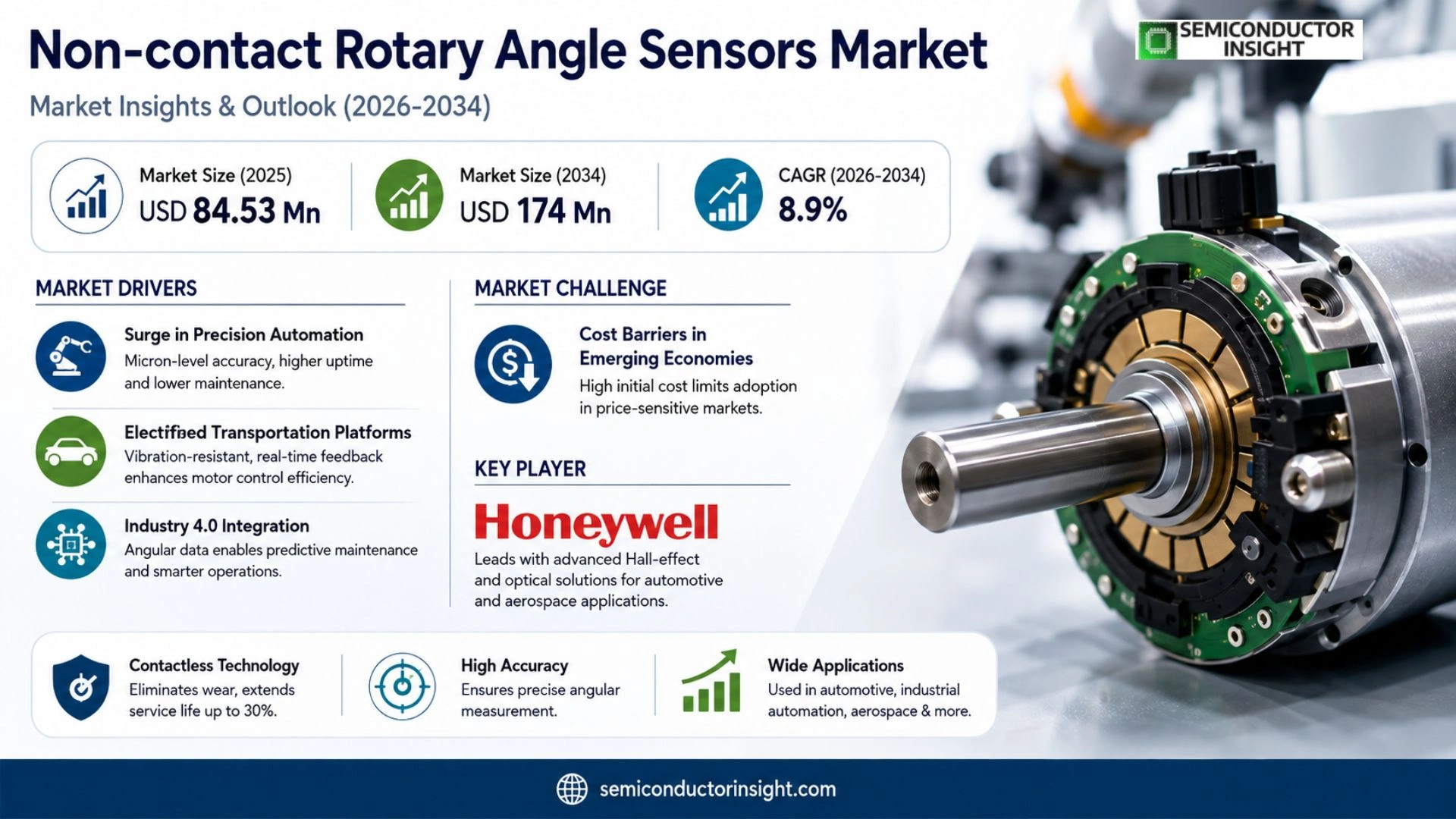
MARKET DRIVERS
Surge in Precision Automation
Manufacturers are re‑engineering production lines to reduce cycle time and scrap rates. Non-contact Rotary Angle Sensors Market participants benefit from the shift toward contact‑free measurement because these devices deliver micron‑level resolution without the friction that degrades traditional potentiometers. The resulting improvement in repeatability translates directly into higher equipment uptime and lower maintenance budgets, prompting plant managers to prioritize sensor upgrades.
Electrified Transportation Platforms
The rollout of electric buses, trucks and two‑wheeler platforms has created a niche where rotor angle feedback is critical for efficient motor torque control. Engineers favour non‑contact designs because they endure the high vibration environments typical of drivetrain applications while offering real‑time positional data that supports regenerative‑braking algorithms. This technical advantage is reshaping procurement specifications across OEM supply chains.
➤ By removing mechanical wear points, non‑contact sensors can extend service intervals by up to 30 %, delivering measurable cost avoidance for end users.
Convergence with Industry 4.0 standards is turning sensor outputs into actionable analytics. When integrated with edge‑computing platforms, angular data feeds predictive maintenance models, allowing operators to schedule interventions before a failure occurs. This data‑driven value proposition is accelerating investment decisions in Non-contact Rotary Angle Sensors market.
MARKET CHALLENGES
Cost Barriers in Emerging Economies
While the performance case for non‑contact technology is clear, the upfront price premium remains a sticking point for manufacturers in cost‑sensitive regions. Budget‑constrained facilities often defer sensor modernization, opting instead for legacy potentiometric solutions that appear cheaper on paper but incur higher lifecycle expenses due to wear and calibration drift.
Other Challenges
Standardization Gaps
Industry specifications for angular accuracy and communication protocols vary widely between sectors. This lack of harmonization forces system integrators to develop custom adapters, inflating engineering effort and prolonging time‑to‑market for new products.
MARKET RESTRAINTS
Technical Complexity Limits OEM Adoption
Deploying non‑contact rotary angle sensors demands specialized calibration tools and software expertise. Small‑to‑mid‑size equipment manufacturers often lack in‑house capabilities, leading them to postpone integration until they can justify the training investment.
Supply‑Chain Vulnerabilities
Key components such as high‑purity sapphire substrates and precision‑etched optics face limited supplier options. Any disruption,whether geopolitical or raw‑material‑related,can create lead‑time spikes that deter firms from committing to large‑scale purchases.
Regulatory Compliance Pressures
Safety‑critical sectors, notably aerospace and medical devices, impose stringent validation procedures. The additional certification steps increase project timelines, making risk‑averse customers hesitant to migrate from established contact‑based sensors.
MARKET OPPORTUNITIES
Growth in Renewable Energy Infrastructure
Wind turbine pitch control systems rely on accurate angular feedback to optimize blade angles under varying wind conditions. Non‑contact rotary angle sensors deliver the durability required for offshore installations where corrosion and maintenance access are major concerns, positioning them as a preferred choice for new turbine generations.
Medical Imaging and Diagnostics
Advanced imaging modalities, such as MRI‑compatible robotic assistants, demand sensor solutions that operate without magnetic interference. The inherent immunity of optical‑based non‑contact designs creates a clear pathway for entry into high‑value healthcare equipment markets, where precision and reliability are non‑negotiable.
Smart Infrastructure and IoT Integration
Smart cities are deploying automated gate systems, traffic monitoring devices and utility meters that benefit from unobtrusive angle sensing. Embedding non‑contact rotary angle sensors with low‑power wireless modules enables continuous data streams, opening subscription‑based service models for sensor manufacturers.
Non-contact Rotary Angle Sensors Market Trends
Growing Adoption in Electric Vehicles and Robotics
The shift toward electrified drivetrains and collaborative automation has placed non‑contact rotary angle sensors at the core of next‑generation motion control. In 2025, manufacturers delivered roughly 1.6 million units worldwide, with an average selling price of $57 and a gross margin near 44 %. This pricing structure reflects economies of scale achieved as production capacity climbs toward 3 million units per year. Automotive OEMs are replacing mechanical potentiometers with these sensors to meet the reliability demands of steer‑by‑wire and torque‑vectoring systems, while robot integrators prefer them for joint feedback in high‑speed pick‑and‑place cells. The result is a steady uplift in order volumes that aligns with broader electrification and automation investments, creating a favorable revenue outlook for component suppliers.
Other Trends
Technology Convergence and Miniaturization
Recent advances in Hall‑effect, magnetoresistive and optical detection chips have enabled sensor footprints to shrink below 5 mm² while preserving sub‑degree resolution. Manufacturers are embedding power management and signal conditioning circuits on the same die, which cuts board space and reduces bill‑of‑materials costs. This integration is especially valuable for drones and portable medical devices where size and weight constraints dominate design choices. The industry’s focus on multi‑turn detection and 360‑degree continuous rotation capability further differentiates premium offerings, allowing customers to consolidate multiple sensing functions into a single module.
Integration of Digital Interfaces and Smart Diagnostics
Digital communication standards such as SPI, I²C, CAN and LIN have become de‑facto requirements for modern control architectures. Sensor vendors now ship products that expose self‑diagnostic registers, fault‑logging memory and remote‑monitoring telemetry, which simplifies system‑level validation and reduces field maintenance. The move toward low‑power operation, achieved through optimized biasing and on‑chip sleep modes, complements the trend of embedding sensors directly into microcontroller units. As factories adopt predictive maintenance platforms, the ability of non‑contact rotary angle sensors to report health metrics in real time is turning a once‑passive component into an active data source, thereby influencing purchasing decisions across automotive and industrial automation segments.
COMPETITIVE LANDSCAPE
Key Industry Players
Competitive dynamics shaping the non‑contact rotary angle sensors sector
Honeywell dominates the upper tier of the market, leveraging its extensive portfolio of Hall‑effect and optical modules to secure long‑term contracts with automotive OEMs and aerospace integrators. The company’s ability to embed diagnostics and safety‑critical firmware within a single package has created a de‑facto standard for high‑reliability applications, narrowing the competitive field for midsize suppliers. Concentration around a few large players is reinforced by the high gross margin environment,approximately 44 %,which rewards economies of scale in silicon wafer processing and automated assembly lines. Honeywell’s strategic acquisitions in the sensor‑fusion space have also broadened its addressable market beyond pure angle measurement, forcing rivals to diversify product road‑maps or specialize in niche technologies such as magnetoresistive or inductive sensing.
Beyond the market leader, a constellation of firms sustains a vibrant ecosystem. TE Connectivity and Bosch exploit global distribution networks to serve industrial automation and robotics customers, emphasizing modularity and ruggedized housing. Sensata Technologies and ams OSRAM focus on integration with power‑train control units, promoting ultra‑low‑power designs that appeal to electric‑vehicle manufacturers. Smaller innovators,including MultiDimension Technology, Suzhou Meiyi Microelectronics, and Nidec,carve out positions through ultra‑high‑resolution optical encoders or bespoke MCU‑embedded solutions for collaborative robots. The presence of specialist manufacturers such as Murata, TDK, and Melexis ensures continuous incremental improvements in signal‑to‑noise ratio, while niche entrants like Asahi Kasei Microdevices and MinebeaMitsumi target emerging sectors such as drones and medical instrumentation. This layered competitive structure creates entry points for both price‑sensitive volume producers and high‑margin technology leaders.
List of Key Non-contact Rotary Angle Sensors Companies Profiled
- Honeywell
- TE Connectivity
- Sensata Technologies
- Bosch
- Contelec
- HELLA
- Melexis
- ams OSRAM
- Allegro MicroSystems
- TDK
- Murata Manufacturing
- Asahi Kasei Microdevices
- MultiDimension Technology
- Suzhou Meiyi Microelectronics Co., Ltd.
- Nidec
Segment Analysis:
| Segment Category | Sub-Segments | Key Insights |
| By Type |
|
High‑Precision Type
|
| By Application |
|
Automotive
|
| By End User |
|
Industrial Robots
|
| By Technology Trend |
|
Hall‑Effect
|
| By Integration Capability |
|
Integrated MCU Sensors
|
Regional Analysis: Non-contact Rotary Angle Sensors
North America
Tier‑1 suppliers are embedding non‑contact rotary angle solutions into power‑train control units to meet stricter efficiency targets. The elimination of wear points reduces warranty claims, while real‑time angle data improves torque vectoring algorithms, a decisive factor for autonomous driving stacks.
Factories adopting collaborative robots favor contact‑less sensors for their superior repeatability. The ability to operate across harsh temperature swings without recalibration supports lean manufacturing initiatives that dominate the regional landscape.
Recent safety standards from UL and IEC stress electromagnetic compatibility, reinforcing the appeal of optical‑based angle measurement. Compliance pathways have been streamlined, encouraging faster adoption across OEM portfolios.
Strategic alliances between sensor startups and established semiconductor firms are unlocking integrated ASIC solutions, delivering higher bandwidth at lower power,a critical combination for edge‑computing devices proliferating in the market.
Europe
European manufacturers are leveraging Non-contact Rotary Angle Sensors market to satisfy stringent emissions mandates that require precise motor control in both automotive and wind‑turbine sectors. Collaborative research programs funded by the EU amplify cross‑border knowledge transfer, especially in photonic sensor design. While cost sensitivity remains high, the region’s strong intellectual property framework encourages long‑term investment in proprietary calibration algorithms, fostering a differentiated supplier base.
Asia-Pacific
The Asia‑Pacific landscape is defined by rapid upscale of consumer electronics and burgeoning smart‑factory deployments. Countries such as China and South Korea prioritize sensor integration to support 5G‑enabled industrial IoT gateways, where low latency angle feedback is a competitive advantage. Although price pressure is intense, local manufacturers are closing the technology gap through aggressive talent acquisition and government‑backed innovation vouchers.
South America
In South America, growth is tied to the expansion of renewable energy projects, particularly hydroelectric and solar farms that rely on precise actuator positioning. Regional OEMs are beginning to replace legacy potentiometers with non‑contact alternatives to meet reliability standards in remote installations. Market entry barriers are lowering as multinational distributors establish localized service hubs, enhancing after‑sales support.
Middle East & Africa
The Middle East & Africa region is witnessing a modest uptick driven by oil‑field automation and defense procurement programs that demand rugged, maintenance‑free angle sensing. Investments in smart‑grid infrastructure further stimulate demand for sensors capable of operating under extreme temperature fluctuations. Partnerships with global technology providers are facilitating knowledge transfer, positioning the region for incremental market share gains.
Report Scope
This market research report provides a comprehensive analysis of the Non-contact Rotary Angle Sensors Market , covering the forecast period 2026–2034. It offers detailed insights into market dynamics, technological advancements, competitive landscape, and key trends shaping the industry.
Key focus areas of the report include:
- Market Overview: The report begins with an overview outlining its current market scenario, key growth indicators, and industry transformation drivers. It discusses macroeconomic factors, demand–supply balance, regulatory landscape, and the strategic role of semiconductors in powering advancements across industries such as automotive, telecommunications, consumer electronics, and industrial automation.
- Market Size & Forecast: Historical data and future projections for revenue, unit shipments, and market value across major regions and segments.
- Segmentation Analysis: Detailed breakdown by product type, technology, application, and end-user industry to identify high-growth segments and investment opportunities.
- Regional Insights: Insights into market performance across North America, Europe, Asia-Pacific, Latin America, and the Middle East & Africa, including country-level analysis where relevant.
- Competitive Landscape: Profiles of leading market participants, including their product offerings, R&D focus, manufacturing capacity, pricing strategies, and recent developments such as mergers, acquisitions, and partnerships.
- Technology Trends & Innovation: Assessment of emerging technologies, integration of AI/IoT, semiconductor design trends, fabrication techniques, and evolving industry standards.
- Market Drivers & Restraints: Evaluation of factors driving market growth along with challenges, supply chain constraints, regulatory issues, and market-entry barriers.
- Stakeholder Insights: Insights for component suppliers, OEMs, system integrators, investors, and policymakers regarding the evolving ecosystem and strategic opportunities.
Primary and secondary research methods are employed, including interviews with industry experts, data from verified sources, and real-time market intelligence to ensure the accuracy and reliability of the insights presented.
FREQUENTLY ASKED QUESTIONS:
What is the current market size of Non-contact Rotary Angle Sensors Market?
-> Non-contact Rotary Angle Sensors market is projected to reach USD 174 million by 2034, exhibiting a CAGR of 8.9% during the forecast period.
Which key companies operate in Non-contact Rotary Angle Sensors Market?
-> Key players include Honeywell, TE Connectivity, Sensata Technologies, Bosch, Contelec, HELLA, Melexis, ams OSRAM, Allegro MicroSystems, TDK, Murata Manufacturing, Asahi Kasei Microdevices, Nidec, MinebeaMitsumi, MultiDimension Technology, Suzhou Meiyi Microelectronics Co., Ltd.
What are the key growth drivers?
-> Key growth drivers include rising adoption of electric vehicles, expanding industrial automation and robotics, increased demand for steer‑by‑wire and electric drive systems, and the need for high‑precision, low‑wear position feedback in aerospace and consumer electronics.
Which region dominates the market?
-> Asia‑Pacific is currently the leading region due to strong automotive and industrial automation demand, while North America and Europe also show significant activity.
What are the emerging trends?
-> Emerging trends include higher accuracy and multi‑turn detection, miniaturization with integrated MCUs and driver ICs, broader digital interface support (SPI, I2C, CAN, LIN, PWM), AI‑enabled diagnostics, and increased emphasis on low power consumption and reliability under high‑speed rotation.

Get Sample Report PDF for Exclusive Insights
Report Sample Includes
- Table of Contents
- List of Tables & Figures
- Charts, Research Methodology, and more...
 Download Sample Report PDF


