Semiconductor Magnetic Sensor Market MARKET INSIGHTS
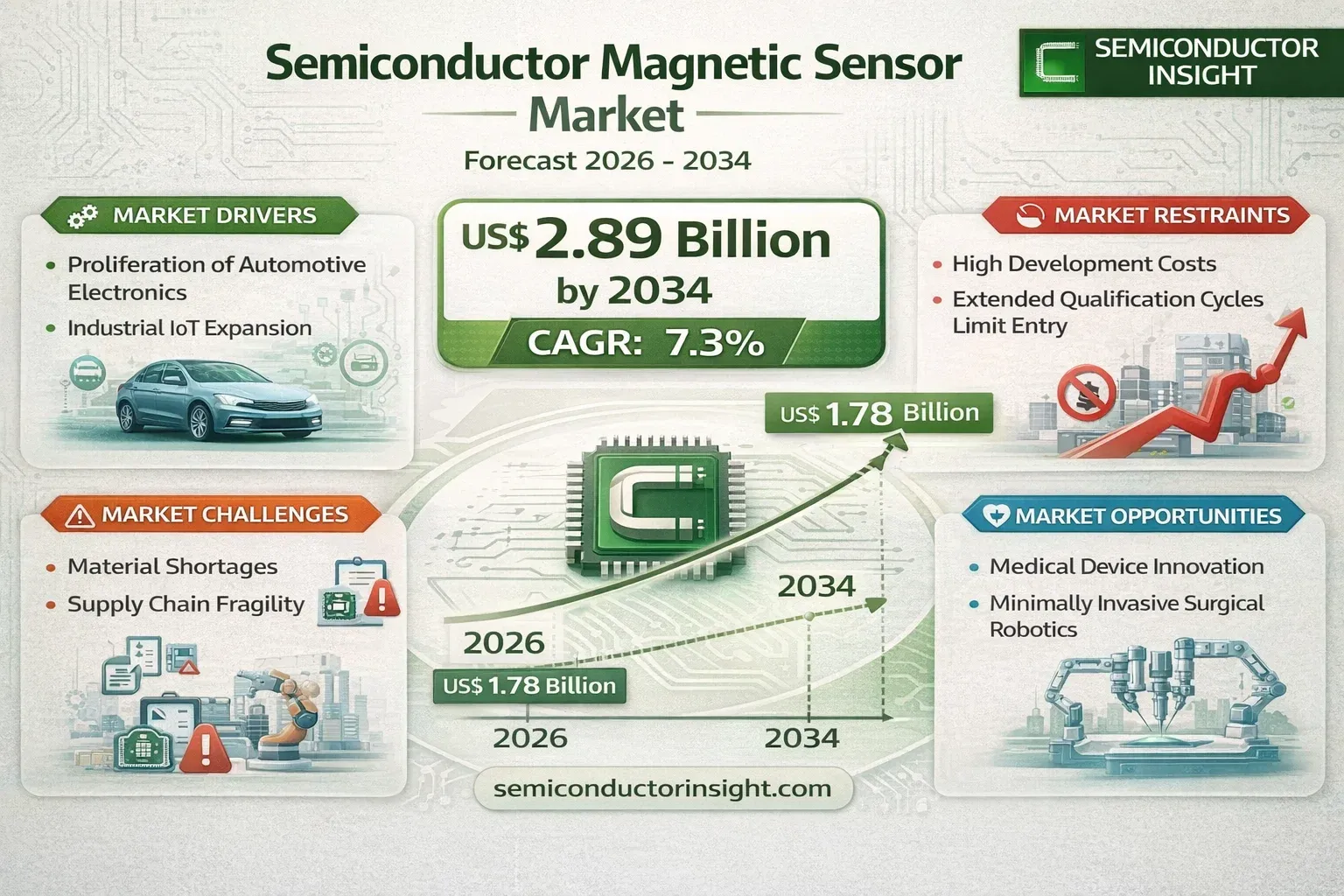
Global Semiconductor Magnetic Sensor Market size was valued at USD 1.78 billion in 2024 and is projected to reach USD 2.89 billion by 2032, at a CAGR of 7.3% during the forecast period 2025-2032.
While this represents steady growth, it outperforms the broader semiconductor market, which is expected to grow at 6% CAGR from 2022-2029, reaching USD 790 billion.
Semiconductor magnetic sensors are specialized components that detect and measure magnetic fields, converting them into electrical signals. These devices include Hall effect sensors, magnetoresistive sensors (AMR, GMR, TMR), and other emerging technologies, finding applications across automotive (for position sensing and speed detection), industrial automation, consumer electronics (smartphones, wearables), and medical devices.
The market growth is driven by increasing demand in automotive electrification (particularly for EV motor control and battery management systems) and the proliferation of IoT devices requiring precise motion detection. However, challenges include price pressures in consumer electronics and technical limitations in extreme environments. Key players like Allegro MicroSystems and Infineon are innovating with higher sensitivity sensors, while Asian manufacturers are expanding production capacity to meet growing demand from automotive and industrial sectors.
Semiconductor Magnetic Sensor Market MARKET DYNAMICS
Semiconductor Magnetic Sensor Market MARKET DRIVERS
Proliferation of Automotive Electronics Accelerates Magnetic Sensor Adoption
The automotive industry’s rapid electrification is creating unprecedented demand for Semiconductor Magnetic Sensor . Modern vehicles now incorporate over 50 magnetic sensors per unit for applications ranging from anti-lock braking systems to electric power steering. This growth correlates directly with the 14.31% year-over-year increase in automotive semiconductor revenues, with magnetic sensors representing one of the fastest-growing segments. The transition to autonomous driving systems further amplifies this need, as precise position sensing becomes critical for advanced driver-assistance systems (ADAS). Magnetic sensors provide contactless operation and high reliability compared to mechanical alternatives, making them indispensable for safety-critical automotive applications.
Industrial IoT Expansion Creates Widespread Sensing Requirements
Industrial automation’s digital transformation is driving substantial magnetic sensor deployment across smart factories. The integration of Industry 4.0 technologies requires precise motion detection and positioning capabilities in robotic arms, conveyor systems, and predictive maintenance equipment. Semiconductor magnetic sensors enable contactless angle measurement with resolutions under 0.5 degrees, essential for modern automation systems. This technological shift coincides with industrial semiconductor revenues surpassing D 80 billion annually, where sensor components demonstrate consistent double-digit growth. Additionally, the proliferation of condition monitoring systems in smart manufacturing creates new opportunities for vibration analysis using three-axis magnetic sensors.
The expansion of wireless sensor networks in industrial environments further accelerates adoption, with magnetic sensors providing reliable operation in electrically noisy conditions where optical alternatives might falter.
Semiconductor Magnetic Sensor Market MARKET RESTRAINTS
High Development Costs and Extended Qualification Cycles Limit Entry
While demand grows exponentially, developing advanced magnetic sensor technologies requires substantial capital investment in specialized fabrication equipment and packaging technologies. The average qualification cycle for automotive-grade magnetic sensors exceeds 18 months, creating significant barriers for new market entrants. Established players with captive manufacturing facilities maintain cost advantages, as building a new 200mm wafer facility for magnetic sensor production requires investments exceeding D 500 million. These economic realities concentrate innovation among a handful of dominant suppliers, potentially slowing overall market expansion.
Other Restraints
Temperature Sensitivity Challenges
Performance degradation in extreme thermal environments remains a persistent technical challenge, particularly for applications in automotive underhood locations or industrial machinery where ambient temperatures can exceed 150°C. While recent advancements mitigate these effects through proprietary compensation algorithms, achieving stable operation across wide temperature ranges adds substantial complexity to sensor IC design.
Alternative Sensing Technologies
Competitive pressure from optical encoders and capacitive sensors continues to restrain price premiums for advanced magnetic sensing solutions. The emergence of MEMS-based inertial measurement units presents particular competition in motion tracking applications, offering comparable accuracy with superior resistance to electromagnetic interference in certain use cases.
Semiconductor Magnetic Sensor Market MARKET CHALLENGES
Material Shortages and Supply Chain Fragility Disrupt Market Stability
The semiconductor industry’s ongoing supply constraints particularly affect magnetic sensor production, which relies on specialized rare-earth materials and proprietary silicon fabrication processes. Gallium arsenide substrates used in high-performance Hall sensors face periodic shortages, while the increasing demand for sensor fusion solutions strains foundry capacity. These disruptions have led to extended lead times exceeding 40 weeks for certain automotive-qualified magnetic sensor products, forcing OEMs to redesign systems around available components.
Other Challenges
Design Iteration Costs
The customized nature of many magnetic sensing applications requires extensive application engineering support, with typical development cycles involving 3-5 prototype iterations before production validation. This hands-on design approach creates substantial overhead costs that sensor vendors struggle to recoup in commoditized market segments.
Standardization Barriers
The absence of universal interfaces for magnetic sensor outputs complicates system integration across different manufacturers’ products. While I²C and SPI digital interfaces gain adoption, proprietary protocols and incompatible output formats remain prevalent, increasing development complexity for end customers.
Semiconductor Magnetic Sensor Market MARKET OPPORTUNITIES
Medical Device Innovation Opens New Frontiers for Precision Sensing
The medical technology sector presents substantial growth potential for Semiconductor Magnetic Sensor , particularly in minimally invasive surgical robotics and implantable devices. Recent advances in biocompatible packaging enable direct integration of magnetic position sensors into catheters and endoscopic tools, where their immunity to fluid exposure provides distinct advantages. Global surgical robotics market projected to surpass D 20 billion creates significant demand for sub-millimeter position tracking solutions requiring absolute angle measurement accuracy below 0.1 degrees.
Energy Infrastructure Modernization Drives Grid Monitoring Adoption
Modern smart grid deployments create exceptional opportunities for current sensing applications utilizing magnetic sensor technologies. The transition to renewable energy sources requires precise DC current measurement in photovoltaic inverters and battery storage systems, where traditional current transformers prove ineffective. Advanced magnetic current sensors with integrated isolation capabilities address these needs while meeting stringent safety standards for grid-connected equipment. This aligns with global investments exceeding D 300 billion annually in electricity network upgrades.
Magnetic sensor manufacturers also benefit from the rapid electrification of heating systems and industrial processes, where contactless current monitoring prevents downtime in critical infrastructure. The development of reinforced galvanic isolation techniques enables reliable operation in these harsh electrical environments while meeting evolving regulatory requirements for energy monitoring accuracy.
SEMICONDUCTOR MAGNETIC SENSOR MARKET TRENDS
Expansion of Automotive Electronics to Drive Market Growth
The increasing adoption of Semiconductor Magnetic Sensor in advanced automotive applications is emerging as a key trend shaping the market. With rising demand for electric vehicles (EVs) and autonomous driving technologies, these sensors are critical for applications such as position sensing, speed detection, and current measurement. Automotive-grade magnetic sensors now account for over 40% of the total market revenue, significantly higher than other segments. Recent advances in noise reduction and temperature stability have further enhanced their reliability in automotive environments, where operating conditions can be extreme. The integration of these sensors with vehicle control systems, particularly in braking and transmission modules, has become indispensable for modern automotive design.
Other Trends
Miniaturization and IoT Integration
The growing demand for compact, low-power sensors in consumer electronics and industrial IoT applications is reshaping product development strategies. Semiconductor magnetic sensors are increasingly being designed with smaller footprints while maintaining high sensitivity, with package sizes reducing nearly 30% compared to previous generations. This miniaturization aligns perfectly with the requirements of wearables and smart home devices, where space constraints are critical. Furthermore, the development of energy-efficient variants consuming less than 1mA current enables longer battery life in portable applications, expanding their use in wireless sensor networks and smart infrastructure monitoring.
Advancements in Industrial Automation
Industrial automation represents one of the fastest-growing segments for Semiconductor Magnetic Sensor , with annual growth exceeding 15%. Modern manufacturing facilities increasingly rely on these sensors for precise position feedback in robotics and motor control applications. The development of robust sensors capable of withstanding harsh industrial environments has opened new opportunities in predictive maintenance systems. Three-axis magnetic sensors in particular are gaining traction for their ability to provide comprehensive spatial data, improving the accuracy of automated systems. The integration of artificial intelligence with sensor data analytics is further enhancing their value proposition in smart factory applications, enabling real-time process optimization.
COMPETITIVE LANDSCAPE
Key Industry Players
Technological Innovation and Strategic Expansions Drive Market Competition
Global Semiconductor Magnetic Sensor Market features a moderately consolidated competitive landscape dominated by established players with strong technological expertise. Infineon Technologies leads the market with approximately 18% revenue share in 2024, owing to its comprehensive product portfolio spanning Hall effect sensors, GMR sensors, and TMR sensors. The company’s strategic focus on automotive applications, particularly in advanced driver-assistance systems (ADAS), has solidified its position.
Allegro MicroSystems follows closely, commanding 15% market share through its specialized high-performance magnetic sensor solutions. The company’s recent launch of ultra-low-power 3D Hall-effect position sensors has been particularly impactful in industrial automation applications. Meanwhile, NXP Semiconductors maintains strong market presence with its innovative Xtrinsic sensing solutions, capturing 12% of global revenues.
Japanese players including AKM Semiconductor and Aichi Steel are gaining traction in Asian markets through their cost-competitive offerings and focus on consumer electronics. Their recent R&D investments in multi-axis magnetic sensors for smartphone and wearable applications demonstrate this strategic direction. European manufacturers like Melexis and STMicroelectronics are countering this with advanced MEMS-based magnetic sensor solutions, particularly for automotive and medical applications.
The market is witnessing increasing competition from emerging players specializing in niche applications. AMS has made significant strides with its AS5000 series magnetic position sensors for brushless DC motor control, while Honeywell maintains dominance in high-reliability industrial and aerospace applications through its SS490 series sensors. These companies are actively pursuing strategic collaborations and acquisitions to expand their technological capabilities and geographic reach.
List of Leading Semiconductor Magnetic Sensor Manufacturers
- Infineon Technologies (Germany)
- Allegro MicroSystems (U.S.)
- NXP Semiconductors (Netherlands)
- AKM Semiconductor (Japan)
- Aichi Steel (Japan)
- Melexis (Belgium)
- STMicroelectronics (Switzerland)
- AMS (Austria)
- Honeywell (U.S.)
- Bosch (Germany)
- Micronas (Switzerland)
- MEMSIC (U.S.)
Segment Analysis:
By Type
Hall Sensor Dominates the Market with Robust Applications in Automotives and Consumer Electronics
The market is segmented based on type into:
- Hall Sensor
- Three-Axis Magnetic Sensor
- Angle Sensor
- Other
- Subtypes: Magnetoresistive sensors, AMR sensors, TMR sensors, and GMR sensors
By Application
Automotive Segment Leads Due to Rising Demand for Advanced Driver Assistance Systems (ADAS)
The market is segmented based on application into:
- Automotive
- Consumer Electronics
- Subtypes: Smartphones, wearables, gaming controllers
- Industrial
- Subtypes: Robotics, factory automation, position sensing
- Medical
- Others
Regional Analysis: Semiconductor Magnetic Sensor Market
North America
The North American market for Semiconductor Magnetic Sensor is driven by high-tech automotive applications and growing demand for industrial automation. The United States, in particular, is witnessing strong adoption of Hall effect sensors in electric vehicles, with major automakers accelerating production to meet strict emission standards. While the region benefits from advanced R&D infrastructure and significant investments in IoT devices, supply chain disruptions and semiconductor shortages pose intermittent challenges. Recent partnerships between sensor manufacturers and automotive OEMs are creating new avenues for innovation, especially in position sensing and current measurement applications.
Europe
Europe’s market growth is shaped by stringent industrial safety regulations and rapid digitization across manufacturing sectors. Germany leads in adoption, with its strong automotive and robotics industries driving demand for precise magnetic field detection. The EU’s focus on green energy solutions has increased deployment of these sensors in wind turbines and smart grid systems. However, the market faces pricing pressures due to competition from Asian manufacturers. Recent breakthroughs include the development of low-power 3D magnetic sensors for medical implants and wearable devices, reflecting the region’s emphasis on healthcare technology innovation.
Asia-Pacific
As the dominant regional market, Asia-Pacific benefits from massive electronics production and expanding automotive manufacturing bases. China’s semiconductor self-sufficiency initiatives have led to increased domestic sensor production, while Japan maintains leadership in high-precision sensor technology. The proliferation of consumer electronics and industrial IoT devices across India and Southeast Asia creates sustained demand, although the market remains highly price-sensitive. Recent investments in semiconductor fabrication plants across the region aim to reduce dependence on imports, with several local manufacturers now competing in the mid-range sensor segment.
South America
The South American market shows gradual growth, primarily supported by automotive assembly plants and mining sector applications. Brazil represents the largest market, where sensors are increasingly used in agricultural machinery and automotive safety systems. However, economic instability and fluctuating currency values continue to restrain market expansion. Recent trade agreements have improved access to sensor components, but local manufacturing capabilities remain limited. The growing renewable energy sector, particularly in Chile and Argentina, presents new opportunities for current and position sensing applications in solar and wind power installations.
Middle East & Africa
This emerging market is characterized by infrastructure development and gradual industrial automation adoption. The UAE and Saudi Arabia lead in sensor deployment for oil & gas applications and smart city projects. While the market size remains relatively small, increasing investments in industrial digitization and automotive production facilities indicate future growth potential. Challenges include limited technical expertise for high-end applications and dependence on imported components. Recent government initiatives to develop local electronics manufacturing ecosystems may stimulate the market over the long term, particularly for sensors used in building automation and transportation systems.
Report Scope
This market research report provides a comprehensive analysis of the global and regional Semiconductor Magnetic Sensor markets, covering the forecast period 2025–2032. It offers detailed insights into market dynamics, technological advancements, competitive landscape, and key trends shaping the industry.
Key focus areas of the report include:
- Market Size & Forecast: Historical data and future projections for revenue, unit shipments, and market value across major regions and segments.
- Segmentation Analysis: Detailed breakdown by product type, technology, application, and end-user industry to identify high-growth segments and investment opportunities.
- Regional Outlook: Insights into market performance across North America, Europe, Asia-Pacific, Latin America, and the Middle East & Africa, including country-level analysis where relevant.
- Competitive Landscape: Profiles of leading market participants, including their product offerings, R&D focus, manufacturing capacity, pricing strategies, and recent developments such as mergers, acquisitions, and partnerships.
- Technology Trends & Innovation: Assessment of emerging technologies, integration of AI/IoT, semiconductor design trends, fabrication techniques, and evolving industry standards.
- Market Drivers & Restraints: Evaluation of factors driving market growth along with challenges, supply chain constraints, regulatory issues, and market-entry barriers.
- Stakeholder Analysis: Insights for component suppliers, OEMs, system integrators, investors, and policymakers regarding the evolving ecosystem and strategic opportunities.
Primary and secondary research methods are employed, including interviews with industry experts, data from verified sources, and real-time market intelligence to ensure the accuracy and reliability of the insights presented.
FREQUENTLY ASKED QUESTIONS:
What is the current market size of Global Semiconductor Magnetic Sensor Market?
-> Semiconductor Magnetic Sensor Market size was valued at USD 1.78 billion in 2024 and is projected to reach USD 2.89 billion by 2032, at a CAGR of 7.3% during the forecast period 2025-2032.
Which key companies operate in Global Semiconductor Magnetic Sensor Market?
-> Key players include Infineon Technologies, Allegro MicroSystems, NXP Semiconductors, TDK Corporation, Honeywell, Texas Instruments, and STMicroelectronics, among others.
What are the key growth drivers?
-> Key growth drivers include rising demand in automotive applications, proliferation of IoT devices, increasing industrial automation, and advancements in consumer electronics.
Which region dominates the market?
-> Asia-Pacific dominates the market with over 45% share, driven by strong manufacturing bases in China, Japan, and South Korea, while North America leads in technological innovation.
What are the emerging trends?
-> Emerging trends include integration with AI/ML algorithms, development of energy-efficient sensors, miniaturization of components, and growing adoption in medical devices.
Get Sample Report PDF for Exclusive Insights
Report Sample Includes
- Table of Contents
- List of Tables & Figures
- Charts, Research Methodology, and more...