MEMS Gyroscope (3-axis, 6-axis IMU) Market Insights
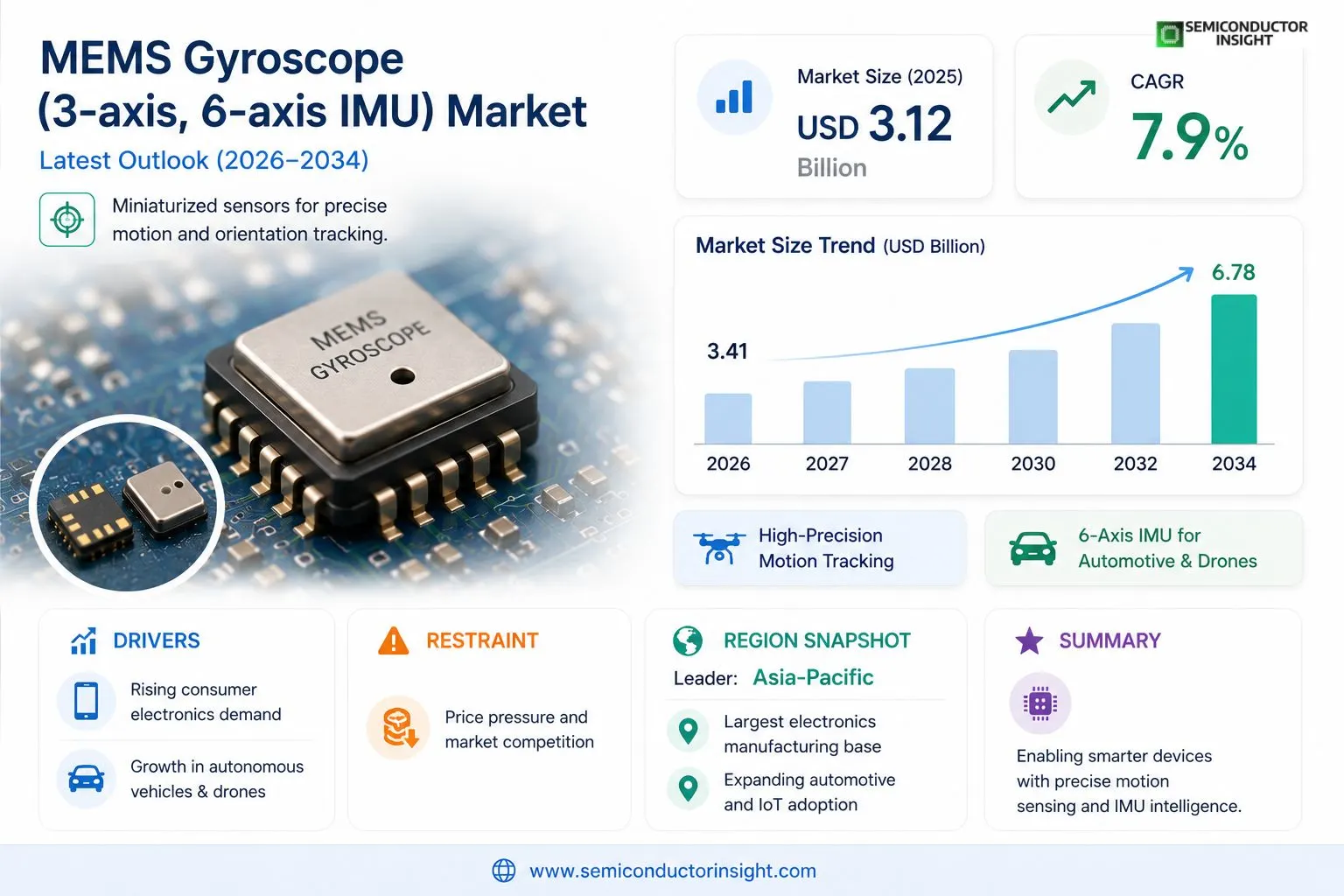
Global MEMS Gyroscope (3-axis, 6-axis IMU) market size was valued at USD 3.12 billion in 2025. The market is projected to grow from USD 3.41 billion in 2026 to USD 6.78 billion by 2034, exhibiting a CAGR of 7.9% during the forecast period.
MEMS (Micro-Electro-Mechanical Systems) gyroscopes are miniaturized sensors designed to measure angular velocity and rotational motion across one or multiple axes. In their most advanced configurations, 3-axis gyroscopes capture rotational data across the X, Y, and Z planes simultaneously, while 6-axis Inertial Measurement Units (IMUs) combine a 3-axis gyroscope with a 3-axis accelerometer within a single integrated package, enabling precise motion tracking, orientation detection, and stabilization in compact form factors. These devices are widely deployed across consumer electronics, automotive systems, aerospace and defense, industrial automation, healthcare wearables, and robotics applications.
The market is witnessing robust expansion driven by the surging adoption of MEMS-based IMUs in smartphones, drones, and autonomous vehicles, alongside growing demand for precise motion sensing in industrial and medical devices. Furthermore, the rapid proliferation of Internet of Things (IoT) ecosystems and the miniaturization trend in electronics are accelerating integration of 6-axis IMU solutions into next-generation connected devices. Key players actively shaping this competitive landscape include STMicroelectronics, TDK Corporation (InvenSense), Bosch Sensortec, Analog Devices, Inc., and Murata Manufacturing Co., Ltd., each maintaining broad product portfolios spanning consumer-grade to high-performance aerospace-qualified MEMS gyroscope solutions.
MARKET DRIVERS
Rising Adoption of Consumer Electronics Fueling Demand for MEMS Gyroscope Solutions
MEMS Gyroscope (3-axis, 6-axis IMU) Market has experienced sustained growth driven by the widespread integration of motion-sensing technologies in smartphones, tablets, wearables, and gaming peripherals. Modern consumer devices increasingly rely on 6-axis IMU configurations that combine three-axis gyroscopes with three-axis accelerometers, enabling precise gesture recognition, image stabilization, and augmented reality applications. As smartphone penetration continues to rise across emerging economies, original equipment manufacturers are prioritizing advanced inertial measurement solutions to differentiate their product offerings and meet evolving user expectations for immersive, responsive device experiences.
Accelerating Autonomous Vehicle Development Expanding MEMS Gyroscope Applications
The rapid advancement of autonomous vehicles and advanced driver-assistance systems (ADAS) has emerged as a powerful structural driver for MEMS Gyroscope (3-axis, 6-axis IMU) Market. In autonomous navigation platforms, 6-axis IMU modules serve as critical components for dead reckoning, vehicle stability control, and sensor fusion algorithms that complement GPS and LiDAR systems. As automotive OEMs and Tier-1 suppliers scale production of semi-autonomous and fully autonomous platforms, the demand for automotive-grade MEMS gyroscopes capable of operating reliably across wide temperature ranges and high-vibration environments continues to intensify, supporting robust market expansion through the forecast period.
➤ The proliferation of industrial IoT, robotics, and unmanned aerial vehicle platforms has further diversified the end-use demand base for 3-axis and 6-axis MEMS gyroscope modules, reinforcing multi-sector revenue growth across MEMS Gyroscope (3-axis, 6-axis IMU) Market.
Industrial automation and robotics represent an increasingly significant demand vector for MEMS Gyroscope (3-axis, 6-axis IMU) Market. Collaborative robots, automated guided vehicles, and precision manufacturing systems increasingly incorporate multi-axis inertial measurement units to achieve accurate positional feedback and dynamic stability. Simultaneously, the commercial drone sector , spanning delivery logistics, aerial mapping, and agricultural monitoring , has amplified procurement volumes for compact, high-performance 6-axis IMU solutions, further broadening the addressable market and reinforcing the long-term growth trajectory of MEMS gyroscope suppliers globally.
MARKET CHALLENGES
Intensifying Price Competition and Commoditization Pressures Challenging MEMS Gyroscope Vendors
One of the most significant challenges confronting participants in MEMS Gyroscope (3-axis, 6-axis IMU) Market is the sustained downward pressure on average selling prices driven by intensifying competition among established semiconductor vendors and emerging low-cost manufacturers, particularly from Asia-Pacific. As 6-axis IMU technology matures and design standardization increases, differentiating on performance specifications alone becomes increasingly difficult, compelling vendors to invest in value-added capabilities such as advanced calibration algorithms, broader operating temperature ranges, and system-level integration to defend profit margins. Smaller market participants with limited R&D budgets face particular vulnerability to margin erosion in this environment.
Technical Barriers in Achieving High-Accuracy Performance Across Diverse Operating Environments
Achieving consistent accuracy and stability in MEMS gyroscope outputs across the full range of operating conditions demanded by automotive, industrial, and aerospace customers remains a technically demanding challenge. Factors including thermal drift, vibration-induced noise, and bias instability continue to constrain the performance ceiling of commercially available MEMS gyroscope solutions relative to fiber optic gyroscopes and ring laser gyroscopes in precision-critical applications. Overcoming these technical limitations requires sustained investment in materials science, MEMS fabrication processes, and signal processing architectures, placing significant demands on engineering resources across MEMS Gyroscope (3-axis, 6-axis IMU) Market value chain.
Other Challenges
Supply Chain Complexity and Semiconductor Sourcing Constraints
MEMS Gyroscope (3-axis, 6-axis IMU) Market remains exposed to broader semiconductor supply chain vulnerabilities, as evidenced by periodic capacity constraints at specialized MEMS foundries. The fabrication of high-performance 3-axis and 6-axis IMU devices requires access to dedicated MEMS process nodes that are not universally available across leading-edge foundry networks, creating sourcing bottlenecks that can disrupt delivery schedules for OEM customers and limit the ability of fabless MEMS gyroscope designers to scale production rapidly in response to demand surges.
Regulatory and Qualification Requirements in Defense and Aerospace Segments
Market participants targeting defense, aerospace, and safety-critical automotive segments face stringent qualification and certification requirements that extend development timelines and increase the cost of market entry. Compliance with standards such as AEC-Q100 for automotive-grade devices and MIL-SPEC requirements for defense-oriented MEMS gyroscope solutions demands extensive reliability testing and documentation, creating meaningful barriers that disproportionately impact new entrants and smaller vendors seeking to expand their addressable market within MEMS Gyroscope (3-axis, 6-axis IMU) Market.
MARKET RESTRAINTS
Performance Limitations Relative to Alternative Gyroscope Technologies Restraining Adoption in Precision Applications
Despite significant advances in MEMS fabrication and signal processing, MEMS Gyroscope (3-axis, 6-axis IMU) Market continues to face adoption restraints in high-precision application segments where alternative technologies maintain a decisive performance advantage. In navigation-grade and tactical-grade inertial systems , such as those deployed in guided munitions, satellite attitude control, and high-accuracy survey instruments , fiber optic gyroscopes and hemispherical resonator gyroscopes retain superior bias stability and angle random walk characteristics that MEMS-based 3-axis and 6-axis IMU solutions have not yet fully replicated at comparable price points. This performance gap restricts the addressable opportunity for MEMS gyroscope vendors in these high-value verticals and limits overall market revenue potential.
Intellectual Property Concentration and Licensing Constraints Limiting Market Participation
MEMS Gyroscope (3-axis, 6-axis IMU) Market is characterized by a substantial concentration of foundational intellectual property among a limited number of established technology developers, including major semiconductor corporations and research institutions that have accumulated extensive patent portfolios covering core MEMS gyroscope sensing structures, signal conditioning circuits, and packaging architectures. This IP landscape creates licensing cost burdens and freedom-to-operate risks for emerging vendors and new market entrants, effectively raising the competitive barrier and restraining the pace of market diversification. The resulting consolidation tendency can suppress competitive pricing dynamics and limit the rate of innovation diffusion across the broader market ecosystem.
Environmental and Reliability Concerns Constraining Deployment in Harsh-Condition Segments
The sensitivity of MEMS gyroscope sensing elements to mechanical shock, humidity ingress, and extreme thermal cycling presents a persistent restraint on market penetration within harsh-environment industrial, oil and gas, and heavy machinery applications. While packaging advancements have progressively improved the environmental resilience of 3-axis and 6-axis IMU devices, achieving the mean time between failure benchmarks required by operators in these segments continues to demand significant engineering investment. Until MEMS gyroscope solutions consistently demonstrate field reliability comparable to ruggedized conventional sensor alternatives across these demanding use cases, adoption within MEMS Gyroscope (3-axis, 6-axis IMU) Market’s most challenging end-use segments will remain selectively constrained.
MARKET OPPORTUNITIES
Expansion of 5G-Connected IoT Infrastructure Creating New Deployment Opportunities for MEMS Gyroscope Technologies
The global rollout of 5G network infrastructure is enabling a new generation of connected IoT devices and edge computing platforms that incorporate embedded motion sensing capabilities, representing a substantial incremental opportunity for MEMS Gyroscope (3-axis, 6-axis IMU) Market. Asset tracking systems, smart infrastructure monitoring nodes, and connected industrial equipment increasingly leverage 6-axis IMU modules to deliver real-time orientation and vibration data that enhances predictive maintenance and operational efficiency workflows. As the installed base of 5G-connected endpoints scales rapidly across manufacturing, logistics, and smart city verticals, MEMS gyroscope suppliers are well-positioned to capture expanding design-win volumes within this structurally growing application landscape.
Healthcare and Medical Device Integration Unlocking High-Value Growth Avenues for IMU Solutions
The medical device sector presents an increasingly important growth opportunity for MEMS Gyroscope (3-axis, 6-axis IMU) Market, driven by the proliferation of wearable health monitors, rehabilitation assessment systems, surgical navigation platforms, and patient mobility tracking devices that require precise, miniaturized inertial measurement capabilities. The integration of 3-axis and 6-axis IMU modules into continuous glucose monitors, orthopedic implant monitoring systems, and neurological tremor assessment devices reflects the expanding clinical validation of MEMS-based motion sensing as a diagnostic and therapeutic tool. Regulatory approvals for IMU-integrated medical wearables across major markets are expected to accelerate commercial adoption, supporting premium pricing and above-market margin profiles for vendors with certified medical-grade MEMS gyroscope offerings.
Defense Modernization Programs and Unmanned Systems Proliferation Driving Strategic Procurement of MEMS Gyroscope Modules
Increased defense spending across North America, Europe, and Asia-Pacific, combined with accelerating procurement of unmanned aerial, ground, and maritime systems, is generating substantial strategic demand within MEMS Gyroscope (3-axis, 6-axis IMU) Market. Modern tactical unmanned systems rely heavily on miniaturized, SWaP-optimized (size, weight, and power) 6-axis IMU solutions that deliver reliable navigation and stabilization performance in GPS-denied environments. As defense agencies expand investment in autonomous surveillance platforms, precision-guided munitions, and soldier-worn navigation aids, MEMS gyroscope vendors with demonstrated capability in defense-qualified inertial measurement solutions are positioned to secure long-cycle procurement contracts that provide durable revenue visibility and support continued technology investment across the market ecosystem.
Trends
Rising Adoption of 6-Axis IMU Solutions in Consumer Electronics and Autonomous Systems
MEMS Gyroscope (3-axis, 6-axis IMU) Market is experiencing significant momentum driven by the accelerating integration of inertial measurement units across a broad spectrum of end-use industries. Consumer electronics remains a primary growth engine, with smartphones, tablets, gaming controllers, and wearable devices increasingly relying on compact 6-axis IMU configurations that combine gyroscopic and accelerometer capabilities within a single miniaturized package. As device manufacturers compete on performance and form factor, the demand for high-precision, low-power MEMS gyroscope solutions continues to intensify. Simultaneously, the autonomous vehicle segment is emerging as a critical adopter, with advanced driver-assistance systems (ADAS) and self-driving platforms requiring robust 3-axis and 6-axis IMU sensors for real-time orientation detection, lane stability, and navigation accuracy. The convergence of these demand drivers is shaping a highly competitive and innovation-oriented market landscape.
Other Trends
Expansion of Drone and Unmanned Aerial Vehicle (UAV) Applications
The rapid proliferation of commercial and industrial drones has emerged as a notable trend influencing MEMS Gyroscope (3-axis, 6-axis IMU) Market. UAV platforms depend heavily on 6-axis IMU sensors for flight stabilization, attitude control, and precise maneuvering in dynamic environments. As drone deployments expand across logistics, agriculture, infrastructure inspection, and defense sectors, manufacturers are increasingly specifying high-performance MEMS gyroscope modules capable of operating reliably under vibration and temperature variation.
IoT Ecosystem Growth Accelerating 6-Axis IMU Integration
The proliferation of Internet of Things (IoT) ecosystems is serving as a structural tailwind for MEMS Gyroscope (3-axis, 6-axis IMU) Market. Connected industrial sensors, smart home devices, and healthcare wearables are increasingly incorporating 6-axis IMU solutions to enable motion tracking, fall detection, and activity recognition functionalities. The miniaturization trend in electronics further supports this integration, allowing MEMS gyroscope components to be embedded in space-constrained form factors without compromising measurement accuracy.
Industrial Automation and Healthcare Wearables Driving Diversified Demand
Beyond consumer and automotive applications, MEMS Gyroscope (3-axis, 6-axis IMU) Market is witnessing diversified demand from industrial automation and medical device sectors. Robotic systems deployed in manufacturing environments utilize 3-axis gyroscopes for precise motion control and spatial orientation, while surgical robots and rehabilitation wearables integrate 6-axis IMU modules to monitor patient movement and support minimally invasive procedures. Leading market participants including STMicroelectronics, TDK Corporation (InvenSense), Bosch Sensortec, Analog Devices, Inc., and Murata Manufacturing Co., Ltd. continue to advance their product portfolios to address performance requirements across both consumer-grade and aerospace-qualified applications, sustaining competitive differentiation in this evolving market.
COMPETITIVE LANDSCAPE
Key Industry Players
MEMS Gyroscope (3-Axis, 6-Axis IMU) Market: Competitive Dynamics and Leading Manufacturers
The global MEMS Gyroscope (3-axis, 6-axis IMU) market, valued at USD 3.12 billion in 2025 and projected to reach USD 6.78 billion by 2034 at a CAGR of 7.9%, is characterized by a concentrated yet intensely competitive landscape. STMicroelectronics holds a prominent position in this market, leveraging its expansive portfolio of consumer and industrial-grade MEMS gyroscopes and 6-axis IMUs, underpinned by significant investments in wafer-level packaging and sensor fusion algorithms. TDK Corporation, through its InvenSense division, remains a formidable force, particularly in smartphone and wearable IMU segments, offering highly integrated 6-axis solutions with advanced digital motion processing capabilities. Bosch Sensortec similarly commands a strong share across automotive and consumer electronics verticals, supported by its robust manufacturing scale and comprehensive MEMS sensor ecosystem. Analog Devices, Inc. differentiates itself with high-precision, aerospace- and defense-qualified MEMS gyroscope platforms, while Murata Manufacturing Co., Ltd. focuses on automotive-grade inertial sensing solutions engineered for reliability under stringent environmental conditions.
Beyond the dominant tier-one players, several niche and regionally significant manufacturers are shaping competitive dynamics in specific application segments. Honeywell International delivers high-performance tactical and navigation-grade MEMS gyroscope systems targeted at aerospace, defense, and industrial automation customers. Northrop Grumman and Safran Electronics & Defense cater to mission-critical inertial navigation requirements, competing on precision, reliability, and environmental robustness rather than volume. Maxim Integrated (now part of Analog Devices) and NXP Semiconductors have strengthened their IMU offerings for automotive and IoT edge applications, integrating sensor fusion and real-time processing capabilities to address the growing demand from autonomous vehicle and robotics developers. Meanwhile, emerging Chinese manufacturers such as SENODIA Technologies and Suzhou Memsplus are increasingly competing in the cost-sensitive consumer and industrial segments, capitalizing on domestic supply chain advantages and government-backed semiconductor initiatives. Collectively, this multi-tiered competitive structure reflects the market’s broad application scope , from high-volume smartphone IMUs to specialized aerospace gyroscopes , driving continuous innovation in miniaturization, power efficiency, and multi-axis integration across the industry.
List of Key MEMS Gyroscope Companies Profiled
- STMicroelectronics
- TDK Corporation (InvenSense)
- Bosch Sensortec GmbH
- Analog Devices, Inc.
- Murata Manufacturing Co., Ltd.
- Honeywell International Inc.
- Northrop Grumman Corporation
- Safran Electronics & Defense
- NXP Semiconductors N.V.
- Epson Toyocom Corporation
- Silicon Sensing Systems Ltd.
- SENODIA Technologies Co., Ltd.
- Suzhou Memsplus Co., Ltd.
- Gladiator Technologies
- Rohm Semiconductor
Segment Analysis:
| Segment Category | Sub-Segments | Key Insights |
| By Type |
|
6-Axis IMU stands as the leading segment within the MEMS gyroscope market by type, driven by its ability to integrate both gyroscopic and accelerometric sensing within a single compact package.
|
| By Application |
|
Consumer Electronics remains the dominant application segment, underpinned by the massive global installed base of smartphones, tablets, gaming peripherals, and AR/VR headsets that rely on MEMS gyroscopes for seamless user interaction and immersive experiences.
|
| By End User |
|
Original Equipment Manufacturers (OEMs) represent the leading end-user segment, as the broad ecosystem of consumer electronics, industrial, and automotive OEMs constitutes the primary channel through which MEMS gyroscopes are integrated into end products at scale.
|
| By Performance Grade |
|
Consumer Grade MEMS gyroscopes command the largest share by volume within the performance grade segmentation, reflecting the outsized production volumes associated with smartphones, wearables, and IoT devices that prioritize cost efficiency and compact packaging over extreme precision.
|
| By Connectivity & Integration |
|
Sensor Fusion-Enabled IMU Modules are emerging as the fastest-growing sub-segment within the connectivity and integration category, as the market increasingly shifts away from discrete sensor architectures toward highly integrated solutions that combine motion sensing with onboard processing and sensor fusion algorithms.
|
Regional Analysis: MEMS Gyroscope (3-axis, 6-axis IMU) Market
Asia-Pacific
Asia-Pacific’s consumer electronics ecosystem remains the single largest end-use driver for 3-axis and 6-axis IMU components. Flagship smartphone launches from leading manufacturers in China and South Korea consistently integrate multi-axis gyroscopes for enhanced motion sensing, augmented reality features, and optical image stabilization, sustaining robust regional demand throughout the forecast period.
Rapid adoption of ADAS technologies and electric vehicle platforms across Japan, South Korea, and China is creating substantial demand for precision MEMS gyroscope modules. Industrial automation and collaborative robotics deployments further amplify requirements for reliable 6-axis IMU solutions capable of delivering real-time motion feedback in demanding manufacturing environments across the region.
Government-led semiconductor self-sufficiency programs in China, coupled with foundry expansions in Taiwan and South Korea, are strengthening the regional MEMS fabrication ecosystem. These investments are reducing reliance on imported MEMS components and enabling domestic production of advanced 3-axis gyroscope and 6-axis IMU devices at competitive price points for both domestic and export markets.
Defense modernization programs across India, China, Japan, and Australia are driving procurement of high-reliability MEMS gyroscope and IMU systems for guided munitions, unmanned aerial vehicles, and naval navigation platforms. The region’s increasing focus on indigenous defense technology development is accelerating local MEMS gyroscope design capabilities and fostering specialized suppliers.
North America
North America represents the second most significant region in the global MEMS Gyroscope (3-axis, 6-axis IMU) Market, underpinned by its formidable presence in aerospace, defense, and advanced automotive technology development. The United States hosts several of the world’s most prominent MEMS sensor designers and system integrators, whose innovations in navigation-grade inertial measurement have set global performance benchmarks. The strong defense procurement budget directed toward unmanned systems, precision-guided weapons, and soldier-worn navigation equipment sustains consistent demand for ruggedized 3-axis and 6-axis IMU modules. Beyond defense, North America’s autonomous vehicle development corridor, spanning Silicon Valley through Detroit, continues to integrate high-performance MEMS gyroscopes into perception and stabilization subsystems. The region’s robust venture capital ecosystem and university research programs further nurture next-generation MEMS gyroscope technologies, particularly those targeting miniaturization and ultra-low power consumption for IoT and wearable medical device applications.
Europe
Europe occupies a strategically important position in MEMS Gyroscope (3-axis, 6-axis IMU) Market, with its strength rooted in precision automotive engineering, industrial automation, and aerospace manufacturing. Germany, France, and Switzerland are home to world-class Tier-1 automotive suppliers and industrial automation companies that integrate advanced 6-axis IMU solutions into vehicle stability control, chassis management, and robotic guidance systems. European automotive manufacturers’ accelerated transition toward electrification and semi-autonomous driving has amplified demand for high-accuracy MEMS inertial sensors. The region also benefits from significant aerospace and satellite program investments, where MEMS gyroscope components contribute to attitude determination and orbital control systems. Europe’s stringent quality and safety standards incentivize suppliers to develop premium-grade MEMS gyroscope products, reinforcing the region’s reputation for high-value, reliability-focused applications across the forecast horizon.
South America
South America represents an emerging opportunity within the global MEMS Gyroscope (3-axis, 6-axis IMU) Market, although the region’s current share remains modest relative to its counterparts. Brazil serves as the primary consumption hub, driven by its growing automotive assembly sector, expanding telecommunications infrastructure, and nascent drone application market covering precision agriculture. The region’s agricultural technology boom, particularly the adoption of GPS-guided farming equipment and autonomous spraying drones requiring reliable 3-axis gyroscope integration, is gradually stimulating local demand. Economic volatility and infrastructure constraints have historically moderated growth pace, but improving trade relationships and foreign direct investment in Brazilian manufacturing are gradually building a more favorable environment for MEMS gyroscope adoption across industrial, consumer, and mobility segments through 2034.
Middle East & Africa
The Middle East and Africa region is in the early stages of meaningful participation in the global MEMS Gyroscope (3-axis, 6-axis IMU) Market, with demand currently concentrated around defense procurement, smart city infrastructure, and telecommunications modernization programs. Gulf Cooperation Council nations, particularly the UAE and Saudi Arabia, are channeling significant investment into autonomous mobility projects, smart logistics, and defense technology development, all of which incorporate MEMS gyroscope and IMU components. Africa’s expanding mobile connectivity landscape is creating incremental demand for gyroscope-enabled smartphones, while South Africa’s developing aerospace and mining automation sectors represent longer-term application opportunities. As regional technology ecosystems mature and localization initiatives gain momentum, the Middle East and Africa are expected to register progressive growth in MEMS gyroscope consumption through the 2026–2034 forecast window.
Report Scope
This market research report provides a comprehensive analysis of the MEMS Gyroscope (3-axis, 6-axis IMU) Market , covering the forecast period 2026–2034. It offers detailed insights into market dynamics, technological advancements, competitive landscape, and key trends shaping the industry.
Key focus areas of the report include:
- Market Overview: The report begins with an overview outlining its current market scenario, key growth indicators, and industry transformation drivers. It discusses macroeconomic factors, demand–supply balance, regulatory landscape, and the strategic role of semiconductors in powering advancements across industries such as automotive, telecommunications, consumer electronics, and industrial automation.
- Market Size & Forecast: Historical data and future projections for revenue, unit shipments, and market value across major regions and segments.
- Segmentation Analysis: Detailed breakdown by product type, technology, application, and end-user industry to identify high-growth segments and investment opportunities.
- Regional Insights: Insights into market performance across North America, Europe, Asia-Pacific, Latin America, and the Middle East & Africa, including country-level analysis where relevant.
- Competitive Landscape: Profiles of leading market participants, including their product offerings, R&D focus, manufacturing capacity, pricing strategies, and recent developments such as mergers, acquisitions, and partnerships.
- Technology Trends & Innovation: Assessment of emerging technologies, integration of AI/IoT, semiconductor design trends, fabrication techniques, and evolving industry standards.
- Market Drivers & Restraints: Evaluation of factors driving market growth along with challenges, supply chain constraints, regulatory issues, and market-entry barriers.
- Stakeholder Insights: Insights for component suppliers, OEMs, system integrators, investors, and policymakers regarding the evolving ecosystem and strategic opportunities.
Primary and secondary research methods are employed, including interviews with industry experts, data from verified sources, and real-time market intelligence to ensure the accuracy and reliability of the insights presented.
FREQUENTLY ASKED QUESTIONS:
What is the current market size of MEMS Gyroscope (3-axis, 6-axis IMU) Market?
-> Global MEMS Gyroscope (3-axis, 6-axis IMU) Market was valued at USD 3.12 billion in 2025 and is projected to grow from USD 3.41 billion in 2026 to USD 6.78 billion by 2034, exhibiting a CAGR of 7.9% during the forecast period.
Which key companies operate in MEMS Gyroscope (3-axis, 6-axis IMU) Market?
-> Key players include STMicroelectronics, TDK Corporation (InvenSense), Bosch Sensortec, Analog Devices, Inc., and Murata Manufacturing Co., Ltd., among others.
What are the key growth drivers?
-> Key growth drivers include the surging adoption of MEMS-based IMUs in smartphones, drones, and autonomous vehicles, growing demand for precise motion sensing in industrial and medical devices, rapid proliferation of Internet of Things (IoT) ecosystems, and the miniaturization trend in electronics accelerating integration of 6-axis IMU solutions into next-generation connected devices.
Which region dominates the market?
-> Asia-Pacific is a key growth region driven by high-volume consumer electronics manufacturing, while North America remains significant owing to strong aerospace, defense, and automotive demand for high-performance MEMS gyroscope solutions.
What are the emerging trends?
-> Emerging trends include integration of 6-axis IMUs in IoT-connected wearables, advancement of MEMS fabrication techniques for miniaturization, adoption of MEMS gyroscopes in autonomous vehicles and UAVs, and growing use of high-precision IMUs in healthcare and industrial robotics applications.

Get Sample Report PDF for Exclusive Insights
Report Sample Includes
- Table of Contents
- List of Tables & Figures
- Charts, Research Methodology, and more...
 Download Sample Report PDF