Mechanical Absolute Encoders Market Insights
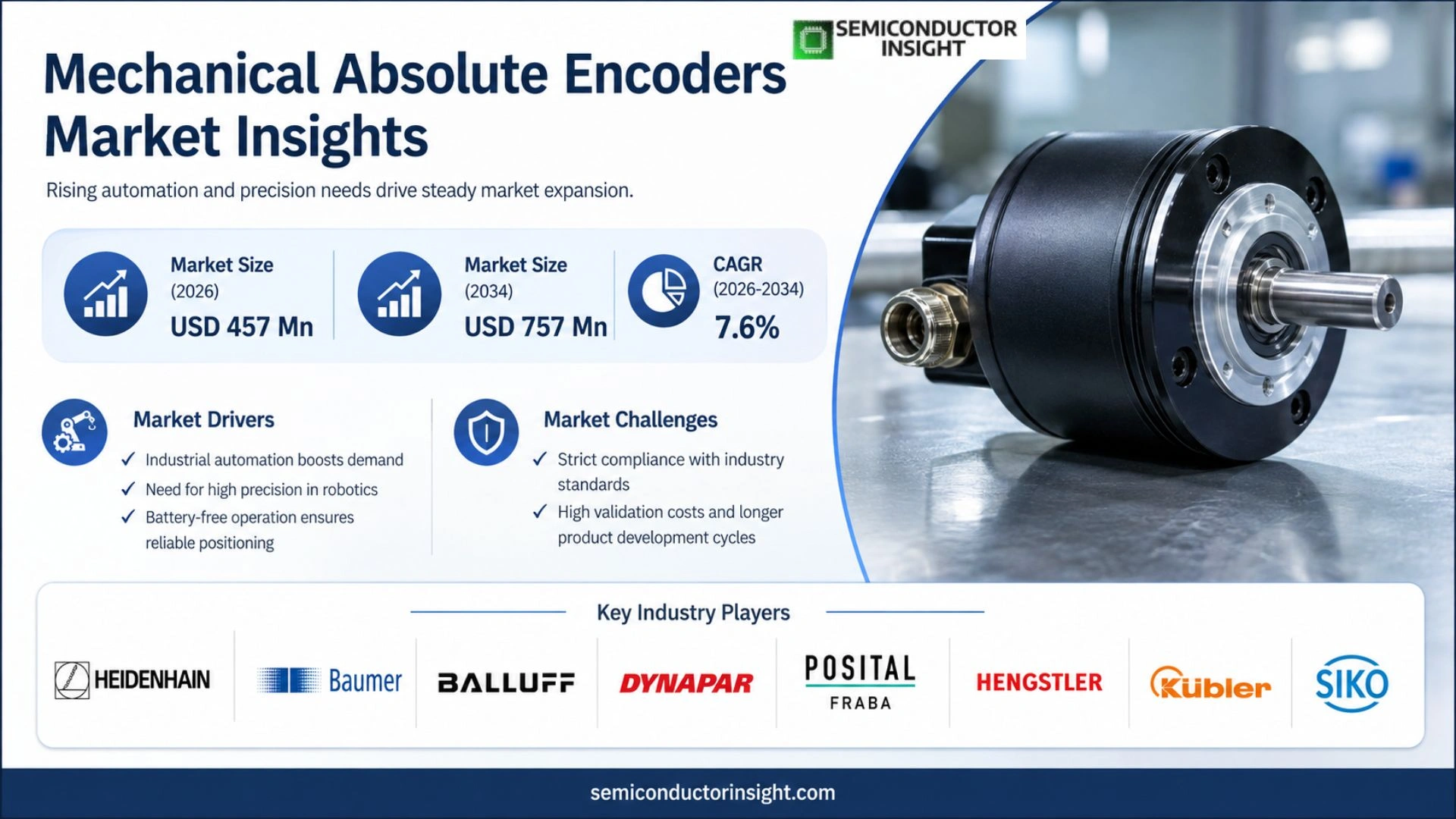
Mechanical Absolute Encoders market will increase from USD 457 million in 2026 to USD 757 million by 2034, showing a CAGR of 7.6% over the forecast period.
Mechanical Absolute Encoders are electromechanical position sensors that translate the instantaneous angular position of a rotating shaft directly into a unique digital code. A typical unit comprises a housing, shaft, bearings, mounting flange, coded disk or mechanical contact assembly, signal‑conditioning electronics and terminals or connectors. Devices are commonly offered in compact cylindrical or square formats with solid‑shaft, hollow‑shaft, bushing or flange‑mounted designs. Functionally they fall into single‑turn and multi‑turn categories; application-wise they serve industrial control, panel‑control and heavy‑duty segments. Their primary advantage is delivering an absolute position value immediately after power‑up without any homing routine. Key applications span servo drives, CNC rotary tables, robot joints, conveyors, construction and mobile machinery, harbor equipment, wind‑turbine yaw/pitch systems, medical devices and broader industrial automation.
MARKET DRIVERS
Industrial Automation Demand
The surge in automated assembly lines across automotive and electronics manufacturers is compelling vendors to adopt Mechanical Absolute Encoders for their robustness and deterministic positioning. Customers value the ability to retain positional data without power, which eliminates costly re‑calibration steps after power interruptions.
Precision Requirements in Robotics
Collaborative robots operating in high‑mix, low‑volume environments require repeatable accuracy that exceeds the limits of incremental sensors. Mechanical Absolute Encoders provide a direct link between rotation angle and output code, delivering the traceability required for quality‑controlled batch production.
➤ “A single‑turn absolute encoder cuts downtime by up to 30 % in precision machining cells, according to recent plant audits.”
Beyond performance, the long‑life mechanical design reduces total cost of ownership. With fewer electronic components exposed to harsh temperatures, maintenance intervals stretch, making the technology attractive for mining conveyors and offshore drilling rigs.
MARKET CHALLENGES
Regulatory Compliance Pressures
In sectors such as aerospace and medical devices, certification standards (e.g., ISO 26262, IEC 60601) demand rigorous traceability and environmental testing. Mechanical Absolute Encoders, while durable, must undergo additional validation to prove immunity to shock and vibration, adding time and expense to product launches.
Other Challenges
Supply Chain Volatility
The reliance on precision‑machined gears and hardened steel components ties the market to a limited pool of specialty suppliers. Recent geopolitical disruptions have elongated lead times, forcing OEMs to hold higher safety stock and compress margins.
These constraints encourage manufacturers to explore hybrid solutions that combine mechanical cores with digital interfaces, a compromise that mitigates certification hurdles while preserving the core benefits of absolute positioning.
MARKET RESTRAINTS
High Capital Expenditure
Entry‑level models of Mechanical Absolute Encoders often sit above $1,000 per unit, a price point that can deter small‑scale system integrators. The upfront investment required for tooling, calibration fixtures, and training amplifies the financial barrier, especially in emerging economies where cost sensitivity remains high.
Moreover, the necessity for customized housings to match diverse machine footprints adds engineering effort, further slowing adoption in fast‑moving consumer‑goods production environments.
MARKET OPPORTUNITIES
Emerging Applications in Aerospace
Next‑generation satellite propulsion systems are integrating Mechanical Absolute Encoders to guarantee precise valve actuation in the vacuum of space. The technology’s immunity to radiation and temperature extremes satisfies the stringent reliability criteria demanded by launch providers.
Additionally, defense contractors are evaluating these encoders for turbofan engine health monitoring, where deterministic position feedback enables predictive maintenance algorithms. The convergence of high‑reliability mechanics with advanced analytics opens a lucrative niche for vendors willing to certify their products for defense use.
Strategic partnerships with original equipment manufacturers and the development of modular encoder kits can accelerate market penetration, turning the current restraint of high capital costs into a scalable business model.
Mechanical Absolute Encoders Market Trends
Shift Toward Embedded Position‑Feedback Solutions
The market is moving from a generic motion‑control component to a dedicated, high‑reliability position‑feedback node. End‑users in automotive‑grade manufacturing, collaborative robotics and CNC machine tools are demanding an encoder that reports the absolute shaft angle immediately after power‑up, eliminating homing procedures and reducing overall equipment downtime. This requirement aligns with tighter functional‑safety standards and the push for shorter commissioning cycles on newly installed production lines. Suppliers that embed robust bearing designs, sealed housings and field‑bus compatible interfaces can differentiate their offerings, turning a single part into a gateway for long‑term service contracts. Consequently, Mechanical Absolute Encoders Market is being shaped less by pure volume growth and more by the ability of vendors to lock into system‑level architectures.
Other Trends
Mechanical Design Advantages vs Non‑Contact Alternatives
The mechanical construction retains appeal where cost constraints, space limitations and straightforward integration dominate the buying decision. Unlike optical or magnetic encoders, a contact‑based absolute unit can be fabricated in compact cylindrical or square formats, offering solid‑shaft, hollow‑shaft or flange‑mounted variants that fit directly into legacy motor housings. For panel‑control panels, operator‑setting units and auxiliary positioning loops, the lack of a calibration step translates into lower training requirements and a more predictable maintenance schedule. However, the same contact principle imposes limits on rotational speed, wear life and resistance to contamination, prompting manufacturers to invest in hardened contact materials, precision bearings and enhanced sealing. Those engineering advances are gradually extending the viable application envelope of mechanical devices into mid‑range automation where the total cost of ownership still favors a rugged, low‑cost solution.
Competitive Landscape Emphasizes System Integration
The competitive arena is increasingly defined by system integration rather than isolated specifications. OEMs now prefer partners that can supply certified interfaces to EtherCAT, PROFINET or CC‑Link, along with software libraries that embed the encoder’s absolute code into motion‑control loops. Companies that complement hardware with field service networks, localized stocking and rapid firmware updates are converting one‑off sales into recurring revenue streams. At the same time, the rise of high‑accuracy non‑contact alternatives is pressuring mechanical vendors to focus on niche segments,such as heavy‑duty conveyor gearboxes, wind‑turbine yaw drives and maritime handling equipment,where durability and simple wiring outweigh the premium of optical precision. In this context, the long‑term outlook for Mechanical Absolute Encoders Market hinges on manufacturers’ capacity to marry mechanical robustness with digital connectivity and to sustain quality across global supply chains.
COMPETITIVE LANDSCAPE
Key Industry Players
Mechanical Absolute Encoders – Competitive Overview
The market is anchored by a handful of globally recognized manufacturers that combine deep mechatronics expertise with extensive field‑service networks. OMRON, for instance, leverages its broad automation portfolio to embed absolute‑encoder modules directly into PLC‑servo packages, thereby shortening integration cycles for OEMs. This strategy has secured OMRON a top‑tier share in both the industrial‑control and heavy‑duty segments, where reliability after power‑up is a decisive factor. Parallel to OMRON, SICK and HEIDENHAIN maintain strong positions by offering highly configurable mechanical‑contact solutions that cater to niche demands such as low‑speed, high‑torque winding equipment. Their emphasis on precision bearing design and modular mounting options reinforces a market structure where a few Tier‑1 firms dominate the high‑volume corridors while cultivating long‑term service contracts that lock customers into ecosystem‑wide solutions.
Beyond the Tier‑1 cohort, a diverse set of niche specialists sustains the market’s breadth. Companies such as ifm, Pepperl+Fuchs, and Renishaw concentrate on sector‑specific variants,panel‑control units for sanitary environments, rugged port‑equipment encoders, and compact multi‑turn devices for robotic joints. Meanwhile, regional players like Baumer (Europe), Balluff (Germany), and Dynapar (India) exploit localized supply chains to win cost‑sensitive contracts in the mid‑range manufacturing segment. Emerging contributors,including POSITAL, HENGSTLER, Kübler, and SIKO,focus on custom‑machined housings and proprietary sealing technologies that differentiate their offerings where environmental protection outweighs raw performance. This layered competitive fabric creates a marketplace where differentiation is achieved through application engineering, rapid after‑sales support, and the ability to co‑develop solutions with OEM system integrators.
List of Key Mechanical Absolute Encoders Companies Profiled
- OMRON
- SICK
- HEIDENHAIN
- ifm
- Pepperl+Fuchs
- Renishaw
- Balluff
- Baumer
- Dynapar
- POSITAL
- HENGSTLER
- Kübler
- SIKO
- Tamagawa Seiki
- Encoder Products Company
Segment Analysis:
| Segment Category | Sub-Segments | Key Insights |
| By Type |
|
Single‑turn Encoder is favored where compactness and cost‑effectiveness dominate.
|
| By Application |
|
Industrial control drives primary demand because of reliability needs.
|
| By End User |
|
Robotics leverages the encoder’s instant positioning to improve cycle times.
|
| By Mounting Structure |
|
Solid Shaft remains dominant in cost‑sensitive installations.
|
| By Output Interface |
|
Fieldbus Output is gaining attention as factories adopt networked control.
|
Regional Analysis: Mechanical Absolute Encoders Market
Europe
In southern Germany and northern Italy, factories are retrofitting legacy CNC equipment with absolute encoders to eliminate homing routines. The resulting uptime boost, though modest in absolute terms, translates into measurable cost avoidance for high‑mix producers that cannot afford production halts.
Premium vehicle platforms are integrating absolute encoders into steering‑by‑wire and electric power‑train modules. Suppliers that can certify long‑term temperature stability are gaining the trust of OEMs keen to meet stringent safety standards across the EU market.
Defense contractors in the United Kingdom are specifying mechanical absolute encoders for flight‑control actuators where electromagnetic interference is a concern. This niche demand encourages manufacturers to explore hardened shaft materials and sealed bearing assemblies.
The European Committee for Standardization (CEN) is drafting guidelines that align encoder resolution metrics with Industry 4.0 data‑exchange protocols, nudging vendors toward interoperable firmware stacks and simplifying system‑integrator decisions.
North America
The United States continues to leverage its extensive robotics deployments in automotive and semiconductor fabs, where absolute position feedback underpins repeatability. Early adopters are pairing mechanical absolute encoders with edge‑computing nodes to offload deterministic calculations, thereby reducing latency in high‑throughput lines. Canadian firms, meanwhile, are exploring low‑temperature variants for oil‑and‑gas applications in the Arctic, a move that could open up a secondary market for ruggedized products. Market participants note that the North American environment rewards rapid product cycles; thus, suppliers that can shorten prototype-to‑production timelines are positioning themselves as preferred partners for OEMs seeking to accelerate time‑to‑market for next‑generation equipment.
Asia‑Pacific
China, Japan, and South Korea dominate the volume side of Mechanical Absolute Encoders Market, driven by expansive manufacturing footprints and aggressive cost‑optimization pressures. Companies in the region focus on scaling production of compact encoders for assembly‑line robots, often sacrificing high‑end materials in favor of cost‑effective alloys. However, a parallel trend is emerging in Japan, where precision‑tool makers demand ultra‑stable encoders for semiconductor lithography equipment, prompting a modest shift toward premium grades. The competitive dynamic forces Asian suppliers to balance price competitiveness with incremental performance upgrades, especially as regional trade shows spotlight emerging use cases in renewable‑energy turbine control.
South America
Brazil’s growing renewable‑energy sector is creating a niche for absolute encoders used in wind‑turbine pitch‑control mechanisms, where deterministic angle measurement is essential for grid compliance. Local manufacturers are forming joint ventures with European firms to acquire the know‑how required for high‑torque applications, a strategy that mitigates the technology gap while preserving cost advantages. Meanwhile, Argentina’s automotive assembly plants are beginning to replace incremental encoders with absolute types to simplify line reconfiguration, a move that reflects a broader regional desire to modernize legacy equipment without extensive downtime.
Middle East & Africa
The United Arab Emirates is channeling investments into smart‑factory projects that incorporate absolute encoders for material‑handling cranes operating in desert conditions. The harsh environment elevates the importance of dust‑proof sealing and thermal stability, prompting suppliers to develop bespoke housings. In South Africa, the mining sector is experimenting with absolute encoders on underground conveyance systems, where electromagnetic interference from heavy‑duty equipment makes mechanical solutions attractive. These targeted applications suggest that, while overall market size remains limited, strategic adoption in high‑value projects could serve as a catalyst for broader awareness across the region.
Report Scope
This market research report provides a comprehensive analysis of the Mechanical Absolute Encoders Market , covering the forecast period 2026–2034. It offers detailed insights into market dynamics, technological advancements, competitive landscape, and key trends shaping the industry.
Key focus areas of the report include:
- Market Overview: The report begins with an overview outlining its current market scenario, key growth indicators, and industry transformation drivers. It discusses macroeconomic factors, demand–supply balance, regulatory landscape, and the strategic role of semiconductors in powering advancements across industries such as automotive, telecommunications, consumer electronics, and industrial automation.
- Market Size & Forecast: Historical data and future projections for revenue, unit shipments, and market value across major regions and segments.
- Segmentation Analysis: Detailed breakdown by product type, technology, application, and end-user industry to identify high-growth segments and investment opportunities.
- Regional Insights: Insights into market performance across North America, Europe, Asia-Pacific, Latin America, and the Middle East & Africa, including country-level analysis where relevant.
- Competitive Landscape: Profiles of leading market participants, including their product offerings, R&D focus, manufacturing capacity, pricing strategies, and recent developments such as mergers, acquisitions, and partnerships.
- Technology Trends & Innovation: Assessment of emerging technologies, integration of AI/IoT, semiconductor design trends, fabrication techniques, and evolving industry standards.
- Market Drivers & Restraints: Evaluation of factors driving market growth along with challenges, supply chain constraints, regulatory issues, and market-entry barriers.
- Stakeholder Insights: Insights for component suppliers, OEMs, system integrators, investors, and policymakers regarding the evolving ecosystem and strategic opportunities.
Primary and secondary research methods are employed, including interviews with industry experts, data from verified sources, and real-time market intelligence to ensure the accuracy and reliability of the insights presented.
FREQUENTLY ASKED QUESTIONS:
What is the current market size of Mechanical Absolute Encoders Market?
-> Mechanical Absolute Encoders market will increase from USD 457 million in 2026 to USD 757 million by 2034, showing a CAGR of 7.6%
Which key companies operate in Mechanical Absolute Encoders Market?
-> Key players include OMRON, SICK, HEIDENHAIN, ifm, Pepperl+Fuchs, Renishaw, Balluff, Baumer, Bourns, Dynapar, POSITAL, HENGSTLER, Kübler, SIKO, Tamagawa Seiki, Leine Linde, Wachendorff, TR-Electronic, ASM Sensor, Encoder Products Company, among others.
What are the key growth drivers?
-> Key growth drivers include factory automation upgrades, increasing robot penetration, higher functional‑safety expectations, demand for higher resolution and lower lifecycle downtime, and expanding adoption of fieldbus and industrial Ethernet interfaces.
Which region dominates the market?
-> Asia‑Pacific is the largest market, driven by rapid manufacturing expansion and localized sourcing, while Europe remains a significant and mature market.
What are the emerging trends?
-> Emerging trends include integration with IoT and Industry 4.0 platforms, modular mechanical designs, stronger fieldbus/Industrial Ethernet compatibility, and a focus on reliability and total cost of ownership reduction.
Get Sample Report PDF for Exclusive Insights
Report Sample Includes
- Table of Contents
- List of Tables & Figures
- Charts, Research Methodology, and more...