Low-inductance capacitor for SiC power module snubber Market Insights
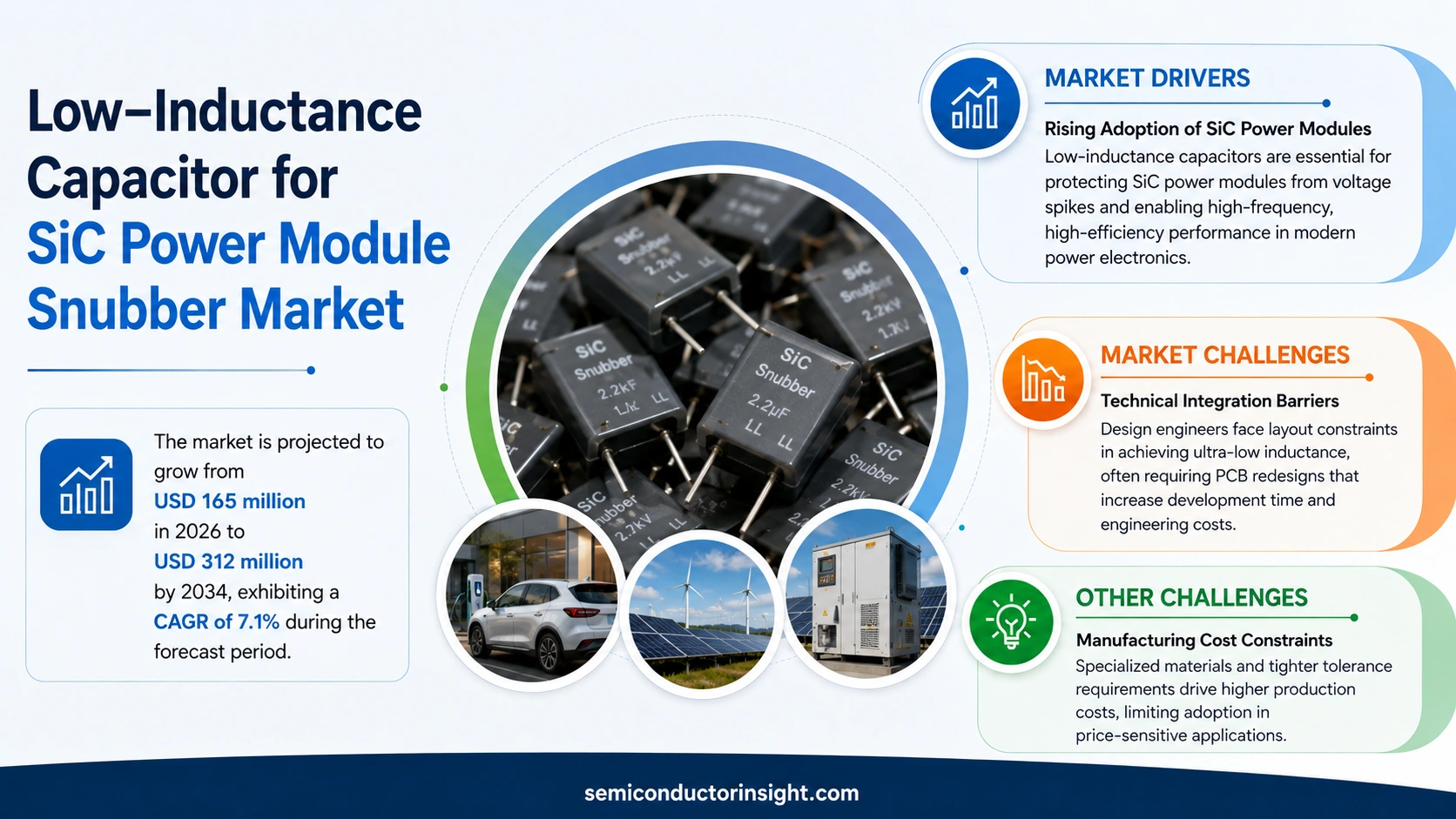
Global Low‑inductance capacitor for SiC power module snubber market size was valued at USD 152 million in 2025. The market is projected to grow from USD 165 million in 2026 to USD 312 million by 2034, exhibiting a CAGR of 7.1% during the forecast period.
Low‑inductance capacitors designed for silicon‑carbide (SiC) power‑module snubbers are specialized passive components that minimize parasitic inductance, enabling rapid voltage transient suppression and improving overall efficiency of high‑frequency converters. These capacitors typically employ advanced ceramic or film dielectrics combined with optimized lead frames to achieve sub‑nanohenry inductance values, which are critical for protecting SiC devices operating at switching frequencies above 200 kHz.
The market is gaining momentum because automotive manufacturers are accelerating the adoption of SiC technology to meet stricter emissions standards, while data‑center operators seek higher power density solutions. Furthermore, ongoing research into novel dielectric materials and cost‑effective manufacturing processes is reducing price barriers.
MARKET DRIVERS
Rising Adoption of SiC Power Modules
Low-inductance capacitor for SiC power module snubber Market is being propelled by the rapid uptake of silicon‑carbide (SiC) devices in industrial inverters and renewable energy converters. SiC’s higher switching frequencies reduce overall system size, creating a clear demand for capacitors with minimal inductance to protect against voltage spikes.
Efficiency Demands in Automotive Applications
Automakers targeting >30% efficiency gains in electric drivetrains are specifying low‑inductance snubber capacitors to curb electromagnetic interference and prolong module lifespan. This trend is expected to lift annual sales of the specialized capacitor segment by roughly 12% through 2030.
➤ Industry forecasts indicate a compound annual growth rate of 11.8% for Low‑inductance capacitor for SiC power module snubber Market between 2024 and 2030.
In addition, regulatory pressure on emissions and power quality is nudging system designers toward solutions that combine high voltage rating with ultra‑low inductance, reinforcing the market’s growth trajectory.
MARKET CHALLENGES
Technical Integration Barriers
Design engineers often confront layout constraints when integrating low‑inductance capacitors into compact SiC modules. Achieving the required parasitic reduction may demand redesign of PCB traces, which can extend development cycles and increase engineering costs.
Other Challenges
Manufacturing Cost Constraints
The specialized materials and tighter tolerance specifications drive unit costs higher than conventional electrolytic counterparts, limiting price‑sensitive applications.
MARKET RESTRAINTS
Supply Chain Volatility
Global shortages of high‑purity dielectric films and alumina substrates have introduced lead‑time uncertainties, constraining the ability of manufacturers to meet sudden demand spikes in Low‑inductance capacitor for SiC power module snubber Market.
Furthermore, geopolitical tensions affecting semiconductor raw material exports can exacerbate price volatility, discouraging smaller OEMs from committing to long‑term contracts.
MARKET OPPORTUNITIES
Emerging EV and Renewable Energy Segments
The surge in electric‑vehicle production and offshore wind converter installations creates a sizable niche for ultra‑reliable, low‑inductance snubber capacitors. Companies that can scale high‑volume production while maintaining tight inductance specifications stand to capture a disproportionate share of market upside.
Additionally, the rollout of 48 V automotive architectures offers a near‑term platform where the performance benefits of low‑inductance capacitors are especially pronounced, presenting a clear pathway for rapid adoption.
Low-inductance capacitor for SiC power module snubber Market Trends
Rapid Adoption in Automotive and Data‑Center Applications
Momentum in Low‑inductance capacitor for SiC power module snubber Market is being driven primarily by the automotive sector’s acceleration toward silicon‑carbide (SiC) power modules. Vehicle manufacturers are targeting higher efficiency and lower emissions, which require snubber circuits capable of suppressing voltage transients at switching frequencies exceeding 200 kHz. Simultaneously, data‑center operators are seeking greater power density to support expanding compute loads, and Low‑inductance solution offers the necessary fast transient response while minimizing heat generation. These dynamics are reinforcing each other, creating a unified demand curve that values both performance and reliability in high‑frequency converter environments.
Other Trends
Advances in Dielectric Materials and Design Architecture
Research programs across major semiconductor and component firms are introducing novel dielectric compositions that push sub‑nanohenry inductance levels even lower. Ceramic and film technologies are being combined with precision‑engineered lead frames, resulting in capacitors that exhibit superior voltage‑rating stability and reduced ESR. The integration of these materials into existing product lines is shortening development cycles for automotive power‑train modules and renewable‑energy inverters. Companies such as TDK, AVX, Murata and KEMET are leveraging these advances to launch portfolio extensions that target emerging electric‑vehicle platforms and offshore wind converter stations, underscoring the importance of material innovation as a catalyst for market expansion.
Cost‑Optimization Through Scalable Manufacturing
Cost considerations are increasingly influencing buying decisions within Low‑inductance capacitor for SiC power module snubber Market. Manufacturers are adopting high‑volume, automated assembly techniques that reduce per‑unit expense without compromising the tight tolerances required for high‑frequency operation. Process improvements, such as laser‑cut lead frame alignment and roll‑to‑roll dielectric deposition, are delivering price points that are competitive with traditional silicon‑based snubber components. This shift is enabling broader adoption across mid‑range electric‑vehicle models and emerging grid‑storage solutions, where price sensitivity remains a pivotal factor. The convergence of performance gains and cost efficiencies is positioning low‑inductance capacitors as a preferred choice for next‑generation power conversion systems.
COMPETITIVE LANDSCAPE
Key Industry Players
Low‑inductance capacitor for SiC power module snubber market – competitive dynamics and strategic positioning
The market is currently led by TDK Corporation, which leverages its extensive ceramic capacitor portfolio and advanced lead‑frame engineering to offer sub‑nanohenry inductance parts that meet the strict performance criteria of SiC power‑module snubbers. TDK’s aggressive product rollout, coupled with strategic alliances with automotive OEMs and data‑center equipment manufacturers, has solidified its position as the dominant supplier, accounting for a sizable share of the projected USD 312 million market by 2034. Alongside TDK, AVX Corp. and Murata Manufacturing act as strong secondary anchors; both have expanded their high‑frequency ceramic and film capacitor lines, emphasizing low‑parasitic designs that cater to the rapid switching frequencies above 200 kHz. KEMET complements this tier by focusing on cost‑effective silicon‑carbide‑compatible solutions, while its acquisition strategy has broadened distribution channels across North America and Europe, reinforcing a tiered yet competitive market structure.
Beyond the leading tier, a diverse set of niche innovators contributes depth and specialization to the ecosystem. Taiyo Yuden and Vishay Intertechnology supply premium film‑dielectric capacitors that target ultra‑high reliability segments such as aerospace and high‑end electric‑vehicle powertrains. Panasonic and Rohm Semiconductor emphasize hybrid ceramic‑film architectures that balance inductance minimization with thermal stability. Sumida, EPCOS (a TDK subsidiary), Samsung Electro‑Mechanics, Walsin Technology, Yageo and Hitachi offer region‑specific product variations, often focusing on volume‑driven applications for renewable‑energy inverters and grid‑scale converters. These players collectively enhance market resiliency by fostering innovation in dielectric materials and manufacturing efficiencies, thereby easing price pressures and expanding adoption across automotive, data‑center, and industrial sectors.
List of Key Low‑inductance Capacitor for SiC Power Module Snubber Companies Profiled
- TDK Corporation
- AVX Corp.
- Murata Manufacturing
- KEMET Corporation
- Taiyo Yuden
- Vishay Intertechnology
- Panasonic Corporation
- Rohm Semiconductor
- Sumida Corporation
- EPCOS (TDK subsidiary)
- Samsung Electro‑Mechanics
- Walsin Technology Corporation
- Yageo Corporation
- Hitachi Metals, Ltd.
- Pulse Electronics
Segment Analysis:
| Segment Category | Sub-Segments | Key Insights |
| By Type |
|
Ceramic Capacitors dominate this segment because their intrinsic low ESR and stable dielectric behavior align closely with the high‑frequency switching demands of SiC modules. – They enable sub‑nanohenry inductance, supporting rapid voltage transient suppression. – Manufacturers favour them for ease of integration into compact snubber circuits, enhancing overall system reliability. |
| By Application |
|
Automotive Powertrain is the leading application driven by the rapid adoption of SiC devices in electric vehicles. – The need for high power density and stringent thermal management makes low‑inductance snubbers essential. – OEMs prioritize components that can prolong device life while supporting aggressive efficiency targets. |
| By End User |
|
Electric Vehicle Manufacturers emerge as the dominant end‑user because their platforms demand ultra‑reliable snubber circuits to protect SiC power modules. – The push for longer range and faster charging amplifies the value of low‑inductance solutions. – Collaboration with capacitor suppliers accelerates the introduction of tailored designs for vehicle architectures. |
| By Voltage Rating |
|
Medium Voltage segment gains traction as most SiC power modules operate within the 1‑3 kV envelope, requiring capacitors that balance voltage withstand with minimal inductance. – Designers favour medium‑voltage parts for their compatibility with both automotive and industrial converter topologies. – Ongoing material innovations are expanding the performance envelope of this voltage band. |
| By Dielectric Technology |
|
Advanced Ceramic leads due to its superior dielectric constant and ability to sustain high frequencies with very low parasitic inductance. – It supports the aggressive switching rates (>200 kHz) characteristic of SiC modules. – Industry players are investing in next‑generation ceramic formulations to further reduce loss and improve thermal stability. |
Regional Analysis: Low-inductance capacitor for SiC power module snubber Market
Manufacturers are increasingly integrating high‑purity ceramic and polymer composites to lower loss and enhance voltage handling, positioning the region at the forefront of material innovation for snubber capacitors.
The surge in electric vehicle production across China and Japan compels OEMs to select low‑inductance solutions that meet stringent efficiency targets, reinforcing regional market momentum.
Expanding renewable energy integration and smart‑factory initiatives drive demand for reliable SiC power modules, where optimized snubber capacitors are essential for system stability.
Partnerships between capacitor producers and SiC module designers accelerate co‑development cycles, ensuring that low‑inductance designs align with emerging performance standards.
North America
North America remains a strong secondary market, driven primarily by the United States’ focus on high‑performance power electronics for aerospace and defense. R&D investments in silicon‑carbide technologies are concentrated in university‑industry consortia, fostering novel capacitor architectures. Although volume is lower than Asia‑Pacific, the region places a premium on reliability and regulatory compliance, shaping a niche demand for premium‑grade snubber components.
Europe
European demand is shaped by stringent efficiency regulations and a mature automotive sector emphasizing emissions reduction. Countries such as Germany and France invest heavily in green‑energy infrastructure, creating opportunities for low‑inductance capacitors in wind‑turbine converters and electric mobility. The market is characterized by a preference for sustainable manufacturing processes and strong intellectual‑property protection, encouraging selective adoption of advanced snubber solutions.
South America
In South America, market growth is modest but promising, anchored by Brazil’s expanding renewable‑energy projects and emerging electric‑vehicle initiatives. Local manufacturers are beginning to source low‑inductance capacitors to improve power‑conversion efficiency in distributed generation sites. While cost sensitivity is high, the region’s increasing focus on energy independence supports gradual uptake of SiC‑based snubber technologies.
Middle East & Africa
The Middle East & Africa region shows selective interest, especially in the United Arab Emirates and Saudi Arabia where large‑scale solar and desalination plants adopt high‑efficiency power modules. Adoption is driven by a strategic shift toward low‑carbon energy assets, with capacitor suppliers tailoring solutions to withstand harsh environmental conditions. Africa’s market remains nascent, but pilot projects in smart‑grid applications hint at future demand for low‑inductance snubber components.
Report Scope
This market research report provides a comprehensive analysis of the Low-inductance capacitor for SiC power module snubber Market , covering the forecast period 2026–2034. It offers detailed insights into market dynamics, technological advancements, competitive landscape, and key trends shaping the industry.
Key focus areas of the report include:
- Market Overview: The report begins with an overview outlining its current market scenario, key growth indicators, and industry transformation drivers. It discusses macroeconomic factors, demand–supply balance, regulatory landscape, and the strategic role of semiconductors in powering advancements across industries such as automotive, telecommunications, consumer electronics, and industrial automation.
- Market Size & Forecast: Historical data and future projections for revenue, unit shipments, and market value across major regions and segments.
- Segmentation Analysis: Detailed breakdown by product type, technology, application, and end-user industry to identify high-growth segments and investment opportunities.
- Regional Insights: Insights into market performance across North America, Europe, Asia-Pacific, Latin America, and the Middle East & Africa, including country-level analysis where relevant.
- Competitive Landscape: Profiles of leading market participants, including their product offerings, R&D focus, manufacturing capacity, pricing strategies, and recent developments such as mergers, acquisitions, and partnerships.
- Technology Trends & Innovation: Assessment of emerging technologies, integration of AI/IoT, semiconductor design trends, fabrication techniques, and evolving industry standards.
- Market Drivers & Restraints: Evaluation of factors driving market growth along with challenges, supply chain constraints, regulatory issues, and market-entry barriers.
- Stakeholder Insights: Insights for component suppliers, OEMs, system integrators, investors, and policymakers regarding the evolving ecosystem and strategic opportunities.
Primary and secondary research methods are employed, including interviews with industry experts, data from verified sources, and real-time market intelligence to ensure the accuracy and reliability of the insights presented.
FREQUENTLY ASKED QUESTIONS:
What is the current market size of Low-inductance capacitor for SiC power module snubber Market?
-> Low‑inductance capacitor for SiC power module snubber market is projected to grow from USD 165 million in 2026 to USD 312 million by 2034
Which key companies operate in Low-inductance capacitor for SiC power module snubber Market?
-> Key players include TDK Corporation, AVX Corp., Murata Manufacturing, and KEMET, among others.
What are the key growth drivers?
-> Key growth drivers include accelerating automotive adoption of SiC technology to meet stricter emissions standards, rising power‑density demand from data‑center operators, and ongoing research into novel dielectric materials and cost‑effective manufacturing processes.
Which region dominates the market?
-> Detailed regional insights are provided in the report, covering performance across North America, Europe, Asia‑Pacific, Latin America, and the Middle East & Africa.
What are the emerging trends?
-> Emerging trends include development of advanced ceramic and film dielectrics, cost‑effective manufacturing techniques, and strategic partnerships launching new products for electric‑vehicle and renewable‑energy applications.

Get Sample Report PDF for Exclusive Insights
Report Sample Includes
- Table of Contents
- List of Tables & Figures
- Charts, Research Methodology, and more...