Key Statistics
Key Takeaways
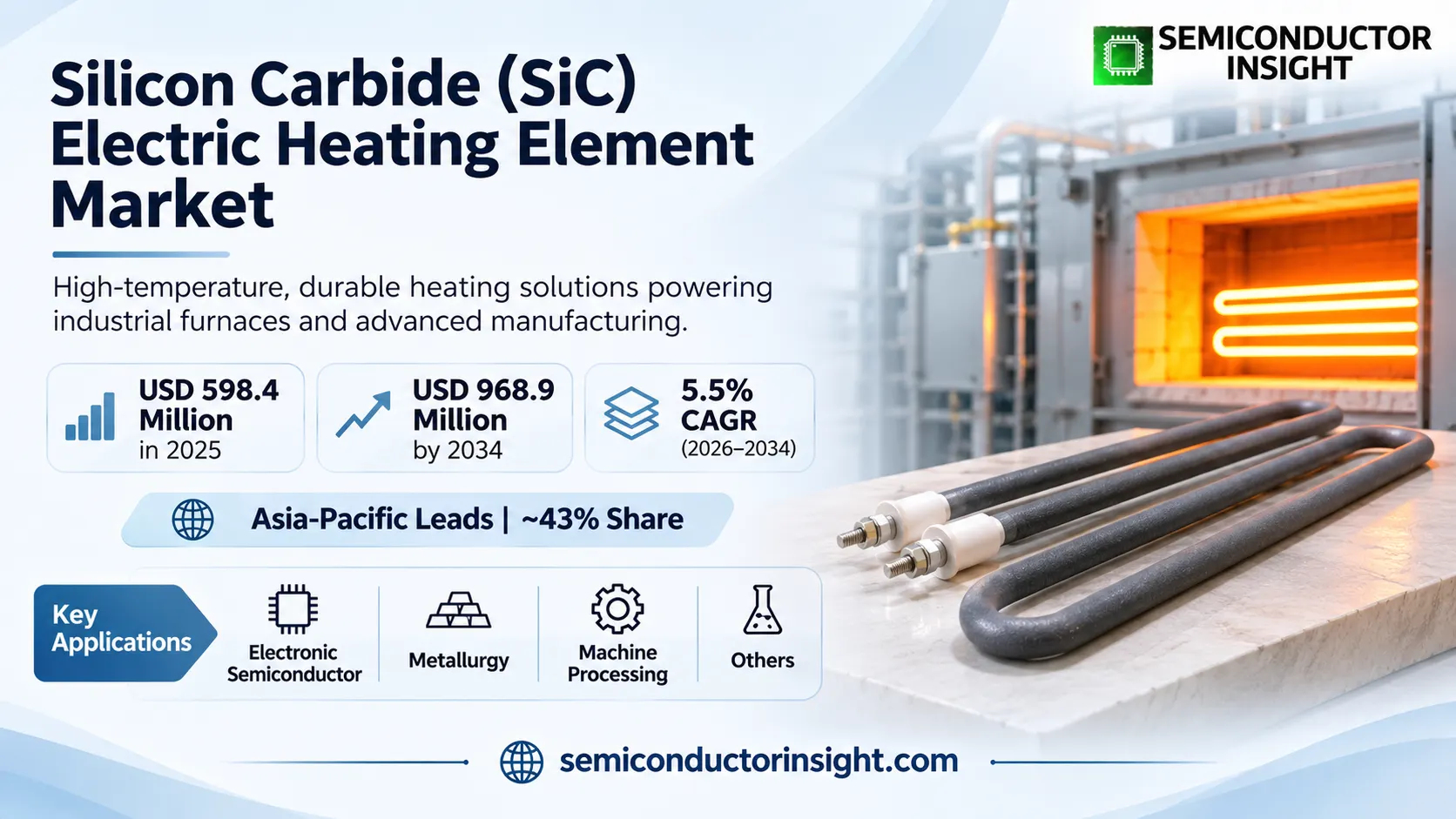
- Market trajectory The market reached USD 598.4 million in 2025 and is forecast to reach USD 968.9 million in 2034, with 5.5% compound annual growth during 2026–2034. Furnace modernization, industrial process electrification and recurrent replacement of consumed resistance elements sustain purchasing across established thermal-processing industries.
- Product mix Rod Form is the leading type with an estimated ~61% share, reflecting long-established straight and multi-leg elements installed in kilns and industrial ovens. Tubular Form comprises an estimated ~39%, serving protected or restricted furnace spaces, custom thermal zones and spiral constructions with electrical connections on one side.
- Demand distribution Metallurgy takes an estimated ~37% of sales, followed by Machine Processing at ~28%, Electronic Semiconductor at ~18% and Others at ~17%. Metal heat treatment creates regular replacement demand, whereas electronic ceramics and semiconductor production emphasize cleanliness, temperature repeatability and an appropriate atmosphere around the active element.
- Regional balance Asia-Pacific is the leading market at an estimated ~43% share, supported by industrial furnaces and local heater manufacturing. Europe holds ~27%, North America ~19%, Middle East & Africa ~6%, and South & Central America ~5%. Regional purchasing reflects furnace installations and element replacement cycles more closely than final exports of manufactured goods.
- Supplier economics Element suppliers differentiate through oxidation resistance, resistance stability, lead-in construction and the ability to replace an existing part without modifying furnace power controls. Increasing temperature can accelerate degradation; longer-life ceramics win orders where a production stoppage costs substantially more than a spare heating rod.
Silicon Carbide (SiC) Electric Heating Element Market Overview
Silicon carbide (SiC) electric heating element market was valued at USD 598.4 million in 2025 and is projected to reach USD 968.9 million by 2034, recording a CAGR of 5.5% over 2026–2034. Asia-Pacific leads with an estimated ~43% share as metallurgical, electronic-ceramic and industrial furnace operators replace heating elements and expand electrically heated production capacity.
A silicon carbide resistance heating element turns electrical current into heat inside a controlled-temperature furnace. Unlike a SiC MOSFET, the ceramic body is itself the resistive load, commonly arranged as a straight hot zone between lower-resistance terminals or as a tubular, spiral or multi-leg construction. Operating limits depend on surrounding gas, electrical surface loading and thermal cycling. Commercial catalogues include equipment suitable for element temperatures near 1,600°C to 1,650°C, with individual grades offering different life and installation characteristics. Kanthal describes standard products in nominal diameters of 10 mm to 55 mm, heating sections as long as 4.2 m and overall lengths of 6 m, measurements that define the practical range of industrial equipment fit.
Revenue comprises finished silicon carbide electrical heater elements of the rod and tubular forms identified in the product segmentation, including suitable specialty bends and spiral shapes. It does not include complete electric furnaces, refractory insulation, power-control transformers, MoSi2 or FeCrAl heating elements, or the semiconductor-grade SiC substrates fabricated into chips. Replacement rods and custom heating elements are included because both are sold as components to industrial customers and furnace-maintenance providers.
Resistance changes as the ceramic ages in service. Kanthal explains that an SD element may experience approximately 5–6% resistance growth per 1,000 operating hours at 1,400°C in clean air, whereas a selected SG/SR construction may experience about 3% under specified conditions; its lower-temperature guidance cites approximately 3% growth per 1,000 hours at 1,000°C. The effect makes transformer voltage reserve and element matching commercial concerns, and it also supports a recurring replacement market that continues even if net new furnace installations slow.
Furnace users are not buying temperature capability alone. A straight rod that can be installed through existing wall penetrations may reduce service time, while a single-ended spiral can be necessary in a compact cylindrical hot zone. Electrical controls, spacing from insulation, atmospheric chemistry and mechanical impact are assessed together. Kanthal lists Globar dimensions from roughly 10 mm to 55 mm in diameter, demonstrating the breadth of standard and customized geometries available to engineering purchasers.
Segment Analysis: By Type
The product split consists of Rod Form and Tubular Form. Rods command an estimated ~61% of sales because standard straight, U-shaped and multi-leg geometries can replace worn parts in numerous established kilns. Tubular elements represent an estimated ~39%, benefiting where the furnace demands a large inner channel, compact terminal routing, or special surface loading that differs from a straight solid rod.
| Type | Function | Market position |
|---|---|---|
| Rod Form | Rod heaters are the mainstream configuration at an estimated ~61% of spending. A typical assembly has a central electrically active section and cooler terminals positioned outside the hot chamber. Silcarb offers a joint-free Alpha Ultra Rod with a specified upper temperature of 1,650°C, while I Squared R offers right-angle Starbar models with hot zones up to 1,500 mm. | Customers select diameter, hot-zone length and nominal resistance to fit the existing furnace wiring and refractory penetrations. |
| Tubular Form | Tubular construction accounts for an estimated ~39% of value and can combine an open interior with a helical electrical path. I Squared R lists TSR units with nominal diameters of 44 mm, 50 mm, 55 mm, 62 mm, 75 mm and 89 mm and heating lengths of 305 mm or 457 mm depending on grade. Its 62 mm design has an approximately 54 mm bore, while a 75 mm version offers an internal diameter near 67 mm. These elements support tube-furnace designs or single-ended electrical access. | Their mechanical design and cost per installed heating zone differ from solid rods, so replacement is determined by equipment fit and process exposure. |
Segment Analysis: By Application
Applications include Electronic Semiconductor, Metallurgy, Machine Processing and Others. Metallurgy leads with an estimated ~37% share because annealing, foundry holding and heat-treatment furnaces use many interchangeable high-temperature elements; Machine Processing follows at ~28%, while electronics takes ~18% and miscellaneous ceramics, glass and laboratory uses represent ~17%. These categories describe the use of the heaters, not the revenue of the final processed materials.
| Application | Demand characteristics |
|---|---|
| Electronic Semiconductor | An estimated ~18% of element sales support electronic component firing, ceramic substrates, ferrites, high-temperature materials and selected wafer-processing thermal equipment. Repeated batch cycles demand tightly controlled ramp rates and minimized contamination from heater surfaces. Procurement specifications may call for a 1,400°C or 1,600°C operating grade, defined atmosphere compatibility and reproducible temperature uniformity. Semiconductor fabs also use alternative heating technologies, so entire wafer-fabrication spending is not an appropriate proxy for SiC element revenue. |
| Metallurgy | The largest application, estimated at ~37%, covers electric heat treatment, aluminum holding, metal annealing, powder metallurgy and other controlled high-temperature processes. Heating-zone serviceability is crucial because unplanned downtime can interrupt continuous production. Kanthal identifies applications including continuous steel galvanizing and aluminum holding furnaces for advanced SiC elements; some furnace banks use 2, 3 or 4 legs to concentrate thermal output in one chamber zone. Typical production decisions balance element lifespan, 3–8 W/cm² loading guidance. In one Kanthal engineering example a furnace at 1,400°C and a 5 W/cm² element load produces an element temperature near 1,450°C, which is why load and product temperature are not interchangeable, and the expense of furnace shutdowns rather than simply choosing the least costly replacement rod. |
| Machine Processing | Machine Processing holds an estimated ~28% of sales through hardening and stress-relief ovens, tool treatment, component sintering and specialized thermal equipment. Process managers specify the temperature history of a steel tool or ceramic workpiece and then select an appropriate heating zone. An RA-style element with cold ends at 90° can suit an overhead-access furnace, whereas a straight through-wall rod simplifies servicing. Equipment utilization and the frequency of component changeovers influence the annual spare-parts budget. |
| Others | The remaining estimated ~17% encompasses glass forehearths, industrial ceramics, research laboratories, waste treatment and specialized battery-material heating. Some processes run continuously near 1,200°C while others require repeatable on-off cycles around 900°C, making element composition and thermal shock behavior important. Glass plants may prefer protective coatings against volatiles, while pilot kilns require economical replaceability. Revenue in this group concerns finished SiC heaters, not the glass, battery material or ceramic product emerging from the furnace. |
Application requirements produce different purchase schedules. A metal heat-treatment customer may stock several replacement rods to avoid a production interruption, whereas a research laboratory orders a custom tube for a limited furnace refurbishment. Process atmosphere also changes maintenance timing: Silcarb lists different limits for air, hydrogen, nitrogen and vacuum operation, meaning the same geometric heater may have different qualified operating envelopes. Element procurement therefore involves the furnace engineer and maintenance team as well as the purchasing department.
Regional Analysis
Asia-Pacific has an estimated ~43% share, reflecting the extensive base of steel, ceramic, glass and electronic manufacturing furnaces across China, Japan, India and South Korea. Europe contributes ~27% because of specialized industrial heating and established suppliers; North America holds ~19% through processing plants and domestic service infrastructure. Middle East & Africa at ~6% and South & Central America at ~5% rely more heavily on imported elements for installed industrial equipment.
How does the installed furnace base shape SiC electric heater demand by region?
Purchases occur where heaters are installed and serviced, even when the element was manufactured elsewhere. A regional metalworking plant may maintain hundreds of furnace zones with standard replacement rods, while an electronics facility may need fewer but higher-specification components. Asia offers a broad manufacturing footprint; European firms compete in specialty high-temperature geometry; and North American customers value emergency supply. In developing economies the ability to source an exact substitute can matter more than new equipment expenditure.
| Region | Position | Growth outlook | Demand profile | What decides supplier selection |
|---|---|---|---|---|
| Asia-Pacific | Largest (~43%) | Steady (~6.0% CAGR) | Steel, electronics and ceramic furnace maintenance | Lead times, atmosphere fit and local pricing |
| Europe | Second (~27%) | Stable (~5.1% CAGR) | Heating technology design and industrial decarbonization | Energy costs and premium element engineering |
| North America | Third (~19%) | Steady (~5.4% CAGR) | Specialty manufacturing and furnace retrofit activity | Parts availability and service coverage |
| Middle East & Africa | Emerging (~6%) | Developing (~5.8% CAGR) | Metal processing, glass and industrial heat | Import reliability and severe operating environments |
| South & Central America | Emerging (~5%) | Developing (~5.6% CAGR) | Metals, ceramics and manufacturing refurbishment | Currency and equipment replacement expense |
Key Silicon Carbide (SiC) Electric Heating Element Manufacturers and Competitive Landscape
Competition in SiC electrical furnace heating is shaped by materials expertise, established element geometries and local replacement service. Kanthal supplies several Globar formulations, I Squared R produces Starbar heaters, and Silcarb makes straight, U-shaped and spiral elements. Regional manufacturers target customized sizes and standard replacement products. Customers scrutinize the hot-zone material, cold-end construction, aging rate, compatible atmosphere and delivery lead time before choosing a supplier.
Kanthal is a prominent specialist in industrial heating, with Globar SD, AS, SG, SR, HD Max and Glass Seal lines. Different product grades address oxidation, mechanical shock, temperature uniformity and compatibility with existing furnaces. Long industrial service histories enable a supplier to maintain drawings and resistance specifications that are difficult for a new entrant to reproduce. For a plant with 20 matched heater positions, repeatability across the whole purchased set may outweigh the price of any individual component.
I Squared R Element supplies Starbar silicon-carbide products from its US operations, using standard grades and custom assemblies for process equipment. Its catalogue separates RR and RA constructions from tubular TSR and single-ended spirals. Silcarb, based in India, offers multiple alpha-SiC forms and describes both ceramic heating rods and separate MoSi2 products. Treating the latter as SiC revenue would misrepresent the commercial boundary, even though both technologies compete for the same industrial furnace budget.
Other listed names such as Tokai Konetsu Kogyo and specialized ceramic fabricators may appear on customer approval lists, but their specific active product families require confirmation before describing them as current manufacturers. Furnace builders and control-system vendors influence heater sales without necessarily making the ceramic component themselves. A brand with credible materials testing, resistance-matching capability and replacement logistics can defend margins in applications where an unexpected shutdown costs considerably more than the spare part.
Tier structure
| Tier | Companies | Basis of competition |
|---|---|---|
| Advanced specialist brands | Kanthal / Alleima, I Squared R Element | Established manufacturers offering defined SiC heater geometries and documented performance specifications. They compete by extending element life, verifying electrical behavior at high temperature and supporting existing furnaces. Multi-year relationships with glass and industrial customers offer an advantage where a design change triggers qualification work and heating uniformity tests. |
| Regional scale producers | Silcarb, Tokai Konetsu Kogyo, qualified Asian industrial heater specialists | Manufacturers serving domestic and export demand through standard heating rods, specialized elements or customer drawings. Regional relationships can shorten replacement lead times, while proven density, electrical connections and atmosphere tolerance are essential. Suppliers must substantiate the current products they sell rather than relying solely on a historical company list. |
| Furnace and component partners | Industrial furnace OEMs, refractory specialists, thermal process distributors | Equipment builders and service suppliers contribute thermal design, terminals, insulation and commissioning around the purchased ceramic element. They often influence the brand approved at a facility, but their complete furnace sales are excluded from heater component revenue. Dependable engineering documentation and stocked spares form the main commercial differentiators in this tier. |
Key companies profiled
- Kanthal (Alleima)
- I Squared R Element
- Silcarb
- Tokai Konetsu Kogyo
- CoorsTek
- IPS Ceramics
- Keith Company
- American Elements
- Zhengzhou Ruisheng New Material
- Zhengzhou Songshan Electric Heating Element
- Volton
- SIM Srl
Silicon Carbide (SiC) Electric Heating Element Production Capacity Analysis
Manufacture of silicon-carbide electrical heaters involves preparing high-purity SiC powders, forming a rod or tube, high-temperature recrystallization or reaction sintering, and making cold-end electrical connections. Manufacturers control porosity, hot-zone resistance, wall thickness and geometric straightness so a component remains mechanically stable during repeated high-temperature operation. Final sorting matches rated resistance across a furnace bank; this production objective differs from the low-defect single-crystal requirements of SiC semiconductor wafers.
Silcarb describes extruding alpha-SiC grains and bonding them through recrystallization at more than 2,500°C, with final product density dependent on processing and form. Silicon carbide for heater use can tolerate microstructure features that would be rejected in an electronic transistor crystal, but it must retain mechanical integrity and predictable electrical resistance after thermal cycling. Manufacturers monitor diameter, heating length, cold-end resistance and surface quality. Joining arrangements also matter: a three-piece rod may use bonded ends, whereas a one-piece design eliminates the joint.
Scale is not simply a count of formed ceramic rods. Longer hot zones require firing equipment, inspection capacity and careful handling to avoid chipping, while a customized U-shaped or spiral item uses different tooling from a straight rod. Kanthal announced combined additions in Scotland and North Carolina during 2026, intended to lift available Globar capacity about 40%. That expansion improves the company’s supply capability, but production output still depends on customer orders, material yields, matched element sets and the size mix of orders.
Testing and packing protect the final economic value. A 54 mm heater for a heavy-duty industrial furnace cannot be substituted with a 13 mm laboratory element even if the materials are nominally similar. Producers verify electrical continuity and the resistance distribution of each batch before dispatch, and shipping protection helps prevent fracture of brittle ceramic components. Longer-life protective grades may command a premium where process stoppages are costly; ordinary replacement grades remain important for smaller installations with straightforward electrical controls.
Silicon Carbide (SiC) Electric Heating Element Market Dynamics: Drivers, Restraints and Opportunities
The market grows through industrial electrification, replacement demand and engineering improvements in ceramic element lifespan. Its constraints arise from the materials cost, chemical degradation, competing heater technologies and retrofit complexity. An equipment operator typically evaluates the heat-zone duty, power-control headroom and planned service interval before deciding whether a premium silicon-carbide element offers an attractive whole-furnace economic return.
MARKET DRIVERS
Drivers Impact Analysis*
| Market Drivers | Impact Rank | CAGR Contribution (%) | 2026–2028 | 2029–2031 | 2032–2034 |
|---|---|---|---|---|---|
| Industrial process electrification and heater replacement | High | +2.20% | High | High | High |
| Metallurgy and heat-treatment furnace demand | Medium-High | +1.65% | High | High | Medium |
| High-temperature electronics and ceramics production | Medium | +1.35% | Medium | High | High |
| Improved ceramic grades and longer element service intervals | Medium | +1.00% | Medium | High | High |
| Industrial glass and thermal processing modernization | Low-Medium | +0.75% | Medium | Medium | High |
| Others (laboratory equipment and specialty furnace retrofits) | Low | +0.55% | Low | Medium | Medium |
Furnace electrification expands the heater addressable base
Industrial plants seeking tighter process-temperature control can replace some combustion systems with electric heat, provided energy supply, thermal insulation and control electronics are adequate. A Globar element can operate in designs approaching 1,625°C, but the business opportunity depends on installed heater positions and qualified replacement choices. This shift supports sales of component sets, maintenance stock and engineered high-temperature elements; the much larger expenditure on an entirely new furnace is outside this market.
Metal-processing cycles sustain replacement orders
Thermal treatment of metallic products requires a prescribed time-temperature cycle, with repeated hot and cold transitions that gradually damage heating components. A plant with six zones may keep multiple matched spare elements so a failed rod does not halt the production line. Buyers consequently compare lifetime performance and maintenance access alongside initial cost. The largest commercial opportunities involve furnaces used steadily for annealing, metal treatment and specialized metal-powder processing rather than occasional laboratory operation.
Advanced ceramics need repeatable high-temperature profiles
Electronics-grade ceramics, ferrite components, technical glass and other engineered materials depend on uniform furnace temperatures to meet dimensional or electrical specifications. Heater geometry affects heat distribution; resistance mismatches between several zones can produce local underfiring or overheating. Products designed to resist oxidation and thermal shock may be preferred over basic rods even if their unit price is higher. This demand differs from sales of semiconductor chips, which can benefit from SiC materials without ever purchasing a SiC electrical heater.
Improved components reduce lifecycle maintenance
Stronger ceramic microstructures and protective surface treatments make a commercial difference when furnace shutdowns are expensive. Kanthal describes Globar HD Max as having up to 50% longer service life in suitable harsh conditions, while other designs aim to maintain stable heating in reactive gases. Industrial customers evaluate such claims within their operating environment, including surface loading and temperature, before approving a premium grade. The prospect of fewer failures can justify additional initial expenditure and improve supplier retention.
MARKET RESTRAINTS
Restraints Impact Analysis*
| Market Restraints | Impact Rank | CAGR Contribution (%) | 2026–2028 | 2029–2031 | 2032–2034 |
|---|---|---|---|---|---|
| Atmosphere-driven aging and ceramic breakage | Medium | -0.70% | High | High | Medium |
| Initial expense of specialized high-temperature components | Medium | -0.55% | High | Medium | Medium |
| Substitution by MoSi2 and metal-alloy heating technology | Low-Medium | -0.45% | Medium | Medium | High |
| Others (installation mismatches and power-control limitations) | Low | -0.30% | Medium | Medium | Medium |
Reactive atmospheres shorten useful component life
Silicon-carbide heaters are not equally durable in every operating environment. Certain hydrogen, nitrogen, vacuum and moisture-rich conditions require lower temperature ceilings or protective products; the rate at which resistance rises can differ across furnace locations. Without a suitable voltage reserve the control system may fail to deliver the required heating power late in an element’s life. These technical uncertainties can increase spare-part consumption and discourage adoption in applications that have a proven alternate heater material.
Special geometries are costly to manufacture and stock
A 12 mm, 20 mm or 30 mm standard rod may be sourced quickly, while a long custom tubular spiral, a bent terminal arrangement or a special corrosion-resistant surface requires more processing and quality checks. Smaller buyers may have to purchase minimum batches, pay for drawing approval or carry additional spare inventory. Imported components face freight damage and duty expenses. Manufacturers cannot always recover the cost of special engineering when a furnace operator orders only a handful of replacements per year.
Competing heating materials satisfy many lower-temperature duties
Molybdenum disilicide can be attractive at temperatures above the practical SiC range, while FeCrAl and nickel-chromium designs remain common at more moderate temperatures. They offer different resistance curves, atmosphere limits and installation costs. A furnace converter must compare the entire hot-zone and power-control arrangement rather than purchase the latest ceramic heater simply because it has a higher temperature rating. Competition is most intense where several element types can meet the same process requirement.
Existing furnace hardware can impede substitution
Replacing a conventional resistance heater with a SiC element may require altered terminal geometry, transformer taps, controller settings and refractory spacing. A cold resistance difference can produce damaging starting current unless the power supply is configured correctly. Engineers must also leave enough clearance to avoid unintended radiant heating of chamber walls. These costs can make an otherwise efficient ceramic element unattractive for a small industrial workshop with limited electrical engineering resources.
MARKET OPPORTUNITIES
Glass forehearth retrofit programmes
Glass production facilities value stable temperature profiles and resistance to corrosive vapours. A protective SiC coating or optimized wall thickness can extend service intervals while remaining compatible with some existing heater mounts. Producers able to support the precise furnace drawing and replacement instructions can capture profitable maintenance contracts. The commercial test is whether measured downtime reduction exceeds the premium element price and any changes needed in the associated electrical control system.
Battery-material thermal treatment
Manufacturing some graphite-based anode materials requires repeated high-temperature firing, creating a potential demand pool for durable SiC heaters. Kanthal describes installations where a protected Globar grade lasted more than eight months in a roller kiln, approximately twice the conventional element lifetime under that specific duty. The opportunity is not the value of the battery material itself, but sales of heating components used in the thermal step and the engineering services associated with maintaining them.
Custom heating zones for pilot lines and research
Laboratory and pilot-scale processing equipment often needs unusual tube diameters or single-ended electrical connections. A supplier offering compact TSR, SR or U-shaped elements can serve these orders without competing solely on the price of a common straight replacement rod. Customers value clear thermal specifications, sample qualification and small-quantity availability, which can make specialty applications attractive despite their limited total heater volumes compared with large industrial production furnaces.
Silicon Carbide (SiC) Electric Heating Element Supply Chain Analysis
The silicon-carbide heating-element supply chain begins with SiC ceramic feedstock, grain-size sorting, forming additives and electrical terminal materials. Manufacturers shape the heater, sinter or recrystallize the ceramic, form cold ends, match resistance and package the brittle parts for shipment. Furnace OEMs, maintenance contractors and industrial distributors then sell or install the elements, with downstream demand tied to the high-temperature processes being operated rather than the annual revenue of their finished products.
Ceramic inputs. Raw powders are prepared to achieve consistent electrical behavior after a high-temperature firing cycle. The SiC used in a 30 mm resistance heater does not need the single-crystal perfection of an electronic wafer, but pore structure and contamination still matter. Manufacturers may add protective surface treatments for glass and other corrosive applications. Supply resilience depends on materials availability and reproducible ceramic batches rather than on the number of semiconductor wafers processed in a separate industry.
Heater forming. Elements can be extruded as straight rods or tubes, then prepared for particular terminal arrangements or hot-zone patterns. A tubular design with a spiral cut offers a different heating configuration from a simple rod, while joining cold ends can create mechanical points that require quality checks. Producers inspect resistance at the specified reference temperature and confirm dimensions to match the furnace drawing. Long slender elements also require suitable handling during packing and international freight.
Channel and maintenance. Industrial customers purchase through direct contracts for standard replacement sets, through furnace manufacturers during a new installation, or through maintenance distributors when an existing part fails. Detailed product codes and verified hot-zone lengths help avoid sending a nearly compatible but unsafe substitute. Some plants maintain an onsite set of four or eight elements and replace them together to preserve zone balance. Service availability supports repeat business even where the original factory is located abroad.
Operating integration. After installation, a ceramic element becomes one part of an engineered thermal assembly that includes transformers, solid-state controls, refractory insulation and monitoring sensors. The operator must ensure the starting current, furnace atmosphere and wall clearances remain within specification. A high-performance heater may save downtime, but poor settings can shorten its lifespan dramatically. Product revenue should therefore be understood as component value, distinct from the whole plant’s electricity consumption or furnace capital cost.
Recent Developments in the Silicon Carbide (SiC) Electric Heating Element Market
- 29 May 2026 Technology
Kanthal published an industrial application briefing explaining Globar silicon-carbide electric resistance heating at temperatures up to 1,625°C, with attention to stability and control during the transition away from combustion-based process heat. The technical discussion reinforces customer interest in furnace electrification while underscoring that element selection must be matched to material, atmosphere and operating cycle. It is evidence of application positioning, not a reported increase in global heater revenue. Source - 26 May 2026 Product
Silcarb described a new heater-bank design aimed at replacing conventional metallic elements in existing industrial furnaces. The company presented the assembly as a way to upgrade reliability without major equipment modification, highlighting the value of retrofit-compatible parts. The commercial implication is a sales opportunity in installed furnace fleets where operators have adequate electrical controls but want improved heat distribution or temperature durability. Source - 26 May 2026 Supply
Silcarb reported shipment of SiC heating elements for float-glass plants, describing a target service life of up to seven years in the intended process environment. This announcement demonstrates the importance of customized heater grades for continuous glass production. It is an individual company claim and should not be treated as a normal lifetime for ordinary kilns, where atmosphere and loading can produce quite different degradation. Source - 25 March 2026 Capacity
Alleima announced expanded Globar silicon-carbide manufacturing in Perth, Scotland, including added capability for larger electric heating projects. Together with its North American initiative, the company identified roughly SEK 100 million of investment and a capacity improvement of about 40%. The announcement supports stronger prospective component supply into steel, electronics and glass industries, rather than providing a verified measure of market growth. Source - 18 March 2026 Service
Kanthal inaugurated a new high-temperature electrification service centre in Concord, North Carolina, and strengthened SiC heater production at that location. A regional technical and spare-parts presence can shorten equipment servicing for industrial customers and help plants qualify a heater geometry before a planned furnace overhaul. The development is particularly relevant to demanding North American operations that need dependable replacement parts and rapid engineering support. Source
REPORT SCOPE & SEGMENTATION
| Attribute | Details |
|---|---|
| Study Period | 2018–2034 |
| Base Year | 2025 |
| Estimated Year | 2026 |
| Forecast Period | 2026–2034 |
| Historical Period | 2018–2024 |
| Market Size 2025 | USD 598.4 million |
| Market Size 2026 | USD 631.3 million |
| Market Size 2034 | USD 968.9 million |
| Growth Rate | CAGR of 5.5% from 2026–2034 |
| Unit | Value (USD Million) and installed heating elements |
| Segmentation | By Type, By Application, and By Region |
| By Type | Rod Form · Tubular Form |
| By Application | Electronic Semiconductor · Metallurgy · Machine Processing · Others |
| By Region | Geographic demand by industrial furnace installation, component sourcing, service capability and operating process Asia-PacificChina, Japan, India, South Korea and other markets EuropeUnited Kingdom, Germany, Italy, Sweden and other markets North AmericaUnited States, Canada, Mexico Middle East & AfricaSaudi Arabia, UAE, South Africa and other markets South & Central AmericaBrazil, Mexico, Chile, Argentina, Colombia and other markets |
| Key Companies Profiled | Kanthal / Alleima, I Squared R Element, Silcarb, Tokai Konetsu Kogyo, CoorsTek, IPS Ceramics, Keith Company, American Elements, Volton and other qualified specialized makers |
| Customization Scope | Additional information on heater shape, hot-zone geometry, atmosphere compatibility, aging behaviour, furnace application and service network. |
Frequently Asked Questions
What is the size of the SiC electric heating element market?
The silicon-carbide electrical heating element market was USD 598.4 million in 2025 and is expected to reach USD 968.9 million by 2034, yielding a CAGR of 5.5% in the 2026–2034 forecast window. The revenue covers finished ceramic electrical heaters fitted to industrial furnaces rather than semiconductor wafers or complete thermal equipment. Growth comes from replacement demand and from upgrading high-temperature production processes to electric heat.
Which product form is purchased most frequently?
Rod Form leads with an estimated ~61% share because straight, multi-leg and other rod-based configurations have a broad installed base across kilns and heat-treatment equipment. Tubular Form follows at an estimated ~39%, with spiral and hollow designs serving narrower chamber shapes and special connection needs. The practical choice is governed by available furnace space, electrical resistance and hot-zone geometry rather than a universal ranking of thermal performance.
What operating temperatures can SiC heater elements withstand?
Commercial products cover high-temperature duty, but the specific permissible temperature varies by manufacturer grade and atmosphere. Kanthal describes standard products for operations around 1,600°C and selected Globar technology with an element limit near 1,625°C. Silcarb identifies other limits for hydrogen, nitrogen and vacuum service. Plant engineers must use the operating envelope for the exact rod and process, since an air rating does not automatically apply in a reducing environment.
Why do ceramic resistance heaters need replacement?
Electrical resistance can increase gradually through material oxidation and extended heat exposure, while thermal cycling may cause cracking or mechanical damage. A power controller without enough voltage reserve can fail to maintain target furnace temperature as the elements age. Replacement demand arises when a heater no longer maintains its qualified thermal output or a physical defect threatens production. The correct maintenance strategy considers temperature, atmosphere, watt loading and service history.
Which applications account for the largest spending?
Metallurgy leads at an estimated ~37% because heat-treatment, foundry and metal-processing furnaces use substantial numbers of resistance components. Machine Processing follows at ~28%, Electronic Semiconductor at ~18%, and other uses such as glass, ceramics and research at ~17%. These shares concern sales of heaters rather than the value of steel, machined parts, electronic components or glass produced using them. A large industrial installation also may use other heating technologies.
Which region is the leading heater market?
Asia-Pacific takes an estimated ~43% share through a combination of metalworking, electronics production, ceramics and regional heater manufacturing. Europe represents about ~27% and North America around ~19%, with the remaining ~11% in emerging markets. Regional sales reflect purchasing by the plant operating the furnace, not necessarily the location of the furnace maker. Replacement components can be manufactured in one country and installed in another, so local distribution is important.
How do SiC and MoSi2 heating elements differ?
Both materials support high-temperature electric furnaces but have distinct temperature ceilings, electrical behaviour and atmosphere requirements. Kanthal lists SiC Globar elements for selected uses up to about 1,625°C, whereas MoSi2 systems can approach 1,850°C in suitable configurations. Metallic heating alloys may be economical at lower temperatures. A furnace designer evaluates thermal duty, chemical exposure, starting current and maintenance before selecting a material, and only SiC components count toward this report.
Does a longer-life ceramic always lower furnace operating cost?
An extended element service life can reduce downtime, labour and spare-part inventory, but the improvement depends on the same process conditions used to demonstrate it. Protective ceramic coatings may help where glass vapours are aggressive, while an inappropriate controller setting can shorten even a premium heater’s life. Buyers should compare the total number of planned and unplanned interventions, the cost of production interruption and the price of a matched element set over several operating campaigns.
How are electrical heater components manufactured?
Producers form high-purity SiC ceramic powder into rods or tubes, bond the material through a high-temperature process, and fabricate the required hot zones and terminals. Resistance sorting and dimensional inspection follow before the parts are packaged for delivery. Depending on grade, one-piece rods avoid bonded terminal joints while spiral heaters have cut paths that control where heat is generated. Manufacturing quality is judged by electrical and mechanical performance in service.
What boundaries does the study use?
The revenue scope includes finished silicon carbide resistance heating elements sold in rod and tubular configurations for metallurgy, machine processing, electronics and other high-temperature applications. It excludes complete furnace structures, control cabinets, refractory bricks, unrelated ceramic hardware and semiconductor SiC wafers or transistors. It also excludes MoSi2 and metallic heating elements, even when the same supplier distributes them. The study analyzes the component market and the industrial conditions affecting its purchasing decisions.
Research Sources & Evidence Base

Get Sample Report PDF for Exclusive Insights
Report Sample Includes
- Table of Contents
- List of Tables & Figures
- Charts, Research Methodology, and more...
 Download Sample Report PDF