SEMICONDUCTOR INSIGHT
MARKET RESEARCH REPORT

Global Civil Organic Polymer Tantalum Capacitors Market

2026 to 2034
MARKET INTELLIGENCE
ACROSS KEY REGIONS
2026 EDITION
CAPACITOR Semiconductor Market Research

Global Civil Organic Polymer Tantalum Capacitors Market

Trends, Business Strategies 2026-2034

◷
UPDATED 20 November 2026
▤
REPORT LENGTH Detailed Report
▣
REPORT CODE 377d60b269f5
▯
FORMATS PDF

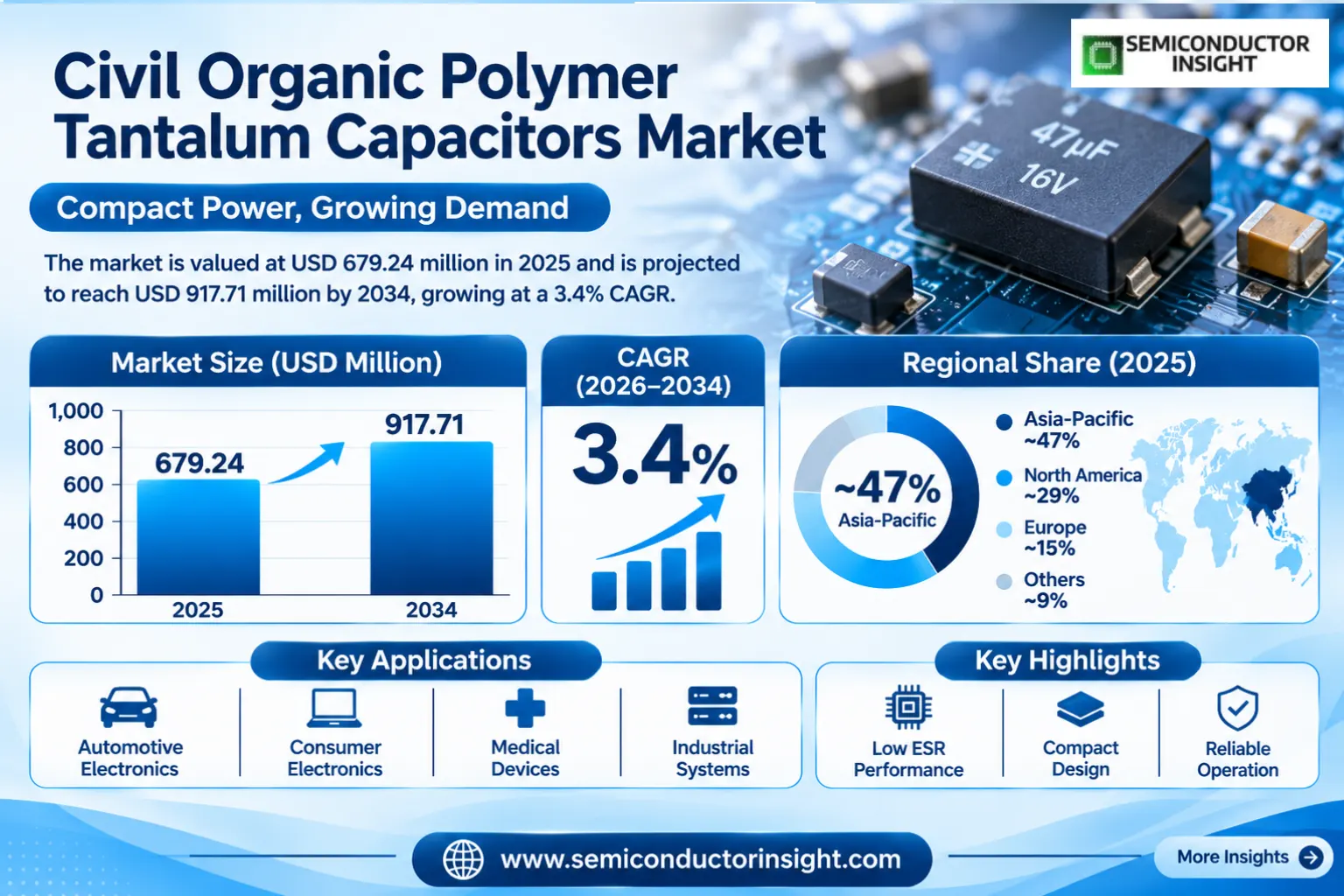
Civil organic polymer tantalum capacitors market totals USD 679.24 million in 2025 and is forecast to reach USD 917.71 million by 2034, reflecting a 3.4% CAGR across 2026–2034. Asia-Pacific is the leading market, with an estimated ~47% share. Revenue concerns the capacitor components, excluding the complete devices and equipment in which they are fitted.

Get the sample PDF with study scope, segmentation and methodology details.

Key Statistics

2025 Market Size
USD 679.24 million
2034 Forecast Size
USD 917.71 million
CAGR (2026–2034)
3.4%
Largest Market in 2025
Asia-Pacific (~47%)

Key Takeaways

  • Revenue outlook: The global civil organic polymer tantalum capacitors market increases from USD 679.24 million in 2025 to USD 917.71 million by 2034, at a 3.4% CAGR. The product is a polymer-cathode tantalum capacitor sold into commercial electronics and related equipment.
  • Type performance: Capacitors with ESR at 100 kHz below 100 mΩ represent an estimated ~49% of value. The 100–200 mΩ class holds ~32% and components above 200 mΩ ~19%. Low resistance is valuable in dense switching rails, although circuit-level impedance determines suitability.
  • Application structure: Portable Consumer Equipment leads with an estimated ~42% share, followed by Automotive at ~25%, Others at ~21% and Medical at ~12%. Production approval, thermal behavior and device life differ substantially between a handheld consumer product and a clinical instrument.
  • Geographic demand: Asia-Pacific leads with an estimated ~47% share in 2025, followed by North America (~27%) and Europe (~18%). South America (~5%) and Middle East & Africa (~3%) participate chiefly through downstream electronic assembly and imported component channels.
  • Procurement constraints: Low ESR, small board footprint and ripple-current tolerance support product selection, while tantalum supply diligence, electrical derating, competitive ceramic designs and notices of component discontinuation limit straightforward substitutions. A qualified replacement is determined at part-number level rather than by a broad catalog description.

Civil Organic Polymer Tantalum Capacitors Market Overview

Civil organic polymer tantalum capacitors market totals USD 679.24 million in 2025 and is forecast to reach USD 917.71 million by 2034, reflecting a 3.4% CAGR across 2026–2034. Asia-Pacific is the leading market, with an estimated ~47% share. Revenue concerns the capacitor components, excluding the complete devices and equipment in which they are fitted.

Base 2025 · Estimate 2026 · Forecast 2034 · Historical 2020–2024 · Worldwide component revenue in USD million

Civil organic polymer tantalum capacitors combine a porous tantalum anode, tantalum-oxide dielectric and conductive-polymer cathode in a compact polarized electronic component. The low series resistance reduces heat and voltage ripple in suitable circuit designs. Product selection depends on rated voltage, capacitance, frequency-dependent impedance and required package height. These capacitors are purchased primarily for power filtering, decoupling and local energy buffering, not as bulk storage devices or substitutes for all multilayer ceramic capacitors.

The eligible market covers qualifying commercially supplied polymer-cathode tantalum parts differentiated by ESR at 100 kHz below 100 mΩ, 100–200 mΩ and above 200 mΩ. Downstream uses include automotive electronics, portable consumer equipment, medical devices and remaining circuits. A complete mobile phone, medical monitor, traction inverter or communication server remains outside the revenue boundary. Conventional manganese-dioxide tantalum, aluminum-polymer and ceramic capacitors enter the competitive discussion but are not automatically counted as organic-polymer tantalum sales.

At 100 kHz a low-ESR capacitor can carry high-frequency ripple more efficiently than an older high-resistance construction, but capacitance, equivalent series inductance and circuit temperature matter as well. KYOCERA AVX markets TCJ polymer capacitors from 0.47 to 680 µF with voltage ratings reaching 125 V; its F38 facedown parts serve compact devices and TCN components emphasize low profile. These examples explain why buyers compare footprint and electrical specifications jointly rather than select solely by the nominal capacitance figure.

The strongest manufacturing pull comes from dense electronic boards that place several regulated rails next to processors, radios and image sensors. A notebook or tablet may use multiple decoupling positions with different impedance requirements; a medical instrument may demand lower leakage, tighter inspection and documented material traceability. Each socket can create a component sale but only after layout validation. The relative share of applications therefore follows purchasing programs for qualified components, not final-device shipment revenue.

Tantalum sourcing and part lifecycle management increasingly influence the supplier shortlist. The European conflict-minerals rules apply to covered importers of tantalum and other 3TG minerals from January 2021, while the Responsible Minerals Initiative supplies smelter reporting tools. Panasonic listed additional POSCAP part discontinuations in October 2026, illustrating that a technically adequate component can still be undesirable for a new long-life design if its lifecycle is uncertain. Commercial distributors must provide replacement data, not merely a matching package code.

Segment Analysis: By Type

At 100 kHz, ESR below 100 mΩ leads with an estimated ~49% of revenue and indicative ~3.8% growth; 100–200 mΩ accounts for ~32% and above 200 mΩ for ~19%. Lower resistance generally permits stronger ripple-current performance but can carry a premium. Qualified use still requires careful matching of capacitance, leakage, case size and transient voltage behavior.

Type Function Market position
ESR at 100kHz Below 100 mΩ The sub-100 mΩ band serves high-frequency output filtering, processor power rails and dense computing boards where ripple current would otherwise heat the capacitor. A KYOCERA AVX TCJ device can be selected from extensive commercial polymer ranges, while Vishay T55 products support surface-mount power smoothing. Practical performance changes with frequency and temperature, so a part rated 25 mΩ cannot be assumed to behave identically at every operating point. Circuit layout and capacitor bank placement affect the final impedance. An estimated ~49% of 2025 revenue belongs to this type, with indicative ~3.8% annual growth. Premium low-ESR components are attractive for compact high-power rails, especially when fewer parallel capacitors meet a designer’s target. The potential upside is constrained by ceramic alternatives, additional board-level qualification and the need to prevent surge damage. Suppliers compete through verified specifications and predictable sourcing rather than an abstract claim that the lowest resistance is always best.
ESR at 100kHz 100-200 mΩ Mid-range ESR polymer tantalum devices balance power filtering with size, voltage and cost. A portable data logger or embedded controller often needs a buffer on a regulated 3.3 V or 5 V rail without the extremely high ripple duty of a processor core. A 150 mΩ-class specification may be sufficient when several passive components share filtering tasks. Designers still check bias conditions and startup transients, because capacitor reliability can depend more on voltage stress than on the single ESR number. This band represents an estimated ~32% of 2025 market value and indicative ~3.1% growth. Its commercial role lies in established board designs and moderately demanding switching rails where a balanced bill of materials matters. Qualified parts can remain in production for several equipment generations, creating stable replenishment orders. Price pressure can increase when ceramic capacitor arrays or aluminum polymer devices achieve adequate electrical behavior without tantalum-specific responsible sourcing documentation.
ESR at 100kHz Above 200 mΩ Above 200 mΩ, capacitor selection tends to favor applications that tolerate higher ripple impedance or prioritize other attributes such as small footprint, available voltage rating or established component approvals. A control indicator, instrumentation interface or modest-current rail can be sufficiently protected without an ultra-low-resistance part. Buyers still review permissible AC ripple current and thermal rise; a higher ESR rating is not a sign of universally inferior reliability. The engineer must match each component to the converter topology and load profile. An estimated ~19% share and indicative ~2.9% annual growth place this type behind the lower-resistance groups. Legacy industrial and medical boards help sustain demand for specific codes, while redesigns can migrate toward lower ESR or other dielectric technologies. Margins depend on differentiation in quality control, supply continuity and package availability. Medical customers may preserve an approved component rather than optimize price if changing it would trigger renewed instrument validation.

Segment Analysis: By Application

Portable Consumer Equipment (~42%) is the largest use in 2025. Automotive (~25%) demands qualified environmental performance; Others (~21%) includes commercial computing and industrial electronics; Medical (~12%) applies stricter device and documentation requirements. These shares describe the purchased component market, not the value of end-user equipment. Each category faces a different component certification process and planned replacement schedule.

Application Demand characteristics
Automotive Vehicle body electronics, displays, telematics and cabin controls use capacitors to absorb brief power disturbances and stabilize sensitive local rails. KYOCERA AVX TCQ explicitly addresses cabin and infotainment applications, is qualified to AEC-Q200 and specifies operation from -55 to +125°C, though its catalog includes an end-of-life notice. Automotive designers inspect qualified part numbers and continuity commitments, not just a generic polymer label. This application holds an estimated ~25% of the civil product market and indicative ~4.0% growth.
Portable Consumer Equipment Notebook computers, tablets, cameras, mobile devices and portable gaming systems rely on compact decoupling components to smooth localized supply fluctuations. KYOCERA AVX F38 targets facedown packages and lists applications from smartphones to SoC bulk decoupling; TCN parts emphasize slim cases and high capacitance density. Competing ceramics remain substantial, so adoption follows actual electrical and board-density tradeoffs. Portable equipment contributes an estimated ~42% of component demand and indicative ~3.2% growth, without implying every consumer device includes tantalum.
Medical Portable diagnostics, electronic monitors and embedded clinical instruments may require stable supply behavior in restricted form factors. Capacitors in these systems must be assessed for leakage, electrical stress, traceable bills of materials and operating environment. A general commercial data sheet does not by itself establish that a part is approved for a specific life-critical application. Medical electronics account for an estimated ~12% of sales and indicative ~3.5% growth, with purchase decisions frequently governed by validation cycles rather than annual device launches.
Others Telecommunication interfaces, enterprise computers, embedded control boards and commercial instrumentation use conductive-polymer tantalum when its capacitance stability and frequency response fit the design. Vishay T55 lists infrastructure and filtering applications, and Panasonic POSCAP documents high-frequency low-ESR behavior for digital electronics. The category also contains production programs outside the three named markets, but excludes complete datacenter equipment and industrial systems. It holds an estimated ~21% share and indicative ~3.1% growth as cost and component availability remain important.

Qualified purchasing channels depend on application: high-volume portable equipment is often built through contract manufacturing, while medical and industrial customers require detailed component change records. A part may be technically interchangeable in a lab but not commercially acceptable after a product-specific qualification. Direct OEM supply and authorized distribution therefore coexist, with separate ordering cycles and requirements for traceable stock.
Global Civil Organic Polymer Tantalum Capacitors Market Trends, Business Strategies

Regional Analysis

Asia-Pacific (~47%) leads civil polymer tantalum capacitor sales through electronics assembly and the supplier ecosystem; North America (~27%) follows with computing, medical and industrial design demand, and Europe (~18%) is third. South America (~5%) and Middle East & Africa (~3%) remain smaller channels. Regional forecasts reflect component purchasing, not the location of every final product user.

Which regional electronics ecosystems shape commercial polymer tantalum demand?

The buyer geography reflects a chain of component design, passive-parts manufacturing, outsourced assembly and final equipment qualification. A tantlum capacitor made in Asia can be specified by a North American OEM and fitted into equipment shipped to Europe; sales cannot be inferred merely from the nationality of the brand. Different price sensitivities, authorized distribution coverage and restrictions on mineral provenance influence purchasing across the five regions.

Region Position Growth outlook Demand profile What decides supplier selection
Asia-Pacific Largest ~47% ~3.7% CAGR High-volume electronics assembly, compact computing boards Package availability and production allocation
North America Second ~27% ~2.9% CAGR Medical instrumentation, networking, electronics design Approved source and traceability
Europe Third ~18% ~3.1% CAGR Automotive, industrial and medical OEMs Regulatory sourcing and lifetime support
South America Emerging ~5% ~3.9% CAGR Regional assembly and maintenance electronics Distributor reach and foreign exchange
Middle East & Africa Small ~3% ~4.6% CAGR Imported instrumentation and connectivity products Qualified channel access

Asia-Pacific LEADER · ~47% SHARE

What makes Asia-Pacific the largest purchasing region?

Asia-Pacific accounts for an estimated ~47% of global component revenue, with indicative ~3.7% CAGR. Large consumer-electronics assembly bases, established Japanese capacitor technology and multinational component purchasing programs support demand. Design-in decisions may happen outside the region but supply commitments and board procurement often occur at Asian manufacturing sites. Buyers compare low-profile package families and qualify multiple sources to avoid interruptions during product launches.

Market positionLargest ~47%
Growth outlookGrowth ~3.7%
Demand profileDense electronics assembly
Market access gateMulti-site qualification
Country Position in region What drives demand
China Consumer-device assembly concentration Chinese factories assemble a wide range of handheld equipment, communications boards and computing modules that contain small power-filtering components. A device may use both ceramic parts and selected polymer tantalum capacitors, with each position chosen for capacitance, ESR and assembly height. Sourcing teams compare 0402, 0603 and larger footprints alongside availability of 100 kHz impedance data. Electronics exports and phone sales offer demand context, but they are not themselves the value of commercial tantalum components.
Japan Polymer materials and device engineering Japanese electronics suppliers contribute materials engineering, polymer capacitor design and compact device integration. Panasonic POSCAP describes a sintered tantalum anode and conductive-polymer cathode with low ESR and strong high-frequency behavior. Local users can qualify products for instrumentation and miniature consumer boards while monitoring production changes. The October 2026 discontinuation notice for certain Panasonic part numbers underscores why a verified active product list is more useful than a legacy catalog entry.
South Korea Computing and display supply chains South Korean consumer electronics and component assembly chains rely on dense printed circuit boards with multiple voltage domains. Power management and decoupling decisions are informed by processors, wireless radios and display-related controls, not by the total retail selling price of each finished device. Designers may combine several passive dielectrics to manage impedance across a 100 kHz-to-MHz range. Authorized component procurement and traceable revisions matter when the same product family is assembled across several factories.

Market instances

  • Low-profile mobile modules drive package tradeoffs. A 0.1–0.2 CV leakage specification on a small polymer device does not eliminate the need to check actual standby drain in a battery-powered product. KYOCERA AVX F38 facedown components address board-density constraints associated with portable electronics, while TCN favors a low case profile. The selection gate is the specific part’s height, capacitor tolerance and transient response. Miniaturization can increase the value of advanced low-ESR parts without implying that every handset adopts them.
  • High-frequency power decoupling needs careful impedance matching. A 100 kHz ESR value is helpful for comparing candidate components, but a modern processor board contains switching behavior across a much wider spectrum. Designers examine equivalent inductance, capacitance variation and the number of capacitors in parallel. TCJ and TCN product ranges address different geometries and voltage classes. A product engineer may retain ceramic devices at the highest frequencies and use polymer tantalum for bulk filtering on selected rails.
  • Contract manufacturers require controlled supply changes. An electronic product built at two factories can fail qualification if substitute capacitors introduce unexpected ripple or solder-joint changes. Procurement therefore considers not only a 10 V or 16 V rating, but also manufacturer change notices, moisture sensitivity, reflow cycles and solder termination. The supplier’s documented data and approved alternate parts determine whether an assembly site may switch sources. This creates an advantage for companies with transparent quality systems and multiple supported package options.
In the full report: Detailed Asia-Pacific coverage examines consumer board assembly, Asian suppliers and procurement specifications.

North America SECOND · ~27% SHARE

Why does North American demand emphasize engineering controls?

North America accounts for an estimated ~27% share and indicative ~2.9% CAGR. Device engineering and industrial procurement support opportunities in medical instrumentation, infrastructure electronics and compact computing boards. Historical global and North American revenue anchors imply a substantial base, yet each supplier remains subject to component qualification and responsible-sourcing requests. Purchasers value documented low-ESR characteristics, reliable distribution and predictable notice periods.

Market positionSecond ~27%
Growth outlookGrowth ~2.9%
Demand profileMedical and network equipment
Market access gateSupplier documentation
Country Position in region What drives demand
United States Medical and infrastructure engineering American equipment makers designing imaging interfaces, medical electronics and server-control boards need passive parts that tolerate thermal stress and supply ripple. Vishay lists T55 and T56 polymer capacitors for infrastructure filtering and point-of-load rails, while the exact selected grade determines its permitted application. A manufacturer often specifies approved alternates before production approval. The value of a medical device or data-center installation cannot be used as a proxy for component procurement.
Canada Embedded devices and specialty electronics Canadian developers of measurement systems, communications electronics and remote instruments often buy through authorized regional channels rather than own large capacitor factories. A 100–200 mΩ polymer component can be appropriate for a moderate-current rail if the circuit’s ripple profile is compatible. Evaluation emphasizes operating temperature and component lifecycle more strongly than the number of application end users. Small industrial manufacturing volumes can still create repeat purchasing after a design is qualified.
Mexico North American electronics assembly Mexican electronics production links component imports with assembly programs serving neighboring markets. Capacitors may be specified by an offshore engineering team and then placed by a contract manufacturer supporting automotive or consumer equipment. A 3-reflow cycle claim or tape-and-reel format matters for process qualification, but does not replace electrical testing. Import routes and supplier traceability affect access to authentic, correctly rated parts during annual production-volume changes.

Market instances

  • Infrastructure power supply design drives tested parts. Vishay T55 targets bulk energy storage and smoothing in wireless and networking hardware, although a specific series should not be assumed to meet every industrial test. A designer may combine 2.5 V polymer parts with ceramic bypass components on a sensitive supply rail. Procurement records include ratings and approved substitutions to avoid introducing excessive equivalent resistance. The relevant revenue is the purchased capacitor, not the server or networking equipment running from that power supply.
  • Medical component changes require evidence. A clinical monitoring board can remain approved for many years, so altering a passive component may require a formal change assessment. A seemingly similar polymer tantalum part can differ in 105°C or 125°C operating limit, leakage and surge rating. Reliability testing and exact manufacturer ordering codes determine acceptability. This process may support stable demand for incumbent components while slowing the initial qualification of newer, smaller alternatives.
  • Tantalum traceability affects preferred-vendor status. USGS 2026 mineral statistics describe 2025 tantalum production and the global upstream resource base, but these data cannot be converted directly into capacitor unit shipments. North American buyers also request RMI conflict-minerals reporting to identify refiners and smelters in supply chains. A buyer who cannot obtain the required smelter information may be unable to approve a component despite its electrical suitability. Transparency and continuity become commercial attributes alongside ESR and price.
In the full report: North American coverage distinguishes engineering approvals from regional placement of components.

Europe THIRD · ~18% SHARE

How do European regulation and long-life uses affect demand?

Europe holds an estimated ~18% share and indicative ~3.1% CAGR. Industrial automation, automotive systems, electronic instruments and healthcare equipment require compact filtering parts with predictable lifecycle support. The EU conflict-minerals regime increases the importance of upstream documentation for relevant importers. Suppliers may need both suitable RoHS documentation and proof that tantalum sourcing has been reviewed by purchasing teams.

Market positionThird ~18%
Growth outlookGrowth ~3.1%
Demand profileIndustrial and vehicle electronics
Market access gateMaterial traceability
Country Position in region What drives demand
Germany Industrial and automotive electronics German component buyers often design power supplies for factory controls, car electronics and test equipment where temperature cycling and electromagnetic behavior are closely reviewed. A low-ESR polymer capacitor may sit near a DC/DC converter while ceramic parts handle faster switching edges. AEC-Q200 qualification is relevant for particular automotive applications, not a blanket approval of every polymer device. Supplier documentation can determine adoption in production systems with multiyear servicing requirements.
France Instrumentation and embedded control boards French electronics programs support industrial measurement and specialized embedded equipment that may require compact supply filtering. A board using a 5 V rail can need different leakage and ESR behavior from a battery-powered 3.3 V design. Component engineering evaluates polymer tantalum alongside alternative dielectrics. EU mineral due diligence and RoHS records add purchasing requirements when materials are sourced through several international distributors.
Italy Machinery and specialty assembly Italian equipment manufacturing produces controllers, automation components and measurement instruments for diverse customers. A molded surface-mount tantalum component can improve board space or ripple-current tolerance if it is selected with adequate voltage derating. Suppliers compete against familiar ceramic and aluminum-polymer technologies, so an approved footprint alone does not secure the order. In this market, order stability often depends on product lifecycle support and the engineer’s ability to obtain a consistent qualified part.

Market instances

  • Responsible sourcing is a tender-level condition. Regulation (EU) 2017/821 applies to certain European importers of tantalum and other covered minerals, with relevant compliance obligations from January 2021. Equipment makers may request supplier declarations and smelter information even when the final assembly is an imported device. The Responsible Minerals Initiative CMRT provides a standardized information route. Sourcing compliance does not guarantee electrical reliability; it is a separate acceptance requirement that may affect the shortlist.
  • Electronics longevity favors verified replacements. An industrial control design qualified in 2024 may still be manufactured in 2034, creating a significant need for stable capacitor availability. The discontinuation of selected POSCAP part numbers in 2026 illustrates the importance of reading a live component notice. An alternate 200 mΩ device should not be installed solely because it fits the same pad geometry. Engineers must confirm temperature, capacitance, voltage and transient testing before accepting a new production source.
  • Medical instrumentation requires controlled specifications. A medical monitor draws small but reliable power from internal regulators and sensors, sometimes operating in a warm sealed enclosure. The capacitor may be selected for stable bulk capacitance and low electrical noise, though system-level approval remains essential. The manufacturer’s reliability data are a starting point rather than evidence of suitability for a specific clinical risk category. Buyers may favor long-standing qualified portfolios over the nominally cheapest available part.
In the full report: European evaluation considers product qualification, supply continuity and mineral-sourcing requirements.

South America EMERGING · ~5% SHARE

What determines purchase growth in South American markets?

South America contributes an estimated ~5% of the global market, with indicative ~3.9% CAGR. Demand comes mainly through imported components fitted into communications, industrial control and consumer electronic products. Regional distributors must support authentication, correct storage and detailed ordering codes. The local opportunity can increase with electronics production even though polymer-tantalum manufacturing remains concentrated outside the region.

Market positionEmerging ~5%
Growth outlookGrowth ~3.9%
Demand profileContract and repair electronics
Market access gateAuthorized import channels
Country Position in region What drives demand
Brazil Electronics assembly and industrial controls Brazilian assemblers and maintenance suppliers purchase passive components for network devices, embedded industrial boards and consumer products. Polymer tantalum is considered where the application needs relatively low ESR in a limited footprint, but ceramic and aluminum parts are serious competing options. Engineers working with imported catalog products need accurate voltage, case-height and termination information. Currency moves and channel availability can matter as much as a 100 kHz impedance specification in scheduling production.
Argentina Instrument maintenance and specialized devices Argentine industrial users source replacement parts for control equipment, measurement instruments and communication systems. A long-lived board may have a very specific approved tantalum capacitor and limited ability to accept substitutions. Stock that matches the nominal capacitance might still differ in ESR or lifetime conditions, making documentation and part authentication important. Specialized purchasing is smaller in volume than mobile electronics assembly but can retain repeat demand for compatible components.
Chile Industrial monitoring and remote electronics Chilean energy and resource operations use ruggedized communications and measurement equipment that may include polymer tantalum capacitors on internal low-voltage rails. The commercially relevant purchase is the fitted component, not the total value of remote monitoring projects. Selection depends on temperature, mechanical stress and supply-transient behavior. Products frequently arrive through international catalog channels, so import documentation, reliability and genuine manufacturer traceability are important to maintenance continuity.

Market instances

  • Distributor inventory influences small buyers. A regional repair business may need only dozens of a particular 16 V capacitor while a large contract manufacturer orders thousands. The former buyer depends strongly on authorized small-quantity distribution and current datasheets. A different 10 V part may be physically similar but unsuitable for the input transients observed in an installed system. Local distribution effectiveness affects demand conversion without changing the technology definition of a polymer-cathode tantalum part.
  • Industrial retrofits provide a modest renewal channel. Modernizing a controller board can replace deteriorated power circuitry and add new digital interfaces. The engineer may select a low-ESR polymer capacitor because it buffers the main 3.3 V rail more effectively within a restricted enclosure. That choice needs verification against ceramic alternative arrangements and start-up current. Such retrofits are a real component market, yet the broader value of plant automation projects is not counted here.
  • Cross-border sourcing raises quality-control requirements. Components purchased through multiple intermediaries may be repackaged or mixed with similar-looking capacitors, creating risks around polarity marking and approved product revisions. An industrial buyer should compare the 100 kHz ESR class, case code and manufacturer documentation before assembly. Moisture-sensitive handling and solder profiles matter for surface-mount polymer parts. Suppliers offering traceability and consistent technical communication may hold an advantage over anonymous low-cost imports.
In the full report: South American demand analysis focuses on imported components, repair systems and industrial procurement.

Middle East & Africa SMALL · ~3% SHARE

How do imported electronic systems shape this region?

Middle East & Africa represents an estimated ~3% share, with indicative ~4.6% CAGR from a small installed purchasing base. Applications include communications systems, building controls, medical instrumentation and network power supplies. Most programs are supplied through imported boards or authorized distributors rather than local polymer tantalum factories. Service life, product authentication and environmental suitability are critical buying conditions.

Market positionSmall ~3%
Growth outlookGrowth ~4.6%
Demand profileConnectivity and embedded control
Market access gateImport and environment checks
Country Position in region What drives demand
United Arab Emirates Technology distribution and medical systems The UAE serves as a regional distribution hub for enterprise electronics, clinical instruments and commercial connectivity equipment. A local service organization may purchase a specific polymer capacitor for a replacement control board whose engineering specification was established elsewhere. Parts must match the selected voltage and ESR range, especially in power supplies exposed to elevated ambient temperatures. Authorized procurement and documentation are more dependable indicators of local demand than overall national technology spending.
Saudi Arabia Industrial and building controls Saudi infrastructure, industrial sites and connected building systems contain embedded electronics with regulated low-voltage rails. Conductive-polymer tantalum can support selected filtering positions when its temperature and transient behavior are appropriate. The capacitor market remains the value of electronic components procured into such equipment, not the completed plant or building installation. Buyers evaluate maintenance parts, reliable distributor coverage and the need for traceable material declarations in internationally sourced supply chains.
South Africa Medical and telecommunications servicing South African network equipment and medical-device users may need replacement capacitors with tightly specified case dimensions, capacitance and resistance. A faulty substitute can increase ripple or fail during heat exposure, so repair professionals should consult exact part data. A 125°C-rated industrial component is not automatically approved for a regulated clinical system. Component supply depends on import availability and authorized channels, with modest local volumes compared with Asian assembly plants.

Market instances

  • Network equipment creates recurring replacement demand. Base-station electronics and enterprise routers rely on multiple rails for processors, radio interfaces and control processors. Low-ESR polymer capacitors can support the lower-frequency energy buffering around point-of-load converters. Procurement teams evaluate 100 kHz ESR and voltage derating rather than merely purchasing the cheapest component with a matching footprint. The revenue from a replacement capacitor must remain separate from mobile data subscriptions and communications-infrastructure service spending.
  • Equipment cooling alters passive selection. An electronic cabinet located in a hot climate can impose thermal stress on components even when the low-voltage regulator appears conservatively designed. The maximum operating-temperature rating and ripple-current self-heating are therefore part of the capacitor review. A design using a 105°C product may require a different cooling assumption from one qualified at 125°C. Component durability and service plans become important even in relatively small geographic markets.
  • Compliance paperwork enables cross-border tenders. A multinational medical or industrial OEM may require CMRT declarations for tantalum sourced through its tiered supply chain. The request is linked to mineral origin and smelter processing, not the equipment’s nominal power rating. Local integrators can lose access to approved capacitor designs if an upstream supplier cannot provide adequate information. Traceable original equipment parts, consistent invoices and manufacturer data sheets support participation in regional projects.
In the full report: Regional coverage examines imported boards, approved replacement parts and environmental durability.

Key Civil Organic Polymer Tantalum Capacitors Manufacturers and Competitive Landscape

The competitive field includes verified polymer-tantalum manufacturers such as KEMET under Yageo ownership, KYOCERA AVX, Vishay and Panasonic, supported by specialist regional distributors. Hongda and Sunlord are named in the wider passive-electronics ecosystem, but a separate product-specific review is needed before assigning any exact polymer-tantalum sales. Component suppliers differentiate through ESR range, capacitance density, reliability screening, environmental declarations and part-lifecycle information.

KYOCERA AVX has a wide conductive-polymer line covering TCJ, TCN, F38, automotive TCQ and other series. TCJ lists rated voltages up to 125 V, while the F38 facedown design reduces footprint for portable electronics. The company also publishes capacitor-interchangeability and environmental documentation, helping OEMs compare choices beyond headline ESR. A wide catalog is commercially valuable when a customer needs several case sizes, but a buyer must still verify whether a particular code remains in production.

Vishay competes with T55, T54 and T56 molded polymer devices for power decoupling and infrastructure hardware, and T27 hermetic variants for specialist reliability requirements. The company announced DLA 04051 capacitors in October 2025 with ratings up to 63 V and very low resistance; these military/aerospace products demonstrate manufacturing capability but are adjacent rather than automatically part of commercial-civil revenue. A supplier earns the order by meeting electrical and qualification conditions for each intended use.

Panasonic POSCAP technology uses a sintered tantalum anode combined with a polymer cathode to support compact high-frequency digital filtering. The company’s product page carries a 30 October 2026 notice discontinuing specified part numbers in several series, a meaningful signal for purchasing teams planning new designs. Buyers should use the current ordering guide, not assume that every older product family remains available. KEMET/Yageo offerings likewise compete through catalog breadth and low-ESR positioning, with sourcing approval determined at part level.

Other named manufacturers participate in passive components, automotive electronics and regional manufacturing channels. A company’s inclusion in a market participant list does not establish that every tantalum series is a conductive-polymer device or is currently shipping. Traditional manganese-dioxide tantalum capacitors, ceramic multilayer parts and aluminum polymer devices remain active substitutes with different failure behavior, voltage ratings and supply conditions. Clear product verification prevents overstating the number of direct polymer-tantalum suppliers.

Tier structure

Tier Companies Basis of competition
Tier 1 confirmed polymer-tantalum suppliers KYOCERA AVX; Vishay Intertechnology; Panasonic Industry; KEMET (Yageo) Official active conductive-polymer tantalum portfolio and technical datasheets
Tier 2 specialist and regional passive suppliers Hongda Electronics; Sunlord Electronics Named passive manufacturers; polymer-tantalum product families need live verification by ordering code
Adjacent semiconductor and dielectric suppliers ROHM Semiconductor; MLCC suppliers; aluminum-polymer makers Competing circuit components, not automatically polymer-tantalum capacitor revenue

Key companies profiled

  • KEMET (Yageo)
  • KYOCERA AVX
  • Vishay Intertechnology
  • Panasonic Industry
  • ROHM Semiconductor
  • Hongda Electronics
  • Sunlord Electronics

Civil Organic Polymer Tantalum Capacitors Production Capacity Analysis

Production begins with tantalum powder processing and sintered anode bodies, followed by dielectric formation, conductive-polymer deposition, termination, molding and electrical inspection. Surface-mount commercial parts may undergo surge screening and reflow validation according to their series. Manufacturing and procurement sites differ from final equipment design locations. Capacity that can produce generic tantalum devices is not automatically qualified to manufacture every polymer formulation or low-ESR component class.

Anode powder purity and pore structure influence capacitance density and the eventual electrical behavior of each part. Conductive polymer must reach the internal porous structure consistently, and the tantalum-oxide dielectric must withstand transient voltage with adequate margin. A 2.5 V low-ESR part intended for processor rails differs materially from a higher-voltage unit used in industrial controls. Yield losses in deposition or electrical screening can affect available output even when sintering furnaces have ample nominal capacity.

Molded packages, facedown terminations and low-profile designs require different assembly controls. KYOCERA AVX lists F38 facedown technology and TCN undertab formats, while Vishay sells several molded and specialist COTS cases. A customer may require 0402-like board footprints, 1.2 mm height or multiple qualified reflow cycles; such requirements constrain interchangeable capacity. Production flexibility is measured in approved part numbers and verified tests rather than the number of passive components a factory could assemble in aggregate.

Quality procedures include capacitance and leakage testing, resistance measurement around 100 kHz, temperature cycling and surge-current screening where specified. Automotive TCQ is documented for AEC-Q200, but its end-of-life notice means buyers must evaluate an active alternate rather than assume continued output. Responsible tantalum sourcing requires additional documentary control at upstream levels. The resulting production economics reflect both electrical test yield and supply-chain diligence; a high-throughput line without approved origin records may fail an OEM procurement gate.

Civil Organic Polymer Tantalum Capacitors Market Dynamics: Drivers, Restraints and Opportunities

Electrical miniaturization and compact voltage-regulator designs support polymer tantalum adoption, although procurement is constrained by tantalum traceability, alternative dielectrics and part-level qualification. Product value depends on capacitance stability, high-frequency impedance, reliable assembly and continuity through equipment lifecycles. Commercial growth is consequently measured rather than explosive. The following impact factors distinguish direct demand mechanisms from restraints during the 2026–2034 window.

MARKET DRIVERS

Drivers Impact Analysis*

Market Drivers Impact Rank CAGR Contribution (%) 2026–2028 2029–2031 2032–2034
Compact consumer-device power buffering High +1.85% High High Medium
High-frequency low-ESR power designs Medium-High +1.60% High High High
Automotive and industrial electronic content Medium +1.25% Medium High High
High-reliability instrument demand Low-Medium +0.75% Medium High High
Others (packaging and voltage-range improvement) Low +0.45% Medium Medium High

Compact electronics use multiple local power capacitors

Portable devices integrate radios, image processing and computing functions in boards whose area is tightly constrained. The need for bulk filtering near switching regulators can favor low-profile polymer tantalum if it achieves the target capacitance and impedance with fewer components. KYOCERA AVX F38 advertises very small packages for smartphones and similar products. Adoption is socket-specific: higher electronics content does not mean every phone replaces its ceramic capacitors or that device retail prices belong in this component market.

Power supply designers value low series resistance

Resistance in the tens of milliohms can reduce ripple-related loss when the component’s voltage and frequency limits are suitable. Vishay T55 and KYOCERA AVX TCJ provide low-ESR commercial options across multiple rated-voltage classes. Engineers consider voltage overshoot, inrush current, temperature and parasitic inductance before deciding on a design. This design specificity supports premium product categories but reduces the usefulness of simple single-specification price comparisons.

Electronic functions expand in transport and controls

A vehicle cabin controller may use several locally regulated voltage rails for cameras, telematics and displays, creating demand for stable decoupling. Automotive-qualified polymer tantalum components face AEC-Q200 and environmental testing requirements that can support higher unit value. General commercial devices may be unsuitable for the same environment. The principal market contribution arises from additional approved capacitor sockets and replacements, not from the total value of electric vehicles or automation equipment.

Instrumentation needs controlled low-noise supplies

Medical and commercial measurement electronics rely on stable power for analog acquisition, wireless telemetry and processor housekeeping. A polymer capacitor can provide low-frequency bulk filtering while smaller ceramic devices address the fastest transients. Procurement evaluates leakage, temperature and documentation because a unit used in a monitor may remain in production longer than a consumer device. The opportunity is selective but can support repeat orders for well-characterized components.

MARKET RESTRAINTS

Restraints Impact Analysis*

Market Restraints Impact Rank CAGR Contribution (%) 2026–2028 2029–2031 2032–2034
Ceramic and alternative polymer competition High -1.20% High High High
Tantalum sourcing and raw material cost Medium-High -0.75% High Medium Medium
Others (qualification and discontinuations) Medium -0.55% High High Medium
*CAGR contribution shows the percentage points each factor adds to or removes from the forecast CAGR for 2026–2034; driver contributions less restraint contributions equal the market CAGR. Period columns rate the strength of each factor in that window.

Other capacitor technologies remain credible substitutes

Ceramic capacitors often provide low inductance at very high frequencies without tantalum, while aluminum-polymer devices can meet certain bulk-filtering needs. A redesigned power stage may use several MLCCs rather than a single polymer tantalum component. Equivalent cost must include board layout and reliability, not only unit price. Competing technologies constrain the ability of tantalum suppliers to convert all growth in electronics manufacturing into their own product sales.

Raw-material diligence creates purchasing friction

Tantalum procurement can require smelter identification and material-origin declarations under customer policies and relevant regulation. The RMI CMRT makes this information transferable, but incomplete supplier responses may postpone approval or necessitate alternative sourcing. USGS mineral data help characterize upstream supply without measuring capacitor production. Documentation, production availability and commodity price changes can increase procurement costs for small buyers or reduce sourcing flexibility.

Product discontinuations disrupt established designs

Panasonic’s October 2026 notice for selected POSCAP part numbers illustrates a practical risk for long-lived boards that use exact capacitor codes. A substitute may have the right voltage and capacitance but different ESR, solder profile or approved lifecycle. Each modification can require thermal and electrical retesting before production release. This delays customer adoption and creates an advantage for suppliers that maintain stable documented ranges over successive equipment generations.

Electrical derating can limit apparent choices

A capacitor listed at 10 V should not automatically be used on a circuit whose startup behavior may briefly overshoot that rating. The correct selection considers surge energy, maximum ambient temperature, leakage and ripple current. Ultra-low ESR alone does not assure system reliability, particularly where faults or poor board layout produce transient stress. Additional verification and safe operating margins can rule out attractive catalog alternatives, slowing conversion to newer designs.

MARKET OPPORTUNITIES

Selective package miniaturization raises component value

A compact facedown capacitor may enable a smaller wearable or handheld controller when its electrical specification replaces a larger traditional package. KYOCERA AVX small-case families extend into familiar 0603 and 0805 circuit footprints, and product lines have different heights and capacitance options. The commercial opportunity lies in a verified part that solves a real mechanical constraint. It does not require a claim that every new mobile device will adopt the same capacitor technology.

Medical equipment supports long approval cycles

Commercial medical instrumentation can require detailed part traceability and stable electrical behavior over multiple product iterations. A supplier with documented material sourcing and reliable control of electrical variation is better positioned than one offering only a low initial price. If the same polymer capacitor remains qualified across successive models, a modest niche can provide durable replacement orders. Sales should be measured at the component level rather than as a fraction of the instrument’s selling price.

Responsible sourcing can differentiate suppliers

A manufacturer that can provide RMI-compatible smelter information and clear RoHS/REACH declarations may reduce the administrative burden on a multinational OEM. KYOCERA AVX publishes environmental documentation for several polymer ranges, and RMAP standards give a reference for mineral-processing due diligence. Purchasing teams also require electrical data and a stable lifecycle. Transparent sourcing is therefore a competitive supporting capability, not a substitute for product-level performance qualification.

Higher-voltage low-ESR portfolios widen design opportunities

KYOCERA AVX TCJ lists a broad commercial voltage range reaching 125 V, demonstrating how polymer tantalum selection is not limited to the smallest processor rails. Higher-voltage equipment still needs evaluation of derating, leakage and circuit transients before a part can be used. Manufacturers that supply several voltage and package combinations may win more design-in positions. The limiting factor remains actual customer qualification, not the upper rating printed for a product family.

Civil Organic Polymer Tantalum Capacitors Supply Chain Analysis

Civil polymer tantalum production links mineral extraction and refinery due diligence with capacitor anode manufacture, conductive-polymer deposition, assembly, test and qualified electronics distribution. Suppliers can own only part of this chain while relying on specialists for powder, packaging or manufacturing services. A customer’s audit often follows material origin and exact product code independently from final manufacturing location.

UpstreamTantalum mineral sourcing, smelting, high-purity powder, wire, polymer chemistry and molding compounds
ManufacturingPorous anode sintering, dielectric formation, cathode impregnation, case termination and electrical screening
ChannelAuthorized distributors, OEM direct contracts, material declarations, PCN notifications and lifecycle support
DownstreamPortable electronics, vehicle controls, medical instrumentation, networking and embedded commercial equipment

Tantalum processing begins before capacitor manufacturing.. Producers use refined tantalum powders and wires with properties suitable for porous anodes. USGS 2026 mineral reporting describes worldwide production and resource conditions, while RMAP standards address responsible material sourcing through smelters and refiners. The commercial supplier must know enough about upstream partners to support customer due diligence. Mining volume is not equivalent to polymer tantalum capacitor output, because quality selection, downstream yields and alternative tantalum applications intervene.

Electrical testing determines usable manufacturing yield.. A finished polymer capacitor is evaluated for capacitance, leakage, 100 kHz series resistance and other series-specific characteristics. Devices designed for 25 mΩ service may require tighter process control than moderate-current filtering parts, and voltage stress must remain within specified conditions. Packaging geometry also affects reflow suitability and solder reliability. As a result, a change in raw material quality can reduce the quantity of fully qualified capacitors even if total assembly throughput is unaffected.

Authorized distribution supports application-specific qualification.. A buyer can locate nominally equivalent polymer parts from several catalog manufacturers, but selecting an approved code demands exact electrical and mechanical information. An authorized channel provides current data, packaging revisions, lifecycle notices and traceability. Buyers of medical and industrial systems may require records for multiple manufacturing lots; portable consumer contract manufacturers may emphasize delivery volumes and assembly fit. The channel’s margin is not identical to the component manufacturer’s market revenue.

The downstream revenue boundary remains the passive part.. Portable computers, medical devices, vehicle controllers and communications boards purchase many component classes, of which a polymer tantalum capacitor is only one. PCB assembly, processors, power semiconductors and mechanical housings contribute value but are not capacitor sales. A single end product may use multiple different capacitors, and some will be ceramic or aluminum rather than tantalum. Market assessment must therefore isolate the qualifying component and its application rather than apply an arbitrary percentage to device shipments.

Recent Developments in the Civil Organic Polymer Tantalum Capacitors Market

  • 30 October 2026 Published
    Panasonic Industry updated its POSCAP product information with discontinuation notices affecting selected parts in TPF, TPE, TPB, TPC and TQC series. The notice matters for designers who maintain commercial boards over several release cycles; a familiar series name does not establish future order availability. Replacement evaluation must check rated voltage, footprint, ESR and solder behavior. The announcement is a supply-lifecycle event and does not state global polymer tantalum market revenue. Source
  • 18 September 2026 Published
    The U.S. Geological Survey released the Mineral Commodity Summaries 2026 data product covering more than 90 nonfuel commodities and earlier estimates of 2025 production. Its tantalum information helps characterize the mineral end of the capacitor supply chain and broader industrial competition for raw metal. The data are mineral statistics rather than reported polymer capacitor demand. Electronics purchasers can use such material context together with verified smelter records without treating mining figures as semiconductor shipment totals. Source
  • 20 May 2026 Published
    Vishay’s online polymer-capacitor technical library listed updated guidance for tantalum solid-electrolyte chip capacitors with conductive-polymer cathodes. The material supports designers comparing leakage, surge behavior, frequency response and safe operating conditions across candidate parts. A guidance update is useful during qualification but does not itself evidence a new factory line or sales volume. Engineers still need the current part-number datasheet and application-specific stress calculations before authorizing a substitution. Source
  • 6 February 2026 Published
    USGS issued the 2026 Mineral Commodity Summaries describing mineral supply conditions and updated annual production estimates for 2025. Tantalum ore and refined metal have other industrial uses in addition to capacitors, so the report provides upstream supply context rather than a capacitor-market revenue anchor. Responsible procurement combines mineral knowledge with smelter due-diligence records. For electronics suppliers, changes in mineral availability can influence pricing and lead times even when the electrical designs of installed devices remain unchanged. Source
  • 8 October 2025 Announced
    Vishay announced its DLA 04051 high-reliability polymer capacitors, specifying 4.7 to 680 µF, voltage ratings up to 63 V and ESR values as low as 25 mΩ. The series targets aerospace, military and space applications and demonstrates the wider technology platform, but its revenue should not be inserted into a civil-commercial application estimate without scope evidence. The announcement illustrates advances in screening and electrical performance rather than a marketwide shipment count. Source
  • 1 January 2021 In force
    European Union conflict-mineral importer requirements under Regulation 2017/821 took effect for covered tin, tantalum, tungsten and gold supply chains. Buyers of commercial electronic components often request evidence of responsible sourcing and smelter identification from suppliers, using standardized reporting formats where appropriate. The legal obligation depends on the importer’s status and materials, so it should not be described as a universal ban on tantalum. The rule remains an important background sourcing condition for purchases made in 2026. Source

REPORT SCOPE & SEGMENTATION

Attribute Details
Study Period 2020–2034
Base Year 2025
Estimated Year 2026
Forecast Period 2026–2034
Historical Period 2020–2024
Market Size 2025 USD 679.24 million
Market Size 2026 USD 702.33 million
Market Size 2034 USD 917.71 million
Growth Rate CAGR of 3.4% from 2026–2034
Unit Revenue (USD million)
Segmentation ESR at 100 kHz, Application and Region
By Type ESR at 100kHz Below 100 mΩ · 100–200 mΩ · Above 200 mΩ
By Application Automotive · Portable Consumer Equipment · Medical · Others
By Region Global civil-commercial conductive-polymer tantalum capacitor components. Excludes full devices, manganese-dioxide tantalum products and competing ceramic or aluminum dielectric components.
Asia-PacificChina, Japan, South Korea, India and neighboring electronics assembly markets
North AmericaUnited States, Canada and Mexico
EuropeGermany, France, Italy, United Kingdom and wider European markets
South AmericaBrazil, Argentina, Chile and surrounding countries
Middle East & AfricaUnited Arab Emirates, Saudi Arabia, South Africa and neighboring markets
Key Companies Profiled KEMET (Yageo), KYOCERA AVX, Vishay Intertechnology, Panasonic Industry, ROHM Semiconductor, Hongda Electronics and Sunlord Electronics.
Customization Scope Customer-specific component ESR tiers, product qualification and country breakdowns where evidence allows.

Frequently Asked Questions

What is the civil organic polymer tantalum capacitor market size?

The global market is estimated at USD 679.24 million for 2025, reaches USD 702.33 million in 2026 and is forecast at USD 917.71 million by 2034. That implies a 3.4% CAGR over the 2025–2034 growth interval, reflecting the market for qualifying conductive-polymer tantalum components rather than finished consumer or industrial electronics.

Which region leads worldwide purchasing?

Asia-Pacific leads with an estimated ~47% of the 2025 market because electronics manufacturing, passive-component supply and final board assembly are concentrated in the region. It is followed by North America (~27%), Europe (~18%), South America (~5%) and Middle East & Africa (~3%). The location of an OEM headquarters is not the only determinant of where capacitors are purchased.

Which ESR category is the largest type?

The below-100 mΩ class has an estimated ~49% share, ahead of the 100–200 mΩ class at ~32% and above-200 mΩ components at ~19%. Resistance is measured at 100 kHz for the stated classes. Lower ESR can improve ripple-current handling but is not an alternative to checking capacitance, voltage and application temperature.

Which end-use application has the highest demand?

Portable Consumer Equipment is the largest category at an estimated ~42% share, with Automotive (~25%), Others (~21%) and Medical (~12%) completing the segmentation. Compact computing and handheld equipment can contain many filtered power rails, but a customer may use different capacitor dielectrics at neighboring positions. Shares concern component sales and not final device value.

What electrical feature makes conductive-polymer tantalum useful?

A conductive-polymer cathode reduces equivalent series resistance and can maintain advantageous high-frequency impedance for power filtering. Designers evaluate ripple current, rated voltage, leakage and the package profile alongside ESR. For example, a 100 kHz specification may not predict performance at the much higher switching harmonics found in modern processors. Current waveform and board layout must be evaluated together.

Do polymer tantalum devices replace all ceramic capacitors?

No. Ceramic parts can offer very low inductance and useful high-frequency decoupling, while polymer tantalum can provide bulk capacitance and energy buffering in selected layouts. The circuit may require both technologies, depending on transient current and temperature. A single nominal capacitance value does not determine interchangeability. The electrical stress and package height also influence replacement choices in real designs.

Why is tantalum sourcing important?

Tantalum belongs to the 3TG group covered by responsible mineral-sourcing processes and relevant importer obligations. The Responsible Minerals Initiative publishes reporting tools to share smelter and refiner information. Procurement approval may require this documentation as well as electrical verification, and USGS mineral volumes do not directly indicate capacitor output. Supply approvals also require consistent production records and current smelter declarations.

Which manufacturers have verified polymer tantalum portfolios?

KYOCERA AVX sells several polymer ranges including TCJ, TCN and F38; Vishay documents T55 and T56 devices; Panasonic markets POSCAP; and KEMET operates under Yageo ownership. Company-level catalogs show capability, but individual product codes and lifecycle notices determine whether a particular device is available and suitable for a new board.

What could slow growth through 2034?

Substitution with ceramic and aluminum-polymer capacitors, raw tantalum processing complexity, sourcing paperwork and mature device qualification all constrain adoption. Buyers must consider part discontinuation notices as well as impedance and thermal specifications. These factors can prevent new designs from replacing proven components despite improvements in nominal electrical performance. Carefully evaluated component alternates can still require lengthy customer engineering approval.

What is excluded from this market definition?

This analysis covers merchant conductive-polymer tantalum capacitor components in the printed ESR and application groups. It excludes the revenue of completed smartphones, cars and medical equipment, together with unrelated dielectric technologies. Adjacent high-reliability military capacitor developments provide technical background rather than being automatically counted as civil-market sales. Revenue boundaries distinguish the final end-use application of each qualified capacitor.

Research Sources & Evidence Base

View research sources used for this overview
  1. KYOCERA AVX. Conductive polymer capacitor portfolio, Component technologies, packages, ratings and automotive offerings
  2. KYOCERA AVX. TCJ high-voltage polymer series, Wide rated-voltage and capacitance selection
  3. KYOCERA AVX. F38 low-profile polymer capacitors, Portable consumer and smartphone applications
  4. KYOCERA AVX. TCN undertab polymer family, Board-density and SoC decoupling properties
  5. KYOCERA AVX. TCQ automotive polymer family, AEC-Q200, endurance and active lifecycle caution
  6. KYOCERA AVX. Capacitor dielectric comparison, Impedance, footprint and circuit substitution
  7. KYOCERA AVX. Capacitor environmental documentation, RoHS and REACH compliance resources
  8. Panasonic Industry. POSCAP polymer tantalum portfolio, Material structure and October 2026 discontinuation notice
  9. Vishay. T55 polymer tantalum, Low-ESR infrastructure and filtering applications
  10. Vishay. T56 high-reliability polymer, COTS screening and power-supply filtering
  11. Vishay. T54 molded polymer, High reliability decoupling and energy buffering
  12. Vishay. T27 hermetic polymer, Specialist dielectric and hermetic design requirements
  13. Vishay. DLA 04051 announcement, October 2025, High-reliability polymer technology context
  14. Vishay. Solar inverter control circuits, Power-stage filtering context
  15. Responsible Minerals Initiative. Conflict Minerals Reporting Template, Tantalum smelter traceability framework
  16. Responsible Minerals Initiative. RMAP smelter standards, Responsible tantalum sourcing verification
  17. European Commission. EU conflict minerals regulation, Importer obligations effective 2021
  18. USGS. Mineral Commodity Summaries 2026, Official upstream tantalum supply context
  19. KYOCERA AVX. Miniature polymer capacitor products, Low profile and case geometry requirements
  20. USGS. Mineral commodity data release, September 2026 official nonfuel mineral statistics
Global Civil Organic Polymer Tantalum Capacitors Market Trends, Business Strategies 2026-2034

Get Sample Report PDF for Exclusive Insights

Report Sample Includes

  • Table of Contents
  • List of Tables & Figures
  • Charts, Research Methodology, and more...

PDF Icon Download Sample Report PDF

Download Sample Report

Table of Content

Table of Contents
1 Research Methodology and Statistical Scope
1.1 Market Definition and Statistical Scope of Civil Organic Polymer Tantalum Capacitors
1.2 Key Market Segments
1.2.1 Civil Organic Polymer Tantalum Capacitors Segment by Type
1.2.2 Civil Organic Polymer Tantalum Capacitors Segment by Application
1.3 Methodology & Sources of Information
1.3.1 Research Methodology
1.3.2 Research Process
1.3.3 Market Breakdown and Data Triangulation
1.3.4 Base Year
1.3.5 Report Assumptions & Caveats
2 Civil Organic Polymer Tantalum Capacitors Market Overview
2.1 Global Market Overview
2.1.1 Global Civil Organic Polymer Tantalum Capacitors Market Size (M USD) Estimates and Forecasts (2026-2034)
2.1.2 Global Civil Organic Polymer Tantalum Capacitors Sales Estimates and Forecasts (2026-2034)
2.2 Market Segment Executive Summary
2.3 Global Market Size by Region
3 Civil Organic Polymer Tantalum Capacitors Market Competitive Landscape
3.1 Global Civil Organic Polymer Tantalum Capacitors Sales by Manufacturers (2019-2025)
3.2 Global Civil Organic Polymer Tantalum Capacitors Revenue Market Share by Manufacturers (2019-2025)
3.3 Civil Organic Polymer Tantalum Capacitors Market Share by Company Type (Tier 1, Tier 2, and Tier 3)
3.4 Global Civil Organic Polymer Tantalum Capacitors Average Price by Manufacturers (2019-2025)
3.5 Manufacturers Civil Organic Polymer Tantalum Capacitors Sales Sites, Area Served, Product Type
3.6 Civil Organic Polymer Tantalum Capacitors Market Competitive Situation and Trends
3.6.1 Civil Organic Polymer Tantalum Capacitors Market Concentration Rate
3.6.2 Global 5 and 10 Largest Civil Organic Polymer Tantalum Capacitors Players Market Share by Revenue
3.6.3 Mergers & Acquisitions, Expansion
4 Civil Organic Polymer Tantalum Capacitors Industry Chain Analysis
4.1 Civil Organic Polymer Tantalum Capacitors Industry Chain Analysis
4.2 Market Overview of Key Raw Materials
4.3 Midstream Market Analysis
4.4 Downstream Customer Analysis
5 The Development and Dynamics of Civil Organic Polymer Tantalum Capacitors Market
5.1 Key Development Trends
5.2 Driving Factors
5.3 Market Challenges
5.4 Market Restraints
5.5 Industry News
5.5.1 New Product Developments
5.5.2 Mergers & Acquisitions
5.5.3 Expansions
5.5.4 Collaboration/Supply Contracts
5.6 Industry Policies
6 Civil Organic Polymer Tantalum Capacitors Market Segmentation by Type
6.1 Evaluation Matrix of Segment Market Development Potential (Type)
6.2 Global Civil Organic Polymer Tantalum Capacitors Sales Market Share by Type (2019-2025)
6.3 Global Civil Organic Polymer Tantalum Capacitors Market Size Market Share by Type (2019-2025)
6.4 Global Civil Organic Polymer Tantalum Capacitors Price by Type (2019-2025)
7 Civil Organic Polymer Tantalum Capacitors Market Segmentation by Application
7.1 Evaluation Matrix of Segment Market Development Potential (Application)
7.2 Global Civil Organic Polymer Tantalum Capacitors Market Sales by Application (2019-2025)
7.3 Global Civil Organic Polymer Tantalum Capacitors Market Size (M USD) by Application (2019-2025)
7.4 Global Civil Organic Polymer Tantalum Capacitors Sales Growth Rate by Application (2019-2025)
8 Civil Organic Polymer Tantalum Capacitors Market Consumption by Region
8.1 Global Civil Organic Polymer Tantalum Capacitors Sales by Region
8.1.1 Global Civil Organic Polymer Tantalum Capacitors Sales by Region
8.1.2 Global Civil Organic Polymer Tantalum Capacitors Sales Market Share by Region
8.2 North America
8.2.1 North America Civil Organic Polymer Tantalum Capacitors Sales by Country
8.2.2 U.S.
8.2.3 Canada
8.2.4 Mexico
8.3 Europe
8.3.1 Europe Civil Organic Polymer Tantalum Capacitors Sales by Country
8.3.2 Germany
8.3.3 France
8.3.4 U.K.
8.3.5 Italy
8.3.6 Russia
8.4 Asia Pacific
8.4.1 Asia Pacific Civil Organic Polymer Tantalum Capacitors Sales by Region
8.4.2 China
8.4.3 Japan
8.4.4 South Korea
8.4.5 India
8.4.6 Southeast Asia
8.5 South America
8.5.1 South America Civil Organic Polymer Tantalum Capacitors Sales by Country
8.5.2 Brazil
8.5.3 Argentina
8.5.4 Columbia
8.6 Middle East and Africa
8.6.1 Middle East and Africa Civil Organic Polymer Tantalum Capacitors Sales by Region
8.6.2 Saudi Arabia
8.6.3 UAE
8.6.4 Egypt
8.6.5 Nigeria
8.6.6 South Africa
9 Civil Organic Polymer Tantalum Capacitors Market Production by Region
9.1 Global Production of Civil Organic Polymer Tantalum Capacitors by Region (2019-2025)
9.2 Global Civil Organic Polymer Tantalum Capacitors Revenue Market Share by Region (2019-2025)
9.3 Global Civil Organic Polymer Tantalum Capacitors Production, Revenue, Price and Gross Margin (2019-2025)
9.4 North America Civil Organic Polymer Tantalum Capacitors Production
9.4.1 North America Civil Organic Polymer Tantalum Capacitors Production Growth Rate (2019-2025)
9.4.2 North America Civil Organic Polymer Tantalum Capacitors Production, Revenue, Price and Gross Margin (2019-2025)
9.5 Europe Civil Organic Polymer Tantalum Capacitors Production
9.5.1 Europe Civil Organic Polymer Tantalum Capacitors Production Growth Rate (2019-2025)
9.5.2 Europe Civil Organic Polymer Tantalum Capacitors Production, Revenue, Price and Gross Margin (2019-2025)
9.6 Japan Civil Organic Polymer Tantalum Capacitors Production (2019-2025)
9.6.1 Japan Civil Organic Polymer Tantalum Capacitors Production Growth Rate (2019-2025)
9.6.2 Japan Civil Organic Polymer Tantalum Capacitors Production, Revenue, Price and Gross Margin (2019-2025)
9.7 China Civil Organic Polymer Tantalum Capacitors Production (2019-2025)
9.7.1 China Civil Organic Polymer Tantalum Capacitors Production Growth Rate (2019-2025)
9.7.2 China Civil Organic Polymer Tantalum Capacitors Production, Revenue, Price and Gross Margin (2019-2025)
10 Key Companies Profile
10.1 Kemet
10.1.1 Kemet Civil Organic Polymer Tantalum Capacitors Basic Information
10.1.2 Kemet Civil Organic Polymer Tantalum Capacitors Product Overview
10.1.3 Kemet Civil Organic Polymer Tantalum Capacitors Product Market Performance
10.1.4 Kemet Business Overview
10.1.5 Kemet Civil Organic Polymer Tantalum Capacitors SWOT Analysis
10.1.6 Kemet Recent Developments
10.2 AVX
10.2.1 AVX Civil Organic Polymer Tantalum Capacitors Basic Information
10.2.2 AVX Civil Organic Polymer Tantalum Capacitors Product Overview
10.2.3 AVX Civil Organic Polymer Tantalum Capacitors Product Market Performance
10.2.4 AVX Business Overview
10.2.5 AVX Civil Organic Polymer Tantalum Capacitors SWOT Analysis
10.2.6 AVX Recent Developments
10.3 Vishay
10.3.1 Vishay Civil Organic Polymer Tantalum Capacitors Basic Information
10.3.2 Vishay Civil Organic Polymer Tantalum Capacitors Product Overview
10.3.3 Vishay Civil Organic Polymer Tantalum Capacitors Product Market Performance
10.3.4 Vishay Civil Organic Polymer Tantalum Capacitors SWOT Analysis
10.3.5 Vishay Business Overview
10.3.6 Vishay Recent Developments
10.4 Panasonic
10.4.1 Panasonic Civil Organic Polymer Tantalum Capacitors Basic Information
10.4.2 Panasonic Civil Organic Polymer Tantalum Capacitors Product Overview
10.4.3 Panasonic Civil Organic Polymer Tantalum Capacitors Product Market Performance
10.4.4 Panasonic Business Overview
10.4.5 Panasonic Recent Developments
10.5 ROHM Semiconductor
10.5.1 ROHM Semiconductor Civil Organic Polymer Tantalum Capacitors Basic Information
10.5.2 ROHM Semiconductor Civil Organic Polymer Tantalum Capacitors Product Overview
10.5.3 ROHM Semiconductor Civil Organic Polymer Tantalum Capacitors Product Market Performance
10.5.4 ROHM Semiconductor Business Overview
10.5.5 ROHM Semiconductor Recent Developments
10.6 Hongda Electronics Corp
10.6.1 Hongda Electronics Corp Civil Organic Polymer Tantalum Capacitors Basic Information
10.6.2 Hongda Electronics Corp Civil Organic Polymer Tantalum Capacitors Product Overview
10.6.3 Hongda Electronics Corp Civil Organic Polymer Tantalum Capacitors Product Market Performance
10.6.4 Hongda Electronics Corp Business Overview
10.6.5 Hongda Electronics Corp Recent Developments
10.7 Sunlord
10.7.1 Sunlord Civil Organic Polymer Tantalum Capacitors Basic Information
10.7.2 Sunlord Civil Organic Polymer Tantalum Capacitors Product Overview
10.7.3 Sunlord Civil Organic Polymer Tantalum Capacitors Product Market Performance
10.7.4 Sunlord Business Overview
10.7.5 Sunlord Recent Developments
11 Civil Organic Polymer Tantalum Capacitors Market Forecast by Region
11.1 Global Civil Organic Polymer Tantalum Capacitors Market Size Forecast
11.2 Global Civil Organic Polymer Tantalum Capacitors Market Forecast by Region
11.2.1 North America Market Size Forecast by Country
11.2.2 Europe Civil Organic Polymer Tantalum Capacitors Market Size Forecast by Country
11.2.3 Asia Pacific Civil Organic Polymer Tantalum Capacitors Market Size Forecast by Region
11.2.4 South America Civil Organic Polymer Tantalum Capacitors Market Size Forecast by Country
11.2.5 Middle East and Africa Forecasted Consumption of Civil Organic Polymer Tantalum Capacitors by Country
12 Forecast Market by Type and by Application (2025-2032)
12.1 Global Civil Organic Polymer Tantalum Capacitors Market Forecast by Type (2025-2032)
12.1.1 Global Forecasted Sales of Civil Organic Polymer Tantalum Capacitors by Type (2025-2032)
12.1.2 Global Civil Organic Polymer Tantalum Capacitors Market Size Forecast by Type (2025-2032)
12.1.3 Global Forecasted Price of Civil Organic Polymer Tantalum Capacitors by Type (2025-2032)
12.2 Global Civil Organic Polymer Tantalum Capacitors Market Forecast by Application (2025-2032)
12.2.1 Global Civil Organic Polymer Tantalum Capacitors Sales (K Units) Forecast by Application
12.2.2 Global Civil Organic Polymer Tantalum Capacitors Market Size (M USD) Forecast by Application (2025-2032)
13 Conclusion and Key FindingsList of Tables
Table 1. Introduction of the Type
Table 2. Introduction of the Application
Table 3. Market Size (M USD) Segment Executive Summary
Table 4. Civil Organic Polymer Tantalum Capacitors Market Size Comparison by Region (M USD)
Table 5. Global Civil Organic Polymer Tantalum Capacitors Sales (K Units) by Manufacturers (2019-2025)
Table 6. Global Civil Organic Polymer Tantalum Capacitors Sales Market Share by Manufacturers (2019-2025)
Table 7. Global Civil Organic Polymer Tantalum Capacitors Revenue (M USD) by Manufacturers (2019-2025)
Table 8. Global Civil Organic Polymer Tantalum Capacitors Revenue Share by Manufacturers (2019-2025)
Table 9. Company Type (Tier 1, Tier 2, and Tier 3) & (based on the Revenue in Civil Organic Polymer Tantalum Capacitors as of 2022)
Table 10. Global Market Civil Organic Polymer Tantalum Capacitors Average Price (USD/Unit) of Key Manufacturers (2019-2025)
Table 11. Manufacturers Civil Organic Polymer Tantalum Capacitors Sales Sites and Area Served
Table 12. Manufacturers Civil Organic Polymer Tantalum Capacitors Product Type
Table 13. Global Civil Organic Polymer Tantalum Capacitors Manufacturers Market Concentration Ratio (CR5 and HHI)
Table 14. Mergers & Acquisitions, Expansion Plans
Table 15. Industry Chain Map of Civil Organic Polymer Tantalum Capacitors
Table 16. Market Overview of Key Raw Materials
Table 17. Midstream Market Analysis
Table 18. Downstream Customer Analysis
Table 19. Key Development Trends
Table 20. Driving Factors
Table 21. Civil Organic Polymer Tantalum Capacitors Market Challenges
Table 22. Global Civil Organic Polymer Tantalum Capacitors Sales by Type (K Units)
Table 23. Global Civil Organic Polymer Tantalum Capacitors Market Size by Type (M USD)
Table 24. Global Civil Organic Polymer Tantalum Capacitors Sales (K Units) by Type (2019-2025)
Table 25. Global Civil Organic Polymer Tantalum Capacitors Sales Market Share by Type (2019-2025)
Table 26. Global Civil Organic Polymer Tantalum Capacitors Market Size (M USD) by Type (2019-2025)
Table 27. Global Civil Organic Polymer Tantalum Capacitors Market Size Share by Type (2019-2025)
Table 28. Global Civil Organic Polymer Tantalum Capacitors Price (USD/Unit) by Type (2019-2025)
Table 29. Global Civil Organic Polymer Tantalum Capacitors Sales (K Units) by Application
Table 30. Global Civil Organic Polymer Tantalum Capacitors Market Size by Application
Table 31. Global Civil Organic Polymer Tantalum Capacitors Sales by Application (2019-2025) & (K Units)
Table 32. Global Civil Organic Polymer Tantalum Capacitors Sales Market Share by Application (2019-2025)
Table 33. Global Civil Organic Polymer Tantalum Capacitors Sales by Application (2019-2025) & (M USD)
Table 34. Global Civil Organic Polymer Tantalum Capacitors Market Share by Application (2019-2025)
Table 35. Global Civil Organic Polymer Tantalum Capacitors Sales Growth Rate by Application (2019-2025)
Table 36. Global Civil Organic Polymer Tantalum Capacitors Sales by Region (2019-2025) & (K Units)
Table 37. Global Civil Organic Polymer Tantalum Capacitors Sales Market Share by Region (2019-2025)
Table 38. North America Civil Organic Polymer Tantalum Capacitors Sales by Country (2019-2025) & (K Units)
Table 39. Europe Civil Organic Polymer Tantalum Capacitors Sales by Country (2019-2025) & (K Units)
Table 40. Asia Pacific Civil Organic Polymer Tantalum Capacitors Sales by Region (2019-2025) & (K Units)
Table 41. South America Civil Organic Polymer Tantalum Capacitors Sales by Country (2019-2025) & (K Units)
Table 42. Middle East and Africa Civil Organic Polymer Tantalum Capacitors Sales by Region (2019-2025) & (K Units)
Table 43. Global Civil Organic Polymer Tantalum Capacitors Production (K Units) by Region (2019-2025)
Table 44. Global Civil Organic Polymer Tantalum Capacitors Revenue (US$ Million) by Region (2019-2025)
Table 45. Global Civil Organic Polymer Tantalum Capacitors Revenue Market Share by Region (2019-2025)
Table 46. Global Civil Organic Polymer Tantalum Capacitors Production (K Units), Revenue (US$ Million), Price (USD/Unit) and Gross Margin (2019-2025)
Table 47. North America Civil Organic Polymer Tantalum Capacitors Production (K Units), Revenue (US$ Million), Price (USD/Unit) and Gross Margin (2019-2025)
Table 48. Europe Civil Organic Polymer Tantalum Capacitors Production (K Units), Revenue (US$ Million), Price (USD/Unit) and Gross Margin (2019-2025)
Table 49. Japan Civil Organic Polymer Tantalum Capacitors Production (K Units), Revenue (US$ Million), Price (USD/Unit) and Gross Margin (2019-2025)
Table 50. China Civil Organic Polymer Tantalum Capacitors Production (K Units), Revenue (US$ Million), Price (USD/Unit) and Gross Margin (2019-2025)
Table 51. Kemet Civil Organic Polymer Tantalum Capacitors Basic Information
Table 52. Kemet Civil Organic Polymer Tantalum Capacitors Product Overview
Table 53. Kemet Civil Organic Polymer Tantalum Capacitors Sales (K Units), Revenue (M USD), Price (USD/Unit) and Gross Margin (2019-2025)
Table 54. Kemet Business Overview
Table 55. Kemet Civil Organic Polymer Tantalum Capacitors SWOT Analysis
Table 56. Kemet Recent Developments
Table 57. AVX Civil Organic Polymer Tantalum Capacitors Basic Information
Table 58. AVX Civil Organic Polymer Tantalum Capacitors Product Overview
Table 59. AVX Civil Organic Polymer Tantalum Capacitors Sales (K Units), Revenue (M USD), Price (USD/Unit) and Gross Margin (2019-2025)
Table 60. AVX Business Overview
Table 61. AVX Civil Organic Polymer Tantalum Capacitors SWOT Analysis
Table 62. AVX Recent Developments
Table 63. Vishay Civil Organic Polymer Tantalum Capacitors Basic Information
Table 64. Vishay Civil Organic Polymer Tantalum Capacitors Product Overview
Table 65. Vishay Civil Organic Polymer Tantalum Capacitors Sales (K Units), Revenue (M USD), Price (USD/Unit) and Gross Margin (2019-2025)
Table 66. Vishay Civil Organic Polymer Tantalum Capacitors SWOT Analysis
Table 67. Vishay Business Overview
Table 68. Vishay Recent Developments
Table 69. Panasonic Civil Organic Polymer Tantalum Capacitors Basic Information
Table 70. Panasonic Civil Organic Polymer Tantalum Capacitors Product Overview
Table 71. Panasonic Civil Organic Polymer Tantalum Capacitors Sales (K Units), Revenue (M USD), Price (USD/Unit) and Gross Margin (2019-2025)
Table 72. Panasonic Business Overview
Table 73. Panasonic Recent Developments
Table 74. ROHM Semiconductor Civil Organic Polymer Tantalum Capacitors Basic Information
Table 75. ROHM Semiconductor Civil Organic Polymer Tantalum Capacitors Product Overview
Table 76. ROHM Semiconductor Civil Organic Polymer Tantalum Capacitors Sales (K Units), Revenue (M USD), Price (USD/Unit) and Gross Margin (2019-2025)
Table 77. ROHM Semiconductor Business Overview
Table 78. ROHM Semiconductor Recent Developments
Table 79. Hongda Electronics Corp Civil Organic Polymer Tantalum Capacitors Basic Information
Table 80. Hongda Electronics Corp Civil Organic Polymer Tantalum Capacitors Product Overview
Table 81. Hongda Electronics Corp Civil Organic Polymer Tantalum Capacitors Sales (K Units), Revenue (M USD), Price (USD/Unit) and Gross Margin (2019-2025)
Table 82. Hongda Electronics Corp Business Overview
Table 83. Hongda Electronics Corp Recent Developments
Table 84. Sunlord Civil Organic Polymer Tantalum Capacitors Basic Information
Table 85. Sunlord Civil Organic Polymer Tantalum Capacitors Product Overview
Table 86. Sunlord Civil Organic Polymer Tantalum Capacitors Sales (K Units), Revenue (M USD), Price (USD/Unit) and Gross Margin (2019-2025)
Table 87. Sunlord Business Overview
Table 88. Sunlord Recent Developments
Table 89. Global Civil Organic Polymer Tantalum Capacitors Sales Forecast by Region (2025-2032) & (K Units)
Table 90. Global Civil Organic Polymer Tantalum Capacitors Market Size Forecast by Region (2025-2032) & (M USD)
Table 91. North America Civil Organic Polymer Tantalum Capacitors Sales Forecast by Country (2025-2032) & (K Units)
Table 92. North America Civil Organic Polymer Tantalum Capacitors Market Size Forecast by Country (2025-2032) & (M USD)
Table 93. Europe Civil Organic Polymer Tantalum Capacitors Sales Forecast by Country (2025-2032) & (K Units)
Table 94. Europe Civil Organic Polymer Tantalum Capacitors Market Size Forecast by Country (2025-2032) & (M USD)
Table 95. Asia Pacific Civil Organic Polymer Tantalum Capacitors Sales Forecast by Region (2025-2032) & (K Units)
Table 96. Asia Pacific Civil Organic Polymer Tantalum Capacitors Market Size Forecast by Region (2025-2032) & (M USD)
Table 97. South America Civil Organic Polymer Tantalum Capacitors Sales Forecast by Country (2025-2032) & (K Units)
Table 98. South America Civil Organic Polymer Tantalum Capacitors Market Size Forecast by Country (2025-2032) & (M USD)
Table 99. Middle East and Africa Civil Organic Polymer Tantalum Capacitors Consumption Forecast by Country (2025-2032) & (Units)
Table 100. Middle East and Africa Civil Organic Polymer Tantalum Capacitors Market Size Forecast by Country (2025-2032) & (M USD)
Table 101. Global Civil Organic Polymer Tantalum Capacitors Sales Forecast by Type (2025-2032) & (K Units)
Table 102. Global Civil Organic Polymer Tantalum Capacitors Market Size Forecast by Type (2025-2032) & (M USD)
Table 103. Global Civil Organic Polymer Tantalum Capacitors Price Forecast by Type (2025-2032) & (USD/Unit)
Table 104. Global Civil Organic Polymer Tantalum Capacitors Sales (K Units) Forecast by Application (2025-2032)
Table 105. Global Civil Organic Polymer Tantalum Capacitors Market Size Forecast by Application (2025-2032) & (M USD)
List of Figures
Figure 1. Product Picture of Civil Organic Polymer Tantalum Capacitors
Figure 2. Data Triangulation
Figure 3. Key Caveats
Figure 4. Global Civil Organic Polymer Tantalum Capacitors Market Size (M USD), 2026-2034
Figure 5. Global Civil Organic Polymer Tantalum Capacitors Market Size (M USD) (2026-2034)
Figure 6. Global Civil Organic Polymer Tantalum Capacitors Sales (K Units) & (2026-2034)
Figure 7. Evaluation Matrix of Segment Market Development Potential (Type)
Figure 8. Evaluation Matrix of Segment Market Development Potential (Application)
Figure 9. Evaluation Matrix of Regional Market Development Potential
Figure 10. Civil Organic Polymer Tantalum Capacitors Market Size by Country (M USD)
Figure 11. Civil Organic Polymer Tantalum Capacitors Sales Share by Manufacturers in 2023
Figure 12. Global Civil Organic Polymer Tantalum Capacitors Revenue Share by Manufacturers in 2023
Figure 13. Civil Organic Polymer Tantalum Capacitors Market Share by Company Type (Tier 1, Tier 2 and Tier 3): 2023
Figure 14. Global Market Civil Organic Polymer Tantalum Capacitors Average Price (USD/Unit) of Key Manufacturers in 2023
Figure 15. The Global 5 and 10 Largest Players: Market Share by Civil Organic Polymer Tantalum Capacitors Revenue in 2023
Figure 16. Evaluation Matrix of Segment Market Development Potential (Type)
Figure 17. Global Civil Organic Polymer Tantalum Capacitors Market Share by Type
Figure 18. Sales Market Share of Civil Organic Polymer Tantalum Capacitors by Type (2019-2025)
Figure 19. Sales Market Share of Civil Organic Polymer Tantalum Capacitors by Type in 2023
Figure 20. Market Size Share of Civil Organic Polymer Tantalum Capacitors by Type (2019-2025)
Figure 21. Market Size Market Share of Civil Organic Polymer Tantalum Capacitors by Type in 2023
Figure 22. Evaluation Matrix of Segment Market Development Potential (Application)
Figure 23. Global Civil Organic Polymer Tantalum Capacitors Market Share by Application
Figure 24. Global Civil Organic Polymer Tantalum Capacitors Sales Market Share by Application (2019-2025)
Figure 25. Global Civil Organic Polymer Tantalum Capacitors Sales Market Share by Application in 2023
Figure 26. Global Civil Organic Polymer Tantalum Capacitors Market Share by Application (2019-2025)
Figure 27. Global Civil Organic Polymer Tantalum Capacitors Market Share by Application in 2023
Figure 28. Global Civil Organic Polymer Tantalum Capacitors Sales Growth Rate by Application (2019-2025)
Figure 29. Global Civil Organic Polymer Tantalum Capacitors Sales Market Share by Region (2019-2025)
Figure 30. North America Civil Organic Polymer Tantalum Capacitors Sales and Growth Rate (2019-2025) & (K Units)
Figure 31. North America Civil Organic Polymer Tantalum Capacitors Sales Market Share by Country in 2023
Figure 32. U.S. Civil Organic Polymer Tantalum Capacitors Sales and Growth Rate (2019-2025) & (K Units)
Figure 33. Canada Civil Organic Polymer Tantalum Capacitors Sales (K Units) and Growth Rate (2019-2025)
Figure 34. Mexico Civil Organic Polymer Tantalum Capacitors Sales (Units) and Growth Rate (2019-2025)
Figure 35. Europe Civil Organic Polymer Tantalum Capacitors Sales and Growth Rate (2019-2025) & (K Units)
Figure 36. Europe Civil Organic Polymer Tantalum Capacitors Sales Market Share by Country in 2023
Figure 37. Germany Civil Organic Polymer Tantalum Capacitors Sales and Growth Rate (2019-2025) & (K Units)
Figure 38. France Civil Organic Polymer Tantalum Capacitors Sales and Growth Rate (2019-2025) & (K Units)
Figure 39. U.K. Civil Organic Polymer Tantalum Capacitors Sales and Growth Rate (2019-2025) & (K Units)
Figure 40. Italy Civil Organic Polymer Tantalum Capacitors Sales and Growth Rate (2019-2025) & (K Units)
Figure 41. Russia Civil Organic Polymer Tantalum Capacitors Sales and Growth Rate (2019-2025) & (K Units)
Figure 42. Asia Pacific Civil Organic Polymer Tantalum Capacitors Sales and Growth Rate (K Units)
Figure 43. Asia Pacific Civil Organic Polymer Tantalum Capacitors Sales Market Share by Region in 2023
Figure 44. China Civil Organic Polymer Tantalum Capacitors Sales and Growth Rate (2019-2025) & (K Units)
Figure 45. Japan Civil Organic Polymer Tantalum Capacitors Sales and Growth Rate (2019-2025) & (K Units)
Figure 46. South Korea Civil Organic Polymer Tantalum Capacitors Sales and Growth Rate (2019-2025) & (K Units)
Figure 47. India Civil Organic Polymer Tantalum Capacitors Sales and Growth Rate (2019-2025) & (K Units)
Figure 48. Southeast Asia Civil Organic Polymer Tantalum Capacitors Sales and Growth Rate (2019-2025) & (K Units)
Figure 49. South America Civil Organic Polymer Tantalum Capacitors Sales and Growth Rate (K Units)
Figure 50. South America Civil Organic Polymer Tantalum Capacitors Sales Market Share by Country in 2023
Figure 51. Brazil Civil Organic Polymer Tantalum Capacitors Sales and Growth Rate (2019-2025) & (K Units)
Figure 52. Argentina Civil Organic Polymer Tantalum Capacitors Sales and Growth Rate (2019-2025) & (K Units)
Figure 53. Columbia Civil Organic Polymer Tantalum Capacitors Sales and Growth Rate (2019-2025) & (K Units)
Figure 54. Middle East and Africa Civil Organic Polymer Tantalum Capacitors Sales and Growth Rate (K Units)
Figure 55. Middle East and Africa Civil Organic Polymer Tantalum Capacitors Sales Market Share by Region in 2023
Figure 56. Saudi Arabia Civil Organic Polymer Tantalum Capacitors Sales and Growth Rate (2019-2025) & (K Units)
Figure 57. UAE Civil Organic Polymer Tantalum Capacitors Sales and Growth Rate (2019-2025) & (K Units)
Figure 58. Egypt Civil Organic Polymer Tantalum Capacitors Sales and Growth Rate (2019-2025) & (K Units)
Figure 59. Nigeria Civil Organic Polymer Tantalum Capacitors Sales and Growth Rate (2019-2025) & (K Units)
Figure 60. South Africa Civil Organic Polymer Tantalum Capacitors Sales and Growth Rate (2019-2025) & (K Units)
Figure 61. Global Civil Organic Polymer Tantalum Capacitors Production Market Share by Region (2019-2025)
Figure 62. North America Civil Organic Polymer Tantalum Capacitors Production (K Units) Growth Rate (2019-2025)
Figure 63. Europe Civil Organic Polymer Tantalum Capacitors Production (K Units) Growth Rate (2019-2025)
Figure 64. Japan Civil Organic Polymer Tantalum Capacitors Production (K Units) Growth Rate (2019-2025)
Figure 65. China Civil Organic Polymer Tantalum Capacitors Production (K Units) Growth Rate (2019-2025)
Figure 66. Global Civil Organic Polymer Tantalum Capacitors Sales Forecast by Volume (2026-2034) & (K Units)
Figure 67. Global Civil Organic Polymer Tantalum Capacitors Market Size Forecast by Value (2026-2034) & (M USD)
Figure 68. Global Civil Organic Polymer Tantalum Capacitors Sales Market Share Forecast by Type (2025-2032)
Figure 69. Global Civil Organic Polymer Tantalum Capacitors Market Share Forecast by Type (2025-2032)
Figure 70. Global Civil Organic Polymer Tantalum Capacitors Sales Forecast by Application (2025-2032)
Figure 71. Global Civil Organic Polymer Tantalum Capacitors Market Share Forecast by Application (2025-2032)