Key Statistics
Key Takeaways
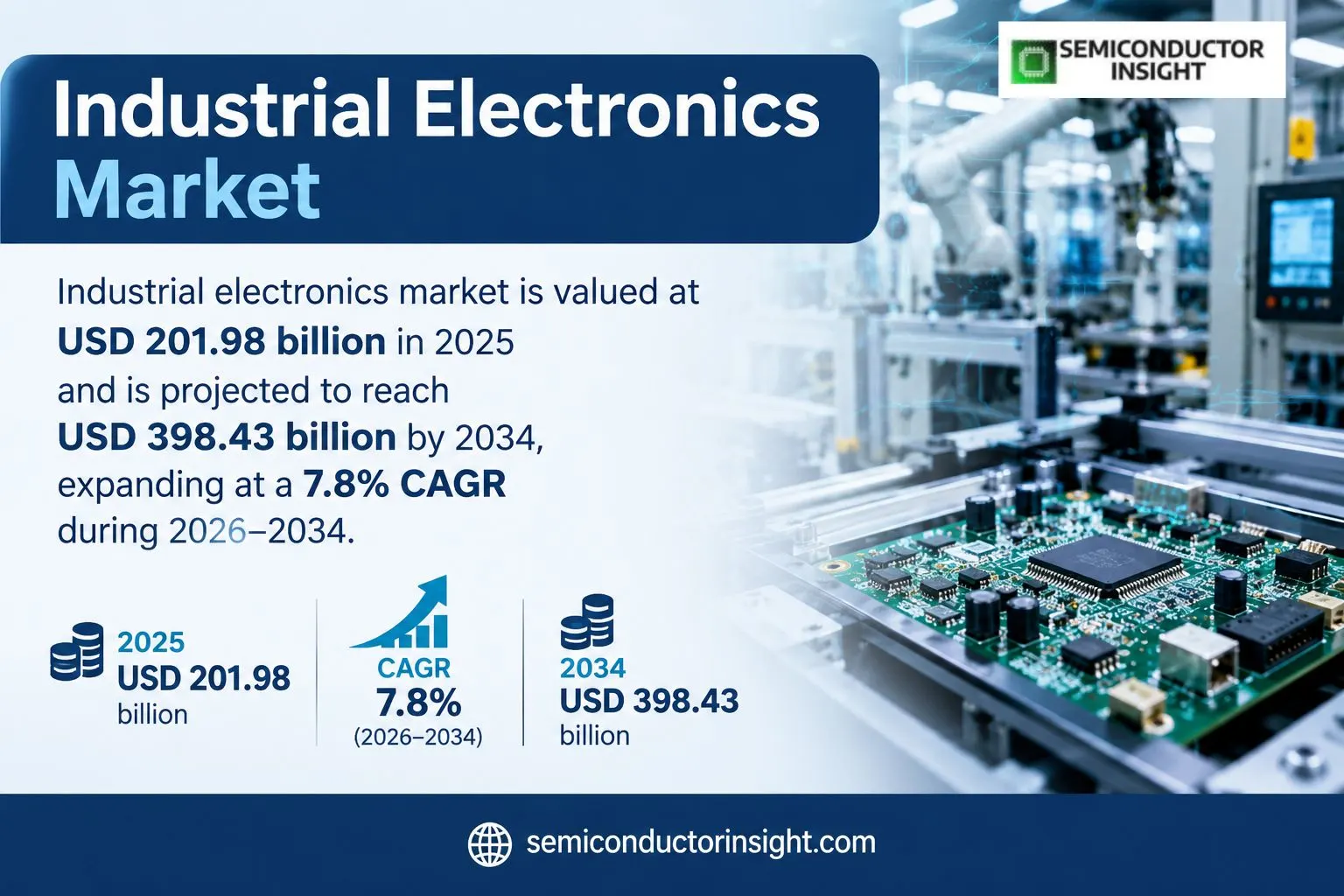
- Market size: The market is valued at USD 201.98 billion in 2025 and is projected to reach USD 398.43 billion by 2034, representing a 7.8% CAGR during 2026–2034.
- Power semiconductor devices are the largest product segment, reflecting the central role of efficient power conversion in drives, renewable energy, EV manufacturing and industrial infrastructure.
- Asia Pacific accounts for more than 45% of market revenue in the reference analysis, supported by China, Japan and South Korea’s manufacturing and semiconductor ecosystems.
- Semiconductor manufacturing is the leading application because advanced fabs require precision power, sensing, motion, inspection and control electronics across hundreds of process steps.
- Industrial AI is moving from pilots to operating infrastructure, with manufacturers investing in edge execution, orchestration, resilient automation and software-defined engineering.
Industrial Electronics Market Overview
Industrial electronics market is valued at USD 201.98 billion in 2025 and is projected to reach USD 398.43 billion by 2034, expanding at a 7.8% CAGR during 2026–2034. The 2026 market level is USD 217.82 billion. Asia Pacific is the largest and fastest-growth region, accounting for more than 45% of global revenue in the reference analysis. The market is broadening from discrete industrial components toward connected automation platforms combining power electronics, sensing, control, edge computing and software.
Industrial electronics covers electronic components and systems engineered for manufacturing, energy, transportation and other demanding operating environments. The market includes power semiconductors, sensors, actuators, motor drives, instrumentation, industrial power systems and intelligent electronic devices. Products are differentiated by reliability, temperature range, electromagnetic compatibility, safety certification and long lifecycle support because industrial equipment commonly remains in service far longer than consumer electronics.
Technology development is converging around industrial AI, edge computing, wide-bandgap power semiconductors and software-defined automation. Rockwell Automation introduced FactoryTalk ResilientEdge and FactoryTalk Orchestration in June 2026, while Siemens expanded Simatic AX with ladder programming and S7-1200 G2 support. These developments show industrial electronics becoming more integrated with software and cloud tools without abandoning deterministic edge control.
Customers purchase industrial electronics as part of machines and production systems rather than isolated components. Qualification, functional safety, cybersecurity, supply continuity and backward compatibility often outweigh short-term unit price. Vendors with broad portfolios can bundle control, drives, sensors, power electronics and software, while semiconductor specialists compete through efficiency, ruggedness and long product availability.
Segment Analysis: By Type
By type, the market spans power semiconductor devices, sensors and actuators, instrumentation, intelligent electronic devices, motor drives, power systems, and measurement and testing. Power semiconductors are the largest segment because nearly every automated or electrified industrial platform needs controlled conversion of electrical energy, while sensors and intelligent devices are growing with connected factories.
| Type | Commercial role |
|---|---|
| Power Semiconductor Devices | IGBTs, MOSFETs, thyristors, SiC and GaN devices for industrial power conversion. |
| Sensors and Actuators | Factory sensing, condition monitoring and control of physical processes. |
| Instrumentation | Process measurement, analyzers and precision industrial monitoring. |
| Intelligent Electronic Devices | Networked controllers, protection devices and embedded industrial intelligence. |
| Motor Drives | Variable-speed and servo-drive electronics for industrial motion. |
| Power Systems | Industrial supplies, converters and distribution electronics. |
| Measurement and Testing | Test, calibration and diagnostic electronics used across industrial production. |
Additional Segmentation: By End User
End-user demand is concentrated in industrial manufacturing, oil and gas, utilities, automotive and electronics production. Industrial manufacturing is the largest group because every automated production line contains control, sensing and power electronics. Utilities and oil and gas prioritize ruggedness and reliability, while electronics and automotive factories add demand for precision automation and machine vision.
| End User | Demand characteristics |
|---|---|
| Industrial Manufacturing | Factory automation, robotics, machine control and predictive maintenance. |
| Oil & Gas | Rugged instrumentation, motor control, safety systems and process electronics. |
| Utilities | Grid protection, renewable conversion, smart metering and substation automation. |
| Automotive | EV production, robotics, testing and electrified powertrain manufacturing. |
| Electronics | Semiconductor, PCB and device production using precision automation and inspection. |
Segment Analysis: By Application
By application, semiconductor manufacturing is the leading segment, followed by energy, transportation, telecom and process industries. Semiconductor fabs use high-value power, control, sensing and test electronics throughout production. Energy applications benefit from renewable conversion and grid modernization, while transportation and industrial plants invest in electrification, automation and predictive maintenance. For commercial decisions in the Industrial Electronics market, buyers also weigh qualification evidence, integration effort, operating reliability, lifecycle support, supply continuity and measurable system-level value rather than a single specification.
| Application | Demand characteristics |
|---|---|
| Semiconductor | Fab automation, power, sensing, motion, process control and test. |
| Telecommunication | Power systems, edge equipment and infrastructure electronics. |
| Energy | Renewable conversion, grid control, storage and industrial power management. |
| Transportation | Rail, EV manufacturing, charging and transport infrastructure. |
| Healthcare | Industrialized medical production and high-reliability equipment electronics. |
| Aerospace and Defense | Ruggedized control, sensing, power and test systems. |
| Chemical | Process instrumentation, safety and motor control. |
| Mining | Rugged power, drives, automation and remote monitoring. |
Additional Segmentation: By Technology Layer
A technology-layer view separates power conversion, control and automation, sensing and instrumentation, and edge computing with connectivity. The layers increasingly operate as one architecture: sensors feed controllers, power electronics drive equipment, and edge software interprets process data. This convergence increases total electronic content per machine and creates opportunities for vendors that can integrate hardware and software.
| Technology Layer | Commercial relevance |
|---|---|
| Power Conversion | Power semiconductors, converters, supplies and motor-drive stages. |
| Control & Automation | PLCs, motion control, safety and deterministic machine execution. |
| Sensing & Instrumentation | Industrial sensors, analyzers, metrology and condition monitoring. |
| Edge Computing & Connectivity | Industrial PCs, gateways, networking and AI-capable edge platforms. |
Regional Analysis
Asia Pacific leads with more than 45% of revenue in the reference analysis, supported by China, Japan and South Korea. North America is highly advanced in industrial AI, semiconductor and aerospace applications, while Europe remains strong in automation, automotive and energy efficiency. South America and the Middle East & Africa offer project-led modernization opportunities.
Why does regional demand differ across the Industrial Electronics market?
Regional demand follows manufacturing output, infrastructure investment and the speed of automation adoption. Asia combines the largest factory base and electronics supply chain, North America has strong software and semiconductor capabilities, and Europe maintains premium industrial engineering. Emerging regions depend more heavily on imported platforms and project economics. For commercial decisions in the Industrial Electronics market, buyers also weigh qualification evidence, integration effort, operating reliability, lifecycle support, supply continuity and measurable system-level value rather than a single specification.
| Region | Position | Demand profile | Supplier-selection factor |
|---|---|---|---|
| Asia Pacific | Largest / fastest | Manufacturing, semiconductor, energy | Scale and local electronics supply |
| North America | High-value | AI automation, aerospace, semiconductor | Technology and software integration |
| Europe | Strategic | Automotive, industrial, renewables | Efficiency, standards and lifecycle |
| South America | Emerging | Mining, energy, manufacturing | Project economics |
| Middle East & Africa | Emerging | Energy, infrastructure, manufacturing | Greenfield modernization |
Competitive Landscape
ABB, Mitsubishi Electric, Rockwell Automation, Infineon, Texas Instruments, STMicroelectronics, NXP, Microchip, onsemi, Renesas and Fuji Electric participate across different layers of the industrial electronics stack. The market remains fragmented because semiconductors, drives, control systems and instrumentation require different capabilities and customer channels. For commercial decisions in the Industrial Electronics market, buyers also weigh qualification evidence, integration effort, operating reliability, lifecycle support, supply continuity and measurable system-level value rather than a single specification.
Automation vendors increasingly connect hardware with software platforms. Rockwell’s FactoryTalk launches and Siemens’ Simatic AX expansion show that control, edge execution, engineering software and analytics are becoming one commercial ecosystem. Semiconductor suppliers differentiate through SiC, GaN, microcontrollers, isolation and long-lifecycle industrial product programs. For commercial decisions in the Industrial Electronics market, buyers also weigh qualification evidence, integration effort, operating reliability, lifecycle support, supply continuity and measurable system-level value rather than a single specification.
Customer relationships are durable because industrial electronics are embedded in validated machines and process systems. Lifecycle availability, cybersecurity, safety documentation and service networks create switching costs. This favors vendors that can support products for many years while providing migration paths to newer controllers, semiconductors and software architectures. For commercial decisions in the Industrial Electronics market, buyers also weigh qualification evidence, integration effort, operating reliability, lifecycle support, supply continuity and measurable system-level value rather than a single specification.
| Competitive tier | Representative companies | Primary differentiation |
|---|---|---|
| Automation platform leaders | ABB, Mitsubishi Electric, Rockwell Automation, Siemens | Control, drives, industrial software and global service. |
| Industrial semiconductor leaders | Infineon, TI, STMicroelectronics, NXP, onsemi | Power devices, MCUs, sensors, isolation and connectivity. |
| Specialist industrial electronics suppliers | Microchip, Renesas, Fuji Electric and niche instrumentation vendors | Long-lifecycle components and application-specific industrial portfolios. |
Key companies profiled
ABB, Mitsubishi Electric, Rockwell Automation, Infineon Technologies, Vishay, Microchip Technology, Texas Instruments, STMicroelectronics, NXP, Toshiba, onsemi, Renesas, Analog Devices and Fuji Electric are included in the competitive scope. Competitive positions vary substantially by product category, so the market should be evaluated as an interconnected industrial electronics ecosystem rather than one uniform product class.
Production Capacity Analysis
Capacity spans semiconductor fabs, sensor manufacturing, drive and controller assembly, industrial-PC production and instrumentation calibration. Power-semiconductor shortages or microcontroller constraints can interrupt entire automation product lines because industrial devices often remain qualified around specific long-lifecycle components. Multi-source design and regional manufacturing therefore remain important resilience strategies. For commercial decisions in the Industrial Electronics market, buyers also weigh qualification evidence, integration effort, operating reliability, lifecycle support, supply continuity and measurable system-level value rather than a single specification.
Industrial electronics capacity is also constrained by engineering and certification. New products must satisfy electromagnetic compatibility, functional safety, cybersecurity and environmental requirements. Software-heavy platforms require ongoing firmware and patch support, so vendor capacity increasingly includes engineering and lifecycle-service resources rather than only physical production lines. For commercial decisions in the Industrial Electronics market, buyers also weigh qualification evidence, integration effort, operating reliability, lifecycle support, supply continuity and measurable system-level value rather than a single specification.
Market Dynamics
The market is driven by smart manufacturing, electrification, renewable energy, semiconductor investment and industrial AI. Growth is restrained by semiconductor supply risk, engineering complexity, cybersecurity and long qualification cycles. Edge computing, wide-bandgap power devices, software-defined automation and predictive maintenance create the strongest opportunities for higher-value growth. For commercial decisions in the Industrial Electronics market, buyers also weigh qualification evidence, integration effort, operating reliability, lifecycle support, supply continuity and measurable system-level value rather than a single specification.
Market Drivers
| Driver | Impact | Commercial mechanism |
|---|---|---|
| Smart manufacturing | High | Factories require more sensing, control and connected electronics. |
| Electrification and energy efficiency | High | Power conversion is central to drives, renewables and EV manufacturing. |
| Industrial AI | Medium-High | Edge platforms turn production data into real-time decisions. |
| Semiconductor manufacturing investment | Medium-High | Fabs consume high-value automation and precision electronics. |
Smart manufacturing
Manufacturers are moving from isolated automation toward integrated data-driven production. More PLCs, sensors, drives, industrial PCs and networking devices are required to monitor and optimize operations, increasing electronic content per production asset. For commercial decisions in the Industrial Electronics market, buyers also weigh qualification evidence, integration effort, operating reliability, lifecycle support, supply continuity and measurable system-level value rather than a single specification.
Electrification and energy efficiency
Industrial motor systems, renewable-energy converters and electrified transport rely on efficient semiconductor switching. SiC and GaN reduce losses and cooling requirements, expanding the value of advanced power electronics. For commercial decisions in the Industrial Electronics market, buyers also weigh qualification evidence, integration effort, operating reliability, lifecycle support, supply continuity and measurable system-level value rather than a single specification.
Industrial AI
AI-based inspection, predictive maintenance and optimization require computing close to machines. Edge execution reduces latency and keeps operations running even when cloud connectivity is unavailable. For commercial decisions in the Industrial Electronics market, buyers also weigh qualification evidence, integration effort, operating reliability, lifecycle support, supply continuity and measurable system-level value rather than a single specification.
Semiconductor manufacturing investment
New semiconductor factories require dense instrumentation, motion control, power conditioning and automation. Advanced-node and packaging investment therefore creates a high-value application segment with demanding reliability requirements. For commercial decisions in the Industrial Electronics market, buyers also weigh qualification evidence, integration effort, operating reliability, lifecycle support, supply continuity and measurable system-level value rather than a single specification.
Market Restraints
| Restraint | Impact | Commercial consequence |
|---|---|---|
| Supply-chain concentration | High | Specialized semiconductors and sensors can have long lead times. |
| Cybersecurity | Medium-High | Connected factories create larger attack surfaces. |
| Certification complexity | Medium-High | Industrial products must satisfy safety and environmental requirements. |
| Legacy integration | Medium | Factories operate equipment for many years. |
Supply-chain concentration
Industrial products often use long-qualified components that cannot be replaced quickly. A shortage in one microcontroller, power device or sensor can disrupt a complete system, encouraging redesign and inventory buffers. For commercial decisions in the Industrial Electronics market, buyers also weigh qualification evidence, integration effort, operating reliability, lifecycle support, supply continuity and measurable system-level value rather than a single specification.
Cybersecurity
Industrial control networks increasingly connect with enterprise IT and cloud platforms. Vendors must support secure boot, encryption, patching and access control without undermining deterministic operation or long equipment lifecycles. For commercial decisions in the Industrial Electronics market, buyers also weigh qualification evidence, integration effort, operating reliability, lifecycle support, supply continuity and measurable system-level value rather than a single specification.
Certification complexity
Applications in energy, chemical, transport and aerospace require rigorous validation. Certification increases development time and can slow adoption of new components even when technical performance is better. For commercial decisions in the Industrial Electronics market, buyers also weigh qualification evidence, integration effort, operating reliability, lifecycle support, supply continuity and measurable system-level value rather than a single specification.
Legacy integration
New electronics must coexist with older fieldbus protocols, voltage levels and control architectures. This increases engineering effort and makes customers cautious about disruptive platform changes. For commercial decisions in the Industrial Electronics market, buyers also weigh qualification evidence, integration effort, operating reliability, lifecycle support, supply continuity and measurable system-level value rather than a single specification.
Market Opportunities
Industrial edge AI
Rugged edge computers and AI-enabled controllers can capture more processing value as factories deploy vision, predictive maintenance and autonomous operations. For commercial decisions in the Industrial Electronics market, buyers also weigh qualification evidence, integration effort, operating reliability, lifecycle support, supply continuity and measurable system-level value rather than a single specification.
Wide-bandgap power electronics
SiC and GaN devices can improve drive and power-system efficiency, supporting premium industrial designs with smaller cooling systems. For commercial decisions in the Industrial Electronics market, buyers also weigh qualification evidence, integration effort, operating reliability, lifecycle support, supply continuity and measurable system-level value rather than a single specification. For commercial decisions in the Industrial Electronics market, buyers also weigh qualification evidence, integration effort, operating reliability, lifecycle support, supply continuity and measurable system-level value rather than a single specification.
Software-defined automation
IT-style engineering and containerized execution can reduce commissioning time and make industrial software easier to update across fleets. For commercial decisions in the Industrial Electronics market, buyers also weigh qualification evidence, integration effort, operating reliability, lifecycle support, supply continuity and measurable system-level value rather than a single specification. For commercial decisions in the Industrial Electronics market, buyers also weigh qualification evidence, integration effort, operating reliability, lifecycle support, supply continuity and measurable system-level value rather than a single specification.
Energy-management electronics
Factories and utilities need more metering, conversion and control hardware to reduce energy intensity and integrate renewable generation. For commercial decisions in the Industrial Electronics market, buyers also weigh qualification evidence, integration effort, operating reliability, lifecycle support, supply continuity and measurable system-level value rather than a single specification. For commercial decisions in the Industrial Electronics market, buyers also weigh qualification evidence, integration effort, operating reliability, lifecycle support, supply continuity and measurable system-level value rather than a single specification.
Supply Chain Analysis
Components. Power semiconductors, MCUs, sensors, passives, isolation devices and communications ICs form the electronic foundation. Industrial-grade products require long availability and robust environmental specifications. For commercial decisions in the Industrial Electronics market, buyers also weigh qualification evidence, integration effort, operating reliability, lifecycle support, supply continuity and measurable system-level value rather than a single specification.
System manufacturing. Components are assembled into PLCs, drives, instruments, industrial PCs and power systems. Hardware is combined with firmware and diagnostic software, then tested for EMC, temperature, vibration and safety. For commercial decisions in the Industrial Electronics market, buyers also weigh qualification evidence, integration effort, operating reliability, lifecycle support, supply continuity and measurable system-level value rather than a single specification.
Integration. Machine builders and system integrators configure controls, networks and software for each production process. Cybersecurity and compatibility with legacy equipment are important design requirements. For commercial decisions in the Industrial Electronics market, buyers also weigh qualification evidence, integration effort, operating reliability, lifecycle support, supply continuity and measurable system-level value rather than a single specification.
Operations. Industrial electronics remain in service for many years and must be maintained, patched and upgraded. Lifecycle support and migration paths generate recurring value beyond initial hardware sales. For commercial decisions in the Industrial Electronics market, buyers also weigh qualification evidence, integration effort, operating reliability, lifecycle support, supply continuity and measurable system-level value rather than a single specification.
Recent Developments in the Industrial Electronics Market
Developments tracked through September 2026 and limited to events that materially affect technology, capacity, adoption or competition.
- 22 June 2026
Rockwell Automation launched FactoryTalk Orchestration software to coordinate material flow and production processes using real-time factory signals, extending industrial electronics toward end-to-end production orchestration. Source - 18 June 2026
Rockwell Automation introduced FactoryTalk ResilientEdge, a unified edge execution architecture designed to support low-latency autonomous manufacturing while connecting with cloud analytics and AI training. Source - 18 June 2026
Siemens expanded Simatic AX with ladder programming and support for the S7-1200 G2 controller, broadening software-defined automation to more operational-technology users and basic automation applications. Source
Report Scope & Segmentation
| Attribute | Scope |
|---|---|
| Base year | 2025 |
| Estimated year | 2026 |
| Forecast period | 2026–2034 |
| 2025 market size | USD 201.98 billion |
| 2026 estimated size | USD 217.82 billion |
| 2034 projected size | USD 398.43 billion |
| CAGR (2026–2034) | 7.8% |
| Largest market in 2025 | Asia Pacific |
| By Type | Power Semiconductor Devices; Sensors and Actuators; Instrumentation; Intelligent Electronic Devices; Motor Drives; Power Systems; Measurement and Testing |
| By Application | Semiconductor; Telecommunication; Energy; Transportation; Healthcare; Aerospace and Defense; Chemical; Mining |
| By End User | Industrial Manufacturing; Oil & Gas; Utilities; Automotive; Electronics |
| By Technology Layer | Power Conversion; Control & Automation; Sensing & Instrumentation; Edge Computing & Connectivity |
| Companies profiled | ABB; Mitsubishi Electric; Rockwell Automation; Infineon; Texas Instruments; STMicroelectronics; NXP; Microchip; onsemi; Renesas; Fuji Electric and others |
Frequently Asked Questions
What is the industrial electronics market size in 2025?
The global industrial electronics market is valued at USD 201.98 billion in 2025 across power, sensing, control, instrumentation and industrial computing.
What is the market forecast for 2034?
The market is projected to reach USD 398.43 billion by 2034, representing a 7.8% CAGR during 2026–2034. The 2026 market level is USD 217.82 billion.
Which region leads the market?
Asia Pacific is the largest and fastest-growth region and accounts for more than 45% of global revenue in the reference analysis.
Which product segment is largest?
Power semiconductor devices are the largest product segment because industrial drives, energy systems and electrification require efficient power conversion.
Which application is largest?
Semiconductor manufacturing is the leading application because fabs require dense automation, sensing, motion, power and test electronics.
How is AI changing industrial electronics?
AI is increasing demand for rugged edge computing, machine vision, predictive maintenance and orchestration software integrated with deterministic control.
Who are the major companies?
ABB, Mitsubishi Electric, Rockwell Automation, Infineon, Texas Instruments, STMicroelectronics, NXP and other industrial suppliers are major participants.
Why are wide-bandgap semiconductors important?
SiC and GaN can reduce power losses and cooling needs in drives, renewable-energy systems and industrial power conversion.
What limits market growth?
Supply-chain concentration, cybersecurity, certification complexity and legacy-system integration are the main restraints.
What will drive growth through 2034?
Smart manufacturing, industrial AI, electrification, semiconductor investment and energy-efficiency programs will support expansion.
Research Sources & Evidence Base
View research sources used in this market overview
- Rockwell Automation — 2026 State of Smart Manufacturing. Global manufacturing digitalization evidence from more than 1,500 manufacturers.
- Siemens — Simatic AX expansion. 2026 software-defined automation development.
- Rockwell Automation — FactoryTalk ResilientEdge. 2026 edge execution architecture development.
Get Sample Report PDF for Exclusive Insights
Report Sample Includes
- Table of Contents
- List of Tables & Figures
- Charts, Research Methodology, and more...