Key Statistics
Key Takeaways
- Ordinary tantalum capacitors remain the largest product group in the report scope, while conductive-polymer tantalum gains value where lower ESR, higher ripple current and improved high-frequency performance are required.
- Consumer electronics is the largest application because compact smartphones, notebooks, wearables and connected devices value high capacitance within small board area.
- Asia Pacific leads the market through dense electronics manufacturing in China, Japan and South Korea and a large regional base of capacitor producers and device OEMs.
- SMD form factors dominate modern demand because automated placement, low profile and high volumetric efficiency align with dense PCB assembly.
- Aerospace, military and space remain high-value niches as DLA- and ESA-qualified polymer tantalum products combine low ESR with stringent screening and long-life reliability.
- Responsible tantalum sourcing is a structural procurement requirement because downstream buyers must trace 3TG mineral origin and monitor smelter conformance, especially amid instability in eastern DRC and neighboring trade routes.
Tantalum Capacitors Market Overview
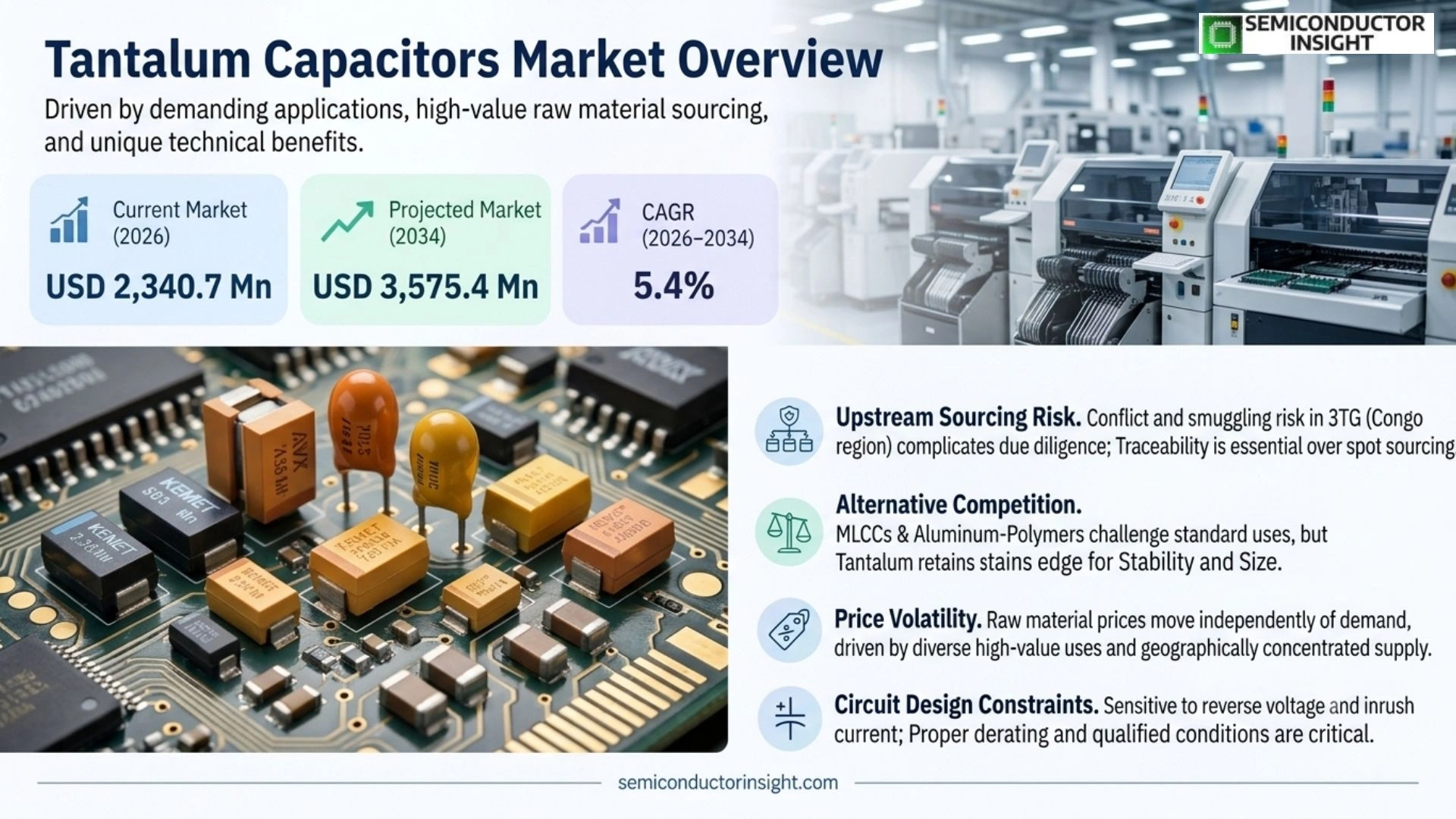
Tantalum Capacitors Market was valued at USD 2,220.0 million in 2025, is estimated at USD 2,340.7 million in 2026, and is projected to reach USD 3,575.4 million by 2034, representing a CAGR of 5.4% during 2026–2034. Asia Pacific is the largest regional market in 2025, while the commercial growth mechanism is increasingly shaped by electronics miniaturization, polymer tantalum adoption, automotive electrification, aerospace and defense reliability needs, medical electronics, and stronger responsible-sourcing controls.
Tantalum capacitors are polarized electrolytic capacitors that use a porous tantalum anode and a thin tantalum-pentoxide dielectric to achieve high capacitance per unit volume. The cathode can use manganese dioxide or conductive polymer, and products are offered in molded surface-mount, high-reliability, wet tantalum and specialized configurations. Their combination of compact size, stable capacitance and long service life supports use in consumer electronics, automotive systems, medical devices, telecom equipment and mission-critical electronics.
Technology differentiation is increasingly concentrated in polymer cathodes, higher voltage ratings, lower ESR and stronger screening. Conductive-polymer tantalum products reduce ESR and improve ripple-current performance, making them attractive in point-of-load power supplies, processors, radios and high-density power distribution. Traditional MnO2 tantalum remains important where established reliability, cost and broad qualification history outweigh the need for the lowest ESR.
The upstream supply chain adds a strategic dimension that is unusual for many passive components. Tantalum is part of the 3TG conflict-minerals framework, so OEMs and capacitor manufacturers must maintain smelter traceability and due diligence. Responsible Minerals Initiative tools and conformant-smelter lists are therefore directly relevant to commercial sourcing, not merely corporate reporting.
Segment Analysis: By Type
By type, the market is segmented into Ordinary Tantalum Capacitor, High Polymer Tantalum Capacitor, and Others. Ordinary tantalum remains the largest group in the report scope, while polymer tantalum is the principal premium growth segment because it supports low ESR, strong high-frequency capacitance retention and higher ripple-current capability.
| Type | Technical role | Market position |
|---|---|---|
| Ordinary Tantalum Capacitor | Uses a solid manganese-dioxide cathode in common molded SMD formats. The technology offers strong volumetric efficiency, stable capacitance and a long qualification history across commercial and high-reliability applications. | The largest product group in the report scope. Demand remains broad in consumer, industrial and general electronic systems where proven behavior and cost matter more than extreme low ESR. |
| High Polymer Tantalum Capacitor | Uses a conductive polymer cathode to lower ESR and improve high-frequency behavior. Product families can span compact consumer devices through automotive, industrial and military applications. | The main premium growth segment. Lower ESR and stronger ripple handling increase suitability for DC/DC converters, processor rails, networking equipment and high-density power systems. |
| Others | Includes wet tantalum, hermetic, axial, radial and specialized high-reliability products tailored to extreme temperature, voltage or mechanical environments. | A smaller but high-value segment. Aerospace, defense, space, medical and industrial users can justify higher unit prices for screening, reliability and long operating life. |
Why is polymer tantalum gaining share in power electronics?
Conductive polymer reduces cathode resistance compared with manganese dioxide, which lowers ESR and allows more ripple current for a given package size. That improves voltage smoothing and transient response in compact switch-mode power supplies. KYOCERA AVX polymer families extend to high-voltage and high-reliability variants, while Vishay’s 2025 DLA 04051 series targets aerospace, military and space systems with ESR as low as 25 mΩ. These developments expand tantalum beyond traditional decoupling into demanding power rails.
Segment Analysis: By Application
By application, the market covers Consumer Electronics, Automotive, Military or Aerospace, Medical, and Others. Consumer electronics remains the largest application by volume, while automotive and mission-critical systems provide attractive value growth through higher reliability and longer qualification cycles.
| Application | Demand characteristics | |
|---|---|---|
| Consumer Electronics | Smartphones, notebooks, wearables, cameras and connected devices use compact SMD tantalum capacitors for power filtering, decoupling and local energy storage. | The largest application by volume because high capacitance in a small footprint supports continued electronic miniaturization. |
| Automotive | ADAS, infotainment, telematics, power distribution and control modules need capacitors that withstand vibration, temperature cycling and long service life. | A strong growth application. Automotive-qualified polymer and MnO2 tantalum can capture higher value through AEC-Q200 requirements and extended temperature operation. |
| Military or Aerospace | Radios, radar, avionics, satellites and mission systems require screened parts with low ESR, mechanical robustness and predictable failure behavior. | A smaller but premium segment. DLA and ESA qualification materially raise supplier barriers and support longer design-in lifecycles. |
| Medical | Implantable, diagnostic, imaging and monitoring electronics value small size, stable electrical behavior and long-term reliability. | A high-value niche where qualification, traceability and low leakage can outweigh component price. |
| Others | Telecom, industrial automation, energy systems and specialized instrumentation use tantalum where capacitance density and reliability justify the material. | A diverse demand pool supported by 5G equipment, industrial controls and high-reliability power conversion. |
Why do automotive and aerospace applications support higher value per capacitor?
These markets impose requirements beyond nominal capacitance and voltage. Components can require surge testing, extended-temperature operation, lot traceability, shock and vibration performance, DLA or ESA qualification and long production availability. The additional screening and documentation increase manufacturing cost, but they also create switching barriers once a part is designed into a vehicle, aircraft or mission platform.
Regional Analysis
Asia Pacific leads the Tantalum Capacitors market, supported by the concentration of electronics manufacturing, capacitor production and consumer-device assembly across China, Japan and South Korea. North America retains strong aerospace, defense and medical demand, while Europe is important in automotive and industrial electronics.
How do regional tantalum-capacitor markets differ?
Asia Pacific combines high-volume SMD demand with major Japanese and Asian capacitor manufacturing. North America is weighted toward aerospace, defense, medical and high-performance computing applications. Europe is driven by automotive, industrial and space electronics. South America is smaller and import dependent, while the Middle East and Africa combine telecom, defense and industrial demand with upstream tantalum-sourcing considerations.
| Region | Position | Growth outlook | Demand profile | What decides supplier selection |
|---|---|---|---|---|
| Asia Pacific | Largest | Steady to strong | Consumer, automotive and industrial electronics | Scale, SMD availability, polymer technology and supply continuity |
| North America | High-value specialist market | Moderate | Aerospace, defense, medical and enterprise electronics | Qualification, reliability and responsible sourcing |
| Europe | Automotive & space specialist | Moderate | Automotive, industrial and aerospace electronics | AEC-Q200, ESA/DLA-grade supply and traceability |
| South America | Smaller import-dependent market | Selective | Telecom, consumer and industrial electronics | Distribution, cost and import availability |
| Middle East & Africa | Emerging application & sourcing region | Selective | Telecom, defense and industrial systems | Responsible sourcing, supply assurance and qualified imports |
Competitive Landscape
The competitive landscape includes KEMET/Yageo, KYOCERA AVX, Vishay Intertechnology, Panasonic, Hongda Electronics, ROHM-related legacyproducts, Matsuo Electric, Sunlord Electronics, Abracon, Walsin, Samwha and other regional suppliers.
KEMET/Yageo, KYOCERA AVX and Vishay have broad tantalum portfolios spanning standard molded, polymer, automotive and high-reliability products. Their advantage is not only capacitor design but also qualification history, surge screening, application support and access to global OEM programs.
KYOCERA AVX differentiates through a wide range of polymer and MnO2 tantalum technologies, including low-profile, high-voltage and ESA-qualified families. Vishay has strengthened military and aerospace polymer offerings through DLA-qualified products, while Asian suppliers compete strongly in standard SMD and cost-sensitive applications.
Responsible sourcing is a competitive capability. Large OEMs increasingly require CMRT documentation and conformant-smelter visibility, so capacitor manufacturers with mature 3TG due-diligence systems can protect preferred-supplier relationships during periods of upstream instability.
| Competitive tier | Representative companies | Commercial basis |
|---|---|---|
| Global technology leaders | KEMET (Yageo); KYOCERA AVX; Vishay Intertechnology | Broad MnO2/polymer portfolios, automotive and military qualification, global distribution and application engineering. |
| Asian diversified suppliers | Panasonic; Hongda Electronics; Matsuo Electric; Sunlord Electronics; Walsin Technology; Samwha Capacitor | High-volume electronics exposure, regional manufacturing and cost-competitive SMD products. |
| Specialist / channel participants | Abracon; Nichicon-related channels; legacy ROHM tantalum products | Application-specific passive portfolios, distribution reach and selected high-reliability niches. |
Key Market Participants
KEMET (Yageo Corporation), KYOCERA AVX, Vishay Intertechnology, Panasonic Corporation, Hongda Electronics, Matsuo Electric, Sunlord Electronics, Abracon, Walsin Technology, Samwha Capacitor, Nichicon.
Production Capacity Analysis
Tantalum-capacitor production depends on high-purity tantalum powder or wire, oxide formation, cathode creation, lead-frame attachment, molding, screening and electrical test. Polymer products add conductive-polymer deposition and require tight moisture and reflow control, while high-reliability products add extensive surge, temperature and life testing.
The anode begins with high-purity tantalum powder pressed and sintered into a porous structure. Greater surface area increases capacitance, but powder characteristics and sintering conditions must be tightly controlled to preserve dielectric integrity.
Anodization grows a thin tantalum-pentoxide dielectric on the porous anode. MnO2 capacitors then build a manganese-dioxide cathode, while polymer products use conductive polymer to lower ESR. Cathode uniformity strongly affects leakage, ESR and reliability.
Final production includes termination, molding, aging and screening. Automotive, military and space parts can require additional surge-current testing, temperature cycling and statistical screening, creating a materially different cost structure from commodity consumer parts.
| Capacity layer | Where it concentrates | Commercial constraint |
|---|---|---|
| Tantalum ore, concentrate & smelting | Central Africa, South America and global processing hubs | Responsible sourcing, smelter conformance and raw-material price. |
| Tantalum powder & wire | Specialty metals suppliers in Asia, Europe and North America | Purity, particle structure and consistency. |
| Capacitor fabrication | Japan, China, Southeast Asia, Europe and North America | Sintering, dielectric quality, cathode uniformity and package yield. |
| Screening & qualification | Integrated at high-reliability capacitor plants | Surge testing, temperature life, DLA/ESA/AEC-Q200 requirements and traceability. |
Market Dynamics
Growth is supported by electronics miniaturization, higher-performance polymer products and resilient demand from automotive, medical and defense systems. The principal risks are upstream tantalum sourcing, price volatility, competition from MLCCs and aluminum-polymer capacitors, and stricter qualification requirements.
Market Drivers
| Factor | Directional impact | Why it matters |
|---|---|---|
| Miniaturized electronics | High | Tantalum provides high capacitance in small SMD packages. |
| Polymer low-ESR adoption | High | Lower ESR supports fast power rails and compact DC/DC converters. |
| Automotive and defense reliability | Medium-High | Qualified products command higher value and remain designed in for long periods. |
| Medical and telecom electronics | Medium | Stable capacitance and small size support specialized long-life systems. |
Miniaturization favors high volumetric efficiency
Smartphones, wearables and compact electronics continually reduce board area while adding functions. Tantalum’s high capacitance density allows designers to place meaningful bulk capacitance in small SMD footprints.
Polymer technology expands the usable frequency range
Lower ESR improves transient response and ripple handling, allowing tantalum polymer to compete in processor, FPGA and networking power rails that historically relied more heavily on other capacitor technologies.
High-reliability sectors create durable design wins
Aerospace, defense, medical and automotive systems impose long qualification cycles. Once a tantalum part is approved, designers avoid unnecessary changes because requalification is expensive.
Telecom and industrial equipment value stable behavior
Network and industrial systems operate continuously and often need compact local energy storage. Tantalum remains attractive where stable capacitance and predictable aging matter.
Market Restraints
| Factor | Directional impact | Why it matters |
|---|---|---|
| Responsible-sourcing risk | High | Tantalum origin and smelter traceability remain critical due-diligence requirements. |
| Competition from MLCC and aluminum polymer | High | Alternative capacitors can offer lower cost or stronger high-frequency performance in some circuits. |
| Raw-material price volatility | Medium-High | Tantalum supply changes can affect capacitor cost and lead times. |
| Polarized-device design constraints | Medium | Incorrect polarity or surge conditions can create reliability risk. |
Upstream sourcing can interrupt otherwise stable electronics supply
Conflict and smuggling risk in eastern DRC and neighboring routes can complicate 3TG due diligence. Buyers must map smelters and maintain traceability instead of relying on spot sourcing.
Alternative capacitors keep pressure on standard products
MLCCs provide excellent high-frequency behavior and aluminum-polymer capacitors offer low ESR at larger capacitance values. Tantalum retains an advantage where size, stability and qualification history matter most.
Tantalum metal prices can move independently of electronics demand
The raw material is used in multiple high-value applications and has a geographically concentrated supply base. Manufacturers therefore use inventories, long-term contracts and recycling to manage cost exposure.
Circuit design must account for polarity and surge
Tantalum is a polarized technology and can be sensitive to reverse voltage or excessive inrush. Proper derating and qualified power-up conditions remain important, especially in high-energy systems.
Market Opportunities
High-reliability polymer tantalum
DLA- and ESA-qualified low-ESR products can expand in radar, avionics, satellites and mission systems.
Automotive power electronics
ADAS, zonal controllers and infotainment need compact, vibration-resistant power decoupling.
Medical miniaturization
Wearable and implantable devices benefit from high capacitance density and long-life performance.
Traceable responsible supply
Suppliers that combine electrical performance with strong 3TG due diligence can gain preferred-supplier status.
Supply Chain Analysis
Tantalum Mining & Smelting. The supply chain starts with mined concentrates and smelters. Responsible-minerals programs identify active and conformant tantalum smelters so downstream companies can verify origin and due diligence.
Powder & Wire. Capacitor-grade tantalum requires high purity and controlled morphology. Powder surface area influences achievable capacitance, while consistency affects dielectric reliability and production yield.
Capacitor Fabrication. Manufacturers press and sinter anodes, form the oxide dielectric, build the cathode and package the device. Polymer products add specialized chemistry and moisture control.
Qualification & OEM Integration. High-value applications require surge testing, life tests and customer approval. CMRT documentation and material compliance increasingly accompany electrical qualification in the commercial approval process.
Recent Developments in the Tantalum Capacitors Market
Developments tracked to September 2026. Entries are dated to the official publication date where available.
- 19 August 2026 Sourcing
The Responsible Minerals Initiative released updated mineral reporting templates, including the Conflict Minerals Reporting Template used for tantalum, tin, tungsten and gold supply-chain reporting. Standardized reporting remains central to tantalum due diligence. Source - 8 October 2025 Product
Vishay released the DLA 04051 vPolyTan polymer tantalum capacitor series for aerospace, military and space applications. The parts combine DLA qualification with ESR down to 25 mΩ and voltage ratings up to 63 V. Source - 24 February 2025 Supply chain
RMI issued a statement on heightened conflict and sourcing risks in eastern DRC. The organization said responsible sourcing of 3TG had become substantially more difficult across affected mining and trade routes. Source - 2026 Technology
KYOCERA AVX continues offering conductive-polymer tantalum families with low ESR, low-profile packaging and voltage ratings extending to 125 V. The portfolio supports consumer, industrial, networking and high-reliability applications. Source - 2026 High reliability
KYOCERA AVX maintains ESA-qualified polymer tantalum products manufactured in an ESA-qualified European plant. The TCS QPL ESCC series addresses avionics, military, space and telecom requirements. Source
Report Scope & Segmentation
| Attribute | Coverage |
|---|---|
| Report title | Tantalum Capacitors Market Size, Global Business Strategies 2026-2034 |
| Base / estimate / forecast | 2025 base year; 2026 estimated year; 2034 forecast end year; CAGR measured for 2026–2034. |
| By Type | Ordinary Tantalum Capacitor; High Polymer Tantalum Capacitor; Others |
| By Application | Consumer Electronics; Automotive; Military or Aerospace; Medical; Others |
| By End User | OEMs; Aftermarket; System Integrators |
| By Form Factor | SMD (Surface Mount Device); Radial Lead; Axial Lead |
| By Voltage Range | Low Voltage (<16V); Medium Voltage (16V-35V); High Voltage (>35V) |
| Regions | North America, Europe, Asia-Pacific, South America, and Middle East & Africa, with country-level analysis across the principal national markets. |
| Companies | KEMET (Yageo Corporation), KYOCERA AVX, Vishay Intertechnology, Panasonic Corporation, Hongda Electronics, Matsuo Electric, Sunlord Electronics, Abracon, Walsin Technology, Samwha Capacitor, Nichicon |
| Customization Scope | Free report customization (equivalent to up to 4 analyst working days) with purchase. Addition or alteration to country, regional and segment scope. |
Frequently Asked Questions
What is the size of the Tantalum Capacitors market?
The global Tantalum Capacitors market is valued at USD 2,220.0 million in 2025, is estimated at USD 2,340.7 million in 2026, and is projected to reach USD 3,575.4 million by 2034, representing a 5.4% CAGR during 2026–2034.
Which region leads the Tantalum Capacitors market?
Asia Pacific leads through its large electronics-manufacturing base and established capacitor supply chains in China, Japan and South Korea.
Which product type leads the market?
Ordinary tantalum capacitors remain the largest type within the report scope, while conductive-polymer tantalum is the main premium growth technology.
Which application is the largest?
Consumer Electronics is the largest application because compact devices use high volumes of SMD capacitors for power filtering and decoupling.
Why are polymer tantalum capacitors important?
Conductive polymer lowers ESR and improves ripple-current performance, enabling compact power supplies, processor rails, networking equipment and high-reliability electronics.
Why is responsible sourcing important?
Tantalum is a 3TG mineral, so OEMs and component suppliers must track origin and smelters through due-diligence systems such as the RMI Conflict Minerals Reporting Template.
What are the main restraints?
Upstream sourcing risk, tantalum price volatility, competition from MLCC and aluminum-polymer technologies, and polarized-device design constraints are the main restraints.
Who are the major companies?
Major companies include KEMET/Yageo, KYOCERA AVX, Vishay, Panasonic, Hongda Electronics, Matsuo Electric, Sunlord, Abracon, Walsin and Samwha.
Which end markets support premium pricing?
Aerospace, military, space, medical and automotive applications support premium products because screening, traceability and long lifecycle are critical.
Where are the strongest future opportunities?
The strongest opportunities are in high-reliability polymer tantalum, automotive electronics, medical miniaturization and traceable responsible supply.
Research Sources & Evidence Base
Get Sample Report PDF for Exclusive Insights
Report Sample Includes
- Table of Contents
- List of Tables & Figures
- Charts, Research Methodology, and more...
 Download Sample Report PDF