Single-output DC-DC Converters, to have the highest market share: by type
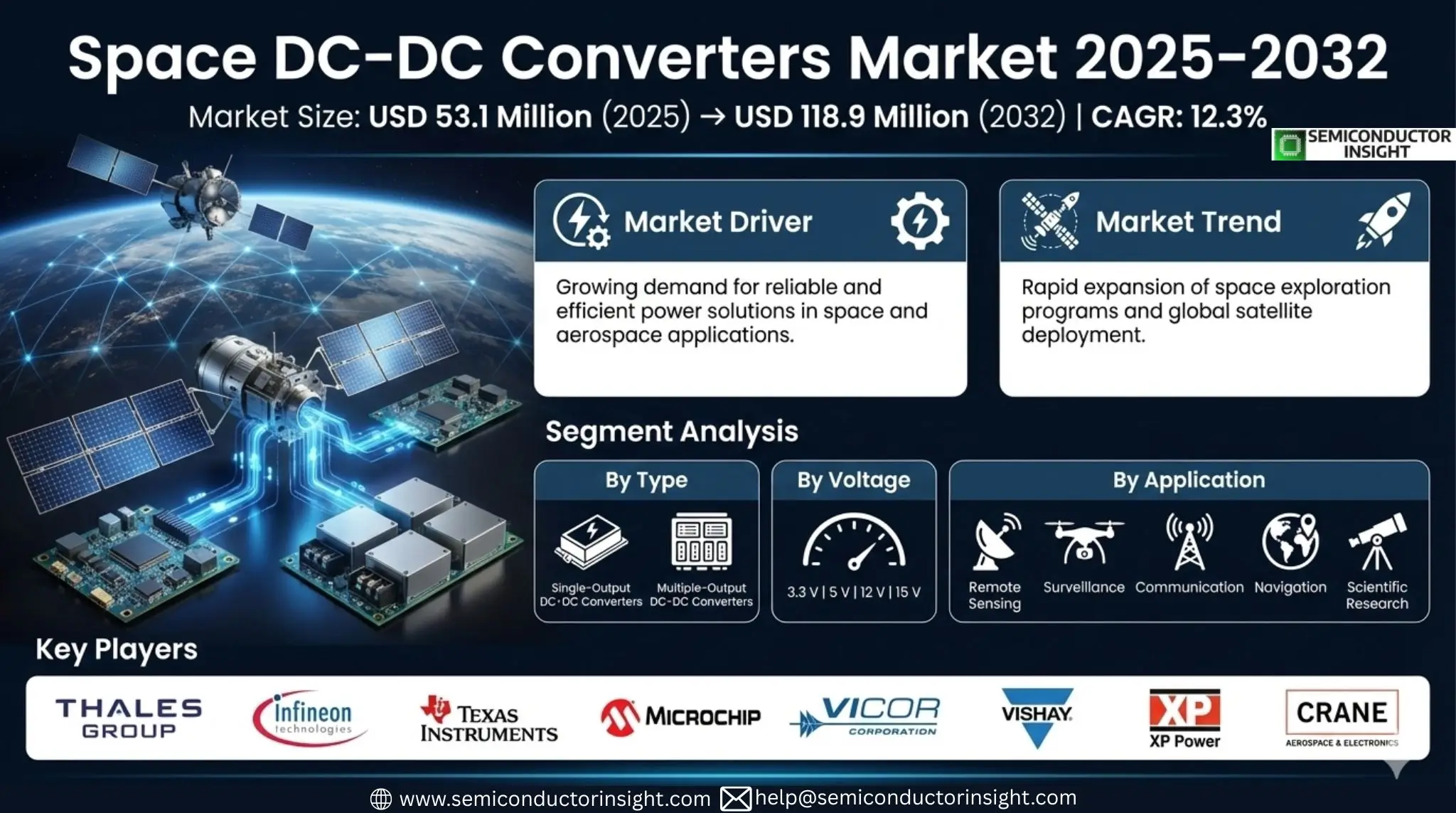
In term of type the Space DC-DC Converter industry has been segmented as Single-output DC-DC Converters, and Multiple Output DC-DC Converter.
Single output DC-DC converters have the largest market share in the space DC-DC converter business, primarily due to their broader application in space applications, where particular power requirements are frequently required for individual components or subsystems within a satellite or spacecraft. Additionally, single output converters are in higher demand due to their efficiency, dependability, and simplicity, which makes them perfect for the harsh conditions of the space environment. Single-output DC-DC converters are employed in situations where precise and steady voltage is required for vital functions, such powering control modules, sensors, and communication systems.
Moreover, these converters are preferred because they provide a steady, single output voltage required for vital functions including communication, navigation, and control systems in the harsh environment of space, where stability and dependability are essential. Their simple design minimizes possible points of failure, simplifies power management, and makes it easier for them to meet the requirements for space missions, which demand strict adherence to stringent standards. Their leading position in the market is further strengthened by the extensive use of these converters across a variety of subsystems in satellites and spacecraft, which is fueled by the rising need for satellite communications, Earth observation, and space exploration. Single-output DC-DC Converters are guaranteed to remain at the forefront of the market due to their vital role in mission-critical applications, high dependability, and ease of integration.
Communication is expected to hold the highest market share: By Application
In terms of Application, the Space DC-DC converter has been segmented as Remote Sensing, Surveillance, Communication, Navigation, and Scientific Research.
The industry for Space DC-DC Converters is anticipated to be dominated by the Communication application due to the essential importance and rapid expansion of satellite-based communication networks. The deployment of communication satellites is expanding at an unprecedented rate because of the growing demand for safe, secure communication channels, television broadcasting, and dependable, fast internet connectivity on a global scale. These satellites rely significantly on DC-DC converters to power their communication payloads, transponders, and other critical components, whether they are in geostationary orbit or are a part of vast low Earth orbit (LEO) constellations like Starlink and OneWeb. This dominance is primarily driven by the increasing demand for reliable and efficient power management solutions in satellite communication systems. As the global need for satellite-based communication grows, particularly in areas such as remote sensing, broadcasting, and global internet connectivity, the demand for DC-DC converters in this application is also rising.
For instance, advanced DC-DC converters are needed for the deployment of low Earth orbit (LEO) satellite constellations, such as SpaceX’s OneWeb and Starlink, in order to guarantee a reliable power supply for communication payloads. Since those additives are essential to maintaining the effectiveness and dependability of satellite television for PC verbal exchange structures, the expansion of the satellite communication growth is directly correlated with the rise in demand for DC-DC converters.
Furthermore, more sophisticated DC-DC converters that can manage higher power densities while minimizing losses have also been developed as a result of the necessity for miniaturization and improved power efficiency in communication satellites. It is anticipated that these developments will strengthen the dominant position of the communication industry in the Space DC-DC Converters market.
Regional Analysis:
In terms of Region, the market has been segmented as North America, Europe, Asia Pacific, Middle East and Africa and South America.
With a projected market value of about USD 25.6 million over the projected period, North America is predicted to have the largest market share in the space DC-DC converters sector. The presence of significant space organizations like NASA and top aerospace and defence firms like Lockheed Martin, Boeing, and Northrop Grumman is primarily responsible for this region’s dominance. Due to their involvement in a variety of missions including satellites, space exploration, and defense-related space assets, these organizations significantly increase the demand for space-grade power management technologies, including DC-DC converters.
Furthermore, with many private businesses like SpaceX and Blue Origin spearheading the charge in satellite deployment, space tourism, and deep space exploration, North America is at the forefront of technological innovation in the space sector. Strong government and private sector initiatives driving the region’s space infrastructure investment provide a consistent demand for high-reliability DC-DC converters that can endure the harsh conditions of space.
Access Your Free Sample Report Now
North America’s market position is further strengthened by the widespread usage of these converters in scientific missions, Earth observation platforms, and communication satellites. North America is predicted to continue to lead the space DC-DC converter market as space activities grow due to improvements in satellite technology and growing interest in space exploration from governments and businesses.
|
Attributes |
Details |
|
Segments |
By Type
By Voltage
By Application
|
|
Region Covered |
|
|
Key Market Players |
|
|
Report Coverage |
|
Competitive Analysis
- Thales Group
- Infineon Technologies AG
- Microchip Technology
- Vicor Corporation
- Texas Instruments
- Crane Aerospace and Electronics
- Asp Equipment GmbH
- Synqor Inc.
- Sitael S.P.A
- VPT Power Inc.
- Peregrine Semiconductor Corp
- XP Power
Driven by the growing need for dependable and effective power solutions in space applications, the space DC-DC converters business is a specialized subset of the larger aerospace and defence market. Because of the strict requirements for radiation-hardened designs, exceptional durability, and adherence to industry standards, this sector is characterized by significant entry barriers. Major aerospace and defence firms like Vicor Corporation, Texas Instruments, and Northrop Grumman are important participants in this sector because they use their resources and experience to control it.
These businesses compete with one another based on product dependability, technological innovation, and adherence to space-grade standards. Startups and smaller businesses also make a contribution by providing highly specialised, niche solutions; they may work in collaboration with larger businesses or concentrate on certain applications, such as small satellites or CubeSats. The market is being driven towards more affordable, efficient, and compact converter designs by the growing need for satellite-based services, space exploration programs, and commercial space endeavours. These factors also have an impact on the competitive landscape. But the requirement for large R&D expenditures and the drawn-out qualifying procedures provide serious obstacles for newcomers, guaranteeing that the market will always be fiercely competitive and controlled by a small number of major firms.
Recent Developments
- December 2025: STMicroelectronics has unveiled three new radiation-hardened low-voltage rectifier diodes designed for power circuits in Low Earth Orbit (LEO) satellites, expanding its portfolio of space-grade components. The LEO1N58xx series is designed for use in high-frequency DC-DC converters and switched-mode power supply. It comes in lightweight SOD128 plastic packaging. The goal of these flight-ready gadgets is to provide dependable power management and safety in the challenging environment of space.
- December 2025: XP Power has launched the ultra-compact BCT40T series of 40W DC-DC converters. This new series, which is housed in a 1″ x 1″ (25.4mm x 25.4mm) PCB mounting package, offers great power density and an extensive feature set, making it appropriate for a variety of demanding industrial technology, ITE, and communications applications where space is a crucial limitation. The series offers variants with nominal 24VDC inputs (ranging from 9.0V to 36.0VDC) and 48VDC inputs (ranging from 18.0V to 75.0VDC). Its broad 4:1 input voltage range ensures functioning across diverse input voltages.
- July 2025: Microchip Technology has expanded its space-grade product portfolio with the release of the SA15-28, a 15W off-the-shelf radiation-hardened DC-DC power converter, paired with the SF100-28 EMI filter. MIL-STD-461 requirements for satellite power systems operating in harsh space environments are met by these compact and dependable devices. The SA15-28 is a typical non-hybrid isolated power converter composed of separate parts that operates on a 28V satellite bus.
- October 2025: ABB has officially completed its acquisition of BrightLoop, a French pioneer in advanced power electronics, marking a key step in ABB’s strategy to accelerate electrification across mining, industrial mobility and marine propulsion. ABB already owns approx. 93% of BrightLoop as a result of the deal; the remaining approx. 7% is anticipated to be acquired by 2028. BrightLoop, a Paris, France-based Company, is well-known for its high-performance DC/DC converters, which were first created for motorsports and are currently utilized in every vehicle on the ABB FIA Formula E grid.
Access Your Free Sample Report Now
End Use Industry Analysis:
- The expansion of a number of important end-use businesses, including satellite communication, Earth observation, and space exploration, is directly associated with the growth of the Space DC-DC Converters industry. For instance, the satellite communication sector is experiencing rapid growth as a result of the growing need for worldwide connectivity, which is being fuelled by the installation of substantial constellations of low Earth orbit (LEO) satellites by businesses like SpaceX and OneWeb. The need for sophisticated DC-DC converters is growing in tandem with the requirement that these satellites have for dependable and effective power management systems.
- In the same way, there is notable expansion in the Earth observation industry, which supplies vital data for defence, disaster management, and environmental monitoring. Global Earth observation satellite market was predicted at USD 3 billion in 2023, with forecasts of stable growth due to increased governmental and commercial spending. Strong DC-DC converters are required to meet the power requirements of more complex sensors and imaging systems, which is a result of this increase.
- The market for Space DC-DC Converters is being driven by the increasing number of space exploration missions, such as those to the Moon, Mars, and beyond, which are being supported by both commercial space businesses like SpaceX and governmental space agencies like NASA. The space economy is forecast to soar to USD 1.8 trillion by 2035 in an increasingly connected and mobile world, impacting and creating value for nearly all industries, the worldwide space exploration market requires converters that are not only highly reliable but also radiation-hardened and able to function in the most hostile situations. Due to the need for ever-more sophisticated power solutions to fulfil the demands of contemporary space missions, these trends in the end-use sectors are directly driving the robust expansion of the Space DC-DC Converters business.
Report Scope
The report includes Global & Regional market status and outlook for 2017-2028. Further, the report provides break down details about each region & countries covered in the report. Identifying its sales, sales volume & revenue forecast. With detailed analysis by types, voltage, applications. The report also covers the key players of the industry including Company Profile, Product Specifications, Production Capacity/Sales, Revenue, Price, and Gross Margin 2017-2028 & Sales with a thorough analysis of the market’s competitive landscape and detailed information on vendors and comprehensive details of factors that will challenge the growth of major market vendors.
Interested in related market reports? Click here to explore more!
Q. What are Space DC-DC Converters used for?
A. Space DC-DC converters are used to regulate and convert DC power from one voltage level to another in space applications. They ensure stable power for spacecraft subsystems, such as sensors, communication systems, and scientific instruments. These converters are essential for efficient power management in satellites, space exploration vehicles, and other space-based technologies operating in harsh environmental conditions.
Q. What are the primary drivers of the DC-DC converters market growth?
A. The primary drivers of the DC-DC converters market growth include the increasing demand for efficient power management in industries like automotive, telecommunications, and aerospace. Advancements in renewable energy technologies, the rise of electric vehicles, and the expansion of data centers also contribute to market expansion. Additionally, the growing adoption of portable electronics and the need for high-efficiency power conversion in various applications drive market demand.
Q. What are the key challenges facing the DC-DC converters market?
A. Key challenges in the DC-DC converters market include managing design complexity, ensuring effective thermal management, maintaining radiation resistance for specialized applications (e.g., space), achieving cost-effective miniaturization, and ensuring seamless integration with various systems. These factors complicate the development and deployment of efficient, reliable, and affordable converters across industries.
Get Sample Report PDF for Exclusive Insights
Report Sample Includes
- Table of Contents
- List of Tables & Figures
- Charts, Research Methodology, and more...