Key Statistics
Key Takeaways
- Power Laser Annealing Equipment is the leading type because the report page assigns Power Laser Annealing Equipment a 58% share and links demand to power-device processing, including SiC and other high-efficiency applications.
- IC Front-end Laser Annealing Equipment is the strongest technology-growth theme as gate-all-around logic, advanced DRAM and HBM require tighter thermal budgets and localized activation steps that increase the value of precision front-end laser annealing platforms.
- Power Semiconductor remains the principal application, where ion-implant activation, contact formation and defect repair must be performed with high local temperature while protecting surrounding structures, making laser thermal processing valuable in SiC and advanced power-device flows.
- Asia Pacific (72%) is the largest regional market in 2025, supported by China, Japan, South Korea and Taiwan concentrate semiconductor and display manufacturing, while the page states Asia Pacific holds 72% of global demand.
- Asia Pacific has the strongest regional growth profile because the region combines large fabs, power-semiconductor expansion, OLED production, equipment suppliers and local semiconductor investment across China, Japan, South Korea and Taiwan.
- capital, process-integration and skilled-service requirements is the main structural restraint, slowing qualification, capacity conversion or supplier switching.
Laser Annealing Equipment Market Overview
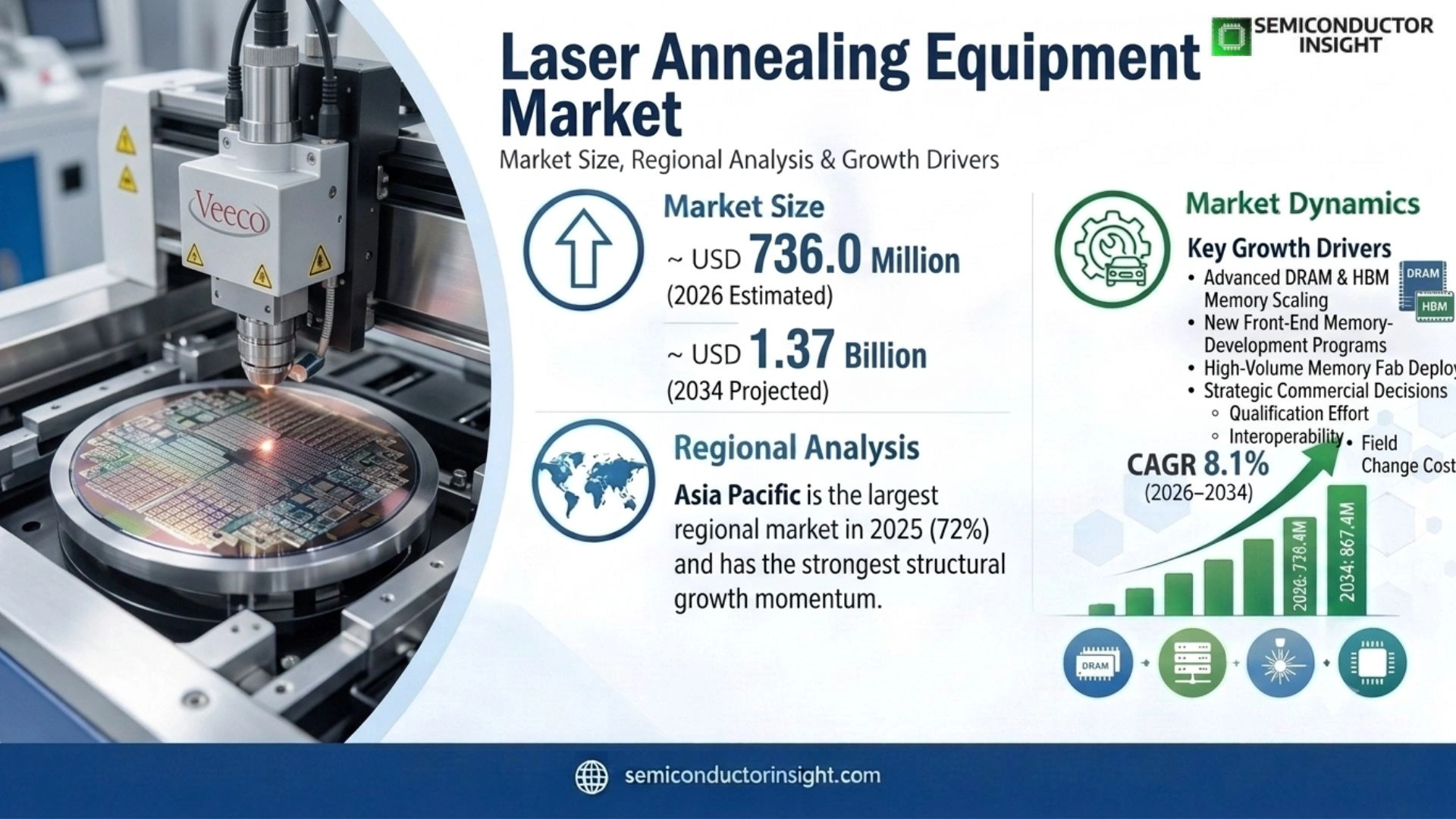
Laser Annealing Equipment was valued at USD 681.0 million in 2025 and is projected to reach USD 1.37 billion by 2034, representing a 8.1% CAGR during 2026–2034. The 2026 estimated market size is USD 736.0 million. Asia Pacific (72%) is the largest market in 2025, while Asia Pacific shows the strongest structural growth momentum.
Laser annealing equipment applies tightly controlled optical energy to semiconductor wafers or display substrates to modify material properties without heating the entire workpiece to the same temperature. In semiconductor manufacturing, the systems activate dopants, repair implantation damage, form contacts and control crystal structure. In display production, excimer laser annealing can crystallize thin-film layers for high-performance OLED backplanes. In laser annealing equipment, commercial decisions also depend on qualification effort, interoperability, long-term availability, engineering support and the cost of a field change after deployment. Suppliers that reduce those risks can protect design wins across multiple system generations, whereas vendors competing only on component price face a more difficult path into applications where revalidation or architecture changes create meaningful cost for the customer.
A production system combines a laser source, beam-shaping optics, motion or scanning stages, wafer handling, thermal and energy monitoring, chamber or atmospheric control and process software. Performance depends on energy uniformity, pulse duration, spot or line shape, overlap, temperature feedback and wafer throughput. Because the usable process window can be narrow, equipment qualification is tightly linked to the customer’s device structure and integration sequence.
Demand is created when conventional furnace or rapid-thermal processing cannot meet the local thermal budget required by a new device. Advanced logic, DRAM, image sensors and power semiconductors all introduce structures that can be damaged by excessive global heating. Laser annealing selectively delivers energy to the target region, allowing manufacturers to activate dopants or engineer materials while protecting previously formed layers.
Segment Analysis: By Type
By type, the laser annealing equipment is segmented into Power Laser Annealing Equipment, IC Front-end Laser Annealing Equipment. Power Laser Annealing Equipment is the leading segment, while IC Front-end Laser Annealing Equipment has the strongest growth momentum. The distinction reflects different performance, integration, manufacturing and qualification requirements across the published scope. In laser annealing equipment, commercial decisions also depend on qualification effort, interoperability, long-term availability, engineering support and the cost of a field change after deployment. Suppliers that reduce those risks can protect design wins across multiple system generations, whereas vendors competing only on component price face a more difficult path into applications where revalidation or architecture changes create meaningful cost for the customer.
| Type | Technical / purchasing role | Market position |
|---|---|---|
| Power Laser Annealing Equipment | These systems are optimized for power-device processes, including silicon and SiC structures where contact formation, dopant activation or defect engineering requires controlled local heating. The report page assigns the type a 58% share, reflecting the growing installed base of power-semiconductor manufacturing for vehicles, industrial drives and energy systems. | Largest type with 58% share. The commercial advantage is high-throughput localized processing for power devices, and vendors differentiate through beam uniformity, wafer handling, productivity and the ability to integrate with ion implantation and other front-end steps. |
| IC Front-end Laser Annealing Equipment | Front-end systems serve advanced logic, DRAM and other IC flows that require extremely low thermal budgets and precise activation after ion implantation. Gate-all-around structures and next-generation memory increase the penalty for unwanted diffusion, so nanosecond and laser-spike techniques can create process windows that conventional thermal tools cannot achieve. | Strongest growth theme. Veeco’s 2025 production-tool wins at gate-all-around logic customers and advanced DRAM evaluation activity show laser annealing moving deeper into leading-edge front-end manufacturing rather than remaining only a niche power-device process. |
Technology, integration level and process positioning
The source page also segments the market by Continuous Wave, Pulsed and Ultrafast Laser technologies and by Standalone Systems, Cluster Tools and In-line Production Systems. These choices directly affect throughput and integration economics. Pulsed or nanosecond approaches minimize thermal diffusion, while cluster or in-line configurations reduce wafer handling, contamination risk and queue time when laser annealing becomes a repeated production step rather than a laboratory treatment.
Segment Analysis: By Application
By application, the market is segmented into Power Semiconductor, Advanced Process Chip, Others. Power Semiconductor represents the most important demand pool, while Advanced Process Chip has the strongest structural momentum as customers adopt new architectures and raise performance, reliability or manufacturing requirements. In laser annealing equipment, commercial decisions also depend on qualification effort, interoperability, long-term availability, engineering support and the cost of a field change after deployment. Suppliers that reduce those risks can protect design wins across multiple system generations, whereas vendors competing only on component price face a more difficult path into applications where revalidation or architecture changes create meaningful cost for the customer.
| Application | Demand characteristics |
|---|---|
| Power Semiconductor | The report identifies power semiconductors as the largest application. Si and SiC devices require carefully controlled activation and contact processes to achieve low resistance and reliable switching performance. The automotive and energy transition increases wafer demand, while suppliers compete on throughput, energy uniformity and the ability to process materials that react differently from mainstream silicon logic. |
| Advanced Process Chip | Leading-edge logic and memory are the fastest-growing application theme because gate-all-around transistors, advanced DRAM and HBM manufacturing operate under tighter thermal budgets. Veeco announced 2025 production-tool selections for new gate-all-around applications and a later DRAM evaluation, demonstrating that precise laser thermal processing is moving into critical high-volume front-end steps. |
| Others | Image sensors, specialty semiconductors, research, display backplanes and emerging materials use laser annealing where localized crystallization or activation improves device performance without exposing the complete substrate to high temperature. These niches can be attractive because process recipes and optics are highly application-specific, supporting specialist equipment and service revenue beyond the largest wafer-fab segments. |
Regional Analysis
Asia Pacific (72%) leads the laser annealing equipment in 2025, while Asia Pacific has the strongest growth outlook. Regional demand differs because manufacturing concentration, infrastructure investment, standards adoption, local engineering ecosystems and customer qualification practices vary materially by geography. In laser annealing equipment, commercial decisions also depend on qualification effort, interoperability, long-term availability, engineering support and the cost of a field change after deployment. Suppliers that reduce those risks can protect design wins across multiple system generations, whereas vendors competing only on component price face a more difficult path into applications where revalidation or architecture changes create meaningful cost for the customer.
How does regional demand differ across the laser annealing equipment?
Asia Pacific dominates because it contains the largest concentration of logic, memory, foundry, power-semiconductor and display manufacturing. Japan also hosts major laser-annealing equipment suppliers. North America is a technology and advanced-logic market, Europe is particularly important in power semiconductors and specialized equipment, while South America and the Middle East & Africa remain small and project-driven. In laser annealing equipment, commercial decisions also depend on qualification effort, interoperability, long-term availability, engineering support and the cost of a field change after deployment. Suppliers that reduce those risks can protect design wins across multiple system generations, whereas vendors competing only on component price face a more difficult path into applications where revalidation or architecture changes create meaningful cost for the customer.
| Region | Position | Growth outlook | Demand profile | What decides supplier selection |
|---|---|---|---|---|
| Asia Pacific | Largest (72%) | Highest | Fab, power-semiconductor and display manufacturing led | Throughput, local service, process qualification and equipment uptime |
| North America | High-value technology market | Strong | Leading-edge logic, memory R&D and fab reshoring | Advanced-node process capability, uptime, data and service |
| Europe | Specialized stronghold | Strengthening | Power semiconductor, automotive and laser-equipment expertise | SiC process know-how, regional service, optics and qualification |
| South America | Small | Selective | Electronics and limited semiconductor activity | Cost, service access and fit for smaller production lines |
| Middle East & Africa | Early stage | Selective | Technology diversification and new fab ambitions | Project economics, supplier partnership and technical support |
Competitive Landscape
The market is led by companies that combine laser-source control, beam shaping, wafer handling and semiconductor process integration. The report page says Mitsui Group (JSW), Sumitomo Heavy Industries and SCREEN Semiconductor Solutions together hold more than 53% of the market, while Veeco, Applied Materials, Hitachi and a group of Asian specialists compete in advanced logic, power devices, displays and regional applications.
Japanese suppliers have a strong position because display excimer laser annealing and power-semiconductor processing developed alongside domestic precision-equipment capability. JSW sells multiple laser systems for displays, sensors and semiconductor activation, while Sumitomo has integrated laser annealing with ion implantation and acquired LASSE in France to strengthen power-semiconductor coverage and global service. In laser annealing equipment, commercial decisions also depend on qualification effort, interoperability, long-term availability, engineering support and the cost of a field change after deployment. Suppliers that reduce those risks can protect design wins across multiple system generations, whereas vendors competing only on component price face a more difficult path into applications where revalidation or architecture changes create meaningful cost for the customer.
Veeco competes strongly in leading-edge logic and memory through Laser Spike Annealing and Nanosecond Annealing. Its 2025 announcements are strategically important because they move laser annealing deeper into gate-all-around logic and advanced DRAM or HBM workflows, where qualification as a production tool of record can translate into recurring multi-system orders as customers ramp new nodes. In laser annealing equipment, commercial decisions also depend on qualification effort, interoperability, long-term availability, engineering support and the cost of a field change after deployment. Suppliers that reduce those risks can protect design wins across multiple system generations, whereas vendors competing only on component price face a more difficult path into applications where revalidation or architecture changes create meaningful cost for the customer.
Chinese and Korean equipment suppliers add cost and regional competition, especially where domestic fabs prefer local service or supply-chain security. The market therefore combines a small number of globally proven platforms with application-specific regional challengers, and buyers judge vendors on process results, uptime, wafer throughput and support responsiveness rather than laser specifications alone. In laser annealing equipment, commercial decisions also depend on qualification effort, interoperability, long-term availability, engineering support and the cost of a field change after deployment. Suppliers that reduce those risks can protect design wins across multiple system generations, whereas vendors competing only on component price face a more difficult path into applications where revalidation or architecture changes create meaningful cost for the customer.
Tier structure
| Competitive tier | Representative participants | How suppliers compete |
|---|---|---|
| Tier 1 global process-equipment leaders | Mitsui Group (JSW); Sumitomo Heavy Industries; SCREEN Semiconductor Solutions; Veeco | Compete on installed base, process-of-record wins, beam-control IP, high-volume productivity and global service capability. |
| Diversified semiconductor equipment suppliers | Applied Materials; Hitachi | Use broader fab relationships and adjacent process knowledge to compete where annealing must integrate with complete front-end process flows. |
| Regional & specialist challengers | YAC BEAM; EO Technics; Beijing U-PRECISION Tech; Shanghai Micro Electronics Equipment; Chengdu Laipu Technology; Hans DSI; ETA Semitech | Compete through specialized laser architectures, regional support, cost and targeted processes in semiconductors or displays. |
Key companies profiled
Companies profiled in the report include Mitsui Group (JSW); Sumitomo Heavy Industries; SCREEN Semiconductor Solutions; Veeco; Applied Materials; Hitachi; YAC BEAM; EO Technics; Beijing U-PRECISION Tech; Shanghai Micro Electronics Equipment; Chengdu Laipu Technology; Hans DSI; ETA Semitech. Competitive position varies by technical domain and customer qualification depth. Scale supports global availability, while specialist suppliers can retain strong positions where standards knowledge, process integration, low-power design, materials expertise or field support are more important than component price alone.
Production Capacity Analysis
Laser annealing equipment production is lower volume than mainstream semiconductor tools but technologically intensive. Capacity depends on high-power laser sources, precision optics, beam homogenization, motion stages, wafer-handling modules, controls and application engineering. Because each customer process can require a unique beam profile and thermal recipe, engineering and field-service capacity may constrain growth before factory floor space or generic machine assembly becomes the bottleneck.
Japan has a particularly strong supplier base. JSW produces excimer and semiconductor laser-processing systems, while Sumitomo Heavy Industries combines laser annealing with ion implantation and has expanded into Europe through LASSE. This concentration supports rapid engineering feedback from domestic power-semiconductor and display customers and provides a platform for exporting equipment to Asian and Western fabs. In laser annealing equipment, commercial decisions also depend on qualification effort, interoperability, long-term availability, engineering support and the cost of a field change after deployment. Suppliers that reduce those risks can protect design wins across multiple system generations, whereas vendors competing only on component price face a more difficult path into applications where revalidation or architecture changes create meaningful cost for the customer.
The United States is important in advanced logic and memory process development through Veeco and a large customer R&D ecosystem. Tool-of-record status is strategically valuable because once an annealing step is integrated into a node, the supplier can participate in each fab ramp. The effective production constraint then becomes the vendor’s ability to build, install, qualify and service multiple systems on schedule.
Optics and laser subsystems are critical upstream inputs. Beam uniformity, pulse stability and long-term component life directly influence wafer yield, so equipment makers need qualified suppliers and spare-parts strategies. Export restrictions affecting high-performance optics or semiconductor equipment can therefore disrupt deliveries even when the mechanical platform itself is available. In laser annealing equipment, commercial decisions also depend on qualification effort, interoperability, long-term availability, engineering support and the cost of a field change after deployment. Suppliers that reduce those risks can protect design wins across multiple system generations, whereas vendors competing only on component price face a more difficult path into applications where revalidation or architecture changes create meaningful cost for the customer.
Laser Annealing Equipment Market Dynamics: Drivers, Restraints and Opportunities
Laser annealing demand rises when semiconductor structures become less tolerant of the thermal budget imposed by conventional processes. Gate-all-around logic, advanced DRAM, power semiconductors and OLED displays all create localized thermal-processing needs, but the market remains constrained by high capital cost, long process qualification and the need for skilled application engineers. Vendors win by becoming part of the customer’s process recipe, not by selling a generic laser machine.
MARKET DRIVERS
Drivers Impact Analysis*
| Factor | Relative impact* | Commercial mechanism |
|---|---|---|
| Advanced-node low thermal budgets | High | GAA logic and advanced memory need precise activation without damaging completed structures. |
| Power semiconductor & SiC expansion | High | EV and energy applications increase demand for specialized annealing in power-device flows. |
| Display & OLED investment | Medium-High | Excimer laser annealing remains important for high-performance display backplanes. |
| Fab expansion & localization | Medium | New semiconductor plants create opportunities for full front-end equipment sets and local service. |
Gate-all-around logic increases the value of localized annealing
Advanced transistor structures use smaller dimensions and tighter material stacks, making unwanted diffusion or thermal damage more costly. Veeco’s 2025 production-tool wins at gate-all-around customers show that precise laser annealing can become a critical front-end step rather than a niche process. As nodes ramp, each qualified recipe can support multiple systems across high-volume fabs. In laser annealing equipment, commercial decisions also depend on qualification effort, interoperability, long-term availability, engineering support and the cost of a field change after deployment. Suppliers that reduce those risks can protect design wins across multiple system generations, whereas vendors competing only on component price face a more difficult path into applications where revalidation or architecture changes create meaningful cost for the customer.
Power semiconductors create a durable equipment demand stream
EVs, industrial drives, renewable energy and data-center power systems increase demand for Si and SiC devices. Laser annealing can support activation and low-resistance contact formation while limiting thermal exposure to the rest of the wafer. Equipment suppliers with strong power-device recipes and high throughput can therefore benefit from both fab expansion and process-intensity gains. In laser annealing equipment, commercial decisions also depend on qualification effort, interoperability, long-term availability, engineering support and the cost of a field change after deployment. Suppliers that reduce those risks can protect design wins across multiple system generations, whereas vendors competing only on component price face a more difficult path into applications where revalidation or architecture changes create meaningful cost for the customer.
Advanced DRAM and HBM open new front-end applications
Veeco’s December 2025 DRAM evaluation announcement shows laser spike annealing entering memory-development programs aimed at next-generation DRAM and HBM. Memory scaling requires precise junction and material control, and successful qualification can create a substantial new market because high-volume memory fabs deploy many repeated process tools once a technology is adopted. In laser annealing equipment, commercial decisions also depend on qualification effort, interoperability, long-term availability, engineering support and the cost of a field change after deployment. Suppliers that reduce those risks can protect design wins across multiple system generations, whereas vendors competing only on component price face a more difficult path into applications where revalidation or architecture changes create meaningful cost for the customer.
OLED and display manufacturing sustain excimer demand
Excimer laser annealing is used to crystallize thin-film transistor layers for advanced displays. JSW continues to invest in eighth-generation ELA systems and Coherent reported shipment of an ELA system for a next-generation OLED facility in fiscal 2025. Display investment therefore remains an adjacent source of demand alongside semiconductor wafer processing. In laser annealing equipment, commercial decisions also depend on qualification effort, interoperability, long-term availability, engineering support and the cost of a field change after deployment. Suppliers that reduce those risks can protect design wins across multiple system generations, whereas vendors competing only on component price face a more difficult path into applications where revalidation or architecture changes create meaningful cost for the customer.
MARKET RESTRAINTS
Restraints Impact Analysis*
| Factor | Relative impact* | Commercial mechanism |
|---|---|---|
| High capital and qualification cost | High | Customers must justify expensive tools and lengthy process-of-record evaluation. |
| Specialized optics and service | Medium-High | Laser sources, beam shaping and calibration create maintenance and supplier dependence. |
| Export controls and geopolitics | Medium | Restrictions can affect high-end optics, components and equipment deliveries across regions. |
| Skilled process-engineering requirements | Medium | Successful adoption depends on recipe development, metrology and trained fab personnel. |
Equipment economics must beat established thermal processes
Laser systems can deliver unique process windows, but fabs will not replace a lower-cost furnace or rapid-thermal step unless yield, device performance or thermal-budget advantages justify the capital and qualification burden. Suppliers therefore need device-level evidence and throughput performance rather than a generic claim of precision heating, especially in mature-node production where existing equipment is fully depreciated. In laser annealing equipment, commercial decisions also depend on qualification effort, interoperability, long-term availability, engineering support and the cost of a field change after deployment. Suppliers that reduce those risks can protect design wins across multiple system generations, whereas vendors competing only on component price face a more difficult path into applications where revalidation or architecture changes create meaningful cost for the customer.
Process-of-record qualification is slow and application-specific
A laser recipe is closely tied to implant dose, material stack, device geometry and downstream process conditions. Tool evaluation can therefore run for many months before a customer commits to high-volume production. This makes sales cycles long and concentrates commercial success among vendors with enough balance-sheet strength to support extended demonstrations and application engineering. In laser annealing equipment, commercial decisions also depend on qualification effort, interoperability, long-term availability, engineering support and the cost of a field change after deployment. Suppliers that reduce those risks can protect design wins across multiple system generations, whereas vendors competing only on component price face a more difficult path into applications where revalidation or architecture changes create meaningful cost for the customer.
Optics, lasers and calibration create service intensity
Beam quality can drift as laser sources and optical components age, while contamination or alignment errors can change energy uniformity across the wafer. Customers need preventive maintenance, calibration and rapid replacement parts because a process excursion directly threatens yield. Suppliers without local service infrastructure face a disadvantage even if the base equipment is competitively priced. In laser annealing equipment, commercial decisions also depend on qualification effort, interoperability, long-term availability, engineering support and the cost of a field change after deployment. Suppliers that reduce those risks can protect design wins across multiple system generations, whereas vendors competing only on component price face a more difficult path into applications where revalidation or architecture changes create meaningful cost for the customer.
Trade restrictions can fragment equipment access
Semiconductor manufacturing equipment is increasingly subject to export controls and regional technology policies. Laser annealing platforms may incorporate precision optics, lasers and control subsystems that cross multiple jurisdictions. Vendors must manage licenses, customer screening and local support structures, which can slow shipment and reduce the addressable market for the most advanced configurations. In laser annealing equipment, commercial decisions also depend on qualification effort, interoperability, long-term availability, engineering support and the cost of a field change after deployment. Suppliers that reduce those risks can protect design wins across multiple system generations, whereas vendors competing only on component price face a more difficult path into applications where revalidation or architecture changes create meaningful cost for the customer.
MARKET OPPORTUNITIES
Next-generation DRAM and HBM
The advanced-memory evaluation announced by Veeco creates a potentially large new production segment if laser annealing becomes part of mainstream DRAM and HBM process flows. Memory fabs operate at high wafer volumes, so one successful process-of-record conversion can translate into repeated tool orders, service revenue and a durable installed base across multiple technology generations. In laser annealing equipment, commercial decisions also depend on qualification effort, interoperability, long-term availability, engineering support and the cost of a field change after deployment. Suppliers that reduce those risks can protect design wins across multiple system generations, whereas vendors competing only on component price face a more difficult path into applications where revalidation or architecture changes create meaningful cost for the customer.
SiC and wide-bandgap power devices
SiC devices require demanding activation and contact processes and are expanding in electric vehicles, industrial power and energy infrastructure. Laser annealing can help localize thermal treatment and improve productivity, giving equipment vendors an opportunity to build dedicated high-throughput platforms and combine them with implantation or other power-semiconductor process tools. In laser annealing equipment, commercial decisions also depend on qualification effort, interoperability, long-term availability, engineering support and the cost of a field change after deployment. Suppliers that reduce those risks can protect design wins across multiple system generations, whereas vendors competing only on component price face a more difficult path into applications where revalidation or architecture changes create meaningful cost for the customer.
Hybrid tool configurations and cluster integration
Cluster tools and in-line systems can reduce wafer handling, contamination risk and cycle time by connecting annealing with adjacent front-end processes. Vendors that integrate automation, metrology and recipe control can increase the value per installation and make laser annealing easier to adopt as a repeatable manufacturing module rather than a stand-alone specialty step. In laser annealing equipment, commercial decisions also depend on qualification effort, interoperability, long-term availability, engineering support and the cost of a field change after deployment. Suppliers that reduce those risks can protect design wins across multiple system generations, whereas vendors competing only on component price face a more difficult path into applications where revalidation or architecture changes create meaningful cost for the customer.
Large-area display and advanced substrate processing
Eighth-generation OLED and future display lines create demand for larger-area excimer annealing with high uniformity and throughput. The same beam-control knowledge can be adapted to sensors, thin films and emerging substrates, allowing established display-equipment suppliers to diversify beyond one semiconductor application and spread R&D across multiple laser-processing markets. In laser annealing equipment, commercial decisions also depend on qualification effort, interoperability, long-term availability, engineering support and the cost of a field change after deployment. Suppliers that reduce those risks can protect design wins across multiple system generations, whereas vendors competing only on component price face a more difficult path into applications where revalidation or architecture changes create meaningful cost for the customer.
Laser Annealing Equipment Supply Chain Analysis
Laser sources & precision optics
Upstream component quality sets the process ceiling because pulse stability, wavelength, beam uniformity and optical lifetime directly affect wafer results. Equipment makers need qualified laser and optics suppliers plus replacement strategies that keep field systems calibrated without excessive downtime. In laser annealing equipment, commercial decisions also depend on qualification effort, interoperability, long-term availability, engineering support and the cost of a field change after deployment. Suppliers that reduce those risks can protect design wins across multiple system generations, whereas vendors competing only on component price face a more difficult path into applications where revalidation or architecture changes create meaningful cost for the customer.
Equipment integration & controls
System engineering converts a laser into semiconductor production equipment. Throughput, wafer-to-wafer repeatability, automation and recipe management determine whether a platform can operate in high-volume fabs, while modular design can reduce service time and simplify upgrades as process requirements change. In laser annealing equipment, commercial decisions also depend on qualification effort, interoperability, long-term availability, engineering support and the cost of a field change after deployment. Suppliers that reduce those risks can protect design wins across multiple system generations, whereas vendors competing only on component price face a more difficult path into applications where revalidation or architecture changes create meaningful cost for the customer.
Process development & qualification
This stage creates much of the vendor lock-in because the process window is tuned to a specific device architecture. Tool-of-record qualification can take many months but creates a durable position once the recipe becomes part of a production node and the fab builds matching metrology and maintenance procedures around the platform. In laser annealing equipment, commercial decisions also depend on qualification effort, interoperability, long-term availability, engineering support and the cost of a field change after deployment. Suppliers that reduce those risks can protect design wins across multiple system generations, whereas vendors competing only on component price face a more difficult path into applications where revalidation or architecture changes create meaningful cost for the customer.
Fab deployment & lifecycle service
Service capacity is economically important because laser and optical systems require ongoing calibration and parts replacement. Vendors with local engineers and spares can protect customer uptime, generate recurring revenue and defend future tool orders when the fab expands or migrates the process to a new product generation. In laser annealing equipment, commercial decisions also depend on qualification effort, interoperability, long-term availability, engineering support and the cost of a field change after deployment. Suppliers that reduce those risks can protect design wins across multiple system generations, whereas vendors competing only on component price face a more difficult path into applications where revalidation or architecture changes create meaningful cost for the customer.
Recent Developments in the Laser Annealing Equipment Market
Recent announcements show laser annealing expanding in three directions at once: advanced gate-all-around logic, next-generation DRAM and HBM, and power semiconductors. Veeco is winning front-end logic and memory evaluations, while Sumitomo is consolidating and globalizing its laser and ion-implantation businesses. These moves indicate that process integration and global service are becoming as important as the laser source itself.
Sumitomo announced trade-name changes for two group companies to unify its semiconductor business after integrating laser annealing with ion implantation and acquiring LASSE. The restructuring signals a strategy to offer broader semiconductor process capability and support customers globally rather than operating laser annealing as a stand-alone niche product. In laser annealing equipment, commercial decisions also depend on qualification effort, interoperability, long-term availability, engineering support and the cost of a field change after deployment. Suppliers that reduce those risks can protect design wins across multiple system generations, whereas vendors competing only on component price face a more difficult path into applications where revalidation or architecture changes create meaningful cost for the customer.
Veeco said a leading memory company selected its laser spike annealing system for advanced DRAM R&D, with an evaluation period expected to last around one year and follow-on orders anticipated from 2027. The program could open a significant new memory-production use case if the technology moves into high-volume manufacturing. In laser annealing equipment, commercial decisions also depend on qualification effort, interoperability, long-term availability, engineering support and the cost of a field change after deployment. Suppliers that reduce those risks can protect design wins across multiple system generations, whereas vendors competing only on component price face a more difficult path into applications where revalidation or architecture changes create meaningful cost for the customer.
Two leading-edge logic customers selected Veeco’s Laser Spike Annealing platform as Production Tool of Record for new gate-all-around applications. Veeco expects high-volume manufacturing orders as the nodes ramp, providing direct evidence that laser annealing is becoming embedded in advanced logic production. In laser annealing equipment, commercial decisions also depend on qualification effort, interoperability, long-term availability, engineering support and the cost of a field change after deployment. Suppliers that reduce those risks can protect design wins across multiple system generations, whereas vendors competing only on component price face a more difficult path into applications where revalidation or architecture changes create meaningful cost for the customer.
Sumitomo Heavy Industries completed the acquisition of Laser Systems & Solutions of Europe, a French supplier of laser annealing equipment for semiconductor manufacturing. The company linked the acquisition to power-semiconductor growth and said it would combine customer networks and R&D to expand globally. In laser annealing equipment, commercial decisions also depend on qualification effort, interoperability, long-term availability, engineering support and the cost of a field change after deployment. Suppliers that reduce those risks can protect design wins across multiple system generations, whereas vendors competing only on component price face a more difficult path into applications where revalidation or architecture changes create meaningful cost for the customer.
REPORT SCOPE & SEGMENTATION
The report scope covers the laser annealing equipment across its published type, application and additional segmentation axes, with regional analysis spanning North America, Europe, Asia Pacific, South America, and the Middle East & Africa. It profiles the companies listed below and standardizes the market series to a 2025 base year, 2026 estimated year and 2034 forecast endpoint. In laser annealing equipment, commercial decisions also depend on qualification effort, interoperability, long-term availability, engineering support and the cost of a field change after deployment. Suppliers that reduce those risks can protect design wins across multiple system generations, whereas vendors competing only on component price face a more difficult path into applications where revalidation or architecture changes create meaningful cost for the customer.
| Report attribute | Coverage |
|---|---|
| Market | Laser Annealing Equipment |
| Base year | 2025 |
| Estimated year | 2026 |
| Forecast period | 2026–2034 |
| 2025 market size | USD 681.0 million |
| 2034 forecast size | USD 1.37 billion |
| CAGR | 8.1% during 2026–2034 |
| Largest market in 2025 | Asia Pacific (72%) |
| By Type | Power Laser Annealing Equipment; IC Front-end Laser Annealing Equipment |
| By Application | Power Semiconductor; Advanced Process Chip; Others |
| Additional segmentation | By End User: IDM; Foundries; Research Institutes. By Technology: Continuous Wave (CW) Laser; Pulsed Laser; Ultrafast Laser. By Integration Level: Standalone Systems; Cluster Tools; In-line Production Systems. |
| Regions | North America; Europe; Asia Pacific; South America; Middle East & Africa |
| Companies profiled | Mitsui Group (JSW); Sumitomo Heavy Industries; SCREEN Semiconductor Solutions; Veeco; Applied Materials; Hitachi; YAC BEAM; EO Technics; Beijing U-PRECISION Tech; Shanghai Micro Electronics Equipment; Chengdu Laipu Technology; Hans DSI; ETA Semitech |
Frequently Asked Questions
What is the laser annealing equipment size in 2025?
The global laser annealing equipment is valued at USD 681.0 million in 2025. This base-year value is used consistently with the 2034 endpoint of USD 1.37 billion and the 8.1% CAGR for 2026–2034. The figure provides the common reference point for comparing segment, regional and competitive conditions throughout the overview. In laser annealing equipment, commercial decisions also depend on qualification effort, interoperability, long-term availability, engineering support and the cost of a field change after deployment. Suppliers that reduce those risks can protect design wins across multiple system generations, whereas vendors competing only on component price face a more difficult path into applications where revalidation or architecture changes create meaningful cost for the customer.
What is the projected laser annealing equipment size by 2034?
The global laser annealing equipment is projected to reach USD 1.37 billion by 2034. Growth is supported by advanced-node thermal-budget limits, SiC and power-semiconductor growth, memory scaling, OLED and display manufacturing, fab expansion and demand for precise localized heat treatment, while adoption rates still depend on system qualification, standards, manufacturing availability and total deployment cost across the end markets addressed in the published report scope.
What CAGR is expected for the laser annealing equipment during 2026–2034?
The standardized market series corresponds to a 8.1% CAGR during 2026–2034. That rate is derived from the report page market-size anchors rather than copied from a conflicting printed percentage, which keeps the 2025, 2026 and 2034 values mathematically consistent across the article and workbook. In laser annealing equipment, commercial decisions also depend on qualification effort, interoperability, long-term availability, engineering support and the cost of a field change after deployment. Suppliers that reduce those risks can protect design wins across multiple system generations, whereas vendors competing only on component price face a more difficult path into applications where revalidation or architecture changes create meaningful cost for the customer.
Which region is the largest laser annealing equipment market in 2025?
Asia Pacific (72%) is treated as the largest market in 2025 based on the published regional evidence and the underlying concentration of relevant production, deployment or customer activity. Regional leadership matters because engineering support, qualification channels, logistics and manufacturing proximity influence supplier selection alongside the product specification itself. In laser annealing equipment, commercial decisions also depend on qualification effort, interoperability, long-term availability, engineering support and the cost of a field change after deployment. Suppliers that reduce those risks can protect design wins across multiple system generations, whereas vendors competing only on component price face a more difficult path into applications where revalidation or architecture changes create meaningful cost for the customer.
Which product type leads the laser annealing equipment?
Power Laser Annealing Equipment is the leading type identified in the market structure. Its position reflects the installed base, performance-to-cost balance and broad application fit, while IC Front-end Laser Annealing Equipment represents the strongest technology-growth theme where newer architectures demand greater bandwidth, integration density, process control or system efficiency. In laser annealing equipment, commercial decisions also depend on qualification effort, interoperability, long-term availability, engineering support and the cost of a field change after deployment. Suppliers that reduce those risks can protect design wins across multiple system generations, whereas vendors competing only on component price face a more difficult path into applications where revalidation or architecture changes create meaningful cost for the customer.
Which application is most important in the laser annealing equipment?
Power Semiconductor is the principal application in the published segmentation. Purchasing is driven by ion-implant activation, contact formation and defect repair must be performed with high local temperature while protecting surrounding structures, making laser thermal processing valuable in SiC and advanced power-device flows. Suppliers gain the strongest position when their products shorten qualification, improve system reliability or enable a performance target that cannot be met economically with an older architecture.
What is the fastest-growing area of the laser annealing equipment?
Advanced Process Chip and IC Front-end Laser Annealing Equipment represent the clearest high-growth themes. Their momentum reflects advanced nodes use increasingly delicate structures and low thermal budgets, and Veeco has reported production-tool selections for gate-all-around logic plus evaluation activity in advanced DRAM and HBM. Growth is therefore concentrated where customers are willing to adopt new architectures because the performance, density, efficiency or manufacturing benefit outweighs qualification and switching costs.
What are the main growth drivers for the laser annealing equipment?
The main drivers are advanced-node thermal-budget limits, SiC and power-semiconductor growth, memory scaling, OLED and display manufacturing, fab expansion and demand for precise localized heat treatment. These forces increase either the number of systems deployed or the technical content required per system, creating more value for qualified suppliers. The commercial upside is strongest where a vendor can convert a one-time technology transition into a repeatable platform across multiple customer programs.
What are the main restraints on the laser annealing equipment?
The main restraints are high equipment cost, long fab qualification, specialized optics and service requirements, export restrictions, process integration complexity and the need for highly trained operators. These constraints can lengthen design cycles, raise capital needs, reduce the number of qualified suppliers and make buyers reluctant to change a working solution. Strong quality systems, standards compliance, documentation and predictable lifecycle support therefore remain central competitive requirements.
Which companies are profiled in the laser annealing equipment?
The report profiles Mitsui Group (JSW); Sumitomo Heavy Industries; SCREEN Semiconductor Solutions; Veeco; Applied Materials; Hitachi; YAC BEAM; EO Technics; Beijing U-PRECISION Tech; Shanghai Micro Electronics Equipment; Chengdu Laipu Technology; Hans DSI; ETA Semitech. The competitive set combines large platform vendors and specialist participants, so market position depends on more than scale. Product breadth, process knowledge, standards participation, local support and the ability to maintain qualified supply can all determine whether a vendor retains a design win.
Research Sources & Evidence Base
Get Sample Report PDF for Exclusive Insights
Report Sample Includes
- Table of Contents
- List of Tables & Figures
- Charts, Research Methodology, and more...
 Download Sample Report PDF