Key Statistics
Key Takeaways
- Market size: The market is valued at USD 131.29 million in 2025 and is projected to reach USD 229.37 million by 2034, representing a 6.4% CAGR during 2026–2034.
- Single-row terminal blocks remain the largest type because conventional industrial control panels and power-distribution cabinets use high volumes of standard feed-through connections.
- Industrial applications are the largest demand segment, supported by factory automation, machine building, infrastructure and process industries across India.
- Push-in and Push-X technologies are gaining share because they reduce wiring time and support tool-free or low-force conductor insertion for manual and automated panel assembly.
- Domestic production and approved local suppliers improve supply resilience, with Phoenix Contact and WAGO both maintaining manufacturing or operating footprints in India.
India Terminal Block Connector Market Overview
India terminal block connector market is valued at USD 131.29 million in 2025 and is projected to reach USD 229.37 million by 2034, expanding at a 6.4% CAGR during 2026–2034. The 2026 market level is USD 139.69 million. India is the full geographic market, with strongest demand concentrated in western and southern industrial corridors. Growth is supported by factory automation, electrical infrastructure, renewable energy, transport projects and domestic electronics manufacturing.
Terminal block connectors are insulated modular devices used to terminate and distribute electrical conductors in control panels, machines, power systems and electronic assemblies. Products include DIN-rail feed-through blocks, multi-level connectors, PCB terminal blocks and pluggable designs. Selection depends on conductor size, current and voltage rating, mounting method, connection technology, safety approvals and the need for compact wiring density.
Indian users are moving from traditional screw terminals toward push-in, spring-cage and Push-X technologies that reduce installation time and maintenance. Phoenix Contact’s India portfolio includes new Push-X families covering a wide conductor range, while WAGO supplies Push-in CAGE CLAMP products for DIN-rail and PCB applications. These connection systems support faster panel building and are increasingly suitable for automated wiring.
The market combines global suppliers with domestic specialists such as Connectwell. Buyers value local inventory, technical support, certification and wide product range because one control panel can require many terminal types. Price competition remains important, but labor savings from tool-less wiring and compact multi-level designs can justify premium products in automation-intensive projects.
Segment Analysis: By Type
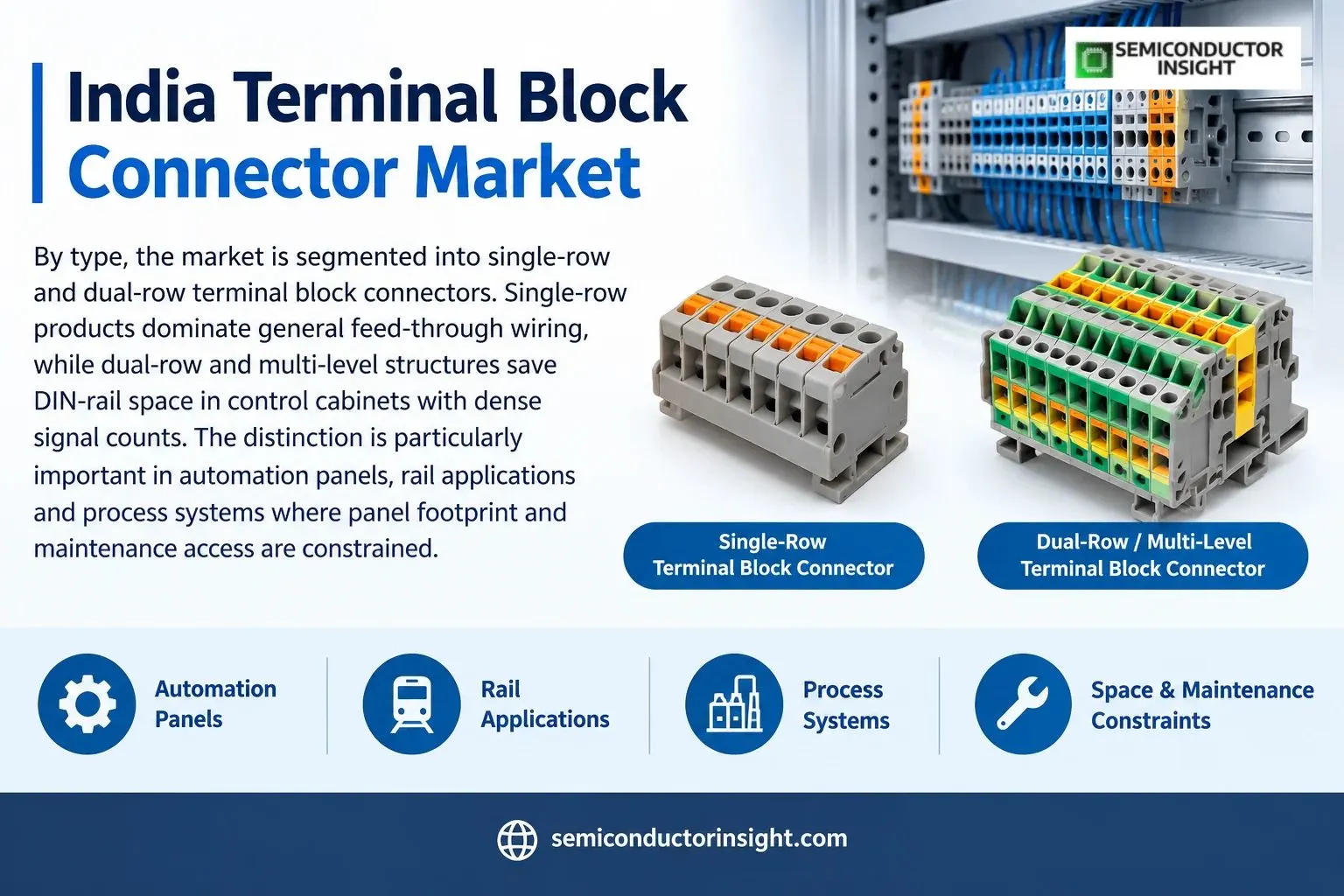
By type, the market is segmented into single-row and dual-row terminal block connectors. Single-row products dominate general feed-through wiring, while dual-row and multi-level structures save DIN-rail space in control cabinets with dense signal counts. The distinction is particularly important in automation panels, rail applications and process systems where panel footprint and maintenance access are constrained.
| Type | Commercial role |
|---|---|
| Single Row | Standard feed-through and functional terminal blocks for broad industrial wiring. |
| Dual Row | Higher-density multi-level arrangements that reduce cabinet footprint. |
Additional Segmentation: By Connection Technology
Connection technology is shifting from conventional screw clamping toward push-in and spring-based systems. Screw terminals remain widely installed and familiar to electricians, while push-in and Push-X designs reduce tool use and wiring time. Spring-cage designs maintain contact force under vibration and thermal cycling, making them attractive in transport and automation applications.
| Connection Technology | Demand characteristics |
|---|---|
| Screw | Traditional clamping technology with broad installed base and high current capability. |
| Push-In | Direct insertion of rigid or ferruled conductors for faster panel assembly. |
| Spring-Cage / Push-X | Spring-based tool-free or low-force wiring optimized for speed and vibration resistance. |
Segment Analysis: By Application
By application, industrial use is the largest segment, followed by power management and other electrical or electronic applications. Factory automation, machine tools, process equipment and rail systems use terminal blocks for organized control wiring, while power applications require higher current and voltage ratings. Other demand comes from building automation, telecom and equipment manufacturing.
| Application | Demand characteristics |
|---|---|
| Industrial | Machine control, PLC panels, process automation and manufacturing equipment. |
| Power Management | Distribution, renewable energy, substations and electrical control panels. |
| Others | Rail, buildings, telecom, electronics and specialized equipment. |
Additional Segmentation: By Mounting Style
DIN-rail mounting dominates industrial control cabinets, while PCB terminal blocks connect external wiring directly to electronic boards and pluggable or panel-mounted formats support modular equipment. Mounting style affects current rating, serviceability and automation potential, so suppliers increasingly offer common connection technology across several mechanical formats. For commercial decisions in the India Terminal Block Connector market, buyers also weigh qualification evidence, integration effort, operating reliability, lifecycle support, supply continuity and measurable system-level value rather than a single specification.
| Mounting Style | Commercial relevance |
|---|---|
| DIN-Rail | Primary industrial control-panel format with modular accessories and marking. |
| PCB-Mount | Direct conductor connection to control and power electronics boards. |
| Panel / Pluggable | Modular removable wiring interfaces for equipment and distributed control. |
Regional Analysis
Because this is a national India market, demand is best viewed by industrial cluster rather than global region. Western and southern India contain major automotive, engineering, electronics and process-industry hubs, while northern and central regions benefit from manufacturing corridors and infrastructure investment. Eastern India is more focused on utilities, metals and process industries.
Why does regional demand differ across the India Terminal Block Connector market?
Regional differences within India reflect manufacturing density, industrial corridors and infrastructure projects. Maharashtra, Gujarat, Karnataka, Tamil Nadu, NCR and Telangana are important demand centers for control-panel and machine-building applications. Suppliers with local warehouses, distributors and application engineers can convert national product portfolios into faster project execution. For commercial decisions in the India Terminal Block Connector market, buyers also weigh qualification evidence, integration effort, operating reliability, lifecycle support, supply continuity and measurable system-level value rather than a single specification.
| Region | Position | Demand profile | Supplier-selection factor |
|---|---|---|---|
| West India | Leading cluster | Automotive, process, machinery | Dense industrial base |
| South India | High growth | Electronics, automotive, machinery | Manufacturing expansion |
| North India | Major | Infrastructure, industrial, rail | NCR and corridor investment |
| East India | Selective | Metals, utilities, process | Heavy-industry demand |
| Central India | Emerging | Manufacturing, power | Industrial corridor growth |
Competitive Landscape
Phoenix Contact India, WAGO, Connectwell, ABB India, Weidmüller, Schneider Electric, Hager, Legrand and Havells participate across different terminal-block and connector categories. Global suppliers compete on product breadth, certification and advanced connection technology, while domestic manufacturers compete on cost, availability and application-specific customization. For commercial decisions in the India Terminal Block Connector market, buyers also weigh qualification evidence, integration effort, operating reliability, lifecycle support, supply continuity and measurable system-level value rather than a single specification.
Phoenix Contact’s Push-X technology and WAGO’s Push-in CAGE CLAMP illustrate the move toward faster tool-free wiring. These products target manual and automated panel assembly by reducing insertion force and improving visual or acoustic confirmation of a secure connection. The benefit is strongest where labor and panel density matter. For commercial decisions in the India Terminal Block Connector market, buyers also weigh qualification evidence, integration effort, operating reliability, lifecycle support, supply continuity and measurable system-level value rather than a single specification.
Local manufacturing and approvals matter because infrastructure and rail projects require documented compliance and dependable supply. Indian customers often source complete terminal-block ecosystems including markers, jumpers, fuse terminals and test accessories, so installed platform breadth can be more important than the price of an individual block. For commercial decisions in the India Terminal Block Connector market, buyers also weigh qualification evidence, integration effort, operating reliability, lifecycle support, supply continuity and measurable system-level value rather than a single specification.
| Competitive tier | Representative companies | Primary differentiation |
|---|---|---|
| Global connection-technology leaders | Phoenix Contact, WAGO, Weidmüller | Advanced push-in systems, broad portfolios and industrial certification. |
| Large electrical-equipment suppliers | ABB, Schneider Electric, Hager, Legrand | Distribution channels and integration with broader electrical portfolios. |
| Domestic / regional specialists | Connectwell and Indian manufacturers | Local production, competitive cost and application customization. |
Key companies profiled
Phoenix Contact India, WAGO Private Limited, Connectwell Industries, Hager, ABB India, Legrand India, Weidmüller India, Schneider Electric Infrastructure and Havells are included in the competitive scope. Their positions differ by connection technology, product breadth, current rating, local production and distributor reach. For commercial decisions in the India Terminal Block Connector market, buyers also weigh qualification evidence, integration effort, operating reliability, lifecycle support, supply continuity and measurable system-level value rather than a single specification.
Production Capacity Analysis
Terminal-block manufacturing uses copper alloys, steel springs, conductive bars, engineering plastics, stamping, machining, injection molding and automated assembly. Local production improves responsiveness because product variants differ by color, connection count, current rating, fuse or disconnect function and marking requirements. For commercial decisions in the India Terminal Block Connector market, buyers also weigh qualification evidence, integration effort, operating reliability, lifecycle support, supply continuity and measurable system-level value rather than a single specification.
India has meaningful local manufacturing capability. Railway vendor documentation identifies approved Phoenix Contact and WAGO facilities and capacities for specific terminal-block products, while domestic manufacturers such as Connectwell add local supply. Capacity expansion increasingly focuses on automated assembly and advanced spring-contact technologies rather than only conventional screw terminals. For commercial decisions in the India Terminal Block Connector market, buyers also weigh qualification evidence, integration effort, operating reliability, lifecycle support, supply continuity and measurable system-level value rather than a single specification.
Market Dynamics
Growth is supported by industrial automation, infrastructure, renewable energy, rail and electronics manufacturing. Faster wiring technologies create premium opportunities, while price sensitivity and fragmented specifications restrain standardization. Local production, compact multi-level designs and automated panel-building compatibility are the strongest strategic opportunities. For commercial decisions in the India Terminal Block Connector market, buyers also weigh qualification evidence, integration effort, operating reliability, lifecycle support, supply continuity and measurable system-level value rather than a single specification.
Market Drivers
| Driver | Impact | Commercial mechanism |
|---|---|---|
| Industrial automation | High | More control panels and machines require reliable field wiring. |
| Infrastructure investment | High | Rail, power, water and smart infrastructure need standardized wiring. |
| Electronics manufacturing | Medium-High | Local equipment and PCB production increase connector demand. |
| Faster wiring technology | Medium | Push-in and Push-X reduce labor and assembly time. |
Industrial automation
Factories adding PLCs, drives, sensors and distributed I/O need more termination points. Terminal blocks provide organized, serviceable connections and remain essential even as control systems become more digital. For commercial decisions in the India Terminal Block Connector market, buyers also weigh qualification evidence, integration effort, operating reliability, lifecycle support, supply continuity and measurable system-level value rather than a single specification.
Infrastructure investment
Large infrastructure projects use extensive control and protection panels. Reliable terminal blocks simplify commissioning and maintenance and can be specified through approved vendor lists. For commercial decisions in the India Terminal Block Connector market, buyers also weigh qualification evidence, integration effort, operating reliability, lifecycle support, supply continuity and measurable system-level value rather than a single specification.
Electronics manufacturing
Growth in electronics, EV and industrial equipment manufacturing creates demand for PCB, pluggable and compact DIN-rail connectors close to the production base. For commercial decisions in the India Terminal Block Connector market, buyers also weigh qualification evidence, integration effort, operating reliability, lifecycle support, supply continuity and measurable system-level value rather than a single specification.
Faster wiring technology
Tool-free conductor insertion can materially reduce panel-building labor, especially for high connection counts. This supports premium adoption despite higher unit prices than basic screw terminals. For commercial decisions in the India Terminal Block Connector market, buyers also weigh qualification evidence, integration effort, operating reliability, lifecycle support, supply continuity and measurable system-level value rather than a single specification.
Market Restraints
| Restraint | Impact | Commercial consequence |
|---|---|---|
| Price sensitivity | High | Standard terminal blocks face strong commodity competition. |
| Fragmented specifications | Medium-High | Projects require many ratings, accessories and form factors. |
| Copper and polymer costs | Medium | Raw-material changes affect margins. |
| Channel dependence | Medium | Many buyers rely on distributors for stock and technical support. |
Price sensitivity
Many general-purpose products are easy to compare by current rating and size. Customers can shift among domestic and imported suppliers when advanced connection technology does not create enough labor savings. For commercial decisions in the India Terminal Block Connector market, buyers also weigh qualification evidence, integration effort, operating reliability, lifecycle support, supply continuity and measurable system-level value rather than a single specification.
Fragmented specifications
Panel builders may need hundreds of part numbers across feed-through, fuse, disconnect, multi-level and ground terminals. Managing inventory and substitutes adds supply-chain complexity. For commercial decisions in the India Terminal Block Connector market, buyers also weigh qualification evidence, integration effort, operating reliability, lifecycle support, supply continuity and measurable system-level value rather than a single specification.
Copper and polymer costs
Conductive metals and engineering plastics are major input costs. Suppliers must balance price stability with high-volume customer expectations and distributor inventory. For commercial decisions in the India Terminal Block Connector market, buyers also weigh qualification evidence, integration effort, operating reliability, lifecycle support, supply continuity and measurable system-level value rather than a single specification.
Channel dependence
Local availability can determine project schedules. Suppliers with weak regional distribution may lose business even when product performance is competitive. For commercial decisions in the India Terminal Block Connector market, buyers also weigh qualification evidence, integration effort, operating reliability, lifecycle support, supply continuity and measurable system-level value rather than a single specification.
Market Opportunities
Push-X and push-in conversion
Replacing screw terminals with tool-free spring technology can reduce panel assembly time and improve consistency. For commercial decisions in the India Terminal Block Connector market, buyers also weigh qualification evidence, integration effort, operating reliability, lifecycle support, supply continuity and measurable system-level value rather than a single specification. For commercial decisions in the India Terminal Block Connector market, buyers also weigh qualification evidence, integration effort, operating reliability, lifecycle support, supply continuity and measurable system-level value rather than a single specification.
Automated panel building
Terminal blocks designed for robotic or automated wiring can benefit as Indian OEMs invest in digital control-panel production. For commercial decisions in the India Terminal Block Connector market, buyers also weigh qualification evidence, integration effort, operating reliability, lifecycle support, supply continuity and measurable system-level value rather than a single specification.
EV and battery equipment
New vehicle and battery factories require large quantities of compact power and control wiring components. For commercial decisions in the India Terminal Block Connector market, buyers also weigh qualification evidence, integration effort, operating reliability, lifecycle support, supply continuity and measurable system-level value rather than a single specification. For commercial decisions in the India Terminal Block Connector market, buyers also weigh qualification evidence, integration effort, operating reliability, lifecycle support, supply continuity and measurable system-level value rather than a single specification.
Renewable energy and grid modernization
Solar, storage and substation projects create opportunities for higher-voltage, fuse and disconnect terminal products. For commercial decisions in the India Terminal Block Connector market, buyers also weigh qualification evidence, integration effort, operating reliability, lifecycle support, supply continuity and measurable system-level value rather than a single specification. For commercial decisions in the India Terminal Block Connector market, buyers also weigh qualification evidence, integration effort, operating reliability, lifecycle support, supply continuity and measurable system-level value rather than a single specification.
Supply Chain Analysis
Materials. Copper alloys provide conductivity, spring steel maintains contact pressure and engineering plastics provide insulation and flame resistance. Material quality determines current rating, heat rise and long-term contact stability. For commercial decisions in the India Terminal Block Connector market, buyers also weigh qualification evidence, integration effort, operating reliability, lifecycle support, supply continuity and measurable system-level value rather than a single specification.
Manufacturing. Conductive parts are stamped or machined, housings are molded and terminals are assembled automatically. Spring-contact products require precise mechanical tolerances to maintain low insertion force and reliable clamping. For commercial decisions in the India Terminal Block Connector market, buyers also weigh qualification evidence, integration effort, operating reliability, lifecycle support, supply continuity and measurable system-level value rather than a single specification.
Distribution. Suppliers and distributors stock terminals, markers, jumpers and accessories. Panel builders depend on fast availability because a missing small accessory can delay commissioning of a complete electrical cabinet. For commercial decisions in the India Terminal Block Connector market, buyers also weigh qualification evidence, integration effort, operating reliability, lifecycle support, supply continuity and measurable system-level value rather than a single specification.
Deployment. Terminal blocks are installed in control panels, machines, substations and electronic equipment. Clear marking, test points and modular disconnect functions simplify commissioning and maintenance over long service lives. For commercial decisions in the India Terminal Block Connector market, buyers also weigh qualification evidence, integration effort, operating reliability, lifecycle support, supply continuity and measurable system-level value rather than a single specification.
Recent Developments in the India Terminal Block Connector Market
Developments tracked through September 2026 and limited to events that materially affect technology, capacity, adoption or competition.
- 2026 Product Portfolio
Phoenix Contact India expanded its Push-X terminal-block range, including 4 mm² feed-through products rated at 32A and 500V and designed for tool-free conductor insertion and manual or automated wiring. Source - 2026 India Portfolio
WAGO continued offering TOPJOB S push-in terminal blocks in India, including high-current distribution products and DIN-rail formats based on Push-in CAGE CLAMP technology. Source - 2025 Railway Vendor Documentation
Indian Railways vendor documentation listed approved Phoenix Contact and WAGO terminal-block products and local works, illustrating the importance of domestic qualification and supply for infrastructure applications. Source
Report Scope & Segmentation
| Attribute | Scope |
|---|---|
| Base year | 2025 |
| Estimated year | 2026 |
| Forecast period | 2026–2034 |
| 2025 market size | USD 131.29 million |
| 2026 estimated size | USD 139.69 million |
| 2034 projected size | USD 229.37 million |
| CAGR (2026–2034) | 6.4% |
| Largest market in 2025 | India (National Market) |
| By Type | Single Row; Dual Row |
| By Application | Industrial; Power Management; Others |
| By Connection Technology | Screw; Push-In; Spring-Cage/Push-X |
| By Mounting Style | DIN-Rail; PCB-Mount; Panel/Pluggable |
| Companies profiled | Phoenix Contact India; WAGO; Connectwell; ABB India; Weidmüller India; Schneider Electric; Hager; Legrand; Havells |
Frequently Asked Questions
What is the India terminal block connector market size in 2025?
The India terminal block connector market is valued at USD 131.29 million in 2025 across industrial, power-management and other applications.
What is the market forecast for 2034?
The market is projected to reach USD 229.37 million by 2034, representing a 6.4% CAGR during 2026–2034. The 2026 market level is USD 139.69 million.
Which application is largest?
Industrial applications are the largest demand segment because control panels, machines and factory automation require extensive field wiring.
Which product type is largest?
Single-row terminal blocks remain the largest type, while dual-row and multi-level formats grow where cabinet space is constrained.
What connection technologies are used?
Screw, push-in, spring-cage and Push-X technologies are widely used, with tool-free spring systems gaining share.
Which Indian regions have the strongest demand?
Western and southern industrial corridors have especially strong demand, although the market is national and served through broad distributor networks.
Who are the major suppliers?
Phoenix Contact India, WAGO, Connectwell, ABB India, Weidmüller, Schneider Electric and other electrical suppliers are important participants.
Why are push-in terminals growing?
They reduce wiring time and tool use while maintaining reliable spring contact, making them attractive for high-volume panel production.
What limits market growth?
Price sensitivity, fragmented specifications, raw-material costs and dependence on distributor availability are the main constraints.
What will drive growth through 2034?
Industrial automation, infrastructure, EV and battery factories, renewable energy and automated panel building will support market expansion.
Research Sources & Evidence Base
View research sources used in this market overview
- Phoenix Contact India — Terminal Blocks and Push-X Technology. Current product technology, ratings and India availability.
- WAGO India — TOPJOB S Distribution Terminal Block. Push-in CAGE CLAMP and India product evidence.
- Indian Railways RDSO — Vendor Directory. Approved supplier and local manufacturing context.

Get Sample Report PDF for Exclusive Insights
Report Sample Includes
- Table of Contents
- List of Tables & Figures
- Charts, Research Methodology, and more...
 Download Sample Report PDF