Implantable Drug Pump (MEMS) Driver IC Market Insights
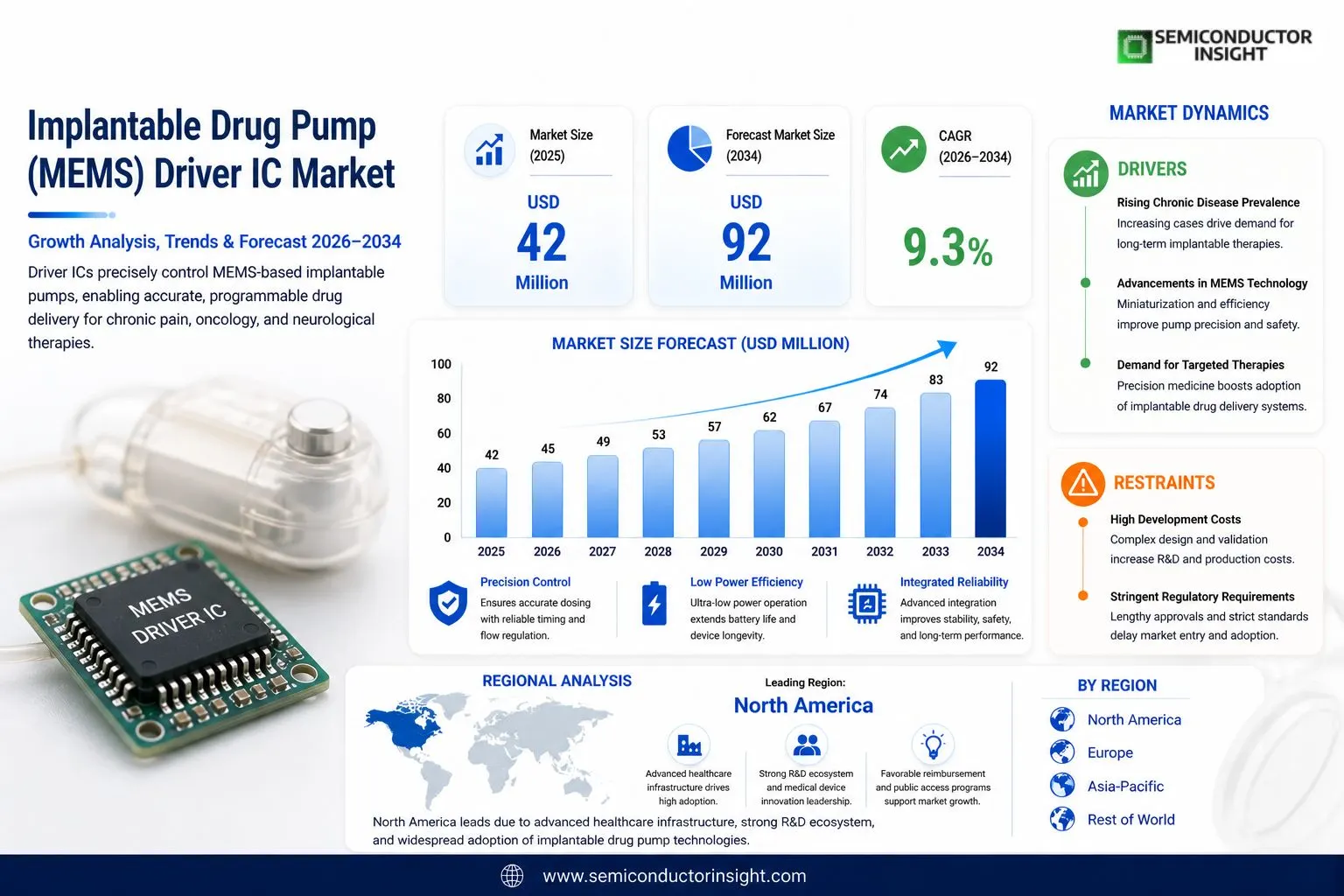
Global Implantable Drug Pump (MEMS) Driver IC Market size was valued at USD 42 million in 2025. The market is projected to grow from USD 45 million in 2026 to USD 92 million by 2034, exhibiting a CAGR of 9.3% during the forecast period.
Implantable drug pump (MEMS) driver ICs are specialized semiconductor components designed to precisely control the actuation and flow regulation mechanisms within micro-electro-mechanical systems (MEMS)-based implantable infusion pumps. These integrated circuits manage low-power signal processing, voltage regulation, timing sequences, and feedback loops essential for accurate, programmable drug delivery in confined biomedical environments. They enable reliable operation of micropumps that deliver minute volumes of medication directly to targeted sites, such as the intrathecal space for pain management or specific tissues for oncology and neurological therapies.
The market is experiencing steady growth due to several factors, including the rising prevalence of chronic conditions like severe chronic pain, spasticity, and cancer that require long-term, controlled drug administration. Advancements in MEMS miniaturization and low-power electronics have made implantable pumps more efficient and biocompatible, driving broader clinical adoption. Furthermore, the demand for personalized and targeted therapies continues to expand as healthcare shifts toward precision medicine approaches that minimize systemic side effects. Key players continue to invest in next-generation driver IC designs that integrate enhanced power management and telemetry capabilities, supporting extended device longevity and improved patient outcomes. Medtronic, Flowonix Medical, and specialized semiconductor suppliers remain prominent in advancing these technologies with comprehensive portfolios tailored for medical implant applications.
MARKET DRIVERS
Growing Adoption of Precision Implantable Therapies
Implantable Drug Pump (MEMS) Driver IC Market is experiencing sustained expansion due to rising adoption of precision-based implantable therapeutic devices. Increasing demand for controlled drug-delivery systems that ensure consistent dosage accuracy is strengthening the requirement for advanced MEMS driver ICs. The market is further supported by the growing prevalence of chronic illnesses, where long-term automated drug administration offers clinical benefits and enhanced patient compliance.
Technological Advancements in MEMS Miniaturization
Continuous advancements in microelectromechanical systems are enabling higher integration density, improved power efficiency, and greater precision in implantable pumps. These innovations support the development of compact driver ICs capable of operating reliably in complex biomedical environments, thus enhancing performance and extending device lifecycle.
➤ Rising demand for minimally invasive and automated drug-delivery solutions continues to boost development of next‑generation driver ICs.
The shift toward connected healthcare ecosystems and implantable devices capable of real-time monitoring is further promoting strategic investments in MEMS-based driver IC technologies, helping manufacturers enhance reliability, control precision, and long-term operation stability.
MARKET CHALLENGES
Complex Design and Regulatory Compliance
Implantable Drug Pump (MEMS) Driver IC Market faces development challenges due to stringent regulatory protocols governing implantable medical electronics. Achieving compliance requires rigorous device validation, extended testing cycles, and the incorporation of advanced safety mechanisms, which substantially increase design complexity and development timelines.
Other Challenges
High Manufacturing Precision Requirements
Manufacturers must maintain exceptionally tight tolerances and reliability parameters to ensure long-term operation within the human body, driving up production costs and limiting rapid scalability.
MARKET RESTRAINTS
Cost and Integration Barriers in Advanced Implantable Systems
High manufacturing and integration costs remain a major restraint for Implantable Drug Pump (MEMS) Driver IC Market. Achieving long-term biocompatibility, reliability, and ultra‑low power consumption requires specialized fabrication processes that increase overall device expenditures. These challenges limit widespread adoption, particularly in cost-sensitive healthcare markets.
MARKET OPPORTUNITIES
Expanding Use of Smart Drug‑Delivery Platforms
The evolution of smart biomedical implants presents strong growth opportunities for Implantable Drug Pump (MEMS) Driver IC Market. As healthcare systems increasingly focus on personalized and automated therapeutic delivery, demand for MEMS driver ICs with enhanced connectivity, diagnostic functionality, and energy‑efficient architectures is rising. This creates pathways for innovation in ultra-miniaturized circuits, integrated sensing capabilities, and adaptive control features for future implantable drug‑delivery devices.
Trends
Primary Trend Heading Here
Implantable Drug Pump (MEMS) Driver IC Market is influenced by sustained advancements in micro-electro-mechanical systems and semiconductor engineering, supporting high-precision infusion technologies used in chronic pain management, oncology, and neurological treatment pathways. A key trend shaping the market is the continuous refinement of low-power signal processing and control architectures that enable consistent dose delivery in complex physiological environments. As healthcare systems prioritize targeted therapeutic approaches, manufacturers are developing driver ICs that enhance pump accuracy, improve long‑term reliability, and maintain stable operation under variable biological conditions. These trends reflect a broader shift toward more intelligent and efficient implantable systems designed to minimize patient burden and optimize drug efficacy.
Other Trends
Integration of Advanced Power Management
The market is increasingly characterized by the integration of optimized power regulation modules within driver IC designs. These enhancements support long-duration device performance, reduce thermal stress, and improve battery efficiency,critical factors for implantable systems that must operate uninterrupted for extended periods. Verified industry developments show that manufacturers are incorporating adaptive voltage control and refined timing sequences to maintain consistent micropump actuation with minimal energy expenditure.
Growth in Precision Medicine Applications
The alignment of implantable pump technologies with precision medicine initiatives is driving new design priorities. Clinicians require systems capable of delivering micro‑dosed therapies with elevated accuracy to minimize systemic exposure. As a result, driver ICs are increasingly engineered to support sophisticated feedback loops and programmable delivery parameters. This trend is reinforced by the rising clinical adoption of targeted treatment protocols across pain management and specialized oncology applications.
Advancements in MEMS Miniaturization
Continued progress in MEMS miniaturization is enabling more compact and biocompatible implantable pumps, creating demand for driver ICs that deliver high functionality within reduced physical footprints. Verified developments in microfabrication and semiconductor processing have supported more efficient integration of sensing, control, and telemetry functions without increasing system complexity.
Another Main Trend Heading
Another notable market trend is the industry’s progression toward enhanced telemetry and monitoring capabilities within implantable pump systems. Driver ICs are increasingly designed to support real‑time operational data exchange, improving treatment oversight and device adjustability. This aligns with the broader evolution of connected medical implants, where reliability, data integrity, and secure communication are central requirements. Collectively, these verified trends demonstrate how technological evolution, clinical need, and precision‑focused therapy strategies are shaping sustained growth in Implantable Drug Pump (MEMS) Driver IC Market.
COMPETITIVE LANDSCAPE
Key Industry Players
Competitive Dynamics in Implantable Drug Pump (MEMS) Driver IC Market
Implantable Drug Pump (MEMS) Driver IC Market is shaped by a concentrated group of leaders specializing in implantable infusion systems, advanced MEMS actuation technologies, and ultra–low-power semiconductor design. Medtronic remains the most influential player, leveraging decades of implantable pump expertise and continually integrating more advanced driver IC architectures into its infusion platforms. Flowonix Medical also maintains a strong competitive presence, supported by growing deployments of implantable targeted drug delivery systems that rely on precision MEMS-based pump control. Several global semiconductor manufacturers contribute critical driver IC innovations, focusing on improved power management, timing control, and safety mechanisms to meet stringent biomedical performance requirements. Together, these companies form the core technological and commercial foundation of the market, driving advancements in reliability, biocompatibility, and precision dosage delivery.
Beyond these dominant players, the competitive landscape includes niche semiconductor suppliers, medical device innovators, and MEMS engineering specialists developing next-generation microactuation and signal-conditioning solutions. Organizations such as Texas Instruments, Analog Devices, and STMicroelectronics support the market with ultra-stable analog ICs and custom ASIC capabilities tailored for implantable biosystems. Additionally, emerging companies and research-driven microelectronics providers are developing application-specific MEMS driver IC modules with enhanced telemetry and real-time monitoring features, enabling more sophisticated drug-delivery algorithms. This broader ecosystem continues to contribute to advancements in performance, safety, and long-term implant reliability, ensuring sustained innovation across the industry.
List of Key Implantable Drug Pump (MEMS) Driver IC Market Companies Profiled
- Medtronic
- Flowonix Medical
- Texas Instruments
- Analog Devices
- STMicroelectronics
- Microchip Technology
- NXP Semiconductors
- Infineon Technologies
- ROHM Semiconductor
- Renesas Electronics
- TE Connectivity (Medical Components Division)
- TDK (MEMS & Sensors Division)
- Omron Healthcare (MEMS Components)
- Cirtec Medical (Implantable Systems Engineering)
- PhaseBio / Specialty MEMS IC Partners
Segment Analysis:
| Segment Category | Sub-Segments | Key Insights |
| By Type |
|
Leading Segment Low-power driver ICs remain highly favored due to their compatibility with long-term implantable systems that require sustained operation.
|
| By Application |
|
Leading Segment Pain management applications dominate due to the increasing need for controlled, targeted infusion systems for chronic conditions.
|
| By End User |
|
Leading Segment Hospitals remain the primary end users as they manage the bulk of implant procedures and long-term patient monitoring.
|
| By [Segment Category 3]] |
|
Leading Segment Digital driver ICs lead as they allow enhanced programmability and precise real-time control of infusion cycles.
|
| By [Segment Category 4]] |
|
Leading Segment Power management architecture stands out due to the critical role it plays in ensuring long operational lifespans for implantable pumps.
|
Regional Analysis: Implantable Drug Pump (MEMS) Driver IC Market
North America
The FDA’s Center for Devices and Radiological Health maintains strict but structured guidelines for MEMS-based implantable drug pump components, including driver ICs. North American manufacturers benefit from decades of regulatory experience, enabling them to navigate pre-market approval processes more efficiently than counterparts in emerging markets, supporting sustained commercial momentum in Implantable Drug Pump (MEMS) Driver IC Market.
North America hosts a prolific network of semiconductor design firms and medical technology incubators actively advancing ultra-low-power MEMS driver IC architectures. Collaborative research between universities and private enterprises accelerates miniaturization and energy efficiency improvements essential for next-generation implantable drug pump platforms serving chronic disease management and targeted therapeutic delivery.
High per-capita healthcare expenditure across the United States and Canada translates into significant procurement budgets for advanced implantable drug delivery devices. Comprehensive insurance coverage and favorable reimbursement structures for implantable pain management and chemotherapy delivery systems create a consistent demand pull for sophisticated MEMS driver IC components throughout the regional supply chain.
Several globally recognized semiconductor and medical device corporations maintain their headquarters or primary innovation centers across North America, fostering strategic partnerships and licensing agreements. These alliances drive the co-development of application-specific MEMS driver ICs tailored to the precise voltage, frequency, and biocompatibility requirements of implantable drug pump systems in clinical settings.
Europe
Europe represents the second most significant geography in Implantable Drug Pump (MEMS) Driver IC Market, underpinned by a mature medical device industry concentrated in Germany, Switzerland, the Netherlands, and the United Kingdom. The region benefits from a harmonized regulatory environment governed by the European Union Medical Device Regulation, which has progressively elevated quality and safety standards for implantable electronic components including MEMS-based driver ICs. European manufacturers are recognized for their engineering precision and strong emphasis on biocompatibility compliance, making the region a preferred source of high-reliability components for implantable drug delivery applications. Public healthcare systems across Western Europe sustain demand by prioritizing long-term cost-effective therapies, including implantable drug pumps for chronic pain and spasticity management. Ongoing investments in digital health and personalized medicine further stimulate demand for intelligent, programmable MEMS driver IC solutions across the continent’s clinical landscape through 2034.
Asia-Pacific
The Asia-Pacific region is emerging as the fastest-growing market for Implantable Drug Pump (MEMS) Driver IC Market, propelled by rapid healthcare infrastructure development, expanding middle-class populations, and increasing chronic disease burdens across China, Japan, South Korea, India, and Australia. Japan and South Korea lead the region in technological sophistication, with established semiconductor industries capable of manufacturing medical-grade MEMS driver ICs to global standards. China is aggressively scaling its domestic medical device manufacturing capabilities with strong government backing under national healthcare modernization initiatives. While regulatory frameworks across the region vary in maturity, countries are progressively aligning their medical device standards with international benchmarks. Growing awareness of implantable therapies among physicians and patients, coupled with rising disposable incomes, positions Asia-Pacific as a pivotal growth engine for Global Implantable Drug Pump (MEMS) Driver IC Market over the forecast period.
South America
South America occupies a developing but increasingly relevant position in Implantable Drug Pump (MEMS) Driver IC Market, with Brazil and Argentina serving as the primary demand centers. The region’s market growth is gradual, constrained by limited healthcare budgets, fragmented regulatory systems, and a dependency on imported medical device components. However, Brazil’s ANVISA regulatory agency is progressively streamlining medical device approvals, which may facilitate greater market entry for implantable drug pump technologies incorporating MEMS driver ICs. Growing private healthcare sector investment and rising awareness of advanced pain management therapies contribute to a cautiously optimistic demand trajectory. Partnerships between global medical device companies and local distributors are beginning to improve market accessibility, laying a foundation for moderate long-term growth in Implantable Drug Pump (MEMS) Driver IC Market across the South American landscape through 2034.
Middle East & Africa
The Middle East and Africa region currently represents a nascent but strategically noteworthy segment of Implantable Drug Pump (MEMS) Driver IC Market. Gulf Cooperation Council nations, particularly the United Arab Emirates and Saudi Arabia, are making substantial investments in modernizing healthcare infrastructure as part of broader national development agendas, creating select pockets of demand for advanced implantable medical technologies. South Africa serves as the primary access point for sub-Saharan Africa, though affordability and healthcare access disparities significantly temper adoption rates. The region largely depends on imports for sophisticated medical components including MEMS driver ICs, and local manufacturing capabilities remain limited. Over the forecast period, gradual improvements in healthcare access, rising medical tourism, and international partnerships are expected to create incremental opportunities for stakeholders operating within Implantable Drug Pump (MEMS) Driver IC Market across this diverse and evolving regional landscape.
Report Scope
This market research report provides a comprehensive analysis of the Implantable Drug Pump (MEMS) Driver IC Market , covering the forecast period 2026–2034. It offers detailed insights into market dynamics, technological advancements, competitive landscape, and key trends shaping the industry.
Key focus areas of the report include:
- Market Overview: The report begins with an overview outlining its current market scenario, key growth indicators, and industry transformation drivers. It discusses macroeconomic factors, demand–supply balance, regulatory landscape, and the strategic role of semiconductors in powering advancements across industries such as automotive, telecommunications, consumer electronics, and industrial automation.
- Market Size & Forecast: Historical data and future projections for revenue, unit shipments, and market value across major regions and segments.
- Segmentation Analysis: Detailed breakdown by product type, technology, application, and end-user industry to identify high-growth segments and investment opportunities.
- Regional Insights: Insights into market performance across North America, Europe, Asia-Pacific, Latin America, and the Middle East & Africa, including country-level analysis where relevant.
- Competitive Landscape: Profiles of leading market participants, including their product offerings, R&D focus, manufacturing capacity, pricing strategies, and recent developments such as mergers, acquisitions, and partnerships.
- Technology Trends & Innovation: Assessment of emerging technologies, integration of AI/IoT, semiconductor design trends, fabrication techniques, and evolving industry standards.
- Market Drivers & Restraints: Evaluation of factors driving market growth along with challenges, supply chain constraints, regulatory issues, and market-entry barriers.
- Stakeholder Insights: Insights for component suppliers, OEMs, system integrators, investors, and policymakers regarding the evolving ecosystem and strategic opportunities.
Primary and secondary research methods are employed, including interviews with industry experts, data from verified sources, and real-time market intelligence to ensure the accuracy and reliability of the insights presented.
FREQUENTLY ASKED QUESTIONS:
What is the current market size of Implantable Drug Pump (MEMS) Driver IC Market?
-> Global Implantable Drug Pump (MEMS) Driver IC Market size was valued at USD 42 million in 2025 and is expected to reach USD 92 million by 2034, growing at a CAGR of 9.3% during the forecast period from 2026 to 2034.
Which key companies operate in Implantable Drug Pump (MEMS) Driver IC Market?
-> Key players include Medtronic, Flowonix Medical, and specialized semiconductor suppliers, among others, who remain prominent in advancing implantable drug pump driver IC technologies with comprehensive portfolios tailored for medical implant applications.
What are the key growth drivers?
-> Key growth drivers include rising prevalence of chronic conditions such as severe chronic pain, spasticity, and cancer requiring long-term controlled drug administration, advancements in MEMS miniaturization and low-power electronics, and the growing demand for personalized and targeted therapies aligned with precision medicine approaches that minimize systemic side effects.
Which region dominates the market?
-> Asia-Pacific is the fastest-growing region driven by expanding healthcare infrastructure and increasing adoption of advanced medical devices, while North America remains a dominant market owing to its well-established medical device industry and high clinical adoption rates.
What are the emerging trends?
-> Emerging trends include next-generation driver IC designs with enhanced power management and telemetry capabilities, integration of low-power electronics for extended device longevity, and increasing focus on biocompatible MEMS miniaturization to support improved patient outcomes in implantable drug delivery systems.

Get Sample Report PDF for Exclusive Insights
Report Sample Includes
- Table of Contents
- List of Tables & Figures
- Charts, Research Methodology, and more...