High Purity Phosphoric Acid for Semiconductor Market, Emerging Trends, Technological Advancements, and Business Strategies 2025-2032

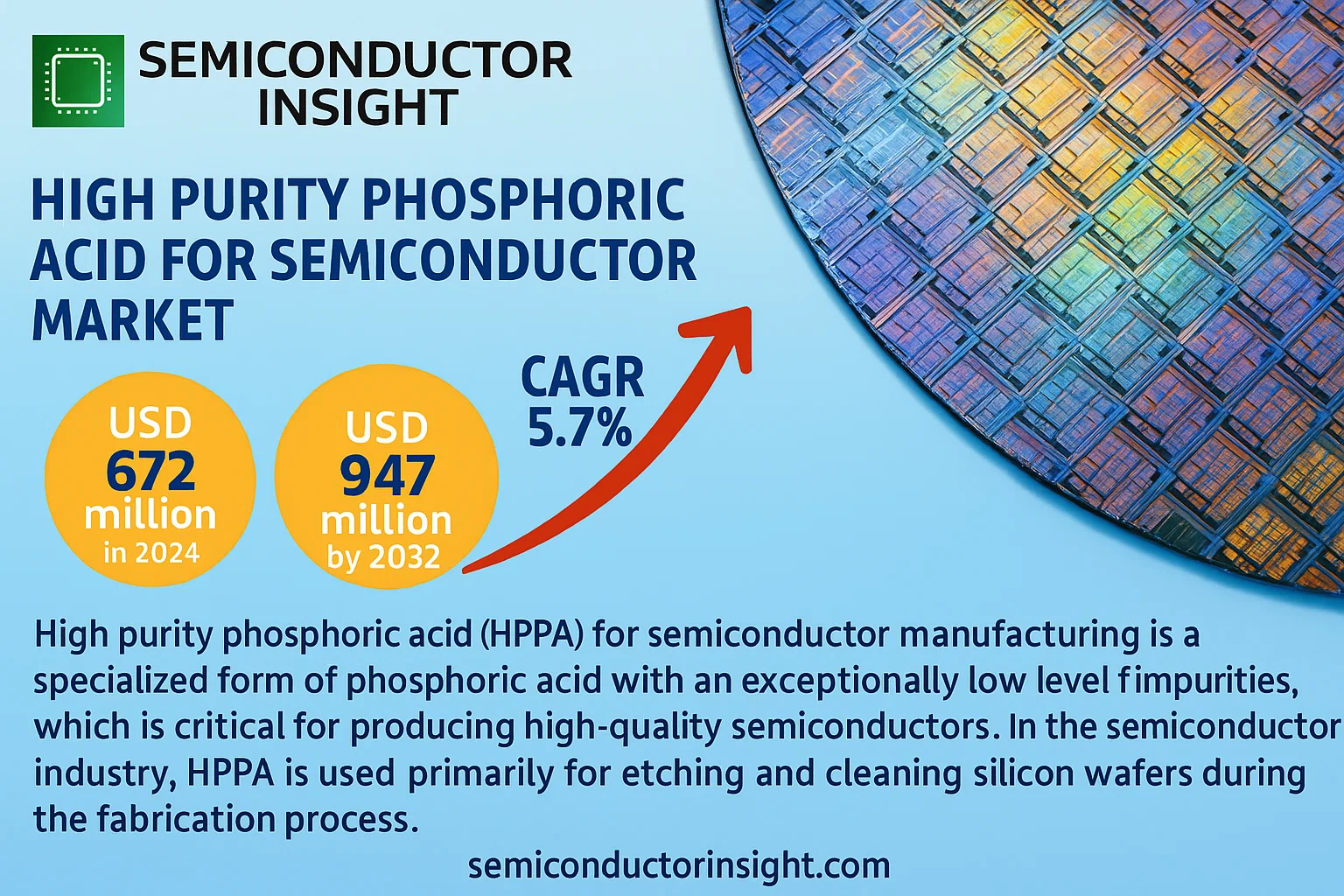
High Purity Phosphoric Acid for Semiconductor Market was valued at USD 672 million in 2024 and is projected to reach USD 947 million by 2032, exhibiting a CAGR of 5.7% during the forecast period.


PDF Icon Download Sample Report PDF
  • Quick Dispatch

    All Orders

  • Secure Payment

    100% Secure Payment

Price range: $1,500.00 through $4,250.00

Clear

MARKET INSIGHTS

Global High Purity Phosphoric Acid for Semiconductor Market was valued at USD 672 million in 2024 and is projected to reach USD 947 million by 2032, exhibiting a CAGR of 5.7% during the forecast period.

High purity phosphoric acid (HPPA) for semiconductor manufacturing is a specialized form of phosphoric acid with an exceptionally low level of impurities, which is critical for producing high-quality semiconductors. In the semiconductor industry, HPPA is used primarily for etching and cleaning silicon wafers during the fabrication process. The purity of the acid ensures that no unwanted contaminants interfere with the delicate processes involved in creating microelectronic devices. This high level of purity helps maintain the integrity and performance of semiconductor components, which are essential for the functioning of various electronic devices.

The high purity phosphoric acid (HPPA) market for semiconductor applications is witnessing significant growth, driven by the expanding semiconductor industry and the increasing demand for advanced electronic devices. As technology continues to advance, there is a growing need for smaller, more powerful, and efficient semiconductor components, which in turn drives demand for HPPA. The high precision required in semiconductor manufacturing necessitates the use of HPPA to ensure the cleanliness and integrity of silicon wafers, making it a critical component in the production process. This trend is further supported by the ongoing development of new semiconductor technologies and the proliferation of electronic devices across various sectors, including consumer electronics, automotive, and telecommunications.

However, the market for HPPA also faces challenges, such as the high cost of production and the need for stringent quality control measures. The production of HPPA involves sophisticated processes to achieve the required purity levels, which can be resource-intensive and expensive. Additionally, fluctuations in the supply of raw materials and regulatory constraints on environmental impacts may affect market dynamics. Despite these challenges, ongoing innovations in production technologies and increasing investments in semiconductor research and development are expected to sustain the growth of the HPPA market. As the demand for cutting-edge electronic devices continues to rise, the importance of high purity phosphoric acid in maintaining the quality and performance of semiconductor products will likely remain strong.

We have surveyed the High Purity Phosphoric Acid for Semiconductor manufacturers, suppliers, distributors, and industry experts on this industry, involving the sales, revenue, demand, price change, product type, recent development and plan, industry trends, drivers, challenges, obstacles, and potential risks. This report aims to provide a comprehensive presentation of the global market for High Purity Phosphoric Acid for Semiconductor, with both quantitative and qualitative analysis, to help readers develop business/growth strategies, assess the market competitive situation, analyze their position in the current marketplace, and make informed business decisions regarding High Purity Phosphoric Acid for Semiconductor.
High Purity Phosphoric Acid for Semiconductor Market

MARKET DRIVERS


Escalating Global Semiconductor Demand

The relentless expansion of the digital economy, driven by artificial intelligence, 5G infrastructure, Internet of Things (IoT) devices, and electric vehicles, continues to fuel unprecedented demand for semiconductors. High Purity Phosphoric Acid (HPPA) is an essential wet chemical used in the etching and cleaning of silicon wafers during chip fabrication. As semiconductor manufacturers ramp up production capacity to meet this demand, the consumption of critical process chemicals like HPPA is increasing proportionally. The construction of new fabrication plants worldwide directly translates to higher volume requirements for ultra-pure chemicals.

Advancements in Semiconductor Manufacturing Nodes

The industry’s persistent march toward smaller and more complex semiconductor nodes, such as 3nm and 2nm processes, demands etchants with exceptional purity and precision. Impurities in process chemicals can cause catastrophic defects at these scales. HPPA used for selectively etching silicon nitride over silicon oxide must meet specifications with metallic impurity levels in the parts-per-trillion (ppt) range. This technological progression acts as a powerful driver, compelling suppliers to develop and provide ever-higher purity grades, thereby sustaining market growth.

The global market for HPPA in semiconductors is projected to grow at a CAGR of approximately 6-8% over the next five years, closely mirroring the expansion of the advanced logic and memory chip sectors.

Furthermore, the increasing complexity of 3D NAND flash memory and DRAM chips requires more processing steps, many of which utilize HPPA for cleaning and planarization. This multi-patterning and multi-stacking trend effectively increases the consumption of HPPA per wafer, providing a steady, structural driver for the market beyond simple volume increases.

MARKET CHALLENGES


Stringent Purity and Consistency Requirements

Producing HPPA that consistently meets the ultra-high purity standards of leading-edge semiconductor fabs is a significant technical challenge. Even minute traces of metallic ions or particulate contaminants can drastically reduce chip yields. Manufacturers must invest heavily in advanced purification technologies, sophisticated filtration systems, and controlled production environments. Maintaining batch-to-batch consistency is equally critical, as variability can disrupt sensitive fabrication processes, leading to costly production halts and qualification delays with customers.

Other Challenges

Supply Chain and Raw Material Volatility
The production of HPPA is dependent on the supply and pricing of thermal phosphoric acid or elemental phosphorus, which are subject to geopolitical, logistical, and energy-cost fluctuations. Any disruption in this upstream supply chain can directly impact HPPA availability and cost stability for semiconductor manufacturers, who operate on tight just-in-time inventory models.

Intense Price Pressure and Competition
The market is characterized by strong competition among a few key global chemical suppliers. Semiconductor manufacturers exert significant pressure to reduce the cost-per-chemical, which squeezes profit margins for HPPA producers. This economic pressure challenges suppliers to continually optimize their manufacturing processes without compromising on the critical purity parameters.

MARKET RESTRAINTS


High Capital and Operational Expenditures

The establishment of a production facility capable of manufacturing electronic-grade HPPA requires immense capital investment in specialized equipment, cleanroom infrastructure, and analytical instruments for quality control. The operational costs are also substantial, encompassing high-energy consumption for purification processes, expensive raw materials, and rigorous testing protocols. These significant financial barriers limit the entry of new players and can restrain the rapid expansion of production capacity to meet sudden demand surges.

Environmental and Regulatory Hurdles

The production and handling of phosphoric acid are subject to stringent environmental regulations concerning wastewater discharge, chemical storage, and worker safety. Compliance with evolving global regulations, such as REACH in Europe and TSCA in the United States, adds complexity and cost. The need for sustainable and environmentally responsible manufacturing processes is becoming a key factor, potentially restraining operations for producers who cannot adapt to these stricter standards.

MARKET OPPORTUNITIES


Expansion in the Asia-Pacific Region

The geographical shift of semiconductor manufacturing to the Asia-Pacific region, particularly in Taiwan, South Korea, China, and Southeast Asia, presents a monumental growth opportunity. The concentration of new mega-fabs in this region creates a localized and booming demand for high-purity chemicals. Establishing production facilities or strengthening supply chain partnerships within Asia-Pacific allows HPPA suppliers to reduce logistics costs, improve responsiveness, and secure long-term supply contracts with major foundries and memory chip makers.

Development of Next-Generation Formulations

As semiconductor architectures evolve beyond traditional FinFETs to structures like Gate-All-Around (GAA) and complementary field-effect transistors (CFETs), new etching challenges emerge. This creates an opportunity for innovative suppliers to develop specialized, next-generation HPPA formulations with enhanced selectivity, lower defectivity, and compatibility with novel materials. Pioneering such tailored solutions can allow companies to capture premium market segments and establish strong technological leadership.

Circular Economy and Recycling Initiatives

There is a growing emphasis on sustainability within the semiconductor industry. Opportunities exist for companies to develop efficient closed-loop recycling and reprocessing systems for spent HPPA and other wet chemicals. By purifying and re-introducing recovered acid back into the manufacturing process, suppliers can offer more sustainable solutions, reduce waste disposal costs for fabs, and create a compelling value proposition aligned with corporate environmental goals.

High Purity Phosphoric Acid for Semiconductor Market Trends
Sustained Market Expansion Driven by Core Industry Demand

The global High Purity Phosphoric Acid (HPPA) for Semiconductor market, valued at $672 million in 2024, is on a steady growth trajectory, projected to reach $947 million by 2032, representing a compound annual growth rate (CAGR) of 5.7%. This growth is fundamentally driven by the relentless expansion of the global semiconductor industry. HPPA is a critical specialty chemical used primarily for etching and cleaning silicon wafers during semiconductor fabrication. Its exceptionally low impurity level is non-negotiable for producing high-performance microelectronic devices, as any contamination can severely compromise the integrity and functionality of the final semiconductor component.

Other Trends

Increasing Diversification by Purity Grade

The market is characterized by segmentation based on purity grades, primarily 0.75, 0.85, and ‘Above 85%’. The demand for higher purity grades (Above 85%) is accelerating, fueled by the manufacturing of advanced nodes and more complex integrated circuits. Each purity grade serves specific applications, with the highest grades reserved for the most sensitive etching processes where nanometer-scale precision is mandatory.

Application-Specific Growth and Regional Dynamics

Application-wise, the market is segmented into Cleaning, Etching, and Others. Etching remains the dominant application, consuming the largest volume of HPPA to define intricate circuit patterns on wafers. Geographically, Asia-Pacific holds the largest market share, a direct result of its concentration of semiconductor fabrication plants, particularly in China, Japan, South Korea, and Taiwan. This regional dominance is expected to continue, supported by massive investments in new semiconductor manufacturing capacity. Key players like Rin Kagaku Kogyo, Arkema, Solvay, and ICL Group are focusing on capacity expansion and technological innovation to meet stringent purity requirements and sustain their competitive positions.

COMPETITIVE LANDSCAPE

Key Industry Players

A concentrated market driven by technical expertise and supply chain integration

The global High Purity Phosphoric Acid (HPPA) market for semiconductors is characterized by a concentrated competitive landscape dominated by a handful of established global chemical giants and specialized electronic materials suppliers. The market leader, Solvay, commands a significant share due to its extensive chemical portfolio, deep R&D capabilities, and strong relationships with major semiconductor fabricators. Arkema and ICL Group are also key global players with substantial production capacities and a focus on high-purity materials for the electronics sector. This market structure is not highly fragmented, as the stringent quality requirements, complex production processes, and need for reliable supply chains create high barriers to entry. Competition is primarily based on product purity, consistency, technical support, and the ability to meet the rigorous specifications demanded by leading semiconductor manufacturers.

Beyond the top-tier players, a cohort of significant niche and regional companies caters to specific geographic markets or application segments. Japanese companies like Rin Kagaku Kogyo and Rasa Industries are prominent, known for their high-quality standards and strong presence in the Asia-Pacific region, which is the largest market for semiconductors. South Korea’s SoulBrain is a critical supplier integrated into the local semiconductor ecosystem. Specialized electronic materials companies such as CMC Materials (now part of Entegris) and Honeywell provide ultra-high-purity chemicals essential for advanced node semiconductor manufacturing. Regional players like China’s Hubei Xingfa Chemicals Group and OCI are expanding their footprint, leveraging local production to serve the growing domestic semiconductor industry. These companies compete by offering tailored solutions, competitive pricing, and robust logistical support.

List of Key High Purity Phosphoric Acid for Semiconductor Companies Profiled

Segment Analysis:

Segment Category Sub-Segments Key Insights
By Type
  • 75% Purity (0.75)
  • 85% Purity (0.85)
  • Above 85% Purity
Above 85% Purity remains the dominant segment, driven by the semiconductor industry’s relentless pursuit of ultra-clean manufacturing environments. This higher grade offers superior contamination control, which is absolutely essential for fabricating advanced technology nodes where even minuscule impurities can compromise chip performance and yield. The stringent requirements for producing cutting-edge microprocessors and memory devices create a sustained and growing preference for the highest purity levels available. The segment benefits from continuous technological advancements in purification processes, although achieving this grade involves sophisticated and resource-intensive manufacturing, presenting a significant barrier to entry but solidifying its leadership position.
By Application
  • Etching
  • Cleaning
  • Others
Etching represents the most critical application segment, as high purity phosphoric acid is indispensable for precisely removing silicon nitride layers without damaging underlying materials during semiconductor fabrication. This application’s dominance is intrinsically linked to the complexity and volume of modern chip manufacturing processes, where precise material removal is a fundamental step. The reliability and selectivity of phosphoric acid in etching are paramount for achieving the fine geometries required in today’s electronic components. As semiconductor designs become more intricate, the demand for high-performance etching solutions that ensure dimensional accuracy and process stability continues to reinforce this segment’s leading role in the market.
By End User
  • Integrated Device Manufacturers (IDMs)
  • Foundries
  • Memory Manufacturers
Foundries are the leading end-user segment, primarily due to their massive scale of production and their role as specialized manufacturers for a wide range of fabless semiconductor companies. The high-volume nature of foundry operations, coupled with their focus on advanced process technologies for multiple clients, creates a substantial and continuous demand for high purity phosphoric acid. These facilities require consistent, high-quality chemical inputs to maintain high yields and meet the diverse specifications of their customers’ chip designs. The competitive landscape among foundries, which drives the adoption of the latest manufacturing technologies, further solidifies their position as the primary consumers of HPPA.
By Technology Node
  • Mature Nodes (Above 28nm)
  • Advanced Nodes (28nm to 7nm)
  • Leading-Edge Nodes (Below 7nm)
Leading-Edge Nodes (Below 7nm) constitute the most demanding and high-growth segment. The fabrication of semiconductors at these extremely small scales imposes exceptionally strict requirements on material purity to prevent defects. The consumption of high purity phosphoric acid is particularly intensive in these processes due to the need for flawless etching and cleaning at an atomic level. Innovation in this segment is driven by the development of next-generation chips for applications like artificial intelligence, high-performance computing, and advanced mobile processors, where performance margins are extremely tight, making the quality of process chemicals a critical differentiator.
By Supply Chain Position
  • Direct Supply to Fabs
  • Distribution through Specialty Chemical Suppliers
  • Captive Production
Direct Supply to Fabs is the predominant model, favored for its ability to ensure supply chain security, consistent quality, and technical support directly from the manufacturer. This segment’s leadership is underpinned by the critical nature of HPPA, where any disruption or variance in quality can lead to significant production losses for semiconductor manufacturers. Long-term partnerships and direct technical collaboration between acid producers and fab operators are common, allowing for customized solutions and rapid response to process changes. The complexity of logistics and the need for stringent handling protocols further reinforce the preference for a streamlined, direct supply chain over more fragmented distribution channels.

Regional Analysis: High Purity Phosphoric Acid for Semiconductor Market

Asia-Pacific

Asia-Pacific has emerged as the unequivocal leader in the high purity phosphoric acid market for the semiconductor industry, primarily driven by its dominance in global electronics manufacturing. The region, particularly Taiwan, South Korea, Japan, and China, hosts the world’s most advanced semiconductor fabrication plants and foundries, creating immense, sustained demand. This demand is supported by robust regional supply chains for specialty chemicals and a strong focus on research and development in etching and cleaning technologies, where high purity phosphoric acid is essential for wafer processing. Governments across the region have implemented favorable policies and substantial investments to bolster domestic semiconductor capabilities, ensuring a continuous pipeline of demand. The proximity of chemical producers to major semiconductor clusters minimizes supply chain risks and allows for tight quality control and just-in-time delivery, which are critical for semiconductor manufacturing. This integrated ecosystem, combined with aggressive capacity expansion plans by major chipmakers, solidifies Asia-Pacific’s position at the forefront of this niche market for the foreseeable future.

Manufacturing Hub Synergy
The concentration of world-leading semiconductor foundries and memory chip manufacturers in countries like Taiwan and South Korea creates a powerful pull for high purity phosphoric acid suppliers. This proximity fosters deep collaboration on product specifications and process integration, ensuring the chemical meets the exacting standards required for leading-edge node production, from wafer cleaning to precise etching applications.
Supply Chain Integration
A mature and highly specialized chemical industry exists within the region, with local producers deeply integrated into the semiconductor ecosystem. This allows for responsive supply chains, reduced logistical complexities, and enhanced ability to manage the stringent quality and consistency requirements for ultra-high purity grades essential for preventing defects in nanometer-scale semiconductor devices.
Government and Investment Support
National strategies across the Asia-Pacific, particularly in China, Japan, and South Korea, heavily prioritize semiconductor self-sufficiency and technological leadership. This results in significant government subsidies, tax incentives, and direct investment in both fab construction and the supporting specialty chemicals sector, creating a stable and growing demand environment for high purity phosphoric acid.
Innovation and R&D Focus
The region is a hotbed for research into next-generation semiconductor processes, including advanced packaging and new transistor architectures. This continuous innovation cycle drives the development of new formulations and applications for high purity phosphoric acid, keeping regional suppliers at the cutting edge and tightly coupled with the evolving needs of chipmakers.

North America
North America maintains a significant and technologically advanced market for high purity phosphoric acid, anchored by major semiconductor corporations and specialized fabrication facilities in the United States. The region’s focus is predominantly on high-performance computing, automotive semiconductors, and defense applications, which demand the highest quality grades. A strong regulatory framework ensures stringent quality control and environmental compliance for chemical suppliers. While the manufacturing base is smaller than Asia-Pacific, the presence of leading semiconductor equipment companies and material science research institutions fosters a demand for innovative and ultra-pure chemical solutions, supporting a stable niche market.

Europe
The European market is characterized by a strong emphasis on research, quality, and specific automotive and industrial semiconductor applications. Countries like Germany, France, and Ireland host important R&D centers and fabs that require high purity phosphoric acid for specialized processes. The market benefits from strict EU regulations that prioritize supply chain sustainability and chemical safety, influencing sourcing decisions. Collaboration between automotive OEMs, chemical companies, and research institutes drives demand for tailored high-purity solutions, though the market size is more specialized compared to the leading region.

South America
The market for high purity phosphoric acid in South America is nascent but developing, primarily serving a growing consumer electronics assembly sector and some industrial applications. The region currently relies heavily on imports, as local production capabilities for semiconductor-grade chemicals are limited. However, increasing investment in technology infrastructure and a slowly expanding industrial base present potential for future growth, though it remains a minor player in the global landscape dominated by other regions.

Middle East & Africa
This region represents an emerging market with potential driven by strategic national initiatives to diversify economies beyond traditional sectors. Countries like Saudi Arabia and the UAE are investing in technology and industrial parks that could eventually incorporate semiconductor-related manufacturing. Current demand for high purity phosphoric acid is minimal and primarily linked to electronics imports and minor industrial uses. The market is characterized by long-term potential rather than immediate significant demand, with growth dependent on the success of broader technology adoption plans.

Report Scope

This market research report provides a comprehensive analysis of the High Purity Phosphoric Acid for Semiconductor Market , covering the forecast period 2025–2032. It offers detailed insights into market dynamics, technological advancements, competitive landscape, and key trends shaping the industry.

Key focus areas of the report include:

  • Market Overview: The report begins with an overview outlining its current market scenario, key growth indicators, and industry transformation drivers. It discusses macroeconomic factors, demand–supply balance, regulatory landscape, and the strategic role of semiconductors in powering advancements across industries such as automotive, telecommunications, consumer electronics, and industrial automation.
  • Market Size & Forecast: Historical data and future projections for revenue, unit shipments, and market value across major regions and segments.
  • Segmentation Analysis: Detailed breakdown by product type, technology, application, and end-user industry to identify high-growth segments and investment opportunities.
  • Regional Insights: Insights into market performance across North America, Europe, Asia-Pacific, Latin America, and the Middle East & Africa, including country-level analysis where relevant.
  • Competitive Landscape: Profiles of leading market participants, including their product offerings, R&D focus, manufacturing capacity, pricing strategies, and recent developments such as mergers, acquisitions, and partnerships.
  • Technology Trends & Innovation: Assessment of emerging technologies, integration of AI/IoT, semiconductor design trends, fabrication techniques, and evolving industry standards.
  • Market Drivers & Restraints: Evaluation of factors driving market growth along with challenges, supply chain constraints, regulatory issues, and market-entry barriers.
  • Stakeholder Insights: Insights for component suppliers, OEMs, system integrators, investors, and policymakers regarding the evolving ecosystem and strategic opportunities.

Primary and secondary research methods are employed, including interviews with industry experts, data from verified sources, and real-time market intelligence to ensure the accuracy and reliability of the insights presented.

FREQUENTLY ASKED QUESTIONS:

What is the current market size of High Purity Phosphoric Acid for Semiconductor Market?

->High Purity Phosphoric Acid for Semiconductor Market was valued at USD 672 million in 2024 and is projected to reach USD 947 million by 2032, exhibiting a CAGR of 5.7% during the forecast period.

Which key companies operate in High Purity Phosphoric Acid for Semiconductor Market?

-> Key players include Rin Kagaku Kogyo, Arkema, Solvay, ICL Group, CMC Materials, Rasa Industries, Honeywell, Hubei Xingfa Chemicals Group, OCI, and SoulBrain, among others.

What are the key growth drivers?

-> Key growth drivers include the expanding semiconductor industry, increasing demand for advanced electronic devices, and the need for smaller, more powerful, and efficient semiconductor components.

Which region dominates the market?

-> Asia is a key region, with significant market performance from countries including China, Japan, South Korea, and Southeast Asia.

What are the emerging trends?

-> Emerging trends include ongoing innovations in production technologies, increasing investments in semiconductor R&D, and the proliferation of electronic devices across sectors like automotive and telecommunications.

High Purity Phosphoric Acid for Semiconductor Market, Emerging Trends, Technological Advancements, and Business Strategies 2025-2032

Get Sample Report PDF for Exclusive Insights

Report Sample Includes

  • Table of Contents
  • List of Tables & Figures
  • Charts, Research Methodology, and more...

PDF Icon Download Sample Report PDF

Download Sample Report

Table of Content

1 Introduction to Research & Analysis Reports
1.1 High Purity Phosphoric Acid for Semiconductor Market Definition
1.2 Market Segments
1.2.1 Segment by Type
1.2.2 Segment by Application
1.3 Global High Purity Phosphoric Acid for Semiconductor Market Overview
1.4 Features & Benefits of This Report
1.5 Methodology & Sources of Information
1.5.1 Research Methodology
1.5.2 Research Process
1.5.3 Base Year
1.5.4 Report Assumptions & Caveats
2 Global High Purity Phosphoric Acid for Semiconductor Overall Market Size
2.1 Global High Purity Phosphoric Acid for Semiconductor Market Size: 2024 VS 2031
2.2 Global High Purity Phosphoric Acid for Semiconductor Market Size, Prospects & Forecasts: 2020-2031
2.3 Global High Purity Phosphoric Acid for Semiconductor Sales: 2020-2031
3 Company Landscape
3.1 Top High Purity Phosphoric Acid for Semiconductor Players in Global Market
3.2 Top Global High Purity Phosphoric Acid for Semiconductor Companies Ranked by Revenue
3.3 Global High Purity Phosphoric Acid for Semiconductor Revenue by Companies
3.4 Global High Purity Phosphoric Acid for Semiconductor Sales by Companies
3.5 Global High Purity Phosphoric Acid for Semiconductor Price by Manufacturer (2020-2025)
3.6 Top 3 and Top 5 High Purity Phosphoric Acid for Semiconductor Companies in Global Market, by Revenue in 2024
3.7 Global Manufacturers High Purity Phosphoric Acid for Semiconductor Product Type
3.8 Tier 1, Tier 2, and Tier 3 High Purity Phosphoric Acid for Semiconductor Players in Global Market
3.8.1 List of Global Tier 1 High Purity Phosphoric Acid for Semiconductor Companies
3.8.2 List of Global Tier 2 and Tier 3 High Purity Phosphoric Acid for Semiconductor Companies
4 Sights by Product
4.1 Overview
4.1.1 Segment by Type – Global High Purity Phosphoric Acid for Semiconductor Market Size Markets, 2024 & 2031
4.1.2 0.75
4.1.3 0.85
4.1.4 Above 85%
4.2 Segment by Type – Global High Purity Phosphoric Acid for Semiconductor Revenue & Forecasts
4.2.1 Segment by Type – Global High Purity Phosphoric Acid for Semiconductor Revenue, 2020-2025
4.2.2 Segment by Type – Global High Purity Phosphoric Acid for Semiconductor Revenue, 2026-2031
4.2.3 Segment by Type – Global High Purity Phosphoric Acid for Semiconductor Revenue Market Share, 2020-2031
4.3 Segment by Type – Global High Purity Phosphoric Acid for Semiconductor Sales & Forecasts
4.3.1 Segment by Type – Global High Purity Phosphoric Acid for Semiconductor Sales, 2020-2025
4.3.2 Segment by Type – Global High Purity Phosphoric Acid for Semiconductor Sales, 2026-2031
4.3.3 Segment by Type – Global High Purity Phosphoric Acid for Semiconductor Sales Market Share, 2020-2031
4.4 Segment by Type – Global High Purity Phosphoric Acid for Semiconductor Price (Manufacturers Selling Prices), 2020-2031
5 Sights by Application
5.1 Overview
5.1.1 Segment by Application – Global High Purity Phosphoric Acid for Semiconductor Market Size, 2024 & 2031
5.1.2 Cleaning
5.1.3 Etching
5.1.4 Others
5.2 Segment by Application – Global High Purity Phosphoric Acid for Semiconductor Revenue & Forecasts
5.2.1 Segment by Application – Global High Purity Phosphoric Acid for Semiconductor Revenue, 2020-2025
5.2.2 Segment by Application – Global High Purity Phosphoric Acid for Semiconductor Revenue, 2026-2031
5.2.3 Segment by Application – Global High Purity Phosphoric Acid for Semiconductor Revenue Market Share, 2020-2031
5.3 Segment by Application – Global High Purity Phosphoric Acid for Semiconductor Sales & Forecasts
5.3.1 Segment by Application – Global High Purity Phosphoric Acid for Semiconductor Sales, 2020-2025
5.3.2 Segment by Application – Global High Purity Phosphoric Acid for Semiconductor Sales, 2026-2031
5.3.3 Segment by Application – Global High Purity Phosphoric Acid for Semiconductor Sales Market Share, 2020-2031
5.4 Segment by Application – Global High Purity Phosphoric Acid for Semiconductor Price (Manufacturers Selling Prices), 2020-2031
6 Sights by Region
6.1 By Region – Global High Purity Phosphoric Acid for Semiconductor Market Size, 2024 & 2031
6.2 By Region – Global High Purity Phosphoric Acid for Semiconductor Revenue & Forecasts
6.2.1 By Region – Global High Purity Phosphoric Acid for Semiconductor Revenue, 2020-2025
6.2.2 By Region – Global High Purity Phosphoric Acid for Semiconductor Revenue, 2026-2031
6.2.3 By Region – Global High Purity Phosphoric Acid for Semiconductor Revenue Market Share, 2020-2031
6.3 By Region – Global High Purity Phosphoric Acid for Semiconductor Sales & Forecasts
6.3.1 By Region – Global High Purity Phosphoric Acid for Semiconductor Sales, 2020-2025
6.3.2 By Region – Global High Purity Phosphoric Acid for Semiconductor Sales, 2026-2031
6.3.3 By Region – Global High Purity Phosphoric Acid for Semiconductor Sales Market Share, 2020-2031
6.4 North America
6.4.1 By Country – North America High Purity Phosphoric Acid for Semiconductor Revenue, 2020-2031
6.4.2 By Country – North America High Purity Phosphoric Acid for Semiconductor Sales, 2020-2031
6.4.3 United States High Purity Phosphoric Acid for Semiconductor Market Size, 2020-2031
6.4.4 Canada High Purity Phosphoric Acid for Semiconductor Market Size, 2020-2031
6.4.5 Mexico High Purity Phosphoric Acid for Semiconductor Market Size, 2020-2031
6.5 Europe
6.5.1 By Country – Europe High Purity Phosphoric Acid for Semiconductor Revenue, 2020-2031
6.5.2 By Country – Europe High Purity Phosphoric Acid for Semiconductor Sales, 2020-2031
6.5.3 Germany High Purity Phosphoric Acid for Semiconductor Market Size, 2020-2031
6.5.4 France High Purity Phosphoric Acid for Semiconductor Market Size, 2020-2031
6.5.5 U.K. High Purity Phosphoric Acid for Semiconductor Market Size, 2020-2031
6.5.6 Italy High Purity Phosphoric Acid for Semiconductor Market Size, 2020-2031
6.5.7 Russia High Purity Phosphoric Acid for Semiconductor Market Size, 2020-2031
6.5.8 Nordic Countries High Purity Phosphoric Acid for Semiconductor Market Size, 2020-2031
6.5.9 Benelux High Purity Phosphoric Acid for Semiconductor Market Size, 2020-2031
6.6 Asia
6.6.1 By Region – Asia High Purity Phosphoric Acid for Semiconductor Revenue, 2020-2031
6.6.2 By Region – Asia High Purity Phosphoric Acid for Semiconductor Sales, 2020-2031
6.6.3 China High Purity Phosphoric Acid for Semiconductor Market Size, 2020-2031
6.6.4 Japan High Purity Phosphoric Acid for Semiconductor Market Size, 2020-2031
6.6.5 South Korea High Purity Phosphoric Acid for Semiconductor Market Size, 2020-2031
6.6.6 Southeast Asia High Purity Phosphoric Acid for Semiconductor Market Size, 2020-2031
6.6.7 India High Purity Phosphoric Acid for Semiconductor Market Size, 2020-2031
6.7 South America
6.7.1 By Country – South America High Purity Phosphoric Acid for Semiconductor Revenue, 2020-2031
6.7.2 By Country – South America High Purity Phosphoric Acid for Semiconductor Sales, 2020-2031
6.7.3 Brazil High Purity Phosphoric Acid for Semiconductor Market Size, 2020-2031
6.7.4 Argentina High Purity Phosphoric Acid for Semiconductor Market Size, 2020-2031
6.8 Middle East & Africa
6.8.1 By Country – Middle East & Africa High Purity Phosphoric Acid for Semiconductor Revenue, 2020-2031
6.8.2 By Country – Middle East & Africa High Purity Phosphoric Acid for Semiconductor Sales, 2020-2031
6.8.3 Turkey High Purity Phosphoric Acid for Semiconductor Market Size, 2020-2031
6.8.4 Israel High Purity Phosphoric Acid for Semiconductor Market Size, 2020-2031
6.8.5 Saudi Arabia High Purity Phosphoric Acid for Semiconductor Market Size, 2020-2031
6.8.6 UAE High Purity Phosphoric Acid for Semiconductor Market Size, 2020-2031
7 Manufacturers & Brands Profiles
7.1 Rin Kagaku Kogyo
7.1.1 Rin Kagaku Kogyo Company Summary
7.1.2 Rin Kagaku Kogyo Business Overview
7.1.3 Rin Kagaku Kogyo High Purity Phosphoric Acid for Semiconductor Major Product Offerings
7.1.4 Rin Kagaku Kogyo High Purity Phosphoric Acid for Semiconductor Sales and Revenue in Global (2020-2025)
7.1.5 Rin Kagaku Kogyo Key News & Latest Developments
7.2 Arkema
7.2.1 Arkema Company Summary
7.2.2 Arkema Business Overview
7.2.3 Arkema High Purity Phosphoric Acid for Semiconductor Major Product Offerings
7.2.4 Arkema High Purity Phosphoric Acid for Semiconductor Sales and Revenue in Global (2020-2025)
7.2.5 Arkema Key News & Latest Developments
7.3 Solvay
7.3.1 Solvay Company Summary
7.3.2 Solvay Business Overview
7.3.3 Solvay High Purity Phosphoric Acid for Semiconductor Major Product Offerings
7.3.4 Solvay High Purity Phosphoric Acid for Semiconductor Sales and Revenue in Global (2020-2025)
7.3.5 Solvay Key News & Latest Developments
7.4 ICL Group
7.4.1 ICL Group Company Summary
7.4.2 ICL Group Business Overview
7.4.3 ICL Group High Purity Phosphoric Acid for Semiconductor Major Product Offerings
7.4.4 ICL Group High Purity Phosphoric Acid for Semiconductor Sales and Revenue in Global (2020-2025)
7.4.5 ICL Group Key News & Latest Developments
7.5 CMC Materials
7.5.1 CMC Materials Company Summary
7.5.2 CMC Materials Business Overview
7.5.3 CMC Materials High Purity Phosphoric Acid for Semiconductor Major Product Offerings
7.5.4 CMC Materials High Purity Phosphoric Acid for Semiconductor Sales and Revenue in Global (2020-2025)
7.5.5 CMC Materials Key News & Latest Developments
7.6 Rasa Industries
7.6.1 Rasa Industries Company Summary
7.6.2 Rasa Industries Business Overview
7.6.3 Rasa Industries High Purity Phosphoric Acid for Semiconductor Major Product Offerings
7.6.4 Rasa Industries High Purity Phosphoric Acid for Semiconductor Sales and Revenue in Global (2020-2025)
7.6.5 Rasa Industries Key News & Latest Developments
7.7 Honeywell
7.7.1 Honeywell Company Summary
7.7.2 Honeywell Business Overview
7.7.3 Honeywell High Purity Phosphoric Acid for Semiconductor Major Product Offerings
7.7.4 Honeywell High Purity Phosphoric Acid for Semiconductor Sales and Revenue in Global (2020-2025)
7.7.5 Honeywell Key News & Latest Developments
7.8 Hubei Xingfa Chemicals Group
7.8.1 Hubei Xingfa Chemicals Group Company Summary
7.8.2 Hubei Xingfa Chemicals Group Business Overview
7.8.3 Hubei Xingfa Chemicals Group High Purity Phosphoric Acid for Semiconductor Major Product Offerings
7.8.4 Hubei Xingfa Chemicals Group High Purity Phosphoric Acid for Semiconductor Sales and Revenue in Global (2020-2025)
7.8.5 Hubei Xingfa Chemicals Group Key News & Latest Developments
7.9 OCI
7.9.1 OCI Company Summary
7.9.2 OCI Business Overview
7.9.3 OCI High Purity Phosphoric Acid for Semiconductor Major Product Offerings
7.9.4 OCI High Purity Phosphoric Acid for Semiconductor Sales and Revenue in Global (2020-2025)
7.9.5 OCI Key News & Latest Developments
7.10 SoulBrain
7.10.1 SoulBrain Company Summary
7.10.2 SoulBrain Business Overview
7.10.3 SoulBrain High Purity Phosphoric Acid for Semiconductor Major Product Offerings
7.10.4 SoulBrain High Purity Phosphoric Acid for Semiconductor Sales and Revenue in Global (2020-2025)
7.10.5 SoulBrain Key News & Latest Developments
8 Global High Purity Phosphoric Acid for Semiconductor Production Capacity, Analysis
8.1 Global High Purity Phosphoric Acid for Semiconductor Production Capacity, 2020-2031
8.2 High Purity Phosphoric Acid for Semiconductor Production Capacity of Key Manufacturers in Global Market
8.3 Global High Purity Phosphoric Acid for Semiconductor Production by Region
9 Key Market Trends, Opportunity, Drivers and Restraints
9.1 Market Opportunities & Trends
9.2 Market Drivers
9.3 Market Restraints
10 High Purity Phosphoric Acid for Semiconductor Supply Chain Analysis
10.1 High Purity Phosphoric Acid for Semiconductor Industry Value Chain
10.2 High Purity Phosphoric Acid for Semiconductor Upstream Market
10.3 High Purity Phosphoric Acid for Semiconductor Downstream and Clients
10.4 Marketing Channels Analysis
10.4.1 Marketing Channels
10.4.2 High Purity Phosphoric Acid for Semiconductor Distributors and Sales Agents in Global
11 Conclusion
12 Appendix
12.1 Note
12.2 Examples of Clients
12.3 DisclaimerList of Tables
Table 1. Key Players of High Purity Phosphoric Acid for Semiconductor in Global Market
Table 2. Top High Purity Phosphoric Acid for Semiconductor Players in Global Market, Ranking by Revenue (2024)
Table 3. Global High Purity Phosphoric Acid for Semiconductor Revenue by Companies, (US$, Mn), 2020-2025
Table 4. Global High Purity Phosphoric Acid for Semiconductor Revenue Share by Companies, 2020-2025
Table 5. Global High Purity Phosphoric Acid for Semiconductor Sales by Companies, (MT), 2020-2025
Table 6. Global High Purity Phosphoric Acid for Semiconductor Sales Share by Companies, 2020-2025
Table 7. Key Manufacturers High Purity Phosphoric Acid for Semiconductor Price (2020-2025) & (US$/MT)
Table 8. Global Manufacturers High Purity Phosphoric Acid for Semiconductor Product Type
Table 9. List of Global Tier 1 High Purity Phosphoric Acid for Semiconductor Companies, Revenue (US$, Mn) in 2024 and Market Share
Table 10. List of Global Tier 2 and Tier 3 High Purity Phosphoric Acid for Semiconductor Companies, Revenue (US$, Mn) in 2024 and Market Share
Table 11. Segment by Type – Global High Purity Phosphoric Acid for Semiconductor Revenue, (US$, Mn), 2024 & 2031
Table 12. Segment by Type – Global High Purity Phosphoric Acid for Semiconductor Revenue (US$, Mn), 2020-2025
Table 13. Segment by Type – Global High Purity Phosphoric Acid for Semiconductor Revenue (US$, Mn), 2026-2031
Table 14. Segment by Type – Global High Purity Phosphoric Acid for Semiconductor Sales (MT), 2020-2025
Table 15. Segment by Type – Global High Purity Phosphoric Acid for Semiconductor Sales (MT), 2026-2031
Table 16. Segment by Application – Global High Purity Phosphoric Acid for Semiconductor Revenue, (US$, Mn), 2024 & 2031
Table 17. Segment by Application – Global High Purity Phosphoric Acid for Semiconductor Revenue, (US$, Mn), 2020-2025
Table 18. Segment by Application – Global High Purity Phosphoric Acid for Semiconductor Revenue, (US$, Mn), 2026-2031
Table 19. Segment by Application – Global High Purity Phosphoric Acid for Semiconductor Sales, (MT), 2020-2025
Table 20. Segment by Application – Global High Purity Phosphoric Acid for Semiconductor Sales, (MT), 2026-2031
Table 21. By Region – Global High Purity Phosphoric Acid for Semiconductor Revenue, (US$, Mn), 2025-2031
Table 22. By Region – Global High Purity Phosphoric Acid for Semiconductor Revenue, (US$, Mn), 2020-2025
Table 23. By Region – Global High Purity Phosphoric Acid for Semiconductor Revenue, (US$, Mn), 2026-2031
Table 24. By Region – Global High Purity Phosphoric Acid for Semiconductor Sales, (MT), 2020-2025
Table 25. By Region – Global High Purity Phosphoric Acid for Semiconductor Sales, (MT), 2026-2031
Table 26. By Country – North America High Purity Phosphoric Acid for Semiconductor Revenue, (US$, Mn), 2020-2025
Table 27. By Country – North America High Purity Phosphoric Acid for Semiconductor Revenue, (US$, Mn), 2026-2031
Table 28. By Country – North America High Purity Phosphoric Acid for Semiconductor Sales, (MT), 2020-2025
Table 29. By Country – North America High Purity Phosphoric Acid for Semiconductor Sales, (MT), 2026-2031
Table 30. By Country – Europe High Purity Phosphoric Acid for Semiconductor Revenue, (US$, Mn), 2020-2025
Table 31. By Country – Europe High Purity Phosphoric Acid for Semiconductor Revenue, (US$, Mn), 2026-2031
Table 32. By Country – Europe High Purity Phosphoric Acid for Semiconductor Sales, (MT), 2020-2025
Table 33. By Country – Europe High Purity Phosphoric Acid for Semiconductor Sales, (MT), 2026-2031
Table 34. By Region – Asia High Purity Phosphoric Acid for Semiconductor Revenue, (US$, Mn), 2020-2025
Table 35. By Region – Asia High Purity Phosphoric Acid for Semiconductor Revenue, (US$, Mn), 2026-2031
Table 36. By Region – Asia High Purity Phosphoric Acid for Semiconductor Sales, (MT), 2020-2025
Table 37. By Region – Asia High Purity Phosphoric Acid for Semiconductor Sales, (MT), 2026-2031
Table 38. By Country – South America High Purity Phosphoric Acid for Semiconductor Revenue, (US$, Mn), 2020-2025
Table 39. By Country – South America High Purity Phosphoric Acid for Semiconductor Revenue, (US$, Mn), 2026-2031
Table 40. By Country – South America High Purity Phosphoric Acid for Semiconductor Sales, (MT), 2020-2025
Table 41. By Country – South America High Purity Phosphoric Acid for Semiconductor Sales, (MT), 2026-2031
Table 42. By Country – Middle East & Africa High Purity Phosphoric Acid for Semiconductor Revenue, (US$, Mn), 2020-2025
Table 43. By Country – Middle East & Africa High Purity Phosphoric Acid for Semiconductor Revenue, (US$, Mn), 2026-2031
Table 44. By Country – Middle East & Africa High Purity Phosphoric Acid for Semiconductor Sales, (MT), 2020-2025
Table 45. By Country – Middle East & Africa High Purity Phosphoric Acid for Semiconductor Sales, (MT), 2026-2031
Table 46. Rin Kagaku Kogyo Company Summary
Table 47. Rin Kagaku Kogyo High Purity Phosphoric Acid for Semiconductor Product Offerings
Table 48. Rin Kagaku Kogyo High Purity Phosphoric Acid for Semiconductor Sales (MT), Revenue (US$, Mn) and Average Price (US$/MT) & (2020-2025)
Table 49. Rin Kagaku Kogyo Key News & Latest Developments
Table 50. Arkema Company Summary
Table 51. Arkema High Purity Phosphoric Acid for Semiconductor Product Offerings
Table 52. Arkema High Purity Phosphoric Acid for Semiconductor Sales (MT), Revenue (US$, Mn) and Average Price (US$/MT) & (2020-2025)
Table 53. Arkema Key News & Latest Developments
Table 54. Solvay Company Summary
Table 55. Solvay High Purity Phosphoric Acid for Semiconductor Product Offerings
Table 56. Solvay High Purity Phosphoric Acid for Semiconductor Sales (MT), Revenue (US$, Mn) and Average Price (US$/MT) & (2020-2025)
Table 57. Solvay Key News & Latest Developments
Table 58. ICL Group Company Summary
Table 59. ICL Group High Purity Phosphoric Acid for Semiconductor Product Offerings
Table 60. ICL Group High Purity Phosphoric Acid for Semiconductor Sales (MT), Revenue (US$, Mn) and Average Price (US$/MT) & (2020-2025)
Table 61. ICL Group Key News & Latest Developments
Table 62. CMC Materials Company Summary
Table 63. CMC Materials High Purity Phosphoric Acid for Semiconductor Product Offerings
Table 64. CMC Materials High Purity Phosphoric Acid for Semiconductor Sales (MT), Revenue (US$, Mn) and Average Price (US$/MT) & (2020-2025)
Table 65. CMC Materials Key News & Latest Developments
Table 66. Rasa Industries Company Summary
Table 67. Rasa Industries High Purity Phosphoric Acid for Semiconductor Product Offerings
Table 68. Rasa Industries High Purity Phosphoric Acid for Semiconductor Sales (MT), Revenue (US$, Mn) and Average Price (US$/MT) & (2020-2025)
Table 69. Rasa Industries Key News & Latest Developments
Table 70. Honeywell Company Summary
Table 71. Honeywell High Purity Phosphoric Acid for Semiconductor Product Offerings
Table 72. Honeywell High Purity Phosphoric Acid for Semiconductor Sales (MT), Revenue (US$, Mn) and Average Price (US$/MT) & (2020-2025)
Table 73. Honeywell Key News & Latest Developments
Table 74. Hubei Xingfa Chemicals Group Company Summary
Table 75. Hubei Xingfa Chemicals Group High Purity Phosphoric Acid for Semiconductor Product Offerings
Table 76. Hubei Xingfa Chemicals Group High Purity Phosphoric Acid for Semiconductor Sales (MT), Revenue (US$, Mn) and Average Price (US$/MT) & (2020-2025)
Table 77. Hubei Xingfa Chemicals Group Key News & Latest Developments
Table 78. OCI Company Summary
Table 79. OCI High Purity Phosphoric Acid for Semiconductor Product Offerings
Table 80. OCI High Purity Phosphoric Acid for Semiconductor Sales (MT), Revenue (US$, Mn) and Average Price (US$/MT) & (2020-2025)
Table 81. OCI Key News & Latest Developments
Table 82. SoulBrain Company Summary
Table 83. SoulBrain High Purity Phosphoric Acid for Semiconductor Product Offerings
Table 84. SoulBrain High Purity Phosphoric Acid for Semiconductor Sales (MT), Revenue (US$, Mn) and Average Price (US$/MT) & (2020-2025)
Table 85. SoulBrain Key News & Latest Developments
Table 86. High Purity Phosphoric Acid for Semiconductor Capacity of Key Manufacturers in Global Market, 2023-2025 (MT)
Table 87. Global High Purity Phosphoric Acid for Semiconductor Capacity Market Share of Key Manufacturers, 2023-2025
Table 88. Global High Purity Phosphoric Acid for Semiconductor Production by Region, 2020-2025 (MT)
Table 89. Global High Purity Phosphoric Acid for Semiconductor Production by Region, 2026-2031 (MT)
Table 90. High Purity Phosphoric Acid for Semiconductor Market Opportunities & Trends in Global Market
Table 91. High Purity Phosphoric Acid for Semiconductor Market Drivers in Global Market
Table 92. High Purity Phosphoric Acid for Semiconductor Market Restraints in Global Market
Table 93. High Purity Phosphoric Acid for Semiconductor Raw Materials
Table 94. High Purity Phosphoric Acid for Semiconductor Raw Materials Suppliers in Global Market
Table 95. Typical High Purity Phosphoric Acid for Semiconductor Downstream
Table 96. High Purity Phosphoric Acid for Semiconductor Downstream Clients in Global Market
Table 97. High Purity Phosphoric Acid for Semiconductor Distributors and Sales Agents in Global Market

List of Figures
Figure 1. High Purity Phosphoric Acid for Semiconductor Product Picture
Figure 2. High Purity Phosphoric Acid for Semiconductor Segment by Type in 2024
Figure 3. High Purity Phosphoric Acid for Semiconductor Segment by Application in 2024
Figure 4. Global High Purity Phosphoric Acid for Semiconductor Market Overview: 2024
Figure 5. Key Caveats
Figure 6. Global High Purity Phosphoric Acid for Semiconductor Market Size: 2024 VS 2031 (US$, Mn)
Figure 7. Global High Purity Phosphoric Acid for Semiconductor Revenue: 2020-2031 (US$, Mn)
Figure 8. High Purity Phosphoric Acid for Semiconductor Sales in Global Market: 2020-2031 (MT)
Figure 9. The Top 3 and 5 Players Market Share by High Purity Phosphoric Acid for Semiconductor Revenue in 2024
Figure 10. Segment by Type – Global High Purity Phosphoric Acid for Semiconductor Revenue, (US$, Mn), 2024 & 2031
Figure 11. Segment by Type – Global High Purity Phosphoric Acid for Semiconductor Revenue Market Share, 2020-2031
Figure 12. Segment by Type – Global High Purity Phosphoric Acid for Semiconductor Sales Market Share, 2020-2031
Figure 13. Segment by Type – Global High Purity Phosphoric Acid for Semiconductor Price (US$/MT), 2020-2031
Figure 14. Segment by Application – Global High Purity Phosphoric Acid for Semiconductor Revenue, (US$, Mn), 2024 & 2031
Figure 15. Segment by Application – Global High Purity Phosphoric Acid for Semiconductor Revenue Market Share, 2020-2031
Figure 16. Segment by Application – Global High Purity Phosphoric Acid for Semiconductor Sales Market Share, 2020-2031
Figure 17. Segment by Application -Global High Purity Phosphoric Acid for Semiconductor Price (US$/MT), 2020-2031
Figure 18. By Region – Global High Purity Phosphoric Acid for Semiconductor Revenue, (US$, Mn), 2025 & 2031
Figure 19. By Region – Global High Purity Phosphoric Acid for Semiconductor Revenue Market Share, 2020 VS 2024 VS 2031
Figure 20. By Region – Global High Purity Phosphoric Acid for Semiconductor Revenue Market Share, 2020-2031
Figure 21. By Region – Global High Purity Phosphoric Acid for Semiconductor Sales Market Share, 2020-2031
Figure 22. By Country – North America High Purity Phosphoric Acid for Semiconductor Revenue Market Share, 2020-2031
Figure 23. By Country – North America High Purity Phosphoric Acid for Semiconductor Sales Market Share, 2020-2031
Figure 24. United States High Purity Phosphoric Acid for Semiconductor Revenue, (US$, Mn), 2020-2031
Figure 25. Canada High Purity Phosphoric Acid for Semiconductor Revenue, (US$, Mn), 2020-2031
Figure 26. Mexico High Purity Phosphoric Acid for Semiconductor Revenue, (US$, Mn), 2020-2031
Figure 27. By Country – Europe High Purity Phosphoric Acid for Semiconductor Revenue Market Share, 2020-2031
Figure 28. By Country – Europe High Purity Phosphoric Acid for Semiconductor Sales Market Share, 2020-2031
Figure 29. Germany High Purity Phosphoric Acid for Semiconductor Revenue, (US$, Mn), 2020-2031
Figure 30. France High Purity Phosphoric Acid for Semiconductor Revenue, (US$, Mn), 2020-2031
Figure 31. U.K. High Purity Phosphoric Acid for Semiconductor Revenue, (US$, Mn), 2020-2031
Figure 32. Italy High Purity Phosphoric Acid for Semiconductor Revenue, (US$, Mn), 2020-2031
Figure 33. Russia High Purity Phosphoric Acid for Semiconductor Revenue, (US$, Mn), 2020-2031
Figure 34. Nordic Countries High Purity Phosphoric Acid for Semiconductor Revenue, (US$, Mn), 2020-2031
Figure 35. Benelux High Purity Phosphoric Acid for Semiconductor Revenue, (US$, Mn), 2020-2031
Figure 36. By Region – Asia High Purity Phosphoric Acid for Semiconductor Revenue Market Share, 2020-2031
Figure 37. By Region – Asia High Purity Phosphoric Acid for Semiconductor Sales Market Share, 2020-2031
Figure 38. China High Purity Phosphoric Acid for Semiconductor Revenue, (US$, Mn), 2020-2031
Figure 39. Japan High Purity Phosphoric Acid for Semiconductor Revenue, (US$, Mn), 2020-2031
Figure 40. South Korea High Purity Phosphoric Acid for Semiconductor Revenue, (US$, Mn), 2020-2031
Figure 41. Southeast Asia High Purity Phosphoric Acid for Semiconductor Revenue, (US$, Mn), 2020-2031
Figure 42. India High Purity Phosphoric Acid for Semiconductor Revenue, (US$, Mn), 2020-2031
Figure 43. By Country – South America High Purity Phosphoric Acid for Semiconductor Revenue Market Share, 2020-2031
Figure 44. By Country – South America High Purity Phosphoric Acid for Semiconductor Sales, Market Share, 2020-2031
Figure 45. Brazil High Purity Phosphoric Acid for Semiconductor Revenue, (US$, Mn), 2020-2031
Figure 46. Argentina High Purity Phosphoric Acid for Semiconductor Revenue, (US$, Mn), 2020-2031
Figure 47. By Country – Middle East & Africa High Purity Phosphoric Acid for Semiconductor Revenue, Market Share, 2020-2031
Figure 48. By Country – Middle East & Africa High Purity Phosphoric Acid for Semiconductor Sales, Market Share, 2020-2031
Figure 49. Turkey High Purity Phosphoric Acid for Semiconductor Revenue, (US$, Mn), 2020-2031
Figure 50. Israel High Purity Phosphoric Acid for Semiconductor Revenue, (US$, Mn), 2020-2031
Figure 51. Saudi Arabia High Purity Phosphoric Acid for Semiconductor Revenue, (US$, Mn), 2020-2031
Figure 52. UAE High Purity Phosphoric Acid for Semiconductor Revenue, (US$, Mn), 2020-2031
Figure 53. Global High Purity Phosphoric Acid for Semiconductor Production Capacity (MT), 2020-2031
Figure 54. The Percentage of Production High Purity Phosphoric Acid for Semiconductor by Region, 2024 VS 2031
Figure 55. High Purity Phosphoric Acid for Semiconductor Industry Value Chain
Figure 56. Marketing Channels