Market Insights
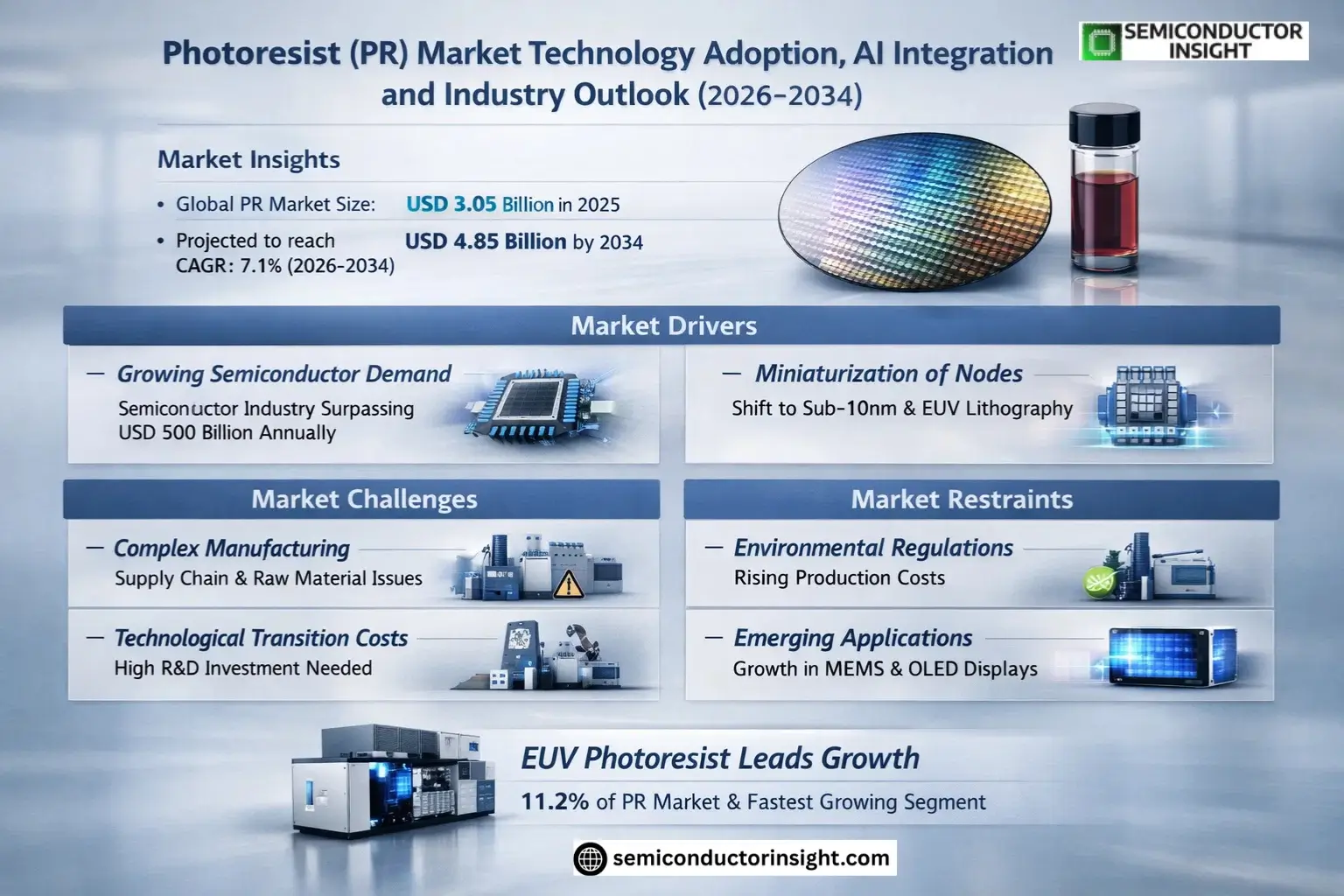
Global Photoresist (PR) Market size was valued at USD 3.05 billion in 2025. The market is projected to grow from USD 3.27 billion in 2026 to USD 4.85 billion by 2034, exhibiting a CAGR of 7.1% during the forecast period.
Photoresist (PR) is a light-sensitive material used in semiconductor manufacturing to transfer circuit patterns onto silicon wafers through photolithography processes. It plays a critical role in defining microscopic features for integrated circuits and advanced packaging applications. The technology is segmented into various types including EUV, ArFi, KrF, and g/i-line photoresists, each serving different node requirements.
Market growth is driven by increasing semiconductor demand across consumer electronics, automotive, and AI applications, coupled with the transition to smaller process nodes requiring advanced photoresist formulations. While EUV photoresists show the highest growth potential due to their adoption in cutting-edge chips, conventional DUV variants continue dominating volume production for mature nodes.
MARKET DRIVERS
Growing Semiconductor Industry Demand
Photoresist (PR) Market is experiencing significant growth due to the expanding semiconductor industry, with annual revenues surpassing USD 500 billion globally. As chip manufacturers increase production, the demand for advanced photoresist materials has surged by 12% year-over-year. High-volume manufacturing of memory and logic chips requires specialized PR formulations, creating sustained market demand.
Miniaturization of Semiconductor Nodes
The transition to sub-10nm and EUV lithography processes has increased the need for ultra-high-resolution photoresists. Semiconductor fabs now require PR materials with enhanced sensitivity and line-edge roughness control, driving innovation in the Photoresist (PR) Market . The EUV photoresist segment alone is projected to grow at 18% CAGR through 2028.
Additionally, the rise of advanced packaging technologies like 3D IC and fan-out wafer-level packaging is expanding application areas for specialized photoresists beyond traditional front-end processes.
MARKET CHALLENGES
Complex Manufacturing and Supply Chain Constraints
Photoresist production faces challenges due to the high purity requirements and complex chemical formulations needed for advanced nodes. Supply chain disruptions, particularly for key raw materials like photoacid generators (PAGs), have caused price volatility in Photoresist (PR) Market .
Other Challenges
Technological Transition Costs
The shift to EUV-compatible photoresists requires substantial R&D investment and production line modifications, creating barriers for smaller manufacturers in the Photoresist (PR) Market.
MARKET RESTRAINTS
Environmental and Regulatory Constraints
Stringent environmental regulations on chemical formulations and waste disposal are impacting photoresist production costs. Compliance with REACH and other chemical safety standards has increased manufacturing expenses by 15-20% for some PR manufacturers.
MARKET OPPORTUNITIES
Expansion in Emerging Applications
Photoresist (PR) Market is seeing new opportunities in MEMS, advanced displays, and photonics applications. The OLED display photoresist segment is projected to grow at 10% CAGR, driven by demand for high-resolution smartphone and TV displays.
Photoresist (PR) Market Trends
EUV Photoresist Leads Growth in Semiconductor Manufacturing
EUV photoresist is experiencing the fastest growth rate in Photoresist (PR) Market , driven by increasing adoption in advanced semiconductor nodes. While currently representing approximately 11.2% of the total market value, EUV resist demand is expanding rapidly as chipmakers transition to finer geometries below 7nm. The introduction of High-NA EUV lithography systems is further accelerating this trend, requiring enhanced resist formulations that address stochastics, roughness, and sensitivity challenges.
Other Trends
Established DUV Technologies Maintain Market Dominance
DUV photoresists (ArFi, KrF, and g/i-Line) continue to account for about 76% of total market value, supported by their extensive use across multiple semiconductor manufacturing layers. ArFi resists remain particularly critical for immersion lithography applications at 28nm-14nm nodes, while KrF resists maintain strong demand for mature logic and memory production. g/i-Line resists show stability in packaging applications and thick-film processes.
Regional Production Concentration and Supply Chain Dynamics
Japan, the United States, and South Korea collectively dominate over 80% of PR production, with leading suppliers including TOK, JSR, and Shin-Etsu Chemical. Chinese manufacturers are expanding capabilities but currently hold a smaller market share. The industry is witnessing increased investment in domestic supply chains, particularly for EUV and advanced DUV photoresists, as geopolitical factors influence procurement strategies.
Application-Specific Demand Patterns
IC manufacturing represents the largest application segment for photoresists, with advanced packaging showing consistent growth. The market sees differentiation between positive and negative photoresist types, with selection dependent on specific lithography requirements. Emerging memory technologies and specialty ICs are creating new demand patterns across different resist categories.
COMPETITIVE LANDSCAPE
Key Industry Players
Oligopolistic Market Structure with Japanese Dominance in Photoresist Supply
Global Photoresist (PR) Market remains highly concentrated, with the top six suppliers (TOK, JSR, Shin-Etsu, Fujifilm, Sumitomo, Dongjin Semichem) controlling 84.6% market share in semiconductor applications. Japanese manufacturers lead in advanced EUV and ArFi formulations critical for sub-10nm nodes, while Korean and Chinese firms are expanding capabilities in mature node KrF/g-line segments. The competitive landscape reflects technological stratification – EUV resist R&D is limited to 3-4 players with semiconductor-grade purification expertise, whereas over 20 suppliers compete in packaging-grade g/i-line materials.
Regional specialization is evident, with Chinese domestic suppliers like Red Avenue and Crystal Clear Electronic Material capturing 32% of China’s KrF demand as supply chain security concerns grow. In specialty segments, Merck KGaA (AZ Electronic Materials) and Allresist GmbH maintain leadership in e-beam resists for mask making, while DuPont’s Photopure portfolio targets advanced packaging applications. Emerging competition comes from SK Materials Performance (SKMP) in South Korea and PhiChem’s high-refractive-index resists for 3D NAND applications.
List of Key Photoresist Companies Profiled
- TOKYO OHKA KOGYO CO., LTD. (TOK)
- JSR Corporation
- Shin-Etsu Chemical Co., Ltd.
- DuPont de Nemours, Inc.
- FUJIFILM Holdings Corporation
- Sumitomo Chemical Co., Ltd.
- Dongjin Semichem Co., Ltd.
- Merck KGaA (AZ Electronic Materials)
- Allresist GmbH
- Futurrex, Inc.
- KemLab™ Inc.
- Shanghai Sinyang Semiconductor Materials
- Red Avenue New Materials Group
- Crystal Clear Electronic Material Co., Ltd.
- PhiChem Corporation
Segment Analysis:
| Segment Category | Sub-Segments | Key Insights |
| By Type |
|
DUV Photoresists dominate the market as foundational lithography solutions.
|
| By Application |
|
IC Manufacturing leads application segments with critical lithography requirements.
|
| By End User |
|
Foundries represent the most demanding photoresist consumers.
|
| By Technology Node |
|
Advanced Nodes drive the most sophisticated photoresist development.
|
| By Imaging Mechanism |
|
Positive Photoresists dominate semiconductor manufacturing applications.
|
Regional Analysis: Asia-Pacific Photoresist (PR) Market
Japan: Technology Leader in Photoresist Development
Japan continues to set industry benchmarks in photoresist development for advanced nodes, particularly in EUV and multi-patterning applications. Domestic manufacturers are investing heavily in photosensitive polymer research to meet exacting semiconductor fabrication standards.
The Kanto and Kansai regions host concentrated photoresist production clusters with integrated material supply chains. This geographic concentration enables rapid technology transfer between chemical suppliers and semiconductor manufacturers across the Photoresist Market value chain.
Growing adoption of 3D IC packaging and fan-out wafer-level packaging in Japan drives specialty photoresist requirements. Manufacturers are developing novel formulations to address increasing complexity in heterogeneous integration applications within the Photoresist Market.
National initiatives like the Leading-edge Semiconductor Technology Center foster public-private partnerships in photoresist innovation. These programs support next-generation material development crucial for maintaining competitiveness in the global Photoresist Market.
South Korea
South Korea’s Photoresist (PR) Market benefits from the world’s largest semiconductor manufacturing base led by Samsung and SK Hynix. The region demonstrates strong expertise in high-volume production of memory-optimized photoresists. Domestic consumption of photoresists remains robust due to ongoing expansions in DRAM and NAND flash manufacturing. Korean chemical companies are making strategic investments to localize critical photoresist formulations and reduce import dependency. The market faces challenges from tightening export controls on advanced photoresist technologies, prompting accelerated domestic R&D efforts.
China
China’s Photoresist (PR) Market is experiencing rapid growth driven by government-led semiconductor self-sufficiency initiatives. Domestic manufacturers are scaling up production of mature-node photoresists while making progress in advanced formulations. Regional differences exist with stronger photoresist capabilities in the Yangtze River Delta cluster. The market benefits from substantial state funding but still depends on imports for high-end semiconductor photoresists. Trade restrictions have accelerated localization efforts across the photoresist supply chain.
Taiwan
Taiwan plays a pivotal role in the global Photoresist (PR) Market as home to the world’s largest pure-play foundries. The region’s semiconductor ecosystem creates sustained demand for diverse photoresist formulations. Taiwanese manufacturers maintain strong partnerships with international photoresist suppliers while developing specialty products for advanced packaging. Market dynamics reflect the need for tailored solutions across logic, memory, and emerging applications like silicon photonics in Taiwan’s Photoresist Market.
Southeast Asia
The Southeast Asian Photoresist (PR) Market is emerging as a growth area with expanding back-end semiconductor operations. Countries like Singapore and Malaysia are developing photoresist application expertise for packaging and testing. The region benefits from proximity to major chip manufacturers and serves as a strategic location for photoresist distribution hubs. Market growth potential exists in supporting the regional semiconductor ecosystem expansion.
Report Scope
This market research report provides a comprehensive analysis of the Photoresist (PR) Market , covering the forecast period 2025–2034. It offers detailed insights into market dynamics, technological advancements, competitive landscape, and key trends shaping the industry.
Key focus areas of the report include:
- Market Overview: The report begins with an overview outlining its current market scenario, key growth indicators, and industry transformation drivers. It discusses macroeconomic factors, demand–supply balance, regulatory landscape, and the strategic role of photoresists in semiconductor manufacturing across industries such as automotive, telecommunications, consumer electronics, and industrial automation.
- Market Size & Forecast: Historical data and future projections for revenue, unit shipments, and market value across major regions and segments.
- Segmentation Analysis: Detailed breakdown by product type (EUV, ArFi, KrF, g/i-Line), technology, application (IC manufacturing, advanced packaging), and end-user industry to identify high-growth segments.
- Regional Insights: Insights into market performance across North America, Europe, Asia-Pacific, Latin America, and the Middle East & Africa, including country-level analysis.
- Competitive Landscape: Profiles of leading market participants including TOKYO OHKA KOGYO (TOK), JSR, Shin-Etsu Chemical, DuPont, and Fujifilm, with their product offerings and market strategies.
- Technology Trends & Innovation: Assessment of emerging technologies including High-NA EUV, fabrication techniques, and evolving industry standards.
- Market Drivers & Restraints: Evaluation of factors driving market growth along with challenges, supply chain constraints, regulatory issues, and market-entry barriers.
- Stakeholder Insights: Strategic opportunities for suppliers, OEMs, investors, and policymakers in the photoresist ecosystem.
Primary and secondary research methods are employed, including interviews with industry experts and data from verified sources to ensure accuracy of insights.
FREQUENTLY ASKED QUESTIONS:
What is the current market size of Photoresist (PR) Market?
-> Photoresist (PR) Market size was valued at USD 3.05 billion in 2025. The market is projected to grow from USD 3.27 billion in 2026 to USD 4.85 billion by 2034, exhibiting a CAGR of 7.1% during the forecast period.
What is the growth rate of Photoresist (PR) Market?
-> The market is expected to grow at a CAGR of 7.1% during 2025-2034.
Which key companies operate in Photoresist (PR) Market?
-> Key players include TOKYO OHKA KOGYO (TOK), JSR, Shin-Etsu Chemical, DuPont, Fujifilm, Sumitomo Chemical, Dongjin Semichem, with top 6 players holding 84.6% market share.
What are the major photoresist types?
-> Dominant types are ArFi (26.1%), KrF (25.5%), and g/i-Line (24.6%) which collectively account for 76% of market value. EUV photoresists are the fastest-growing segment.
Which region dominates the market?
-> Asia-Pacific dominates with key production in Japan, South Korea and China, supported by semiconductor manufacturing hubs.
Get Sample Report PDF for Exclusive Insights
Report Sample Includes
- Table of Contents
- List of Tables & Figures
- Charts, Research Methodology, and more...
 Download Sample Report PDF