SEMICONDUCTOR INSIGHT
MARKET RESEARCH REPORT

High-power GaN Devices for EV Market

2026 to 2034
MARKET INTELLIGENCE
ACROSS KEY REGIONS
2026 EDITION
POWER ELECTRONICS Semiconductor Market Research

High-power GaN Devices for EV Market

◷
UPDATED 26 October 2026
▤
REPORT LENGTH Detailed Report
▣
REPORT CODE 7c6446dad17d
▯
FORMATS PDF

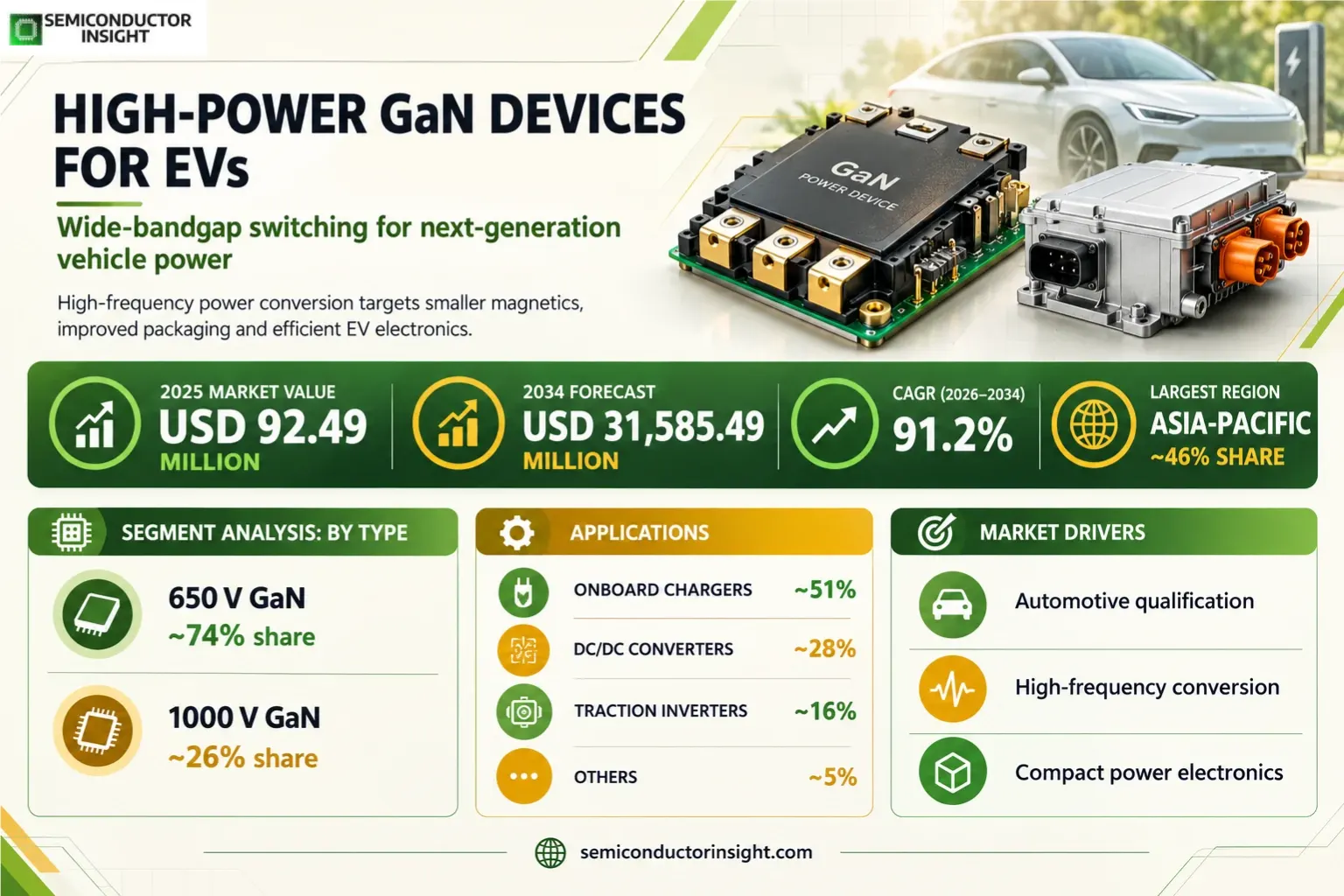
High-power GaN devices for EV market was valued at USD 92.49 million in 2025 and is projected to reach USD 31,585.49 million by 2034, representing a CAGR of 91.2% across 2026–2034. Asia-Pacific held the largest estimated regional position in 2025 at ~46%, where vehicle-electronics manufacturing and emerging automotive-grade GaN supply intersect.

Get the sample PDF with study scope, segmentation and methodology details.

Key Statistics

2025 Market Size
USD 92.49 million
2034 Projected Size
USD 31,585.49 million
CAGR (2026–2034)
91.2%
Largest Market in 2025
Asia-Pacific (~46%)

Key Takeaways

  • Market size and trajectory. The global market measured USD 92.49 million in 2025 and is projected at USD 31,585.49 million in 2034, equivalent to 91.2% growth compounded through the 2026–2034 forecast window; the accelerated curve incorporates early automotive validation, small initial device shipments and later design-win conversion rather than a mature semiconductor replacement cycle.
  • Voltage-class balance. 650 V GaN commands an estimated ~74% of 2025 device revenue because onboard charger and converter topologies have clearer qualification pathways, whereas 1000 V GaN begins at ~26% and is modeled to grow faster at ~98.5% CAGR as higher-voltage vehicle architectures develop.
  • Application economics. Onboard Battery Chargers lead with about ~51% of 2025 value, followed by DC/DC Converter at ~28%; Traction Inverter, with a smaller ~16% starting share, exhibits the fastest modeled application expansion at ~99.0% CAGR, subject to difficult thermal and fault-management requirements.
  • Geographic concentration. Asia-Pacific accounts for an estimated ~46% in 2025, ahead of North America (~25%) and Europe (~21%); its projected ~93.0% regional CAGR reflects supplier ecosystems and local vehicle integration, with South America carrying a higher growth rate from a far smaller installed base.
  • Commercialization restraint. Automotive life testing, fault tolerance, die-to-package integration and competition from qualified silicon carbide devices constrain the speed of production awards; technical announcements must not be confused with delivered high-power GaN semiconductor revenue.

High-power GaN Devices for EV Market Overview

High-power GaN devices for EV market was valued at USD 92.49 million in 2025 and is projected to reach USD 31,585.49 million by 2034, representing a CAGR of 91.2% across 2026–2034. Asia-Pacific held the largest estimated regional position in 2025 at ~46%, where vehicle-electronics manufacturing and emerging automotive-grade GaN supply intersect.

Base year: 2025 · Estimated year: 2026 · Forecast period: 2026–2034 · Historical data: 2020–2024 · Values in USD million

High-voltage gallium nitride switches are power semiconductors intended to transfer electrical energy with limited switching loss at higher frequencies than many conventional silicon architectures permit. Vehicle designers evaluate them principally in onboard charging and high-voltage-to-low-voltage conversion, where smaller inductors, transformers and thermal hardware can improve packaging flexibility. Commercial demand does not arise simply when electric-vehicle registrations increase: each approved converter platform must pass stringent electrical, environmental and production controls before semiconductor bills of materials can translate into recurring deliveries.

The revenue boundary is the high-power GaN switching device and qualifying integrated GaN power IC used in electric-vehicle power conversion, including prototype shipments, development and non-recurring engineering, pilot units and volume components. It covers the publisher-defined 650 V and 1000 V type classes and the four stated end uses: Onboard Battery Chargers, Traction Inverter, DC/DC Converter and Others. Vehicle sales, complete onboard chargers, traction inverter assemblies, offboard charging stations, standalone silicon or SiC components, and radio-frequency GaN unrelated to traction and vehicle electricity are excluded from device revenue.

Converter architecture governs semiconductor adoption. An onboard charger rectifies grid input and controls the battery charging profile; its power-factor-correction stage, isolated converter and magnetics must operate under varying line conditions. A DC/DC unit instead bridges a traction battery and lower-voltage distribution rail. A traction inverter experiences a markedly different envelope of regenerative energy, surge currents and high thermal cycling. The same nominal voltage rating therefore does not imply interchangeable switch qualifications or an equal opportunity to displace established silicon carbide modules.

Automotive qualification moved from a laboratory promise toward practical program evidence in 2025. Navitas announced GaNSafe high-power integrated circuit compliance with the AEC-Q100 and AEC-Q101 qualification frameworks in April, while an Innoscience and Inovance Automotive announcement in December described a 6.6 kW onboard-charger and DC/DC system integrated into Changan vehicles. Those signals establish concrete technical routes but do not establish that the whole projected market has already shifted to GaN. Component purchasing remains conditioned on lifetime reliability, failure containment and a defensible total-system cost comparison.

The unusually steep modeled revenue path results from a very small historical starting point and a wide gap between demonstration programs and eventual broad design adoption. The financial curve is consequently more sensitive to qualification delays and competing device economics than a conventional automobile production forecast. Modern automotive electronics can use a combination of GaN, silicon carbide and improved silicon in separate functional stages; leading suppliers accordingly compete through application engineering, gate driving, protection, supply assurance and proof of reliability rather than through a single headline efficiency claim.

Segment Analysis: By Type

The product segmentation has precisely two published voltage classes: 650 V GaN and 1000 V GaN. The 650 V family holds an estimated ~74% of 2025 sales and grows at roughly ~88.0% annually in the modeled allocation. The 1000 V class contributes ~26% initially and has the higher projected growth rate, ~98.5%, because applications at elevated dc-link voltage remain less mature and require more extensive architecture testing.

Type Function Market position
650 V GaN This voltage class addresses high-frequency converter stages where operating voltage, voltage derating and transient margins suit a 650 V-rated switch. Automotive onboard chargers and some battery-to-accessory conversion designs can benefit from smaller magnetic components and rapid switching, but engineers still have to control electromagnetic emissions, switching overshoot and parasitic inductance. Integrated gate drive and fast fault protection are often as important as nominal conduction losses for system acceptance. Largest type, an estimated ~74% of 2025 revenue. The modeled ~88.0% CAGR reflects greater design maturity and existing supplier demonstrations rather than a guarantee of ubiquitous automotive production. Infineon, Navitas, Renesas and several other suppliers offer relevant high-voltage GaN platforms, yet individual catalogue ratings and automotive certification differ. Suppliers win commercial placement by converting test-board performance into qualified converter assemblies while meeting thermal, traceability and field-failure targets over a vehicle service life.
1000 V GaN The higher-voltage class is positioned for conversion tasks that seek additional voltage headroom as EV platforms raise electrical bus voltages and transient stresses. Because this device category is at an earlier commercial stage, future penetration depends on stable dynamic resistance, repeatable high-voltage fabrication and package insulation performance. Vehicle manufacturers need simultaneous verification of short-circuit behavior, fault isolation, thermal cycling and control-board compatibility before awarding multi-year production sourcing. Fastest-growing type, ~26% estimated share with ~98.5% modeled CAGR. Its forecast reflects a later technology adoption curve from a smaller base, not a claim that all 800 V traction designs already purchase 1000 V GaN. Semiconductor companies face entrenched SiC competition in highly stressed drivetrain applications, and a perceived die efficiency advantage can be offset by extra protective circuitry or qualification expense. Product announcements at 700 V and 1200 V are technology context rather than additional members of the fixed type segmentation.

Segment Analysis: By Application

Demand is divided into Onboard Battery Chargers, Traction Inverter, DC/DC Converter and Others. In the modeled 2025 mix, onboard chargers lead at ~51%, ahead of DC/DC converters (~28%), traction inverters (~16%) and other automotive power functions (~5%). Traction conversion grows fastest at an estimated ~99.0% CAGR, but the absence of uniformly qualified GaN traction platforms makes its projected growth materially riskier than the established charger development path.

Application Demand characteristics
Onboard Battery Chargers Largest application at ~51% of 2025 value; modeled ~89.0% CAGR. This buyer requires stable operation across AC line conditions, dependable bidirectional power handling when specified, safety isolation and predictable thermal behavior in a tightly packaged housing. A conversion-stage design win can require months of electromagnetic compatibility testing and vehicle-level validation. The reported Changan 6.6 kW integration is a tangible illustration of how qualifying semiconductors become part of complete charger platforms, without making the finished system price part of the device market.
Traction Inverter Estimated ~16% share; highest application expansion at ~99.0% CAGR. Inverter semiconductor selection hinges on continuous current, transient overvoltage, repeated acceleration and regeneration pulses, and failure containment at high temperature. Wide-bandgap efficiencies offer substantial theoretical benefits, but major automakers have well-developed silicon-carbide sourcing and cooling strategies. GaN therefore encounters the longest verification path in this application, with opportunities concentrated in novel inverter designs that can exploit high switching frequency without adding unacceptable protection complexity.
DC/DC Converter Estimated ~28% share; modeled ~91.0% CAGR. High-voltage-to-low-voltage converters supply vehicle electronics, auxiliary batteries and increasingly demanding electrified subsystems. Their operating envelopes can be better matched to high-frequency GaN design than the full traction inverter, particularly where converter mass and magnetic volume are limiting. Suppliers must still meet the customer’s isolation, load-dump resilience and functional-safety requirements. Procurement tends to follow platform-level electronic control unit approvals rather than purchases of generic power FETs from distribution inventory.
Others Estimated ~5% of initial revenue; modeled ~83.0% CAGR. This residual application category covers eligible power-switching functions beyond the three primary automotive groups, such as specialized auxiliary conversion or experimental electric-drive architectures. It does not include public fast-charging station installations, the cost of battery packs or other unrelated power semiconductors. Qualification proceeds in fragmented projects with smaller initial bill-of-material commitments. Different thermal environments and switching duties limit the extent to which one catalogue device can serve every niche vehicle subsystem.

Routes to market diverge by application. An onboard-charger integrator may coordinate switch design with the control electronics supplier, while an automaker’s traction team runs prolonged qualification alongside an inverter manufacturing partner. Auxiliary DC/DC designs often evaluate packaging and isolation at the subsystem tier before the OEM makes a sourcing commitment. These channels reward direct engineering support and automotive-grade process documentation, even where catalogued components appear electrically similar. Prototype unit purchases are not automatically evidence of a production contract or a stable annual attach rate.
High-power GaN Devices for EV Market market Size, Share, & Growth, 2026-2034

Regional Analysis

Asia-Pacific represents an estimated ~46% of the high-power automotive GaN device market in 2025, followed by North America (~25%) and Europe (~21%). The regional model reflects where EV powertrain electronics are assembled, where qualification engineering occurs and which component platforms can access automotive production awards. Asia-Pacific grows at approximately ~93.0% CAGR through 2034, with South America potentially faster at ~95.0% from a smaller commercial starting point.

Where do GaN component makers encounter distinct vehicle commercialization requirements?

China-centered manufacturing provides an immediate link between GaN wafer fabrication, converter design and passenger-car assembly, whereas the United States emphasizes device innovation and OEM validation. European automotive suppliers prioritize long-term qualification, repairability and safety documentation. South American projects largely depend on imported vehicles or electronic assemblies, and Middle Eastern opportunities often arrive through technology partnerships rather than a large domestic passenger-vehicle power-device factory base. These differences matter because a quoted EV production target is not a direct measure of GaN switch purchases; qualified converter content and local semiconductor sourcing determine the value attributable to this market.

Region Position Growth outlook Demand profile What decides supplier selection
Asia-Pacific Largest (~46% share, 2025) Modeled ~93.0% CAGR through 2034 China vehicle platforms, Japanese power electronics and South Korean battery-system design form a multi-country engineering base. This network can connect high-voltage device testing with converter layout and vehicle-platform engineering, shortening exchanges over magnetic components and thermal requirements. Its 2025 estimated position is a regional device model, rather than a count of automobiles or production sites. Local integration support, automotive quality systems and repeatability across 650 V production lots determine whether a supplier enters a vehicle program. OEM release is separate from component availability, requiring traceable process changes and verification under cycling conditions. Strong nearby engineering networks help coordinate fault-response design, but they do not waive vehicle-level electromagnetic compatibility screening.
North America Second largest (~25% share, 2025) Modeled ~87.0% CAGR through 2034 EV component developers and semiconductor designers influence standards and design architectures even when physical assembly occurs abroad. Automotive engineering laboratories assess device protection, control-loop response and package layout before purchasing switches in meaningful quantities. This separation between development and assembly makes semiconductor design influence a more useful market signal than locating the final vehicle assembly plant. Automotive reliability records, secure supply agreements and design-in cooperation between switch companies and Tier 1 module suppliers are essential. Contract discussions include traceability, approved manufacturing locations, production-change notices and failure analysis support. A technology developer may supply engineering samples in one calendar year while an independent system integrator controls the later manufacturing nomination and shipment schedule.
Europe Third largest (~21% share, 2025) Modeled ~91.0% CAGR through 2034 Premium vehicle electrical architectures and strong power-electronics engineering attract higher-voltage feasibility programs. The demand profile is often specification-led: manufacturers investigate converter efficiency across temperature, fault containment and long-term component stability. Such work can support technically advanced semiconductor adoption, although incumbent power devices already satisfy many established platform requirements and create meaningful switching costs. Customer release procedures, functional safety assessments and the ability to document lifetime operation carry greater weight than catalogue availability. A candidate device must withstand qualification at the converter and vehicle levels, with thermal margins and electromagnetic emissions evaluated under changing loads. Technical documentation and service continuity are therefore central to sourcing outcomes throughout the multi-year launch cycle.
South America Developing (~5% share, 2025) Highest modeled ~95.0% CAGR through 2034 Vehicle assembly and import channels transmit adoption indirectly through selected EV platforms and localized power-electronics integration. Most prospective semiconductor sales are embedded in supplied charger and inverter assemblies rather than orders from a local wafer facility. Timing is highly program-specific, and the small modeled base creates high sensitivity to even a few approved converter design changes. Price sensitivity, service infrastructure and continuity of imported converter supply are decisive because semiconductor wafer capacity is limited. OEM purchasing must verify that improved switching efficiency compensates for greater qualification and spare-part costs. Buyers also need assurance that replacement modules can be obtained throughout a fleet service cycle, particularly when component manufacturing and final vehicle assembly are geographically separated.
Middle East & Africa Emerging (~3% share, 2025) Modeled ~89.1% CAGR through 2034 New mobility manufacturing initiatives coexist with markets relying on imported electric-vehicle systems and charging hardware. The immediate market for high-voltage GaN devices is consequently uneven among individual countries and depends on participating vehicle brands. Hot-climate reliability, module cooling and technical service are concrete design considerations, while broad clean-transport investment figures are not semiconductor revenue. A credible after-sales chain and heat-resistant system qualification are important before component specifications move to repeat vehicle orders. New semiconductor sourcing must align with the actual electrical platform, isolation requirements and maintenance regime used by the fleet. Regional system partners need stable component availability and documentation covering field failures, not simply a demonstration that a device achieves fast switching in the laboratory.

Asia-Pacific LARGEST · ~46% SHARE

Why is Asian EV electronics integration the first commercialization center?

An estimated ~46% of 2025 revenue belongs to Asia-Pacific, with a modeled ~93.0% CAGR through 2034. Vehicle platform supply chains connect GaN foundry manufacturing, high-frequency converter design and OEM production engineering within comparatively short distances, although no regional share is a directly reported audited device figure. China creates the most visible near-term deployment path; Japan and South Korea provide advanced automotive electronics programs whose adoption follows separate qualification and manufacturing schedules.

Market positionLargest region: ~46% of 2025 device sales
Growth outlook~93.0% annual modeled expansion, 2025–2034
Demand profileOnboard chargers and power-conversion integration
Market access gateMulti-year automotive release and process traceability
Country Position in region What drives demand
China Vehicle integration center China combines power-semiconductor manufacturing with a large vehicle engineering and electronics assembly base. Suppliers can place 650 V switches into converter design projects while coordinating package, substrate and thermal improvements with local Tier 1 partners. A platform that uses GaN for a 6.6 kW charging function still represents a specific component purchase, not the entire cost of the charger or automobile. Chinese customer validation can therefore turn technical demonstration into repeat qualification work before revenue becomes broad based.
Japan Materials and reliability hub Japanese automakers and electronics suppliers evaluate high-frequency power conversion against demanding environmental and warranty conditions. Suppliers compete through lifetime drift measurement, consistent thermal design and predictable gate behavior during repeated switching. The country has deep automotive semiconductor expertise, yet the final manufacturing location of an EV should not be inferred from where its switching chip was designed. Collaborations may begin with engineering samples before the purchasing organization authorizes source approval for a new converter family.
South Korea Battery-system design influence South Korean vehicle and battery manufacturing ecosystems provide opportunities for new high-voltage auxiliary power designs. Component qualification intersects with pack voltage strategies, on-board charging requirements and long-standing inverter supplier relationships. Switching-frequency improvements become useful only if they reduce magnetic volume or cooling burden at the complete converter level. For 2025 programs, semiconductor designers need to demonstrate robust load transitions and fault recovery rather than simply advertise a smaller die or a higher laboratory efficiency reading.

Market instances

  • Changan onboard-charger deployment. In December 2025, Innoscience and Inovance Automotive reported installation of a 6.6 kW GaN-based on-board charger and DC/DC system in Changan vehicles using 650 V devices. The commercial implication is significant because it joins high-voltage switches with a named production vehicle platform and a complete power-conversion architecture. The announcement is evidence of an integrated design, while the device shipment value must remain distinct from the 6.6 kW electrical rating.
  • Inovance converter engineering. The co-development arrangement described a two-in-one power system that combines battery charging and DC/DC conversion instead of treating each function as an isolated electronics box. This layout rewards reduced magnetics and coordinated switching strategies, but it also demands strong electromagnetic-interference control and fault segregation. Equipment integrators choosing components in 2025 and 2026 consider both semiconductor performance and the system engineering required to make the complete assembly serviceable.
  • Industrial-scale qualification pathway. Asian suppliers can make power-device decisions earlier in converter development when die production, package assembly and OEM feedback are coordinated locally. That advantage does not bypass automotive audit requirements. For a 2026 sourcing award, purchasers still review process changes, long-duration stress testing, traceability and capacity to deliver the same electrical characteristics across many wafers. The business consequence is a higher chance of iterative engineering orders, with larger revenue contingent on final platform approval.
In the full report: Country-level device share, automotive GaN supplier positioning, modeled 2025–2034 performance and integration partnerships across China, Japan, South Korea, India and the wider region.

North America SECOND LARGEST · ~25% SHARE

What gives North America commercial influence without every component being made locally?

North America holds an estimated ~25% of the 2025 global GaN device market in this model, advancing at ~87.0% CAGR through 2034. Semiconductor design teams, qualification facilities and electric-vehicle system architects influence device requirements before volume commitments are made. Their leverage lies in intellectual property, safety validation and automotive customer relationships; manufacturing may nevertheless involve distributed foundry and assembly locations. The customer’s vehicle program controls the final revenue opportunity more directly than regional chip design employment or broad EV sales figures.

Market positionSecond position: ~25% share in 2025
Growth outlook~87.0% modeled CAGR to 2034
Demand profileAdvanced power-IC architecture and design validation
Market access gateOEM sourcing approval and qualified package availability
Country Position in region What drives demand
United States Design and qualification focus The United States hosts major GaN architecture, protection-circuit and automotive application-engineering efforts. Navitas, Texas Instruments and other suppliers illustrate the breadth of power-device innovation, though a company-wide sales result should never be read as domestic electric-vehicle GaN revenue. A 650 V product release can stimulate evaluation boards and pilot converters, but winning a supply agreement requires customer-specific thermal reliability, documented test results and compatible gate-driving behavior on an actual vehicle electrical platform.
Canada Engineering and fleet adjacency Canadian automotive electronics engineering, research institutions and cross-border vehicle supply chains can contribute to EV power component specifications. Procurement influence may be exercised through North American system integrators rather than through stand-alone domestic GaN manufacturing plants. Converter efficiency matters particularly for space-constrained fleet applications where mounting position and cable layout drive thermal conditions. A 2025 design effort can influence future purchasing without implying that every vehicle assembled in Canada incorporates GaN switches.
Mexico Automotive assembly interface Mexico occupies a manufacturing link in the continental vehicle ecosystem, where electrical assemblies designed elsewhere are integrated into automobile production. Opportunities for high-power GaN arise when a qualified onboard-charger or converter platform is built into an OEM program using local supply-chain capacity. The limiting factor is normally specification and supplier release, not the existence of a general vehicle assembly line. A component imported in 2026 may enter a Mexican-produced module without any local wafer fabrication.

Market instances

  • High-power IC automotive qualification. Navitas disclosed in April 2025 that its high-power GaNSafe devices met both AEC-Q100 and AEC-Q101 qualification frameworks, connecting an integrated driver and protection concept with automotive component screening. This milestone is commercially different from a generic power FET catalogue entry because vehicle customers demand repeatable defect performance over long operating periods. The announcement concerns qualifying device technology rather than audited GaN content per car or a confirmed multi-year order book.
  • Protected switch architecture. The GaNSafe platform integrates sensing and protection around a high-speed power stage, addressing a problem encountered when GaN switching is pushed into compact automotive converter layouts. Short-circuit detection, controlled slew rates and integrated fault behavior can simplify validation across many load states. North American engineering teams evaluate the complete electrical response in 2025 and 2026 rather than using just nominal rated voltage as a purchasing shortcut.
  • Renesas ownership transition. Renesas completed its purchase of Transphorm in June 2024, moving the acquired SuperGaN technology into a broader semiconductor portfolio. For the American automotive engineering ecosystem this changes supplier continuity: customers reviewing a legacy product family must now assess Renesas support, manufacturing roadmaps and future device releases. The acquired company remains historically relevant, but attributing it a separate current market competitor position would misrepresent ownership of the technology.
In the full report: US, Canadian and Mexican buyer requirements, device-qualification milestones, component sourcing pathways and the estimated shift in 650 V versus 1000 V products.

Europe THIRD LARGEST · ~21% SHARE

How does a European automotive qualification culture affect GaN adoption?

Europe accounts for an estimated ~21% of global 2025 high-power EV GaN device value, with a modeled ~91.0% CAGR through 2034. Premium automotive manufacturers and power-electronics engineering groups examine switching components through safety, durability and control-system standards rather than relying on demonstrations alone. Applications with difficult cooling or packaging constraints may benefit from a GaN topology, but established silicon carbide sourcing relationships and the need for predictable field service limit rapid substitution in traction powertrains.

Market positionThird position: ~21% of 2025 sales
Growth outlook~91.0% modeled annual growth through 2034
Demand profilePremium converter architecture and qualified suppliers
Market access gateFunctional safety evidence and long service life
Country Position in region What drives demand
Germany OEM validation gatekeeper German automobile manufacturers and first-tier suppliers subject traction and charging electronics to extensive thermal, reliability and system-level testing. Infineon’s power-device portfolio provides nearby technology expertise, but a 650 V production transistor should not automatically be classified as an automotive GaN supply award. High-switching-frequency components are assessed against converter efficiency, noise emissions, lifetime drift and maintainability. Procurement teams generally require documentary proof for package changes and second-source arrangements before authorizing vehicle-platform release.
France Power converter ecosystem French power-electronics design and semiconductor engineering can support compact GaN converter evaluation alongside European vehicle platforms. STMicroelectronics offers 650 V integrated half-bridge GaN products that illustrate component-level capability, yet individual automotive applicability requires separate validation. The country’s opportunities include specialized converter control and high-density packaging rather than only direct passenger-car assembly. In 2025 and later, success depends on linking test-lab results to the functional and economic criteria of a particular vehicle system.
Italy High-frequency conversion design Italian industrial electronics and automotive supply chains create opportunities for integrated power stages used in auxiliary conversion and test platforms. The ability to support controlled switching edges and electromagnetic compatibility is particularly relevant when mechanical room for filtering is limited. GaN suppliers must coordinate thermal layout and driver behavior with the system builder because a fast device can increase unwanted noise if integration is poor. Revenue follows released components rather than general innovation announcements from adjacent industrial markets.

Market instances

  • CoolGaN product-platform expansion. Infineon introduced a new generation of 650 V CoolGaN power discretes in November 2024, providing a technical foundation for more efficient high-frequency conversion. Automotive revenue requires additional customer-specific release activity, so this announcement is adjacent capability rather than proof of EV shipment volume. European system integrators can use such products in early trials while qualifying boards, magnetics and filtering through complete converter testing.
  • Bidirectional switching roadmap. In May 2025, Infineon publicized a 650 V bidirectional CoolGaN switch concept that can simplify selected power-conversion structures. Electric-vehicle charger designers have an interest in reversible energy flow, but architecture selection depends on isolation requirements, current paths and regulatory approval. The commercial lesson is that a switching topology may offer a cost and space advantage without immediately changing the number of qualified automotive semiconductor sources.
  • Integrated half-bridge selection. STMicroelectronics MasterGaN component families combine 650 V power switching and drive circuitry in highly integrated assemblies intended for power conversion. European engineers can compare their switching behavior and board-level component count with discrete-device options during 2025 design work. Product data provides useful adjacent technical evidence; it is not, by itself, confirmation that the entire MasterGaN catalogue meets every automotive environmental qualification requirement.
In the full report: Germany, France, Italy and other European vehicle program analysis, technical approval steps, cross-border procurement patterns and region-specific share scenarios.

South America DEVELOPING · ~5% SHARE · FASTEST-GROWING

Why can South America grow quickly without becoming a major chip fabrication base?

An estimated ~5% of the 2025 device market is allocated to South America, with an illustrative ~95.0% CAGR toward 2034. Low initial deployment and greater exposure to imported vehicle platforms make growth rates sensitive to a small number of program selections. Regional revenue depends mainly on semiconductor content delivered through approved chargers, converters and assembled EVs; charging infrastructure expenditure or vehicle fleet size cannot be directly reclassified as local semiconductor purchases.

Market positionEmerging market: ~5% share in 2025
Growth outlook~95.0% modeled annual growth to 2034
Demand profileImported converters and selected assembly programs
Market access gateCost, service support and availability of qualified parts
Country Position in region What drives demand
Brazil Primary vehicle-market gateway Brazil provides the region’s broadest industrial framework for automobile production and local component integration. Converter technology may be introduced through vehicles developed under overseas electrical architectures and then adapted to domestic operating environments. Qualified GaN chip adoption depends on the parts specified by the responsible Tier 1 supplier, not solely on government electrification targets. A 2026 switch substitution must also justify cost and after-sales reliability against proven alternatives serving the same charging function.
Argentina Vehicle assembly connection Argentina participates in regional automotive supply networks where power electronic assemblies often arrive as imported or common-platform components. High-voltage GaN prospects therefore attach to future electrified nameplates and system integration choices rather than a large independent local device-production ecosystem. Automotive buyers weigh currency exposure, replacement-part access and warranty policies in addition to efficiency. Engineering evaluation in one model year should not be interpreted as commercial rollout across the entire national passenger-car fleet.
Chile Import-led electrification Chile’s electrified mobility procurement creates downstream opportunities for efficient charging and auxiliary electronics even when semiconductors are manufactured abroad. Fleet operators focus on uptime, maintenance and charging operations, whereas the GaN market measures only components inside qualifying vehicle power systems. The distinction affects market sizing: a bus charging project may be an indicator of demand for future vehicle electronics but cannot be counted at its whole-project expenditure value. Thermal conditions and service access shape component acceptance.

Market instances

  • Cross-border vehicle platform transfer. Many South American electrification opportunities start with equipment configurations already validated in another geographic market. If the imported onboard charger contains a qualified 650 V GaN device, regional semiconductor demand emerges through finished power-system sourcing rather than a separate national chip manufacturing investment. Tracking platform composition and local production mix in 2026 is more useful than extrapolating semiconductor sales mechanically from vehicle registration growth.
  • Bus-fleet auxiliary conversion. Electric bus duty cycles emphasize continual accessory-power demand, cooling and daily charging availability, creating interest in compact conversion electronics. Whether GaN is appropriate depends on the exact voltage and thermal envelope of each auxiliary power stage. System integrators assess repair capability and fleet uptime before choosing a higher-switching-frequency topology. An electronic power unit with multiple technologies contributes only its qualifying high-power GaN switch value to this market.
  • Small-base growth sensitivity. A region representing an estimated ~5% of 2025 global device revenue can show strong annual percentage expansion after only a limited number of converter awards. The same arithmetic also makes forecasts vulnerable to postponed vehicle introductions and procurement changes. The regional outlook models ~95.0% growth but should be interpreted as a scenario for component content expansion, not as an assured number of semiconductor wafers produced or EVs sold within South America.
In the full report: Regional comparison of Brazil, Argentina, Chile and additional import-led economies, with automotive subsystem channels and modelled device uptake conditions.

Middle East & Africa EMERGING · ~3% SHARE

Which mobility investments can translate into GaN device demand in MEA?

Middle East & Africa accounts for an estimated ~3% of 2025 sales, expanding at a modeled ~89.1% CAGR through 2034. This region has heterogeneous vehicle assembly capabilities, wide climatic differences and several national initiatives that favor advanced mobility technologies. Near-term semiconductor opportunity is principally associated with imported qualified power converters and partnerships supporting local system integration. High ambient temperatures, warranty servicing and supply continuity are particularly important when considering new switching devices.

Market positionEarly-stage region: ~3% device share in 2025
Growth outlook~89.1% modeled annual growth to 2034
Demand profileMobility investment and import-led EV integration
Market access gateHigh-temperature validation and durable service networks
Country Position in region What drives demand
Saudi Arabia Vehicle manufacturing ambition Saudi Arabia’s new electric mobility manufacturing initiatives may eventually increase local demand for compact vehicle power electronics. The timing of GaN component sourcing will be governed by actual vehicle platform bills of materials, supplier qualification and production readiness rather than investment publicity. Suppliers must address high ambient temperature operation and maintainable cooling solutions. During 2025–2026, research partnerships and pilot assemblies can build engineering familiarity while most qualified devices continue to move through international supply chains.
United Arab Emirates Technology adoption and integration The United Arab Emirates offers a market for advanced electric mobility systems, fleet pilots and new vehicle technology partnerships. Adoption of a qualifying onboard-charger GaN switch depends on the specification of the imported or locally integrated power module. Heat exposure and service expectations create a demanding test environment for high-frequency electronics. Charging-station deployments are commercially relevant to the broader EV transition, but their physical cost must remain outside the defined vehicle-semiconductor revenue boundary.
South Africa Automotive manufacturing bridge South Africa possesses established vehicle production and component logistics capabilities that could transmit future GaN electronics decisions made by international automakers. Market participation is therefore shaped by platform localization, imported automotive-grade components and reliability requirements under diverse operating conditions. A change to onboard charger architecture may require fresh validation of thermal and electrical interfaces across the complete subsystem. Domestic semiconductor fabrication is not a prerequisite for power-device demand, yet its absence limits local production-value capture.

Market instances

  • Hot-weather qualification pressure. High-temperature operating environments increase the importance of junction-temperature control, package robustness and cooling-system design. An EV charger developed for a temperate market may need additional endurance testing before wide deployment in Gulf fleets. Device providers supplying 650 V GaN technology compete partly on credible lifetime data under these conditions. The market effect is to lengthen sourcing qualification even when a new switching stage promises lower conduction loss or smaller magnetic assemblies.
  • Local assembly economics. Vehicle manufacturing partnerships in the Gulf and southern Africa can influence where power electronic modules are assembled, but the semiconductor die may be produced in a wholly different country. This disaggregation matters for 2026 demand estimates because headline facility announcements do not identify the exact GaN content of a vehicle. Purchasing models therefore require the correct bill-of-material slot and platform volumes before they can represent any incremental component opportunity.
  • Service-supported fleet programs. Regional fleets place a high value on spare-part continuity, technician training and consistent converter behavior during repeated charging operations. These requirements favor device suppliers able to support long-lived modules and approved replacements. For an estimated ~3% share market at the 2025 baseline, just a few credible automotive awards could change percentage growth materially. The constraint is converting a promising laboratory component into a maintainable product supported by local service systems.
In the full report: Country breakdowns for Saudi Arabia, UAE, South Africa and other markets, including thermal validation priorities, supply channels and 2025–2034 scenario assumptions.

High-power GaN Devices for EV Manufacturers and Competitive Landscape

Competitive positioning is driven by automotive process controls, device protection architecture, qualified voltage ratings and the engineering support needed for a platform transition. Infineon, Navitas and Renesas have relevant high-voltage product technologies, whereas Texas Instruments offers a broader integrated GaN platform whose specific 600 V examples should not be silently reclassified as the publisher’s 650 V type. The page-defined company roster is preserved for profiling even when individual participants operate in adjacent voltage classes or power-conversion functions.

The commercial contest begins at the system-design bench. A switching transistor can show excellent losses under standardized conditions and still lose an automotive project because its package parasitics, electromagnetic signature, gate drive or fault response do not match the converter architecture. Suppliers that provide validated evaluation boards and detailed aging behavior can shorten qualification discussions. In high-power automotive applications, this system-engineering service often matters more than the number of devices advertised in an online product catalogue.

Navitas occupies an important position in automotive-qualified integrated GaN power circuits, including protected high-power designs intended for chargers and HV-LV converters. Infineon expands high-voltage device options and provides broad process infrastructure for power electronics. Renesas incorporates the acquired Transphorm SuperGaN portfolio within a much larger automotive and industrial semiconductor organization. These firms approach the market through different combinations of discrete switching, integration and design support; revenue is not equivalent to their combined total company sales.

Texas Instruments has a 600 V GaN product with integrated driver, protection and temperature reporting, providing useful evidence about power-stage integration without automatically making that particular part a 650 V automotive device. Power Integrations is important to high-voltage conversion architecture, yet an automotive GaN supplier claim must be tied to a relevant part and qualification. EPC is known principally for lower-voltage enhancement-mode GaN products; its inclusion in a company profile does not mean that every EPC power transistor enters high-power EV traction or charger revenue.

Competition also includes firms outside the inherited headline roster. Innoscience has presented automotive high-voltage GaN applications and vehicle-system cooperation, while STMicroelectronics offers integrated 650 V GaN assemblies useful for adjacent converter benchmarking. Nexperia appears in the publisher company list but specific automotive-qualified high-power GaN design wins require project-level validation before use as a leading share claim. The distinction between technical product capability, automotive qualification and shipped device volumes prevents an overly concentrated depiction of a still-emerging market.

Tier structure

Tier Companies Basis of competition
Tier 1 high-voltage platform suppliers Infineon, Navitas, Renesas These suppliers possess relevant high-voltage GaN power-switch portfolios, integrated protection expertise or acquired device technology together with significant application engineering resources. Market positions depend on 650 V suitability, reliability qualification and an ability to move from samples to controlled production. Tier placement denotes product and automotive commercialization capacity, not a verified company-level market share or an assumption that every device model has already been designed into an EV.
Tier 2 and adjacent component contenders Texas Instruments, Nexperia, Innoscience Integrated power stages, manufacturing capability and application-specific devices support participation in the converter ecosystem, but individual offerings differ materially in voltage and qualification coverage. A 600 V component remains adjacent to the exact 650 V category, and an announced high-power project is not the same as mass production. Competitive advancement requires independently documented product specifications, customer approvals and the ability to maintain tight device parameters through repeated manufacturing lots.
Profiled or ecosystem participants Power Integrations, EPC, Transphorm (historical Renesas subsidiary), STMicroelectronics This grouping distinguishes system-conversion technology, lower-voltage GaN offerings and former ownership identities from current independent high-voltage automotive suppliers. Power Integrations influences converter architecture; EPC products are often below the defined voltage classes; Transphorm was acquired by Renesas in 2024; and ST supplies integrated GaN converter building blocks. These connections may affect future automotive adoption without proving separately attributable high-power vehicle GaN shipments in the forecast period.

Key companies profiled

  • Infineon
  • Texas Instruments
  • Power Integrations
  • EPC
  • Navitas Semiconductor
  • Nexperia
  • Transphorm (acquired by Renesas)
  • Renesas Electronics
  • Innoscience
  • STMicroelectronics

High-power GaN Devices for EV Production Capacity Analysis

GaN device availability depends on epitaxial wafer quality, high-voltage transistor process control, packaging yield, and automotive-grade testing rather than solely on announced wafer starts. Production, qualification and converter integration may take place in different countries, so device manufacturing capacity cannot be inferred from where an electric vehicle is finally assembled. Asia-Pacific has a growing role in upstream device processing; European, Japanese and US companies provide important architecture and validation capabilities.

Power GaN begins with substrate and epitaxial layer manufacturing followed by semiconductor fabrication, device passivation, electrical screening and package assembly. Automotive-grade yield is a tighter constraint than generic device counts because threshold stability, dynamic resistance and repetitive surge behavior must stay within approved specifications. A plant capable of producing devices for adapters or industrial converters is not automatically capable of supplying high-power vehicle parts at equal qualification. The 2025–2034 outlook therefore assumes staged capacity conversion as product lots demonstrate repeatability.

Production diversification is commercially important because vehicle manufacturers dislike single-source exposure in safety-relevant power electronics. Companies may combine external wafer processing with in-house packaging, or qualify several assembly lines over a multi-year introduction period. The actual location of the die, final package and testing station can differ, creating multiple supply-chain origins for one power module. This structure encourages the use of second-source plans, change-control agreements and validated alternatives even if a novel GaN device delivers better switching figures than the incumbent component.

The upstream bottleneck is not simply access to gallium; power-device characteristics depend on epitaxial defects, buffer structures, wafer stress and manufacturing reproducibility. At high voltage, packaging parasitics and surface-field management further influence switching loss and breakdown margins. Automotive sample demand can be met in relatively small lots, but production awards require statistical process control and dependable delivery over years. Capacity comparisons must also separate GaN used in consumer chargers, AI power supplies and industrial converters from qualifying semiconductors intended for vehicle electronics.

High-power GaN Devices for EV Market Dynamics: Drivers, Restraints and Opportunities

The market outlook depends on component qualification converting high-frequency performance into affordable, serviceable vehicle power systems. Design momentum in onboard chargers, compact HV-LV converters, protected power ICs and improved fabrication pushes demand forward. Negative contributions reflect reliability validation costs, silicon carbide competition, manufacturing discipline and program postponements. The contributions in the two impact tables represent an analytical decomposition of the projected industry growth path rather than individually observed growth rates.

MARKET DRIVERS

Drivers Impact Analysis*

Market Drivers Impact Rank CAGR Contribution (%) 2026–2028 2029–2031 2032–2034
Electric-vehicle platform adoption of compact power conversion High +31.20% High High Medium
Automotive-qualified 650 V switch and integrated IC availability High +27.50% High High High
Migration toward higher-frequency onboard charging stages Medium-High +22.10% Medium High High
Converter mass reduction and thermal packaging improvements Medium +15.70% Medium High High
New 1000 V architecture and protection development Low-Medium +10.80% Low Medium High
Others (bidirectional charging, digital control, supplier partnerships, pilot lines) Low +8.30% Low Medium Medium

Electric-vehicle electrical content expands the design funnel

Every additional battery-electric or plug-in hybrid platform creates engineering opportunities for onboard charging, HV-LV conversion and drivetrain power stages. The relevant purchase is the qualified semiconductor device rather than total vehicle revenue. A 2025 model launch may retain silicon-based charging hardware, while a 2027 redesign can create a GaN evaluation opportunity. The projected acceleration therefore depends on platform changeovers that permit engineers to revise magnetics, cooling, gate drivers and electrical safety approval together.

Automotive qualification converts sample interest into sourcing potential

Device manufacturers increasingly document stress testing, fault response and long-term behavior needed by carmakers. Protected power ICs can simplify fault-handling interfaces, but automobile engineers still test the complete converter within specified thermal and electromagnetic limits. The commercial effect of a successful 2025 qualification milestone is to expand the pool of projects that can consider GaN, not to prove that any given proportion of 2034 vehicles will use the technology.

Higher-frequency conversion can shrink magnetics

GaN switches are useful when higher operating frequency enables a more compact magnetic design and acceptable efficiency under real-world load profiles. That system benefit is particularly relevant in onboard chargers sharing narrow packaging space with battery management equipment. Automotive customers evaluate complete loss maps, insulation requirements and noise filtering before assigning a cost advantage. A lower transistor switching loss does not guarantee a cheaper converter if additional shielding or thermal structures offset the saving.

Wider design participation supports higher-voltage devices

A growing group of semiconductor and system companies is investigating higher-voltage power conversion, which could improve development options for the publisher-defined 1000 V class. The engineering challenge is to provide meaningful voltage headroom during repetitive transients while preserving reliable dynamic behavior. Relative growth can be high because the existing application base is small. Suppliers that master packaging, lifetime screening and predictable switching may access new inverter or converter sockets later in the 2026–2034 forecast.

MARKET RESTRAINTS

Restraints Impact Analysis*

Market Restraints Impact Rank CAGR Contribution (%) 2026–2028 2029–2031 2032–2034
Automotive reliability and certification lead times High -10.20% High Medium Medium
Entrenched silicon carbide and silicon converter designs Medium-High -7.00% High High Medium
Dynamic switching and package-integration risk Medium -4.30% High Medium Low
Others (cost volatility, second-source gaps, project deferrals) Low -2.90% Medium Medium Low
*CAGR contribution shows the percentage points each factor adds to or removes from the forecast CAGR for 2026–2034; driver contributions less restraint contributions equal the market CAGR. Period columns rate the strength of each factor in that window.

Lifetime evidence remains slower than laboratory efficiency progress

Power devices in road vehicles face years of temperature cycling, vibration, electrical stress and potentially harsh service environments. Reliability evidence must connect silicon-equivalent expectations with new GaN failure modes, package aging and stable off-state behavior. Even when a prototype achieves an excellent 2026 bench result, production approval can be delayed by a single unclosed qualification issue. Manufacturers consequently invest in field records, sample traceability and process audits before committing to extended output schedules.

Silicon carbide enjoys established traction sourcing channels

Traction inverter purchasing is not a neutral contest of semiconductor datasheets. Automotive suppliers already deploy silicon carbide switches in many high-voltage architectures and have invested in cooling strategies, gate-driving expertise and service records around them. Replacing an approved platform with GaN would require evidence of a material system improvement after factoring in development costs. This competitive inertia is strongest where current pulses, failure containment and broad operating temperature ranges dominate performance requirements.

Rapid switching complicates electromagnetic compatibility

A fast power transition can reduce switching energy but also increase common-mode noise, overshoot and sensitivity to printed circuit board parasitics. These constraints become severe when a converter must fit within a shielded automotive enclosure close to sensitive electronics. Engineers may need more sophisticated gate control, integrated protection or filtering to ensure a safe design. Such additions can undermine the original size or cost case for a device, limiting conversion of prototypes to high-volume awards.

Production yields and program timing add volatility

A new device process must deliver stable electrical characteristics across many wafers and repeated package lots to be useful in a vehicle program. Customers also demand long-term support and notification before material manufacturing changes. Demand forecasts built from announced technology roadmaps may shift when an OEM postpones a platform or changes its preferred power stage. The market is therefore more vulnerable to individual purchasing delays than established automotive silicon businesses with broader installed device portfolios.

MARKET OPPORTUNITIES

Bidirectional onboard charging invites fresh converter layouts

Vehicle-to-home and other controlled bidirectional power paths encourage designers to revisit rectification, isolation and switching arrangements. GaN bidirectional devices can be considered where they reduce component count and preserve acceptable loss and safety margins. The addressable market appears in the switch bill of materials of a successfully qualified vehicle charger, not in the value of home storage equipment or the surrounding grid interface. Suppliers providing reference systems may gain earlier customer engagement.

Protection-rich ICs may shorten engineering iteration

Integrating sensing, gate drive and fault management with a high-frequency transistor reduces some external design dependencies, potentially helping converter developers close short-circuit and thermal requirements. A protected IC also changes procurement priorities from discrete on-resistance alone toward behavior during exceptional operating states. The opportunity is greatest when suppliers can furnish repeatable application test results and clear change-control records. An attractive integrated solution still needs automotive environmental approval before a final 2028 sourcing decision.

Cross-company engineering improves automotive design maturity

Partnerships among power semiconductor producers, microcontroller vendors, converter specialists and carmakers can accelerate controller optimization and power-stage qualification. For example, high-frequency switching benefits from precise timing, monitored fault states and tuned thermal operation across the vehicle voltage range. Commercial success may arise from coordinated reference designs rather than a single winning die technology. Contracts should distinguish the value of engineering services, pilot deliveries and qualified semiconductor shipments within the publisher’s stated revenue object.

Auxiliary converter niches offer manageable initial scale

Smaller vehicle power functions with moderate current and highly constrained packaging may provide a tractable pathway before broad traction adoption. An electric drivetrain includes multiple conversion tasks with different voltage, thermal and safety requirements, so a vendor can build competence in one subsystem without claiming to serve the entire vehicle. This incremental route can support measurable product learning and application-specific differentiation even if the highest-voltage main drive remains dominated by existing technologies.

High-power GaN Devices for EV Supply Chain Analysis

The EV high-power GaN supply chain links epitaxial growth, device fabrication, high-voltage package assembly, driver and protection integration, automotive testing, converter manufacturing and final vehicle approval. Control of a semiconductor platform does not automatically provide ownership of the charger or traction inverter assembly. Buyers evaluate traceability and lifecycle support at each interface because small electrical variations can change losses, noise and long-term performance in tightly controlled automotive modules.

UpstreamGaN epitaxy, substrates, process chemicals and wafer-fabrication equipment.
Manufacturing650 V and 1000 V power devices, packaged ICs, screening and burn-in.
ChannelTier 1 power converter makers, automotive engineers and approved distributors.
DownstreamVehicle onboard chargers, traction designs and high-to-low-voltage converters.

Upstream materials. Epitaxy uniformity, buffer design and substrate stress affect high-voltage device performance before a package is assembled. Material variation can translate into leakage or dynamic resistance spread, which raises qualification work for a vehicle customer. Producers need a stable process window and documented supplier changes across the program life. Sourcing from more than one materials manufacturer can improve continuity but requires parallel verification of wafer properties rather than a simple replacement of vendor paperwork.

Device manufacture. Fabrication and package assembly translate wafer performance into tested automotive components with controlled insulation, parasitic inductance and thermal behavior. High-power GaN production is not interchangeable with consumer adapter manufacturing because the accepted field-failure limits and quality systems differ. Screening must detect unacceptable shifts in threshold or switching response. A package revision during 2027 may create fresh validation obligations even when the nominal component voltage rating remains unchanged.

Commercial channel. Most vehicle semiconductor orders are specified by an OEM or Tier 1 design team long before volume purchase orders appear. Reference designs and engineering samples help a GaN supplier enter consideration, but sustained procurement depends on winning the converter bill of materials and subsequent manufacturing release. Distributor listings can support experimental demand while automotive supply contracts require product-change notices, multi-year traceability and agreed quality response procedures tailored to the vehicle platform.

Vehicle integration. The downstream customer ultimately purchases a power stage that meets vehicle-level safety, efficiency and service requirements. A design change that saves space may be attractive only if it preserves electromagnetic compatibility and can be repaired within the manufacturer’s warranty system. The semiconductor value captured by this market is much smaller than the cost of the complete vehicle subsystem. Quantifying opportunity therefore depends on eligible switch content per charger or converter, not headline expenditure on EVs or charging infrastructure.

Recent Developments in High-power GaN Devices for EV Technology

  • July 2026 Reported
    Innoscience publicized an automotive-grade packaged GaN product distinction at CSPSD 2026, highlighting its work in integrated high-voltage switching. This industry recognition supplies evidence of the manufacturer’s continuing development activity, although an award does not disclose automotive semiconductor shipment totals. For suppliers competing in vehicle electronics, the strategic relevance lies in process consistency, the progression of automotive packages and the ability to support regulated quality documentation alongside application engineers. Source
  • December 2025 Announced
    Inovance Automotive and Innoscience announced that a 6.6 kW GaN-based onboard charging system using 650 V devices had been integrated into Changan vehicles. Their joint disclosure connects high-voltage switching technology with a named system integrator and passenger-car platform. It illustrates one potential route from converter engineering to vehicle installation, while providing no public allocation of the finished charger cost to individual devices or a verified global market-revenue total. Source
  • October 2025 Announced
    Infineon outlined automotive GaN work spanning production-oriented lower-voltage offerings and development of higher-voltage device solutions. The distinction matters because the automotive qualification status of a 100 V product cannot be carried over to an unrelated 650 V or 1000 V component. For EV charger development teams, the announcement signals a wider supplier engineering commitment while leaving model-specific power-device ratings, lifecycle tests and customer sourcing decisions to separate verification. Source
  • June 2025 Announced
    Navitas disclosed a technical collaboration award from VREMT, an automotive power-system organization, following activity in advanced power conversion technologies. The announcement positions the semiconductor developer within an identifiable vehicle electronics supplier ecosystem, but the associated solutions include more than one wide-bandgap material. Market assessment therefore requires separating eligible high-power GaN switching components from silicon carbide elements and from the completed vehicle power-system price. Source
  • May 2025 Announced
    Infineon introduced its 650 V CoolGaN bidirectional switch approach for converter designers seeking reversible power paths and simplified topologies. The technology can support architecture evaluation in vehicle onboard charging and other energy-conversion tasks, subject to applicable device and system qualification. The commercial opportunity depends on whether electrical loss, control behavior, package layout and safety evidence deliver a cost-effective automotive implementation; the launch itself does not reveal EV device unit shipments. Source
  • April 2025 Announced
    At PCIM, Navitas presented 650 V bidirectional GaNFast integrated circuits and automotive-qualified GaNSafe high-power products among broader GaN and SiC developments. Single-stage converter options could reduce component count for selected onboard chargers, but practical gains depend on isolation, input-current quality and thermal implementation. The product presentation offers credible component-level evidence for expanding engineering choice, not a direct measure of the semiconductor market’s forecast sales. Source
  • 15 April 2025 Announced
    Navitas stated that high-power GaNSafe devices had attained both AEC-Q100 and AEC-Q101 qualification, reflecting requirements for integrated circuits and packaged discrete automotive semiconductors. This is a more relevant commercialization indicator than an unqualified consumer-power product launch because vehicle buyers depend on structured reliability testing. Adoption nevertheless requires a particular customer to validate the integrated part within its own charger or HV-LV converter design and manufacturing system. Source
  • November 2024 Announced
    Infineon launched a new generation of 650 V CoolGaN G5 discrete transistors for advanced power-conversion applications. Improvements in switching performance provide a foundation for engineering evaluation where higher-frequency operation could reduce size or electrical losses. Automotive usage must be distinguished from the general-purpose catalogue; a device appearing in industrial or computing supplies is not automatically an approved EV switch. Sustained vehicle revenue depends on component qualification and converter sourcing decisions. Source

REPORT SCOPE & SEGMENTATION

Attribute Details
Study period 2020–2034
Base year 2025
Estimated year 2026
Forecast period 2026–2034
Historical period 2020–2024
2025 market size USD 92.49 million
2026 estimated market size USD 176.84 million
2034 forecast size USD 31,585.49 million
Market CAGR 91.2%
Unit Revenue in USD million; manufacturer device and qualified IC revenue for EV use
By Type 650 V GaN · 1000 V GaN
By Application Onboard Battery Chargers · Traction Inverter · DC/DC Converter · Others
By Region Five global regions are included; percentages and growth rates are analyst-modeled estimates for the 2025 base year.
North America United States · Canada · Mexico
Europe Germany · France · Italy · United Kingdom · Rest of Europe
Asia-Pacific China · Japan · South Korea · India · Southeast Asia
South America Brazil · Argentina · Chile · Rest of South America
Middle East & Africa Saudi Arabia · United Arab Emirates · South Africa · Rest of MEA
Key Companies Profiled Infineon · Texas Instruments · Power Integrations · EPC · Navitas · Nexperia · Transphorm (now part of Renesas) · Renesas · Innoscience · STMicroelectronics
Customization Scope Geography, voltage-class selection, charger versus inverter qualifications, semiconductor suppliers, power-device integration and scenario-based automotive adoption can be examined at finer resolution as part of a tailored study.

Frequently Asked Questions

What is the size and forecast of the high-power GaN devices for EV market?

The global market reached USD 92.49 million in the 2025 base year and is forecast to reach USD 31,585.49 million in 2034, implying a 91.2% CAGR across the 2026–2034 outlook. This trajectory is unusually rapid because initial automotive high-voltage GaN semiconductor revenue starts from a small base. The market covers qualifying device and integrated power-IC sales, including development and pilot supply, rather than the total sales value of electric vehicles or vehicle charging equipment.

Which GaN voltage category is the largest?

650 V GaN accounts for an estimated ~74% of device value in 2025, because charger and selected DC/DC converter design work provides a clearer route to near-term component qualification. The 1000 V family starts at about ~26% and expands faster in the modeled outlook as higher-voltage architecture research progresses. These are the two named product classes. Voltage ratings such as 600 V, 700 V and 1200 V occurring in adjacent technical material do not create additional report segments.

Which EV end use drives the most semiconductor spending?

Onboard Battery Chargers account for an estimated ~51% of 2025 high-power GaN semiconductor demand, ahead of DC/DC Converter at ~28%. Charging electronics provide a strong reason to evaluate high-frequency switches because converter dimensions and efficiency matter to packaging. Traction Inverter remains smaller at about ~16% but carries substantial longer-term potential if protection, high-current handling and manufacturing reliability requirements can be met. The remaining applications collectively represent around ~5% of the starting value.

Which geography has the largest estimated share?

Asia-Pacific leads with an estimated ~46% of 2025 sales, reflecting the intersection of EV assembly, component manufacturing and converter design capability. North America follows at ~25%, while Europe contributes around ~21%. The remaining ~8% is split between South America and the Middle East & Africa. These are modeled device-revenue allocations rather than independently measured country shipment shares; regional customer programs and local semiconductor supply choices ultimately determine where commercial value accrues.

Which regional market has the fastest modeled growth?

South America has the highest modeled regional rate at about ~95.0% CAGR through 2034, supported by a small starting share of roughly ~5%. Asia-Pacific has much greater absolute device opportunity and still grows by an estimated ~93.0% per year. High percentage growth from a limited base does not imply larger local manufacturing capacity or more current automobile device usage. Vehicle platform timing, imported system content and approved semiconductors will decide realized outcomes.

Why are onboard chargers attractive to gallium nitride suppliers?

Onboard charging stages operate under repeated conversion duty and compete for limited packaging space within a vehicle. Faster switching can permit smaller magnetic parts, while efficient devices can reduce heat management requirements. Designers must also satisfy line-current quality, isolation, electromagnetic compatibility and reliability targets. Automotive GaN earns commercial value only when a complete certified power stage proves a tangible system benefit and a supplier secures the qualified semiconductor position in that assembly.

Does high-power GaN replace silicon carbide in traction inverters?

Replacement is neither immediate nor universal. Silicon carbide already serves many high-voltage propulsion systems with established manufacturing and automotive reliability records, while GaN traction architectures require careful control of thermal cycling, overcurrent and transient voltage. A GaN switch can be attractive for particular high-frequency designs, but its benefits must survive complete inverter testing. Device selection will probably remain application-specific, with chargers and auxiliary converters often offering easier initial qualification paths than main propulsion.

How should the company landscape be interpreted?

Suppliers have different roles in the technology ecosystem. Navitas and Infineon develop relevant GaN power devices, and Renesas owns the former Transphorm SuperGaN portfolio. Texas Instruments offers some lower-rated integrated power stages, while EPC is better known for lower-voltage switches. A company appearing in a publisher profile list is not proof that every part meets automotive qualification or falls into the 650 V and 1000 V categories. Share leadership requires stronger shipment evidence.

What technical risk most affects the forecast?

Long-term automotive reliability is a central commercialization risk. High-frequency power stages require controlled switching transients, stable device parameters, proven thermal behavior and documented manufacturing changes. The qualification of a component alone does not approve the full converter, and changing the board or package can trigger fresh work. Early deployment announcements demonstrate feasibility, yet industry revenue scales only when automakers authorize repeat production volumes that are economically favorable relative to incumbent devices.

What exactly does the market scope include and exclude?

Included revenue comprises qualified high-power GaN discrete switches and integrated power ICs within the named EV charging, traction and DC/DC applications, including qualifying development or pilot supply. The model excludes full vehicles, completed charging and inverter units, offboard infrastructure spending, batteries, and unrelated silicon or silicon carbide semiconductor purchases. Geographic coverage follows five global regions with country groups, while the historical, estimated and forecast periods allow comparison of early device commercialization and later projected adoption.

Research Sources & Evidence Base

View research sources used for this overview
  1. Innoscience and Inovance Automotive. GaN onboard charger integrated into Changan vehicle, 9–10 December 2025, 650 V power switching and 6.6 kW system context.
  2. Navitas Semiconductor. Automotive qualification of high-power GaNSafe devices, 15 April 2025; AEC-Q100 and AEC-Q101 device screening claims.
  3. Navitas Semiconductor. GaN and SiC developments, including 650 V bidirectional integrated circuits, 22 April 2025 product and automotive converter technology.
  4. Navitas Semiconductor and VREMT. Outstanding Technical Collaboration Award, 24 June 2025, vehicle power-system collaboration context.
  5. Navitas Semiconductor and GigaDevice. High-frequency power and control partnership, 9 April 2025, adjacent control architecture evidence.
  6. Infineon Technologies. Automotive gallium nitride innovation, October 2025, automotive devices at distinct voltage and qualification stages.
  7. Infineon Technologies. New generation of GaN power discrete products, November 2024, high-voltage product development evidence.
  8. Infineon Technologies. CoolGaN bidirectional switch at 650 V, May 2025, topology development for power conversion.
  9. Infineon Technologies. IGLT65R025D2 high-voltage GaN transistor product documentation, 650 V transistor technical specifications and packaging characteristics.
  10. Renesas Electronics. TP65H480G4JSG 650 V SuperGaN product, Discontinued-brand acquisition context and device rating documentation.
  11. Texas Instruments. LMG3422R050 integrated GaN FET documentation, 600 V protected power stage, adjacent voltage-class comparison.
  12. STMicroelectronics. MasterGaN6 product information, 650 V integrated GaN half-bridge and conversion architecture.
  13. STMicroelectronics. MasterGaN7 product information, High-voltage integrated power-stage commercial capability.
  14. Innoscience. High-power 700 V integrated GaN announcement, March 2025 engineering evidence; outside the exact two voltage classes.
  15. Innoscience. Automotive packaged GaN recognition at CSPSD 2026, July 2026 industry and product capability context.
  16. Navitas Semiconductor. First-quarter 2025 business and technology update, May 2025; adjacent commercialization discussion, not market size.
  17. Infineon Technologies. IGLR65R140D2 650 V GaN product, High-voltage device specification and manufacturing platform context.
  18. Renesas Electronics. Renesas completes acquisition of Transphorm, 20 June 2024 transaction and current ownership evidence.
  19. Renesas Electronics. Powering the future with GaN, GaN portfolio strategy and EV converter applications, 2025.
High-power GaN Devices for EV Market

Get Sample Report PDF for Exclusive Insights

Report Sample Includes

  • Table of Contents
  • List of Tables & Figures
  • Charts, Research Methodology, and more...

PDF Icon Download Sample Report PDF

Download Sample Report

Table of Content

Table of Contents
1 Research Methodology and Statistical Scope
1.1 Market Definition and Statistical Scope of High-power GaN Devices for EV
1.2 Key Market Segments
1.2.1 High-power GaN Devices for EV Segment by Type
1.2.2 High-power GaN Devices for EV Segment by Application
1.3 Methodology & Sources of Information
1.3.1 Research Methodology
1.3.2 Research Process
1.3.3 Market Breakdown and Data Triangulation
1.3.4 Base Year
1.3.5 Report Assumptions & Caveats
2 High-power GaN Devices for EV Market Overview
2.1 Global Market Overview
2.1.1 Global High-power GaN Devices for EV Market Size (M USD) Estimates and Forecasts (2026-2034)
2.1.2 Global High-power GaN Devices for EV Sales Estimates and Forecasts (2026-2034)
2.2 Market Segment Executive Summary
2.3 Global Market Size by Region
3 High-power GaN Devices for EV Market Competitive Landscape
3.1 Global High-power GaN Devices for EV Sales by Manufacturers (2019-2025)
3.2 Global High-power GaN Devices for EV Revenue Market Share by Manufacturers (2019-2025)
3.3 High-power GaN Devices for EV Market Share by Company Type (Tier 1, Tier 2, and Tier 3)
3.4 Global High-power GaN Devices for EV Average Price by Manufacturers (2019-2025)
3.5 Manufacturers High-power GaN Devices for EV Sales Sites, Area Served, Product Type
3.6 High-power GaN Devices for EV Market Competitive Situation and Trends
3.6.1 High-power GaN Devices for EV Market Concentration Rate
3.6.2 Global 5 and 10 Largest High-power GaN Devices for EV Players Market Share by Revenue
3.6.3 Mergers & Acquisitions, Expansion
4 High-power GaN Devices for EV Industry Chain Analysis
4.1 High-power GaN Devices for EV Industry Chain Analysis
4.2 Market Overview of Key Raw Materials
4.3 Midstream Market Analysis
4.4 Downstream Customer Analysis
5 The Development and Dynamics of High-power GaN Devices for EV Market
5.1 Key Development Trends
5.2 Driving Factors
5.3 Market Challenges
5.4 Market Restraints
5.5 Industry News
5.5.1 New Product Developments
5.5.2 Mergers & Acquisitions
5.5.3 Expansions
5.5.4 Collaboration/Supply Contracts
5.6 Industry Policies
6 High-power GaN Devices for EV Market Segmentation by Type
6.1 Evaluation Matrix of Segment Market Development Potential (Type)
6.2 Global High-power GaN Devices for EV Sales Market Share by Type (2019-2025)
6.3 Global High-power GaN Devices for EV Market Size Market Share by Type (2019-2025)
6.4 Global High-power GaN Devices for EV Price by Type (2019-2025)
7 High-power GaN Devices for EV Market Segmentation by Application
7.1 Evaluation Matrix of Segment Market Development Potential (Application)
7.2 Global High-power GaN Devices for EV Market Sales by Application (2019-2025)
7.3 Global High-power GaN Devices for EV Market Size (M USD) by Application (2019-2025)
7.4 Global High-power GaN Devices for EV Sales Growth Rate by Application (2019-2025)
8 High-power GaN Devices for EV Market Consumption by Region
8.1 Global High-power GaN Devices for EV Sales by Region
8.1.1 Global High-power GaN Devices for EV Sales by Region
8.1.2 Global High-power GaN Devices for EV Sales Market Share by Region
8.2 North America
8.2.1 North America High-power GaN Devices for EV Sales by Country
8.2.2 U.S.
8.2.3 Canada
8.2.4 Mexico
8.3 Europe
8.3.1 Europe High-power GaN Devices for EV Sales by Country
8.3.2 Germany
8.3.3 France
8.3.4 U.K.
8.3.5 Italy
8.3.6 Russia
8.4 Asia Pacific
8.4.1 Asia Pacific High-power GaN Devices for EV Sales by Region
8.4.2 China
8.4.3 Japan
8.4.4 South Korea
8.4.5 India
8.4.6 Southeast Asia
8.5 South America
8.5.1 South America High-power GaN Devices for EV Sales by Country
8.5.2 Brazil
8.5.3 Argentina
8.5.4 Columbia
8.6 Middle East and Africa
8.6.1 Middle East and Africa High-power GaN Devices for EV Sales by Region
8.6.2 Saudi Arabia
8.6.3 UAE
8.6.4 Egypt
8.6.5 Nigeria
8.6.6 South Africa
9 High-power GaN Devices for EV Market Production by Region
9.1 Global Production of High-power GaN Devices for EV by Region (2019-2025)
9.2 Global High-power GaN Devices for EV Revenue Market Share by Region (2019-2025)
9.3 Global High-power GaN Devices for EV Production, Revenue, Price and Gross Margin (2019-2025)
9.4 North America High-power GaN Devices for EV Production
9.4.1 North America High-power GaN Devices for EV Production Growth Rate (2019-2025)
9.4.2 North America High-power GaN Devices for EV Production, Revenue, Price and Gross Margin (2019-2025)
9.5 Europe High-power GaN Devices for EV Production
9.5.1 Europe High-power GaN Devices for EV Production Growth Rate (2019-2025)
9.5.2 Europe High-power GaN Devices for EV Production, Revenue, Price and Gross Margin (2019-2025)
9.6 Japan High-power GaN Devices for EV Production (2019-2025)
9.6.1 Japan High-power GaN Devices for EV Production Growth Rate (2019-2025)
9.6.2 Japan High-power GaN Devices for EV Production, Revenue, Price and Gross Margin (2019-2025)
9.7 China High-power GaN Devices for EV Production (2019-2025)
9.7.1 China High-power GaN Devices for EV Production Growth Rate (2019-2025)
9.7.2 China High-power GaN Devices for EV Production, Revenue, Price and Gross Margin (2019-2025)
10 Key Companies Profile
10.1 Infineon
10.1.1 Infineon High-power GaN Devices for EV Basic Information
10.1.2 Infineon High-power GaN Devices for EV Product Overview
10.1.3 Infineon High-power GaN Devices for EV Product Market Performance
10.1.4 Infineon Business Overview
10.1.5 Infineon High-power GaN Devices for EV SWOT Analysis
10.1.6 Infineon Recent Developments
10.2 Texas Instruments
10.2.1 Texas Instruments High-power GaN Devices for EV Basic Information
10.2.2 Texas Instruments High-power GaN Devices for EV Product Overview
10.2.3 Texas Instruments High-power GaN Devices for EV Product Market Performance
10.2.4 Texas Instruments Business Overview
10.2.5 Texas Instruments High-power GaN Devices for EV SWOT Analysis
10.2.6 Texas Instruments Recent Developments
10.3 Power Integrations
10.3.1 Power Integrations High-power GaN Devices for EV Basic Information
10.3.2 Power Integrations High-power GaN Devices for EV Product Overview
10.3.3 Power Integrations High-power GaN Devices for EV Product Market Performance
10.3.4 Power Integrations High-power GaN Devices for EV SWOT Analysis
10.3.5 Power Integrations Business Overview
10.3.6 Power Integrations Recent Developments
10.4 EPC
10.4.1 EPC High-power GaN Devices for EV Basic Information
10.4.2 EPC High-power GaN Devices for EV Product Overview
10.4.3 EPC High-power GaN Devices for EV Product Market Performance
10.4.4 EPC Business Overview
10.4.5 EPC Recent Developments
10.5 Navitas
10.5.1 Navitas High-power GaN Devices for EV Basic Information
10.5.2 Navitas High-power GaN Devices for EV Product Overview
10.5.3 Navitas High-power GaN Devices for EV Product Market Performance
10.5.4 Navitas Business Overview
10.5.5 Navitas Recent Developments
10.6 Nexperia
10.6.1 Nexperia High-power GaN Devices for EV Basic Information
10.6.2 Nexperia High-power GaN Devices for EV Product Overview
10.6.3 Nexperia High-power GaN Devices for EV Product Market Performance
10.6.4 Nexperia Business Overview
10.6.5 Nexperia Recent Developments
10.7 Transphorm
10.7.1 Transphorm High-power GaN Devices for EV Basic Information
10.7.2 Transphorm High-power GaN Devices for EV Product Overview
10.7.3 Transphorm High-power GaN Devices for EV Product Market Performance
10.7.4 Transphorm Business Overview
10.7.5 Transphorm Recent Developments
11 High-power GaN Devices for EV Market Forecast by Region
11.1 Global High-power GaN Devices for EV Market Size Forecast
11.2 Global High-power GaN Devices for EV Market Forecast by Region
11.2.1 North America Market Size Forecast by Country
11.2.2 Europe High-power GaN Devices for EV Market Size Forecast by Country
11.2.3 Asia Pacific High-power GaN Devices for EV Market Size Forecast by Region
11.2.4 South America High-power GaN Devices for EV Market Size Forecast by Country
11.2.5 Middle East and Africa Forecasted Consumption of High-power GaN Devices for EV by Country
12 Forecast Market by Type and by Application (2025-2032)
12.1 Global High-power GaN Devices for EV Market Forecast by Type (2025-2032)
12.1.1 Global Forecasted Sales of High-power GaN Devices for EV by Type (2025-2032)
12.1.2 Global High-power GaN Devices for EV Market Size Forecast by Type (2025-2032)
12.1.3 Global Forecasted Price of High-power GaN Devices for EV by Type (2025-2032)
12.2 Global High-power GaN Devices for EV Market Forecast by Application (2025-2032)
12.2.1 Global High-power GaN Devices for EV Sales (K Units) Forecast by Application
12.2.2 Global High-power GaN Devices for EV Market Size (M USD) Forecast by Application (2025-2032)
13 Conclusion and Key FindingsList of Tables
Table 1. Introduction of the Type
Table 2. Introduction of the Application
Table 3. Market Size (M USD) Segment Executive Summary
Table 4. High-power GaN Devices for EV Market Size Comparison by Region (M USD)
Table 5. Global High-power GaN Devices for EV Sales (K Units) by Manufacturers (2019-2025)
Table 6. Global High-power GaN Devices for EV Sales Market Share by Manufacturers (2019-2025)
Table 7. Global High-power GaN Devices for EV Revenue (M USD) by Manufacturers (2019-2025)
Table 8. Global High-power GaN Devices for EV Revenue Share by Manufacturers (2019-2025)
Table 9. Company Type (Tier 1, Tier 2, and Tier 3) & (based on the Revenue in High-power GaN Devices for EV as of 2022)
Table 10. Global Market High-power GaN Devices for EV Average Price (USD/Unit) of Key Manufacturers (2019-2025)
Table 11. Manufacturers High-power GaN Devices for EV Sales Sites and Area Served
Table 12. Manufacturers High-power GaN Devices for EV Product Type
Table 13. Global High-power GaN Devices for EV Manufacturers Market Concentration Ratio (CR5 and HHI)
Table 14. Mergers & Acquisitions, Expansion Plans
Table 15. Industry Chain Map of High-power GaN Devices for EV
Table 16. Market Overview of Key Raw Materials
Table 17. Midstream Market Analysis
Table 18. Downstream Customer Analysis
Table 19. Key Development Trends
Table 20. Driving Factors
Table 21. High-power GaN Devices for EV Market Challenges
Table 22. Global High-power GaN Devices for EV Sales by Type (K Units)
Table 23. Global High-power GaN Devices for EV Market Size by Type (M USD)
Table 24. Global High-power GaN Devices for EV Sales (K Units) by Type (2019-2025)
Table 25. Global High-power GaN Devices for EV Sales Market Share by Type (2019-2025)
Table 26. Global High-power GaN Devices for EV Market Size (M USD) by Type (2019-2025)
Table 27. Global High-power GaN Devices for EV Market Size Share by Type (2019-2025)
Table 28. Global High-power GaN Devices for EV Price (USD/Unit) by Type (2019-2025)
Table 29. Global High-power GaN Devices for EV Sales (K Units) by Application
Table 30. Global High-power GaN Devices for EV Market Size by Application
Table 31. Global High-power GaN Devices for EV Sales by Application (2019-2025) & (K Units)
Table 32. Global High-power GaN Devices for EV Sales Market Share by Application (2019-2025)
Table 33. Global High-power GaN Devices for EV Sales by Application (2019-2025) & (M USD)
Table 34. Global High-power GaN Devices for EV Market Share by Application (2019-2025)
Table 35. Global High-power GaN Devices for EV Sales Growth Rate by Application (2019-2025)
Table 36. Global High-power GaN Devices for EV Sales by Region (2019-2025) & (K Units)
Table 37. Global High-power GaN Devices for EV Sales Market Share by Region (2019-2025)
Table 38. North America High-power GaN Devices for EV Sales by Country (2019-2025) & (K Units)
Table 39. Europe High-power GaN Devices for EV Sales by Country (2019-2025) & (K Units)
Table 40. Asia Pacific High-power GaN Devices for EV Sales by Region (2019-2025) & (K Units)
Table 41. South America High-power GaN Devices for EV Sales by Country (2019-2025) & (K Units)
Table 42. Middle East and Africa High-power GaN Devices for EV Sales by Region (2019-2025) & (K Units)
Table 43. Global High-power GaN Devices for EV Production (K Units) by Region (2019-2025)
Table 44. Global High-power GaN Devices for EV Revenue (US$ Million) by Region (2019-2025)
Table 45. Global High-power GaN Devices for EV Revenue Market Share by Region (2019-2025)
Table 46. Global High-power GaN Devices for EV Production (K Units), Revenue (US$ Million), Price (USD/Unit) and Gross Margin (2019-2025)
Table 47. North America High-power GaN Devices for EV Production (K Units), Revenue (US$ Million), Price (USD/Unit) and Gross Margin (2019-2025)
Table 48. Europe High-power GaN Devices for EV Production (K Units), Revenue (US$ Million), Price (USD/Unit) and Gross Margin (2019-2025)
Table 49. Japan High-power GaN Devices for EV Production (K Units), Revenue (US$ Million), Price (USD/Unit) and Gross Margin (2019-2025)
Table 50. China High-power GaN Devices for EV Production (K Units), Revenue (US$ Million), Price (USD/Unit) and Gross Margin (2019-2025)
Table 51. Infineon High-power GaN Devices for EV Basic Information
Table 52. Infineon High-power GaN Devices for EV Product Overview
Table 53. Infineon High-power GaN Devices for EV Sales (K Units), Revenue (M USD), Price (USD/Unit) and Gross Margin (2019-2025)
Table 54. Infineon Business Overview
Table 55. Infineon High-power GaN Devices for EV SWOT Analysis
Table 56. Infineon Recent Developments
Table 57. Texas Instruments High-power GaN Devices for EV Basic Information
Table 58. Texas Instruments High-power GaN Devices for EV Product Overview
Table 59. Texas Instruments High-power GaN Devices for EV Sales (K Units), Revenue (M USD), Price (USD/Unit) and Gross Margin (2019-2025)
Table 60. Texas Instruments Business Overview
Table 61. Texas Instruments High-power GaN Devices for EV SWOT Analysis
Table 62. Texas Instruments Recent Developments
Table 63. Power Integrations High-power GaN Devices for EV Basic Information
Table 64. Power Integrations High-power GaN Devices for EV Product Overview
Table 65. Power Integrations High-power GaN Devices for EV Sales (K Units), Revenue (M USD), Price (USD/Unit) and Gross Margin (2019-2025)
Table 66. Power Integrations High-power GaN Devices for EV SWOT Analysis
Table 67. Power Integrations Business Overview
Table 68. Power Integrations Recent Developments
Table 69. EPC High-power GaN Devices for EV Basic Information
Table 70. EPC High-power GaN Devices for EV Product Overview
Table 71. EPC High-power GaN Devices for EV Sales (K Units), Revenue (M USD), Price (USD/Unit) and Gross Margin (2019-2025)
Table 72. EPC Business Overview
Table 73. EPC Recent Developments
Table 74. Navitas High-power GaN Devices for EV Basic Information
Table 75. Navitas High-power GaN Devices for EV Product Overview
Table 76. Navitas High-power GaN Devices for EV Sales (K Units), Revenue (M USD), Price (USD/Unit) and Gross Margin (2019-2025)
Table 77. Navitas Business Overview
Table 78. Navitas Recent Developments
Table 79. Nexperia High-power GaN Devices for EV Basic Information
Table 80. Nexperia High-power GaN Devices for EV Product Overview
Table 81. Nexperia High-power GaN Devices for EV Sales (K Units), Revenue (M USD), Price (USD/Unit) and Gross Margin (2019-2025)
Table 82. Nexperia Business Overview
Table 83. Nexperia Recent Developments
Table 84. Transphorm High-power GaN Devices for EV Basic Information
Table 85. Transphorm High-power GaN Devices for EV Product Overview
Table 86. Transphorm High-power GaN Devices for EV Sales (K Units), Revenue (M USD), Price (USD/Unit) and Gross Margin (2019-2025)
Table 87. Transphorm Business Overview
Table 88. Transphorm Recent Developments
Table 89. Global High-power GaN Devices for EV Sales Forecast by Region (2025-2032) & (K Units)
Table 90. Global High-power GaN Devices for EV Market Size Forecast by Region (2025-2032) & (M USD)
Table 91. North America High-power GaN Devices for EV Sales Forecast by Country (2025-2032) & (K Units)
Table 92. North America High-power GaN Devices for EV Market Size Forecast by Country (2025-2032) & (M USD)
Table 93. Europe High-power GaN Devices for EV Sales Forecast by Country (2025-2032) & (K Units)
Table 94. Europe High-power GaN Devices for EV Market Size Forecast by Country (2025-2032) & (M USD)
Table 95. Asia Pacific High-power GaN Devices for EV Sales Forecast by Region (2025-2032) & (K Units)
Table 96. Asia Pacific High-power GaN Devices for EV Market Size Forecast by Region (2025-2032) & (M USD)
Table 97. South America High-power GaN Devices for EV Sales Forecast by Country (2025-2032) & (K Units)
Table 98. South America High-power GaN Devices for EV Market Size Forecast by Country (2025-2032) & (M USD)
Table 99. Middle East and Africa High-power GaN Devices for EV Consumption Forecast by Country (2025-2032) & (Units)
Table 100. Middle East and Africa High-power GaN Devices for EV Market Size Forecast by Country (2025-2032) & (M USD)
Table 101. Global High-power GaN Devices for EV Sales Forecast by Type (2025-2032) & (K Units)
Table 102. Global High-power GaN Devices for EV Market Size Forecast by Type (2025-2032) & (M USD)
Table 103. Global High-power GaN Devices for EV Price Forecast by Type (2025-2032) & (USD/Unit)
Table 104. Global High-power GaN Devices for EV Sales (K Units) Forecast by Application (2025-2032)
Table 105. Global High-power GaN Devices for EV Market Size Forecast by Application (2025-2032) & (M USD)
List of Figures
Figure 1. Product Picture of High-power GaN Devices for EV
Figure 2. Data Triangulation
Figure 3. Key Caveats
Figure 4. Global High-power GaN Devices for EV Market Size (M USD), 2026-2034
Figure 5. Global High-power GaN Devices for EV Market Size (M USD) (2026-2034)
Figure 6. Global High-power GaN Devices for EV Sales (K Units) & (2026-2034)
Figure 7. Evaluation Matrix of Segment Market Development Potential (Type)
Figure 8. Evaluation Matrix of Segment Market Development Potential (Application)
Figure 9. Evaluation Matrix of Regional Market Development Potential
Figure 10. High-power GaN Devices for EV Market Size by Country (M USD)
Figure 11. High-power GaN Devices for EV Sales Share by Manufacturers in 2023
Figure 12. Global High-power GaN Devices for EV Revenue Share by Manufacturers in 2023
Figure 13. High-power GaN Devices for EV Market Share by Company Type (Tier 1, Tier 2 and Tier 3): 2023
Figure 14. Global Market High-power GaN Devices for EV Average Price (USD/Unit) of Key Manufacturers in 2023
Figure 15. The Global 5 and 10 Largest Players: Market Share by High-power GaN Devices for EV Revenue in 2023
Figure 16. Evaluation Matrix of Segment Market Development Potential (Type)
Figure 17. Global High-power GaN Devices for EV Market Share by Type
Figure 18. Sales Market Share of High-power GaN Devices for EV by Type (2019-2025)
Figure 19. Sales Market Share of High-power GaN Devices for EV by Type in 2023
Figure 20. Market Size Share of High-power GaN Devices for EV by Type (2019-2025)
Figure 21. Market Size Market Share of High-power GaN Devices for EV by Type in 2023
Figure 22. Evaluation Matrix of Segment Market Development Potential (Application)
Figure 23. Global High-power GaN Devices for EV Market Share by Application
Figure 24. Global High-power GaN Devices for EV Sales Market Share by Application (2019-2025)
Figure 25. Global High-power GaN Devices for EV Sales Market Share by Application in 2023
Figure 26. Global High-power GaN Devices for EV Market Share by Application (2019-2025)
Figure 27. Global High-power GaN Devices for EV Market Share by Application in 2023
Figure 28. Global High-power GaN Devices for EV Sales Growth Rate by Application (2019-2025)
Figure 29. Global High-power GaN Devices for EV Sales Market Share by Region (2019-2025)
Figure 30. North America High-power GaN Devices for EV Sales and Growth Rate (2019-2025) & (K Units)
Figure 31. North America High-power GaN Devices for EV Sales Market Share by Country in 2023
Figure 32. U.S. High-power GaN Devices for EV Sales and Growth Rate (2019-2025) & (K Units)
Figure 33. Canada High-power GaN Devices for EV Sales (K Units) and Growth Rate (2019-2025)
Figure 34. Mexico High-power GaN Devices for EV Sales (Units) and Growth Rate (2019-2025)
Figure 35. Europe High-power GaN Devices for EV Sales and Growth Rate (2019-2025) & (K Units)
Figure 36. Europe High-power GaN Devices for EV Sales Market Share by Country in 2023
Figure 37. Germany High-power GaN Devices for EV Sales and Growth Rate (2019-2025) & (K Units)
Figure 38. France High-power GaN Devices for EV Sales and Growth Rate (2019-2025) & (K Units)
Figure 39. U.K. High-power GaN Devices for EV Sales and Growth Rate (2019-2025) & (K Units)
Figure 40. Italy High-power GaN Devices for EV Sales and Growth Rate (2019-2025) & (K Units)
Figure 41. Russia High-power GaN Devices for EV Sales and Growth Rate (2019-2025) & (K Units)
Figure 42. Asia Pacific High-power GaN Devices for EV Sales and Growth Rate (K Units)
Figure 43. Asia Pacific High-power GaN Devices for EV Sales Market Share by Region in 2023
Figure 44. China High-power GaN Devices for EV Sales and Growth Rate (2019-2025) & (K Units)
Figure 45. Japan High-power GaN Devices for EV Sales and Growth Rate (2019-2025) & (K Units)
Figure 46. South Korea High-power GaN Devices for EV Sales and Growth Rate (2019-2025) & (K Units)
Figure 47. India High-power GaN Devices for EV Sales and Growth Rate (2019-2025) & (K Units)
Figure 48. Southeast Asia High-power GaN Devices for EV Sales and Growth Rate (2019-2025) & (K Units)
Figure 49. South America High-power GaN Devices for EV Sales and Growth Rate (K Units)
Figure 50. South America High-power GaN Devices for EV Sales Market Share by Country in 2023
Figure 51. Brazil High-power GaN Devices for EV Sales and Growth Rate (2019-2025) & (K Units)
Figure 52. Argentina High-power GaN Devices for EV Sales and Growth Rate (2019-2025) & (K Units)
Figure 53. Columbia High-power GaN Devices for EV Sales and Growth Rate (2019-2025) & (K Units)
Figure 54. Middle East and Africa High-power GaN Devices for EV Sales and Growth Rate (K Units)
Figure 55. Middle East and Africa High-power GaN Devices for EV Sales Market Share by Region in 2023
Figure 56. Saudi Arabia High-power GaN Devices for EV Sales and Growth Rate (2019-2025) & (K Units)
Figure 57. UAE High-power GaN Devices for EV Sales and Growth Rate (2019-2025) & (K Units)
Figure 58. Egypt High-power GaN Devices for EV Sales and Growth Rate (2019-2025) & (K Units)
Figure 59. Nigeria High-power GaN Devices for EV Sales and Growth Rate (2019-2025) & (K Units)
Figure 60. South Africa High-power GaN Devices for EV Sales and Growth Rate (2019-2025) & (K Units)
Figure 61. Global High-power GaN Devices for EV Production Market Share by Region (2019-2025)
Figure 62. North America High-power GaN Devices for EV Production (K Units) Growth Rate (2019-2025)
Figure 63. Europe High-power GaN Devices for EV Production (K Units) Growth Rate (2019-2025)
Figure 64. Japan High-power GaN Devices for EV Production (K Units) Growth Rate (2019-2025)
Figure 65. China High-power GaN Devices for EV Production (K Units) Growth Rate (2019-2025)
Figure 66. Global High-power GaN Devices for EV Sales Forecast by Volume (2026-2034) & (K Units)
Figure 67. Global High-power GaN Devices for EV Market Size Forecast by Value (2026-2034) & (M USD)
Figure 68. Global High-power GaN Devices for EV Sales Market Share Forecast by Type (2025-2032)
Figure 69. Global High-power GaN Devices for EV Market Share Forecast by Type (2025-2032)
Figure 70. Global High-power GaN Devices for EV Sales Forecast by Application (2025-2032)
Figure 71. Global High-power GaN Devices for EV Market Share Forecast by Application (2025-2032)