Key Statistics
Key Takeaways
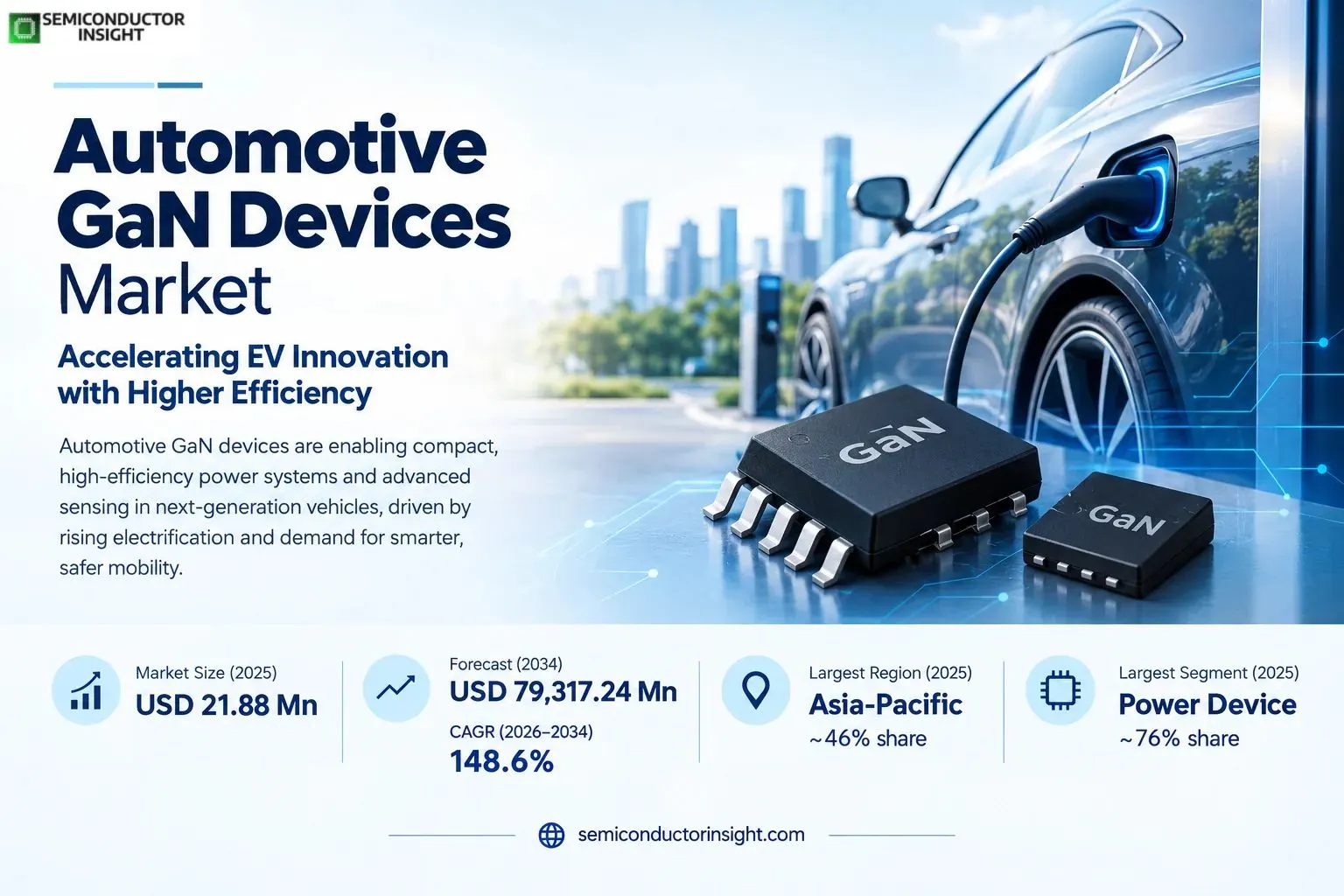
- Market outlook: the automotive GaN devices market is modeled at USD 21.88 million in 2025 and projected to USD 79,317.24 million by 2034, corresponding to 148.6% annualized growth over the nine-year base-to-forecast interval; the projection is exceptionally sensitive to vehicle-platform qualification and is not a straight-line estimate of current design-win revenue.
- Device mix: power devices represent an estimated ~76% of 2025 semiconductor revenue within this product boundary, compared with ~24% for radio-frequency devices; charger and DC/DC power sockets account for most present GaN commercialization while pulsed automotive sensing has different technical requirements.
- Applications: car chargers form the largest application at an estimated ~43% of 2025 revenue, followed by inverters at ~28%, motor drives at ~18% and other uses at ~11%; those percentages refer to semiconductor device revenue rather than the selling price of complete vehicle systems.
- Regional structure: Asia-Pacific leads with an estimated ~46% of 2025 demand, ahead of North America at ~24% and Europe at ~22%; its scale reflects automotive electronics production and electric-vehicle assembly, while North America retains a prominent role in circuit architecture and qualification.
- Execution risk: automotive qualification, switching-node electromagnetic interference, thermals and packaging yield determine whether announced 100V and 650V devices translate into repeatable purchase orders; industrial GaN launches and public EV sales are useful context but are not automotive semiconductor sales evidence.
Automotive GaN Devices Market Overview
Automotive GaN devices market was valued at USD 21.88 million in 2025 and is projected to reach USD 79,317.24 million by 2034, representing a CAGR of 148.6% for 2026–2034. Asia-Pacific is the largest regional market at an estimated ~46% of 2025 revenue, and power devices account for an estimated ~76% of the product mix.
Automotive gallium nitride devices are semiconductor components that exploit the wide-bandgap properties of GaN to switch electrical power rapidly or deliver radio-frequency and high-speed pulsed functions inside a vehicle. The revenue boundary includes discrete transistors, qualifying integrated power stages and automotive GaN radio-frequency devices; it excludes complete onboard chargers, finished inverters, traction motors, batteries, bare wafers and general telecommunications amplifiers. This distinction is important because the value of a 650V switching die is only one part of a much larger conversion assembly.
The immediate commercial opportunity lies in lower switching losses, reduced magnetics and smaller cooling requirements, but those advantages must survive a vehicle maker’s validation cycle. AEC-Q100 and AEC-Q101 are relevant qualification frameworks for integrated circuits and discrete components, respectively; passing a qualification programme does not by itself demonstrate production fitment on a specific vehicle platform. In October 2025 Infineon announced an automotive-qualified 100V GaN transistor family, while Navitas had reported automotive qualification of high-power GaNSafe integrated circuits in April of that year.
GaN competes against silicon MOSFETs and silicon-carbide devices in different electrical domains. At lower bus voltages it can displace a silicon switch where fast transitions, compact magnetics or reduced conduction losses justify the qualification burden. In 400V and 800V vehicle architectures, the choice becomes more complicated because system designers balance blocking-voltage margin, fault tolerance, high-temperature operation and gate-drive integration. Silicon carbide is already established in many traction applications, so a GaN substitution requires evidence of system-level cost and reliability rather than a laboratory efficiency result alone.
The market model starts from a very small 2024 revenue base and assumes exceptionally rapid penetration by 2031, with a further mathematical extension to 2034. Such a trajectory is highly contingent: a delayed platform approval, lower GaN content per vehicle or a decision to retain silicon-carbide power stages could materially change the outcome. A separate publisher power-device segment number does not reconcile with the global headline and is not incorporated into this model. Regional and segment percentages throughout the analysis are modeled allocations, not audited company disclosures.
Vehicle electrification provides an expanding pool of potential design sockets without establishing GaN device revenue by itself. The International Energy Agency reported more than 20 million electric cars sold worldwide in 2025, around one-quarter of new-car sales, and particularly strong adoption in China and several emerging Asian markets. Device suppliers must still secure design wins, demonstrate long-term electrical robustness, meet automotive supply-chain expectations and scale packaged production before that downstream vehicle activity becomes recognizable GaN semiconductor turnover.
Segment Analysis: By Type
By type, the market comprises Power Device and Radio-frequency Device. Power devices account for an estimated ~76% of 2025 revenue and are modeled to grow near ~152.1% annually as qualified converter switches expand from pilot builds into onboard charging and auxiliary power stages. Radio-frequency devices represent an estimated ~24% and have a distinct ~134.0% modeled trajectory linked to sensing and specialized high-speed automotive electronics.
| Type | Electrical role and purchasing boundary | Market position |
|---|---|---|
| Power Device | Includes automotive GaN FETs, integrated switches and qualifying power ICs used to convert or regulate electricity within a vehicle. Switching frequencies, package parasitics and protection functions influence the selection of each 100V, 650V or other voltage-class component. Finished converter assemblies are excluded, as are driver-only silicon ICs even when they control GaN switches. | Largest type (~76% of 2025 revenue; modeled ~152.1% CAGR). Qualification momentum is clearest in onboard charging and high-voltage-to-low-voltage conversion. Integrated protection can lower the number of external components, but automotive customers still evaluate fault response, thermal cycling, electromagnetic compatibility and the economics of an entire converter bill of materials. |
| Radio-frequency Device | Covers GaN semiconductor components performing automotive radio-frequency or pulsed signal functions where GaN itself is the active device. Automotive LiDAR transmitters and selected sensing circuits provide examples of fast-switching requirements; however, a general RF amplifier for a base station does not enter the vehicle market merely because it uses the same semiconductor material. | Secondary type (~24% share; modeled ~134.0% CAGR). Demand depends on automotive sensing architectures, pulse widths and detector requirements rather than charger power density. The addressable device value is often small per vehicle, making unit count, packaging yield and OEM-specific qualification particularly important even when switching performance is technically attractive. |
Power Device: qualification is the decisive commercial filter
An automotive power-device supplier has to establish a credible path from electrical performance to a production part number. The GaN transistor may switch at hundreds of kilohertz, but its useful value comes from the design of magnetics, filters and thermal paths around it. Engineers also test transient overvoltage, short-circuit behavior and high-temperature stress. As a result, a 650V product announcement is not equivalent to a 650V production award for an electric-vehicle onboard charger.
The modeled power-device allocation of ~76% reflects a wider collection of conversion sockets than the RF category, not a claim that most electric vehicles already use GaN. Automotive applications may consume one or several switches per converter leg, while higher-power architectures require parallelism and carefully controlled layout. Revenue recognition follows actual qualified semiconductor shipments and excludes the greater value of housings, control boards, inductors, cooling plates and vehicle integration services.
Radio-frequency Device: short pulses demand a different design discipline
In optical sensing, nanosecond-scale current pulses can be more important than continuous power efficiency. A compact GaN switch can reduce transition time and deliver steep current edges, but the laser diode, optics, receiver and timing circuitry must be engineered as a complete sensing chain. The semiconductor market includes only the qualifying GaN device, while the LiDAR unit, its photonics and the vehicle’s advanced driver-assistance system are separate revenue pools.
RF-device adoption also depends on architecture choice: not every time-of-flight sensor requires a GaN transmitter and not every automotive radar design uses a GaN active device. The estimated ~24% type share therefore represents a bounded opportunity within the publisher’s two-type classification. A vehicle maker can retain silicon or other compound semiconductors when cost, integration or proven supply continuity outweighs the incremental pulse-speed advantage.
Segment Analysis: By Application
Applications comprise Car Charger, Inverter, Motor Drive and Others. Car Charger leads with an estimated ~43% of 2025 revenue and a modeled ~147.6% CAGR. Inverter contributes ~28%, Motor Drive ~18% and Others ~11%; the smaller applications can still have faster modeled growth rates because early commercialization begins from limited qualified shipments.
| Application | Demand characteristics |
|---|---|
| Car Charger | Largest application (~43% share, ~147.6% CAGR). Vehicle onboard chargers and auxiliary charging circuits use switching devices that must handle AC/DC conversion, power-factor correction and isolation stages. The market counts GaN die and packaged switch value only. GaN’s high-frequency operation can shrink magnetic components, yet system engineers weigh EMI filtering, isolation, protection and warranty life before approving a change to the power stage. |
| Inverter | Second application (~28% share, ~146.0% CAGR). Vehicle power inverters connect energy storage with electrical loads and, in some architectures, traction systems. High-power GaN must compete against mature SiC solutions on blocking voltage, current density, fault withstand and thermal performance. A supplier may win an auxiliary inverter socket before entering a principal traction inverter, so design qualification is a staged process rather than a single market-wide transition. |
| Motor Drive | Third application (~18% share, ~153.0% CAGR). Electrified pumps, fans, compressors and other motors provide distributed switching opportunities inside battery-electric and hybrid vehicles. Device voltage and current needs vary widely, and a compact high-frequency switch may reduce passive-component size in selected controllers. However, thermal design, noise coupling and long-life qualification still determine whether GaN replaces silicon MOSFETs in an individual actuator. |
| Others | Residual application (~11% share, ~151.0% CAGR). This group includes qualifying vehicle sensing, LiDAR-related pulsed electronics and niche onboard power functions not counted in the three principal conversion categories. Its mix differs from charging because fast pulse edges, low gate charge and board-area savings can be more valuable than continuous kilowatt-level output. General telecom and stationary charging infrastructure remain outside the boundary. |
Application mix is sensitive to the way automotive suppliers integrate power stages. A packaged GaN FET sold to a tier-one converter manufacturer is included even if the vehicle brand never buys that transistor directly. A complete charger sold by the tier-one is not counted at the same selling price. For the 2025 model, ~43% of device revenue sits in the charging application and ~57% is distributed across the remaining sockets, which prevents the same semiconductor shipment from being assigned to two end uses.
The modeled growth rates are scenario outputs tied to a steep global endpoint, not independent application forecasts. Inverters may be larger in power handling but slower to change semiconductor material because vehicle platforms lock component specifications several years before production. Motor-drive and sensing sockets may be easier to prototype yet deliver lower semiconductor revenue per assembly. Investors and buyers should therefore distinguish prototype demonstrations, qualification announcements, awarded designs and production shipments when evaluating market conversion.
Regional Analysis
Asia-Pacific represents an estimated ~46% of 2025 automotive GaN device revenue, followed by North America at ~24%, Europe at ~22%, South America at ~5% and the Middle East & Africa at ~3%. Modeled annual regional growth spans ~146.0% to ~154.0%, reflecting the extraordinary global scenario and differing rates of vehicle electrification, supplier qualification and electronics manufacturing localization.
Where are automotive GaN device design and production opportunities concentrated?
The regional allocation distinguishes the location of device demand from the corporate headquarters of semiconductor vendors. A vehicle converter may be designed in Germany, manufactured in China and installed in a car sold in North America; only one destination should receive its semiconductor revenue. Asia-Pacific leads on vehicle assembly and electronics production, while North America and Europe exert substantial influence through architecture decisions, automotive standards and validation. The 2025 regional shares are estimated allocations summing to 100%, not supplier-reported geographic turnover.
Regional growth rates are modeled within the same global forecast rather than inferred from electric-car sales alone. The strongest potential increases occur where a small installed GaN base meets new automotive power-electronics manufacturing, yet every region remains subject to design-win timing and substitution by silicon or SiC. A ~154.0% growth assumption in the Middle East & Africa, for example, expresses a low-base scenario; it does not imply that regional automotive GaN qualification has reached the scale of Japan, China or the United States.
| Region | Position | Growth outlook | Demand profile | What decides supplier selection |
|---|---|---|---|---|
| Asia-Pacific | Largest (~46%) | Modeled (~147.9% CAGR) | Vehicle assembly and electronics supply | Automotive-grade device qualification, 100V/650V supply, tier-one manufacturing readiness |
| North America | Second (~24%) | Modeled (~146.0% CAGR) | Architecture and specialist device design | OEM approvals, sensing integration, power-stage safety and domestic technical support |
| Europe | Third (~22%) | Modeled (~151.0% CAGR) | Premium vehicle power electronics | Functional safety, 400V/800V platform fit and long-duration component traceability |
| South America | Fourth (~5%) | Modeled (~152.0% CAGR) | Imported platforms and localized assembly | Supply through global tier-ones, total converter cost and import logistics |
| Middle East & Africa | Fifth (~3%) | Modeled (~154.0% CAGR) | Emerging vehicle electrification | Temperature robustness, vehicle import mix and availability of qualified service channels |
Automotive GaN Device Manufacturers and Competitive Landscape
The automotive GaN competitive field spans specialist FET developers, diversified power semiconductor groups and adjacent automotive electronics suppliers. Qualification status is a stronger indicator of near-term device revenue than the number of GaN-related patents or the size of a company’s total automotive business. Commercial buyers evaluate voltage class, protection functions, packaging, long-term availability and the specific AEC qualification of the offered part.
Infineon combines a broad automotive semiconductor franchise with automotive-qualified GaN transistors and integrated power products. Renesas has expanded its GaN technology portfolio following its 2024 acquisition of Transphorm, while Infineon acquired GaN Systems in 2023; neither former independent company should be counted as a separate contemporary supplier group. Navitas and Efficient Power Conversion offer specialist GaN technologies with automotive-qualified devices or designs, but the scale of their entire corporate revenue cannot be assigned to automotive applications.
Other named companies occupy different places in the value chain. Texas Instruments markets an automotive-qualified GaN/MOSFET driver that supports fast pulsed applications, but a silicon gate-driver IC is not itself GaN device revenue. Qorvo, NXP, MACOM and OSRAM-related businesses participate in RF, sensing, photonics or automotive electronics markets; a company name in a competitive universe does not establish that every product it sells is a merchant automotive GaN transistor. Soitec supplies substrate technologies and therefore sits upstream of packaged devices.
Competitive differentiation is multidimensional. For 100V switches, low gate charge, small package footprint and nanosecond pulse control may outweigh the benefits of higher blocking voltage. For 650V power stages, thermal impedance, common-mode transient behavior and short-circuit protection can decide acceptance. Suppliers that can document 1,000-hour stress performance, automotive change notification and a multi-year manufacturing plan have a different proposition from firms selling only evaluation boards to design engineers.
Automotive qualification announcements should be treated as enabling milestones, not evidence of a particular customer’s 2026 volume commitment. A device may be AEC-Q101 qualified but still lack an approved inverter application, and an AEC-Q100 power IC may require additional validation when integrated into a 400V vehicle platform. Competition therefore takes place at several gates: component specification, reference-design performance, tier-one engineering approval, OEM vehicle approval and stable high-volume packaging yield.
Tier structure
| Tier | Companies | Basis of competition |
|---|---|---|
| Automotive GaN specialists | Navitas Semiconductor; Efficient Power Conversion | AEC-qualified power ICs and discrete FETs; compact switching and sensing applications; engineering support through 100V/650V device selection |
| Diversified power groups | Infineon Technologies; Renesas Electronics; Nexperia; ROHM Semiconductor; Toshiba | Automotive supply infrastructure, complementary silicon and SiC options, long-duration quality systems and broader converter platform relationships |
| Adjacent RF and system ecosystem | NXP Semiconductors; Texas Instruments; Qorvo; MACOM; Panasonic Automotive Systems; OSRAM-related photonics | Drivers, RF electronics, sensing, power-stage control and system integration; inclusion does not imply every product is an automotive GaN switch |
| Materials and integration links | Soitec; Innoscience; STMicroelectronics | Substrate or GaN device technologies and manufacturing capabilities; automotive-specific commercial qualification must be checked for the particular product |
Key companies profiled
- Infineon Technologies
- Navitas Semiconductor
- Efficient Power Conversion
- Renesas Electronics
- Nexperia
- ROHM Semiconductor
- Toshiba
- NXP Semiconductors
- Texas Instruments
- Qorvo
- MACOM
- Panasonic Automotive Systems
- Innoscience
- STMicroelectronics
- Soitec
Automotive GaN Technology, Manufacturing and Qualification
Automotive GaN commercialization requires more than growing a semiconductor film and fabricating a transistor. The manufacturing route must deliver reproducible threshold behavior, low-defect passivation, controlled dynamic on-resistance, package reliability and traceable automotive test results. The optimal product is the one that meets the converter’s electrical and economic requirements throughout a vehicle’s service life, not necessarily the device with the highest laboratory switching frequency.
Many power GaN products use lateral high-electron-mobility transistor structures, often manufactured on silicon substrates, to exploit a high-density channel with relatively low gate charge. The structure can support fast transitions, but device behavior under high voltage and switching stress requires careful gate control and surface engineering. Engineers compare 100V low-voltage parts with 650V high-voltage devices according to the system topology, and they should not apply one voltage class’s qualification evidence to another product without reviewing the test matrix.
Packaging is a significant cost and performance lever. A short current loop reduces parasitic inductance, while thermal design determines how efficiently heat moves from the active die into a vehicle power board or module. Integrated driver and protection functions can reduce external component count, but they also move failure analysis and change control inside the semiconductor supplier’s package. A 650V half-bridge may improve assembly density in one application yet impose different service and repair economics than two discrete transistors.
Dynamic on-resistance, false turn-on immunity, voltage overshoot and electromagnetic emissions are closely linked. A fast GaN edge may lower switching energy but generate more noise unless the PCB layout, driver resistance and filtering are coordinated. Automotive design teams therefore test a complete 400V or 800V conversion stage across operating temperature, load transients and fault conditions. A catalog claim of high switching speed cannot substitute for vehicle-level EMC evidence.
Reliability qualification involves accelerated stress, statistical control and change management. AEC-Q100 addresses integrated circuits, while AEC-Q101 addresses discrete semiconductors; neither standard guarantees a 15-year vehicle lifetime in every mission profile. Component manufacturers also need robust test coverage, traceable wafer lots and clear failure-analysis procedures. When a new process revision improves yield, automotive customers may require requalification before the change can be introduced into a production converter.
Supply-chain economics are sensitive to the gap between wafer yield and automotive-qualified package yield. High wafer output does not guarantee saleable automotive components when a device must pass tighter leakage, dynamic performance and reliability screens. Dual sourcing can be difficult for an integrated GaN power stage because pinouts, control logic and thermal paths vary by vendor. A second source may require a board redesign, so supply continuity can outweigh a marginal reduction in semiconductor unit price.
Automotive GaN Market Dynamics, Drivers, Restraints and Opportunities
The automotive GaN forecast reflects the interaction of vehicle electrification, high-frequency converter design, semiconductor qualification and manufacturing constraints. The contribution figures below are modeled percentage-point components of the published scenario rather than independently observed causal measurements. Because the starting revenue pool is small, both upside design wins and delays in a few major automotive programs can have unusually large effects on the reported growth path.
MARKET DRIVERS
Drivers Impact Analysis*
| Market Drivers | Impact Rank | CAGR Contribution (%) | 2026–2028 | 2029–2031 | 2032–2034 |
|---|---|---|---|---|---|
| Expansion from prototype converters to automotive production | High | +63.00% | High | High | Medium |
| Electric vehicle onboard charging and DC/DC redesigns | High | +44.00% | High | High | High |
| Qualified 100V and 650V product introductions | Medium-High | +31.00% | High | High | Medium |
| Compact power-stage and thermal-management benefits | Medium | +19.00% | Medium | High | High |
| Others (sensing pulses, auxiliary motor drives and additional supplier qualification) | Low-Medium | +10.00% | Low | Medium | High |
Automotive production conversion is the main modeled growth lever
Moving from engineering samples to repeated qualified shipments can change semiconductor revenue by orders of magnitude when the initial base is measured in tens of millions rather than billions. A GaN device must progress through evaluation, component approval, converter validation and platform sourcing before that conversion occurs. The modeled +63.00 percentage-point driver is therefore sensitive to a relatively small number of successful high-volume programs and should not be interpreted as a measured 2025 order-book contribution.
Onboard charging redesign creates a broad component socket
An electric vehicle contains multiple conversion stages with different current, voltage and isolation needs. GaN may be considered where higher switching frequency reduces magnetics or improves packaging density, particularly in onboard chargers and high-voltage-to-low-voltage converters. The modeled +44.00 percentage-point contribution reflects the possibility of several switch positions per vehicle, while excluding the value of the complete charger and recognizing that many designs will continue to use silicon or SiC.
Qualified devices reduce the technology adoption barrier
Automotive-grade product announcements establish that suppliers are investing in test coverage and failure-mode evidence rather than treating vehicle use as a laboratory demonstration. The arrival of AEC-qualified 100V discrete devices and high-power integrated GaN stages broadens the options available to tier-one design teams. The +31.00 percentage-point modeled effect remains conditional on actual OEM selection; a qualification label alone does not establish a production contract or a forecast shipment quantity.
System power density can justify a new semiconductor bill of materials
Faster switching can reduce transformer and inductor dimensions and may simplify some cooling decisions, but only after electromagnetic compatibility and thermal behavior are engineered together. A 650V stage that saves board area could improve vehicle packaging even when the GaN switch costs more than a silicon alternative. The modeled +19.00 percentage-point contribution reflects these system-level incentives rather than a uniform efficiency advantage in every 400V or 800V architecture.
Sensing and auxiliary power diversify early demand
GaN is not limited to high-kilowatt chargers. Nanosecond LiDAR pulses, low-voltage motor control and compact auxiliary conversion can each provide separate design opportunities, often with smaller device counts and different qualification requirements. The residual +10.00 percentage-point driver groups those channels without assigning complete sensor-module or actuator revenue to the GaN market. Their commercial value depends on whether vehicle designers choose GaN over competing pulse and power technologies.
MARKET RESTRAINTS
Restraints Impact Analysis*
| Market Restraints | Impact Rank | CAGR Contribution (%) | 2026–2028 | 2029–2031 | 2032–2034 |
|---|---|---|---|---|---|
| Automotive qualification and production ramp delays | High | -8.00% | High | High | Medium |
| Competition from established silicon and SiC devices | Medium-High | -5.50% | High | High | High |
| Switching noise, protection and thermal integration | Medium | -3.20% | High | Medium | Medium |
| Others (package yield, sourcing concentration and change-control costs) | Low | -1.70% | Medium | Medium | Low |
Qualification cycles can delay revenue beyond a forecast window
Automotive component testing covers electrical stress, temperature variation, packaging reliability and production change control. Even after a semiconductor passes AEC-Q100 or AEC-Q101, a vehicle OEM can require application-specific tests and platform-level approvals. A design deferred from 2028 to 2030 may have little effect on the eventual engineering solution but a large effect on near-term market revenue. The modeled −8.00 percentage-point drag represents this timing and execution risk.
Mature alternatives offer a demanding commercial benchmark
Silicon MOSFETs and SiC switches already serve many vehicle converters with established supply chains, known failure behavior and familiar design tools. GaN must overcome not only the semiconductor price difference but also engineering costs associated with gate drive, PCB layout and warranty validation. The modeled −5.50 percentage-point restraint reflects substitution pressure, particularly where the incremental efficiency benefit is small relative to total system cost or where high blocking voltage favors SiC.
Fast switching adds design and manufacturing complexity
Very short switching edges can intensify parasitic-induced voltage overshoot and electromagnetic interference. Designers may need additional filtering, careful current-loop geometry and sophisticated protection, reducing some expected board-area savings. The modeled −3.20 percentage-point effect covers these practical integration issues rather than an inherent inability of GaN to meet automotive standards. Better packages and integrated control can mitigate the constraint but require engineering investment and rigorous qualification.
Package yield and sourcing continuity remain exposed
Automotive semiconductor customers value stable production lots, controlled revisions and predictable lead times. A supplier may achieve good wafer yield but lose devices during tight final testing, or may have limited alternative assembly sites for a particular package. The modeled −1.70 percentage-point residual includes these manufacturing and procurement frictions. They can be especially significant when a vehicle platform depends on a single integrated GaN power stage without a pin-compatible second source.
MARKET OPPORTUNITIES
Low-voltage vehicle power networks
As vehicles add sensors, processors and distributed electrical loads, compact conversion stages create opportunities for qualified 100V GaN switches. These applications can offer a different adoption path from 650V traction electronics because their current, fault and insulation requirements are not identical. Suppliers that provide validated reference layouts, reliability data and stable packages may capture sockets in auxiliary power systems even where the main propulsion inverter remains silicon-carbide based.
Integrated power stages for compact charging
Combining GaN switches with control, sensing or protection can reduce external components and simplify selected converter architectures. The opportunity is strongest when integration improves the total bill of materials without making thermal management or repairability worse. Automotive customers will assess 2026–2034 production readiness, long-term supply and system-level emissions; a successful integrated product could increase device value per converter but should not be confused with the selling price of the complete charging unit.
Pulsed optical sensing and specialized electronics
Automotive LiDAR and other optical sensing circuits may benefit from extremely short pulses, low charge and fast current rise times. Qualified GaN devices provide one route to these requirements, although the final sensor architecture determines whether they are used. Suppliers can compete through compact 80V-class packages, predictable pulse timing and application support. This niche offers design diversification without implying that the full value of the camera, laser or processing unit belongs in the semiconductor market.
Automotive GaN Supply Chain and Route to Market
Automotive GaN devices move through substrate and epitaxy production, transistor fabrication, automotive packaging, electrical and reliability testing, distribution or tier-one integration, and finally vehicle qualification. The location of each stage may differ. A successful commercial supplier must connect process control to a documented component part number that a vehicle platform can use repeatedly, not merely supply a working evaluation board.
Upstream materials. A substrate provider can enable a GaN device technology without selling the finished automotive semiconductor. Epitaxy quality affects trapping and dynamic on-resistance, while wafer processing determines consistency across lots. The distinction is commercially important because company revenue from substrates or manufacturing equipment should not be added to device sales. A component supplier must convert upstream process capability into a tested product with a clear voltage rating, package specification and automotive quality record.
Automotive packaging. Package design can be as decisive as the transistor itself when fast switching raises sensitivity to parasitic inductance. Bonding, thermal resistance and gate-loop geometry affect both efficiency and electromagnetic emissions. A 100V LiDAR FET may favor a tiny low-inductance footprint, whereas a 650V power stage may require stronger thermal and isolation features. Qualified assembly capacity, final-test yield and change-control documentation are therefore direct determinants of commercially available device supply.
Commercial channels. A GaN manufacturer may sell to a tier-one converter producer, an authorized distributor or a specialized automotive electronics company. The vehicle brand often influences the specification without appearing as the immediate semiconductor customer. Engineering samples and evaluation boards help win design positions but are not evidence of production-scale revenue. Distribution agreements, approved vendor lists and reliable replacement parts can sustain a socket over several model years once a platform enters series manufacture.
Supply concentration. Integrated GaN products can be difficult to second-source because driver behavior, protection functions and pin assignments differ among suppliers. A vehicle maker may therefore require capacity assurances, contingency plans and advance notice of process changes. The commercial benefit of reduced converter size has to be weighed against sourcing concentration and the costs of revalidating a replacement device. The model does not assign the revenue of a finished converter to its semiconductor supplier.
Recent Developments in Automotive GaN and Adjacent Power Devices
- 15 Oct 2025 AUTOMOTIVE QUALIFICATION
Infineon announced an automotive-qualified 100V CoolGaN transistor family addressing lower-voltage vehicle applications. The significance is a new class of qualified discrete GaN switches for engineering teams that previously relied on industrial-grade catalogues. It does not demonstrate mass deployment in 650V onboard chargers, and the 100V rating should not be conflated with high-voltage traction switches. Automotive customers must still validate their exact power-stage mission profiles. Source - 15 Apr 2025 AUTOMOTIVE POWER IC
Navitas disclosed AEC-Q100 and AEC-Q101 qualification for its high-power GaNSafe integrated circuits, positioning the devices for onboard charging and high-to-low-voltage conversion. The announcement described integrated protection and a maximum short-circuit response latency of 350 ns. This improves the availability of automotive-oriented GaN technology, but qualification alone does not specify the number of vehicle platforms that will ship the devices. Source - 23 Apr 2025 SENSING DESIGN
Efficient Power Conversion introduced an indirect time-of-flight laser-driver evaluation board using the automotive-qualified EPC2203 GaN FET. The reference design demonstrated pulses as short as 5 ns and peak current above 10 A, showing how GaN may serve specialized vehicle sensing rather than only conversion. Evaluation-board sales and the value of complete LiDAR systems remain outside the merchant automotive GaN device boundary. Source - 26 Feb 2026 INTEGRATED STAGE
Infineon announced a 600V CoolGaN Drive integrated half-bridge product for high-frequency power conversion. The release illustrates continuing integration of switching and control functions that can influence future vehicle designs, but the announcement does not establish automotive qualification for that specific part. The technology is therefore treated as adjacent engineering context rather than proof of 2026 automotive device shipments or platform adoption. Source - 10 Jun 2026 PRODUCT PORTFOLIO
Nexperia expanded its 650V GaN FET portfolio with several resistance classes intended for industrial power conversion. These additions broaden the competitive set of GaN switching technologies and can inform component benchmarking, although an industrial product launch cannot be counted as an automotive design win. Vehicle applications require separate documentation for quality, lifetime, temperature and production change control before qualifying revenue is recognized. Source - 30 Sep 2026 PACKAGING ADVANCE
Renesas presented a 650V GaN device in an 8 mm by 8 mm dual-side-cooled package for high-density data-center power applications. The packaging development is relevant to the wider GaN technology roadmap, but the stated target is not a vehicle powertrain. Its presence in the evidence base illustrates a possible engineering direction, not an automotive revenue figure or proof of a qualified converter socket. Source
REPORT SCOPE & SEGMENTATION
| Attribute | Details |
|---|---|
| Market name | Global Automotive GaN Devices Market |
| Base-year market size | USD 21.88 million |
| Estimated 2026 market size | USD 54.38 million |
| 2034 market forecast | USD 79,317.24 million |
| Forecast CAGR | 148.6% |
| Base year / estimate year | 2025 / 2026 |
| Forecast interval | 2026–2034, with annualized growth calculated from the 2025 base to the 2034 endpoint |
| Revenue boundary | Automotive GaN power and radio-frequency semiconductor devices; excludes finished chargers, inverters, vehicles, bare substrates and general telecom RF products |
| By Type | Power Device (~76% of 2025 revenue); Radio-frequency Device (~24%) |
| By Application | Car Charger (~43%); Inverter (~28%); Motor Drive (~18%); Others (~11%) |
| Regional model | Asia-Pacific (~46%); North America (~24%); Europe (~22%); South America (~5%); Middle East & Africa (~3%) |
| By Region | The five regional allocations refer to estimated 2025 device revenue and sum to 100%; they are not audited corporate sales by destination. North AmericaUnited States; Canada; Mexico EuropeGermany; France; Italy; United Kingdom; rest of Europe Asia-PacificChina; Japan; South Korea; India; Southeast Asia; rest of Asia-Pacific South AmericaBrazil; Argentina; Chile; rest of South America Middle East & AfricaSaudi Arabia; United Arab Emirates; South Africa; rest of Middle East and Africa |
| Key Companies Profiled | Infineon Technologies; Navitas Semiconductor; Efficient Power Conversion; Renesas Electronics; Nexperia; ROHM Semiconductor; Toshiba; NXP Semiconductors; Texas Instruments; Qorvo; MACOM; Panasonic Automotive Systems; Innoscience; STMicroelectronics; Soitec |
| Customization Scope | Device-type and application revenue, 100V and 650V automotive qualification mapping, country-level purchasing channels, supplier positions, converter design-win milestones and alternative silicon/SiC technology comparisons. |
Frequently Asked Questions
How large is the automotive GaN devices market and what is its forecast?
The modeled global value is USD 21.88 million for 2025, with a 2034 projection of USD 79,317.24 million and a calculated annual growth rate of 148.6%. The implied path is exceptionally steep because the initial semiconductor revenue base is small and the endpoint assumes rapid adoption. It should be interpreted as a high-uncertainty market scenario rather than a measured production order book or independently confirmed future shipment value.
What qualifies as an automotive GaN device in this market?
The scope covers gallium nitride power switches, qualifying integrated GaN power stages and GaN radio-frequency or pulsed devices designed for automotive applications. A finished charger, traction inverter, battery pack or vehicle is excluded even when it contains a GaN semiconductor. The same rule excludes raw GaN wafers and unrelated telecommunications amplifiers, so the market represents device-level revenue rather than downstream system sales.
Which device type accounts for the largest share?
Power Device is the leading type with an estimated ~76% of 2025 revenue, reflecting onboard charging, voltage conversion and selected auxiliary switching functions. Radio-frequency Device represents ~24% and covers specialized automotive RF or pulsed electronics. The type allocation is a modeled share split, not a disclosure of worldwide automotive GaN sales by suppliers, and it does not imply that most vehicles already use GaN transistors.
Which automotive application leads semiconductor demand?
Car Charger is the largest modeled application at ~43% of 2025 revenue. Inverter follows at ~28%, Motor Drive at ~18% and Others at ~11%. The car-charger classification counts GaN device content sold into vehicle conversion equipment, not the selling price of the charger itself. Inverter adoption faces especially demanding electrical and thermal qualification because high-current vehicle power stages already have established silicon-carbide alternatives.
Which region has the largest automotive GaN market?
Asia-Pacific leads with an estimated ~46% share in 2025 because of vehicle electronics manufacturing, converter supply chains and electric-car assembly activity. North America contributes ~24%, Europe ~22%, South America ~5% and the Middle East & Africa ~3%. The percentages allocate semiconductor device demand geographically and should not be interpreted as the locations of all supplier headquarters or as audited regional turnover.
What automotive qualification standards are relevant to GaN devices?
AEC-Q100 applies to integrated circuits and AEC-Q101 to discrete semiconductors, providing recognized stress-test frameworks for automotive components. A device’s qualification under either standard is a meaningful readiness milestone but does not guarantee fitment in a specific vehicle model. OEM and tier-one engineering teams may require further temperature, EMC, short-circuit and production traceability evidence before granting platform approval.
How does GaN compare with silicon carbide in vehicle electronics?
GaN offers fast switching and potentially compact magnetic components in selected converter designs, whereas SiC has a substantial established position in high-voltage, high-current automotive power stages. The best choice depends on blocking voltage, fault behavior, switching loss, package thermals and system cost. A 100V auxiliary GaN switch should not be judged by the same operating constraints as a 1200V SiC traction device.
Are GaN LiDAR devices included in automotive demand?
Qualifying GaN semiconductor switches used for automotive optical sensing are included under the appropriate RF or residual application category. Their appeal can lie in nanosecond pulse control rather than continuous conversion efficiency. The LiDAR module, laser, receiver, optics and vehicle perception computer remain outside device-level revenue. This narrower sensing opportunity overlaps technically with broader automotive GaN electronics without being the same commercial market.
What could prevent the market from reaching its projected size?
The principal risks are slower OEM design approvals, continued use of silicon and SiC, high-frequency electromagnetic interference, thermal packaging challenges and insufficient automotive-qualified manufacturing capacity. A supplier may announce a promising 650V GaN part without winning a production vehicle platform. The modeled trajectory is particularly sensitive to such delays because a small initial base amplifies the apparent annual growth rate.
What is the coverage period and how is the market segmented?
The study uses 2025 as the base year, 2026 as the estimate year and 2034 as the terminal forecast year. It separates Power Device and Radio-frequency Device types, four application groups and five geographic regions. The analysis also discusses 100V and 650V product classes, automotive qualification, competitive substitution and supply-chain requirements, while keeping semiconductor device revenue separate from complete converter and vehicle values.
Research Sources & Evidence Base

Get Sample Report PDF for Exclusive Insights
Report Sample Includes
- Table of Contents
- List of Tables & Figures
- Charts, Research Methodology, and more...
 Download Sample Report PDF