Key Statistics
Key Takeaways
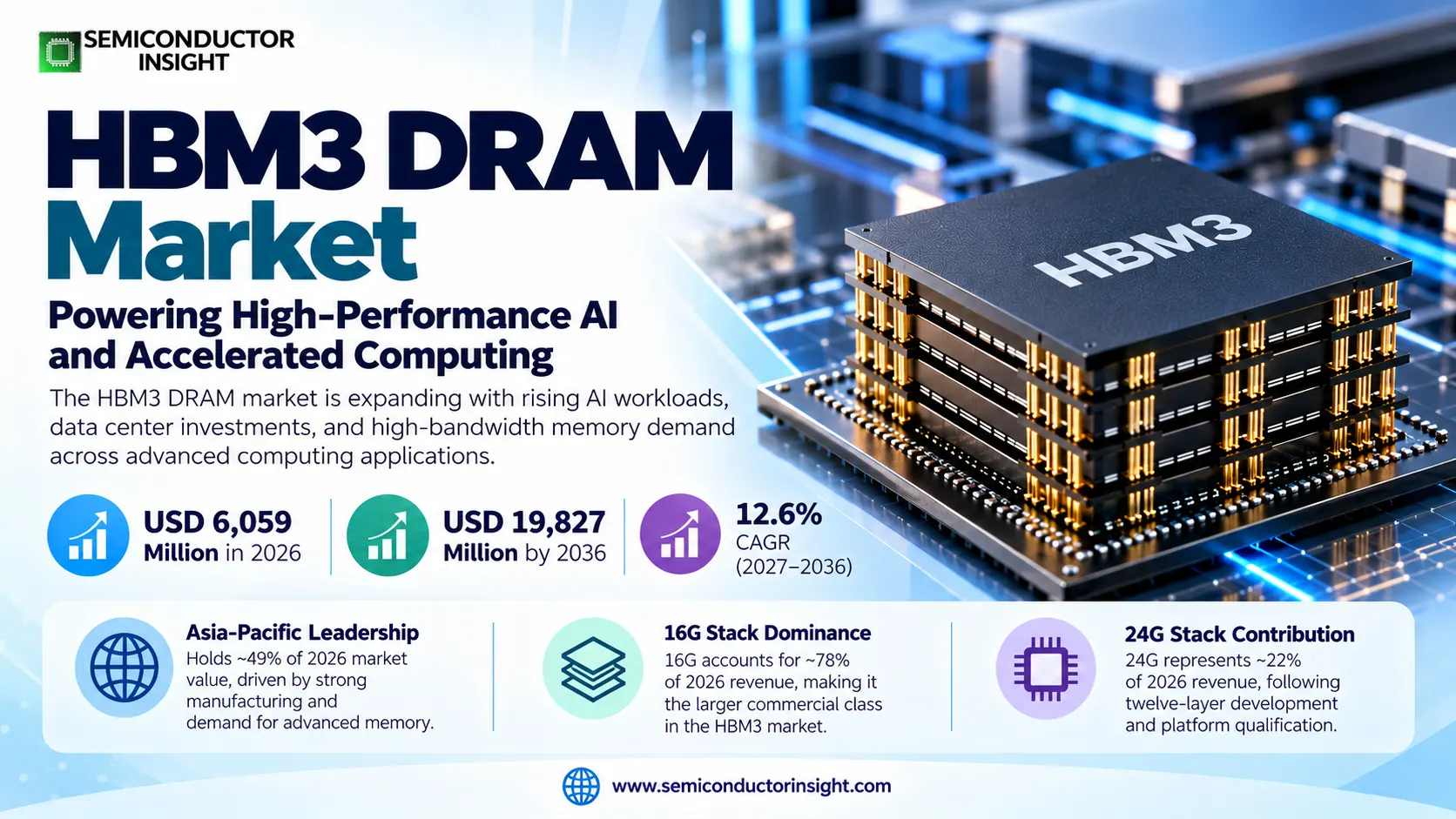
- Market size: Global HBM3-generation DRAM memory sales are valued at USD 6,059 million in 2026 and the historical-anchor extrapolation reaches USD 19,827 million by 2036, implying 12.6% compound annual growth. Actual revenue can diverge materially as newer HBM3E and HBM4 products replace the earlier generation in AI accelerators.
- Product boundary: Only finished HBM3 DRAM stacks are counted; the model excludes HBM3E, HBM4, complete graphics processors, AI server systems, independently sold packaging services and controller intellectual property. The distinction prevents a supplier’s total AI semiconductor sales from being mistaken for merchant HBM3 memory revenue.
- Largest type: 16G is the larger published type category at an estimated ~78% of 2026 HBM3 revenue, while 24G represents ~22% after twelve-layer products began sampling in 2023. These allocations are scenario estimates rather than shipment statistics, and future mix depends on product qualification and displacement by newer generations.
- Application structure: Servers are estimated to absorb ~77% of HBM3 revenue in 2026 because H100 and MI300X accelerators were designed around high-bandwidth stacked memory. Networking contributes an estimated ~13%, while consumer and specialist uses remain relatively limited owing to package costs, thermals and power budgets.
- Geographic mix: Asia-Pacific is modeled as the largest region at ~49% of 2026 value, supported by Korean DRAM manufacturing and Asian packaging capacity; North America is estimated at ~31% through accelerator design and cloud procurement. Region refers to the allocated commercial value chain, not an independently measured country shipment census.
- Supplier landscape: SK hynix and Samsung have documented original-generation HBM3 production, whereas Micron’s cited 2024 volume-production announcement concerns HBM3E. The original three-company roster is retained, but company roles are differentiated rather than presented as equally evidenced suppliers of merchant HBM3.
- Growth and transition: AI training memory demand, accelerator capacity per package, advanced interposer availability and multi-stack server platforms support high-bandwidth memory economics. The main counterforce is migration to 36GB HBM3E and 24–48GB HBM4 stacks, which could sharply reduce the addressable life of original HBM3.
- Forecast interpretation: The 2026 base and 2036 projection form a ten-year extension of two historical market anchors. The scenario assumes continued qualification of 16GB and 24GB original HBM3 stacks in selected computing deployments; it should not be confused with a manufacturer-confirmed shipment roadmap through the end of the forecast horizon.
HBM3 DRAM Market Overview
HBM3 DRAM market reached USD 6,059 million in 2026 and is projected under a historical-anchor extension to reach USD 19,827 million by 2036, equivalent to a 12.6% CAGR during 2027–2036. Asia-Pacific holds an estimated ~49% of 2026 value, although substitution by HBM3E and HBM4 creates substantial downside risk to a straight-line generation-specific outlook.
HBM3 is a vertically stacked dynamic random access memory technology connected by through-silicon vias and a very wide interface. Instead of moving data across conventional memory modules at a relatively narrow bus width, the stack sits beside an accelerator on an advanced package, shortening electrical paths and raising aggregate bandwidth. SK hynix began mass production in June 2022 and identified NVIDIA H100 as an early deployment platform, with stack throughput up to 819 gigabytes per second.
The commercial unit is a qualified memory stack, not a finished accelerator or a package containing a GPU and several stacks. A stack contains DRAM dies, a base interface and vertical interconnects; its sale can be recognized by a memory supplier independently of the value of a server containing the component. Revenue from packaging equipment, interposer substrates, cloud computing services and separate controller licensing is excluded even when those activities are essential to HBM3 adoption.
Two original capacity classes shape the product mix. The 16GB eight-high configuration established early availability, while SK hynix introduced a 24GB twelve-high version in April 2023 by thinning individual dies and applying advanced mass-reflow molded underfill. Samsung confirmed in October 2023 that its eight-high and twelve-high HBM3 products were in mass production. The higher capacity raises useful memory per accelerator socket without a proportional increase in package area, but adds fabrication and yield complexity.
The demand connection is observable in deployed accelerator architectures. NVIDIA placed HBM3 alongside its H100 Hopper processor, and AMD announced MI300X with 192GB of HBM3 per accelerator in December 2023. An eight-accelerator MI300X platform consequently carries 1.5 terabytes of HBM3, a memory configuration that helps large language models keep active parameters close to compute resources. These processor figures indicate design adoption, not the merchant revenue received by the DRAM suppliers.
The generation boundary becomes decisive after 2024. Micron announced 24GB eight-high HBM3E volume production in February 2024 for NVIDIA H200, Samsung presented 36GB twelve-high HBM3E, and SK hynix began twelve-layer HBM3E volume production in September 2024. SK hynix completed HBM4 development in September 2025, followed by Samsung commercial HBM4 shipments in February 2026. These milestones support overall HBM demand but reduce confidence in indefinite growth of original HBM3 alone.
Market value is therefore sensitive to both accelerator shipments and the fraction of each platform still using original HBM3 rather than successor memory. If an older GPU continues to ship in a cost-sensitive inference or research configuration, it can sustain replacement and installed-platform demand even as new flagship processors migrate. Conversely, faster qualification of HBM4 or changes in memory contract prices could produce a much smaller original-generation market than a constant-growth extrapolation suggests.
Segment Analysis: By Type
The original HBM3 product segmentation distinguishes 24G and 16G stacks. The 16G category is the larger commercial class in the 2026 model at an estimated ~78%, while 24G contributes ~22% following twelve-layer development. Both classes are stacked DRAM, not graphics processor boards, and their growth paths are conditioned on platform qualification rather than universal replacement by higher-capacity parts.
| Type | Technology and buyer requirement | Modeled revenue position |
|---|---|---|
| 16G | Eight-high HBM3 memory stacks serve qualified Hopper-era accelerator sockets and earlier high-performance computing designs. Their manufacturing advantage is an established assembly process with fewer vertically bonded dies than twelve-high products, which can improve yield and delivery predictability for customers maintaining long-lived systems. They compete increasingly with HBM3E upgrades that offer more bandwidth without changing the broad system purpose. | An estimated ~78% of 2026 revenue corresponds to USD 4,726 million, with a modeled 12.42% annual growth path and a 2036 scenario value of USD 15,235 million. 2026: USD 4,726m 2027: USD 5,313m 2028: USD 5,973m 2029: USD 6,714m 2030: USD 7,548m 2031: USD 8,485m 2032: USD 9,539m 2033: USD 10,723m 2034: USD 12,055m 2035: USD 13,552m 2036: USD 15,235m |
| 24G | Twelve-high 24GB HBM3 increases capacity by 50% compared with an eight-high 16GB stack. SK hynix used thinner dies and improved underfill to maintain package height, making the format attractive when model parameters or simulation datasets exceed the memory budget of older sockets. Qualification cost and substitution by 24GB HBM3E constrain its long-run original-generation demand. | An estimated ~22% of 2026 revenue corresponds to USD 1,333 million, with a modeled 13.17% annual growth path and a 2036 scenario value of USD 4,592 million. 2026: USD 1,333m 2027: USD 1,508m 2028: USD 1,707m 2029: USD 1,932m 2030: USD 2,186m 2031: USD 2,474m 2032: USD 2,800m 2033: USD 3,169m 2034: USD 3,586m 2035: USD 4,058m 2036: USD 4,592m |
Secondary segmentation: stack height, customer channel and package integration
Stack height is estimated at ~78% for eight-high HBM3 and ~22% for twelve-high HBM3 in 2026, corresponding to the mature 16GB and newer 24GB configurations. Customer-channel demand is modeled at ~62% for cloud and hyperscale AI buyers, ~30% for enterprise and HPC integrators and ~8% for research specialists. Package integration is concentrated in 2.5D interposer designs at an estimated ~90%, with other qualified approaches near ~10%.
Segment Analysis: By Application
By application, servers lead with an estimated ~77% of 2026 HBM3 revenue, followed by networking at ~13%, consumer devices at ~3% and other specialized deployments at ~7%. The categories describe where qualified memory stacks are used, not separate manufacturing processes; an AI accelerator sold inside a server remains a server application even when the processor also performs network analytics.
| Application | Demand characteristics |
|---|---|
| Servers | Accelerator-rich servers using NVIDIA H100 and AMD MI300X provide the clearest original-generation HBM3 attachment. Eight MI300X devices together provide 1.5TB of HBM3 in AMD platform documentation, while H100-class deployments support training and inference in hyperscale data centers. An estimated ~77% of 2026 revenue corresponds to USD 4,665 million, with a modeled 13.20% annual growth path and a 2036 scenario value of USD 16,120 million. 2026: USD 4,665m 2027: USD 5,281m 2028: USD 5,978m 2029: USD 6,768m 2030: USD 7,661m 2031: USD 8,672m 2032: USD 9,817m 2033: USD 11,113m 2034: USD 12,579m 2035: USD 14,240m 2036: USD 16,120m |
| Networking | High-throughput network analytics, traffic processing and specialized data-plane accelerators can use stacked memory where bandwidth per watt matters more than commodity DIMM capacity. This remains a narrower addressable base than cloud training because many switches use SRAM or GDDR alternatives. An estimated ~13% of 2026 revenue corresponds to USD 788 million, with a modeled 11.00% annual growth path and a 2036 scenario value of USD 2,237 million. 2026: USD 788m 2027: USD 874m 2028: USD 970m 2029: USD 1,077m 2030: USD 1,196m 2031: USD 1,327m 2032: USD 1,473m 2033: USD 1,635m 2034: USD 1,815m 2035: USD 2,015m 2036: USD 2,237m |
| Consumer | Consumer products are a minor category because package size, power consumption and advanced interposer costs make original HBM3 unattractive for mainstream laptops and phones. The modeled allocation captures specialist graphics and experimental devices rather than claiming broad retail adoption. An estimated ~3% of 2026 revenue corresponds to USD 182 million, with a modeled 8.10% annual growth path and a 2036 scenario value of USD 396 million. 2026: USD 182m 2027: USD 196m 2028: USD 212m 2029: USD 230m 2030: USD 248m 2031: USD 268m 2032: USD 290m 2033: USD 314m 2034: USD 339m 2035: USD 366m 2036: USD 396m |
| Others | Research clusters, specialized scientific instruments and defense or industrial accelerators can retain an HBM3 design after mass-market flagship products migrate to HBM3E. Long qualification periods may sustain small batches but do not establish a broad merchant volume market. An estimated ~7% of 2026 revenue corresponds to USD 424 million, with a modeled 9.75% annual growth path and a 2036 scenario value of USD 1,075 million. 2026: USD 424m 2027: USD 465m 2028: USD 511m 2029: USD 561m 2030: USD 615m 2031: USD 675m 2032: USD 741m 2033: USD 813m 2034: USD 892m 2035: USD 979m 2036: USD 1,075m |
Application revenue depends on the memory generation designed into a specific accelerator, the number of stacks per package and the volume of deployed processors. Server platforms have the strongest documented evidence, but they also migrate quickly to faster HBM generations. The modeled networking, consumer and specialist shares should be read as commercial scenarios constrained by cost, thermal and interface requirements, rather than as a census of original HBM3 purchase orders.
Regional Analysis
Asia-Pacific is the largest modeled HBM3 DRAM region at ~49% of 2026 revenue, followed by North America at ~31%, Europe at ~12%, South America at ~4% and the Middle East & Africa at ~4%. Manufacturing geography and procurement geography differ: South Korea fabricates the principal DRAM stacks, Taiwan provides advanced packaging capacity, and US accelerator designers determine much of the architecture and end demand.
How do HBM3 manufacturing concentration and accelerator procurement differ by region?
A regional share assigned to finished HBM3 memory reflects the location of relevant production, package integration, procurement and use rather than a count of complete servers sold in each country. The same DRAM stack can be manufactured in South Korea, packaged with a processor in Taiwan, purchased by a United States cloud company and installed in a European data center. This creates substantial uncertainty around any single geographical allocation.
The demand cycle is concentrated in AI and high-performance computing rather than conventional consumer memory. North American chip designers set important specifications through H100 and MI300X architectures, while Asian manufacturers and packaging specialists control the physical throughput of qualified stacks. Europe and emerging regions participate principally as purchasers and integrators; the shares below are modeled values and should not be read as customs statistics.
| Region | Position | Growth outlook | Demand profile | What decides supplier selection |
|---|---|---|---|---|
| Asia-Pacific | Largest (~49%) | Modeled ~13.4% CAGR | Memory fabrication and package assembly | DRAM die yield, TSV assembly, CoWoS allocation, Korean supplier qualification |
| North America | Second (~31%) | Modeled ~12.1% CAGR | Accelerator architecture and hyperscale procurement | System qualification, bandwidth-per-watt, contractual delivery, software compatibility |
| Europe | Third (~12%) | Modeled ~10.9% CAGR | Scientific computing and enterprise AI | Long-term serviceability, procurement budgets, compliance, thermal design |
| South America | Smaller (~4%) | Modeled ~11.0% CAGR | Cloud service imports and research clusters | Imported accelerator availability, power supply, service contracts, financing |
| Middle East & Africa | Smaller (~4%) | Modeled ~12.2% CAGR | Sovereign AI projects and academic compute | System integration, high-density cooling, tender structure, project delivery |
HBM3 DRAM Manufacturers and Competitive Landscape
The merchant HBM3 DRAM manufacturer roster comprises SK hynix, Samsung and Micron, but the evidence is not equivalent across the three names. SK hynix documented early HBM3 volume production, Samsung confirmed eight-high and twelve-high original HBM3 output, and Micron documented volume HBM3E rather than original HBM3 in the cited release. Customer qualification, stacking yield and transition timing determine competitive position.
SK hynix established an early commercial position by beginning HBM3 production in June 2022 after NVIDIA evaluated samples for the H100 accelerator. It subsequently introduced a 24GB twelve-layer HBM3 design that maintained stack height despite thinner DRAM dies. This progression illustrates how a memory supplier can win qualified accelerator sockets through packaging process innovation, not merely by offering a higher theoretical interface rate.
Samsung provides documented competitive evidence for original HBM3 as well. At its October 2023 Memory Tech Day, the company stated that eight-high and twelve-high HBM3 products were in mass production, while presenting HBM3E Shinebolt as the next generation. Samsung’s non-conductive film approach and broad semiconductor manufacturing portfolio create a different integration strategy from SK hynix’s advanced molded-underfill route. The two suppliers therefore compete on yield, package reliability and qualification schedules.
Micron belongs in the publisher’s three-company roster because it is a leading high-bandwidth memory supplier, but its February 2024 announcement explicitly concerns HBM3E for NVIDIA H200. That disclosure cannot establish original HBM3 sales volumes or market share. Its presence in competitive analysis describes the transition in supplier participation, and any allocation of original-generation merchant revenue to Micron requires separate customer and product evidence.
Customer concentration is unusually important in stacked memory. A qualified design win with an accelerator developer can drive large shipments, while a rejected or delayed qualification can strand capacity for a specific die and package configuration. Unlike commodity DDR modules, HBM3 cannot be switched freely between unrelated processors because interposer routing, controller timing, thermals and system validation are tightly coupled. This makes commercial relationships and manufacturing execution central competitive variables.
Tier structure
| Tier | Companies | Basis of competition |
|---|---|---|
| Direct original HBM3 manufacturers | SK hynix; Samsung Electronics | Both companies have first-party announcements documenting original HBM3 production, including eight-high and twelve-high formats. Qualification for H100-class and other advanced compute platforms is commercially meaningful, but neither company discloses an independently audited split of merchant HBM3 revenue in the evidence reviewed. |
| Adjacent-generation manufacturer | Micron Technology | Micron has documented 24GB eight-high HBM3E volume production for NVIDIA H200, which is a successor-generation product rather than direct proof of original HBM3 sales. The manufacturer remains in the original roster while its evidenced competitive role is clearly distinguished. |
| Ecosystem demand setters | NVIDIA; AMD; TSMC; Amkor | These firms influence accelerator socket demand, interposer qualification and package capacity but are not counted as the three merchant HBM3 DRAM manufacturers. NVIDIA and AMD supply computing platforms; TSMC and Amkor provide integration technologies rather than finished DRAM die sales. |
Key companies profiled
- SK hynix
- Samsung Electronics
- Micron Technology
HBM3 DRAM Production Capacity and Manufacturing Analysis
Original HBM3 supply depends on DRAM fabrication, wafer thinning, through-silicon via formation, vertical stacking, underfill and package-level test. The qualified manufacturing base is concentrated among a small number of memory suppliers, with downstream interposer and accelerator assembly capacity in Asia. Production capability for HBM3E or HBM4 is technologically adjacent but does not establish additional original HBM3 merchant capacity.
The 16GB eight-high format uses eight DRAM layers and a base interface, while the 24GB twelve-high format requires additional die thinning and bonding operations. SK hynix described thinning the DRAM dies by roughly 40% to hold stack height steady when moving to twelve layers, with advanced MR-MUF used to protect the structure and manage thermal behavior. These process steps raise yield sensitivity and reduce the usefulness of simple wafer-start counts as a capacity measure.
Samsung’s 2023 confirmation of eight-high and twelve-high HBM3 mass production demonstrates a second manufacturing route. The company has emphasized non-conductive film technology for high-stack products, while SK hynix has highlighted molded-underfill integration. A comparison of process names alone does not reveal unit economics: the decisive variables include known-good die yield, vertical interconnect continuity, final package warpage, thermal resistance and acceptance testing at the customer’s target data rate.
TSMC’s 2023 technology symposium described CoWoS package designs capable of holding up to twelve HBM stacks, demonstrating that downstream assembly can become a limiting factor even when DRAM fabrication has spare capacity. Advanced packaging must align interposer size, bump placement, power delivery and mechanical integrity with the processor and memory interface. Capacity assigned to next-generation GPU platforms can compete with the assembly slots required for installed HBM3 designs.
As HBM3E and HBM4 enter production, suppliers face a portfolio allocation problem. SK hynix moved to twelve-layer HBM3E in 2024 and prepared HBM4 manufacturing in 2025, while Samsung announced commercial HBM4 shipments in February 2026. Those steps can redirect wafer starts, packaging engineers and test equipment toward higher-value successor products. A ten-year original HBM3 forecast therefore represents a conditional scenario rather than a disclosed manufacturer production plan.
HBM3 DRAM Market Dynamics: Drivers, Restraints and Opportunities
Original HBM3 demand benefits from accelerator memory intensity, high-performance computing adoption, qualified platform lifetimes and packaging improvements. The counterweights are migration to HBM3E and HBM4, constrained advanced assembly, yield sensitivity and customer concentration. These opposing forces create an uncertain generation-specific trajectory even when the broader high-bandwidth memory ecosystem continues to expand.
MARKET DRIVERS
Drivers Impact Analysis*
| Market Drivers | Impact Rank | CAGR Contribution (%) | 2027–2029 | 2030–2032 | 2033–2036 |
|---|---|---|---|---|---|
| Installed AI accelerator demand and memory intensity | High | +5.20% | High | Medium | Low |
| Qualified H100 and MI300X platform continuity | High | +4.00% | High | Medium | Low |
| Growth in high-performance scientific computing | Medium-High | +3.20% | Medium | Medium | Medium |
| More memory capacity per accelerator package | Medium | +2.10% | Medium | Medium | Low |
| Improved stack yield and integration reliability | Low-Medium | +1.80% | Medium | Medium | Low |
| Others (specialist inference, legacy platform service and research clusters) | Low | +1.50% | Low | Medium | Low |
AI accelerators require high memory bandwidth
HBM3 was designed to feed compute engines whose arithmetic throughput would otherwise exceed external memory bandwidth. NVIDIA H100 and AMD MI300X provide concrete original-generation deployments, and the latter carries 192GB per accelerator. As workloads grow in parameter count and batch size, memory capacity and bandwidth become direct constraints on useful accelerator utilization. The revenue opportunity, however, follows qualified HBM3 sockets rather than all future AI compute spending.
Existing platform qualification can sustain deliveries
A server operator may continue purchasing a qualified H100-class or MI300X-class configuration after a newer flagship GPU launches, particularly when software validation, procurement budgets or replacement parts favor continuity. That installed-generation effect can preserve demand for eight-high and twelve-high HBM3 stacks. It is strongest in research and enterprise environments with longer refresh cycles and weaker in hyperscale fleets that rapidly adopt new accelerator designs.
Scientific computing broadens the workload base
Simulation, computational chemistry, physics and data-intensive engineering can benefit from the same memory bandwidth used in machine-learning training. These applications often retain validated software stacks for several years, making original HBM3-equipped hardware useful after its launch cycle. The addressable merchant memory revenue remains tied to actual processor shipments, and a rise in scientific compute budgets does not automatically translate into purchases of loose DRAM stacks.
Capacity per socket raises component value
Moving from a 16GB eight-high HBM3 stack to a 24GB twelve-high format increases capacity by 50% without requiring a proportional expansion of package footprint. The added dies and process complexity can raise component value per qualified socket, especially when memory capacity limits the size of working datasets. Yield losses and successor HBM3E options nevertheless constrain how much of this upgrade benefit original HBM3 can capture.
MARKET RESTRAINTS
Restraints Impact Analysis*
| Market Restraints | Impact Rank | CAGR Contribution (%) | 2027–2029 | 2030–2032 | 2033–2036 |
|---|---|---|---|---|---|
| Substitution by HBM3E and HBM4 | High | -2.00% | High | High | High |
| Packaging capacity and yield constraints | Medium-High | -1.60% | High | Medium | Medium |
| Concentration of qualified customers and suppliers | Medium | -1.00% | Medium | Medium | High |
| Others (thermal limits, contract pricing and qualification delays) | Low | -0.60% | Medium | Medium | Low |
Successor generations displace original HBM3
Micron and Samsung disclosed HBM3E product advances in February 2024, SK hynix moved to twelve-high HBM3E production later that year, and commercial HBM4 shipments began in 2026. These events show that new accelerator platforms increasingly specify faster and denser memory. Even if total HBM revenue expands, original HBM3 may lose its highest-value sockets, making a mechanically extended forecast vulnerable to a generation-mix reversal.
Assembly bottlenecks restrict finished-stack supply
Vertical stacking, through-silicon via reliability, interposer capacity and thermal testing are all necessary before an HBM3 stack becomes saleable. A shortage in one step can prevent completed DRAM die inventory from reaching accelerator manufacturers. TSMC’s expanded CoWoS designs illustrate the importance of package area and integration throughput, while imec’s thermal studies show why denser future configurations require coordinated electrical and cooling design.
Few suppliers and customers amplify volatility
The original manufacturer roster contains only three names, with direct HBM3 production evidence concentrated in SK hynix and Samsung. A small number of accelerator developers establish most high-volume memory requirements, so design changes and qualification decisions can move revenue between suppliers or generations quickly. This concentration increases bargaining complexity and makes quarterly delivery patterns less stable than a smooth compound growth line would suggest.
MARKET OPPORTUNITIES
Long-life HBM3 systems and replacement demand
Original HBM3 memory can remain embedded in accelerator platforms that continue to serve validated inference and scientific workloads. Suppliers able to support qualified replacement parts and consistent reliability may capture business beyond the first shipment wave, particularly when buyers prefer software and hardware continuity. This opportunity is narrower than the overall HBM4 transition, and it depends on genuine continued system procurement rather than hypothetical demand for standalone memory modules.
Packaging yield improvements for twelve-high stacks
The 24GB twelve-high HBM3 format creates room for process improvements in die thinning, molded underfill, thermal control and final test. Better yields can lower cost per usable gigabyte and preserve competitiveness for platforms already qualified around that stack height. The technical lessons also transfer to newer generations, so manufacturers may prioritize their most valuable process improvements for HBM3E and HBM4 instead.
Regional AI infrastructure procurement
Government and enterprise compute programs outside the main US cloud market may deploy older accelerator generations when budgets, availability or application requirements make them appropriate. Such purchases could extend the commercial tail of original HBM3 in Europe, South America and the Middle East. The opportunity must be evaluated at the specific processor and memory-generation level, because many announced AI investments will instead use newer HBM products.
HBM3 DRAM Supply Chain and Value-Creation Analysis
The HBM3 supply chain starts with DRAM wafers and through-silicon via processing, proceeds through known-good die selection and vertical stack assembly, and ends with package integration alongside an accelerator. SK hynix and Samsung have documented original HBM3 production; advanced foundry and outsourced assembly firms support integration but do not replace the merchant DRAM supplier.
Upstream DRAM fabrication. DRAM wafer yield, fine-pitch vertical connections and die thinning determine how many usable HBM3 stacks can be produced from a given manufacturing run. Twelve-high configurations use more dies per stack than eight-high products, increasing exposure to defect accumulation and mechanical warpage. Material and equipment suppliers therefore influence the memory maker’s cost and capacity without their own sales being counted as merchant HBM3 DRAM revenue.
Stack assembly and testing. Known-good dies are stacked, interconnected and protected using processes such as advanced MR-MUF or non-conductive film approaches, then screened for electrical performance and thermal reliability. The required bandwidth and capacity must be maintained under the power and cooling constraints of the target accelerator. An assembly defect can invalidate a full stack, which makes final test and process control central to profitability.
Package integration. TSMC’s CoWoS technology and the broader advanced packaging ecosystem connect memory stacks to processors across dense interposers. Signal integrity, package dimensions, power delivery and thermal paths must all match the accelerator design before commercial qualification. Amkor’s heterogeneous packaging capabilities illustrate adjacent industry infrastructure, but the packaging service value is separate from the finished DRAM stack market.
System deployment. OEMs and cloud operators purchase complete accelerator boards and servers, with memory value embedded inside processor package economics. A qualified HBM3 stack cannot be treated as an interchangeable DDR DIMM because its interface and physical integration are platform specific. Software lifetime, model size, cooling cost and system refresh cycles determine whether older HBM3 platforms remain commercially attractive after successor memory launches.
Recent Developments in HBM3 DRAM and Successor Memory Technologies
- 8 June 2022 HBM3 production
SK hynix announced mass production of original HBM3 DRAM after completing NVIDIA qualification for the H100 accelerator. The company cited up to 819GB/s per stack and expected deliveries aligned with NVIDIA platform availability. This is direct evidence of commercial original-generation HBM3 supply and provides an important benchmark for distinguishing actual memory manufacturing from later HBM3E and HBM4 developments. Source - 20 September 2022 Accelerator launch
NVIDIA reported full production of its Hopper H100 processor and described initial systems from major OEMs and cloud providers. The announcement matters because accelerator production converts a qualified memory specification into recurring component orders, although system shipments include many elements beyond DRAM. It establishes the deployment timing of an important original HBM3 application without supplying a merchant HBM3 revenue breakdown. Source - 20 April 2023 24GB HBM3 sampling
SK hynix announced twelve-layer 24GB HBM3 samples, using thinner DRAM dies and advanced MR-MUF to increase capacity by 50% while maintaining package height. This extends the original HBM3 product taxonomy beyond the mature eight-high 16GB configuration. Customer evaluation and manufacturing yield determine commercial uptake, so the sample milestone does not itself establish a quantified market share. Source - 21 October 2023 Samsung production
Samsung stated at Memory Tech Day that eight-high and twelve-high original HBM3 products were in mass production, while showing the successor HBM3E Shinebolt. The statement confirms direct manufacturing participation in both original stack-height classes. It also demonstrates how quickly the technology roadmap advanced, creating a risk that future accelerator sockets move to faster memory even while earlier HBM3 systems remain in service. Source - 6 December 2023 MI300X introduction
AMD introduced its Instinct MI300X accelerator with 192GB of HBM3 and an eight-accelerator platform providing 1.5TB aggregate memory capacity. These figures document a high-memory-content server application and show how stack count per accelerator affects component demand. They describe platform specifications, not the value received by memory manufacturers, and they do not prove that all subsequent AMD accelerators use original HBM3. Source - 26 February 2024 HBM3E transition
Micron announced volume production of 24GB eight-high HBM3E for NVIDIA H200, citing more than 1.2TB/s memory bandwidth and a lower power profile than competing HBM3E offerings. The milestone belongs to the successor generation, not original HBM3 merchant revenue. Its significance is competitive substitution: qualified next-generation memory can replace older HBM3 stacks in premium AI accelerators. Source - 26 September 2024 Twelve-high HBM3E
SK hynix began volume production of a 36GB twelve-layer HBM3E product, following earlier eight-layer HBM3E shipments. Higher capacity and improved thermal behavior address demand for larger AI models, but the product is outside the original HBM3 revenue boundary. This event helps explain why extrapolated growth of the earlier generation faces increasing pressure from higher-density qualified successors. Source - 12 February 2026 HBM4 commercialization
Samsung announced commercial HBM4 shipments with twelve-layer capacities of 24GB to 36GB and bandwidth up to 3.3TB/s per stack. The company also described plans for higher layer counts and expanding production. These specifications establish the magnitude of the generation shift beyond original HBM3 and reinforce the importance of treating long-run HBM3 forecasts as scenarios exposed to product displacement. Source
REPORT SCOPE & SEGMENTATION
| Attribute | Details |
|---|---|
| Study Period | 2021–2036 |
| Base Year | 2026 |
| Estimated Year | 2027 |
| Forecast Period | 2027–2036 |
| Historical Period | 2021–2025 |
| Market Size 2026 | USD 6,059 million |
| Market Size 2027 | USD 6,822 million |
| Market Size 2036 | USD 19,827 million |
| Growth Rate | CAGR of 12.6% from 2027–2036 |
| Unit | Revenue in USD million; finished HBM3 DRAM memory stacks |
| Segmentation | By Type, Application, Stack Height, Buyer Channel, Integration Platform and Region |
| By Type | 24G · 16G |
| By Application | Servers · Networking · Consumer · Others |
| By Stack Height | 8-High HBM3 · 12-High HBM3 |
| By Buyer Channel | Cloud and hyperscale AI · Enterprise and HPC integrators · Research and specialist buyers |
| By Integration Platform | 2.5D silicon-interposer packages · Other qualified HBM3 packaging |
| By Region | Regional analysis by product qualification, manufacturing, packaging, accelerator end-use and country North AmericaUnited States, Canada, Mexico EuropeGermany, France, United Kingdom, Italy, Russia, Nordics, Benelux Asia-PacificSouth Korea, Taiwan, China, Japan, India, Southeast Asia South AmericaBrazil, Argentina, Rest of South America Middle East & AfricaSaudi Arabia, UAE, Israel, Türkiye, Rest of Middle East & Africa |
| Key Companies Profiled | SK hynix; Samsung Electronics; Micron Technology |
| Customization Scope | Customized country demand, original HBM3 16G/24G mix, installed platform replacement analysis and buyer qualification schedules may be added to the full commercial study. |
Frequently Asked Questions
What is the current size of the HBM3 DRAM market?
The global original-generation HBM3 DRAM market is modeled at USD 6,059 million in 2026 and a historical-anchor extrapolation of USD 19,827 million by 2036, representing a 12.6% CAGR over 2027–2036. This is a conditional generation-specific scenario, not a disclosed supplier shipment forecast. The most important uncertainty is how rapidly HBM3E and HBM4 displace older HBM3 accelerator sockets.
What is HBM3 DRAM and how does it differ from ordinary DRAM?
HBM3 is a vertically stacked DRAM product that connects multiple dies using through-silicon vias and presents a very wide interface to a nearby processor on an advanced package. It delivers high bandwidth at relatively short interconnect distances, unlike commodity DDR memory modules on a separate board. Original HBM3 includes eight-high 16GB and twelve-high 24GB formats; HBM3E and HBM4 are separate successor generations.
Which manufacturers supply original HBM3 DRAM?
SK hynix and Samsung have first-party evidence of original HBM3 production, including eight-high and twelve-high products. Micron appears in the original three-company roster, but the cited 2024 Micron volume-production announcement concerns HBM3E for NVIDIA H200 rather than original HBM3. Supplier rankings should therefore distinguish documented original-generation manufacturing from participation in the broader high-bandwidth memory ecosystem.
Which HBM3 capacity class has the largest share?
The 16G type is modeled as the larger 2026 category at an estimated ~78% of original HBM3 value, compared with ~22% for 24G. Eight-high 16GB stacks established early commercial availability, while twelve-high 24GB products expanded capacity without a larger package height. These percentages are analyst allocations and not verified shipment counts; qualified platform mix and successor-memory substitution can materially change the result.
What applications generate the most HBM3 revenue?
Servers are estimated to account for ~77% of original HBM3 revenue in 2026, followed by networking at ~13%, consumer at ~3% and other specialized applications at ~7%. NVIDIA H100 and AMD MI300X provide direct evidence of server-oriented HBM3 adoption. Memory value should be separated from the price of the GPU, interposer, server board and cloud computing service in which the stack is used.
Which region is the largest HBM3 DRAM market?
Asia-Pacific is modeled at ~49% of 2026 original HBM3 commercial value, followed by North America at ~31% and Europe at ~12%. Korean memory production and Taiwan-based advanced packaging support the Asian allocation, while US accelerator architecture and hyperscale procurement support North American demand. These are analytical regional shares rather than independently audited country sales; one stack may cross multiple geographies before deployment.
How do HBM3 and HBM3E differ commercially?
HBM3E is an extended successor to original HBM3, offering higher per-pin speeds and larger qualified stack capacities. Micron announced 24GB HBM3E volume production in February 2024, and SK hynix began 36GB twelve-high HBM3E production later that year. Although both products serve AI accelerators, counting HBM3E as original HBM3 would overstate the older generation’s market and conceal the speed of product substitution.
Why is HBM3 manufacturing capacity constrained?
HBM3 requires DRAM fabrication, known-good die selection, through-silicon via processing, precise stacking, underfill, final test and package integration with a compatible accelerator. A defect in one die or a bottleneck in CoWoS-class assembly can reduce usable output. Twelve-high stacks add mechanical and thermal complexity, while HBM3E and HBM4 programs compete for many of the same engineers, test tools and advanced packaging resources.
What is the largest risk to the HBM3 forecast through 2036?
The largest risk is that new accelerators specify HBM3E or HBM4 instead of original HBM3. Samsung announced commercial HBM4 shipments in February 2026, and SK hynix prepared HBM4 production in 2025. Older HBM3-equipped servers may remain useful for years, but installed-system longevity does not guarantee new merchant stack sales. A constant-growth extension should be tested against faster retirement scenarios.
What does the HBM3 DRAM market study include?
The scope covers finished original-generation HBM3 DRAM stacks, segmented by 24G and 16G type, server and other applications, stack height, buyer channel, package integration and five regions. The study uses 2026 as base year, 2027 as estimated year and 2036 as the projection horizon. It excludes HBM3E, HBM4, accelerator processors, complete servers, separate packaging services and controller licensing to prevent double counting.
Research Sources & Evidence Base
Get Sample Report PDF for Exclusive Insights
Report Sample Includes
- Table of Contents
- List of Tables & Figures
- Charts, Research Methodology, and more...
 Download Sample Report PDF