Key Statistics
Key Takeaways
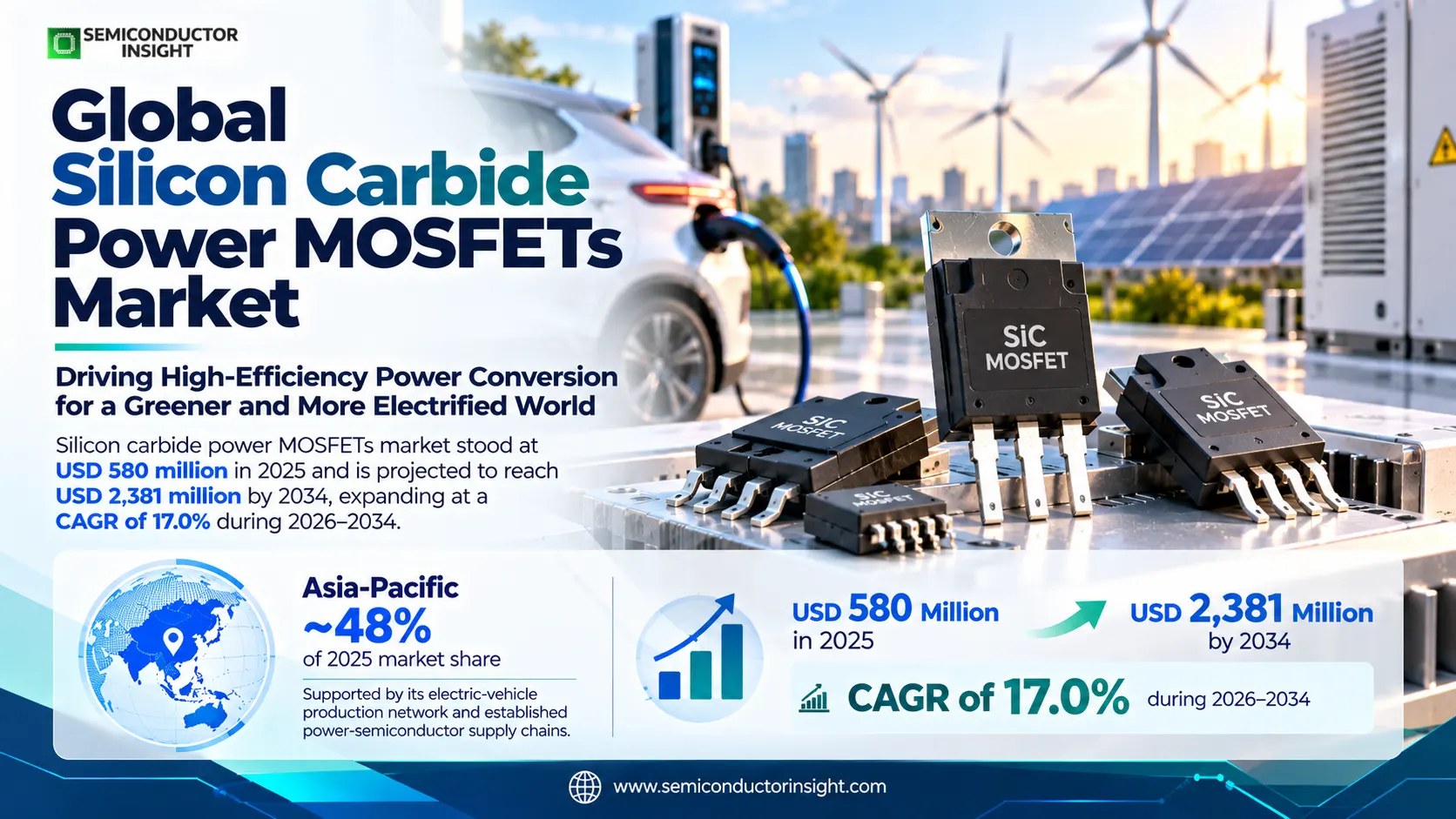
- Market trajectory: The global silicon carbide power MOSFETs market is valued at USD 580 million for 2025 and reaches USD 2,381 million in the 2034 outlook, equivalent to 17.0% compound annual growth over 2026–2034; traction inverters, fast chargers and high-density industrial converters form the central adoption pathways.
- Discrete devices: SiC MOSFET Chip and Device represents an estimated ~61% of 2025 revenue, reflecting the breadth of individual switching components installed in charging equipment, renewable-power electronics and power supplies; the module category carries the faster modeled expansion as customers purchase integrated assemblies.
- Automotive demand: Automotive is the largest application at an estimated ~48% of 2025 revenue, with an estimated ~18.2% growth rate, as battery-electric vehicle architectures introduce more 750 V and 1200 V switching positions in propulsion, charging and auxiliary conversion.
- Regional leadership: Asia-Pacific contributes an estimated ~48% of the 2025 market, with modeled ~17.8% annual growth; the concentration of electric-car assembly, semiconductor fabrication and power-device engineering makes the region the largest consumption and production cluster.
- Competitive forces: Vertically integrated manufacturers compete on gate-oxide lifetime, short-circuit tolerance, package cooling and die yield, while specialty power suppliers compete by offering qualified 650 V to 3300 V families and application-specific support.
Global Silicon Carbide Power MOSFETs Market Overview
Slicon carbide power MOSFETs market stood at USD 580 million in 2025 and is projected to reach USD 2,381 million by 2034, expanding at a CAGR of 17.0% during 2026–2034. Asia-Pacific accounts for the largest estimated share, ~48% in the base year, supported by its electric-vehicle production network and established power-semiconductor supply chains.
Silicon carbide power MOSFETs are voltage-controlled switching transistors manufactured from a wide-bandgap semiconductor rather than conventional silicon. Their material characteristics support rapid switching, high blocking voltage and operation under elevated thermal stress. The commercially relevant comparison is at the converter level: reducing switching and conduction losses can shrink magnetic components, heatsinks and the electrical enclosure, but the benefit must justify device cost and gate-drive redesign.
The revenue boundary includes silicon carbide MOSFET chips and packaged devices together with SiC MOSFET modules, matching the two published type classes. Automotive, telecommunications, consumer electronics, energy and utility, medical and other applications are included where these switching products are installed. Bare silicon carbide substrates, epitaxial wafer processing sold separately, standalone gate-driver chips and finished inverters are excluded unless their SiC switch value is counted within a supplied MOSFET assembly.
Vehicle architecture is a particularly important design filter. A traction inverter built around an 800 V battery generally needs a different switch voltage margin, insulation arrangement and cooling concept than a 400 V vehicle platform. Infineon reported a 1200 V CoolSiC device selection for an 800 V on-board charging solution in January 2025, demonstrating that adoption extends beyond the main propulsion inverter to the vehicle charging subsystem.
The commercial opportunity is not uniform across the voltage range. Compact 650 V packages address server power supplies, telecom rectifiers and photovoltaic converters, whereas 1200 V families are important for vehicle charging, industrial drives and grid-connected conversion. Wolfspeed extended the design envelope in March 2026 with a commercially available 10 kV device, opening specialized high-voltage opportunities that require different qualification procedures and much smaller production volumes than mass-market automotive parts.
Market expansion also faces meaningful counterweights. Automakers have shifted battery-electric product launches and adjusted inventory as demand fluctuates, while device manufacturers have committed capital to larger wafer formats and new fabrication capacity. The International Energy Agency expects global electric-car sales to reach 23 million in 2026, yet it also documented a decline in first-quarter global sales versus the previous year, illustrating why long-term power-device growth need not follow a smooth quarterly path.
Segment Analysis: By Type
The published product split comprises SiC MOSFET Chip and Device and SiC MOSFET Module. Individually sold chips and packaged switches lead with an estimated ~61% share in 2025, while integrated module revenue holds ~39% and has the higher modeled growth rate of ~17.9% because thermal integration and prequalified half-bridge assemblies raise content per converter.
| Type | Technology and purchasing configuration | Estimated market position |
|---|---|---|
| SiC MOSFET Chip and Device | This category spans die and individually packaged switching transistors used as building blocks in board-level converters. Selection is typically made by voltage class, on-resistance at operating temperature, avalanche robustness, gate-charge profile and qualification grade. Designers often parallel multiple discrete switches to manage heat and current, making package inductance and current sharing critical purchasing variables. | Largest type (~61% share in 2025; ~16.4% modeled CAGR). Its broad reach across 650 V industrial supplies, 750 V automotive systems and 1200 V charging stages creates many lower-volume sockets. Customers can combine a qualified transistor with their own gate driver and cooling hardware, retaining flexibility to change layout and supplier while managing higher engineering effort. |
| SiC MOSFET Module | Modules integrate multiple MOSFET chips with electrical interconnections, insulation, thermal substrates and often temperature sensing. Half-bridge and full-bridge packages reduce assembly complexity in high-current power stages, but module procurement involves system-level validation of cooling plates, stray inductance, bond reliability and operating duty cycles. A module is therefore more than a collection of interchangeable bare die. | Estimated ~39% share in 2025; faster ~17.9% CAGR. Integrated assemblies gain relevance in traction inverters, large charging cabinets and utility converters where the buyer values tested thermal interfaces and mechanical repeatability. Packaging innovation can command greater value per design, although customers remain sensitive to supplier-specific module footprints and long qualification cycles. |
SiC MOSFET Chip and Device
Discrete design wins depend on a transistor remaining stable during hard switching, fault recovery and repetitive temperature cycling. Toshiba expanded 650 V surface-mount options in 2025 using DFN8x8 and TOLL packages, showing how industrial buyers prioritize board area and manufacturability alongside electrical losses. Automotive engineers additionally evaluate gate-oxide drift, body-diode behavior and qualification documentation before approving a switch for years of service.
SiC MOSFET Module
Power modules consolidate die attachment, thermal conduction and electrical connections inside a pre-engineered assembly. Mitsubishi Electric introduced full-SiC and hybrid-SiC SLIMDIP samples for air-conditioning equipment in April 2025, illustrating how modules can enter appliances without using the same form factor as automotive traction products. In higher-voltage infrastructure, module suppliers must also solve insulation coordination and maintenance access rather than only optimize transistor efficiency.
Segment Analysis: By Application
Applications comprise Telecommunications, Automotive, Consumer Electronics, Energy and Utility, Medical, and Others. Automotive leads with an estimated ~48% share in 2025, while Energy and Utility represents ~21%; the remaining applications differ in voltage, certification and production volume. These modeled shares describe SiC MOSFET revenue, not the revenue of finished cars, photovoltaic systems or communications equipment.
| Application | Demand characteristics |
|---|---|
| Telecommunications | Estimated ~10% share; ~15.4% modeled CAGR. Telecom rectifiers and high-efficiency DC power shelves benefit from low switching losses and dense packaging, particularly when equipment is installed in constrained base-station shelters. Operators seek dependable power conversion rather than the highest possible switching frequency, and long replacement cycles place a premium on traceable components and predictable sourcing. |
| Automotive | Largest application at ~48% share; ~18.2% modeled CAGR. Traction inverters, on-board chargers and DC-DC stages create multiple opportunities for SiC switches. Battery voltage and thermal duty determine the appropriate device class; manufacturers evaluate the trade-off between range improvements and higher transistor prices before committing to vehicle platforms with multi-year production lives. |
| Consumer Electronics | Estimated ~8% share; ~15.0% modeled CAGR. Premium appliances and compact high-power adapters adopt SiC where heat reduction and power density justify component expense. Most low-wattage consumer devices still rely on inexpensive silicon or gallium nitride, so this application is narrower than the general electronics category and depends on premium power ratings. |
| Energy and Utility | Estimated ~21% share; ~16.8% modeled CAGR. Photovoltaic inverters, battery storage converters, grid equipment and charging infrastructure use wide-bandgap switches to manage conversion losses. European solar deployment and investment in high-voltage grid hardware support demand, but tender economics and utility qualification can lengthen the transition from prototype to recurring device purchases. |
| Medical | Estimated ~5% share; ~14.7% modeled CAGR. Imaging equipment, laboratory power supplies and specialized high-voltage systems value thermal stability and reduced cooling requirements. Reliability testing and regulatory validation often matter more than component price, while lower production volumes mean a single platform win may not produce the same unit scale as an automotive design. |
| Others | Estimated ~8% share; ~14.8% modeled CAGR. This residual category covers industrial welding, aerospace development, test instruments and other converter niches not assigned to the named applications. Procurement may involve custom packages, long operating lives or unusual voltage requirements, creating attractive engineering margins without implying a uniformly high-volume market. |
The application mix influences sales channels as much as transistor architecture. Automotive customers usually require an approved quality system and long change-notification periods; utility integrators emphasize service life and field replacement; telecom buyers compare system power efficiency and rack density. A device family that succeeds in one environment cannot automatically transfer its qualification to another, even when both converters operate near the same nominal voltage.
Regional Analysis
Asia-Pacific is estimated to lead with ~48% of 2025 revenue and ~17.8% CAGR, followed by North America at ~23% and Europe at ~18%. South America accounts for ~6% and Middle East & Africa for ~5%, reflecting a narrower manufacturing base and a greater reliance on imported power modules. These are modeled regional shares, not separately reported company shipments.
Where are silicon carbide power MOSFET design and deployment opportunities concentrated?
Regional demand follows the location of converter manufacturing and the pace at which vehicle, charging and renewable-energy platforms change their electrical architectures. Asia-Pacific combines semiconductor suppliers with vehicle factories, while North America has a substantial engineering and wafer-processing base. Europe places particular weight on automotive efficiency and industrial energy conversion; smaller markets tend to import qualified assemblies through equipment makers rather than buy bare MOSFETs directly.
| Region | Position | Growth outlook | Demand profile | What decides supplier selection |
|---|---|---|---|---|
| Asia-Pacific | Largest (~48%) | ~17.8% CAGR | Vehicle and device manufacturing | Automotive qualification, die supply and price-performance |
| North America | Second (~23%) | ~16.6% CAGR | Power innovation and grid equipment | Domestic sourcing, product robustness and service support |
| Europe | Third (~18%) | ~16.5% CAGR | Industrial efficiency and EV platforms | Thermal design, automotive documentation and reliability |
| South America | Fourth (~6%) | ~16.4% CAGR | Solar and imported charging equipment | Importer inventory, landed cost and application engineering |
| Middle East & Africa | Fifth (~5%) | ~12.6% CAGR | Infrastructure and selected renewables | Project finance, ambient-temperature resilience and local service |
Competitive Landscape of the Silicon Carbide Power MOSFETs Market
Competition spans integrated device manufacturers, specialist wide-bandgap designers and firms that supply packaged modules for selected converter platforms. The market is not a single ranking of corporate semiconductor revenue: each supplier participates in a different mixture of SiC die, packaged switches, modules and adjacent power products. Product qualification and manufacturing scale influence commercial positioning more directly than headline corporate sales.
STMicroelectronics, Infineon, onsemi, Wolfspeed and ROHM are prominent suppliers with visible device roadmaps and broad automotive or industrial engagement. Toshiba and Mitsubishi Electric add industrial and module expertise; Microchip emphasizes rugged high-voltage discrete devices. The ability to support long automotive qualification cycles, consistent gate-oxide behavior and package-level thermal design makes repeat platform wins difficult for unqualified entrants.
GeneSiC is a Navitas Semiconductor brand rather than an independent present-day corporate owner, while IXYS belongs to Littelfuse. These ownership distinctions matter because listing both an acquired name and its parent as separate competitors can inflate the apparent number of manufacturers. Imperix is better treated as a power-electronics engineering and control-platform participant unless a directly sold SiC MOSFET product is established.
Manufacturing investments can reduce cost per usable die, but wafer-diameter transitions create process risk. Wolfspeed linked its 2026 Gen 5 roadmap to a qualified 200 mm production platform, while supplier packages such as top-cooled Q-DPAK and T2PAK address thermal design rather than wafer cost alone. Customers often qualify more than one source, yet pin compatibility does not guarantee identical switching behavior.
Tier structure
| Tier | Companies | Basis of competition |
|---|---|---|
| Tier 1 | STMicroelectronics; Infineon; onsemi; Wolfspeed; ROHM | Broad SiC product portfolios, qualification infrastructure and substantial device engineering for automotive or industrial power systems. |
| Tier 2 | Toshiba; Mitsubishi Electric; Microchip; Navitas / GeneSiC | Specialized packages, industrial system expertise, rugged discrete technology and differentiated high-voltage products. |
| Other profiled names | Littelfuse / IXYS; Imperix | Historical ownership and adjacent engineering roles are distinguished from current high-volume SiC MOSFET manufacturing. |
Key companies profiled
- STMicroelectronics
- Infineon Technologies
- ROHM
- GeneSiC (Navitas Semiconductor)
- Wolfspeed
- onsemi
- Microchip Technology
- IXYS (Littelfuse)
- Littelfuse
- Toshiba
- Mitsubishi Electric
- Imperix
Production and Manufacturing Outlook
SiC MOSFET production begins with crystal and wafer preparation, proceeds through epitaxy and transistor processing, and finishes with die testing, packaging and module assembly. A wider wafer can increase theoretical die output, but commercial cost depends on defect density, usable yield and package qualification. Device manufacturers therefore face linked decisions about process scale and application-specific product reliability.
The most demanding steps are crystal growth, epitaxial control and gate-oxide formation, because material defects and transistor threshold drift affect electrical yield and lifetime. Die processing also needs tight control of edge termination for high blocking voltages. Production economics improve when a supplier can test predictable device populations and reduce losses during packaging, rather than merely purchasing a larger-diameter wafer.
Packaging innovation is accelerating in parallel with fabrication. Top-side-cooled Q-DPAK, T2PAK and TOLL formats move heat extraction away from conventional through-hole layouts and can support smaller converter footprints. Industrial buyers still require mechanical robustness, acceptable creepage and clearance, and compatible manufacturing lines, so a superior laboratory switching figure does not automatically translate into a cheaper finished system.
Supply strategies increasingly distinguish mature 650 V and 1200 V products from emerging high-voltage offerings. The former compete through repeatable production and multi-source qualification, whereas 3300 V and 10 kV designs require specialized customers and more intensive application support. Producers able to align device physics, module engineering and documentation can earn longer-lasting design wins, although capital intensity remains substantial.
Market Dynamics, Drivers, Restraints and Opportunities
Demand growth reflects the spread of high-efficiency switching into vehicle, energy and industrial systems, moderated by device cost, qualification delays and uneven customer capital spending. The impact framework allocates modeled percentage-point contributions to the forecast rate; it is a scenario attribution for this defined product market, not a claim that individual announcements caused measured changes in annual revenue.
MARKET DRIVERS
Drivers Impact Analysis*
| Market Drivers | Impact Rank | CAGR Contribution (%) | 2026–2028 | 2029–2031 | 2032–2034 |
|---|---|---|---|---|---|
| Electric-vehicle traction and charging platforms | High | +8.20% | High | High | High |
| Renewable-energy and storage converters | Medium-High | +5.10% | High | High | Medium |
| Industrial power and grid electrification | Medium | +3.70% | Medium | High | High |
| High-density server and telecom supplies | Low-Medium | +2.70% | Medium | High | High |
| Others (medical equipment and specialist high-voltage systems) | Low | +1.50% | Low | Medium | Medium |
Electric-vehicle voltage architecture
Traction inverters and on-board chargers benefit when SiC devices reduce losses at high voltage, especially as vehicle makers optimize charging speed and thermal packaging. The 800 V charging-system selection reported by Infineon and FORVIA HELLA illustrates a specific design pathway. Long vehicle development cycles mean engineering qualification can precede recurring device shipments by several years, so adoption depends on successful platform launches.
Renewable generation and battery storage
Solar and storage converters use semiconductor switches repeatedly to shape and control power flows between DC equipment and AC networks. Higher switching frequency can reduce passive-component size, but converter designers balance this benefit against switching noise and semiconductor cost. European deployment goals and the rising contribution of solar electricity support a growing equipment base in which SiC can compete for premium power stages.
Grid and industrial electrification
Industrial drives, solid-state protection and medium-voltage power conversion create specialized demand for robust MOSFETs. Wolfspeed and GE Aerospace identified high-voltage module standardization as an area of collaboration in June 2026. Such projects expand the technically addressable range of SiC but require system redesign, safety assessment and procurement approvals before they generate sustained semiconductor volume.
Dense computing and communications power
AI data-center and telecommunications power supplies face pressure to deliver more output from limited rack space while controlling waste heat. Top-cooled SiC packages allow designers to rethink heat extraction and board arrangement in some power stages. The strongest opportunities arise where conversion efficiency and service reliability justify a higher switching-device bill of materials rather than where inexpensive silicon already meets requirements.
MARKET RESTRAINTS
Restraints Impact Analysis*
| Market Restraints | Impact Rank | CAGR Contribution (%) | 2026–2028 | 2029–2031 | 2032–2034 |
|---|---|---|---|---|---|
| High wafer and die manufacturing costs | High | -1.90% | High | Medium | Medium |
| Lengthy reliability and automotive qualification | Medium-High | -1.20% | High | High | Medium |
| Uncertain electric-vehicle build schedules | Medium | -0.70% | High | Medium | Low |
| Others (silicon and gallium-nitride competition, supply imbalance) | Low | -0.40% | Medium | Medium | High |
Yield and packaging cost
SiC fabrication remains more capital-intensive than mature silicon processing, and material defects can make the cost per good die difficult to reduce. Advanced thermal packages and modules add manufacturing steps that must be justified at the converter level. If vehicle and inverter customers delay purchasing, suppliers may face underutilized capacity even while their next-generation transistor performance improves.
Reliability proof takes time
High-voltage switching devices must withstand repeated electrical stress, short-circuit events and temperature cycling over long product lives. Automotive and grid customers evaluate gate-oxide stability, dynamic resistance and qualification records rather than accept a single published efficiency benchmark. This scrutiny can slow supplier substitution and prevent a newly announced product from becoming immediate production revenue.
Volatile customer orders
The IEA documented uneven electric-car demand in early 2026 despite a positive full-year global outlook. Device inventories and converter platform transitions can amplify these changes, because a chip maker may deliver months before a vehicle reaches the showroom. Industrial project delays create similar timing risk for utility and charging applications, even when their long-run efficiency economics remain attractive.
MARKET OPPORTUNITIES
Higher-voltage solid-state infrastructure
Commercial 10 kV MOSFET availability gives engineers another option for grid modernization and industrial power protection, potentially reducing the number of devices connected in series. The addressable customer base is specialized, and insulation design is demanding, but a successful standard module platform could create differentiated revenue beyond the crowded automotive 1200 V category.
Thermal package redesign
Top-side-cooled MOSFET packages open space for compact server supplies, charging cabinets and industrial power shelves. Customers can reduce heatsink volume or improve airflow when the complete thermal stack is optimized. Vendors that publish reproducible thermal data and provide reference designs can win adoption without competing solely on the lowest bare-die price.
Industrial multi-source qualification
Converter makers increasingly seek alternative qualified SiC suppliers to reduce disruption from fabrication changes or regional logistics. This creates opportunities for firms offering stable electrical characteristics, compatible footprints and long-term supply commitments. Winning a second-source position may produce lower immediate volume than a new platform award, but it can establish an entry point for future generations.
Applications beyond passenger cars
Medical imaging, industrial welding and aerospace power systems have requirements that differ from automotive traction. Some favor very high blocking voltage, others low switching noise or exceptional fault robustness. Suppliers with application engineering resources can address these small but technically demanding niches without assuming that every new design will use the same module architecture.
Silicon Carbide Power MOSFET Supply Chain Analysis
The value chain links SiC crystal and wafer producers to epitaxial and device fabrication, transistor packaging, module assembly and converter customers. Quality control at each stage determines usable die output and long-term reliability. Commercial differentiation increasingly comes from coordinating the material process with gate-oxide engineering and the final thermal interface.
Upstream materials. Crystal growth and wafer finishing establish defect density and dimensional consistency before a MOSFET is processed. Substrate and epitaxy supply can be internal or contracted, with sourcing decisions shaped by qualification risk and production scale. A wafer shipment is not equivalent to a MOSFET sale, because additional device processing, testing and packaging are needed before a usable switch reaches the converter manufacturer.
Device manufacturing. The fabrication stage forms the transistor channel, drift region and protective structures that determine voltage capability and switching behavior. Wafer probe and screening separate usable die from defective material, making yield central to cost. Engineers also evaluate oxide stability under prolonged bias and fault conditions, since a marginal threshold shift can compromise the reliability of a power stage.
Packaging and modules. Assembly combines electrical connections, heat-spreading materials and insulating structures suited to the target converter. A 650 V surface-mount device and a high-current 1200 V half-bridge module face different manufacturing constraints, even if their semiconductor material is identical. Thermal resistance, parasitic inductance and repeatability of mechanical mounting all influence customer approval and field service costs.
Downstream integration. Vehicle makers and power-equipment integrators choose switches as part of an entire electrical architecture, then validate efficiency, fault behavior and thermal performance in the finished converter. Procurement may be direct from a semiconductor manufacturer or through a module supplier. Because replacing a qualified transistor can require board and software changes, design wins often remain commercially important over several product years.
Recent Developments in the Silicon Carbide Power MOSFETs Market
- 9 June 2026 Introduced
Wolfspeed presented its fifth-generation SiC MOSFET technology for 750 V and 1200 V designs, describing improved specific on-resistance and a 200 mm manufacturing platform. The announcement matters because transistor performance, process maturity and wafer scale must advance together to make the next device generation commercially viable for vehicle and industrial power converters. Source - 5 May 2026 Reported
Navitas highlighted an expansion of its fifth-generation GeneSiC 1200 V MOSFET portfolio into top-side-cooled QDPAK and low-profile TO-247-4L formats in its first-quarter business update. The packaging additions target high-density power systems, where a reliable heat-removal path and converter layout can determine whether a device is practical beyond the laboratory. Source - 5 March 2026 Launched
Wolfspeed announced commercial availability of a 10 kV silicon carbide power MOSFET intended for grid modernization and high-voltage industrial equipment. The new voltage class broadens architecture choices for solid-state conversion and protection; its significance lies in specialized engineering capability rather than evidence of immediate mass-market unit shipments. Source - 4 December 2025 Released
onsemi launched EliteSiC MOSFET products in top-cooled T2PAK packages, including 650 V and 950 V variants for automotive and industrial power stages. Improved heat extraction and a standardized footprint can help designers manage dense boards and simplify mechanical integration, though full system savings depend on the surrounding converter design. Source - 29 July 2025 Introduced
Infineon launched its 1200 V CoolSiC G2 MOSFETs in Q-DPAK top-side-cooled packages for chargers, solar inverters and other industrial applications. The company reported lower switching losses and thermal resistance versus its preceding generation. This illustrates the competition to improve power density while maintaining robustness under real operating conditions. Source - 20 May 2025 Shipped
Toshiba began volume shipments of four third-generation 650 V SiC MOSFETs in compact DFN8x8 packages for industrial power supplies and photovoltaic conditioning. Package miniaturization helps equipment makers increase power density, but electrical qualification remains essential when replacing through-hole devices with surface-mount alternatives in high-voltage converter layouts. Source
REPORT SCOPE & SEGMENTATION
| Attribute | Details |
|---|---|
| Study Period | 2020–2034 |
| Base Year | 2025 |
| Estimated Year | 2026 |
| Forecast Period | 2026–2034 |
| Historical Period | 2020–2024 |
| Market Size 2025 | USD 580 million |
| Market Size 2026 | USD 678 million |
| Market Size 2034 | USD 2,381 million |
| Growth Rate | CAGR of 17.0% from 2026–2034 |
| Unit | Value (USD Million); device volume and average selling price by segment |
| Segmentation | By Type, By Application and By Region |
| By Type | SiC MOSFET Chip and Device · SiC MOSFET Module |
| By Application | Telecommunications · Automotive · Consumer Electronics · Energy and Utility · Medical · Others |
| By Region | Five modeled global regions; regional and segment shares are analyst estimates for the 2025 base year. North AmericaUnited States, Canada, Mexico EuropeGermany, France, United Kingdom, Italy, Spain, Rest of Europe Asia-PacificChina, Japan, India, South Korea, Southeast Asia, Rest of Asia-Pacific South AmericaBrazil, Chile, Argentina, Rest of South America Middle East & AfricaSaudi Arabia, United Arab Emirates, South Africa, Egypt, Rest of Middle East & Africa |
| Key Companies Profiled | STMicroelectronics, Infineon Technologies, ROHM, GeneSiC (Navitas Semiconductor), Wolfspeed, onsemi, Microchip Technology, IXYS (Littelfuse), Littelfuse, Toshiba, Mitsubishi Electric, Imperix |
| Customization Scope | Customization can cover country splits, power-voltage classes, manufacturer product comparisons and end-use converter procurement; all changes are scoped before delivery. |
Frequently Asked Questions
How large is the silicon carbide power MOSFETs market?
The global silicon carbide power MOSFETs market was valued at USD 580 million in 2025 and is forecast to reach USD 2,381 million by 2034, representing a 17.0% CAGR over 2026–2034. This value covers MOSFET chips, packaged devices and integrated MOSFET modules, rather than all silicon carbide materials or the revenue of complete electric vehicles and power converters.
What distinguishes a SiC MOSFET from a silicon power transistor?
Silicon carbide has a wider bandgap and higher critical electric field than conventional silicon, allowing suitable transistor designs to handle high voltage with attractive switching performance. The benefit appears in a complete converter through reduced losses or smaller cooling and magnetic components. A SiC device is not automatically cheaper or better for every low-voltage application.
Which type accounts for the greatest revenue?
The SiC MOSFET Chip and Device category leads with an estimated ~61% share of 2025 sales, supported by individually packaged transistors and die used across industrial and charging applications. Modules account for ~39% and are modeled to grow faster at ~17.9% annually because more customers purchase integrated, thermally managed switching assemblies for high-current power stages.
Why is the automotive application important?
Automotive applications represent an estimated ~48% of 2025 revenue and are projected to expand by about ~18.2% annually. Vehicle makers use SiC in traction inverters, on-board chargers and high-voltage conversion stages when efficiency and thermal benefits outweigh device cost. Adoption depends on the vehicle electrical architecture and completion of demanding reliability qualifications.
Which region leads demand for SiC power MOSFETs?
Asia-Pacific is the largest estimated regional market at ~48% of 2025 revenue, with modeled ~17.8% annual growth. China anchors electric-car production, while Japan contributes important device and packaging suppliers. North America is the second-largest region at ~23%; these shares are estimates for the defined MOSFET product market, not country shares of global semiconductor sales.
What are the main technical purchasing criteria?
Customers compare blocking voltage, on-resistance at operating temperature, switching energy, gate-charge behavior, fault tolerance and package thermal resistance. Automotive programs also examine long-term oxide stability and traceable qualification. A nominal 1200 V rating does not by itself establish suitability, because the converter topology, cooling path and expected duty cycle determine actual stress.
How does the renewable-energy sector use SiC switches?
Photovoltaic inverters, battery storage converters and selected grid power systems employ semiconductor switches to regulate current and voltage. SiC can improve power density or conversion efficiency when the system is designed around its capabilities. The equipment maker still evaluates cost, electromagnetic interference, cooling and field service requirements before selecting a wide-bandgap solution.
Which companies supply silicon carbide MOSFET products?
The supplier landscape includes STMicroelectronics, Infineon, onsemi, Wolfspeed, ROHM, Toshiba, Microchip and other specialized power-device businesses. GeneSiC operates under Navitas Semiconductor, and IXYS is associated with Littelfuse. These names are not an audited ranking of market share; each has a different product mix, voltage range and degree of manufacturing integration.
What risks could slow the forecast?
Material defects, wafer yield, packaging costs and lengthy design qualification can slow commercial adoption. Electric-car sales are also uneven between countries and quarters, creating inventory and capacity risks for semiconductor producers. Competing silicon and gallium-nitride solutions remain attractive in some converter designs, so power-system economics rather than device efficiency alone determine purchasing decisions.
What years and segments are covered in this analysis?
The analysis uses 2025 as the base year, 2026 as the estimate year and 2034 as the forecast endpoint, with historical context from 2020–2024. It separates SiC MOSFET Chip and Device from SiC MOSFET Module, reviews six named application categories, and compares five global regions using estimated segment and regional shares.
Research Sources & Evidence Base
Get Sample Report PDF for Exclusive Insights
Report Sample Includes
- Table of Contents
- List of Tables & Figures
- Charts, Research Methodology, and more...
 Download Sample Report PDF