MARKET INSIGHTS
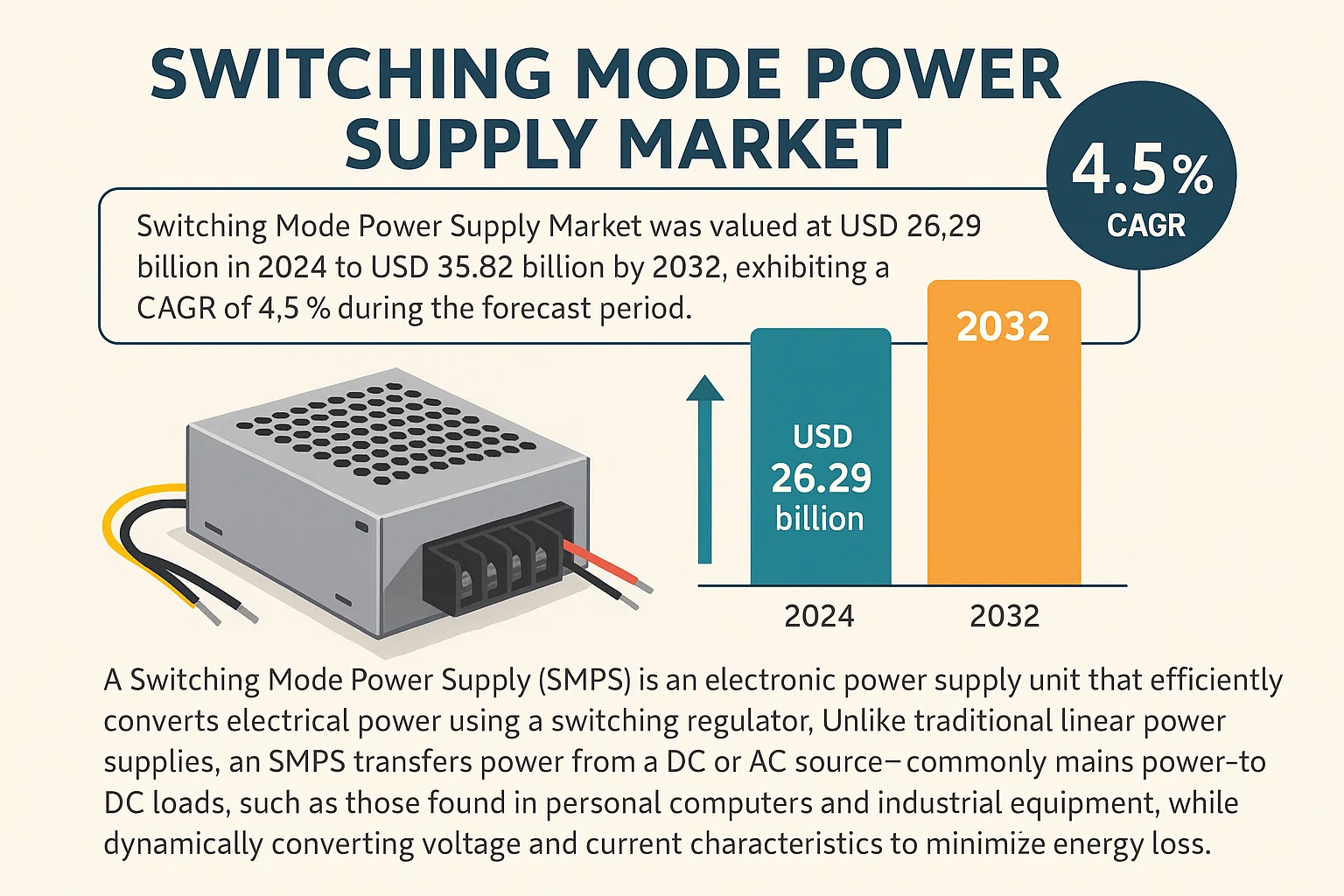
Global Switching Mode Power Supply Market was valued at USD 26.29 billion in 2024 to USD 35.82 billion by 2032, exhibiting a CAGR of 4.5% during the forecast period.
A Switching Mode Power Supply (SMPS) is an electronic power supply unit that efficiently converts electrical power using a switching regulator. Unlike traditional linear power supplies, an SMPS transfers power from a DC or AC source—commonly mains power—to DC loads, such as those found in personal computers and industrial equipment, while dynamically converting voltage and current characteristics to minimize energy loss.
The market’s steady growth is primarily driven by the rising demand for energy-efficient power solutions across various sectors, including industrial automation, consumer electronics, and telecommunications. Furthermore, the rapid expansion of data centers and the increasing adoption of IoT devices are significant contributors to market expansion. The industrial segment currently dominates application-wise, holding a 48% market share, while the AC/DC type leads the product segment with an 88% share. Geographically, Asia-Pacific is the largest market, accounting for over 71% of global revenue, because it is a major manufacturing hub for electronics. Key players such as DELTA, Lite-On Technology, and MEAN WELL continue to innovate, focusing on higher efficiency and compact designs to meet evolving industry standards.
MARKET DRIVERS
Energy Efficiency Regulations and Standards
Stringent global energy efficiency standards, particularly the EU’s Ecodesign Directive and similar regulations in North America, are pushing manufacturers to develop more efficient power supplies. This regulatory pressure is accelerating the adoption of advanced switching mode power supplies across industries.
Digitalization and IoT Expansion
The exponential growth of Internet of Things devices requires compact, efficient power solutions. Switching mode power supplies offer the necessary power density and efficiency for these applications while supporting the miniaturization trend in electronics.
➤ The rapid growth of data centers and cloud computing infrastructure is creating unprecedented demand for efficient power delivery systems, with switching mode power supplies becoming the standard for high-efficiency operations.
Additionally, the increasing electrification of vehicles and industrial equipment is creating new markets for advanced power supplies. The transition to electric vehicles alone is expected to require millions of high-efficiency charging stations, each utilizing multiple switching mode power supplies.
MARKET CHALLENGES
Complexity in Design and Manufacturing
Designing switching mode power supplies requires specialized knowledge of power electronics, magnetics, and control systems. This complexity creates a barrier to entry for new manufacturers and can lead to longer development cycles, especially for custom or high-power applications where thermal management and electromagnetic interference become significant challenges.
Other Challenges
Cost Sensitivity in Price-Sensitive Markets
In highly competitive market segments, particularly consumer electronics and some industrial applications, customers are extremely price-sensitive. While switching mode power supplies offer better efficiency, their higher initial cost compared to linear power supplies can be a deterrent, especially in markets where energy costs are low or where long-term operational savings are not a primary consideration.
MARKET RESTRAINTS
Supply Chain Constraints and Component Shortages
The global semiconductor shortage has particularly affected the power semiconductor components essential for switching mode power supplies. Limited availability of high-quality MOSFETs, IGBTs, and control ICs has increased lead times and costs, slowing down some market segments despite strong underlying demand.
MARKET OPPORTUNITIES
Renewable Energy Integration and Electrification
The global transition toward renewable energy is creating massive opportunities for advanced power conversion systems. Solar inverters, wind turbine converters, and energy storage systems all require high-efficiency switching mode power supplies. The electrification of transportation, particularly the rapid growth of electric vehicles, is creating an entirely new market for high-power, high-efficiency charging infrastructure and on-board power systems.
Switching Mode Power Supply Market Trends
Rising Demand for Energy-Efficient Power Solutions
The global focus on energy efficiency and carbon footprint reduction continues to drive innovation in the Switching Mode Power Supply (SMPS) market. Manufacturers are increasingly developing power supplies with higher efficiency ratings, with many products now exceeding 90% efficiency. This trend is particularly driven by stringent government regulations in North America and Europe, as well as growing consumer awareness about energy consumption in emerging markets. The transition from linear power supplies to switching mode technology has enabled significant energy savings across industrial, commercial, and consumer applications.
Other Trends
Miniaturization and Higher Power Density
Advancements in semiconductor technology and component design have enabled significant miniaturization of SMPS units while increasing their power density. Modern SMPS units are up to 60% smaller than equivalent models from a decade ago while delivering the same or higher power output. This trend is particularly important for consumer electronics and data center applications where space constraints are critical. The development of gallium nitride (GaN) and silicon carbide (SiC) transistors has been a key enabler, allowing for higher switching frequencies and reduced heat generation.
Growth in Industrial Automation and IoT
The rapid expansion of industrial automation and IoT devices has created substantial demand for reliable and efficient power supplies. SMPS units are essential components in factory automation systems, robotics, and smart manufacturing equipment. The Industry 4.0 initiative across major economies has accelerated adoption of automated systems, subsequently driving demand for high-quality power supplies. The market has seen particular growth in Asia-Pacific, where manufacturing activities are concentrated, with China leading both in production and consumption of industrial SMPS units.
Regional Market Dynamics
Asia-Pacific continues to dominate the global SMPS market, holding over 71% market share by volume in 2024. This dominance is driven by massive electronics manufacturing in China, Taiwan, South Korea, and Southeast Asian countries. North America and Europe remain strong markets for high-end and specialized SMPS units, particularly in industrial and medical applications. The European market shows particular strength in renewable energy integration SMPS, while North America leads in data center and telecommunications applications.
COMPETITIVE LANDSCAPE
Key Industry Players
Switching Mode Power Supply Market Leaders
The global Switching Mode Power Supply (SMPS) market is dominated by several key players who specialize in different power supply segments including AC/DC and DC/DC converters. These companies have established strong market positions through technological innovation, global distribution networks, and diverse application expertise across consumer electronics, industrial automation, telecommunications, and data center sectors.
Market leaders like Delta Electronics and Lite-On Technology have maintained their dominance through continuous R&D investments and strategic acquisitions. Meanwhile, emerging players from Asia-Pacific region are gaining market share with competitive pricing and specialized solutions for growing markets like electric vehicles, renewable energy, and 5G infrastructure.
List of Key Switching Mode Power Supply Companies
- DELTA Electronics, Inc.
- Lite-On Technology Corp.
- MEAN WELL Enterprises Co. Ltd.
- Chicony Power Technology Co., Ltd.
- Siemens AG
- Schneider Electric SE
- ABB Ltd.
- Omron Corporation
- PULS GmbH
- PHOENIX CONTACT GmbH & Co. KG
- TDK-Lambda Corporation
- Cosel Co., Ltd.
- MOSO Electronics (Shenzhen) Co., Ltd.
- 4NIC Technologies Ltd.
- Weidmüller Interface GmbH & Co. KG
Segment Analysis:
| Segment Category | Sub-Segments | Key Insights |
| By Type |
|
AC-DC Converters dominate due to their extensive use in industrial applications and consumer electronics where grid power conversion is essential, while DC-DC segments show strong growth in portable electronics and automotive applications requiring efficient power management. |
| By Application |
|
Industrial Equipment segment shows strongest adoption due to the critical need for reliable power conversion in manufacturing processes and automation systems, while consumer electronics benefits from miniaturization trends and increasing power density requirements across all application segments. |
| By End User |
|
Original Equipment Manufacturers lead in market share due to their direct integration of SMPS units into final products across industries, while system integrators benefit from custom power solution requirements in specialized industrial applications requiring tailored power delivery solutions. |
| By Power Rating |
|
Medium Power (500-1500W) segment demonstrates strongest growth due to balanced demand from industrial automation, telecom infrastructure and high-performance computing where power requirements exceed consumer electronics but don’t require industrial-scale solutions, while high power segments serve specialized applications with specific power delivery needs. |
| By Voltage Range |
|
Medium Voltage (48-400V) segment shows strongest adoption due to its versatility across consumer, commercial and industrial applications where this voltage range provides optimal balance between safety regulations and power delivery requirements, while high voltage applications remain more specialized and niche in their implementation. |
Regional Analysis: Switching Mode Power Supply Market
Asia-Pacific’s leadership stems from its role as the world’s primary electronics manufacturing hub, with countries specializing in different supply chain segments while maintaining seamless integration. China dominates final assembly and semiconductor production, while Japan and South Korea lead in high-precision components and automation equipment. This integrated ecosystem creates natural demand for switching mode power supplies across all application segments.
National strategies across the region aggressively promote electronics self-sufficiency and technological sovereignty. China’s Made in China 2025 initiative, India’s Make in India campaign, and similar policies in Japan and South Korea all prioritize domestic electronics manufacturing through subsidies, tax incentives and infrastructure investment. These policies directly drive demand for power supply components while creating protected markets that benefit local manufacturers over international competitors.
The region accounts for over 60% of global consumer electronics production, creating immense natural demand for switching mode power supplies across smartphones, computers, home appliances and emerging IoT devices. This massive scale enables manufacturers to achieve unprecedented economies of scale, driving down costs while improving performance characteristics. The consumer electronics ecosystem also drives innovation in power efficiency and miniaturization as manufacturers compete for space-constrained applications.
Asia-Pacific’s rapid industrialization has created the world’s largest market for industrial automation equipment, all requiring sophisticated power management solutions. Manufacturing automation, process control systems and robotics all demand reliable, efficient and compact power supplies. This sector shows the highest growth rate globally, particularly in China and India where manufacturing modernization drives double-digit annual growth in industrial equipment markets, subsequently pulling demand for associated components.
North America
North America maintains a mature but innovation-driven market for switching mode power supplies, characterized by high demand for energy-efficient and specialized applications. The region benefits from strong aerospace, defense and telecommunications sectors that demand extremely reliable and high-performance power solutions meeting stringent certification requirements. North American manufacturers focus on high-value segments with strong R&D investment, particularly in areas of thermal management, electromagnetic compatibility and miniaturization. The market shows gradual shift toward renewable energy integration and electric vehicle infrastructure, creating new demand patterns while traditional industrial and consumer applications maintain stable growth.
Europe
European markets emphasize environmental regulations and energy efficiency standards, creating both challenges and opportunities for switching mode power supply manufacturers. The region shows strong demand from industrial automation, renewable energy integration and high-performance computing applications. European manufacturers specialize in precision engineering and reliability, with particular strength in medical equipment, automotive and aerospace applications where certification requirements create barriers to entry. The market shows consolidation trends with established manufacturers acquiring smaller specialists to expand technology portfolios, while new entrants focus on niche applications with innovative cooling or control technologies.
Latin America
Latin American markets show promising growth potential with improving economic conditions driving infrastructure investment and industrial modernization. The region benefits from proximity to North American supply chains while developing its own manufacturing capabilities, particularly in Brazil and Mexico. Market growth remains uneven with stronger performance in manufacturing-focused economies compared to commodity-dependent nations. The region shows increasing adoption of international standards and certification requirements, creating opportunities for both local manufacturing and international suppliers offering cost-competitive solutions.
Middle East & Africa
These regions show the fastest growth rate from a relatively small base, with particular strength in infrastructure development and energy sector investments. Gulf states leverage petrochemical resources to fund diversification into technology and manufacturing, creating demand for high-quality power components. Africa shows promise in selective markets where economic growth drives electronics adoption, though the market remains dominated by imports with limited local manufacturing capacity. Both regions show increasing integration with global supply chains as infrastructure development accelerates.
Report Scope
This market research report provides a comprehensive analysis of the Switching Mode Power Supply Market, covering the forecast period 2025-2032. It offers detailed insights into market dynamics, technological advancements, competitive landscape, and key trends shaping the industry.
Key focus areas of the report include:
- Market Overview: The report begins with an overview outlining its current market scenario, key growth indicators, and industry transformation drivers. It discusses macroeconomic factors, demand-supply balance, regulatory landscape, and the strategic role of semiconductors in powering advancements across industries such as automotive, telecommunications, consumer electronics, and industrial automation.
- Market Size & Forecast: Historical data and future projections for revenue, unit shipments, and market value across major regions and segments.
- Segmentation Analysis: Detailed breakdown by product type, technology, application, and end-user industry to identify high-growth segments and investment opportunities.
- Regional Insights: Insights into market performance across North America, Europe, Asia-Pacific, Latin America, and the Middle East & Africa, including country-level analysis where relevant.
- Competitive Landscape: Profiles of leading market participants, including their product offerings, R&D focus, manufacturing capacity, pricing strategies, and recent developments such as mergers, acquisitions, and partnerships.
- Technology Trends & Innovation: Assessment of emerging technologies, integration of AI/IoT, semiconductor design trends, fabrication techniques, and evolving industry standards.
- Market Drivers & Restraints: Evaluation of factors driving market growth along with challenges, supply chain constraints, regulatory issues, and market-entry barriers.
- Stakeholder Insights: Insights for component suppliers, OEMs, system integrators, investors, and policymakers regarding the evolving ecosystem and strategic opportunities.
Primary and secondary research methods are employed, including interviews with industry experts, data from verified sources, and real-time market intelligence to ensure the accuracy and reliability of the insights presented.
FREQUENTLY ASKED QUESTIONS:
What is the current market size of Switching Mode Power Supply Market?
-> Global Switching Mode Power Supply market was valued at USD 26290 million in 2024 and is projected to reach USD 35820 million by 2032.
Which key companies operate in Switching Mode Power Supply Market?
-> Key players include DELTA, Lite-On Technology, Chicony Power, Siemens, Schneider Electric, ABB, Omron, Puls, PHOENIX, TDK-Lambda, and MEAN WELL, among others.
What is the growth rate of Switching Mode Power Supply Market?
-> The market is expected to grow at a CAGR of 4.5% during the forecast period 2024-2032.
Which region dominates the market?
-> Asia-Pacific is the largest market, accounting for over 71% of the global market share.
What are the main product types?
-> The market is segmented into AC/DC, DC/DC, and Others, with AC/DC accounting for approximately 88% of the market.

Get Sample Report PDF for Exclusive Insights
Report Sample Includes
- Table of Contents
- List of Tables & Figures
- Charts, Research Methodology, and more...