SEMICONDUCTOR INSIGHT
MARKET RESEARCH REPORT

Global SiC Based Power Electronics and Inverter Market

2026 to 2034
MARKET INTELLIGENCE
ACROSS KEY REGIONS
2026 EDITION
POWER ELECTRONICS Semiconductor Market Research

Global SiC Based Power Electronics and Inverter Market

Size, Share and Industry Analysis, 2026–2034

◷
UPDATED 29 October 2026
▤
REPORT LENGTH Detailed Report
▣
REPORT CODE c53d5b839d67
▯
FORMATS PDF

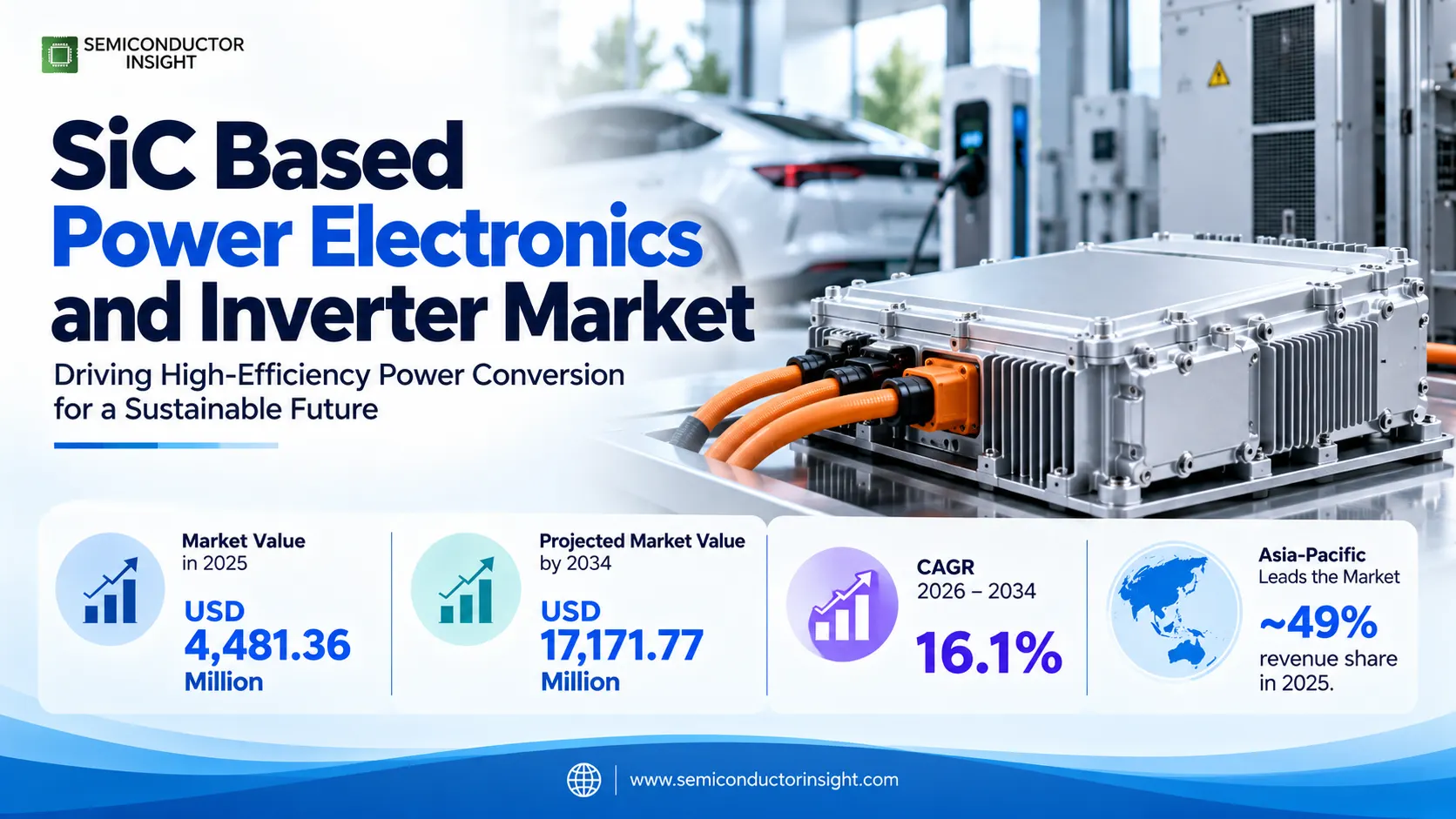
SiC based power electronics and inverter market reached USD 4,481.36 million in 2025 and is projected to reach USD 17,171.77 million by 2034, registering a CAGR of 16.1% over 2026–2034. Asia-Pacific accounted for the largest regional market in 2025 at an estimated ~49%, reflecting its concentration of electric-vehicle manufacturing and power-semiconductor supply chains.


Get the sample PDF with study scope, segmentation and methodology details.

Key Statistics

2025 Market Size
USD 4,481.36 million
2034 Projected Size
USD 17,171.77 million
CAGR (2026–2034)
16.1%
Largest Market in 2025
Asia-Pacific (~49%)

Key Takeaways

  • Market trajectory: Global revenue was USD 4,481.36 million in 2025, with an estimated USD 5,202.75 million for 2026 and USD 17,171.77 million forecast for 2034; the implied 2026–2034 expansion rate is 16.1%, reflecting a broader adoption of silicon carbide in power conversion.
  • Power electronics: Discrete devices and power modules represent the larger type, an estimated ~61% of 2025 revenue, because semiconductor components enter traction systems, charging equipment, industrial drives and high-efficiency power supplies before assembly into complete converters.
  • Inverter systems: Finished SiC-enabled inverters account for the remaining estimated ~39% of type revenue and exhibit the stronger type growth rate at ~16.8% CAGR as 800 V traction architectures and large energy-storage systems require higher switching efficiency.
  • Automotive: The automotive application leads with an estimated ~55% of the 2025 market, supported by electric-vehicle traction drives, onboard chargers, DC-to-DC converters and supplier programmes for 750 V and 1,200 V silicon-carbide components.
  • Regional balance: Asia-Pacific represents an estimated ~49% of 2025 demand, ahead of North America at ~23% and Europe at ~19%; different automotive supply chains and regional power-equipment investment patterns explain the ranking.
  • Technology priorities: Device makers are improving switching losses, gate stability, package inductance and thermal cycling while vehicle integrators seek smaller cooling systems and more compact powertrains at comparable delivered output.
  • Supplier structure: Wolfspeed, Infineon Technologies, STMicroelectronics, onsemi and Mitsubishi Electric supply key power devices and modules, while BorgWarner and other system integrators translate those components into inverter programmes.
  • Forecast scope: The 2025 base, 2026 estimate and 2034 projection encompass the publisher-defined mix of SiC power electronics and finished inverters across Automotive, Consumer Electronics, Aerospace, Information Technology and Others applications.

SiC Based Power Electronics and Inverter Market Overview

SiC based power electronics and inverter market reached USD 4,481.36 million in 2025 and is projected to reach USD 17,171.77 million by 2034, registering a CAGR of 16.1% over 2026–2034. Asia-Pacific accounted for the largest regional market in 2025 at an estimated ~49%, reflecting its concentration of electric-vehicle manufacturing and power-semiconductor supply chains.

Base year: 2025 · Estimated year: 2026 · Forecast period: 2026–2034 · Values in USD million · Historical context: 2020–2024

Silicon carbide is a wide-bandgap semiconductor whose power-switching properties differ from those of conventional silicon. The material tolerates high electric fields and allows devices to switch at elevated frequencies with comparatively low losses, subject to operating voltage, packaging and circuit design. A SiC MOSFET is therefore not merely a replacement part: its use changes magnetics, gate-drive requirements, thermal interfaces, electromagnetic compatibility and the overall engineering of an inverter or power supply. Commercial value depends on the complete design rather than a single chip specification.

The market boundary covers both the SiC power-electronics products identified in the publisher type axis and finished inverter assemblies. Power electronics includes relevant discrete MOSFETs, diodes and integrated power modules used for controlled energy conversion; the inverter category captures assembled systems that convert direct-current electricity to alternating-current output. Standalone wafers, bare substrates, manufacturing tools, batteries, whole electric vehicles and utility generating assets fall outside this boundary. The two type groups represent separate commercial products, not an instruction to add a device invoice to an inverter invoice in a company-level revenue statement.

Automotive programmes have the clearest route from engineering specification to repeatable component orders. A traction inverter controls the electrical energy supplied to an electric motor, while onboard charging and auxiliary conversion create further SiC sockets within the same vehicle platform. An 800 V battery architecture can make higher-voltage devices particularly useful because it combines fast-charging objectives with demanding thermal and insulation requirements. The benefits vary by vehicle class, drive cycle, switching strategy and silicon-carbide content; not every electric vehicle uses a fully SiC-based traction inverter.

Outside vehicles, renewable-power equipment, battery-storage converters and industrial motor drives use SiC to improve the relationship between conduction loss, switching frequency and system footprint. A 320 kW solar-inverter application and a 430 kW energy-storage system illustrate the scale of power conversion being addressed by suppliers, but those ratings are equipment specifications rather than measures of market revenue. The distinction matters because shipments of photovoltaic panels or installed renewable capacity cannot be equated directly with sales of SiC semiconductor components.

Technology competition is also changing the structure of procurement. Semiconductor suppliers sell qualified die and modules to automotive tier-one integrators, and some equipment manufacturers develop the control software, power stage, enclosure and cooling system as a single validated assembly. Qualification may extend across several vehicle model years, so a production award can precede meaningful revenue by multiple calendar periods. On the supply side, 200 mm wafer capability, epitaxial uniformity, gate-oxide reliability and module packaging influence cost and delivery confidence, especially where customers require long production support.

The modeled 2025 regional allocation is led by Asia-Pacific at ~49%, followed by North America at ~23%, Europe at ~19%, Latin America at ~6% and Middle East & Africa at ~3%. Those shares express an estimated distribution of this defined product mix, not a direct measurement of every national supplier shipment. The forecast combines rising automotive penetration with a larger set of industrial and infrastructure use cases, while acknowledging that adoption can vary with device pricing, vehicle programmes, grid interconnection requirements and competing silicon or gallium-nitride solutions.

Segment Analysis: By Type

The type axis distinguishes Power Electronics from Inverter. Power Electronics leads with an estimated ~61% of 2025 revenue and ~15.6% growth, whereas Inverter holds ~39% and is projected to expand at ~16.8% CAGR as more complete power-conversion systems incorporate SiC switching stages. The distinction follows the commercial product purchased, not the end-use industry or voltage class.

Type Function Market position
Power Electronics This category includes SiC MOSFETs, relevant diodes and power modules supplied for switching and rectification in traction drives, chargers, storage systems and industrial power stages. Device vendors compete through on-resistance, switching-energy characteristics, gate-charge control, avalanche robustness and packaging reliability. Products may be supplied as discrete packages or module assemblies for integration by another manufacturer, and qualification often precedes high-volume orders by several engineering milestones. The larger type contributes an estimated ~61% of 2025 market revenue, with modeled ~15.6% CAGR. Its broad customer base spans 750 V and 1,200 V device families, 800 V automotive systems, grid equipment and specialised high-voltage applications. Component-level revenue is spread among many system builders, so growth depends on both unit penetration and average silicon-carbide content per design rather than finished inverter deliveries alone.
Inverter An inverter converts a DC input to a controlled AC output, integrating the SiC switching bridge with control electronics, protection circuits, electrical interfaces and thermal management. Automotive traction, photovoltaic generation, energy storage and industrial motors demand different inverter topologies and qualification cycles. An integrated drive module may include mechanical and electrical subsystems that exceed the inverter revenue boundary; only the applicable inverter assembly is included in this market category. Finished inverter systems account for an estimated ~39% of 2025 revenue and have modeled growth of ~16.8% CAGR, above the overall market rate. The category benefits when original-equipment manufacturers migrate 400 V platforms toward 800 V architectures and specify SiC power stages in new products. Revenue per system is greater than for an individual chip, but project timing, thermal design and vehicle-program launch schedules can make annual order flows less even.

Commercial differentiation across the two product types

The power-electronics category is evaluated first on semiconductor reliability, fabrication yield and the ability to support repeatable switching characteristics across temperature. Inverters are evaluated as functioning systems, where firmware, electromagnetic interference, coolant routing and protection logic affect acceptance. A 1,200 V device can be used in multiple assemblies, but a qualified 800 V automotive inverter usually has a narrower application and a longer integration cycle. These differences explain why semiconductor market share cannot be inferred from the shipment volume of complete converters.

The 2025 split of ~61% for Power Electronics and ~39% for Inverter reflects two routes to market rather than two interchangeable engineering definitions. Device suppliers typically negotiate part-level contracts, while inverter vendors negotiate platform awards and production schedules. In 2026–2034, higher device density can reduce semiconductor count per unit even as system shipments grow, whereas more stringent efficiency targets can raise SiC content in premium designs. Both effects are incorporated qualitatively into the modeled type outlook.

Segment Analysis: By Application

Applications comprise Automotive, Consumer Electronics, Aerospace, Information Technology (IT) and Others. Automotive is the largest with an estimated ~55% of 2025 revenue and a modeled ~17.0% CAGR. The residual Others category contains industrial, renewable-energy and stationary power-conversion demand rather than an unspecified duplication of the automotive category. Its diversity means project-driven orders must be separated from automotive model launches, while aerospace and IT purchasers evaluate different equipment lifetimes and reliability requirements.

Application Demand characteristics
Automotive Largest application (~55% share, ~17.0% CAGR). Traction drives are the principal demand centre because high-voltage battery vehicles need compact, efficient switching assemblies. The 800 V architecture creates a strong case for 1,200 V-class SiC devices, while 750 V parts can address selected conversion functions. Procurement follows platform nominations, functional-safety requirements, thermal qualification and production validation. Onboard charging and DC-to-DC conversion add secondary applications, although their SiC penetration and unit value differ from the main traction inverter.
Consumer Electronics Estimated ~9% share and ~14.3% CAGR. Consumer products use high-efficiency conversion where thermal constraints, weight and power density justify the premium of wide-bandgap switches. Demand is concentrated in higher-power appliances, charging and specialised supplies rather than low-voltage handheld devices. Silicon and gallium nitride remain strong competitors in many compact chargers, so SiC adoption depends on voltage, output power and operating environment. Short product cycles also make qualification economics different from automotive production.
Aerospace Estimated ~7% share and ~15.5% CAGR. Aircraft electrical systems and defence platforms value high-temperature capability, compact conversion and reliability under vibration and harsh environments. Programmes typically involve small initial volumes, extensive testing and long replacement cycles, which can support specialised devices but slow broad commercialization. A 10 kV SiC MOSFET demonstrates the available high-voltage direction, although that device rating does not imply deployment in a particular aircraft. Certification and lifetime evidence remain essential to supplier selection.
Information Technology (IT) Estimated ~11% share and ~15.2% CAGR. Data-centre electrical infrastructure uses conversion at facility and rack levels, including power-distribution stages, backup systems and high-power rectification. Silicon carbide competes where bus voltage, cooling requirements and power density reward lower switching losses. Not every server power supply is a SiC product, and rapidly changing rack architectures make design choices contingent on operating voltage. Enterprise procurement prioritises uptime, redundancy and field support alongside efficiency, so component cost alone does not determine demand.
Others Estimated ~18% share and ~14.8% CAGR. This category covers industrial drives, photovoltaic and battery-storage conversion, grid interfaces and other non-automotive equipment. Supplier announcements for 320 kW solar and 430 kW storage applications illustrate the variety of system scales involved. Purchasing is linked to project commissioning, equipment standards and installation conditions rather than vehicle-model years. The group is diverse: a grid-tied storage converter, a factory motor drive and a rail auxiliary system have different duty cycles and power-stage requirements.

The application mix matters for product design because a semiconductor package that performs well in a stationary solar inverter may not satisfy an automotive vibration and thermal-cycling profile. Aerospace customers may demand traceability and extensive validation for low-volume hardware, whereas IT infrastructure buyers prioritise serviceability and efficiency at high utilisation. Automotive nevertheless remains the volume anchor at ~55% in 2025; the remaining ~45% is distributed across four application groups with distinct purchasing processes and replacement intervals.

Revenue growth is not identical to end-market unit growth. Vehicle production can expand without a matching rise in SiC content if silicon-based inverters remain cost-effective, and solar capacity additions can occur with several different semiconductor architectures. Conversely, a high-power industrial redesign can increase semiconductor value without much change in equipment unit count. The 2026–2034 outlook therefore follows conversion-platform decisions and product qualifications as closely as it follows headline electric-vehicle and renewable-energy statistics.
Regional Analysis

Asia-Pacific holds the largest modeled 2025 share at ~49% and a regional growth outlook of ~16.3% CAGR. North America follows at ~23% with ~15.8% growth, Europe accounts for ~19% with ~16.0%, Latin America contributes ~6% with ~16.2%, and Middle East & Africa represents ~3% with ~15.4%. The five regional demand patterns reflect differences in vehicle manufacturing, semiconductor sourcing, industrial electrification and stationary energy conversion.

How do geographic supply chains shape demand for SiC power electronics and inverters?

Regional revenue reflects the location of customers purchasing qualified components or inverter assemblies rather than simply the place where a SiC wafer is grown. A device may be fabricated in one country, packaged in a second and installed in a vehicle assembled in a third. For that reason, automotive platform awards, local inverter manufacturing and renewable-project procurement are more useful demand signals than wafer-fab capacity alone. The modeled distribution distinguishes those commercial routes without presenting national totals as independently observed sales.

Asia-Pacific has the deepest combination of vehicle assembly, electronics manufacturing and high-volume power-component demand, whereas North America emphasises technology development and strategic semiconductor sourcing. Europe has a strong automotive inverter engineering base and rigorous efficiency requirements. Latin America and Middle East & Africa are smaller but show opportunities in imported equipment, grid-connected storage and industrial drives. Regional growth estimates are not additive to global growth; they are weighted by the 2025 allocation and evaluated across the 2025–2034 period.

Region Position Growth outlook Demand profile What decides supplier selection
Asia-Pacific Largest (~49%) ~16.3% CAGR Automotive manufacturing and semiconductor supply Device qualification, local sourcing and scale economics
North America Second (~23%) ~15.8% CAGR Technology platforms and industrial electrification Domestic capacity, reliability evidence and design support
Europe Third (~19%) ~16.0% CAGR Vehicle engineering and energy efficiency Automotive validation, lifecycle support and system integration
Latin America Fourth (~6%) ~16.2% CAGR Imported inverters and grid equipment Service networks, project financing and landed cost
Middle East & Africa Fifth (~3%) ~15.4% CAGR Utility storage and infrastructure investment Environmental robustness and long-term field service

Asia-Pacific LARGEST · ~49% SHARE

Why is Asia-Pacific the leading regional market for SiC conversion technology?

Asia-Pacific accounts for an estimated ~49% of 2025 revenue and expands at a modeled ~16.3% CAGR through 2034. Its advantage is the combined scale of vehicle manufacturing, electronics supply chains and semiconductor materials expertise rather than a single national policy. China supplies substantial electric-vehicle demand, Japan supports high-reliability power-device engineering, and South Korea contributes automotive and battery-system integration. The regional customer base includes both semiconductor buyers and finished inverter purchasers.

Market positionLargest region (~49%)
Growth outlook~16.3% CAGR
Demand profileVehicle and electronics scale
Market access gateQualification and local supply
Country Position in region What drives demand
China Volume anchor China is a major destination for 800 V traction inverter designs and high-volume electric-vehicle production, creating demand for qualified 750 V and 1,200 V SiC components. Local vehicle brands evaluate switching efficiency alongside package cost and manufacturing continuity. Suppliers can participate through discrete devices, modules or completed power stages, but those categories carry different contractual margins. Competition also reflects domestic sourcing strategies and the maturity of thermal and gate-drive integration within individual vehicle platforms.
Japan Technology centre Japan combines long-established power-semiconductor suppliers with demanding automotive and industrial customers. Mitsubishi Electric offers full-SiC and hybrid-SiC module families for inverter equipment, demonstrating that customers choose different semiconductor combinations according to cost and efficiency targets. Japanese equipment makers also place strong emphasis on long production support and failure analysis. This favours device packages with documented thermal cycling and stable characteristics rather than specifications that optimise only a single laboratory operating point.
South Korea System integration South Korea has a strong battery, vehicle and power-electronics ecosystem, so SiC demand is closely linked to complete platform engineering. An 800 V vehicle architecture affects the design of the inverter, charging path and high-voltage distribution system simultaneously. Customers evaluate switching behaviour, electromagnetic compatibility and coolant architecture as connected design questions. The region can source chips internationally while adding value through automotive qualification, manufacturing control and integration of high-power electrical subsystems.
India and Southeast Asia Developing base India and Southeast Asia represent growing markets for electric mobility, industrial conversion and renewable integration, but the mix of locally assembled and imported SiC equipment differs by country. Two-wheeler, bus and commercial-vehicle designs do not necessarily require the same 800 V component set as premium passenger cars. System integrators also consider maintenance skills, power-grid quality and price sensitivity. This creates opportunities for rugged modules and cost-optimised inverters rather than only the highest-voltage product families.

Market instances

  • Japan extends SiC module options for appliances. Mitsubishi Electric announced its SLIMDIP full-SiC and hybrid-SiC power-module offerings on 15 April 2025, broadening the device choices available to inverter-appliance designers. The product distinction is commercially important because full-SiC conversion is not always the lowest-cost option. Customers can weigh losses, cooling, switching speed and package compatibility against procurement price. This announcement supports the depth of Japanese power-device engineering rather than a claim about the total size of Japan’s inverter market.
  • Automotive voltage migration changes module selection. An 800 V traction platform often calls for 1,200 V-class switching devices with suitable transient margin, whereas 400 V architectures may use different semiconductor ratings. The transition affects busbar insulation, gate-drive protection, cooling and electromagnetic emissions. It is not a simple substitution of one part number for another. Asia-Pacific vehicle makers can benefit from local engineering and volume production, but qualification programmes determine when the technical benefit becomes commercial revenue.
  • Regional demand spans three purchasing layers. A single Asia-Pacific electric-vehicle programme can generate orders for SiC chips, power modules and finished traction inverters at different points in the supplier chain. The 2025 market split is modeled as ~61% Power Electronics and ~39% Inverter globally, not as an instruction to count each purchase several times. Analysts comparing supplier disclosures must therefore distinguish chip shipments from complete assemblies and avoid treating vehicle production statistics as semiconductor revenue.
In the full report: country-level value and volume forecasts for China, Japan, South Korea, India and Southeast Asia, with supplier positioning by Power Electronics and Inverter and demand splits for automotive, consumer, aerospace, IT and industrial uses.

North America SECOND LARGEST · ~23% SHARE

What makes the North American market different from Asia-Pacific?

North America holds an estimated ~23% share of 2025 revenue with a modeled ~15.8% CAGR. Demand combines US power-semiconductor technology, automotive electrification, energy-storage deployment and industrial power conversion. The region has important chip designers and device manufacturers, but much of its vehicle and inverter supply chain extends across borders. Customers prioritise manufacturing resilience, design support and reliable high-voltage operation, especially where electrical equipment must remain serviceable for extended operating lifetimes.

Market positionSecond largest (~23%)
Growth outlook~15.8% CAGR
Demand profileTechnology and industrial demand
Market access gateSourcing and reliability review
Country Position in region What drives demand
United States Primary demand centre The United States has a substantial base of power-semiconductor development, automotive engineering and large stationary-power projects. Wolfspeed introduced a Gen 5 SiC MOSFET family in June 2026 and has pursued 200 mm manufacturing, showing the link between device performance and wafer-scale economics. End users require different qualifications for a traction drive, grid-connected storage inverter and industrial power supply. The presence of chip production does not mean every finished inverter sold domestically is assembled in the same location.
Canada Industrial and transport Canadian demand includes electrified transport, renewable-energy equipment and industrial motor-control systems. Cold-weather vehicle duty cycles place particular importance on inverter thermal management and system-level efficiency, while remote industrial sites value predictable service and spare-parts availability. Procurement frequently occurs through multinational automotive or electrical-equipment manufacturers, so the national market cannot be inferred from the headquarters of the semiconductor supplier. The 2025–2034 opportunity depends on vehicle-platform adoption and capital spending in electricity infrastructure.
Mexico Manufacturing interface Mexico links North American vehicle assembly with international semiconductor and inverter supply networks. An automotive factory may install a qualified 800 V traction inverter whose SiC chips were fabricated elsewhere, making final assembly and component sourcing separate economic activities. Local equipment producers also require drives and power supplies for automated manufacturing. Market access depends on original-equipment nominations, production logistics, regional content requirements and reliable field support, rather than on a stand-alone national chip-fabrication statistic.

Market instances

  • Wolfspeed moves to a fifth-generation device family. On 9 June 2026, Wolfspeed announced its Gen 5 SiC MOSFET technology with 750 V and 1,200 V offerings and manufacturing qualification on 200 mm wafers. The announcement matters because lower device losses can alter an inverter’s cooling and switching design. Commercial adoption still requires package validation, customer qualification and capacity planning. The event is evidence of supplier technology progress, not a measured North American revenue share for 2026.
  • High-voltage devices broaden potential use cases. Wolfspeed announced a commercially available 10,000 V SiC MOSFET in March 2026, addressing a substantially different voltage class from automotive 800 V traction systems. Such devices can be relevant to medium-voltage power conversion, where fewer series-connected switches may simplify particular topologies. Higher voltage also raises insulation, testing and protection requirements. The product demonstrates a technology direction without establishing that every industrial customer will switch from silicon during the 2026–2034 window.
  • Integrated drive awards illustrate long lead times. BorgWarner described a February 2026 programme involving an 800 V integrated drive module and a generator module with a dual-inverter configuration for a North American original-equipment customer. These awards show how the inverter can be packaged within a larger propulsion subsystem. Engineering, validation and vehicle-launch schedules determine the revenue timing. The disclosed system scope should not be treated as identical to the value of the SiC devices inside the power stage.
In the full report: detailed value, supplier shipment and application forecasts for the United States, Canada and Mexico, including traction inverter nominations, stationary power installations and qualified semiconductor component categories.

Europe THIRD LARGEST · ~19% SHARE

Why does Europe remain an important SiC inverter engineering market?

Europe represents an estimated ~19% of 2025 demand with modeled ~16.0% CAGR. The region is distinguished by automotive tier-one engineering, high-efficiency industrial equipment and grid-connected energy systems. European customers frequently specify component lifetime, electromagnetic compatibility and functional-safety performance alongside power density. Inverter programmes can be designed in one country and produced for several vehicle plants, making programme ownership and final assembly distinct indicators of commercial demand.

Market positionThird largest (~19%)
Growth outlook~16.0% CAGR
Demand profileAutomotive systems and grids
Market access gateLong-life system qualification
Country Position in region What drives demand
Germany Automotive engineering Germany has a deep automotive powertrain and industrial-drive engineering base, creating demand for qualified SiC devices and complete inverter assemblies. Customers compare conduction loss, switching efficiency and cost at the intended motor duty cycle rather than adopting SiC solely because a component carries a 1,200 V rating. Vehicle platform planning can stretch across several years, with volume production dependent on validation milestones. Industrial automation provides a second demand channel with different maintenance and power-quality priorities.
France Electrical systems France combines vehicle electrification, power-conversion engineering and grid infrastructure that can benefit from efficient semiconductor switching. Aerospace and defence programmes add specialised requirements for traceability, harsh-environment reliability and controlled design changes. A high-voltage SiC device may serve multiple technical purposes, but qualification evidence differs sharply between aircraft electrical equipment and a commercial battery-storage inverter. Suppliers with local engineering support can address these distinctions without assuming one application follows another automatically.
Italy Industrial equipment Italy’s machinery and industrial automation sectors create a market for variable-speed drives, motor-control inverters and high-efficiency conversion equipment. Smaller production runs can make customisation and technical support more important than a nominal reduction in chip price. Semiconductor suppliers must work with equipment builders on switching frequency, motor insulation and electromagnetic interference. Adoption can be incremental because existing silicon inverter designs have established supply chains, documented service procedures and acceptable efficiency for many applications.
United Kingdom and Nordics Specialised applications The United Kingdom and Nordic countries contribute through automotive engineering, renewable integration, aerospace and industrial electrification. Stationary converters in northern climates must accommodate wide temperature swings, while offshore and remote installations place a premium on reliability and maintenance access. In such applications, an efficiency gain is valuable only when it translates into lower cooling, weight or lifecycle costs. Procurement may be project-based rather than a high-volume repeating automotive purchase order.

Market instances

  • BorgWarner extends European 800 V inverter programmes. On 3 August 2026, BorgWarner announced extensions of multiple high-volume inverter programmes with a major European automaker, with production planned from 2029. The time gap between nomination and start of production illustrates why engineering awards should not be counted immediately as annual inverter revenue. The 800 V architecture creates opportunities for SiC power stages, but the commercial outcome also depends on vehicle demand, factory readiness and final product qualification.
  • European automotive procurement links several tiers. A European vehicle manufacturer can nominate an inverter integrator that buys qualified SiC modules from a separate semiconductor company. The system vendor is responsible for control software, cooling, housing and vehicle integration, while the device supplier manages semiconductor manufacturing and package reliability. The 2025 modeled type split of ~61% Power Electronics and ~39% Inverter highlights the different revenue objects. Treating all programme contract values as chip sales would distort market boundaries.
  • Industrial drives provide a different replacement cycle. A factory motor inverter may remain installed for 10 or more years, unlike a rapidly redesigned consumer power supply. A move to SiC is therefore likely when equipment is replaced, efficiency regulation changes or a new machine design requires higher power density. European drive manufacturers also need to validate motor-cable interactions and conducted emissions. The result is a measured adoption path whose technical logic differs from a premium 800 V passenger-car launch.
In the full report: Germany, France, Italy, United Kingdom, Nordic and other European market forecasts by type and end use, with vehicle platform programmes, industrial conversion, supplier contracts and country-specific engineering constraints.

Latin America ~6% SHARE · PROJECT-LED

What determines SiC power-electronics adoption in Latin America?

Latin America holds an estimated ~6% of 2025 revenue and a modeled ~16.2% CAGR. The region primarily buys SiC-containing equipment through imported vehicles, industrial power systems and grid-connected energy projects rather than through a large local SiC wafer-manufacturing base. The principal purchasing tests are total installed cost, service capability, electricity-market conditions and product reliability. Renewable investment can support demand, but project commissioning dates are not equivalent to semiconductor shipment dates.

Market positionFourth (~6%)
Growth outlook~16.2% CAGR
Demand profileImported equipment and projects
Market access gateLanded cost and service coverage
Country Position in region What drives demand
Brazil Largest regional outlet Brazil is a significant regional market for electric mobility, industrial drives and renewable-energy conversion equipment. Utility and commercial solar projects can use inverters containing SiC modules, but the semiconductor content varies across equipment designs. Local buyers weigh financing, grid connection, equipment warranties and maintenance networks alongside conversion efficiency. Imported modules and complete inverters may travel through different distributors, so national demand is better understood through equipment specifications than through local wafer-production capacity.
Mexico Industrial and vehicle link Mexico combines automotive assembly, export manufacturing and demand for industrial power equipment. A SiC traction inverter fitted to a vehicle for export may be purchased through a global original-equipment contract, while local factories separately buy high-efficiency motor drives and conversion systems. These commercial flows should not be conflated. Cost-sensitive applications may continue to use silicon devices even when 800 V SiC technology is available, particularly where power density is not a binding design constraint.
Chile and Argentina Energy-system opportunities Chile and Argentina offer opportunities in renewable integration, energy storage and mining-related power equipment, where reliability and power density can influence converter design. Remote sites impose constraints on cooling, maintenance access and electrical protection. A 1,200 V module is only one component in a grid-compliant inverter that also needs controls and installation certification. Demand is consequently tied to individual project awards and utility interconnection schedules rather than to regional electric-vehicle registrations alone.

Market instances

  • Storage equipment illustrates project-driven demand. A utility battery project purchases a complete conversion system with protection, controls and grid interface rather than a stand-alone SiC MOSFET. The silicon-carbide content can improve switching performance and cooling design, but it represents only part of the equipment value. Latin American projects may involve foreign integrators and imported modules, making local installation and semiconductor fabrication separate steps. Revenue should be attributed to the applicable product category when the equipment is supplied, not to the announced battery capacity.
  • Industrial energy costs influence conversion choices. In a factory, the case for replacing a silicon inverter with a SiC design depends on motor duty cycle, electricity price, operating hours and maintenance practices. A continuously operated pump or compressor may justify an efficiency premium sooner than a lightly used machine. For Latin American industrial customers, local service availability and spare parts can outweigh a small theoretical switching-loss advantage. This creates a market for technically supported equipment rather than indiscriminate semiconductor substitution.
  • Brazilian renewable growth requires differentiated analysis. Photovoltaic installations and battery storage can increase the number of potential inverter sockets, but not every converter contains SiC devices. Supplier product announcements for 320 kW solar and 430 kW energy-storage systems show that the technology is relevant at commercial and utility scale. The applicable market revenue depends on the actual SiC-based hardware purchased. Solar generation capacity and power-electronics sales therefore remain separate measures in the 2025–2034 outlook.
In the full report: country-level market value, imported-equipment channels and supplier forecasts for Brazil, Mexico, Chile, Argentina and the rest of Latin America, with industrial, solar, storage and transport segmentation.

Middle East & Africa ~3% SHARE · INFRASTRUCTURE-LED

How do grid and industrial projects support SiC adoption in the Middle East and Africa?

Middle East & Africa represents an estimated ~3% of 2025 revenue, with modeled ~15.4% CAGR. The market is smaller than the other regions because semiconductor and inverter production is less concentrated locally, yet large power projects and industrial facilities can use advanced conversion technology. Equipment qualification places special weight on heat, dust, service intervals and grid conditions. Demand is driven by specific installations rather than a uniform regional automotive supply chain.

Market positionFifth (~3%)
Growth outlook~15.4% CAGR
Demand profileEnergy and infrastructure projects
Market access gateEnvironmental reliability
Country Position in region What drives demand
Saudi Arabia Large project buyer Saudi Arabia has opportunities for power conversion in renewable-energy systems, industrial plants and electrified infrastructure. High ambient temperatures make thermal management a critical consideration when specifying 1,200 V devices or complete inverter cabinets. A system integrator must demonstrate performance at the actual installation conditions rather than relying on a laboratory efficiency point. Project financing, local maintenance arrangements and equipment acceptance procedures influence when an announced development turns into a semiconductor or inverter purchase.
United Arab Emirates Advanced infrastructure The United Arab Emirates combines large commercial infrastructure, energy-system investment and specialised electrical equipment demand. Solar and battery installations can create opportunities for SiC-containing converters, particularly where compactness and reduced cooling loads matter. However, equipment specifications vary with plant topology, grid-code obligations and operator maintenance practices. Buyers may select hybrid SiC-silicon designs when they provide an acceptable balance between efficiency and capital cost for the particular project.
South Africa Power reliability focus South African commercial and industrial facilities evaluate conversion equipment in the context of grid reliability, backup power and variable electricity supply. Battery systems, renewable installations and motor drives can employ SiC power stages, but the economics depend on operating cycles and the availability of qualified service teams. Inverter robustness, protective coordination and spare-part access are particularly important. These requirements can favour established integrators even when a newer semiconductor component offers attractive laboratory performance.
Egypt and North Africa Developing projects Egypt and neighbouring North African markets offer opportunities through industrial electrification and utility-scale renewable-energy installations. Import logistics, certification and the ability to maintain equipment under high temperatures shape supplier decisions. A 750 V or 1,200 V device rating alone is not sufficient to predict market penetration because the complete power stage must match grid and equipment requirements. Revenue tends to follow project execution and replacement demand rather than local chip-manufacturing activity.

Market instances

  • Hot-climate reliability changes inverter specifications. In a desert installation, an inverter can face high ambient temperature, airborne dust and long service intervals, making package thermal resistance and enclosure design central purchasing criteria. Silicon-carbide switching can reduce some losses, but thermal-system savings must be validated at full operating conditions. For Middle Eastern power projects, a reliable 430 kW storage converter is more commercially useful than a component claim lacking field qualification. The requirement creates demand for integrated engineering support.
  • Industrial electrification broadens the customer base. Mining, water treatment, petrochemical processing and large building systems require motor drives and power-conversion equipment with different duty cycles. A 1,200 V SiC module may improve switching characteristics in some of these designs, but existing silicon equipment can remain competitive where purchase cost dominates. Regional buyers therefore examine lifecycle efficiency, downtime and serviceability together. Project-by-project specification, not a single national semiconductor policy, determines the pace of adoption.
  • Renewable build-out is an adjacent indicator. The International Renewable Energy Agency reported a major addition of global renewable power capacity in 2025, providing context for future converter demand. That deployment measure includes equipment with silicon, SiC and other power stages, so it cannot be converted directly into a regional SiC revenue figure. In Middle East & Africa, developers choose inverters based on grid compliance, availability and plant economics. The modeled ~3% share remains a product-market estimate rather than a renewable-capacity share.
In the full report: Saudi Arabia, United Arab Emirates, South Africa, Egypt and wider regional forecasts by SiC device and inverter type, covering grid conversion, industrial motor drives, mobility and project procurement channels.

Key SiC Power Electronics and Inverter Manufacturers and Competitive Landscape

Competition operates across semiconductor design, wafer manufacturing, module packaging and completed inverter integration. Wolfspeed, Infineon Technologies, onsemi, STMicroelectronics and Mitsubishi Electric are important power-device participants, while BorgWarner illustrates the system-integration layer. Their total corporate revenues are not equivalent to revenue from this mixed SiC product boundary. Customers select suppliers on qualified performance, automotive reliability, production continuity and the ability to support successive 750 V, 1,200 V and 800 V design generations.

Semiconductor competition begins with the relationship between on-resistance, chip area, switching energy and manufacturing yield. A lower-resistance 1,200 V MOSFET can reduce conduction losses, but it must also operate predictably with its gate driver and packaging. Wolfspeed’s Gen 5 announcement in June 2026 illustrates the device-level emphasis on performance and 200 mm manufacturing. The commercial challenge is to translate improved electrical characteristics into qualified, cost-effective deliveries across thousands of operating hours and repeated thermal cycles.

Infineon Technologies competes through broad power-semiconductor portfolios and automotive customer relationships. Its February 2026 announcement concerning CoolSiC technology in Toyota’s bZ4X charging and conversion functions illustrates that a vehicle can contain SiC outside the main traction inverter. This broadens the number of potential sockets per platform without establishing that every onboard charger uses the same device type. The competitive advantage lies in providing engineering support, qualification documentation and a supply roadmap that matches the automaker’s product life.

onsemi has announced EliteSiC applications in vehicle platforms, including a 2025 Xiaomi YU7 programme and a 2026 collaboration involving Geely. It has also publicised SiC hybrid power-integrated modules for solar and energy-storage conversion. The common capability is packaging power switches for different duty cycles; the competitive requirements are not identical. Automotive customers focus on production validation and functional safety, whereas stationary systems emphasise field service, grid compliance and energy throughput.

STMicroelectronics and Mitsubishi Electric contribute alternative device and module approaches. STMicroelectronics introduced a fourth-generation SiC MOSFET technology in September 2024 for automotive traction, while Mitsubishi Electric has supplied full-SiC and hybrid-SiC modules for inverter equipment. Those offerings demonstrate that the market is not a single technology grade. A customer may prefer a hybrid topology to reduce initial cost, or a full-SiC design to meet aggressive power-density requirements. System-level trade-offs shape each supplier’s accessible market.

Inverter integrators occupy a different point in the value chain. BorgWarner’s 2026 announcements concern vehicle programme awards and integrated drive modules, with production schedules that can extend to 2029. The customer pays for a validated assembly with control, protection and thermal management rather than for a bare semiconductor. Suppliers at this tier compete through launch execution, software integration and automotive manufacturing quality. Device makers and inverter makers may both appear in a competitive landscape without their revenues being directly comparable.

Tier structure

Tier Companies Basis of competition
Power device leaders Wolfspeed; Infineon Technologies; onsemi; STMicroelectronics; Mitsubishi Electric These suppliers develop SiC MOSFET and module technologies for multiple voltage classes and applications. Competition is based on qualified semiconductor performance, gate reliability, yield, packaging and customer support rather than a single announced peak-efficiency figure. A 750 V device and a 1,200 V module may address different circuit architectures, and the ability to maintain supply over an automotive programme is central to winning orders.
System integrators BorgWarner and qualified automotive or stationary inverter manufacturers These companies supply completed power-conversion assemblies, sometimes with motors, control electronics or integrated driveline functions. Their differentiation comes from system architecture, vehicle integration, thermal design, software and programme management. An inverter award can involve several semiconductor vendors and a start-of-production date years after announcement, so supplier positions must be interpreted at the appropriate product layer.
Specialist participants Regional module suppliers; industrial drive makers; renewable and storage converter specialists Focused suppliers serve industrial and infrastructure niches with customised packages, high-voltage capability or local service networks. They may source SiC die externally and add value through packaging, control systems or field support. Market access depends on product qualification, safety certification and the availability of replacement units. The segment is fragmented because a factory drive and a utility storage converter have distinct procurement requirements.

Key companies profiled

  • Wolfspeed
  • Infineon Technologies
  • onsemi
  • STMicroelectronics
  • Mitsubishi Electric
  • BorgWarner
  • Schaeffler
  • Toyota Motor Corporation
  • Geely
  • Xiaomi
  • Sineng Electric
  • Sungrow

SiC Power Electronics and Inverter Production Capacity Analysis

Production capacity depends on several linked stages: SiC substrate supply, epitaxial growth, device fabrication, packaging and final inverter assembly. Semiconductor output cannot be inferred from inverter factory capacity, because one inverter contains multiple switching devices and the semiconductor supply may come from several regions. The move toward 200 mm wafer processing is strategically important, but production yield, customer qualification and package assembly determine how much nominal capacity becomes sellable product.

SiC wafer manufacturing presents challenges that differ from conventional silicon. Crystal quality, defect density and epitaxial uniformity affect the proportion of fabricated devices that meet electrical specifications. The 200 mm transition offers a larger wafer area than 150 mm production, but usable die output depends on edge exclusion, equipment readiness and process maturity. Wolfspeed’s June 2026 Gen 5 technology statement links device development to 200 mm qualification; it does not establish a uniform industry yield or a guaranteed reduction in every finished inverter’s price.

Power-module manufacturing adds die attachment, substrate insulation, wire or clip interconnection, encapsulation and thermal-interface control. These stages influence switching parasitics and resistance to thermal cycling. Automotive products must survive repeated acceleration, regenerative braking and changing coolant temperatures, whereas stationary energy equipment may operate for extended periods at comparatively steady load. Capacity investment must therefore be matched to the intended qualification regime. A plant capable of packaging industrial modules is not automatically approved to supply a vehicle traction platform.

Final inverter assembly integrates semiconductor modules with DC-link capacitors, busbars, cooling plates, current sensing and protective controls. A 320 kW solar inverter and an 800 V traction inverter require different electrical interfaces and certification, even when both contain SiC switching devices. Manufacturers must coordinate semiconductor supply with mechanical parts, firmware validation and end-of-line testing. Production bottlenecks can shift from chips to capacitors, cooling hardware or testing resources, so capacity analysis must consider the complete bill of materials.

Geographically, Asia-Pacific hosts extensive automotive and electronics production, Europe has specialised vehicle-inverter engineering, and North America has substantial semiconductor technology and industrial demand. Manufacturing location does not always correspond to end-market revenue. For a 2025 base-year estimate, a component fabricated in the United States, packaged in Asia and fitted into a European vehicle should be counted under the relevant product sale, not three times as separate market growth. The 2026–2034 forecast assumes qualification-led capacity additions rather than uninterrupted utilisation at nameplate output.

SiC Based Power Electronics and Inverter Market Dynamics: Drivers, Restraints and Opportunities

The principal growth forces are electric-vehicle powertrain redesign, adoption of 800 V systems, greater semiconductor efficiency in energy conversion and the extension of SiC into industrial and high-voltage applications. The largest restraints are semiconductor manufacturing cost, qualification complexity and competition from mature silicon solutions. Their combined analytical impact supports the stated 2026–2034 outlook without treating EV registrations, renewable installations or supplier programme awards as direct sales of SiC products.

MARKET DRIVERS

Drivers Impact Analysis*

Market Drivers Impact Rank CAGR Contribution (%) 2026–2028 2029–2031 2032–2034
EV traction inverter adoption and platform conversion High +8.40% High High High
800 V charging and vehicle electrical architectures High +5.30% High High Medium
Solar, storage and industrial power-conversion demand Medium-High +3.80% Medium High High
Higher efficiency and smaller thermal systems Medium +2.60% High Medium Medium
Medium-voltage and aerospace technology expansion Low-Medium +1.60% Low Medium High
Others (supplier capacity maturity and module integration) Low +1.30% Medium Medium Medium

Automotive powertrain redesign increases SiC content

An electric traction inverter controls motor torque and regenerative energy flow, making switching efficiency important to vehicle range and cooling. Suppliers must balance semiconductor losses against motor-control behaviour, bus voltage and package durability. The modeled Automotive application holds ~55% of 2025 market revenue and grows at ~17.0% CAGR, but penetration is not uniform across vehicles. A lower-cost model may retain silicon devices while a high-performance 800 V platform adopts SiC for packaging and efficiency benefits.

High-voltage architectures reward efficient switching

Moving from a 400 V to an 800 V battery platform can reduce current for a given power transfer, although the electrical design becomes more demanding. SiC MOSFETs rated at 1,200 V can provide switching characteristics suited to these systems when paired with appropriate drivers and protection. The value proposition includes charging performance, reduced cable and cooling demands, and a compact inverter stage. It remains dependent on platform-level engineering, not on the nominal voltage printed on a device datasheet.

Stationary conversion adds non-vehicle customers

Renewable and battery-storage installations create demand for efficient DC-to-AC conversion, while industrial drives seek control accuracy and reduced heat. onsemi has described SiC hybrid modules for 320 kW solar and 430 kW storage equipment, showing that component vendors target both equipment categories. Such announcements validate technical use cases but do not disclose total SiC revenue. The commercial opportunity depends on project economics, grid interconnection, inverter service life and the ability to maintain performance under site conditions.

Thermal and switching advantages support redesign

Higher switching frequency can reduce passive component size, but it also increases electromagnetic interference and places demands on gate drivers and layout. SiC enables a different balance of conduction and switching losses compared with silicon in suitable circuits. Engineers must validate junction temperatures, isolation, overvoltage transients and cooling arrangements before accepting a redesign. The benefit is strongest when the entire inverter or converter is optimised, rather than when a SiC device is inserted into an unchanged silicon circuit.

MARKET RESTRAINTS

Restraints Impact Analysis*

Market Restraints Impact Rank CAGR Contribution (%) 2026–2028 2029–2031 2032–2034
Substrate quality, device yield and fabrication costs High -3.10% High Medium Medium
Qualification duration and system integration complexity Medium-High -1.80% High High Medium
Mature silicon and alternative wide-bandgap competition Medium -1.10% Medium Medium High
Others (project delays and capacity utilisation) Low -0.90% Medium Medium Low
*CAGR contribution shows the percentage points each factor adds to or removes from the forecast CAGR for 2026–2034; driver contributions less restraint contributions equal the market CAGR. For SiC power-electronics and inverter demand, the three period columns describe how strongly each factor affects equipment purchasing in that window.

Semiconductor cost remains a decisive purchasing factor

SiC substrates and device fabrication require specialised processes, and defects can lower the proportion of usable chips. The premium is particularly visible in price-sensitive consumer products and entry-level vehicles, where a silicon solution may already meet efficiency and packaging requirements. A move to 200 mm wafers can improve manufacturing economics over time, but equipment depreciation, yield learning and module packaging still affect delivered cost. Suppliers must demonstrate total system savings rather than relying on device performance claims alone.

Automotive qualification slows immediate revenue conversion

A new MOSFET generation may be announced before it has completed all customer tests for a particular inverter. Vehicle makers evaluate gate stability, thermal cycling, short-circuit robustness, electromagnetic compatibility and failure analysis. Even after nomination, production can begin years later, as illustrated by inverter programmes announced in 2026 with planned starts in 2029. This delay creates a difference between the commercial pipeline and current-year component revenue, especially when platforms undergo redesign or production scheduling changes.

Competing architectures limit automatic substitution

Conventional silicon IGBTs and MOSFETs remain cost-effective in many established conversion systems, while gallium nitride can be attractive in selected lower-voltage high-frequency power supplies. The choice depends on power rating, switching speed, thermal design and manufacturing cost. An industrial customer may achieve adequate performance from a mature silicon inverter with an established service network. SiC adoption therefore proceeds through application-specific redesigns rather than a universal replacement cycle across every electrical product.

Project timing and utilisation create uneven demand

Utility-scale inverter orders follow permitting, financing, grid connection and installation schedules, whereas automotive orders follow model launches and factory production plans. Semiconductor factories, however, incur fixed costs whether utilisation is high or low. A mismatch between expected EV demand and actual equipment orders can affect pricing and inventory. The 2026–2034 outlook accommodates those cycles without assuming a constant annual shipment profile or equating announced capacity with immediately saleable SiC devices.

MARKET OPPORTUNITIES

Integrated traction platforms with better thermal design

Vehicle manufacturers increasingly evaluate the inverter, motor and cooling circuit together. A SiC power stage can allow different switching frequencies and package arrangements, creating an opening for suppliers that offer both semiconductor expertise and validated inverter hardware. BorgWarner’s 800 V integrated drive programmes illustrate this commercial model. The opportunity is not simply to sell a more expensive MOSFET, but to reduce overall system size or energy loss while meeting safety and warranty requirements across a full vehicle production programme.

Energy storage and utility conversion upgrades

Battery energy storage needs bidirectional conversion, fast control response and reliable grid-interface protection. SiC and hybrid modules can be engineered into equipment where efficiency and cooling affect lifetime operating cost. onsemi’s 2026 storage-related announcements show supplier attention to this sector. Opportunities depend on standards, inverter qualification and project service arrangements, so the strongest vendors may be those that combine device supply with application engineering rather than those offering the highest switching-frequency rating alone.

High-voltage industrial and grid applications

The availability of a 10,000 V SiC MOSFET indicates a path toward medium-voltage conversion with different device counts and circuit topologies. Grid equipment, heavy industrial drives and specialised transport can benefit where insulation and protection are designed for the higher rating. Commercialisation remains selective because equipment certification and long service lives impose high switching costs for customers. The technology offers potential beyond 800 V vehicles without implying that all medium-voltage equipment will adopt SiC immediately.

More resilient semiconductor and module supply chains

Customers increasingly evaluate whether suppliers can maintain delivery through successive vehicle model years and industrial product generations. Wider 200 mm manufacturing capability, multiple packaging locations and stronger application support can reduce perceived sourcing risk. For a new customer, a stable supply roadmap may be more valuable than a marginal improvement in datasheet on-resistance. The opportunity is to convert technical performance into repeatable, qualified programmes with predictable quality and spare-part availability across several regions.

SiC Power Electronics and Inverter Supply Chain Analysis

The SiC supply chain connects high-purity crystal growth, wafer preparation, epitaxial deposition, device fabrication, packaging and inverter-system integration. Each stage has different capital intensity, qualification requirements and customer contracts. Device makers may control several semiconductor steps, while inverter integrators typically buy modules and combine them with capacitors, cooling systems and control electronics. The customer ultimately evaluates conversion performance and delivered reliability, so quality failures upstream can affect a much larger finished assembly.

UpstreamSiC crystals and substrates, epitaxial wafers, process gases, ceramic packages and specialised fabrication materials
Device manufacturingMOSFET and diode fabrication, gate-oxide processing, electrical testing, die selection and module packaging
System integrationPower-stage design, DC-link capacitors, gate drivers, cooling assemblies, control firmware and protection circuits
End usersAutomotive OEMs, charging-system builders, industrial equipment manufacturers, utilities and storage integrators

Upstream materials. Crystal growth and epitaxial wafer quality influence defect density and the economics of downstream device production. A larger 200 mm substrate provides more nominal area than a 150 mm wafer, but the realised cost advantage depends on usable die yield, equipment compatibility and process stability. Substrate suppliers and device makers therefore need long-term qualification relationships. A change in material supplier can require substantial electrical revalidation even when the finished component retains the same voltage and current rating.

Device fabrication. SiC MOSFET manufacturing includes implantation, high-temperature annealing, gate formation, metallisation and electrical testing. The gate oxide and termination structure are particularly important to long-term performance at high fields. Process variation can change threshold voltage, leakage and switching behaviour, so device makers sort and qualify parts for their intended applications. A 1,200 V automotive MOSFET and a 10,000 V grid-oriented switch occupy different process and packaging regimes, despite sharing the silicon-carbide material platform.

Module and inverter integration. Packaging combines selected semiconductor die with insulated substrates, conductors and thermal paths, while an inverter adds control logic, current sensing, capacitors and cooling. Switching parasitics become important when the circuit operates rapidly, and poor layout can negate part of the device-level efficiency gain. Integrators must also manage fault protection and electromagnetic compatibility. The value added at this stage explains why a completed 800 V traction inverter cannot be valued by multiplying a bare-chip price by the number of switches.

Distribution and lifecycle support. Automotive components are commonly supplied under long qualification and programme contracts, while industrial and renewable equipment can be purchased through original-equipment channels or specialised integrators. Customers expect traceability, replacement parts and engineering support for many years. A change in semiconductor package may affect an inverter’s mechanical interface, cooling and firmware. Suppliers that document product longevity and maintain stable electrical characteristics can defend their position even when a competing device offers a lower initial purchase price.

Recent Developments in the SiC Based Power Electronics and Inverter Market

  • 14 October 2026 Announced
    onsemi announced collaboration with Sungrow to apply SiC hybrid technology in utility-scale battery energy storage, including the PowerTitan 3.0 platform. The development indicates that storage converters are becoming an important destination for high-efficiency switching modules beyond automotive traction. System performance will depend on converter architecture, thermal design and operating conditions, so the announcement supports a technology-adoption narrative rather than a numerical estimate of worldwide SiC inverter sales. Source
  • 3 August 2026 Announced
    BorgWarner reported extensions of several high-volume inverter programmes with a major European automaker, covering 800 V applications and a production start planned for 2029. The interval between contract announcement and manufacturing illustrates the importance of vehicle platform timing. Such an award is a forward commercial indicator, but the full value of an integrated automotive contract should not be treated as present-year semiconductor revenue. Source
  • 9 June 2026 Launched
    Wolfspeed introduced its Gen 5 SiC MOSFET technology, including 750 V and 1,200 V products, and highlighted 200 mm manufacturing qualification. The generation focuses on device performance that can help designers manage switching and conduction losses. The product launch is relevant to inverter efficiency and power density, while customer-specific reliability testing and package integration remain necessary before broad use in qualified automotive or industrial programmes. Source
  • 28 April 2026 Expanded
    onsemi described an expanded strategic relationship with Geely covering automotive electronics and EliteSiC integration. The collaboration demonstrates the continuing role of vehicle manufacturers in specifying semiconductor technology at the platform level. A design partnership can support several conversion functions, but the eventual volume depends on vehicle production and the chosen electrical architecture. It should not be interpreted as a measured market share for either participant. Source
  • 31 March 2026 Introduced
    onsemi announced SiC hybrid power-integrated modules for Sineng Electric applications, including 430 kW energy-storage and 320 kW solar-inverter equipment. These power ratings demonstrate a stationary-equipment opportunity distinct from passenger-car traction. The modules address switching efficiency and thermal considerations within larger grid-connected systems. Announced equipment ratings describe engineering capability, not the number of converters installed or the revenue generated by the SiC components. Source
  • 5 March 2026 Launched
    Wolfspeed presented a commercially available 10,000 V SiC power MOSFET for high-voltage conversion applications. This voltage class broadens the possible circuit topologies for industrial and grid equipment beyond familiar 800 V vehicle architectures. Higher device ratings require corresponding insulation, protection and system qualification, so the technical achievement does not imply immediate mass adoption. It does establish another potential application path for wide-bandgap switching technology. Source
  • 11 February 2026 Awarded
    BorgWarner announced an integrated drive module and generator module incorporating a dual-inverter design for a major North American automotive customer. The award highlights the commercial importance of complete electric propulsion subsystems rather than isolated semiconductor parts. Inverter design decisions influence mechanical packaging, cooling and control software, and the programme schedule governs revenue recognition. This development illustrates why the inverter category requires a distinct market definition. Source
  • 15 April 2025 Expanded
    Mitsubishi Electric announced full-SiC and hybrid-SiC SLIMDIP module offerings aimed at inverter appliances. The product options reflect differing trade-offs between power loss, package compatibility and system cost. Hybrid modules can preserve established silicon elements while using SiC where efficiency gains justify the premium. The announcement is evidence of application diversification, but it does not establish that all appliance inverter shipments are moving to silicon carbide. Source

REPORT SCOPE & SEGMENTATION

Attribute Details
Study Period 2020–2034
Base Year 2025
Estimated Year 2026
Forecast Period 2026–2034
Historical Period 2020–2024
Market Size 2025 USD 4,481.36 million
Market Size 2026 USD 5,202.75 million
Market Size 2034 USD 17,171.77 million
Growth Rate CAGR of 16.1% from 2026–2034
Unit Value (USD million)
Segmentation By Type, By Application and By Region
By Type Power Electronics · Inverter
By Application Automotive · Consumer Electronics · Aerospace · Information Technology (IT) · Others
By Region Regional outlooks reflect the publisher product scope and modeled 2025 allocation.
Asia-PacificChina, Japan, South Korea, India, Southeast Asia and Rest of Asia-Pacific
North AmericaUnited States, Canada and Mexico
EuropeGermany, France, Italy, United Kingdom, Nordic countries and Rest of Europe
Latin AmericaBrazil, Mexico, Chile, Argentina and Rest of Latin America
Middle East & AfricaSaudi Arabia, United Arab Emirates, South Africa, Egypt and Rest of region
Key Companies Profiled Wolfspeed, Infineon Technologies, onsemi, STMicroelectronics, Mitsubishi Electric, BorgWarner, Schaeffler, Toyota Motor Corporation, Geely, Xiaomi, Sineng Electric, Sungrow
Customization Scope Custom country, company and application breakouts can be scoped for automotive voltage classes, device packaging, industrial drives, renewable conversion and supply-chain qualification.

Frequently Asked Questions

What is the global size of the SiC based power electronics and inverter market?

The market was valued at USD 4,481.36 million in 2025 and is forecast to reach USD 17,171.77 million by 2034, representing a CAGR of 16.1% over 2026–2034. The 2026 estimate is USD 5,202.75 million. The scope combines SiC power-electronic products with finished inverter assemblies, and it excludes standalone substrates, semiconductor fabrication equipment and whole vehicles. Its growth is associated with higher efficiency and power density in several electrical systems.

Which products are included in this market?

Two commercial product types are covered. Power Electronics includes relevant SiC switching devices and modules supplied to equipment manufacturers, while Inverter covers completed assemblies that convert direct-current input to alternating-current output. The estimated 2025 mix is ~61% Power Electronics and ~39% Inverter. A device installed inside an inverter must be considered in the appropriate product-sales context, because counting multiple invoices for the same assembly would overstate end-market value.

Why is automotive the largest application?

Automotive demand accounts for an estimated ~55% of 2025 revenue because electric traction drives use power switches that control large energy flows under strict thermal constraints. SiC can help designers improve efficiency and compactness, particularly in 800 V vehicle architectures. Onboard charging and auxiliary conversion add other opportunities, but not every vehicle uses SiC in all these functions. Qualification schedules and model launches determine when component design wins become commercial shipments.

How fast are SiC inverters expected to grow?

The finished Inverter type has a modeled ~16.8% CAGR, compared with ~15.6% for the broader Power Electronics type. Its expansion reflects new traction platforms, storage converters and industrial equipment that incorporate SiC power stages. A complete inverter includes controls, protection and thermal management, so its commercial value and production schedule differ from those of a discrete MOSFET. These estimates are product-category forecasts, not independent shipment measurements for every manufacturer.

Which region has the highest market share?

Asia-Pacific leads with an estimated ~49% of 2025 revenue and a modeled ~16.3% CAGR. Its strength comes from vehicle assembly, electronics production and established semiconductor supply chains. North America accounts for ~23% and Europe for ~19%, reflecting different combinations of power-device development, automotive engineering and industrial demand. The remaining revenue is distributed between Latin America and Middle East & Africa, where imported equipment and project investment are more prominent.

What are the main technical advantages of SiC?

Silicon carbide can operate at higher electric fields and enables power devices with favourable switching characteristics in suitable circuits. That can reduce electrical losses, cooling requirements or passive component size when an inverter is redesigned around the technology. The improvement is not automatic: gate driving, electromagnetic interference, thermal interfaces and reliability must all be validated. A 1,200 V SiC MOSFET offers different possibilities from a conventional silicon switch, but total system cost remains decisive.

Which suppliers are prominent in the competitive landscape?

Wolfspeed, Infineon Technologies, onsemi, STMicroelectronics and Mitsubishi Electric are important semiconductor and module suppliers, while BorgWarner illustrates the inverter-system integration layer. Their roles differ across device fabrication, packaging and complete powertrain assemblies. Automotive customers assess qualified electrical performance, stable supply and programme support over multiple years. A company’s total sales cannot be assumed to equal revenue from this specific market, because the participants sell many other electrical products.

How do renewable energy and battery storage affect demand?

Solar and battery-storage systems require conversion between direct-current sources and alternating-current networks, making them potential users of SiC power stages. Supplier examples include equipment rated at 320 kW for solar conversion and 430 kW for energy storage. Those specifications show technical suitability but do not reveal the share of installed equipment containing SiC. Market growth depends on actual inverter design choices, commissioning schedules, grid compliance and lifetime efficiency benefits, not on renewable capacity additions alone.

What limits adoption of SiC devices and inverters?

Substrate defects, manufacturing yield, package cost and customer qualification requirements can slow adoption even when the switching performance is attractive. Established silicon IGBTs remain suitable for many lower-cost systems, and gallium nitride competes in selected high-frequency power supplies. Automotive programmes require testing across thermal cycles and fault conditions, while grid equipment must meet different certification standards. These practical barriers can delay the translation of announced devices into recurring revenue.

What is the forecast coverage and analytical scope?

The time series begins with a 2025 revenue baseline, moves through the 2026 market estimate and closes with the 2034 industry projection. It examines Power Electronics and Inverter types and five application groups: Automotive, Consumer Electronics, Aerospace, Information Technology and Others. Regional analysis covers Asia-Pacific, North America, Europe, Latin America and Middle East & Africa. It distinguishes supplier product launches, vehicle platform awards and renewable-project indicators from direct market revenue, allowing commercially meaningful comparisons across the value chain.

Research Sources & Evidence Base

View research sources used for this overview
  1. Wolfspeed. Gen 5 SiC MOSFET technology announcement, 9 June 2026 device-generation details and 200 mm qualification.
  2. Wolfspeed. Commercial 10,000 V SiC MOSFET, 5 March 2026 high-voltage switching technology.
  3. Infineon Technologies. CoolSiC automotive power-conversion adoption, 9 February 2026 Toyota bZ4X charging and DC conversion applications.
  4. BorgWarner. Extension of European high-volume inverter programmes, 3 August 2026 800 V system programmes and 2029 planned production.
  5. BorgWarner. Integrated drive and generator modules, 11 February 2026 North American automotive award and dual-inverter architecture.
  6. Mitsubishi Electric. SLIMDIP full-SiC and hybrid-SiC power modules, 15 April 2025 inverter appliance module announcement.
  7. Mitsubishi Electric. SiC power-device technology information, Module portfolio and manufacturing roadmap for power conversion.
  8. onsemi. EliteSiC and Schaeffler hybrid vehicle platform, 24 July 2025 automotive design collaboration.
  9. onsemi. SiC hybrid modules for Sineng solar and storage, 31 March 2026 equipment applications at 320 kW and 430 kW.
  10. onsemi. Sungrow utility-scale storage collaboration, 14 October 2026 SiC hybrid technology in storage systems.
  11. onsemi. Strategic cooperation with Geely, 28 April 2026 automotive SiC integration.
  12. onsemi. EliteSiC technology in Xiaomi YU7, 4 August 2025 electric-vehicle traction application.
  13. STMicroelectronics. Fourth-generation SiC MOSFET technology, 24 September 2024 750 V and 1,200 V traction devices.
  14. International Energy Agency. Global EV Outlook 2026 executive summary, Global and regional EV sales context, not direct semiconductor revenue.
  15. International Energy Agency. Electric-car market outlook announcement, 20 May 2026 electric vehicle market context and projected sales.
  16. International Renewable Energy Agency. Renewable capacity additions in 2025, 1 April 2026 electricity-generation capacity context, not converter revenue.
  17. onsemi. EliteSiC traction modules for Hyundai Motor Group, 4 January 2023 high-performance 800 V vehicle application.
Global SiC Based Power Electronics and Inverter Market Size, Share and Industry Analysis, 2026–2034

Get Sample Report PDF for Exclusive Insights

Report Sample Includes

  • Table of Contents
  • List of Tables & Figures
  • Charts, Research Methodology, and more...

PDF Icon Download Sample Report PDF

Download Sample Report

Table of Content

1 SiC Based Power Electronics and Inverter Market Overview
1.1 Product Overview and Scope of SiC Based Power Electronics and Inverter
1.2 SiC Based Power Electronics and Inverter Segment by Type
1.2.1 Global SiC Based Power Electronics and Inverter Market Size Growth Rate Analysis by Type 2025 VS 2032
1.2.2 Power Electronics
1.2.3 Inverter
1.3 SiC Based Power Electronics and Inverter Segment by Application
1.3.1 Global SiC Based Power Electronics and Inverter Consumption Comparison by Application: 2025 VS 2032
1.3.2 Automotive
1.3.3 Consumer Electronics
1.3.4 Aerospace
1.3.5 Information Technology ?IT?
1.3.6 Others
1.4 Global Market Growth Prospects
1.4.1 Global SiC Based Power Electronics and Inverter Revenue Estimates and Forecasts (2026-2034)
1.4.2 Global SiC Based Power Electronics and Inverter Production Estimates and Forecasts (2026-2034)
1.5 Global Market Size by Region
1.5.1 Global SiC Based Power Electronics and Inverter Market Size Estimates and Forecasts by Region: 2020 VS 2024 VS 2032
1.5.2 North America SiC Based Power Electronics and Inverter Estimates and Forecasts (2026-2034)
1.5.3 Europe SiC Based Power Electronics and Inverter Estimates and Forecasts (2026-2034)
1.5.4 China SiC Based Power Electronics and Inverter Estimates and Forecasts (2026-2034)
1.5.5 Japan SiC Based Power Electronics and Inverter Estimates and Forecasts (2026-2034)
1.5.6 South Korea SiC Based Power Electronics and Inverter Estimates and Forecasts (2026-2034)
2 Market Competition by Manufacturers
2.1 Global SiC Based Power Electronics and Inverter Production Market Share by Manufacturers (2020-2025)
2.2 Global SiC Based Power Electronics and Inverter Revenue Market Share by Manufacturers (2020-2025)
2.3 SiC Based Power Electronics and Inverter Market Share by Company Type (Tier 1, Tier 2 and Tier 3)
2.4 Global SiC Based Power Electronics and Inverter Average Price by Manufacturers (2020-2025)
2.5 Manufacturers SiC Based Power Electronics and Inverter Production Sites, Area Served, Product Types
2.6 SiC Based Power Electronics and Inverter Market Competitive Situation and Trends
2.6.1 SiC Based Power Electronics and Inverter Market Concentration Rate
2.6.2 Global 5 and 10 Largest SiC Based Power Electronics and Inverter Players Market Share by Revenue
2.6.3 Mergers & Acquisitions, Expansion
3 Production by Region
3.1 Global Production of SiC Based Power Electronics and Inverter Market Share by Region (2020-2025)
3.2 Global SiC Based Power Electronics and Inverter Revenue Market Share by Region (2020-2025)
3.3 Global SiC Based Power Electronics and Inverter Production, Revenue, Price and Gross Margin (2020-2025)
3.4 North America SiC Based Power Electronics and Inverter Production
3.4.1 North America SiC Based Power Electronics and Inverter Production Growth Rate (2020-2025)
3.4.2 North America SiC Based Power Electronics and Inverter Production, Revenue, Price and Gross Margin (2020-2025)
3.5 Europe SiC Based Power Electronics and Inverter Production
3.5.1 Europe SiC Based Power Electronics and Inverter Production Growth Rate (2020-2025)
3.5.2 Europe SiC Based Power Electronics and Inverter Production, Revenue, Price and Gross Margin (2020-2025)
3.6 China SiC Based Power Electronics and Inverter Production
3.6.1 China SiC Based Power Electronics and Inverter Production Growth Rate (2020-2025)
3.6.2 China SiC Based Power Electronics and Inverter Production, Revenue, Price and Gross Margin (2020-2025)
3.7 Japan SiC Based Power Electronics and Inverter Production
3.7.1 Japan SiC Based Power Electronics and Inverter Production Growth Rate (2020-2025)
3.7.2 Japan SiC Based Power Electronics and Inverter Production, Revenue, Price and Gross Margin (2020-2025)
3.8 South Korea SiC Based Power Electronics and Inverter Production
3.8.1 South Korea SiC Based Power Electronics and Inverter Production Growth Rate (2020-2025)
3.8.2 South Korea SiC Based Power Electronics and Inverter Production, Revenue, Price and Gross Margin (2020-2025)
4 Global SiC Based Power Electronics and Inverter Consumption by Region
4.1 Global SiC Based Power Electronics and Inverter Consumption by Region
4.1.1 Global SiC Based Power Electronics and Inverter Consumption by Region
4.1.2 Global SiC Based Power Electronics and Inverter Consumption Market Share by Region
4.2 North America
4.2.1 North America SiC Based Power Electronics and Inverter Consumption by Country
4.2.2 United States
4.2.3 Canada
4.3 Europe
4.3.1 Europe SiC Based Power Electronics and Inverter Consumption by Country
4.3.2 Germany
4.3.3 France
4.3.4 U.K.
4.3.5 Italy
4.3.6 Russia
4.4 Asia Pacific
4.4.1 Asia Pacific SiC Based Power Electronics and Inverter Consumption by Region
4.4.2 China
4.4.3 Japan
4.4.4 South Korea
4.4.5 China Taiwan
4.4.6 Southeast Asia
4.4.7 India
4.4.8 Australia
4.5 Latin America
4.5.1 Latin America SiC Based Power Electronics and Inverter Consumption by Country
4.5.2 Mexico
4.5.3 Brazil
5 Segment by Type
5.1 Global SiC Based Power Electronics and Inverter Production Market Share by Type (2020-2025)
5.2 Global SiC Based Power Electronics and Inverter Revenue Market Share by Type (2020-2025)
5.3 Global SiC Based Power Electronics and Inverter Price by Type (2020-2025)
6 Segment by Application
6.1 Global SiC Based Power Electronics and Inverter Production Market Share by Application (2020-2025)
6.2 Global SiC Based Power Electronics and Inverter Revenue Market Share by Application (2020-2025)
6.3 Global SiC Based Power Electronics and Inverter Price by Application (2020-2025)
7 Key Companies Profiled
7.1 STMicroelectronics
7.1.1 STMicroelectronics SiC Based Power Electronics and Inverter Corporation Information
7.1.2 STMicroelectronics SiC Based Power Electronics and Inverter Product Portfolio
7.1.3 STMicroelectronics SiC Based Power Electronics and Inverter Production, Revenue, Price and Gross Margin (2020-2025)
7.1.4 STMicroelectronics Main Business and Markets Served
7.1.5 STMicroelectronics Recent Developments/Updates
7.2 Wolfspeed
7.2.1 Wolfspeed SiC Based Power Electronics and Inverter Corporation Information
7.2.2 Wolfspeed SiC Based Power Electronics and Inverter Product Portfolio
7.2.3 Wolfspeed SiC Based Power Electronics and Inverter Production, Revenue, Price and Gross Margin (2020-2025)
7.2.4 Wolfspeed Main Business and Markets Served
7.2.5 Wolfspeed Recent Developments/Updates
7.3 ON Semiconductor
7.3.1 ON Semiconductor SiC Based Power Electronics and Inverter Corporation Information
7.3.2 ON Semiconductor SiC Based Power Electronics and Inverter Product Portfolio
7.3.3 ON Semiconductor SiC Based Power Electronics and Inverter Production, Revenue, Price and Gross Margin (2020-2025)
7.3.4 ON Semiconductor Main Business and Markets Served
7.3.5 ON Semiconductor Recent Developments/Updates
7.4 ROHM CO., LTD.
7.4.1 ROHM CO., LTD. SiC Based Power Electronics and Inverter Corporation Information
7.4.2 ROHM CO., LTD. SiC Based Power Electronics and Inverter Product Portfolio
7.4.3 ROHM CO., LTD. SiC Based Power Electronics and Inverter Production, Revenue, Price and Gross Margin (2020-2025)
7.4.4 ROHM CO., LTD. Main Business and Markets Served
7.4.5 ROHM CO., LTD. Recent Developments/Updates
7.5 Infineon Technologies AG
7.5.1 Infineon Technologies AG SiC Based Power Electronics and Inverter Corporation Information
7.5.2 Infineon Technologies AG SiC Based Power Electronics and Inverter Product Portfolio
7.5.3 Infineon Technologies AG SiC Based Power Electronics and Inverter Production, Revenue, Price and Gross Margin (2020-2025)
7.5.4 Infineon Technologies AG Main Business and Markets Served
7.5.5 Infineon Technologies AG Recent Developments/Updates
7.6 NXP Semiconductor N.V.
7.6.1 NXP Semiconductor N.V. SiC Based Power Electronics and Inverter Corporation Information
7.6.2 NXP Semiconductor N.V. SiC Based Power Electronics and Inverter Product Portfolio
7.6.3 NXP Semiconductor N.V. SiC Based Power Electronics and Inverter Production, Revenue, Price and Gross Margin (2020-2025)
7.6.4 NXP Semiconductor N.V. Main Business and Markets Served
7.6.5 NXP Semiconductor N.V. Recent Developments/Updates
7.7 ABB Group
7.7.1 ABB Group SiC Based Power Electronics and Inverter Corporation Information
7.7.2 ABB Group SiC Based Power Electronics and Inverter Product Portfolio
7.7.3 ABB Group SiC Based Power Electronics and Inverter Production, Revenue, Price and Gross Margin (2020-2025)
7.7.4 ABB Group Main Business and Markets Served
7.7.5 ABB Group Recent Developments/Updates
7.8 Renesas Electronics Corporation
7.8.1 Renesas Electronics Corporation SiC Based Power Electronics and Inverter Corporation Information
7.8.2 Renesas Electronics Corporation SiC Based Power Electronics and Inverter Product Portfolio
7.8.3 Renesas Electronics Corporation SiC Based Power Electronics and Inverter Production, Revenue, Price and Gross Margin (2020-2025)
7.8.4 Renesas Electronics Corporation Main Business and Markets Served
7.7.5 Renesas Electronics Corporation Recent Developments/Updates
7.9 Fuji Electric Co, Ltd.
7.9.1 Fuji Electric Co, Ltd. SiC Based Power Electronics and Inverter Corporation Information
7.9.2 Fuji Electric Co, Ltd. SiC Based Power Electronics and Inverter Product Portfolio
7.9.3 Fuji Electric Co, Ltd. SiC Based Power Electronics and Inverter Production, Revenue, Price and Gross Margin (2020-2025)
7.9.4 Fuji Electric Co, Ltd. Main Business and Markets Served
7.9.5 Fuji Electric Co, Ltd. Recent Developments/Updates
7.10 Mitsubishi Electric Corp
7.10.1 Mitsubishi Electric Corp SiC Based Power Electronics and Inverter Corporation Information
7.10.2 Mitsubishi Electric Corp SiC Based Power Electronics and Inverter Product Portfolio
7.10.3 Mitsubishi Electric Corp SiC Based Power Electronics and Inverter Production, Revenue, Price and Gross Margin (2020-2025)
7.10.4 Mitsubishi Electric Corp Main Business and Markets Served
7.10.5 Mitsubishi Electric Corp Recent Developments/Updates
8 SiC Based Power Electronics and Inverter Manufacturing Cost Analysis
8.1 SiC Based Power Electronics and Inverter Key Raw Materials Analysis
8.1.1 Key Raw Materials
8.1.2 Key Suppliers of Raw Materials
8.2 Proportion of Manufacturing Cost Structure
8.3 Manufacturing Process Analysis of SiC Based Power Electronics and Inverter
8.4 SiC Based Power Electronics and Inverter Industrial Chain Analysis
9 Marketing Channel, Distributors and Customers
9.1 Marketing Channel
9.2 SiC Based Power Electronics and Inverter Distributors List
9.3 SiC Based Power Electronics and Inverter Customers
10 Market Dynamics
10.1 SiC Based Power Electronics and Inverter Industry Trends
10.2 SiC Based Power Electronics and Inverter Market Drivers
10.3 SiC Based Power Electronics and Inverter Market Challenges
10.4 SiC Based Power Electronics and Inverter Market Restraints
11 Production and Supply Forecast
11.1 Global Forecasted Production of SiC Based Power Electronics and Inverter by Region (2023-2032)
11.2 North America SiC Based Power Electronics and Inverter Production, Revenue Forecast (2023-2032)
11.3 Europe SiC Based Power Electronics and Inverter Production, Revenue Forecast (2023-2032)
11.4 China SiC Based Power Electronics and Inverter Production, Revenue Forecast (2023-2032)
11.5 Japan SiC Based Power Electronics and Inverter Production, Revenue Forecast (2023-2032)
11.6 South Korea SiC Based Power Electronics and Inverter Production, Revenue Forecast (2023-2032)
12 Consumption and Demand Forecast
12.1 Global Forecasted Demand Analysis of SiC Based Power Electronics and Inverter
12.2 North America Forecasted Consumption of SiC Based Power Electronics and Inverter by Country
12.3 Europe Market Forecasted Consumption of SiC Based Power Electronics and Inverter by Country
12.4 Asia Pacific Market Forecasted Consumption of SiC Based Power Electronics and Inverter by Region
12.5 Latin America Forecasted Consumption of SiC Based Power Electronics and Inverter by Country
13 Forecast by Type and by Application (2023-2032)
13.1 Global Production, Revenue and Price Forecast by Type (2023-2032)
13.1.1 Global Forecasted Production of SiC Based Power Electronics and Inverter by Type (2023-2032)
13.1.2 Global Forecasted Revenue of SiC Based Power Electronics and Inverter by Type (2023-2032)
13.1.3 Global Forecasted Price of SiC Based Power Electronics and Inverter by Type (2023-2032)
13.2 Global Forecasted Consumption of SiC Based Power Electronics and Inverter by Application (2023-2032)
13.2.1 Global Forecasted Production of SiC Based Power Electronics and Inverter by Application (2023-2032)
13.2.2 Global Forecasted Revenue of SiC Based Power Electronics and Inverter by Application (2023-2032)
13.2.3 Global Forecasted Price of SiC Based Power Electronics and Inverter by Application (2023-2032)
14 Research Finding and Conclusion
15 Methodology and Data Source
15.1 Methodology/Research Approach
15.1.1 Research Programs/Design
15.1.2 Market Size Estimation
15.1.3 Market Breakdown and Data Triangulation
15.2 Data Source
15.2.1 Secondary Sources
15.2.2 Primary Sources
15.3 Author List
15.4 DisclaimerList of Tables
Table 1. Global SiC Based Power Electronics and Inverter Market Size by Type (K Units) & (US$ Million) (2025 VS 2032)
Table 2. Global SiC Based Power Electronics and Inverter Market Size by Application (K Units) & (US$ Million) (2025 VS 2032)
Table 3. SiC Based Power Electronics and Inverter Market Size Comparison by Region: 2020 VS 2024 VS 2032
Table 4. Global SiC Based Power Electronics and Inverter Production by Manufacturers (2020-2025) & (K Units)
Table 5. Global SiC Based Power Electronics and Inverter Production (K Units) by Manufacturers (2020-2025)
Table 6. Global SiC Based Power Electronics and Inverter Production Market Share by Manufacturers (2020-2025)
Table 7. Global SiC Based Power Electronics and Inverter Revenue by Manufacturers (2020-2025) & (US$ Million)
Table 8. Global SiC Based Power Electronics and Inverter Revenue Share by Manufacturers (2020-2025)
Table 9. Company Type (Tier 1, Tier 2 and Tier 3) & (based on the Revenue in SiC Based Power Electronics and Inverter as of 2024)
Table 10. Global Market SiC Based Power Electronics and Inverter Average Price (US$/Unit) of Key Manufacturers (2020-2025)
Table 11. Manufacturers SiC Based Power Electronics and Inverter Production Sites and Area Served
Table 12. Manufacturers SiC Based Power Electronics and Inverter Product Types
Table 13. Global SiC Based Power Electronics and Inverter Manufacturers Market Concentration Ratio (CR5 and HHI)
Table 14. Mergers & Acquisitions, Expansion
Table 15. Global SiC Based Power Electronics and Inverter Production (K Units) by Region (2020-2025)
Table 16. Global SiC Based Power Electronics and Inverter Revenue (US$ Million) by Region (2020-2025)
Table 17. Global SiC Based Power Electronics and Inverter Revenue Market Share by Region (2020-2025)
Table 18. Global SiC Based Power Electronics and Inverter Production (K Units), Revenue (US$ Million), Price (US$/Unit) and Gross Margin (2020-2025)
Table 19. North America SiC Based Power Electronics and Inverter Production (K Units), Revenue (US$ Million), Price (US$/Unit) and Gross Margin (2020-2025)
Table 20. Europe SiC Based Power Electronics and Inverter Production (K Units), Revenue (US$ Million), Price (US$/Unit) and Gross Margin (2020-2025)
Table 21. China SiC Based Power Electronics and Inverter Production (K Units), Revenue (US$ Million), Price (US$/Unit) and Gross Margin (2020-2025)
Table 22. Japan SiC Based Power Electronics and Inverter Production (K Units), Revenue (US$ Million), Price (US$/Unit) and Gross Margin (2020-2025)
Table 23. South Korea SiC Based Power Electronics and Inverter Production (K Units), Revenue (US$ Million), Price (US$/Unit) and Gross Margin (2020-2025)
Table 24. Global SiC Based Power Electronics and Inverter Consumption Market by Region (2020-2025) & (K Units)
Table 25. Global SiC Based Power Electronics and Inverter Consumption Market Share by Region (2020-2025)
Table 26. North America SiC Based Power Electronics and Inverter Consumption by Country (2020-2025) & (K Units)
Table 27. Europe SiC Based Power Electronics and Inverter Consumption by Country (2020-2025) & (K Units)
Table 28. Asia Pacific SiC Based Power Electronics and Inverter Consumption by Region (2020-2025) & (K Units)
Table 29. Latin America SiC Based Power Electronics and Inverter Consumption by Country (2020-2025) & (K Units)
Table 30. Global SiC Based Power Electronics and Inverter Production (K Units) by Type (2020-2025)
Table 31. Global SiC Based Power Electronics and Inverter Production Market Share by Type (2020-2025)
Table 32. Global SiC Based Power Electronics and Inverter Revenue (US$ Million) by Type (2020-2025)
Table 33. Global SiC Based Power Electronics and Inverter Revenue Share by Type (2020-2025)
Table 34. Global SiC Based Power Electronics and Inverter Price (US$/Unit) by Type (2020-2025)
Table 35. Global SiC Based Power Electronics and Inverter Production by Application (2020-2025) & (K Units)
Table 36. Global SiC Based Power Electronics and Inverter Production Market Share by Application (2020-2025)
Table 37. Global SiC Based Power Electronics and Inverter Revenue (US$ Million) by Application (2020-2025)
Table 38. Global SiC Based Power Electronics and Inverter Revenue Share by Application (2020-2025)
Table 39. Global SiC Based Power Electronics and Inverter Price (US$/Unit) by Application (2020-2025)
Table 40. STMicroelectronics SiC Based Power Electronics and Inverter Corporation Information
Table 41. STMicroelectronics Specification and Application
Table 42. STMicroelectronics SiC Based Power Electronics and Inverter Production (K Units), Revenue (US$ Million), Price (US$/Unit) and Gross Margin (2020-2025)
Table 43. STMicroelectronics Main Business and Markets Served
Table 44. STMicroelectronics Recent Developments/Updates
Table 45. Wolfspeed SiC Based Power Electronics and Inverter Corporation Information
Table 46. Wolfspeed Specification and Application
Table 47. Wolfspeed SiC Based Power Electronics and Inverter Production (K Units), Revenue (US$ Million), Price (US$/Unit) and Gross Margin (2020-2025)
Table 48. Wolfspeed Main Business and Markets Served
Table 49. Wolfspeed Recent Developments/Updates
Table 50. ON Semiconductor SiC Based Power Electronics and Inverter Corporation Information
Table 51. ON Semiconductor Specification and Application
Table 52. ON Semiconductor SiC Based Power Electronics and Inverter Production (K Units), Revenue (US$ Million), Price (US$/Unit) and Gross Margin (2020-2025)
Table 53. ON Semiconductor Main Business and Markets Served
Table 54. ON Semiconductor Recent Developments/Updates
Table 55. ROHM CO., LTD. SiC Based Power Electronics and Inverter Corporation Information
Table 56. ROHM CO., LTD. Specification and Application
Table 57. ROHM CO., LTD. SiC Based Power Electronics and Inverter Production (K Units), Revenue (US$ Million), Price (US$/Unit) and Gross Margin (2020-2025)
Table 58. ROHM CO., LTD. Main Business and Markets Served
Table 59. ROHM CO., LTD. Recent Developments/Updates
Table 60. Infineon Technologies AG SiC Based Power Electronics and Inverter Corporation Information
Table 61. Infineon Technologies AG Specification and Application
Table 62. Infineon Technologies AG SiC Based Power Electronics and Inverter Production (K Units), Revenue (US$ Million), Price (US$/Unit) and Gross Margin (2020-2025)
Table 63. Infineon Technologies AG Main Business and Markets Served
Table 64. Infineon Technologies AG Recent Developments/Updates
Table 65. NXP Semiconductor N.V. SiC Based Power Electronics and Inverter Corporation Information
Table 66. NXP Semiconductor N.V. Specification and Application
Table 67. NXP Semiconductor N.V. SiC Based Power Electronics and Inverter Production (K Units), Revenue (US$ Million), Price (US$/Unit) and Gross Margin (2020-2025)
Table 68. NXP Semiconductor N.V. Main Business and Markets Served
Table 69. NXP Semiconductor N.V. Recent Developments/Updates
Table 70. ABB Group SiC Based Power Electronics and Inverter Corporation Information
Table 71. ABB Group Specification and Application
Table 72. ABB Group SiC Based Power Electronics and Inverter Production (K Units), Revenue (US$ Million), Price (US$/Unit) and Gross Margin (2020-2025)
Table 73. ABB Group Main Business and Markets Served
Table 74. ABB Group Recent Developments/Updates
Table 75. Renesas Electronics Corporation SiC Based Power Electronics and Inverter Corporation Information
Table 76. Renesas Electronics Corporation Specification and Application
Table 77. Renesas Electronics Corporation SiC Based Power Electronics and Inverter Production (K Units), Revenue (US$ Million), Price (US$/Unit) and Gross Margin (2020-2025)
Table 78. Renesas Electronics Corporation Main Business and Markets Served
Table 79. Renesas Electronics Corporation Recent Developments/Updates
Table 80. Fuji Electric Co, Ltd. SiC Based Power Electronics and Inverter Corporation Information
Table 81. Fuji Electric Co, Ltd. Specification and Application
Table 82. Fuji Electric Co, Ltd. SiC Based Power Electronics and Inverter Production (K Units), Revenue (US$ Million), Price (US$/Unit) and Gross Margin (2020-2025)
Table 83. Fuji Electric Co, Ltd. Main Business and Markets Served
Table 84. Fuji Electric Co, Ltd. Recent Developments/Updates
Table 85. Mitsubishi Electric Corp SiC Based Power Electronics and Inverter Corporation Information
Table 86. Mitsubishi Electric Corp Specification and Application
Table 87. Mitsubishi Electric Corp SiC Based Power Electronics and Inverter Production (K Units), Revenue (US$ Million), Price (US$/Unit) and Gross Margin (2020-2025)
Table 88. Mitsubishi Electric Corp Main Business and Markets Served
Table 89. Mitsubishi Electric Corp Recent Developments/Updates
Table 90. Production Base and Market Concentration Rate of Raw Material
Table 91. Key Suppliers of Raw Materials
Table 92. SiC Based Power Electronics and Inverter Distributors List
Table 93. SiC Based Power Electronics and Inverter Customers List
Table 94. SiC Based Power Electronics and Inverter Market Trends
Table 95. SiC Based Power Electronics and Inverter Market Drivers
Table 96. SiC Based Power Electronics and Inverter Market Challenges
Table 97. SiC Based Power Electronics and Inverter Market Restraints
Table 98. Global SiC Based Power Electronics and Inverter Production (K Units) Forecast by Region (2023-2032)
Table 99. North America SiC Based Power Electronics and Inverter Consumption Forecast by Country (2023-2032) & (K Units)
Table 100. Europe SiC Based Power Electronics and Inverter Consumption Forecast by Country (2023-2032) & (K Units)
Table 101. Asia Pacific SiC Based Power Electronics and Inverter Consumption Forecast by Region (2023-2032) & (K Units)
Table 102. Latin America SiC Based Power Electronics and Inverter Consumption Forecast by Country (2023-2032) & (K Units)
Table 103. Global SiC Based Power Electronics and Inverter Production Forecast by Type (2023-2032) & (K Units)
Table 104. Global SiC Based Power Electronics and Inverter Revenue Forecast by Type (2023-2032) & (US$ Million)
Table 105. Global SiC Based Power Electronics and Inverter Price Forecast by Type (2023-2032) & (US$/Unit)
Table 106. Global SiC Based Power Electronics and Inverter Production Forecast by Application (2023-2032) & (K Units)
Table 107. Global SiC Based Power Electronics and Inverter Revenue Forecast by Application (2023-2032) & (US$ Million)
Table 108. Global SiC Based Power Electronics and Inverter Price Forecast by Application (2023-2032) & (US$/Unit)
Table 109. Research Programs/Design for This Report
Table 110. Key Data Information from Secondary Sources
Table 111. Key Data Information from Primary Sources
List of Figures
Figure 1. Product Picture of SiC Based Power Electronics and Inverter
Figure 2. Global SiC Based Power Electronics and Inverter Market Share by Type: 2025 VS 2032
Figure 3. Power Electronics Product Picture
Figure 4. Inverter Product Picture
Figure 5. Global SiC Based Power Electronics and Inverter Market Share by Application: 2025 VS 2032
Figure 6. Automotive
Figure 7. Consumer Electronics
Figure 8. Aerospace
Figure 9. Information Technology ?IT?
Figure 10. Others
Figure 11. Global SiC Based Power Electronics and Inverter Revenue (US$ Million), 2020 VS 2024 VS 2032
Figure 12. Global SiC Based Power Electronics and Inverter Revenue (US$ Million) (2026-2034)
Figure 13. Global SiC Based Power Electronics and Inverter Production (K Units) & (2026-2034)
Figure 14. North America SiC Based Power Electronics and Inverter Revenue (US$ Million) and Growth Rate (2026-2034)
Figure 15. Europe SiC Based Power Electronics and Inverter Revenue (US$ Million) and Growth Rate (2026-2034)
Figure 16. China SiC Based Power Electronics and Inverter Revenue (US$ Million) and Growth Rate (2026-2034)
Figure 17. Japan SiC Based Power Electronics and Inverter Revenue (US$ Million) and Growth Rate (2026-2034)
Figure 18. South Korea SiC Based Power Electronics and Inverter Revenue (US$ Million) and Growth Rate (2026-2034)
Figure 19. SiC Based Power Electronics and Inverter Production Share by Manufacturers in 2024
Figure 20. Global SiC Based Power Electronics and Inverter Revenue Share by Manufacturers in 2024
Figure 21. SiC Based Power Electronics and Inverter Market Share by Company Type (Tier 1, Tier 2 and Tier 3): 2020 VS 2024
Figure 22. Global Market SiC Based Power Electronics and Inverter Average Price (US$/Unit) of Key Manufacturers in 2024
Figure 23. The Global 5 and 10 Largest Players: Market Share by SiC Based Power Electronics and Inverter Revenue in 2024
Figure 24. Global SiC Based Power Electronics and Inverter Production Market Share by Region (2020-2025)
Figure 25. North America SiC Based Power Electronics and Inverter Production (K Units) Growth Rate (2020-2025)
Figure 26. Europe SiC Based Power Electronics and Inverter Production (K Units) Growth Rate (2020-2025)
Figure 27. China SiC Based Power Electronics and Inverter Production (K Units) Growth Rate (2020-2025)
Figure 28. Japan SiC Based Power Electronics and Inverter Production (K Units) Growth Rate (2020-2025)
Figure 29. South Korea SiC Based Power Electronics and Inverter Production (K Units) Growth Rate (2020-2025)
Figure 30. Global SiC Based Power Electronics and Inverter Consumption Market Share by Region (2020-2025)
Figure 31. North America SiC Based Power Electronics and Inverter Consumption and Growth Rate (2020-2025) & (K Units)
Figure 32. North America SiC Based Power Electronics and Inverter Consumption Market Share by Country in 2024
Figure 33. Canada SiC Based Power Electronics and Inverter Consumption Growth Rate (2020-2025) & (K Units)
Figure 34. U.S. SiC Based Power Electronics and Inverter Consumption Growth Rate (2020-2025) & (K Units)
Figure 35. Europe SiC Based Power Electronics and Inverter Consumption Growth Rate (2020-2025) & (K Units)
Figure 36. Europe SiC Based Power Electronics and Inverter Consumption Market Share by Country in 2024
Figure 37. Germany SiC Based Power Electronics and Inverter Consumption and Growth Rate (2020-2025) & (K Units)
Figure 38. France SiC Based Power Electronics and Inverter Consumption and Growth Rate (2020-2025) & (K Units)
Figure 39. U.K. SiC Based Power Electronics and Inverter Consumption and Growth Rate (2020-2025) & (K Units)
Figure 40. Italy SiC Based Power Electronics and Inverter Consumption and Growth Rate (2020-2025) & (K Units)
Figure 41. Russia SiC Based Power Electronics and Inverter Consumption and Growth Rate (2020-2025) & (K Units)
Figure 42. Asia Pacific SiC Based Power Electronics and Inverter Consumption and Growth Rate (2020-2025) & (K Units)
Figure 43. Asia Pacific SiC Based Power Electronics and Inverter Consumption Market Share by Regions in 2024
Figure 44. China SiC Based Power Electronics and Inverter Consumption and Growth Rate (2020-2025) & (K Units)
Figure 45. Japan SiC Based Power Electronics and Inverter Consumption and Growth Rate (2020-2025) & (K Units)
Figure 46. South Korea SiC Based Power Electronics and Inverter Consumption and Growth Rate (2020-2025) & (K Units)
Figure 47. China Taiwan SiC Based Power Electronics and Inverter Consumption and Growth Rate (2020-2025) & (K Units)
Figure 48. Southeast Asia SiC Based Power Electronics and Inverter Consumption and Growth Rate (2020-2025) & (K Units)
Figure 49. India SiC Based Power Electronics and Inverter Consumption and Growth Rate (2020-2025) & (K Units)
Figure 50. Australia SiC Based Power Electronics and Inverter Consumption and Growth Rate (2020-2025) & (K Units)
Figure 51. Latin America SiC Based Power Electronics and Inverter Consumption and Growth Rate (2020-2025) & (K Units)
Figure 52. Latin America SiC Based Power Electronics and Inverter Consumption Market Share by Country in 2024
Figure 53. Mexico SiC Based Power Electronics and Inverter Consumption and Growth Rate (2020-2025) & (K Units)
Figure 54. Brazil SiC Based Power Electronics and Inverter Consumption and Growth Rate (2020-2025) & (K Units)
Figure 55. Production Market Share of SiC Based Power Electronics and Inverter by Type (2020-2025)
Figure 56. Production Market Share of SiC Based Power Electronics and Inverter by Type in 2024
Figure 57. Revenue Share of SiC Based Power Electronics and Inverter by Type (2020-2025)
Figure 58. Revenue Market Share of SiC Based Power Electronics and Inverter by Type in 2024
Figure 59. Production Market Share of SiC Based Power Electronics and Inverter by Application (2020-2025)
Figure 60. Production Market Share of SiC Based Power Electronics and Inverter by Application in 2024
Figure 61. Revenue Share of SiC Based Power Electronics and Inverter by Application (2020-2025)
Figure 62. Revenue Market Share of SiC Based Power Electronics and Inverter by Application in 2024
Figure 63. Manufacturing Cost Structure of SiC Based Power Electronics and Inverter
Figure 64. Manufacturing Process Analysis of SiC Based Power Electronics and Inverter
Figure 65. SiC Based Power Electronics and Inverter Industrial Chain Analysis
Figure 66. Channels of Distribution
Figure 67. Distributors Profiles
Figure 68. Global SiC Based Power Electronics and Inverter Production Market Share Forecast by Region (2023-2032)
Figure 69. North America SiC Based Power Electronics and Inverter Production (K Units) Growth Rate Forecast (2023-2032)
Figure 70. Europe SiC Based Power Electronics and Inverter Production (K Units) Growth Rate Forecast (2023-2032)
Figure 71. China SiC Based Power Electronics and Inverter Production (K Units) Growth Rate Forecast (2023-2032)
Figure 72. Japan SiC Based Power Electronics and Inverter Production (K Units) Growth Rate Forecast (2023-2032)
Figure 73. South Korea SiC Based Power Electronics and Inverter Production (K Units) Growth Rate Forecast (2023-2032)
Figure 74. Global Forecasted Demand Analysis of SiC Based Power Electronics and Inverter (2026-2034) & (K Units)
Figure 75. Global SiC Based Power Electronics and Inverter Production Market Share Forecast by Type (2023-2032)
Figure 76. Global SiC Based Power Electronics and Inverter Revenue Market Share Forecast by Type (2023-2032)
Figure 77. Global SiC Based Power Electronics and Inverter Production Market Share Forecast by Application (2023-2032)
Figure 78. Global SiC Based Power Electronics and Inverter Revenue Market Share Forecast by Application (2023-2032)
Figure 79. Bottom-up and Top-down Approaches for This Report
Figure 80. Data Triangulation