Power Interference Filtering Equipment Market Insights
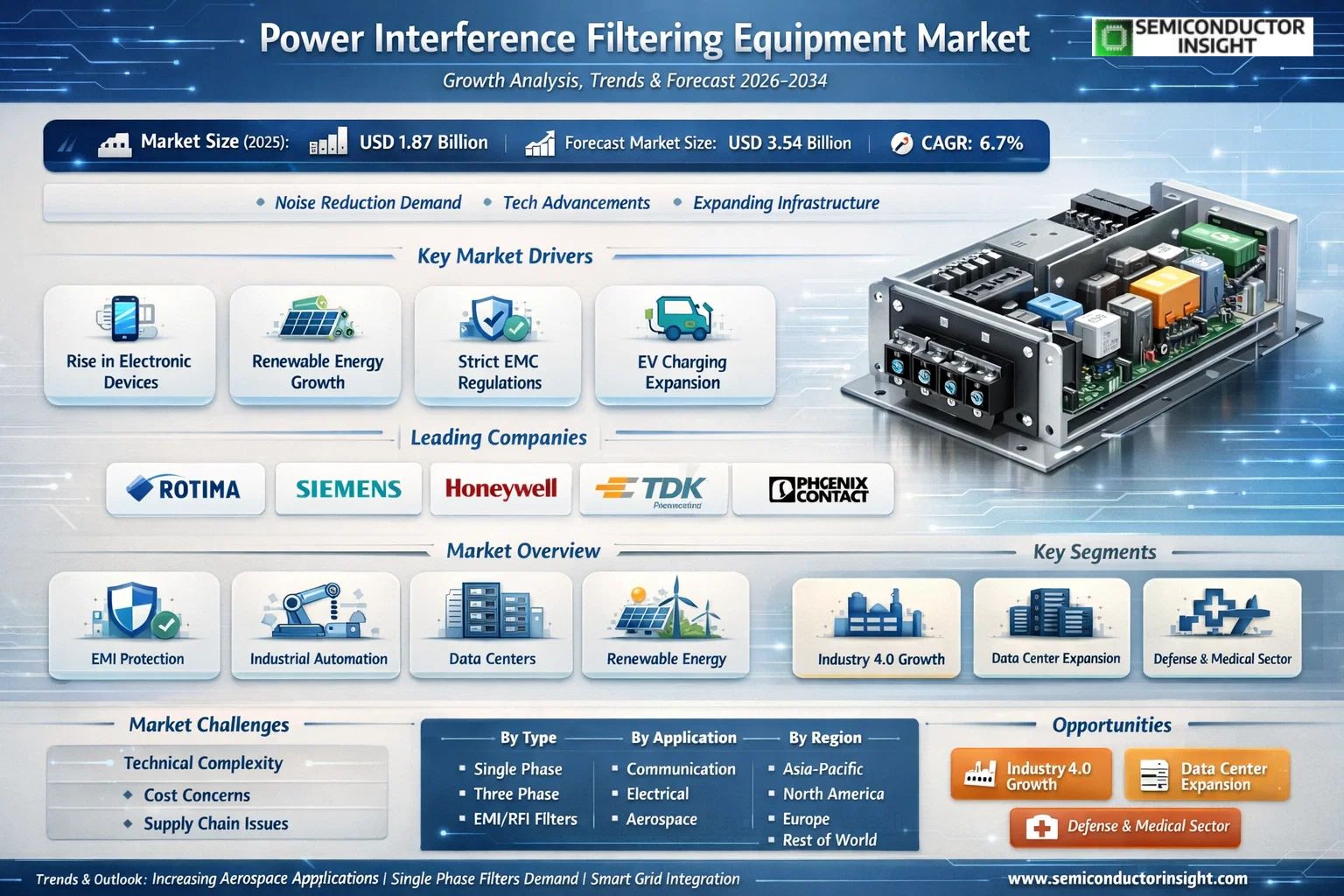
Global Power Interference Filtering Equipment market size was valued at USD 1.87 billion in 2025. The market is projected to grow from USD 1.98 billion in 2026 to USD 3.54 billion by 2034, exhibiting a CAGR of 6.7% during the forecast period.
Power supply interference filtering equipment refers to devices specifically designed to reduce or eliminate unwanted interference signals , such as electromagnetic noise, harmonic distortions, or unnecessary frequency components , present in power lines. These interferences may originate from the power supply itself, surrounding electronic equipment, or the broader external environment, and can significantly affect the normal operation and performance of sensitive electronic systems. The equipment encompasses a broad range of product types, including single-phase filters, three-phase filters, EMI/RFI filters, line filters, and surge suppression devices, each engineered to address specific interference challenges across diverse industrial and commercial applications.
The market is witnessing steady growth driven by the rapid proliferation of electronic devices across industries, increasingly stringent electromagnetic compatibility (EMC) regulations worldwide, and the rising adoption of advanced power infrastructure in sectors such as aerospace, telecommunications, and industrial automation. Furthermore, Global transition toward renewable energy systems and smart grid technologies has intensified the need for reliable power quality management solutions. Key manufacturers actively shaping the competitive landscape of this market include ROTIMA, SIEMENS, Honeywell, TE Connectivity, TDK Electronics, Phoenix Contact, AVX, Okaya Electric, Schaffner, and Iskra, among others, each offering diversified product portfolios tailored to meet the evolving demands of end-use industries globally.
MARKET DRIVERS
Rising Demand for Power Quality Solutions Across Industrial and Commercial Sectors
Global Power Interference Filtering Equipment Market is experiencing significant momentum, driven by the accelerating need for reliable and clean power delivery across a broad spectrum of industries. As industrial automation, smart manufacturing, and digitized infrastructure continue to expand, the sensitivity of electronic systems to electromagnetic interference (EMI) and radio frequency interference (RFI) has increased substantially. Power interference filtering equipment plays a critical role in ensuring operational continuity by suppressing unwanted electrical noise that can disrupt sensitive equipment, compromise data integrity, and reduce the lifespan of electronic components. The proliferation of variable frequency drives (VFDs), switching power supplies, and industrial control systems has made EMI/RFI filtration an essential engineering requirement rather than an optional safeguard.
Expansion of Renewable Energy Infrastructure and Grid Modernization Initiatives
One of the most compelling forces shaping the Power Interference Filtering Equipment Market is Global transition toward renewable energy sources, including solar photovoltaic (PV) systems, wind energy installations, and energy storage systems. These technologies inherently generate harmonic distortions and switching transients that necessitate robust power filtering solutions to maintain grid stability and regulatory compliance. Governments and utility operators across North America, Europe, and the Asia-Pacific region are investing heavily in smart grid modernization programs, which incorporate advanced power conditioning and interference filtering technologies at both transmission and distribution levels. This structural shift in energy infrastructure is creating sustained long-term demand for high-performance filtering equipment capable of operating under dynamic and variable load conditions.
➤ The integration of power interference filtering equipment within renewable energy systems and smart grids is rapidly evolving from a compliance requirement to a strategic operational priority, reflecting the market’s growing emphasis on power quality management as a cornerstone of energy system resilience.
Furthermore, the rapid proliferation of electric vehicles (EVs) and the corresponding expansion of EV charging infrastructure are generating new categories of power quality challenges, including harmonic injection and conducted emissions. Charging stations, particularly DC fast chargers, represent active sources of electrical interference that must be mitigated through dedicated filtering solutions at the point of installation. This emerging application segment is expected to contribute meaningfully to the overall growth trajectory of the Power Interference Filtering Equipment Market over the coming decade, as EV adoption scales globally and grid-interactive charging becomes standard practice.
MARKET CHALLENGES
Technical Complexity and Integration Challenges in Diverse Power Environments
Despite strong growth fundamentals, the Power Interference Filtering Equipment Market faces notable challenges related to the technical complexity of designing and deploying filtering solutions across heterogeneous power environments. Power systems vary widely in terms of voltage levels, load types, frequency characteristics, and harmonic profiles, requiring filtering equipment manufacturers to develop highly customized or application-specific solutions. The lack of universal standards for power quality measurement and interference thresholds across different geographies further complicates product development and market penetration. For original equipment manufacturers (OEMs) and system integrators, selecting appropriate filtering technologies that deliver effective attenuation without introducing impedance mismatches or affecting system efficiency requires significant engineering expertise and application knowledge.
Other Challenges
Cost Sensitivity in Price-Competitive Markets
In highly cost-competitive end-use sectors such as consumer electronics manufacturing, small-scale industrial operations, and emerging market infrastructure projects, the perceived cost of incorporating power interference filtering equipment can act as a barrier to adoption. While the long-term return on investment through reduced equipment failure rates and downtime is well-documented, upfront capital expenditure remains a consideration for budget-constrained buyers. This dynamic is particularly pronounced in developing economies where infrastructure investment decisions are often driven by initial cost rather than total cost of ownership, creating a challenge for premium filtering equipment providers seeking to expand their geographic footprint.
Supply Chain Disruptions Affecting Key Components
The Power Interference Filtering Equipment Market has not been immune to broader global supply chain disruptions that have affected the availability and pricing of critical passive components, including inductors, capacitors, and ferrite cores. Lead time extensions and raw material price volatility have placed pressure on manufacturers’ production schedules and margin structures. Companies reliant on single-source suppliers or concentrated manufacturing geographies have faced heightened exposure to these disruptions, underscoring the need for supply chain diversification and strategic inventory management as ongoing operational imperatives.
MARKET RESTRAINTS
Evolving Regulatory Frameworks and Compliance Uncertainty
A significant restraint affecting the Power Interference Filtering Equipment Market is the evolving and sometimes inconsistent regulatory landscape governing electromagnetic compatibility (EMC) and power quality standards. While frameworks such as IEC 61000, EN 55011, and FCC Part 15 provide foundational compliance benchmarks, the divergence in regional requirements and the periodic revision of technical standards create uncertainty for manufacturers engaged in multi-market product development. Companies must invest continuously in testing, certification, and product re-engineering to maintain compliance across target geographies, which increases operational costs and can delay time-to-market for new filtering solutions.
Miniaturization Pressures and Thermal Management Constraints
As the electronics industry continues to trend toward compact, high-density designs, power interference filtering equipment manufacturers face the dual challenge of delivering effective interference attenuation within increasingly constrained physical footprints. Miniaturization requirements are especially acute in sectors such as aerospace, medical devices, telecommunications equipment, and industrial IoT, where space and weight are at a premium. Achieving the necessary filtering performance while managing thermal dissipation within compact enclosures demands advanced materials engineering and innovative circuit topologies. These technical constraints can limit the pace of product innovation and may restrict the addressable market for standard off-the-shelf filtering solutions in applications requiring bespoke design approaches.
MARKET OPPORTUNITIES
Accelerating Industrial Digitalization and Industry 4.0 Adoption
The ongoing global transition toward Industry 4.0, characterized by the widespread deployment of industrial IoT sensors, edge computing systems, collaborative robotics, and real-time data acquisition platforms, presents a substantial and expanding opportunity for the Power Interference Filtering Equipment Market. These advanced manufacturing technologies are highly susceptible to power quality disturbances, as even momentary voltage fluctuations or conducted EMI events can compromise sensor accuracy, disrupt communication protocols, and trigger unplanned system shutdowns. As manufacturers across automotive, pharmaceutical, food and beverage, and semiconductor fabrication sectors digitize their production environments, the embedded requirement for power interference filtering at the equipment and facility level is expected to scale proportionally, generating strong demand for both integrated and standalone filtering solutions.
Data Center Expansion and the Growth of High-Performance Computing Infrastructure
The exponential growth in global data center capacity, fueled by cloud computing adoption, artificial intelligence workloads, and streaming media consumption, represents a high-value opportunity segment for the Power Interference Filtering Equipment Market. Data centers operate large arrays of server equipment, uninterruptible power supplies (UPS), precision air conditioning systems, and power distribution units, all of which generate and are susceptible to significant levels of electrical interference. Power quality management, including the deployment of EMI/RFI filters, harmonic filters, and active power conditioners, is a critical component of data center design and operations to ensure maximum uptime, equipment longevity, and energy efficiency. As hyperscale data center construction accelerates across North America, Europe, Southeast Asia, and the Middle East, the associated demand for advanced power interference filtering infrastructure is expected to grow commensurately, presenting manufacturers with significant revenue expansion potential.
Emerging Opportunities in Defense, Aerospace, and Medical Electronics
High-reliability application sectors including defense electronics, aerospace systems, and medical imaging and diagnostic equipment represent premium opportunity segments for the Power Interference Filtering Equipment Market, where performance requirements are stringent and price sensitivity is comparatively low. Military and aerospace platforms demand filtering solutions capable of withstanding extreme environmental conditions while meeting demanding EMC standards such as MIL-STD-461 and DO-160. Similarly, the expanding global market for medical devices , driven by aging populations, increasing chronic disease prevalence, and healthcare infrastructure investment in emerging markets , requires power filtering components that meet IEC 60601 safety and EMC standards. These specialized segments offer manufacturers the potential to develop differentiated, high-margin product lines that leverage deep application expertise and certification capabilities as key competitive advantages within the broader Power Interference Filtering Equipment Market landscape.
Power Interference Filtering Equipment Market Trends
Rising Demand for Clean Power Solutions Driving the Power Interference Filtering Equipment Market
The Power Interference Filtering Equipment Market is witnessing a significant upswing as industries worldwide prioritize power quality and electromagnetic compatibility. With the accelerating proliferation of sensitive electronic systems across manufacturing, telecommunications, and aerospace sectors, the need to suppress conducted and radiated noise on power lines has become a critical operational requirement. Power interference filtering equipment , designed to attenuate unwanted frequency components and noise signals from power supplies and external environments , is increasingly integral to ensuring uninterrupted performance of modern electronic infrastructure. Leading players such as SIEMENS, Honeywell, TDK Electronics, Schaffner, and TE Connectivity continue to advance product portfolios to address evolving electromagnetic interference (EMI) challenges across diverse end-use applications.
Other Trends
Expansion Across the Communication and Electrical Industries
The communication and electrical industries represent two of the most prominent application segments propelling the Power Interference Filtering Equipment Market forward. As 5G infrastructure deployment intensifies globally, telecom operators are investing heavily in power filtering solutions to safeguard signal integrity across base stations, data centers, and network switching equipment. Similarly, within the electrical industry, grid modernization initiatives and the integration of renewable energy sources such as solar and wind are generating new harmonic disturbances on power networks, necessitating robust interference filtering at multiple voltage levels. Equipment manufacturers including Phoenix Contact, Schurter, and Delta Electronics are developing application-specific filter configurations to serve these high-growth verticals more effectively.
Aerospace and Defense Sector Imposing Stringent EMI Standards
The aerospace industry continues to emerge as a high-value application segment within the Power Interference Filtering Equipment Market. Avionics systems, satellite communication equipment, and defense electronics operate under exceptionally rigorous electromagnetic compatibility standards, compelling OEMs and system integrators to adopt high-performance filtering solutions capable of functioning reliably across extreme temperature ranges and vibration environments. Companies such as Spectrum Control and Filtronic are recognized for delivering mil-spec compliant power line filters tailored to these demanding operational conditions. This trend is expected to sustain long-term procurement activity from both commercial aviation and defense procurement agencies.
Single Phase Filters Gaining Traction Amid Industrial Automation Wave
Within the product type segmentation of the Power Interference Filtering Equipment Market, single phase filters are registering notable adoption momentum, particularly among small and medium-scale industrial automation deployments, commercial HVAC systems, and distributed energy installations. The relatively lower installation complexity and cost-effectiveness of single phase filtering solutions make them an attractive choice for facility managers seeking to protect programmable logic controllers, variable frequency drives, and precision measurement instruments. Meanwhile, three-phase filter demand remains robust in heavy industrial environments where large motors, welding equipment, and industrial robots generate substantial conducted emissions. The competitive landscape remains active, with companies including KEMET, Cosel, AVX, and Okaya Electric continuously innovating across both single and three-phase product lines to capture share in this evolving market.
COMPETITIVE LANDSCAPE
Key Industry Players
Power Interference Filtering Equipment Market – Global Competitive Analysis and Leading Manufacturer Profiles
Global Power Interference Filtering Equipment market is characterized by a moderately consolidated competitive structure, with a handful of established multinational corporations commanding a significant share of total revenues. Leading the competitive field are industry giants such as Siemens, Honeywell, TE Connectivity, TDK Electronics, and Schaffner, whose extensive product portfolios, global distribution networks, and sustained investment in research and development provide them with durable competitive advantages. These top five players collectively accounted for a substantial portion of global market revenue in 2025, reinforcing the dominance of well-capitalized incumbents with decades of expertise in electromagnetic compatibility (EMC) solutions, power quality management, and electronic noise suppression technologies. Their ability to serve diversified end-use sectors , including communication, electrical, and aerospace industries , across North America, Europe, and Asia further consolidates their market leadership. Strategic activities such as mergers, acquisitions, and technology partnerships continue to reshape the competitive dynamics of this market, with major players expanding their EMI/RFI filter product lines to address increasingly stringent regulatory standards and evolving customer requirements in industrial and mission-critical applications.
Beyond the dominant global players, several specialized and regional manufacturers play a significant role in shaping niche segments of the Power Interference Filtering Equipment market. Companies such as Phoenix Contact, Schurter, KEMET, Cosel, and Okaya Electric have carved out competitive positions by focusing on high-performance single-phase and three-phase filtering solutions tailored for specific industrial verticals. Emerging players including Mankun Technology, YBX, and Akyga are gaining traction particularly in the Asia-Pacific region, where rapid industrialization and expanding electronics manufacturing ecosystems are driving robust demand. Filtronic and Spectrum Control maintain strong footholds in aerospace and defense-grade filtering applications, where product reliability and compliance with international EMC standards are paramount. The competitive landscape is further influenced by ongoing innovations in miniaturization, higher frequency filtering capabilities, and integration with smart power management systems, prompting both established manufacturers and new entrants to accelerate their product development cycles and pursue differentiated go-to-market strategies across key geographies including the United States, China, Germany, Japan, and South Korea.
List of Key Power Interference Filtering Equipment Companies Profiled
- ROTIMA
- SIEMENS
- Honeywell
- TE Connectivity
- TDK Electronics
- Phoenix Contact
- AVX
- Okaya Electric
- Schaffner
- Iskra
- Cosel
- Akyga
- Filtronic
- Spectrum Control
- KEMET
- Schurter
- YBX
- Mankun Technology
- Delta Electronics
Segment Analysis:
| Segment Category | Sub-Segments | Key Insights |
| By Type |
|
Single Phase filters represent the leading segment in the Power Interference Filtering Equipment market, driven by their broad applicability across consumer electronics, light industrial setups, and residential power systems.
|
| By Application |
|
Communication Industry stands as the dominant application segment, reflecting the ever-growing reliance on uninterrupted signal transmission and data integrity across global telecommunication networks.
|
| By End User |
|
Industrial end users constitute the leading segment, as manufacturing plants, process industries, and energy facilities operate highly sensitive equipment that is perpetually exposed to electrical noise and harmonic disturbances generated by heavy machinery.
|
| By Filter Technology |
|
Passive Filters remain the predominant technology segment within the Power Interference Filtering Equipment market, owing to their cost-effectiveness, proven reliability, and ease of integration into existing power distribution architectures.
|
| By Installation Type |
|
Panel Mounted installation represents the leading segment, as it offers a centralized and organized approach to power interference filtering that aligns well with the requirements of industrial control panels and large-scale electrical distribution systems.
|
Regional Analysis: Power Interference Filtering Equipment Market
Asia-Pacific
Asia-Pacific’s vast manufacturing sector, particularly in China and South Korea, drives consistent demand for power interference filtering equipment. High-density production environments require robust electromagnetic compatibility solutions to ensure operational continuity, protect sensitive electronics, and comply with increasingly stringent regional and international electromagnetic interference regulatory standards.
The accelerated rollout of 5G infrastructure across China, Japan, and Southeast Asia is generating unprecedented demand for advanced filtering solutions. Telecommunications networks require precision-engineered power interference filtering equipment to maintain signal integrity, minimize electromagnetic disruption, and support the high-frequency operational requirements of next-generation wireless communication systems.
The region’s aggressive push toward solar and wind energy adoption introduces complex power quality challenges. Power interference filtering equipment plays a critical role in stabilizing grid connections for renewable installations, mitigating harmonic disturbances generated by inverters and converters, and ensuring compliance with grid interconnection standards across developing and developed Asia-Pacific economies.
Strengthening electromagnetic compatibility regulations across Asia-Pacific markets, including China’s GB standards and Japan’s VCCI guidelines, are compelling manufacturers to invest in certified power interference filtering equipment. Regulatory alignment with international frameworks is driving product innovation and elevating quality benchmarks across the regional supply chain.
North America
North America represents a highly mature and technologically advanced segment of the Power Interference Filtering Equipment Market, characterized by strong demand from defense, aerospace, healthcare, and industrial automation sectors. The United States, in particular, maintains a robust regulatory environment enforced by the Federal Communications Commission, which mandates stringent electromagnetic interference compliance across a broad spectrum of electronic and electrical applications. The region’s transition toward smart grid modernization and widespread adoption of electric vehicles is further elevating the importance of power interference filtering equipment in both utility and consumer applications. Canada’s growing renewable energy sector and increasing data center investments also contribute meaningfully to regional demand. The presence of globally recognized technology companies and defense contractors provides a stable and innovation-driven end-user base, supporting sustained market development across the forecast period of 2026 to 2034.
Europe
Europe occupies a significant position in Global Power Interference Filtering Equipment Market, underpinned by rigorous electromagnetic compatibility directives enforced across European Union member states. The CE marking requirement and EN standards compel manufacturers and system integrators to incorporate high-quality filtering solutions into a wide range of products and installations. Germany, France, and the United Kingdom lead regional demand, driven by advanced automotive manufacturing, industrial automation, and a rapidly expanding renewable energy sector. The region’s ambitious energy transition agenda, including offshore wind development and solar power integration, necessitates sophisticated power quality management solutions. European emphasis on sustainability and energy efficiency also encourages investment in filtering technologies that reduce power losses and minimize electromagnetic pollution, reinforcing the market’s steady expansion trajectory through the forecast horizon.
South America
South America presents an emerging growth opportunity within the Power Interference Filtering Equipment Market, with Brazil and Argentina serving as primary contributors to regional demand. Industrial expansion, increasing urbanization, and growing investments in energy infrastructure are gradually elevating awareness of power quality issues and electromagnetic interference challenges. The region’s developing telecommunications sector, alongside government-supported initiatives to expand grid connectivity in rural and semi-urban areas, is beginning to create meaningful demand for filtering equipment. However, economic volatility, limited local manufacturing capability, and reliance on imported technology continue to moderate the pace of market adoption. As regulatory frameworks mature and foreign direct investment in manufacturing and energy sectors increases, South America is expected to demonstrate progressive market growth through the 2026 to 2034 forecast period.
Middle East & Africa
The Middle East and Africa region represents a nascent but progressively expanding market for Power Interference Filtering Equipment, driven primarily by infrastructure development, energy sector investments, and increasing adoption of digital technologies. Gulf Cooperation Council nations, particularly Saudi Arabia and the United Arab Emirates, are investing heavily in smart city projects, industrial diversification, and renewable energy installations under national vision frameworks, all of which generate demand for reliable power quality solutions. In Africa, the gradual expansion of grid infrastructure and the growing adoption of off-grid and hybrid energy systems in underserved regions introduce new applications for filtering equipment. While regulatory enforcement and technical awareness remain at developing stages across much of the region, long-term infrastructure commitments and foreign investment inflows position the Middle East and Africa as a market with considerable growth potential through 2034.
Report Scope
This market research report provides a comprehensive analysis of the Power Interference Filtering Equipment Market, covering the forecast period 2026–2034. It offers detailed insights into market dynamics, technological advancements, competitive landscape, and key trends shaping the industry.
Key focus areas of the report include:
- Market Overview: The report begins with an overview outlining its current market scenario, key growth indicators, and industry transformation drivers. It discusses macroeconomic factors, demand–supply balance, regulatory landscape, and the strategic role of power interference filtering equipment in powering advancements across industries such as communication, electrical, aerospace, and industrial automation.
- Market Size & Forecast: Historical data and future projections for revenue, unit shipments, and market value across major regions and segments.
- Segmentation Analysis: Detailed breakdown by product type, technology, application, and end-user industry to identify high-growth segments and investment opportunities.
- Regional Insights: Insights into market performance across North America, Europe, Asia-Pacific, Latin America, and the Middle East & Africa, including country-level analysis where relevant.
- Competitive Landscape: Profiles of leading market participants, including their product offerings, R&D focus, manufacturing capacity, pricing strategies, and recent developments such as mergers, acquisitions, and partnerships.
- Technology Trends & Innovation: Assessment of emerging technologies, integration of AI/IoT, semiconductor design trends, fabrication techniques, and evolving industry standards.
- Market Drivers & Restraints: Evaluation of factors driving market growth along with challenges, supply chain constraints, regulatory issues, and market-entry barriers.
- Stakeholder Insights: Insights for component suppliers, OEMs, system integrators, investors, and policymakers regarding the evolving ecosystem and strategic opportunities.
Primary and secondary research methods are employed, including interviews with industry experts, data from verified sources, and real-time market intelligence to ensure the accuracy and reliability of the insights presented.
FREQUENTLY ASKED QUESTIONS:
What is the current market size of Power Interference Filtering Equipment Market?
-> Global Power Interference Filtering Equipment Market was valued at USD 1.87 billion in 2025 and is expected to reach USD 3.54 billion by 2034, growing at a CAGR of 6.7% during the forecast period.
Which key companies operate in Power Interference Filtering Equipment Market?
-> Key players include ROTIMA, SIEMENS, Honeywell, TE Connectivity, TDK Electronics, Phoenix Contact, AVX, Okaya Electric, Schaffner, Iskra, Cosel, Akyga, Filtronic, Spectrum Control, KEMET, Schurter, YBX, Mankun Technology, and Delta Electronics, among others. In 2025, Global top five players held approximately % of the market in terms of revenue.
What are the key growth drivers?
-> Key growth drivers include rising demand for noise reduction in power lines, increasing adoption of electronic equipment across communication, electrical, and aerospace industries, and growing need to protect devices from power supply interference. Expanding infrastructure investments and technological advancements in filtering solutions further support market growth.
Which region dominates the market?
-> Asia is a significant and fast-growing region in the Power Interference Filtering Equipment Market, with China projected to reach USD million by the forecast period. North America, led by the U.S. market estimated at USD million in 2025, also represents a major share of Global market.
What are the emerging trends?
-> Emerging trends include increasing integration of advanced filtering technologies in aerospace applications, growing demand for single-phase and three-phase filtering equipment, and rising adoption of power interference filtering solutions in the communication and electrical industries. The Single Phase segment is projected to reach USD million by 2034, with a % CAGR over the next six years.

Get Sample Report PDF for Exclusive Insights
Report Sample Includes
- Table of Contents
- List of Tables & Figures
- Charts, Research Methodology, and more...
 Download Sample Report PDF