Key Statistics
Key Takeaways
- High-precision GNSS chips and modules lead the type outlook as RTK and PPP move centimeter-level positioning into automotive, surveying, machine control, robotics and precision agriculture.
- Smartphones remain the dominant application by unit volume, while automotive and asset tracking create stronger demand for multi-band, secure and high-reliability positioning.
- Asia Pacific accounts for 42% of global demand and is also the fastest-growing region, supported by electronics manufacturing, BeiDou adoption and large smartphone and automotive ecosystems.
- Authentication and integrity are becoming commercial features. Galileo’s OSNMA became operational in 2025, giving compatible receivers a way to verify that navigation data originate from Galileo and have not been altered.
- Cost barriers to centimeter-level positioning are falling. u-blox launched the ZED-X20P in March 2025 and states that its architecture can reduce total cost of ownership by up to 90% versus conventional high-precision approaches.
GNSS Chips and Modules Market Overview
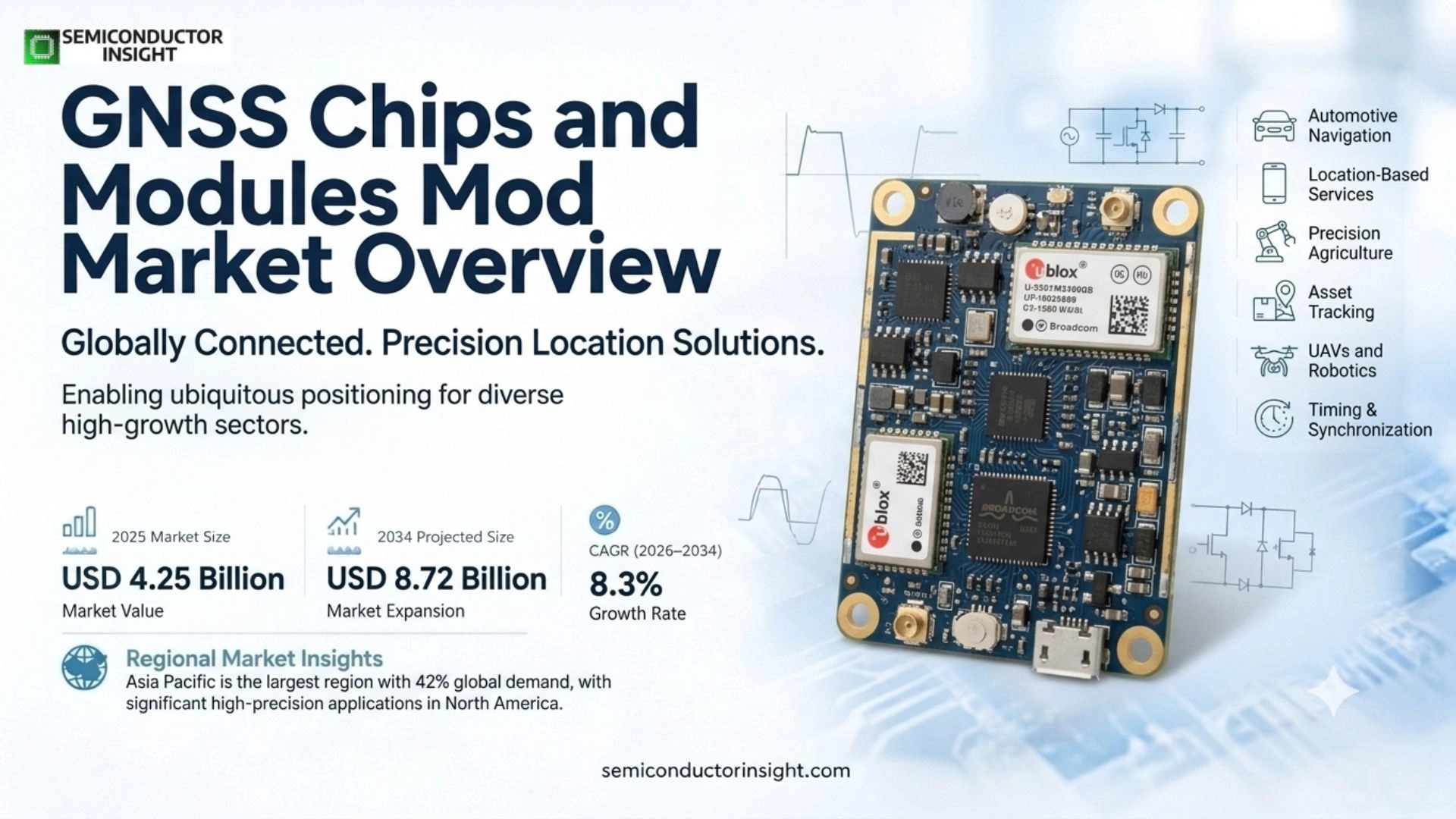
GNSS Chips and Modules market is valued at USD 4.25 billion in 2025 and is projected to reach USD 8.72 billion by 2034, representing an 8.3% CAGR during 2026–2034. The 2026 estimated market size is USD 4.60 billion. Asia Pacific is the largest region with 42% of global demand, while North America retains a strong position in high-precision applications.
GNSS chips and modules receive and process signals from satellite-navigation constellations such as GPS, Galileo, BeiDou and GLONASS to provide positioning, navigation and timing. Standard solutions target meter-level positioning and low power, while high-precision platforms combine multiple frequencies, correction services and advanced algorithms to reach decimeter or centimeter performance in supported conditions.
The market is moving from single-constellation receivers toward multi-band, multi-constellation and authenticated positioning. The U.S. GPS modernization program adds new civil signals, while Galileo offers a free High Accuracy Service that can provide real-time positioning improvements to decimeter level. These infrastructure upgrades give chip and module vendors more signals and correction data to use, increasing the value of flexible RF front ends and positioning engines.
High accuracy is becoming easier to deploy. u-blox’s X20 platform supports L1, L2, L5 and L6 bands with an integrated L-band receiver, and the ZED-X20P module launched in March 2025 targets global centimeter-level positioning at materially lower total cost. The commercial effect is to expand high-precision GNSS beyond surveying into industrial automation, robotics, drones, automotive and mobile machinery.
Segment Analysis: By Type
By type, the market is segmented into High-Precision GNSS Chips and Modules and Standard-Precision GNSS Chips and Modules. High-precision products lead the growth outlook because RTK and PPP are expanding into mass-market industrial and automotive use, while standard-precision receivers remain essential in smartphones, basic tracking and cost-sensitive IoT devices.
| Type | Technology profile | Market position |
|---|---|---|
| High-Precision GNSS Chips and Modules | This category includes RTK, PPP and related multi-band solutions that use correction data, carrier-phase processing and several satellite constellations to reach decimeter or centimeter positioning. Products increasingly combine GNSS with inertial sensors and correction services to maintain continuity, faster convergence and usable accuracy when satellite visibility becomes difficult. | Leading growth segment. Demand comes from surveying, machine control, precision agriculture, drones, robotics and advanced vehicles. Falling hardware and correction-service costs are expanding addressable applications beyond specialist geodesy, while authentication and integrity features can add value in automotive and infrastructure deployments. |
| Standard-Precision GNSS Chips and Modules | This category includes standalone GNSS, assisted GNSS and other meter-level positioning solutions optimized for cost, size and power. These devices are common in smartphones, wearables, trackers and embedded IoT systems where long battery life and rapid acquisition matter more than centimeter accuracy or expensive correction services. | The broadest unit-volume base. Smartphone integration and low-power asset tracking sustain large shipments, while vendors compete on sensitivity, startup time, power consumption, package size and the ability to combine satellite positioning with cellular, Wi-Fi, Bluetooth and inertial assistance without materially increasing system cost. |
Technology segmentation
The market is also segmented by GNSS technology: GPS, GLONASS, Galileo, BeiDou and Hybrid multi-constellation solutions. Hybrid capability is gaining importance because receivers can select more satellites, frequencies and correction sources, improving availability in cities and other obstructed environments. Authentication and integrity services add another differentiation layer for safety, critical infrastructure and professional positioning.
| Technology | Role in receiver design | Commercial implication |
|---|---|---|
| GPS | The U.S. system remains a foundational global positioning signal set and is undergoing continuing modernization with additional civil signals and upgraded satellites. Receiver makers support multiple GPS bands to improve accuracy, interoperability and performance in challenging environments. | Broad device support makes GPS essential, but premium differentiation increasingly comes from combining it with additional constellations, frequencies, correction services and integrity features rather than offering GPS-only positioning. |
| Galileo | European GNSS adds open-service signals, High Accuracy Service corrections and OSNMA authentication capabilities. Multi-band receivers can use these services alongside GPS and other constellations for professional and consumer positioning. | HAS and OSNMA support higher-accuracy and trusted-positioning use cases, encouraging receiver vendors to add Galileo E6 and authentication support in professional, automotive and infrastructure products. |
| BeiDou | China’s global constellation supports a large Asia-Pacific electronics and automotive ecosystem. Compatibility is common in multi-constellation products sold in China and in global devices intended to maximize satellite visibility. | BeiDou support is commercially important in China and strengthens the case for multi-constellation architectures in global products, particularly in smartphones, automotive systems and industrial positioning. |
| Hybrid / Multi-Constellation | Processes several constellations and often several frequency bands simultaneously, sometimes together with inertial or terrestrial sensors. More visible satellites can improve availability and geometry in urban or obstructed environments. | Fastest strategic direction. Multi-constellation capability improves resilience and lets product makers use regional services without building separate hardware, making it the preferred architecture for many new professional and mass-market receivers. |
Segment Analysis: By Application
By application, the market covers Smartphones, In-Vehicle Systems, Wearable Devices, Asset Tracking and Others. Smartphones remain the dominant segment by unit volume, while in-vehicle systems and asset tracking are increasing the value of multi-band, low-power, authenticated and high-precision modules.
| Application | Demand characteristics |
|---|---|
| Smartphones | The largest application by broad GNSS integration. Mobile platforms combine GNSS with cellular, Wi-Fi and inertial data to improve urban and indoor-outdoor location. Competition favors highly integrated chipsets with low power and small area because positioning is one function inside a much larger mobile system-on-chip and must share battery, antenna and thermal budgets with many other radios. |
| In-Vehicle Systems | Automotive systems use GNSS for navigation, telematics, emergency calling, fleet management and increasingly lane-level or high-integrity positioning. Premium applications combine GNSS with IMUs, wheel-speed data and correction services to maintain continuity through tunnels and urban canyons, raising qualification, reliability and functional-safety requirements relative to consumer receivers. |
| Wearable Devices | Wearables require very low power, small packages and acceptable performance under body blocking and limited antenna size. Fitness, safety and outdoor devices benefit from multi-band GNSS, but battery life remains a critical trade-off, pushing vendors to use duty cycling, assisted acquisition and sensor fusion so positioning quality improves without excessive energy consumption. |
| Asset Tracking | Logistics, industrial equipment, livestock and container tracking need compact, power-efficient modules that can work with cellular or LPWAN connectivity. High-precision capability is becoming relevant for valuable equipment, yard logistics and automated machinery, while basic tracking remains strongly price sensitive and often prioritizes long battery life over maximum positioning accuracy. |
| Others | Surveying, agriculture, drones, construction, timing and critical infrastructure use GNSS in lower volumes but at higher value per device. These applications can justify dual-frequency reception, correction services, anti-spoofing, timing outputs and ruggedized hardware because positioning errors can directly affect productivity, safety, machine control or network synchronization. |
Regional Analysis
Asia Pacific leads the market with 42% of global demand and is also the fastest-growing region. North America has strong high-precision, automotive and defense demand, Europe benefits from Galileo and automotive applications, South America is important in agriculture and mining, and the Middle East & Africa are expanding through smart-city, infrastructure and logistics use cases.
How does GNSS demand differ across the five global regions?
Regional demand depends on both device manufacturing and application mix. Asia Pacific combines electronics production and indigenous navigation systems such as BeiDou, QZSS and NavIC. Europe has a distinctive Galileo-driven ecosystem with High Accuracy Service and OSNMA. North America combines GPS leadership with automotive, industrial and defense demand. Emerging regions depend more heavily on imported modules but can create strong professional-use niches in agriculture, mining and infrastructure.
| Region | Market position | Growth outlook | Demand profile | What decides supplier selection |
|---|---|---|---|---|
| Asia Pacific | Largest, 42% demand | Highest | Electronics, automotive, manufacturing | Cost, multi-constellation support and local ecosystem |
| North America | High-precision leader | High | Automotive, defense, IoT | Accuracy, integrity, certification and platform integration |
| Europe | Galileo-led advanced market | High | Automotive, industrial, agriculture | Galileo support, OSNMA, privacy and reliability |
| South America | Smaller professional market | Moderate | Agriculture, mining, logistics | Price, correction coverage and local support |
| Middle East & Africa | Emerging | Moderate to high | Smart cities, logistics, mining | Availability, security and connectivity |
Competitive Landscape
The market combines integrated semiconductor vendors with specialist positioning companies. Qualcomm Technologies, Broadcom, MediaTek, u-blox, STMicroelectronics, Intel, Furuno Electric, Hexagon, NovAtel and Septentrio represent a competitive structure that spans smartphone and connectivity silicon, embedded modules and professional positioning platforms. Smartphone competition favors integration and low power, while automotive, surveying and industrial segments reward multi-band RF performance, correction services, sensor fusion and long-term support.
Integrated chip vendors compete by embedding GNSS into larger connectivity or application-processor platforms. That lowers board area and cost in smartphones and consumer devices, but it also makes GNSS one part of a broader modem and SoC purchasing decision. Specialist module suppliers differentiate through RF design, certified reference layouts, antenna support and software that helps customers achieve reliable positioning without developing the full receiver stack internally.
High-precision suppliers are moving toward platform economics. u-blox combines X20 silicon, modules and PointPerfect correction services, while Hexagon and Septentrio participate in professional positioning ecosystems. This creates recurring service and software opportunities in addition to module sales. A customer evaluating centimeter positioning therefore considers correction availability, convergence, integrity and integration effort, not only the receiver price.
Security and resilience are becoming new competitive axes. Galileo OSNMA creates a standardized authentication capability, while multi-constellation reception reduces dependence on a single signal set. Vendors able to combine authenticated navigation, spoofing detection, inertial sensors and robust timing can address infrastructure, automotive and defense use cases where a temporary positioning error has higher consequences than in ordinary consumer navigation.
Competitive tier structure
| Tier | Companies | Basis of competition |
|---|---|---|
| Integrated silicon leaders | Qualcomm; Broadcom; MediaTek; STMicroelectronics; Intel | SoC integration, power efficiency, smartphone and embedded design wins, and broad connectivity portfolios. These suppliers can reduce board area and system cost by combining positioning with cellular, Wi-Fi, Bluetooth or application-processing functions. |
| High-precision specialists | u-blox; Hexagon; NovAtel; Septentrio | Multi-band precision, RTK and PPP, correction services, industrial and automotive positioning, and application engineering. Their differentiation extends beyond the receiver chip into modules, antennas, software, integrity and deployment support. |
| Application specialists | Furuno Electric and focused navigation suppliers | Marine, timing, industrial and professional navigation niches with strong domain integration. These suppliers compete through application knowledge, ruggedness, certification and specialized interfaces rather than the extreme unit scale of smartphone silicon. |
Key companies profiled in the report scope
- Qualcomm Technologies
- Broadcom
- MediaTek
- u-blox
- STMicroelectronics
- Intel
- Furuno Electric
- Hexagon
- NovAtel
- Septentrio
GNSS Chip and Module Production Capacity Analysis
GNSS capacity spans semiconductor fabrication, RF packaging, module assembly, antenna integration and software validation. Standard receiver silicon can leverage mainstream mixed-signal semiconductor manufacturing, while high-precision modules add more RF paths, oscillators, filtering, shielding and calibration. The practical bottleneck is often qualified design and RF performance rather than raw wafer capacity.
Chip vendors can scale GNSS silicon through established foundry supply chains, but multi-band products require careful RF architecture and packaging to preserve sensitivity in the presence of cellular, Wi-Fi and other radios. Module suppliers add crystals, filters, power management, memory and sometimes inertial sensors, then certify reference layouts and antennas. This integration work can shorten customer development but also makes module quality control and component availability more complex.
High-precision products add correction services and software infrastructure to the capacity equation. A receiver can support RTK or PPP in hardware, but commercial performance depends on correction-network coverage, data delivery, convergence algorithms and support. Vendors therefore invest in cloud services, regional reference networks and firmware updates. The scalable asset is not only the physical module; it is the complete positioning platform that can be deployed consistently across geographies.
Market Dynamics
The market is driven by ubiquitous location services, automotive positioning, industrial automation, asset tracking and the falling cost of high precision. The strongest restraints are signal vulnerability, urban multipath, power consumption and certification complexity. Opportunities center on trusted positioning, centimeter-level mass-market modules, hybrid sensor fusion and timing for critical infrastructure.
MARKET DRIVERS
Drivers Impact Analysis*
| Factor | Forecast impact* | Geographic relevance | Impact timeline |
|---|---|---|---|
| Automotive positioning and ADAS | High | North America, Europe, Asia Pacific | Medium to long term |
| IoT and asset tracking | High | Global | Short to medium term |
| RTK/PPP cost reduction | High | Industrial markets globally | Medium term |
| Constellation modernization and new services | Medium to high | Global | Persistent |
*Directional analytical rating used to compare market forces; it is not a measured contribution to the headline CAGR.
Automotive systems increase receiver value
Vehicles use GNSS for navigation, emergency services, telematics, fleet management and increasingly high-accuracy positioning. As ADAS and automated-driving functions expand, receivers are paired with IMUs and vehicle sensors to maintain position through tunnels and urban canyons. This raises the value of multi-band modules and software while also increasing qualification and functional-safety requirements.
IoT tracking expands the unit base
Asset trackers, logistics tags, industrial equipment and wearables need small, low-power positioning. Improvements in active-current consumption and assisted GNSS make continuous or frequent location more practical. The economic driver is visibility: companies can reduce lost assets, improve routing or monitor equipment utilization, creating recurring demand even when each module carries a low selling price.
High precision is moving down the cost curve
u-blox says the ZED-X20P can deliver global centimeter-level positioning at total cost of ownership up to 90% lower than conventional solutions. Lower module and correction costs allow machine control, drones and robotics projects to adopt precision GNSS without the budget of traditional surveying systems, materially expanding the addressable customer base.
Modern constellations add useful signals and services
GPS modernization adds new civil signals, while Galileo provides High Accuracy Service and OSNMA authentication. More frequencies and constellations improve availability and create new commercial features. Receiver vendors can differentiate through better use of these signals, faster convergence and more robust integrity rather than competing only on basic latitude and longitude output.
MARKET RESTRAINTS
Restraints Impact Analysis*
| Factor | Forecast impact* | Geographic relevance | Impact timeline |
|---|---|---|---|
| Jamming and spoofing vulnerability | High | Critical applications globally | Persistent |
| Urban canyon and multipath error | High | Dense cities | Persistent |
| Power consumption in high-precision modes | Medium | Wearables and IoT | Persistent |
| Certification and integration complexity | Medium to high | Automotive, aviation, industrial | Medium term |
*Directional analytical rating used to compare market forces; it is not a measured contribution to the headline CAGR.
Weak satellite signals are vulnerable to interference
GNSS signals arrive at very low power and can be disrupted by jamming or spoofing. The commercial response is additional inertial sensors, multi-constellation reception, interference detection and authenticated navigation, all of which increase system cost and engineering complexity. Critical users also need monitoring and fallback procedures because receiver improvements cannot eliminate every external interference event.
Urban environments create unavoidable propagation problems
Buildings block direct satellite visibility and create reflected paths that can bias position. Better antennas, multi-frequency measurements and advanced algorithms reduce the problem but do not eliminate the underlying physics. Customers deploying robots, vehicles or trackers in dense cities often need Wi-Fi, cellular, vision or inertial assistance, limiting the value of GNSS as a standalone solution.
Accuracy can conflict with battery life
Processing more frequencies, constellations and corrections consumes additional power. That is manageable in vehicles and machinery but harder in compact trackers or wearables. Chip vendors must balance RF duty cycle, acquisition speed and processor workload so customers do not sacrifice battery life for positioning performance that their application does not require.
Professional markets demand long qualification cycles
Automotive, aviation and industrial customers validate accuracy, environmental performance, software behavior and long-term supply. A technically capable chip may still take many months to become a qualified production part. This protects established suppliers but slows adoption of new architectures and means revenue can lag engineering investment and product launch timing.
MARKET OPPORTUNITIES
Commercialize trusted GNSS using Galileo OSNMA
Galileo OSNMA gives compatible receivers a way to authenticate navigation messages. Vendors can package that capability with spoofing detection and multi-constellation logic for automotive, timing and infrastructure customers that care about signal trust. The opportunity is strongest where buyers need a documented security feature rather than a proprietary black-box claim.
Push centimeter positioning into mass-market machinery
Lower-cost all-band modules and correction services can make high precision practical in lawn equipment, warehouse vehicles, construction machines, drones and agricultural tools. These markets are much larger in unit count than traditional surveying. Suppliers that simplify antenna design, corrections and calibration can capture customers that lack specialist GNSS engineering teams.
Combine GNSS with inertial and terrestrial positioning
Hybrid positioning solves the transition between open sky, urban canyons, tunnels and indoor environments. Modules that fuse GNSS, IMU, wheel-speed, cellular, Wi-Fi or Bluetooth observations can provide a more continuous position stream. This creates software value and deeper system integration, improving supplier stickiness compared with a basic receiver-only product.
Expand precision timing applications
Telecom networks, power grids and financial infrastructure use GNSS for accurate time as well as position. Multi-band receivers, holdover oscillators and authenticated signals can support critical timing systems. These applications value reliability and monitoring, allowing suppliers to compete on total solution assurance rather than consumer-electronics price points.
GNSS Chips and Modules Supply Chain Analysis
Constellation upgrades create the raw signal environment
Receiver capability depends on the signals available from satellite systems and correction services. GPS modernization, Galileo HAS and OSNMA are examples of upstream infrastructure changes that create new receiver features without changing the physical module market directly. Chip vendors must support the relevant frequencies, message formats and authentication logic before customers can monetize those services.
Silicon vendors compete on RF and algorithm efficiency
GNSS chips combine sensitive RF reception with digital signal processing and navigation algorithms. More bands improve robustness but increase design complexity, die area and power. Competitive advantage comes from extracting usable measurements under weak or reflected signals while maintaining low power and integrating efficiently with the host processor or connectivity subsystem.
Modules translate silicon into faster customer integration
Module vendors add reference RF design, clocks, filtering, firmware and sometimes inertial sensors. They reduce the customer’s antenna and PCB-development burden and can pre-qualify configurations for automotive or industrial use. This creates value for customers that need positioning expertise but do not have enough volume to design a custom chip-level solution.
Application economics determine the required accuracy
A smartphone navigation app can tolerate meter-level error most of the time, while surveying or machine control cannot. Customers pay for precision only when it improves safety, productivity or automation. Suppliers therefore need portfolios that scale from low-power standard receivers to centimeter-class platforms rather than forcing every application into the same cost and power profile.
Recent Developments in the GNSS Chips and Modules Market
Galileo marks one year of operational OSNMA
EUSPA reported that receiver manufacturers worldwide are embedding Galileo OSNMA into commercial products one year after operational declaration. The service gives compatible devices a way to verify navigation-message authenticity, increasing demand for security-aware receiver designs.
Galileo OSNMA moves into user operations
EUSPA highlighted the operational availability of Open Service Navigation Message Authentication after declaration in July 2025. The capability addresses spoofing risk by allowing receivers to validate the origin and integrity of Galileo navigation data.
u-blox launches ZED-X20P all-band high-precision module
The module targets global centimeter-level positioning and is built on the X20 platform. u-blox states that the solution can reduce total cost of ownership by up to 90% versus conventional high-precision approaches, lowering the adoption barrier for industrial applications.
u-blox unveils the X20 all-band GNSS platform
The X20 platform supports multiple bands and constellations with an integrated L-band receiver for correction services. It is designed for industrial automation, automotive and other applications that require centimeter-level position accuracy.
REPORT SCOPE & SEGMENTATION
| Attribute | Details |
|---|---|
| Study Period | 2019–2034 |
| Base Year | 2025 |
| Estimated Year | 2026 |
| Forecast Period | 2026–2034 |
| Historical Period | 2019–2025 |
| Market Size 2025 | USD 4.25 billion |
| Market Size 2034 | USD 8.72 billion |
| Growth Rate | CAGR of 8.3% from 2026–2034 |
| Unit | Value (USD Million/Billion) and unit shipments |
| Segmentation | By Type, By Application, By Technology, By Region |
| By Type | High-Precision GNSS Chips and Modules · Standard-Precision GNSS Chips and Modules |
| By Application | Smartphones · In-Vehicle Systems · Wearable Devices · Asset Tracking · Others |
| By Technology | GPS · GLONASS · Galileo · BeiDou · Hybrid (Multi-Constellation) |
| By Region | Each region analysed by type, application, technology and country marketNorth AmericaUnited States, Canada, MexicoEuropeGermany, France, United Kingdom, Italy and other European marketsAsia PacificChina, Japan, South Korea, India, Southeast Asia and other Asian marketsSouth AmericaBrazil, Argentina, Chile and other South American marketsMiddle East & AfricaSaudi Arabia, UAE, South Africa and other MEA markets |
| Key Companies Profiled | Qualcomm Technologies · Broadcom · MediaTek · u-blox · STMicroelectronics · Intel · Furuno Electric · Hexagon · NovAtel · Septentrio |
| Customization Scope | Free report customization equivalent to up to four analyst working days with purchase. Addition or alteration to country, regional and segment scope. |
Frequently Asked Questions
What is the 2025 size of the GNSS Chips and Modules market?
The market is valued at USD 4.25 billion in 2025 and is projected to reach USD 8.72 billion by 2034, representing an 8.3% CAGR during 2026–2034. The 2026 estimated market size is USD 4.60 billion. The same normalized forecast series is used throughout the Key Statistics, Market Overview, Report Scope and FAQ sections.
Which type leads the market?
High-precision GNSS chips and modules lead the growth outlook because RTK and PPP are moving centimeter-level positioning into industrial automation, agriculture, surveying, robotics and automotive systems. Standard-precision receivers remain the broadest unit-volume base in smartphones, wearables and low-cost asset-tracking applications where power consumption and integration cost dominate purchasing decisions.
Which application is the largest?
Smartphones remain the dominant application by broad unit volume because GNSS is integrated into mobile chipsets and location services worldwide. In-vehicle systems are strategically important because ADAS, telematics and high-integrity positioning raise the value per receiver through multi-band RF, sensor fusion, correction services and automotive qualification requirements.
Which region leads in 2025?
Asia Pacific is the largest region with 42% of global demand. The region combines electronics manufacturing, large smartphone and automotive markets and support for BeiDou, QZSS and NavIC. North America remains especially important in high-precision, defense and professional positioning applications, while Europe benefits from Galileo-based services.
What is the 2026 estimated market size?
The estimated 2026 market size is USD 4.60 billion. The value follows the same compound-growth path used between the 2025 base and the 2034 forecast endpoint and is repeated consistently across the article so that market-size and CAGR references do not conflict between sections.
What are the main market drivers?
The main drivers are automotive positioning, IoT and asset tracking, lower-cost RTK and PPP, satellite-constellation modernization and the spread of multi-band multi-constellation receivers. These factors increase both receiver volumes and the value of software, correction services, authentication, timing and sensor-fusion capabilities across professional and consumer markets.
What are the main restraints?
The strongest restraints are jamming and spoofing vulnerability, urban multipath, the power cost of high-precision modes and lengthy qualification in automotive, aviation and industrial systems. Customers often need inertial or terrestrial backup positioning, which increases system cost and integration complexity even when the core GNSS receiver becomes smaller and cheaper.
How is Galileo affecting the GNSS module market?
Galileo provides a free High Accuracy Service and operational OSNMA authentication. HAS can improve real-time positioning toward decimeter performance, while OSNMA helps receivers verify navigation-message authenticity. These capabilities create demand for modules that support the relevant Galileo frequencies, correction data and security functions alongside other constellations.
Why is high-precision GNSS becoming more accessible?
New all-band receiver platforms integrate more frequencies and correction functionality while reducing deployment cost. u-blox’s ZED-X20P, launched in March 2025, targets global centimeter positioning and is marketed with total cost of ownership up to 90% lower than conventional high-precision solutions, widening the potential industrial customer base.
What does the report cover?
The report covers high-precision and standard-precision GNSS chips and modules; applications in smartphones, vehicles, wearables, asset tracking and other uses; GPS, GLONASS, Galileo, BeiDou and hybrid technology; five global regions; and the full company list including Qualcomm, Broadcom, MediaTek, u-blox, STMicroelectronics, Intel, Furuno, Hexagon, NovAtel and Septentrio.
Research Sources & Evidence Base
View primary and authoritative evidence used in this overview
- GPS.gov. GPS Modernization – Official U.S. government background on new GPS civil signals, satellite modernization and control-segment upgrades.
- EU Agency for the Space Programme. Galileo High Accuracy Service – Official description of Galileo’s free global PPP correction service and decimeter-level positioning capability.
- EU Agency for the Space Programme. Galileo OSNMA service available to users – Official 2025 update on the operational authentication service.
- EU Agency for the Space Programme. One year of Galileo OSNMA – 2026 evidence of commercial receiver adoption of navigation-message authentication.
- u-blox. ZED-X20P all-band GNSS receiver launch – Manufacturer evidence on global centimeter positioning and cost reduction.
- u-blox. X20 all-band high-precision GNSS platform – Manufacturer evidence on all-band architecture and target applications.
Get Sample Report PDF for Exclusive Insights
Report Sample Includes
- Table of Contents
- List of Tables & Figures
- Charts, Research Methodology, and more...