
Semiconductors in Smart Agriculture Market Insights
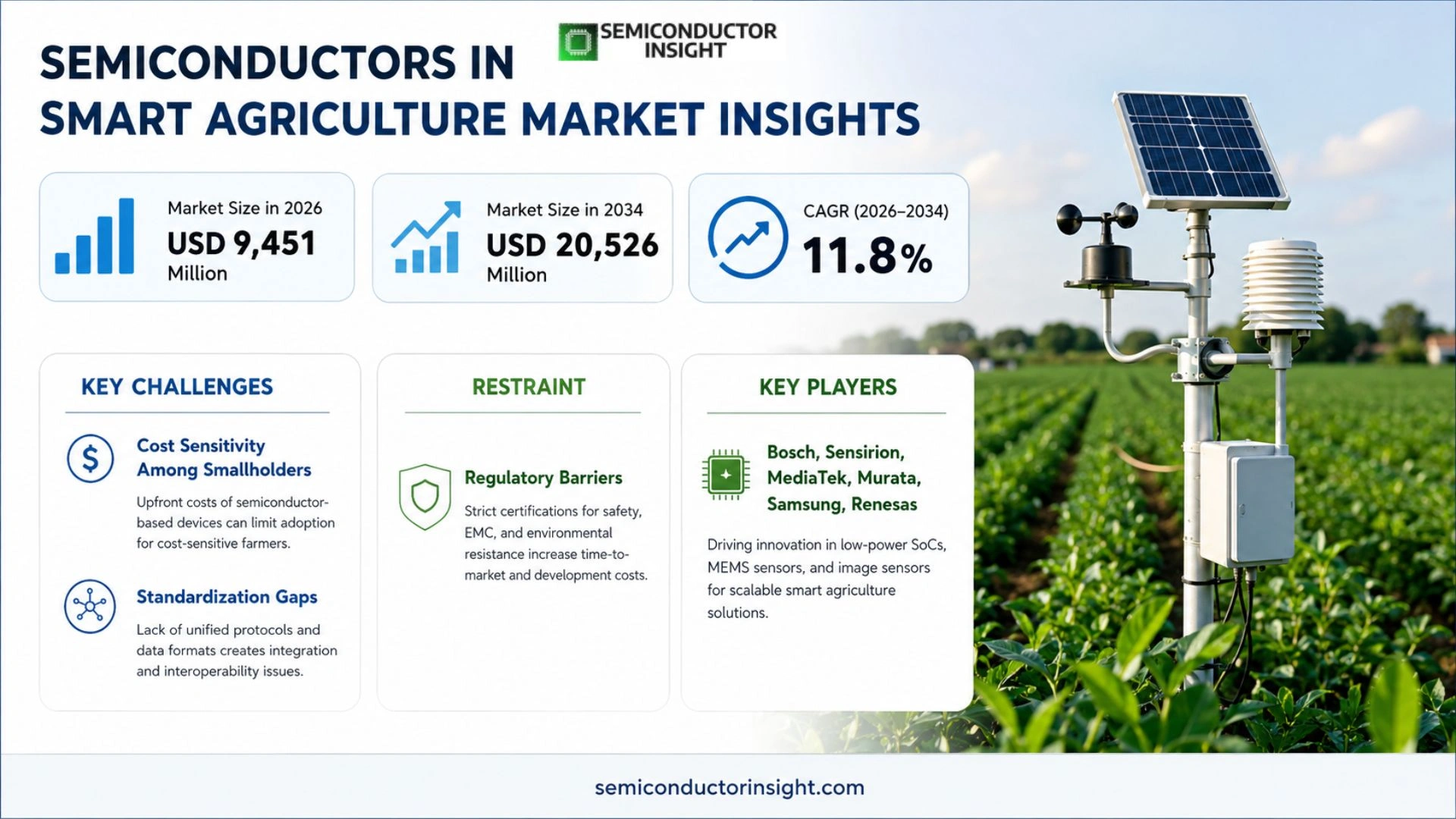
Semiconductors in Smart Agriculture market is projected to grow from USD 9,451 million in 2026 to USD 20,526 million by 2034, exhibiting a CAGR of 11.8% during the forecast period.
Semiconductors in smart agriculture comprise a portfolio of chips and devices that enable sensing, connectivity, control, positioning, imaging, lighting and edge‑computing across open fields, greenhouses, livestock operations, machinery, drones and grain storage. Core products include MCUs, MPUs, wireless SoCs (LoRa/Cellular), GNSS/RTK modules, MEMS inertial units, millimeter‑wave radars, CMOS multispectral sensors, gas sensors, horticulture LEDs and power‑management ICs.
The market accelerates because precision‑farming investments are rising worldwide and farmers demand real‑time data for water‑use efficiency and autonomous equipment. Recent collaborations,such as MediaTek’s MT6825 satellite‑IoT solution for remote farms and ams‑OSRAM’s horticulture lighting platform,demonstrate how OEMs are expanding ecosystem support while low‑power wide‑area connectivity standards broaden node deployment.
MARKET DRIVERS
Precision Farming Demands
The shift toward data‑driven agronomy pushes growers to adopt sensor networks that can measure soil moisture, nutrient levels, and micro‑climate conditions in real time. Semiconductors in Smart Agriculture Market benefit because each node relies on low‑power, high‑resolution chips to relay actionable metrics to farm management platforms. This precision reduces input waste and improves yield consistency, making the technology financially attractive for large‑scale producers.
IoT Connectivity Expansion
Broadband rollout in rural regions and the rollout of private 5G slices give agricultural IoT devices the bandwidth needed for continuous data streaming. As connectivity gaps shrink, the incentive to embed sophisticated semiconductor controllers in irrigation valves, drones, and autonomous tractors rises sharply. The resulting ecosystem encourages vendors to invest in ruggedized, energy‑efficient designs tailored for field conditions.
➤ “Every hectare equipped with edge‑compute modules can cut fertilizer use by up to 15 % while lifting yields by 8 %,” notes a leading agritech analyst.
Beyond immediate cost savings, the integration of smart chips enables predictive maintenance schedules that keep equipment uptime high during critical sowing windows. This operational resilience is a decisive factor for producers who cannot afford downtime, reinforcing the momentum behind semiconductor adoption.
MARKET CHALLENGES
Cost Sensitivity Among Smallholders
Many family‑run farms operate on thin margins and view upfront technology spend as a risk. Even though the long‑term economics of sensor‑enabled fields are favorable, the initial outlay for robust semiconductor‑based devices can stall adoption, especially where credit facilities are limited.
Other Challenges
Standardization Gaps
A fragmented ecosystem of communication protocols and data formats hampers seamless integration across equipment vendors. Without widely accepted standards, growers face interoperability hurdles that diminish the perceived value of new semiconductor solutions.
MARKET RESTRAINTS
Regulatory Barriers
Stringent safety certifications for electronic equipment used in harsh agricultural environments add extra time and cost to product launches. Compliance testing for electromagnetic compatibility, weather sealing, and chemical resistance can delay market entry for innovative chips.
Supply‑Chain Volatility
Recent disruptions in raw‑material sourcing for silicon wafers and rare‑earth elements create lead‑time uncertainties. When component availability fluctuates, manufacturers may be forced to hold excess inventory, eroding profit margins and limiting the scalability of new semiconductor offerings.
MARKET OPPORTUNITIES
Edge‑AI Integration
Embedding artificial‑intelligence inference engines directly on semiconductor dies empowers field devices to process sensor data locally, reducing reliance on cloud latency. This capability opens avenues for real‑time disease detection, autonomous weeding, and adaptive irrigation,applications that command premium pricing.
Partnerships with Agri‑Tech Platforms
Collaborative ventures between chip manufacturers and farm‑management software providers can create bundled solutions that simplify procurement for growers. By offering turnkey packages that include hardware, firmware, and analytics, vendors can penetrate segments that previously demanded piecemeal purchases.
Semiconductors in Smart Agriculture Market Trends
Edge‑AI Integration and Ultra‑Low‑Power Sensing
The convergence of edge artificial‑intelligence processors with multi‑parameter sensors is reshaping data capture on farms. Modern microcontroller units now embed neural‑network inference engines capable of filtering soil moisture, electrical conductivity, temperature and gas signatures locally, reducing the bandwidth required for cloud transmission. This shift lowers energy consumption and extends battery life of field‑deployed nodes, which is critical for installations across thousands of acres where power infrastructure is sparse. By converting raw analog signals into actionable insights at the chip level, equipment manufacturers can offer growers precise irrigation schedules and fertilization maps without costly retrofits, accelerating adoption of data‑centric cultivation practices.
Other Trends
Long‑Range, Low‑Power Connectivity for Remote Assets
Coverage gaps in traditional cellular networks have prompted a move toward sub‑GHz, LoRa and satellite‑backed IoT modules. These chips provide kilometer‑scale reach while maintaining microampere sleep currents, enabling continuous monitoring of livestock pens, peripheral storage silos and dispersed field sensors. Companies such as MediaTek have introduced satellite‑ready System‑on‑Chips that support bulk telemetry, allowing agribusinesses to aggregate environmental data from otherwise isolated locations. The operational impact is a reduction in manual inspection trips, tighter control of resource inputs, and the ability to trigger automated alerts when threshold conditions are breached.
Spectral Lighting and Vision Systems for Controlled‑Environment Farms
In greenhouse and vertical‑farm settings, semiconductor‑based horticultural LEDs paired with CMOS multispectral imagers are delivering higher photon utilization and real‑time crop health diagnostics. Tunable‑wavelength drivers, integrated with edge AI, modulate light spectra to match plant growth stages while concurrently detecting early disease signatures through machine‑vision algorithms. This hardware stack shortens crop cycles, reduces energy waste, and supports premium produce pricing by ensuring uniform quality. Vendors that embed these capabilities into turnkey modules create a compelling value proposition for growers seeking to scale indoor production without extensive engineering effort.
COMPETITIVE LANDSCAPE
Key Industry Players
Semiconductors Powering the Digitalization of Agriculture
Microchip Technology, Texas Instruments and Analog Devices dominate the core computing block, supplying MCUs, MPUs and power management ICs that underpin most field‑deployed nodes. Their extensive design‑win programs and long‑term supply agreements create a high barrier to entry for new entrants. These firms also command a sizeable share of the ecosystem services market, offering reference designs and SDKs that lock in OEMs to their platforms. Meanwhile, NXP and STMicroelectronics leverage broader automotive‑grade portfolios to capture the growing demand for robust edge AI and vehicular‑grade connectivity in autonomous tractors and harvesters. The market structure resembles a tiered hierarchy where a few multinational chassis suppliers command the bulk of volume, while a vibrant Mid‑tier of specialist firms supplies differentiated sensor and connectivity blocks.
Specialist players such as Bosch, Sensirion, ams‑OSRAM and u‑blox differentiate themselves through multi‑parameter sensing, gas‑analytics and centimeter‑level positioning. Bosch’s BME688 and Sensirion’s SCD4x illustrate a shift toward algorithm‑enabled environmental monitoring that reduces node count on farms. Asian manufacturers,including MediaTek, Murata, Samsung and Renesas,focus on low‑power wireless SoCs, MEMS IMUs and high‑resolution image sensors, providing cost‑effective alternatives for large‑scale IoT deployments in open‑field and greenhouse settings. Regional champions like ROHM and TDK contribute niche analog front‑ends that improve signal integrity in harsh farm environments. Collectively, these firms expand the functional breadth of the market, encouraging OEMs to assemble highly customized modules rather than relying on a single monolithic chip.
List of Key Semiconductors in Smart Agriculture Companies Profiled
- Microchip Technology Inc.
- Texas Instruments Incorporated
- Analog Devices, Inc.
- NXP Semiconductors
- STMicroelectronics
- Bosch Sensortechnik GmbH
- Sensirion Holding AG
- ams‑OSRAM AG
- u‑blox Holding AG
- MediaTek Inc.
- Murata Manufacturing Co., Ltd.
- Renesas Electronics Corporation
- Samsung Electronics Co., Ltd.
- ROHM Co., Ltd.
- TDK Corporation
Segment Analysis:
| Segment Category | Sub-Segments | Key Insights |
| By Type |
|
Leading Segment: Sensing devices
|
| By Application |
|
Leading Segment: Open‑field farming
|
| By End User |
|
Leading Segment: Sensor manufacturers
|
| By Technology Paradigm |
|
Leading Segment: Low‑power wide‑area connectivity
|
| By Delivery Model |
|
Leading Segment: Module integration
|
Regional Analysis: Semiconductors in Smart Agriculture Market
Europe
The EU’s Green Deal has embedded electronic efficiency targets into agricultural subsidies, compelling growers to adopt semiconductor‑driven monitoring tools. Compliance checks now reference data granularity achievable only through high‑precision sensing chips, influencing purchase decisions at the farm level.
Large‑scale dairy and grain operations in the Netherlands and France have migrated from manual gauges to integrated semiconductor platforms that process climate variables on the edge, delivering real‑time feedback without reliance on distant cloud services.
Proximity of semiconductor fabs in Germany and the Czech Republic reduces lead times for bespoke agricultural chips, enabling rapid iteration cycles that align tightly with seasonal planting schedules and varietal experimentation.
Venture capital flows targeting ag‑tech incubators in Scandinavia prioritize startups that embed low‑power semiconductors, fostering a pipeline of niche solutions that address region‑specific agronomic challenges.
North America
North America leverages a vast expanse of commodity farming where scale drives demand for interoperable semiconductor systems that can be deployed across millions of acres. Federal research programs collaborate with chip designers to address the latency constraints of real‑time field analytics, while major ag‑input firms integrate sensor suites into their existing equipment portfolios. The region’s emphasis on data sovereignty encourages on‑premise processing, prompting manufacturers to produce ruggedized chips that withstand the dust and heat typical of Midwest farms. Market participants view these technologies as pathways to reduce input waste and meet consumer expectations for traceability, prompting a steady reallocation of capital toward digital infrastructure on the farm.
Asia‑Pacific
In Asia‑Pacific, the convergence of smallholder intensity and rapid mechanization fuels a distinct demand profile for semiconductor solutions that balance affordability with performance. Governments in Japan, South Korea, and China subsidize smart sensor deployments to accelerate precision agriculture adoption, especially in water‑scarce regions. Local semiconductor firms are tailoring low‑cost, high‑volume chips that can be embedded into inexpensive handheld devices, enabling millions of growers to capture soil health data without extensive capital outlay. Collaborative pilots linking university research with agribusinesses are generating region‑specific algorithms that enhance crop resilience, thereby shaping the next wave of semiconductor product development focused on localized environmental variables.
South America
South America’s heterogeneous terrain, ranging from Andean highlands to Amazonian lowlands, compels a versatile approach to semiconductor integration. Large agribusinesses in Brazil and Argentina are experimenting with autonomous sprayers equipped with edge‑processing chips that adjust application rates based on real‑time canopy imaging. Meanwhile, emerging cooperatives in Chile’s fruit valleys are employing low‑power semiconductor sensors to monitor micro‑climatic conditions that dictate harvest timing. The region’s evolving trade agreements incentivize technology transfer, encouraging multinational chip manufacturers to establish regional design centers that address the unique phytosanitary challenges faced by local growers.
Middle East & Africa
Across the Middle East and Africa, water scarcity dictates the strategic value of semiconductor‑enabled irrigation control. Pilot projects in the United Arab Emirates and Israel showcase ultra‑low‑power chips that power remote moisture sensors powered by ambient energy, facilitating precise water delivery in arid environments. In sub‑Saharan Africa, NGOs partner with semiconductor startups to deploy resilient sensor networks that survive extreme temperature fluctuations, empowering smallholder farmers with data previously unavailable. These initiatives are reshaping funding landscapes, as impact investors prioritize technologies that couple semiconductor efficiency with tangible resource conservation outcomes.
Report Scope
This market research report provides a comprehensive analysis of the Semiconductors in Smart Agriculture Market , covering the forecast period 2026–2034. It offers detailed insights into market dynamics, technological advancements, competitive landscape, and key trends shaping the industry.
Key focus areas of the report include:
- Market Overview: The report begins with an overview outlining its current market scenario, key growth indicators, and industry transformation drivers. It discusses macroeconomic factors, demand–supply balance, regulatory landscape, and the strategic role of semiconductors in powering advancements across industries such as automotive, telecommunications, consumer electronics, and industrial automation.
- Market Size & Forecast: Historical data and future projections for revenue, unit shipments, and market value across major regions and segments.
- Segmentation Analysis: Detailed breakdown by product type, technology, application, and end-user industry to identify high-growth segments and investment opportunities.
- Regional Insights: Insights into market performance across North America, Europe, Asia-Pacific, Latin America, and the Middle East & Africa, including country-level analysis where relevant.
- Competitive Landscape: Profiles of leading market participants, including their product offerings, R&D focus, manufacturing capacity, pricing strategies, and recent developments such as mergers, acquisitions, and partnerships.
- Technology Trends & Innovation: Assessment of emerging technologies, integration of AI/IoT, semiconductor design trends, fabrication techniques, and evolving industry standards.
- Market Drivers & Restraints: Evaluation of factors driving market growth along with challenges, supply chain constraints, regulatory issues, and market-entry barriers.
- Stakeholder Insights: Insights for component suppliers, OEMs, system integrators, investors, and policymakers regarding the evolving ecosystem and strategic opportunities.
Primary and secondary research methods are employed, including interviews with industry experts, data from verified sources, and real-time market intelligence to ensure the accuracy and reliability of the insights presented.
FREQUENTLY ASKED QUESTIONS:
What is the current market size of Semiconductors in Smart Agriculture Market?
-> Semiconductors in Smart Agriculture market is projected to grow from USD 9,451 million in 2026 to USD 20,526 million by 2034, exhibiting a CAGR of 11.8%
Which key companies operate in Semiconductors in Smart Agriculture Market?
-> Key players include Microchip Technology Inc., Analog Devices, Texas Instruments Incorporated, STMicroelectronics, Semtech Corporation, Nordic Semiconductor, NXP Semiconductors, Infineon, Robert Bosch GmbH, Sensirion Holding AG, ams‑OSRAM AG, u‑blox Holding AG, ON Semiconductor, Silicon Laboratories Inc., Renesas Electronics Corporation, Sony Semiconductor Solutions Corporation, Murata Manufacturing Co., Ltd., ROHM Co., Ltd., Hamamatsu Photonics K.K., TDK Corporation, Samsung Electronics Co., Ltd., ABOV Semiconductor Co., Ltd., Nextchip Co., Ltd., Silicon Mitus, Inc., Magnachip Semiconductor Corporation, Pixelplus Co., Ltd., Espressif Systems Co., Ltd., GigaDevice Semiconductor Inc., SmartSens Technology Co., Ltd., Will Semiconductor Co., Ltd. Shanghai, UNISOC (Shanghai) Technologies Co., Ltd., MediaTek Inc., Nuvoton Technology Corporation, Rockchip Electronics Co., Ltd., Himax Technologies, Inc., Vishay Intertechnology, among others.
What are the key growth drivers?
-> Key growth drivers include the transition to data‑driven agriculture, rising demand for precision irrigation and fertilization, increasing adoption of autonomous machinery and drones, expansion of low‑power wide‑area IoT connectivity in remote fields, and the need for energy‑efficient lighting and environmental control in greenhouse and vertical farming.
Which region dominates the market?
-> Asia‑Pacific holds the largest market share, propelled by extensive mechanized farming in China, India and Japan, while North America and Europe remain important secondary markets.
What are the emerging trends?
-> Emerging trends include low‑power wide‑area connectivity solutions such as LoRa, Sub‑GHz, cellular and satellite IoT; advanced LED and spectral lighting technologies for controlled‑environment agriculture; and the deployment of autonomous tractors, spraying and harvesting robots, and drones enabled by centimeter‑level GNSS, MEMS IMUs, millimeter‑wave radar and edge AI.

Get Sample Report PDF for Exclusive Insights
Report Sample Includes
- Table of Contents
- List of Tables & Figures
- Charts, Research Methodology, and more...
 Download Sample Report PDF