Market Insights
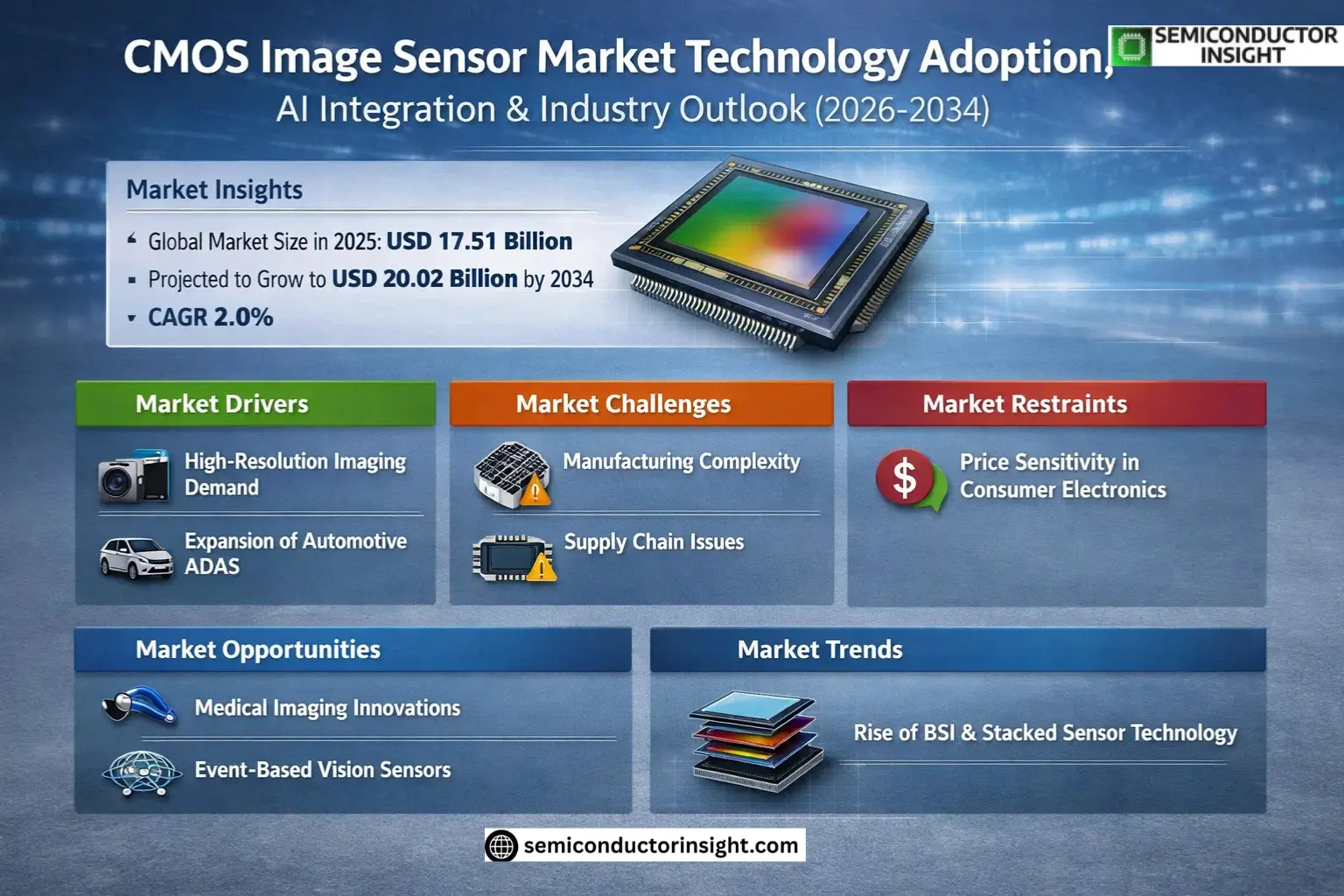
Global CMOS Image Sensor Market size was valued at USD 17.51 billion in 2025. The market is projected to grow from USD 18.23 billion in 2026 to USD 20.02 billion by 2034, exhibiting a CAGR of 2.0% during the forecast period.
CMOS (complementary metal-oxide-semiconductor) image sensors are semiconductor devices that convert light into electrical signals, widely used in digital imaging applications. These sensors leverage standard CMOS manufacturing processes, offering advantages such as low power consumption, high-speed operation, and integration with other circuitry. Key variants include front-side illuminated (FSI), back-side illuminated (BSI), and stacked CMOS architectures.
The market growth is driven by increasing demand for high-resolution imaging across smartphones, automotive cameras, and surveillance systems. Technological advancements like multi-camera setups in mobile devices and ADAS adoption in vehicles are accelerating deployment. Major players such as Sony Semiconductor Solutions and Samsung Electronics continue to dominate through innovations in pixel technology and miniaturization.
MARKET DRIVERS
Growing Demand for High-Resolution Imaging
CMOS Image Sensor Market is experiencing significant growth due to increasing demand for high-resolution imaging in smartphones, automotive cameras, and medical devices. Advances in pixel technology and low-light performance are driving adoption across multiple industries, with the smartphone sector accounting for over 60% of global shipments.
Expansion of Automotive ADAS Applications
Automotive applications such as advanced driver-assistance systems (ADAS) and autonomous vehicles are fueling CMOS image sensor demand. The market is projected to grow at a CAGR of 8.2% in the automotive segment through 2027, with increasing adoption of multi-camera setups for 360-degree vision systems.
Industrial automation and machine vision applications are further contributing to market expansion, with manufacturers developing specialized sensors for factory automation and quality control systems.
MARKET CHALLENGES
Manufacturing Complexity and Yield Rates
CMOS Image Sensor Market faces challenges in wafer-level manufacturing, where increasing pixel densities and smaller node processes impact yield rates. Fabrication complexities for backside-illuminated (BSI) and stacked sensors require significant capital investment in specialized equipment.
Other Challenges
Intellectual Property Barriers
Developing innovative sensor technologies while navigating a landscape with over 5,000 active patents creates significant entry barriers for new market participants.
Supply Chain Constraints
Recent semiconductor shortages have impacted CMOS image sensor production, with lead times stretching to 26 weeks for certain high-end automotive-grade sensors.
MARKET RESTRAINTS
Price Sensitivity in Consumer Electronics
Intense competition in the consumer electronics segment creates pricing pressures for CMOS image sensor manufacturers. With smartphone OEMs demanding higher performance at lower costs, profit margins for standard resolution sensors have declined by 12% year-over-year.
MARKET OPPORTUNITIES
Emerging Applications in Medical Imaging
CMOS Image Sensor Market is seeing growth opportunities in medical endoscopy and diagnostic imaging, with demand for miniaturized, high-sensitivity sensors compatible with sterilization processes. The medical segment is projected to grow at 9.4% CAGR through 2028.
Development of Event-Based Vision Sensors
Neuromorphic event-based vision sensors represent a significant innovation opportunity, offering low-latency, high-dynamic-range imaging for industrial automation and surveillance applications, with prototype devices already achieving 10,000 fps performance.
CMOS Image Sensor Market Trends
Shift Toward Advanced Pixel Technologies
CMOS Image Sensor Market is witnessing rapid adoption of backside-illuminated (BSI) and stacked sensor designs. These technologies enable higher pixel densities while maintaining light sensitivity, crucial for applications like smartphone cameras and automotive vision systems. Leading manufacturers are focusing on sub-0.8µm pixel pitches to support ultra-high-resolution requirements.
Other Trends
Automotive Sector Driving Innovation
Automotive applications now represent the fastest-growing segment for CMOS Image Sensor Market demand. The rise of ADAS and autonomous vehicles has increased requirements for high-dynamic-range (HDR) sensors capable of 120dB+ performance. Suppliers are developing specialized automotive-grade sensors meeting AEC-Q100 qualification standards.
Emerging Industrial Applications
Industrial machine vision systems are adopting global shutter CMOS sensors at growing rates. These specialized sensors with thousand-frames-per-second capability enable precise motion capture for manufacturing automation and robotics applications. The market sees increasing demand for sensors with <1e- read noise performance.
Security and Surveillance Upgrades
Security cameras are transitioning to 4K and 8K resolution sensors with improved low-light performance. CMOS Image Sensor Market is responding with new designs featuring advanced noise reduction algorithms and near-infrared sensitivity enhancements. AI-powered analytics functions are being integrated directly into sensor designs for edge processing.
Supply Chain Realignments
Geopolitical factors are causing restructuring in CMOS Image Sensor Market supply chains. Companies are diversifying manufacturing locations while maintaining advanced nodes at established semiconductor hubs. This includes expanded capacity in regions with mature semiconductor ecosystems to mitigate concentration risks.
COMPETITIVE LANDSCAPE
Key Industry Players
Sony Dominates While Chinese Challengers Emerge in the CIS Market
Sony Semiconductor Solutions maintains undisputed leadership in CMOS Image Sensor Market with over 40% global share, leveraging its advanced stacked sensor technology and vertical integration capabilities. The market exhibits an oligopolistic structure where Sony, Samsung, and OmniVision collectively control nearly 70% of the production capacity. IDM players with captive manufacturing facilities hold significant advantages in technology iteration and yield control compared to fabless competitors.
Emerging Chinese players like GalaxyCore and Smartsens Technology are gaining traction in mid-to-low-end markets through aggressive pricing and government subsidies. Specialized automotive CIS suppliers such as On Semiconductor and STMicroelectronics demonstrate strong growth potential as vehicle camera adoption accelerates. The competitive landscape is further diversified by foundry-dependent designers (SK Hynix) and imaging veterans (Canon) bringing differentiated solutions.
List of Key CMOS Image Sensor Companies Profiled
- Samsung Electronics
- Sony Semiconductor Solutions
- OmniVision Technologies
- STMicroelectronics
- On Semiconductor
- SK Hynix
- GalaxyCore Inc
- Panasonic
- Smartsens Technology
- Canon
- SOI Technologies
- PixArt Imaging
- AMS-OSRAM AG
- Himax Technologies
- BYD Semiconductor
Segment Analysis:
| Segment Category | Sub-Segments | Key Insights |
| By Type |
|
Stacked CMOS Image Sensor dominates with superior performance characteristics:
|
| By Application |
|
Mobile Applications maintain leadership while automotive shows strongest growth potential:
|
| By End User |
|
Consumer Electronics remains the dominant segment with expanding needs:
|
| By Technology |
|
HDR Technology emerges as critical performance differentiator:
|
| By Pixel Structure |
|
Active Pixel Sensor dominates with continuous innovation:
|
Regional Analysis: CMOS Image Sensor Market
Asia-Pacific
Japanese companies maintain strong R&D capabilities in high-resolution and specialized image sensors, with leading manufacturers developing advanced backside-illuminated products for professional and industrial applications.
China’s semiconductor industry policy initiatives are rapidly expanding domestic CMOS production capabilities, particularly for automotive and IoT applications, while nurturing next-generation sensor technologies through academic partnerships.
The strong smartphone and display manufacturing base drives demand for cutting-edge CMOS image sensors with advanced HDR and AI-processing features, creating symbiotic supply chain relationships.
Countries like Vietnam and Malaysia are becoming important CMOS assembly and test locations, supported by semiconductor packaging investments and proximity to major EMS providers.
North America
North America maintains strong positioning in the CMOS Image Sensor Market through advanced R&D and early adoption of cutting-edge applications. The region leads in specialized sensor development for defense, scientific, and medical imaging applications where performance outweighs cost considerations. Silicon Valley remains a hub for emerging CMOS technologies, with companies developing novel architectures for autonomous vehicles and space applications. The strong presence of fabless semiconductor firms and close university-industry collaborations foster innovation in computational imaging and quantum efficiency improvements.
Europe
Europe demonstrates particular strength in automotive CMOS image sensors, driven by stringent safety regulations and leading auto manufacturers. The region hosts several specialized foundries producing high-performance sensors for industrial and scientific applications. European research institutions are pioneering work in time-of-flight sensors and bio-inspired imaging technologies. The growing emphasis on industrial automation and smart city applications provides additional growth avenues for CMOS image sensor deployment across the region.
South America
The South American CMOS Image Sensor Market shows increasing adoption in security and agricultural applications, though primarily remains an importer of technology. Governments are investing in surveillance infrastructure, while agricultural technology adoption drives demand for specialized imaging systems. Local assembly of consumer electronics creates some manufacturing footprint, though limited semiconductor fabrication exists. The market demonstrates strong potential growth as regional economies develop more sophisticated technology ecosystems.
Middle East & Africa
This emerging CMOS Image Sensor Market region shows growing adoption in security and smart city applications, supported by urban development initiatives. Middle Eastern governments actively deploy advanced surveillance systems, while African nations increasingly adopt imaging for agricultural and medical applications. The region hosts minimal manufacturing but serves as an important consumption market for imported sensor technologies, with growing local expertise in system integration and IoT applications.
Report Scope
This market research report provides a comprehensive analysis of the CMOS Image Sensor Market , covering the forecast period 2025–2034. It offers detailed insights into market dynamics, technological advancements, competitive landscape, and key trends shaping the industry.
Key focus areas of the report include:
- Market Overview: The report begins with an overview outlining its current market scenario, key growth indicators, and industry transformation drivers. It discusses macroeconomic factors, demand–supply balance, regulatory landscape, and the strategic role of semiconductors in powering advancements across industries such as automotive, telecommunications, consumer electronics, and industrial automation.
- Market Size & Forecast: Historical data and future projections for revenue, unit shipments, and market value across major regions and segments.
- Segmentation Analysis: Detailed breakdown by product type, technology, application, and end-user industry to identify high-growth segments and investment opportunities.
- Regional Insights: Insights into market performance across North America, Europe, Asia-Pacific, Latin America, and the Middle East & Africa, including country-level analysis where relevant.
- Competitive Landscape: Profiles of leading market participants, including their product offerings, R&D focus, manufacturing capacity, pricing strategies, and recent developments such as mergers, acquisitions, and partnerships.
- Technology Trends & Innovation: Assessment of emerging technologies, integration of AI/IoT, semiconductor design trends, fabrication techniques, and evolving industry standards.
- Market Drivers & Restraints: Evaluation of factors driving market growth along with challenges, supply chain constraints, regulatory issues, and market-entry barriers.
- Stakeholder Insights: Insights for component suppliers, OEMs, system integrators, investors, and policymakers regarding the evolving ecosystem and strategic opportunities.
Primary and secondary research methods are employed, including interviews with industry experts, data from verified sources, and real-time market intelligence to ensure the accuracy and reliability of the insights presented.
FREQUENTLY ASKED QUESTIONS:
What is the current market size of CMOS Image Sensor Market?
-> CMOS Image Sensor Market size was valued at USD 17.51 billion in 2025. The market is projected to grow from USD 18.23 billion in 2026 to USD 20.02 billion by 2034, exhibiting a CAGR of 2.0% during the forecast period.
Which key companies operate in CMOS Image Sensor Market?
-> Key players include SONY, Samsung, OmniVision, STMicroelectronics, On Semi, SK Hynix, GalaxyCore, Panasonic, Smartsens Technology, Canon, and SOI, among others.
What are the key growth drivers?
-> Key growth drivers include increasing demand for automotive cameras, security monitoring systems, and industrial machine vision applications.
Which region dominates the market?
-> Asia-Pacific is the largest market for CMOS Image Sensors, while North America remains a significant player in high-end applications.
What are the emerging trends?
-> Emerging trends include advanced pixel technologies, stacked CMOS sensors, and integration of AI capabilities in imaging systems.

Get Sample Report PDF for Exclusive Insights
Report Sample Includes
- Table of Contents
- List of Tables & Figures
- Charts, Research Methodology, and more...
 Download Sample Report PDF