MARKET INSIGHTS
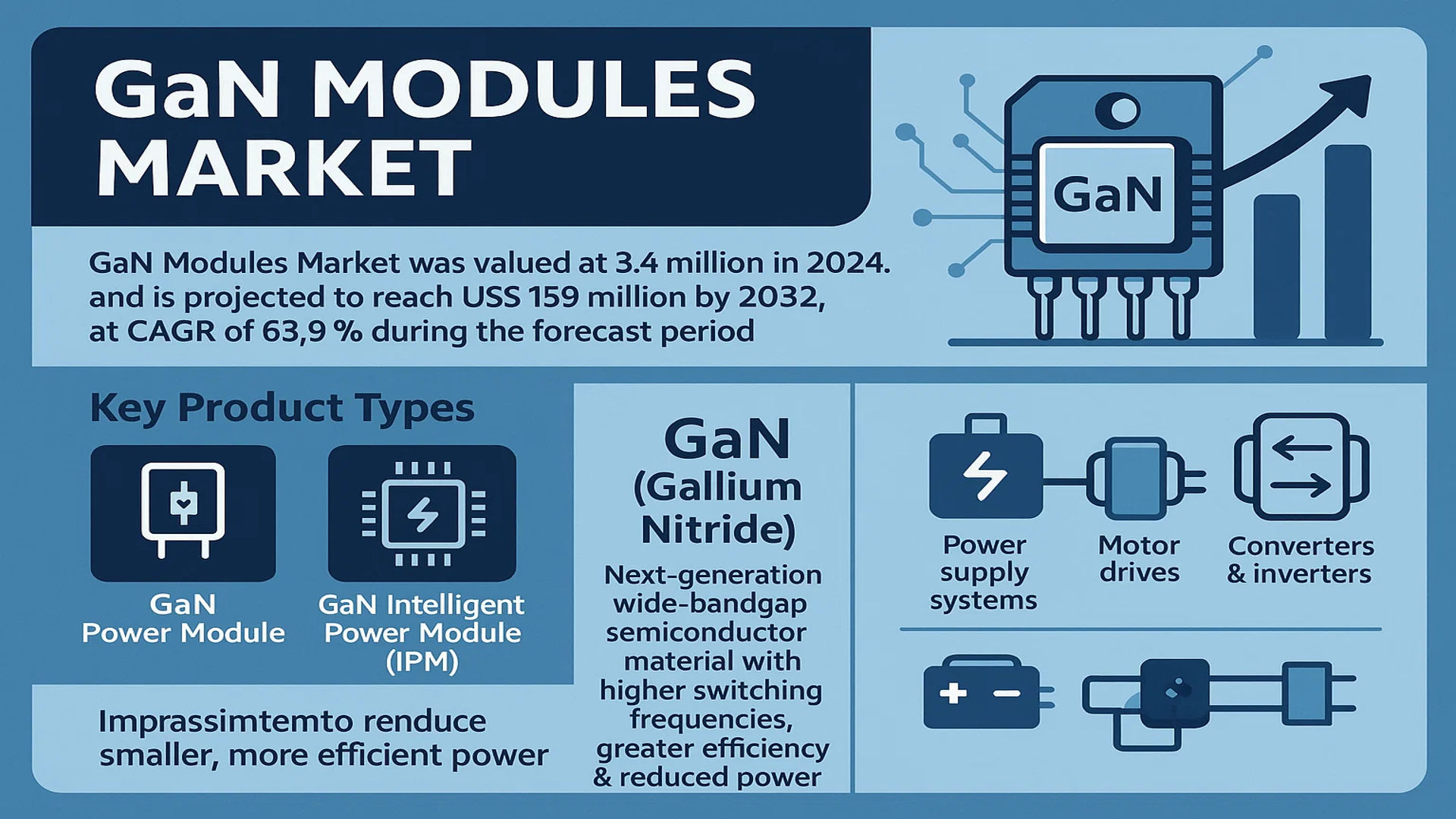
The global GaN Modules Market was valued at 3.4 million in 2024 and is projected to reach US$ 159 million by 2032, at a CAGR of 63.9% during the forecast period.
GaN Modules are advanced power electronic assemblies that integrate Gallium Nitride (GaN) semiconductor devices. These modules are engineered to deliver superior performance in power conversion and management applications, primarily encompassing two key product types: GaN Power Modules and GaN Intelligent Power Modules (IPMs). GaN is a next-generation wide-bandgap semiconductor material renowned for its exceptional switching performance, characterized by higher switching frequencies and greater efficiency compared to traditional silicon. This leads to substantially reduced power losses, enabling the development of smaller, more efficient, and cost-effective power supply systems, motor drives, converters, and inverters.
The market is currently in a nascent stage of development, sampling, and promotion, which explains its relatively small initial valuation. However, it is poised for explosive growth driven by the relentless demand for energy efficiency across multiple industries. Key growth drivers include the rapid expansion of the electric vehicle (EV) sector, the proliferation of renewable energy systems like solar inverters, and the need for more efficient power management in data centers (servers/UPS) and consumer electronics. While the broader Power GaN Device market was valued at USD 341.3 million in 2024, the module segment represents a high-growth frontier. As of 2024, Texas Instruments is a notable pioneer, being the first company to initiate mass production of GaN Modules, specifically its DRV7308 IPM, while other major players like Infineon and Mitsubishi Electric are advancing through the development and sampling phases.
MARKET DYNAMICS
MARKET DRIVERS
Rising Demand for Energy-Efficient Power Electronics to Accelerate GaN Module Adoption
The global push toward energy efficiency is significantly driving the GaN modules market, as these semiconductors offer superior performance compared to traditional silicon-based components. GaN modules enable higher switching frequencies and reduced power losses, which are critical for applications requiring compact and efficient power conversion. The energy savings potential is substantial; for instance, GaN-based systems can achieve efficiency levels exceeding 98%, compared to 92-95% for silicon-based alternatives. This efficiency is particularly vital in data centers, renewable energy systems, and electric vehicles, where energy consumption directly impacts operational costs and environmental goals. The increasing stringency of energy regulations worldwide further propels the adoption of GaN technology, as industries seek compliant, high-performance solutions that also reduce carbon footprints.
Expansion of Electric Vehicle Infrastructure to Fuel Market Growth
The rapid growth of the electric vehicle (EV) market is a major catalyst for GaN modules, which are increasingly used in onboard chargers, traction inverters, and DC-DC converters. GaN technology supports faster charging times, higher power density, and improved thermal management, addressing key challenges in EV adoption. With global EV sales projected to surpass 40 million units annually by 2030, the demand for efficient power electronics is surging. GaN modules facilitate the development of compact, lightweight, and high-efficiency power systems that enhance vehicle range and reduce charging times. Automotive manufacturers and suppliers are investing heavily in GaN-based solutions to meet the evolving requirements of next-generation electric mobility, thereby driving substantial market expansion.
Growth in Renewable Energy Integration to Boost GaN Module Deployment
The integration of renewable energy sources, such as solar and wind power, into the grid is creating robust demand for advanced power electronics like GaN modules. These modules are essential in photovoltaic inverters and energy storage systems, where they enhance conversion efficiency and reliability. Solar installations alone are expected to exceed 2.5 terawatts globally by 2030, necessitating high-performance components that minimize energy losses. GaN technology enables inverters to operate at higher frequencies, reducing the size of passive components and overall system costs. Furthermore, the trend toward decentralized energy systems and microgrids amplifies the need for efficient, durable power modules, positioning GaN as a key enabler of the clean energy transition.
MARKET CHALLENGES
High Initial Costs and Manufacturing Complexities to Hinder Widespread Adoption
Despite their advantages, GaN modules face significant challenges related to high production costs and complex manufacturing processes. The fabrication of GaN semiconductors requires specialized materials and equipment, leading to higher per-unit costs compared to mature silicon technologies. Current GaN module prices can be 20-30% higher than silicon equivalents, which deters cost-sensitive applications. Additionally, achieving high yield rates in mass production remains difficult due to material defects and processing intricacies. These factors slow down commercialization and limit penetration into price-conscious markets, such as consumer electronics and industrial drives, where margins are tight and competition is intense.
Other Challenges
Thermal Management Issues
Effective heat dissipation is critical for GaN modules, as high power densities can lead to overheating and reduced reliability. Managing thermal performance requires advanced packaging and cooling solutions, which add complexity and cost. In high-power applications like electric vehicles and industrial motor drives, thermal constraints can limit the full utilization of GaN’s capabilities, necessitating additional engineering efforts and potentially delaying product launches.
Supply Chain Constraints
The GaN module market is susceptible to supply chain disruptions, particularly for raw materials like gallium and specialized substrates. Geopolitical tensions and limited production capacity for high-purity materials can lead to shortages and price volatility. These constraints affect manufacturing scalability and may impede the ability of suppliers to meet growing demand, especially during periods of rapid market expansion.
MARKET RESTRAINTS
Limited Standardization and Compatibility Issues to Restrain Market Growth
The lack of industry-wide standards for GaN modules poses a significant restraint, as compatibility issues can arise when integrating these components into existing systems. Many end-users rely on standardized silicon-based solutions, and transitioning to GaN may require redesigning circuit layouts and control systems. This inertia slows adoption, particularly in conservative industries like industrial automation and power infrastructure, where reliability and interoperability are paramount. Furthermore, the absence of uniform testing and qualification protocols creates uncertainty regarding long-term performance and durability, causing potential customers to hesitate despite the technological benefits.
Competition from Established Silicon and SiC Technologies to Limit Market Share
GaN modules face intense competition from well-established silicon-based power devices and emerging silicon carbide (SiC) alternatives. Silicon technology benefits from decades of optimization, cost reductions, and extensive supplier networks, making it a default choice for many applications. Meanwhile, SiC offers a compelling value proposition in high-voltage and high-temperature environments, capturing segments where GaN might otherwise excel. This competitive landscape forces GaN suppliers to demonstrate clear superiority in specific use cases, such as high-frequency switching or ultra-compact designs, to gain traction. Until GaN achieves greater cost parity and proven reliability across diverse conditions, its market growth may be tempered by the dominance of incumbent technologies.
MARKET OPPORTUNITIES
Advancements in 5G and Telecommunications Infrastructure to Unlock New Opportunities
The rollout of 5G networks and the expansion of telecommunications infrastructure present significant growth opportunities for GaN modules. These components are ideal for radio frequency (RF) power amplifiers and base station power supplies due to their high efficiency and frequency capabilities. With 5G deployment accelerating globally—projected to cover 65% of the world’s population by 2025—the demand for energy-efficient and compact power solutions is rising. GaN modules can reduce energy consumption in base stations by up to 30%, addressing both operational costs and sustainability targets. Telecommunications providers and equipment manufacturers are increasingly adopting GaN technology to enhance network performance and support the massive data throughput required by next-generation applications.
Emerging Applications in Aerospace and Defense to Drive Future Demand
The aerospace and defense sectors offer promising opportunities for GaN modules, where their high power density, reliability, and radiation tolerance are highly valued. Applications include radar systems, electronic warfare, and satellite communications, where efficiency and size reduction are critical. Defense budgets worldwide are increasing, with a focus on modernizing electronic systems, which aligns with the capabilities of GaN technology. Additionally, the growing use of unmanned aerial vehicles (UAVs) and space exploration initiatives further amplifies the need for advanced power electronics. GaN modules are poised to play a pivotal role in these high-stakes environments, providing the performance and durability required for mission-critical operations.
Strategic Collaborations and R&D Investments to Foster Innovation
Increased investments in research and development, along with strategic partnerships between semiconductor manufacturers and end-users, are creating fertile ground for GaN module innovation. Companies are collaborating to develop application-specific solutions, such as integrated motor drives and all-GaN power systems, which unlock new market segments. For example, recent advancements in GaN-on-silicon substrates are reducing production costs and improving scalability. These efforts are likely to accelerate the commercialization of GaN modules, making them more accessible and reliable for a broader range of industries. Furthermore, government initiatives supporting semiconductor independence and energy efficiency are providing additional funding and incentives, bolstering the long-term growth prospects of the GaN module market.
GAN MODULES MARKET TRENDS
Accelerated Electrification Across Industries to Emerge as a Pivotal Trend
The global push towards electrification, particularly in the automotive and industrial sectors, is fundamentally reshaping the power electronics landscape and creating unprecedented demand for GaN modules. These modules, which integrate multiple Gallium Nitride power devices into a single package, offer superior switching frequencies and efficiencies that are critical for next-generation applications. While the broader GaN power device market is experiencing robust growth, the module segment represents the next frontier, moving from development and sampling phases into initial mass production. This transition is being driven by the need for higher power density and more integrated solutions in systems like electric vehicle powertrains, where efficiency gains directly translate to extended range. The market’s projected explosive growth, from a valuation of 3.4 million in 2024 to an anticipated 159 million by 2032, reflects this critical industry inflection point.
Other Trends
Technological Integration and Miniaturization
The relentless demand for smaller, more efficient power systems is a primary catalyst for GaN module adoption. These modules consolidate several discrete components into a single, optimized package, significantly reducing the parasitic inductances that plague traditional designs. This integration is paramount for applications like server power supplies and telecom infrastructure, where space is at a premium and thermal management is a constant challenge. Furthermore, the ability of GaN to operate at much higher frequencies than silicon enables the use of smaller passive components like inductors and capacitors, leading to a substantial reduction in the overall system size and weight. This trend towards miniaturization without sacrificing performance is unlocking new design possibilities across consumer electronics, data centers, and renewable energy systems.
Expansion into High-Power Application Segments
Initially focused on lower-power consumer adapters, the application horizon for GaN technology is rapidly expanding into more demanding sectors. GaN modules are now being specifically engineered for high-power applications such as solar inverters, industrial motor drives, and uninterruptible power supplies (UPS). In solar energy, for instance, the higher efficiency of GaN modules reduces energy loss in the conversion process from DC to AC, thereby increasing the overall energy yield of a photovoltaic system. Similarly, in motor drives, the superior switching performance allows for more precise control and higher efficiency, which is crucial for industrial automation and electric vehicles. This strategic move up the power chain is a clear indicator of the technology’s maturation and its readiness to challenge silicon-based IGBTs and SiC modules in a wider range of applications, signaling a significant shift in the power electronics competitive landscape.
COMPETITIVE LANDSCAPE
Key Industry Players
Companies Accelerate Product Development to Capture Emerging Market Opportunity
The global GaN Modules market exhibits a fragmented but rapidly evolving competitive structure, characterized by established semiconductor giants, specialized technology firms, and emerging innovators all vying for position in this high-growth sector. While the market is currently in its nascent commercialization phase, competition is intensifying as companies race to develop reliable, high-performance modules for mass adoption.
Texas Instruments (TI) has established an early-mover advantage, being the first company to achieve mass production of GaN Modules starting in 2024 with products like its DRV7308 Intelligent Power Module (IPM). This head start, combined with its vast manufacturing scale and extensive customer relationships, positions TI as a formidable leader. However, its dominance is being challenged by companies with deep expertise in power semiconductors.
Infineon Technologies, through its acquisition of GaN Systems, is a particularly significant competitor. It boasts a robust portfolio of GaN power discretes and has developed advanced module prototypes, such as its 650V 300A 3-Phase GaN Power Module, showcasing its technological prowess. Similarly, Mitsubishi Electric (operating through its subsidiary Vincotech) leverages decades of experience in power modules to develop competitive GaN-based solutions, aiming to transition its existing customer base to the new technology.
Furthermore, the landscape includes pure-play technology developers pushing the boundaries of performance. Companies like QPT (Quartet Power Technology) and VisIC Technologies are focusing on high-power applications, particularly targeting the electric vehicle and industrial motor drive markets. Their growth is fueled by specialized technical expertise and strategic partnerships with tier-one manufacturers.
Meanwhile, other players like Kyocera AVX and Fujitsu General Electronics Limited are strengthening their market presence through significant investments in R&D and by leveraging their expertise in packaging and module integration. These companies are crucial for driving down costs and improving the reliability of GaN modules, which are essential for broader market penetration beyond early adopters.
List of Key GaN Modules Companies Profiled
- Texas Instruments (TI) (U.S.)
- Kyocera AVX (U.S.)
- QPT (U.K.)
- Infineon (GaN Systems) (Germany)
- Mitsubishi Electric (Vincotech) (Japan)
- Fujitsu General Electronics Limited (Japan)
- Sensitron Semiconductor (U.S.)
- NJSM Electronics (China)
- VisIC Technologies (Israel)
- X-IPM Technology (China)
Segment Analysis:
By Type
GaN Power Module Segment Leads the Market Due to Superior Efficiency in High-Power Applications
The market is segmented based on type into:
- GaN Power Module
- GaN Intelligent Power Module (IPM)
By Application
Electric Vehicles (EVs) Segment Shows Strong Growth Potential Driven by Demand for Efficient Power Conversion
The market is segmented based on application into:
- Home Appliances/Consumer
- Servers/UPS
- Solar Inverters
- Motor Drives
- Electric Vehicles (EVs)
- HVAC
- Others
By Voltage Rating
650V Segment Dominates Owing to Widespread Adoption in Industrial and Automotive Applications
The market is segmented based on voltage rating into:
- 100V-400V
- 650V
- 1200V and Above
By Packaging Technology
Module Packaging Gains Traction for Enhanced Thermal Management and System Integration
The market is segmented based on packaging technology into:
- Discrete Packages
- Module Packages
Regional Analysis: GaN Modules Market
Asia-Pacific
Asia-Pacific is the dominant force in the global GaN modules market, driven by massive electronics manufacturing hubs and aggressive government support for semiconductor independence. China leads this charge, with its “Made in China 2025” initiative pouring billions into domestic GaN research and production. The region is a hotbed for consumer electronics, electric vehicle production, and solar inverter manufacturing—all key applications for GaN modules. While cost sensitivity initially favored silicon-based solutions, the push for greater energy efficiency in data centers and appliances is accelerating the adoption of GaN technology. Japan and South Korea, with their established semiconductor giants, are also significant contributors, focusing on high-quality, reliable modules for automotive and industrial applications.
North America
North America, particularly the United States, is a hub for innovation and early adoption of GaN module technology. The region benefits from strong R&D capabilities, presence of leading semiconductor firms like Texas Instruments—the first company to achieve mass production of GaN modules in 2024—and significant venture capital investment in wide-bandgap semiconductors. Demand is primarily driven by the data center and server/UPS sectors, where the need for higher power density and efficiency is critical. Furthermore, stringent energy efficiency regulations and the rapid growth of the electric vehicle market are creating substantial opportunities for GaN-based motor drives and power converters.
Europe
Europe’s market is characterized by a strong focus on research, environmental sustainability, and high-performance industrial applications. The region’s strict regulations on energy efficiency dovetail perfectly with the value proposition of GaN modules. Germany, a manufacturing powerhouse, is leading adoption in automotive and industrial motor drives, seeking the superior switching frequency and reduced losses that GaN offers. Collaborative research projects funded by the European Union are also accelerating the development of next-generation power modules. While the market is currently smaller in volume compared to Asia-Pacific, it is a high-value segment with a strong emphasis on quality and reliability.
South America
The GaN modules market in South America is in a nascent stage of development. Economic volatility and a less mature technological infrastructure have slowed the widespread adoption of advanced semiconductor solutions. Currently, the market is primarily limited to specific applications within the industrial sector and niche high-performance projects. Brazil and Argentina show the most potential, with growing interests in renewable energy installations, such as solar inverters, which could drive future demand. However, the market’s growth is contingent on greater economic stability and increased investment in technological modernization.
Middle East & Africa
This region represents an emerging market with long-term potential, though current adoption of GaN modules is minimal. Development is largely focused on infrastructure projects, including data centers and telecommunications, which could benefit from the efficiency gains of GaN technology. The United Arab Emirates and Saudi Arabia, with their visions for economic diversification and smart city initiatives, are the most likely early adopters. However, progress is hindered by a reliance on established silicon technology, limited local manufacturing, and a focus on cost-effective solutions over cutting-edge performance. Growth is expected to be gradual, aligning with broader regional economic development plans.
Report Scope
This market research report provides a comprehensive analysis of the global and regional Semiconductor and Electronics markets, covering the forecast period 2025–2032. It offers detailed insights into market dynamics, technological advancements, competitive landscape, and key trends shaping the industry.
Key focus areas of the report include:
- Market Size & Forecast: Historical data and future projections for revenue, unit shipments, and market value across major regions and segments.
- Segmentation Analysis: Detailed breakdown by product type, technology, application, and end-user industry to identify high-growth segments and investment opportunities.
- Regional Outlook: Insights into market performance across North America, Europe, Asia-Pacific, Latin America, and the Middle East & Africa, including country-level analysis where relevant.
- Competitive Landscape: Profiles of leading market participants, including their product offerings, R&D focus, manufacturing capacity, pricing strategies, and recent developments such as mergers, acquisitions, and partnerships.
- Technology Trends & Innovation: Assessment of emerging technologies, integration of AI/IoT, semiconductor design trends, fabrication techniques, and evolving industry standards.
- Market Drivers & Restraints: Evaluation of factors driving market growth along with challenges, supply chain constraints, regulatory issues, and market-entry barriers.
- Stakeholder Analysis: Insights for component suppliers, OEMs, system integrators, investors, and policymakers regarding the evolving ecosystem and strategic opportunities.
Primary and secondary research methods are employed, including interviews with industry experts, data from verified sources, and real-time market intelligence to ensure the accuracy and reliability of the insights presented.
FREQUENTLY ASKED QUESTIONS:
What is the current market size of Global GaN Modules Market?
-> GaN Modules Market was valued at 3.4 million in 2024 and is projected to reach US$ 159 million by 2032, at a CAGR of 63.9% during the forecast period.
Which key companies operate in Global GaN Modules Market?
-> Key players include Texas Instruments (TI), Kyocera AVX, QPT, Infineon (GaN Systems), Mitsubishi Electric (Vincotech), Fujitsu General Electronics Limited, Sensitron Semiconductor, and VisIC Technologies, among others.
What are the key growth drivers?
-> Key growth drivers include demand for energy-efficient power electronics, rapid adoption in electric vehicles and renewable energy systems, and the superior switching performance of GaN technology.
Which region dominates the market?
-> Asia-Pacific is the fastest-growing region, driven by strong manufacturing and adoption in countries like China and Japan, while North America holds significant market share due to technological advancements.
What are the emerging trends?
-> Emerging trends include integration of GaN modules in motor drives and solar inverters, development of GaN Intelligent Power Modules (IPMs), and expansion into HVAC and consumer appliance applications.

Get Sample Report PDF for Exclusive Insights
Report Sample Includes
- Table of Contents
- List of Tables & Figures
- Charts, Research Methodology, and more...
 Download Sample Report PDF