Key Statistics
Key Takeaways
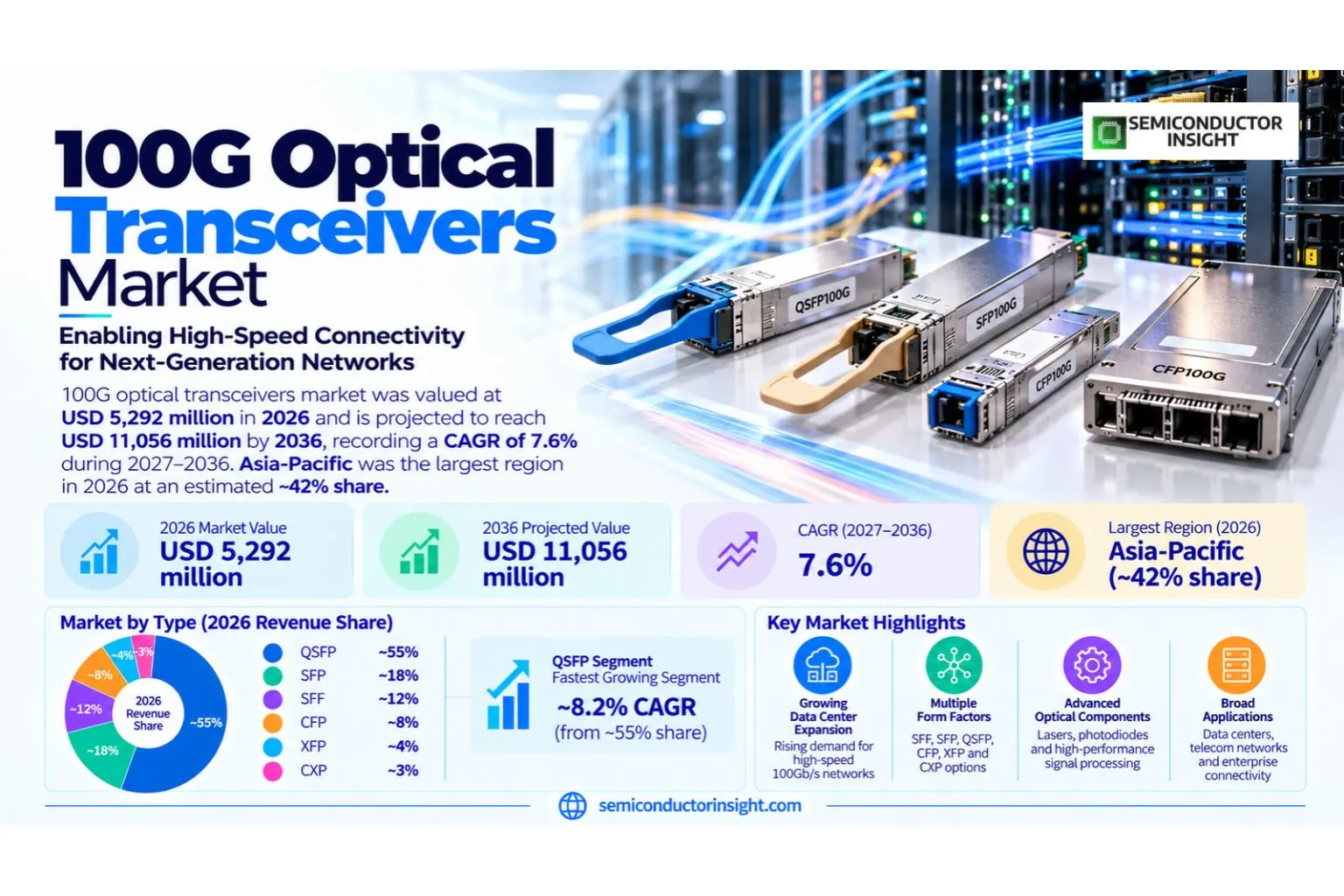
- Market trajectory: The global 100g optical transceivers market reached USD 5,292 million in 2026 and is projected to reach USD 11,056 million by 2036 at 7.6% CAGR over 2027–2036. Demand follows the actual sale of 100Gb/s optical transmit and receive assemblies using lasers, photodiodes, clock recovery, multiplexed lanes and removable or packaged optical-electrical interfaces in a variety of MSA form factors, rather than the full revenue of adjacent digital infrastructure.
- QSFP leadership: QSFP has the largest estimated type share at ~55% in 2026. The fastest-growing type is QSFP, at ~8.2% CAGR from an estimated ~55% share. QSFP28 is the dominant physical host module for 100GbE in many installed switch generations, combining four 25Gb/s electrical lanes with single-mode or multimode optical configurations. It provides a mature density and price position while customers increasingly adopt QSFP-DD at higher speeds.
- Internal Data Center demand: Internal Data Center leads application revenue at an estimated ~46% in 2026, while Internal Data Center grows most rapidly near ~8.0% CAGR. Data center server and spine-leaf networks retain large installed populations of QSFP28 100G links, particularly in older switches and lower-tier network domains. Forward purchasing increasingly favors 400G and 800G, creating price compression and replacement-oriented 100G demand.
- Asia-Pacific position: Asia-Pacific represents the largest regional revenue pool at an estimated ~42% in 2026. Asia-Pacific has the highest regional modeled growth at ~8.0% CAGR. China hosts large manufacturing and assembly ecosystems for QSFP28 optical modules; Japan and South Korea add operator network refurbishment and high-density cloud links. India is expanding long-haul and metro networks; Ciena and Constl demonstrated a 1.6 Tb/s channel in September 2026, reflecting technology transition rather than current 100G-only module sales.
- Principal constraint: Cannibalization by 400G and 800G ports is a fundamental restraint. Purchase decisions are also affected by older pluggable format incompatibilities. Commercial investment in optical market equipment supply balances the affordability of mature 100G modules against the growing availability of higher-rate network ports. For adoption barriers in 2027, the purchase decision depends on explicit equipment compatibility, verifiable component performance and whether the supplier can sustain replacement support throughout the planned service interval.
100G Optical Transceivers Market Overview
100g optical transceivers market was valued at USD 5,292 million in 2026 and is projected to reach USD 11,056 million by 2036, recording a CAGR of 7.6% during 2027–2036. Asia-Pacific was the largest region in 2026 at an estimated ~42% share. The market centers on 100Gb/s optical transmit and receive assemblies using lasers, photodiodes, clock recovery, multiplexed lanes and removable or packaged optical-electrical interfaces in a variety of MSA form factors.
A 100G optical transceiver converts electrical data into modulated light and then reconstructs an electrical signal at the receiving end. QSFP28 modules commonly combine four electrical lanes at 25Gb/s, while CFP-class formats accommodate earlier high-power or longer-reach configurations. Product names such as SFP and XFP persist in the original classification but usually refer to lower-speed interfaces; not every device carrying such a label is compatible with a 100GbE optical port.
The defined commercial boundary includes merchant 100-gigabit optical transceiver modules and equivalent optical port modules sold in SFF, SFP, QSFP, CFP, XFP and CXP form factors; excludes switch and router chassis, fibre-cable construction, separately invoiced optical chips and 400G-or-higher transceivers even when made by the same suppliers. Purchases involving integrated product architecture depend on installed switching capacity and fault-replacement schedules rather than headline optical fiber traffic alone. In integrated product architecture, operators preserve compatible 100G spare inventories while moving demanding network connections to 400G or faster optical formats.
The 100G category is mature in the technical sense: established standards define host lane rates, optical reach, power budgets and pluggable mechanical interfaces. QSFP28 100G modules cover common short-reach multimode and longer single-mode links, while coherent 100G implementations add optical signal-processing complexity. Product roadmaps from Ethernet Alliance and Coherent now emphasize 400G, 800G and 1.6T. That progress both broadens adjacent networking investment and constrains the long-term pricing power of standalone 100G modules.
Network operators install optical modules as they upgrade switch ports, increase backbone capacity or refresh failing transceivers. ITU estimated fixed broadband traffic of 7.3 zettabytes in 2025, providing infrastructure context rather than a direct 100G unit count. Cloud networks increasingly introduce faster optics while some enterprise and telecom locations retain 100G links for years. Demand can consequently grow in qualified replacement volume even when average prices decline and higher-speed products capture new-build spending.
Technology priorities are evolving toward more reliable and serviceable optical architectures. Suppliers serving integrated product architecture must document interface standards and optical performance while managing price pressure from mature module supply. The technical purchase decision for integrated product architecture includes package type, host connectors and confirmed support for the intended link distance. Maintenance demand in integrated product architecture supports established 100GbE modules even as newer AI data-center builds favor faster connections.
Segment Analysis: By Type
By type, the 100g optical transceivers market comprises SFF, SFP, QSFP, CFP, XFP, CXP. QSFP leads with an estimated ~55% revenue share in 2026; QSFP expands most rapidly at about ~8.2% CAGR from a ~55% share. Equipment qualification for Product Type supply tests receiver sensitivity, signal integrity and thermal behavior under the operating conditions of each host. In the type overview setting, an engineering advantage becomes a sale only after procurement teams review validation evidence, inventory risk, maintenance requirements and the operating economics of the intended deployment.
| Type | Function | Market position |
|---|---|---|
| SFF | Small form-factor legacy optical modules provide compact interface footprints but are not usually the main 100G deployment format; historical labeling can mix lower data rates, so qualified 100G variants must be confirmed at the product specification level. Suppliers serving SFF products must document interface standards and optical performance while managing price pressure from mature module supply. Suppliers therefore need to establish how the SFF variant affects installation requirements and ongoing service. | Estimated ~8% of 2026 revenue and ~7.0% CAGR. SFF is a distinct product category, with demand linked to the particular requirements of its buyers. Purchases involving SFF products depend on installed switching capacity and fault-replacement schedules rather than headline optical fiber traffic alone. Procurement teams evaluate component availability, unit cost and the necessary test records. |
| SFP | Single-lane SFP-class modules are valuable in mature networking but many SFP and SFP+ parts do not physically support aggregate 100G operation. The revenue model retains this source segmentation name while avoiding any assumption that every SFP optical device is a 100G transceiver. In SFP products, operators preserve compatible 100G spare inventories while moving demanding network connections to 400G or faster optical formats. Suppliers therefore need to establish how the SFP variant affects installation requirements and ongoing service. | Estimated ~12% of 2026 revenue and ~7.5% CAGR. SFP is a distinct product category, with demand linked to the particular requirements of its buyers. The technical purchase decision for SFP products includes package type, host connectors and confirmed support for the intended link distance. Network upgrades across SFP products generate both replacement 100G sockets and newer optical requirements, producing different supplier incentives. Procurement teams evaluate component availability, unit cost and the necessary test records. |
| QSFP | Maintenance demand in QSFP products supports established 100GbE modules even as newer AI data-center builds favor faster connections. Qualified 100G demand in QSFP products depends on transceiver interoperability, optical link budgets and repeat orders for existing network equipment. For QSFP products, network owners evaluate port compatibility, fiber reach and module power before replacing established pluggable optics. Suppliers therefore need to establish how the QSFP variant affects installation requirements and ongoing service. | Estimated ~55% of 2026 revenue and ~8.2% CAGR. QSFP is the largest type by value, with demand linked to the particular requirements of its buyers. Equipment qualification for QSFP products tests receiver sensitivity, signal integrity and thermal behavior under the operating conditions of each host. Purchases involving QSFP products depend on installed switching capacity and fault-replacement schedules rather than headline optical fiber traffic alone. Procurement teams evaluate component availability, unit cost and the necessary test records. |
| CFP | CFP modules have larger footprints suited to early 100G optical transport and some longer-reach coherent network applications. They accommodate complex optoelectronics but lose rack-density advantages against compact QSFP generations; replacement demand remains relevant in installed network gear. In CFP products, operators preserve compatible 100G spare inventories while moving demanding network connections to 400G or faster optical formats. Suppliers therefore need to establish how the CFP variant affects installation requirements and ongoing service. | Estimated ~15% of 2026 revenue and ~7.2% CAGR. CFP is a distinct product category, with demand linked to the particular requirements of its buyers. The technical purchase decision for CFP products includes package type, host connectors and confirmed support for the intended link distance. Network upgrades across CFP products generate both replacement 100G sockets and newer optical requirements, producing different supplier incentives. Procurement teams evaluate component availability, unit cost and the necessary test records. |
| XFP | XFP was established for 10Gb/s optics and normally cannot provide a standalone 100G transceiver. This retained legacy source category should be interpreted cautiously as historical portfolio classification, not proof of a qualified 100G XFP standard product. Maintenance demand in XFP products supports established 100GbE modules even as newer AI data-center builds favor faster connections. Suppliers therefore need to establish how the XFP variant affects installation requirements and ongoing service. | Estimated ~5% of 2026 revenue and ~6.0% CAGR. XFP is a distinct product category, with demand linked to the particular requirements of its buyers. For XFP products, network owners evaluate port compatibility, fiber reach and module power before replacing established pluggable optics. Commercial investment in XFP products balances the affordability of mature 100G modules against the growing availability of higher-rate network ports. Procurement teams evaluate component availability, unit cost and the necessary test records. |
| CXP | CXP can aggregate multiple lanes for short-reach parallel optical interconnects, with historical high-density data center use. It has a specialized role compared with QSFP28 and later QSFP-DD interfaces, and future sales depend heavily on replacements for specific installed systems. Equipment qualification for CXP products tests receiver sensitivity, signal integrity and thermal behavior under the operating conditions of each host. Suppliers therefore need to establish how the CXP variant affects installation requirements and ongoing service. | Estimated ~5% of 2026 revenue and ~6.1% CAGR. CXP is a distinct product category, with demand linked to the particular requirements of its buyers. In CXP products, operators preserve compatible 100G spare inventories while moving demanding network connections to 400G or faster optical formats. Suppliers serving CXP products must document interface standards and optical performance while managing price pressure from mature module supply. Procurement teams evaluate component availability, unit cost and the necessary test records. |
Segment Analysis: By Application
Application segments are Metropolitan Area, Remotely, Internal Data Center. Internal Data Center takes the largest estimated 2026 revenue share at ~46%, whereas Internal Data Center is the fastest-growing application at ~8.0% CAGR. Suppliers serving Application supply must document interface standards and optical performance while managing price pressure from mature module supply. This matters for application overview, because the technically feasible option must also be installable, serviceable and properly documented across the operating life of the equipment and its supporting software.
| Application | Demand characteristics |
|---|---|
| Metropolitan Area | Estimated ~38% of 2026 revenue and ~7.7% CAGR. Telecom metro aggregation and city-to-city interconnects procure 100G optical modules on the basis of reach, wavelength plan, amplification and compatibility with existing transport equipment. Ciena demonstrated coherent platforms at Futurecom 2026, highlighting upgrades that coexist with installed 100G ports. Maintenance demand in Metropolitan Area applications supports established 100GbE modules even as newer AI data-center builds favor faster connections. |
| Remotely | Estimated ~16% of 2026 revenue and ~7.0% CAGR. Longer-distance or remote connections require explicit link-budget engineering, dispersion control and optical transport compatibility. The source label Remotely is retained even though technical specifications typically describe reaches and modulation formats rather than a formal industry application category. Equipment qualification for Remotely applications tests receiver sensitivity, signal integrity and thermal behavior under the operating conditions of each host. |
| Internal Data Center | Estimated ~46% of 2026 revenue and ~8.0% CAGR. Legacy data-center fabric upgrades sustain 100G QSFP28 replacement purchases where the installed leaf switches still lack cost-effective higher-speed optical ports. In Internal Data Center applications, operators preserve compatible 100G spare inventories while moving demanding network connections to 400G or faster optical formats. Suppliers serving Internal Data Center applications must document interface standards and optical performance while managing price pressure from mature module supply. |
The commercial channel is shaped by hyperscale data centers, network switch manufacturers, metropolitan fibre operators, service-provider aggregation equipment manufacturers and campus networking integrators. Direct equipment purchase, specialist distributor supply and OEM qualification have different order economics. For Application supply, network owners evaluate port compatibility, fiber reach and module power before replacing established pluggable optics.
Regional Analysis
Asia-Pacific leads global revenue with an estimated ~42% share in 2026. North America follows at ~28% and Europe at ~20%. Asia-Pacific has the fastest growth at ~8.0% CAGR. Regional purchases and supplier manufacturing footprints must be distinguished for market comparisons. The technical purchase decision for Regional Analysis supply includes package type, host connectors and confirmed support for the intended link distance.
How do regional purchasing patterns differ in 100g optical transceivers?
Asia-Pacific: China hosts large manufacturing and assembly ecosystems for QSFP28 optical modules; Japan and South Korea add operator network refurbishment and high-density cloud links. Purchases involving Regional Analysis supply depend on installed switching capacity and fault-replacement schedules rather than headline optical fiber traffic alone. North America: US cloud and enterprise networks retain substantial installed 100G QSFP28 populations alongside upgrades toward 400G, 800G and 1.6T. Network replacements are driven by switch port compatibility, low error rates and transceiver power limits. 100G benefits as an inexpensive aggregation and server-uplink format even as AI-scale clusters adopt faster ports. For Regional Analysis supply, network owners evaluate port compatibility, fiber reach and module power before replacing established pluggable optics.
| Region | Position | Growth outlook | Demand profile | What decides supplier selection |
|---|---|---|---|---|
| Asia-Pacific | Largest (~42%) | ~8.0% CAGR | The technical purchase decision for Asia-Pacific purchasing includes package type, host connectors and confirmed support for the intended link distance. Network upgrades across Asia-Pacific purchasing generate both replacement 100G sockets and newer optical requirements, producing different supplier incentives. Purchases involving Asia-Pacific purchasing depend on installed switching capacity and fault-replacement schedules rather than headline optical fiber traffic alone. | Suppliers serving Asia-Pacific purchasing must document interface standards and optical performance while managing price pressure from mature module supply. For 100Gb/s optical transmit and receive assemblies using lasers, photodiodes, clock recovery, multiplexed lanes and removable or packaged optical-electrical interfaces in a variety of MSA form factors, interface stability and the availability of replacement products can determine whether a promising order proceeds beyond initial evaluation. |
| North America | Second (~28%) | ~7.5% CAGR | US cloud and enterprise networks retain substantial installed 100G QSFP28 populations alongside upgrades toward 400G, 800G and 1.6T. Qualified 100G demand in North America purchasing depends on transceiver interoperability, optical link budgets and repeat orders for existing network equipment. The technical purchase decision for North America purchasing includes package type, host connectors and confirmed support for the intended link distance. | Maintenance demand in North America purchasing supports established 100GbE modules even as newer AI data-center builds favor faster connections. Commercial investment in North America purchasing balances the affordability of mature 100G modules against the growing availability of higher-rate network ports. Buyers verify network host interface, optical reach and power draw before a 100G transceiver enters a replacement or upgrade order. For North America purchasing, network owners evaluate port compatibility, fiber reach and module power before replacing established pluggable optics. |
| Europe | Third (~20%) | ~7.4% CAGR | European telecommunications providers operate mixed 100G coherent metro, enterprise and data-center transport networks. ITU-T G.698.2 requirements and OIF interoperability demonstrations provide engineering context. Germany and the United Kingdom prioritize energy per transported bit, vendor compatibility and long operational lifetimes for fibre links. For Europe purchasing, network owners evaluate port compatibility, fiber reach and module power before replacing established pluggable optics. | Equipment qualification for Europe purchasing tests receiver sensitivity, signal integrity and thermal behavior under the operating conditions of each host. Purchases involving Europe purchasing depend on installed switching capacity and fault-replacement schedules rather than headline optical fiber traffic alone. In Europe purchasing, operators preserve compatible 100G spare inventories while moving demanding network connections to 400G or faster optical formats. Suppliers serving Europe purchasing must document interface standards and optical performance while managing price pressure from mature module supply. |
| South America | Fourth (~6%) | ~7.1% CAGR | Brazilian cloud facilities and carrier transport upgrades are important market opportunities for 100G optical modules. Ciena announced multiple coherent portfolio demonstrations for São Paulo Futurecom 2026. Chilean data-center and intercity links create specialized demand, but procurement is sensitive to tariffs, equipment qualification and local replacement inventories. Suppliers serving South America purchasing must document interface standards and optical performance while managing price pressure from mature module supply. | Network upgrades across South America purchasing generate both replacement 100G sockets and newer optical requirements, producing different supplier incentives. Maintenance demand in South America purchasing supports established 100GbE modules even as newer AI data-center builds favor faster connections. Qualified 100G demand in South America purchasing depends on transceiver interoperability, optical link budgets and repeat orders for existing network equipment. For South America purchasing, network owners evaluate port compatibility, fiber reach and module power before replacing established pluggable optics. |
| Middle East & Africa | Fifth (~4%) | ~6.9% CAGR | Gulf investment in cloud exchanges and carrier optical transport raises demand for tested 100G and higher-rate pluggables. South African regional networks value stable intercity capacity and repairable spare modules. Upgrades are staggered because metro-network routing, interconnection and equipment service contracts differ widely by national operator. Commercial investment in Middle East & Africa purchasing balances the affordability of mature 100G modules against the growing availability of higher-rate network ports. | Purchases involving Middle East & Africa purchasing depend on installed switching capacity and fault-replacement schedules rather than headline optical fiber traffic alone. Network upgrades across Middle East & Africa purchasing generate both replacement 100G sockets and newer optical requirements, producing different supplier incentives. In Middle East & Africa purchasing, operators preserve compatible 100G spare inventories while moving demanding network connections to 400G or faster optical formats. Suppliers serving Middle East & Africa purchasing must document interface standards and optical performance while managing price pressure from mature module supply. |
Competitive Landscape
Competition is led by firms with relevant 100Gb/s optical transmit and receive assemblies using lasers, photodiodes, clock recovery, multiplexed lanes and removable or packaged optical-electrical interfaces in a variety of MSA form factors. Commercial investment in Competitive Landscape supply balances the affordability of mature 100G modules against the growing availability of higher-rate network ports. Equipment qualification for Competitive Landscape supply tests receiver sensitivity, signal integrity and thermal behavior under the operating conditions of each host.
Finisar Corporation and Lumentum Holdings Inc illustrate different capabilities within the sector. Their product portfolios, production locations and support arrangements cannot be assumed identical. The technical purchase decision for Competitive Landscape supply includes package type, host connectors and confirmed support for the intended link distance. Network upgrades across Competitive Landscape supply generate both replacement 100G sockets and newer optical requirements, producing different supplier incentives.
Broadcom appear in the wider manufacturer and distributor field. Qualified 100G demand in Competitive Landscape supply depends on transceiver interoperability, optical link budgets and repeat orders for existing network equipment. For Competitive Landscape supply, network owners evaluate port compatibility, fiber reach and module power before replacing established pluggable optics. For supplier roles in 2032, the purchase decision depends on explicit equipment compatibility, verifiable component performance and whether the supplier can sustain replacement support throughout the planned service interval.
Other suppliers and historical business names include . Purchases involving Competitive Landscape supply depend on installed switching capacity and fault-replacement schedules rather than headline optical fiber traffic alone. In Competitive Landscape supply, operators preserve compatible 100G spare inventories while moving demanding network connections to 400G or faster optical formats. In the historical company list setting, an engineering advantage becomes a sale only after procurement teams review validation evidence, inventory risk, maintenance requirements and the operating economics of the intended deployment.
Suppliers serving Competitive Landscape supply must document interface standards and optical performance while managing price pressure from mature module supply. Maintenance demand in Competitive Landscape supply supports established 100GbE modules even as newer AI data-center builds favor faster connections. Qualified 100G demand in Competitive Landscape supply depends on transceiver interoperability, optical link budgets and repeat orders for existing network equipment as part of qualified 2026 procurement pathway 83. This matters for competitive economics, because the technically feasible option must also be installable, serviceable and properly documented across the operating life of the equipment and its supporting software.
Tier structure
| Tier | Companies | Basis of competition |
|---|---|---|
| Tier 1 | Finisar Corporation; Lumentum Holdings Inc; Broadcom | Network upgrades across Tier 1 supplier qualification generate both replacement 100G sockets and newer optical requirements, producing different supplier incentives. The first technical gate is the ability to supply 100Gb/s optical transmit and receive assemblies using lasers, photodiodes, clock recovery, multiplexed lanes and removable or packaged optical-electrical interfaces in a variety of MSA form factors in a documented, reproducible format, followed by customer qualification and reliable lead times. |
| Tier 2 | Qualified 100G demand in Tier 2 supplier qualification depends on transceiver interoperability, optical link budgets and repeat orders for existing network equipment. For Tier 2 supplier qualification, network owners evaluate port compatibility, fiber reach and module power before replacing established pluggable optics. Commercial investment in Tier 2 supplier qualification balances the affordability of mature 100G modules against the growing availability of higher-rate network ports. A commercial evaluation of tier 2 therefore compares the cost of qualified materials, process yield, lead times, quality assurance and post-installation support rather than product specifications alone. | |
| Tier 3 | Purchases involving Tier 3 supplier qualification depend on installed switching capacity and fault-replacement schedules rather than headline optical fiber traffic alone. In Tier 3 supplier qualification, operators preserve compatible 100G spare inventories while moving demanding network connections to 400G or faster optical formats. Product applicability is determined by specific device families, production status and customer approvals. The 2027–2036 opportunity in tier 3 is linked to deployment timing and customer acceptance, with supplier selection reflecting reliability, supply continuity, interface requirements and actual unit economics. |
Key companies profiled
- Finisar Corporation
- Lumentum Holdings Inc
- Broadcom
Production Capacity Analysis
Production capacity relies on specialized manufacturing and testing for 100Gb/s optical transmit and receive assemblies using lasers, photodiodes, clock recovery, multiplexed lanes and removable or packaged optical-electrical interfaces in a variety of MSA form factors. In Production Capacity supply, operators preserve compatible 100G spare inventories while moving demanding network connections to 400G or faster optical formats. Suppliers serving Production Capacity supply must document interface standards and optical performance while managing price pressure from mature module supply.
Initial manufacturing operations include 100Gb/s optical transmit and receive assemblies using lasers, photodiodes, clock recovery, multiplexed lanes and removable or packaged optical-electrical interfaces in a variety of MSA form factors. Qualified 100G demand in Production Capacity supply depends on transceiver interoperability, optical link budgets and repeat orders for existing network equipment. For Production Capacity supply, network owners evaluate port compatibility, fiber reach and module power before replacing established pluggable optics.
Diversified capacity can reduce country-of-origin exposure and help supply different qualification requirements. Equipment qualification for Production Capacity supply tests receiver sensitivity, signal integrity and thermal behavior under the operating conditions of each host. Purchases involving Production Capacity supply depend on installed switching capacity and fault-replacement schedules rather than headline optical fiber traffic alone. For capacity diversification in 2027, the purchase decision depends on explicit equipment compatibility, verifiable component performance and whether the supplier can sustain replacement support throughout the planned service interval.
Upstream constraints include materials, specialized assembly equipment and trained optical manufacturing staff. For 100g optical transceivers, packaging, testing and maintenance infrastructure shape the ability to convert a technical design into reproducible revenue. The technical purchase decision for Production Capacity supply includes package type, host connectors and confirmed support for the intended link distance. In the capacity bottlenecks setting, an engineering advantage becomes a sale only after procurement teams review validation evidence, inventory risk, maintenance requirements and the operating economics of the intended deployment.
Market Dynamics
Demand is driven by installed 100g switch port replacement and metro transport capacity upgrades. Suppliers serving commercial opportunities must document interface standards and optical performance while managing price pressure from mature module supply. Supplier economics also reflect the negative impact of cannibalization by 400g and 800g ports, particularly when customers require long operational support. This matters for dynamics lead, because the technically feasible option must also be installable, serviceable and properly documented across the operating life of the equipment and its supporting software.
MARKET DRIVERS
Drivers Impact Analysis*
| Driver | (~) % impact on CAGR forecast | Geographic relevance | Impact timeline |
|---|---|---|---|
| Installed 100G switch port replacement | +1.8% | Asia-Pacific | 2027–2036 |
| Metro transport capacity upgrades | +1.4% | Global | 2028–2034 |
| Lower cost per 100G optical link | +1.1% | North America | 2027–2031 |
| 5G transport and fiber backhaul requirements | +0.9% | Europe | 2029–2036 |
| Cloud-network connection density | +0.7% | Global | 2028–2035 |
Installed 100G switch port replacement
Installed 100G switch port replacement supports specialized purchases for 100g optical transceivers. 100Gb/s optical transmit and receive assemblies using lasers, photodiodes, clock recovery, multiplexed lanes and removable or packaged optical-electrical interfaces in a variety of MSA form factors must be integrated into customer processes, inspected and supported. The growth effect is directional, not a separate addition to the headline CAGR. The technical purchase decision for driving factors includes package type, host connectors and confirmed support for the intended link distance.
Metro transport capacity upgrades
Metro transport capacity upgrades supports specialized purchases for 100g optical transceivers. 100Gb/s optical transmit and receive assemblies using lasers, photodiodes, clock recovery, multiplexed lanes and removable or packaged optical-electrical interfaces in a variety of MSA form factors must be integrated into customer processes, inspected and supported. The growth effect is directional, not a separate addition to the headline CAGR. Maintenance demand in driving factors supports established 100GbE modules even as newer AI data-center builds favor faster connections.
Lower cost per 100G optical link
Lower cost per 100G optical link supports specialized purchases for 100g optical transceivers. 100Gb/s optical transmit and receive assemblies using lasers, photodiodes, clock recovery, multiplexed lanes and removable or packaged optical-electrical interfaces in a variety of MSA form factors must be integrated into customer processes, inspected and supported. The growth effect is directional, not a separate addition to the headline CAGR. For driving factors, network owners evaluate port compatibility, fiber reach and module power before replacing established pluggable optics.
5G transport and fiber backhaul requirements
5G transport and fiber backhaul requirements supports specialized purchases for 100g optical transceivers. 100Gb/s optical transmit and receive assemblies using lasers, photodiodes, clock recovery, multiplexed lanes and removable or packaged optical-electrical interfaces in a variety of MSA form factors must be integrated into customer processes, inspected and supported. The growth effect is directional, not a separate addition to the headline CAGR. Equipment qualification for driving factors tests receiver sensitivity, signal integrity and thermal behavior under the operating conditions of each host.
MARKET RESTRAINTS
Restraints Impact Analysis*
| Restraint | (~) % impact on CAGR forecast | Geographic relevance | Impact timeline |
|---|---|---|---|
| Cannibalization by 400G and 800G ports | −1.5% | Global | 2027–2036 |
| Older pluggable format incompatibilities | −1.1% | Europe and North America | 2027–2034 |
| Module power and thermal constraints | −0.8% | Asia-Pacific | 2028–2035 |
| Declining average selling prices | −0.6% | Global | 2029–2036 |
Cannibalization by 400G and 800G ports
Cannibalization by 400G and 800G ports increases the effort required to qualify or replace 100g optical transceivers. The technical purchase decision for restraints includes package type, host connectors and confirmed support for the intended link distance. Network upgrades across restraints generate both replacement 100G sockets and newer optical requirements, producing different supplier incentives. A commercial evaluation of Cannibalization by 400G and 800G ports restraint therefore compares the cost of qualified materials, process yield, lead times, quality assurance and post-installation support rather than product specifications alone.
Older pluggable format incompatibilities
Older pluggable format incompatibilities increases the effort required to qualify or replace 100g optical transceivers. Suppliers serving restraints must document interface standards and optical performance while managing price pressure from mature module supply. Qualified 100G demand in restraints depends on transceiver interoperability, optical link budgets and repeat orders for existing network equipment. The 2027–2036 opportunity in Older pluggable format incompatibilities restraint is linked to deployment timing and customer acceptance, with supplier selection reflecting reliability, supply continuity, interface requirements and actual unit economics.
Module power and thermal constraints
Module power and thermal constraints increases the effort required to qualify or replace 100g optical transceivers. Maintenance demand in restraints supports established 100GbE modules even as newer AI data-center builds favor faster connections. Commercial investment in restraints balances the affordability of mature 100G modules against the growing availability of higher-rate network ports. For Module power and thermal constraints restraint in 2032, the purchase decision depends on explicit equipment compatibility, verifiable component performance and whether the supplier can sustain replacement support throughout the planned service interval.
Declining average selling prices
Declining average selling prices increases the effort required to qualify or replace 100g optical transceivers. Purchases involving restraints depend on installed switching capacity and fault-replacement schedules rather than headline optical fiber traffic alone. Equipment qualification for restraints tests receiver sensitivity, signal integrity and thermal behavior under the operating conditions of each host. In the Declining average selling prices restraint setting, an engineering advantage becomes a sale only after procurement teams review validation evidence, inventory risk, maintenance requirements and the operating economics of the intended deployment.
MARKET OPPORTUNITIES
Cost-effective 100G enterprise aggregation
Cost-effective 100G enterprise aggregation creates an opportunity to improve deployment or the supplier value proposition. The relevant engineering work concerns 100Gb/s optical transmit and receive assemblies using lasers, photodiodes, clock recovery, multiplexed lanes and removable or packaged optical-electrical interfaces in a variety of MSA form factors. Maintenance demand in commercial opportunities supports established 100GbE modules even as newer AI data-center builds favor faster connections. Qualified 100G demand in commercial opportunities depends on transceiver interoperability, optical link budgets and repeat orders for existing network equipment.
100ZR metro-coherent interworking
100ZR metro-coherent interworking creates an opportunity to improve deployment or the supplier value proposition. Commercial investment in commercial opportunities balances the affordability of mature 100G modules against the growing availability of higher-rate network ports. Equipment qualification for commercial opportunities tests receiver sensitivity, signal integrity and thermal behavior under the operating conditions of each host. For commercial opportunities, network owners evaluate port compatibility, fiber reach and module power before replacing established pluggable optics.
Extended life for installed QSFP28 networks
Extended life for installed QSFP28 networks creates an opportunity to improve deployment or the supplier value proposition. In commercial opportunities, operators preserve compatible 100G spare inventories while moving demanding network connections to 400G or faster optical formats. Purchases involving commercial opportunities depend on installed switching capacity and fault-replacement schedules rather than headline optical fiber traffic alone. The technical purchase decision for commercial opportunities includes package type, host connectors and confirmed support for the intended link distance.
Secondary sourcing for legacy 100G switches
Secondary sourcing for legacy 100G switches creates an opportunity to improve deployment or the supplier value proposition. Network upgrades across commercial opportunities generate both replacement 100G sockets and newer optical requirements, producing different supplier incentives. For commercial opportunities, network owners evaluate port compatibility, fiber reach and module power before replacing established pluggable optics as part of qualified 2026 procurement pathway 114. Qualified 100G demand in commercial opportunities depends on transceiver interoperability, optical link budgets and repeat orders for existing network equipment in the 2027–2036 equipment planning horizon.
Supply Chain Analysis
The supply chain links specialized raw materials, device fabrication, verification, system integration and servicing for 100g optical transceivers. A failure at any stage can invalidate the qualified end product. Network upgrades across Supply Chain supply generate both replacement 100G sockets and newer optical requirements, producing different supplier incentives. Inventory planning must reflect installed QSFP28 host-platform lifetimes and transceiver power limits.
Upstream materials. Suppliers serving Supply Chain supply must document interface standards and optical performance while managing price pressure from mature module supply. For 100g optical transceivers, controlling change across this stage enables traceability, reliability and repeatable delivery. For Supply Chain supply, network owners evaluate port compatibility, fiber reach and module power before replacing established pluggable optics.
Manufacturing. Fabrication, alignment, sealing or recording operations matched to the market boundary. Commercial investment in Supply Chain supply balances the affordability of mature 100G modules against the growing availability of higher-rate network ports. Equipment qualification for Supply Chain supply tests receiver sensitivity, signal integrity and thermal behavior under the operating conditions of each host. The 2027–2036 opportunity in Manufacturing chain is linked to deployment timing and customer acceptance, with supplier selection reflecting reliability, supply continuity, interface requirements and actual unit economics.
Channels. OEM engineering contracts, technical distributors and integrated storage or optical equipment vendors. Purchases involving Supply Chain supply depend on installed switching capacity and fault-replacement schedules rather than headline optical fiber traffic alone. In Supply Chain supply, operators preserve compatible 100G spare inventories while moving demanding network connections to 400G or faster optical formats. For Channels chain in 2032, the purchase decision depends on explicit equipment compatibility, verifiable component performance and whether the supplier can sustain replacement support throughout the planned service interval.
Downstream users. The technical purchase decision for Supply Chain supply includes package type, host connectors and confirmed support for the intended link distance. Qualified 100G demand in Supply Chain supply depends on transceiver interoperability, optical link budgets and repeat orders for existing network equipment as part of qualified 2026 procurement pathway 124. For Supply Chain supply, network owners evaluate port compatibility, fiber reach and module power before replacing established pluggable optics as part of qualified 2026 procurement pathway 125.
Recent Developments
- 30 September 2026 Announced
Ciena outlined optical and coherent routing innovations for Futurecom 2026 in Brazil, including 100G-to-800G metro and data-center connectivity options. This shows why deployed 100G module demand should be separated from the faster coherent optical systems that increasingly replace legacy interface generations. Migration economics depend on equipment availability and operator qualification. In the 100G Optical Transceivers development 30 September 2026 setting, an engineering advantage becomes a sale only after procurement teams review validation evidence, inventory risk, maintenance requirements and the operating economics of the intended deployment. Source - 29 September 2026 Announced
Constl and Ciena disclosed a live 1.6Tb/s long-haul optical channel in India using WaveLogic 6 Extreme. That milestone illustrates the capacity pressure on optical aggregation and transport networks but does not create sales of 100G optical modules directly. Existing 100G tributaries can be retained while high-capacity wavelength links modernize. This matters for 100G Optical Transceivers development 29 September 2026, because the technically feasible option must also be installable, serviceable and properly documented across the operating life of the equipment and its supporting software. Source - 17 March 2026 Announced
Coherent demonstrated AI-scale optical architectures spanning 400G-per-lane technologies, co-packaged optics and next-generation pluggables at OFC. The development creates competitive pressure on standardized 100G QSFP28 ports, while maintaining opportunities for mature 100G replacements in installed cloud, enterprise and telecom equipment. A commercial evaluation of 100G Optical Transceivers development 17 March 2026 therefore compares the cost of qualified materials, process yield, lead times, quality assurance and post-installation support rather than product specifications alone. Source - 10 March 2026 Announced
Ciena presented 1.6T coherent transmission and scalable optical-networking demonstrations at OFC 2026. High-capacity transport requires interoperability with older access equipment, including 100G interfaces. The commercial implication is a coexistence market where module replacement cycles depend on switch port generations, rather than headline intercity traffic alone. The 2027–2036 opportunity in 100G Optical Transceivers development 10 March 2026 is linked to deployment timing and customer acceptance, with supplier selection reflecting reliability, supply continuity, interface requirements and actual unit economics. Source - 9 December 2025 Published
The Ethernet Alliance released its 2026 Ethernet Roadmap, describing 100G–800G upgrades and emerging 1.6Tb/s links. It confirms that 100G remains an established interface generation in a rapidly evolving standards ecosystem. Suppliers must maintain mature optical compatibility as buyers adopt higher-speed transceivers in new switch platforms. For 100G Optical Transceivers development 9 December 2025 in 2027, the purchase decision depends on explicit equipment compatibility, verifiable component performance and whether the supplier can sustain replacement support throughout the planned service interval. Source - 25 September 2025 Announced
Adtran participated in OIF multivendor demonstrations covering 100ZR+ and 400ZRE optical interoperability at ECOC 2025. This activity strengthens the technical context for metro networks that use both 100G optical interfaces and higher-rate coherent transport. Successful interoperability testing can lower qualification friction but is not a direct measure of finished module shipments. In the 100G Optical Transceivers development 25 September 2025 setting, an engineering advantage becomes a sale only after procurement teams review validation evidence, inventory risk, maintenance requirements and the operating economics of the intended deployment. Source - 26 March 2025 Announced
Adtran showcased transport technology supporting OIF 100G to 800G ZR interoperability at OFC 2025. The multi-rate demonstration emphasizes the need for operators to preserve interfaces across installed routers, optical line systems and new coherent pluggables as port speeds advance. Device prices and equipment replacement schedules determine market conversion. This matters for 100G Optical Transceivers development 26 March 2025, because the technically feasible option must also be installable, serviceable and properly documented across the operating life of the equipment and its supporting software. Source
REPORT SCOPE & SEGMENTATION
| Attribute | Details |
|---|---|
| Study Period | 2021–2036 |
| Base Year | 2026 |
| Estimated Year | 2027 |
| Forecast Period | 2027–2036 |
| Historical Period | 2021–2025 |
| Base Year Market Size | USD 5,292 million |
| Estimated Year Market Size | USD 5,697 million |
| Forecast Year Market Size | USD 11,056 million |
| CAGR | 7.6% |
| Unit | USD million |
| Market Definition | merchant 100-gigabit optical transceiver modules and equivalent optical port modules sold in SFF, SFP, QSFP, CFP, XFP and CXP form factors; excludes switch and router chassis, fibre-cable construction, separately invoiced optical chips and 400G-or-higher transceivers even when made by the same suppliers |
| By Type | SFF · SFP · QSFP · CFP · XFP · CXP |
| By Application | Metropolitan Area · Remotely · Internal Data Center |
| By Region | Five region market segmentation is based on where the final specialized optical equipment is sold, not the location of raw-material fabrication. Asia-PacificChina · Japan · India · South Korea North AmericaUnited States · Canada · Mexico EuropeGermany · United Kingdom · France South AmericaBrazil · Chile · Argentina Middle East & AfricaSaudi Arabia · United Arab Emirates · South Africa |
| Key Companies Profiled | Finisar Corporation; Lumentum Holdings Inc; Broadcom |
| Customization Scope | Supplier, type, application and regional price analysis for 100g optical transceivers; estimated market shares in 2026 and differentiated growth paths for 2027–2036. |
Frequently Asked Questions
What is the global 100g optical transceivers market size?
The global 100g optical transceivers market is valued at USD 5,292 million in 2026 and is forecast to reach USD 11,056 million by 2036, with 7.6% CAGR during 2027–2036. In regional and product comparisons, operators preserve compatible 100G spare inventories while moving demanding network connections to 400G or faster optical formats.
Which geographic region is the largest market?
Asia-Pacific is the leading 2026 regional market with an estimated ~42% of revenue. North America and Europe follow at ~28% and ~20%, respectively. The technical purchase decision for regional and product comparisons includes package type, host connectors and confirmed support for the intended link distance. A commercial evaluation of FAQ 2 therefore compares the cost of qualified materials, process yield, lead times, quality assurance and post-installation support rather than product specifications alone.
Which region has the fastest growth rate?
Asia-Pacific has the highest estimated regional expansion at ~8.0% CAGR through 2036. Purchases involving regional and product comparisons depend on installed switching capacity and fault-replacement schedules rather than headline optical fiber traffic alone. Maintenance demand in regional and product comparisons supports established 100GbE modules even as newer AI data-center builds favor faster connections. Qualified 100G demand in regional and product comparisons depends on transceiver interoperability, optical link budgets and repeat orders for existing network equipment.
Which type holds the largest revenue share?
QSFP represents an estimated ~55% of the 2026 market. Commercial investment in regional and product comparisons balances the affordability of mature 100G modules against the growing availability of higher-rate network ports. Network upgrades across regional and product comparisons generate both replacement 100G sockets and newer optical requirements, producing different supplier incentives. Equipment qualification for regional and product comparisons tests receiver sensitivity, signal integrity and thermal behavior under the operating conditions of each host.
Which type is projected to expand fastest?
QSFP carries the strongest estimated type growth at ~8.2% CAGR, from around ~55% of 2026 revenue. Suppliers serving regional and product comparisons must document interface standards and optical performance while managing price pressure from mature module supply. The 2027–2036 opportunity in FAQ 5 is linked to deployment timing and customer acceptance, with supplier selection reflecting reliability, supply continuity, interface requirements and actual unit economics.
What is the leading application?
Internal Data Center is the largest application at approximately ~46% of 2026 revenue. For regional and product comparisons, network owners evaluate port compatibility, fiber reach and module power before replacing established pluggable optics. Maintenance demand in regional and product comparisons supports established 100GbE modules even as newer AI data-center builds favor faster connections as part of qualified 2026 procurement pathway 133. Qualified 100G demand in regional and product comparisons depends on transceiver interoperability, optical link budgets and repeat orders for existing network equipment as part of qualified 2026 procurement pathway 134.
Which application grows fastest?
Internal Data Center is projected to grow at ~8.0% CAGR from approximately ~46% of 2026 revenue. Commercial investment in regional and product comparisons balances the affordability of mature 100G modules against the growing availability of higher-rate network ports as part of qualified 2026 procurement pathway 135. Equipment qualification for regional and product comparisons tests receiver sensitivity, signal integrity and thermal behavior under the operating conditions of each host as part of qualified 2026 procurement pathway 136. Purchases involving regional and product comparisons depend on installed switching capacity and fault-replacement schedules rather than headline optical fiber traffic alone as part of qualified 2026 procurement pathway 137.
Which companies are included?
The profiled market participants include Finisar Corporation, Lumentum Holdings Inc, Broadcom. Suppliers serving regional and product comparisons must document interface standards and optical performance while managing price pressure from mature module supply as part of qualified 2026 procurement pathway 138. The technical purchase decision for regional and product comparisons includes package type, host connectors and confirmed support for the intended link distance as part of qualified 2026 procurement pathway 139. For FAQ 8 in 2032, the purchase decision depends on explicit equipment compatibility, verifiable component performance and whether the supplier can sustain replacement support throughout the planned service interval.
What restrains adoption?
Cannibalization by 400G and 800G ports is a notable limitation, alongside older pluggable format incompatibilities. Customers must also examine service cost, quality-control requirements and purchasing terms. Maintenance demand in regional and product comparisons supports established 100GbE modules even as newer AI data-center builds favor faster connections as part of qualified 2026 procurement pathway 140. In the FAQ 9 setting, an engineering advantage becomes a sale only after procurement teams review validation evidence, inventory risk, maintenance requirements and the operating economics of the intended deployment.
What is the study period and segmentation scope?
For regional and product comparisons, network owners evaluate port compatibility, fiber reach and module power before replacing established pluggable optics as part of qualified 2026 procurement pathway 141. Segmentation by type covers SFF, SFP, QSFP, CFP, XFP, CXP and by application covers Metropolitan Area, Remotely, Internal Data Center. Five geographic regions are included. This matters for FAQ 10, because the technically feasible option must also be installable, serviceable and properly documented across the operating life of the equipment and its supporting software.
Research Sources & Evidence Base

Get Sample Report PDF for Exclusive Insights
Report Sample Includes
- Table of Contents
- List of Tables & Figures
- Charts, Research Methodology, and more...
 Download Sample Report PDF