Key Statistics
Key Takeaways
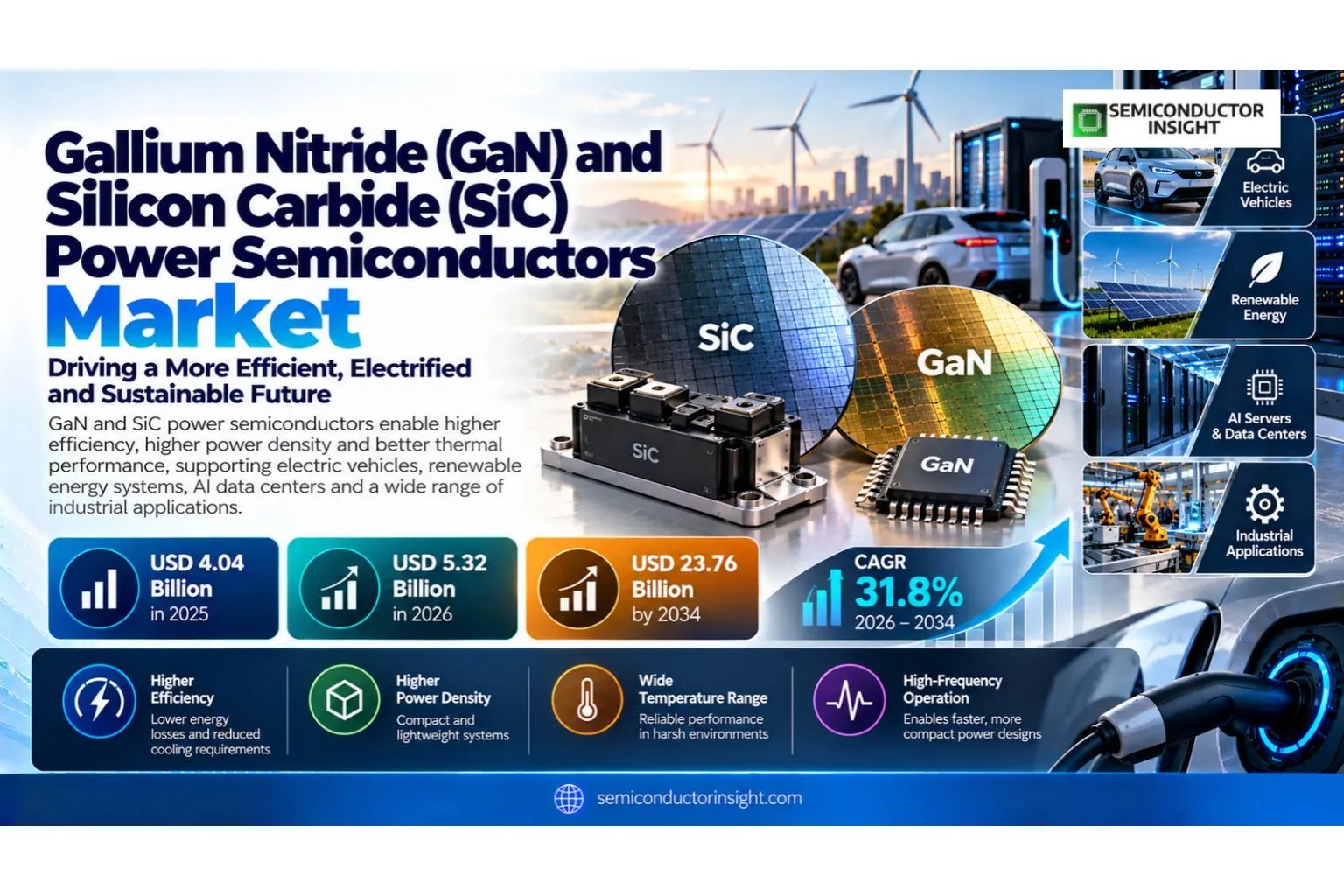
- The market is valued at USD 4.04 billion in 2025 and is projected to reach USD 23.76 billion by 2034, representing a 31.8% CAGR over 2026–2034.
- Silicon Carbide Power Semiconductors is a major product segment, while adjacent variants are expanding as performance, integration and cost requirements evolve.
- Electric Vehicles is a leading application area, supported by demand across Consumer Electronics & Fast Charging, Data Centers & AI Power.
- Asia Pacific is the largest market in 2025 based on current demand, manufacturing concentration and ecosystem maturity.
Gallium Nitride (GaN) and Silicon Carbide (SiC) Power Semiconductors Market Overview
Gallium Nitride (GaN) and Silicon Carbide (SiC) Power Semiconductors are wide-bandgap devices that outperform conventional silicon in switching speed, breakdown field and high-temperature operation. SiC excels at high-voltage, high-power conversion, while GaN is particularly strong at high frequency and compact lower-voltage power stages. Commercial adoption of Gallium Nitride (GaN) and Silicon Carbide (SiC) Power Semiconductors products therefore depends on system-level productivity, integration requirements, reliability expectations and the economics of replacing established alternatives in real operating environments.
The market is expanding rapidly as electric vehicles, AI data centers, solar systems and industrial electrification push efficiency and power-density requirements beyond conventional silicon. Manufacturing is simultaneously moving toward larger wafers, with 200mm SiC and 300mm GaN intended to lower unit cost and support much larger production volumes. Suppliers that translate technical improvements into measurable gains in efficiency, uptime, cost, throughput or workflow simplicity are better positioned to win long-duration programs and repeat purchases.
Segment Analysis: By Type
SiC leads current revenue because automotive traction, renewable-energy and industrial systems require high voltage and temperature capability. GaN is expanding faster in high-frequency and lower-voltage applications such as fast chargers, AI server power supplies and compact motor drives. Within this segment, customers increasingly compare lifecycle support, qualification requirements, integration effort and total ownership cost rather than relying on a single specification or upfront price.
| Type | Market relevance |
|---|---|
| Silicon Carbide Power Semiconductors | Largest current value in automotive and industrial power. |
| Gallium Nitride Power Semiconductors | Fastest growth in high-frequency compact power. |
Segment Analysis: By Application
Electric vehicles are the largest SiC opportunity, while AI data centers and consumer fast charging are accelerating GaN adoption. Renewable energy and industrial drives broaden wide-bandgap demand where efficiency gains reduce cooling, passive component size and lifecycle energy losses. Within this segment, customers increasingly compare lifecycle support, qualification requirements, integration effort and total ownership cost rather than relying on a single specification or upfront price.
| Application | Market relevance |
|---|---|
| Electric Vehicles | Largest SiC system opportunity. |
| Consumer Electronics & Fast Charging | High-volume GaN use case. |
| Data Centers & AI Power | Fastest new infrastructure opportunity. |
| Renewable Energy | Solar, storage and wind conversion. |
| Industrial Motor Drives | Factory automation and robotics. |
| Telecom | RF and telecom power systems. |
Segment Analysis: By Device Type
SiC MOSFETs are the most mature high-value device class, SiC power modules simplify high-current system integration, and GaN HEMTs deliver exceptional switching speed. Integrated GaN-on-silicon power stages are increasingly used where compact size and high-frequency operation matter. Within this segment, customers increasingly compare lifecycle support, qualification requirements, integration effort and total ownership cost rather than relying on a single specification or upfront price.
| Device Type | Market relevance |
|---|---|
| SiC MOSFETs | Mainstream automotive/industrial SiC switch. |
| SiC Diodes | Low-loss rectification. |
| SiC Power Modules | High-current integrated power. |
| GaN HEMTs | Core high-frequency GaN switch. |
| GaN-on-Si Integrated Devices | Integrated compact power stages. |
Segment Analysis: By Voltage Class
Below 650V is the core GaN domain for chargers and server supplies, 650–1200V is the commercial center for EV and renewable SiC, and above-1200V devices address rail, grid and heavy industrial systems requiring higher blocking voltage. Within this segment, customers increasingly compare lifecycle support, qualification requirements, integration effort and total ownership cost rather than relying on a single specification or upfront price.
| Voltage Class | Market relevance |
|---|---|
| Below 650V | Chargers, adapters and server power. |
| 650–1200V | EV, solar and industrial systems. |
| Above 1200V | Grid, rail and heavy-duty power. |
Regional Analysis
Asia Pacific leads because China, Japan, South Korea and Taiwan combine large EV, electronics, renewable-energy and semiconductor manufacturing ecosystems. Europe and North America remain strategically important through leading device suppliers, automotive platforms and manufacturing investments. Regional share also reflects supplier depth, engineering support, manufacturing concentration and the speed at which new Gallium Nitride (GaN) and Silicon Carbide (SiC) Power Semiconductors designs can move from evaluation into repeat deployment.
| Region | 2025 Position | Growth Outlook | Demand Profile |
|---|---|---|---|
| Asia Pacific | Largest | Very strong | EV, electronics and manufacturing led |
| Europe | Technology and automotive hub | Very strong | Automotive, industrial and GaN manufacturing led |
| North America | High-value market | Very strong | AI power, EV and SiC materials led |
| South America | Emerging | Strong | EV, renewables and industrial led |
| Middle East & Africa | Developing | Strong | Renewables, AI and industrial led |
Detailed Regional Blocks
Why is Asia Pacific important to this market?
Asia Pacific leads through China’s EV scale, Japan’s SiC technology base, South Korea’s electronics industry and Taiwan’s semiconductor manufacturing. Regional demand spans both high-voltage SiC and lower-voltage GaN devices. In Asia Pacific, procurement decisions also depend on service coverage, qualification resources, logistics and long-term availability, so ecosystem maturity can materially influence adoption even when core technology performance is similar.
| Country / Subregion | Role | Market Context |
|---|---|---|
| China | Largest demand growth engine | EVs, solar and domestic wide-bandgap supply expand quickly. |
| Japan | SiC technology hub | ROHM, Mitsubishi Electric and Fuji Electric support advanced power devices. |
| South Korea | Automotive and electronics | High-density power systems broaden adoption. |
| Taiwan | Foundry and electronics ecosystem | GaN-on-silicon and power integration support global OEMs. |
- SiC is widely adopted in traction inverters and high-voltage charging where lower losses improve range and thermal design.
- Regional consumer-electronics production creates large GaN volumes in adapters and compact power supplies.
- Government industrial policy is accelerating domestic substrate and device capacity in China and Japan.
Why is Europe important to this market?
Europe is strategically important through Infineon, STMicroelectronics, automotive OEMs and industrial power-electronics suppliers. The region is investing in both SiC and large-wafer GaN manufacturing. In Europe, procurement decisions also depend on service coverage, qualification resources, logistics and long-term availability, so ecosystem maturity can materially influence adoption even when core technology performance is similar.
| Country / Subregion | Role | Market Context |
|---|---|---|
| Germany | Power semiconductor and automotive hub | Infineon and EV platforms drive wide-bandgap adoption. |
| Italy | SiC manufacturing base | STMicroelectronics invests in vertically integrated SiC. |
| France | Automotive and industrial demand | Power-electronics systems broaden use. |
- Infineon announced in July 2025 that its scalable 300mm GaN manufacturing was on track, with customer samples planned from Q4 2025.
- Infineon states that a 300mm GaN wafer can produce 2.3 times more chips than an established 200mm wafer.
- European automotive systems are major adopters of 1200V SiC devices and modules.
Why is North America important to this market?
North America is a high-value market through AI data centers, EV platforms and silicon-carbide materials. U.S. suppliers have invested heavily in 200mm SiC substrates, fabs and power-device capacity. In North America, procurement decisions also depend on service coverage, qualification resources, logistics and long-term availability, so ecosystem maturity can materially influence adoption even when core technology performance is similar.
| Country / Subregion | Role | Market Context |
|---|---|---|
| United States | Largest regional market | AI infrastructure, EVs and domestic SiC investment drive demand. |
| Canada | Clean-tech and data-center niche | Power electronics create selective demand. |
| Mexico | Automotive manufacturing hub | EV and industrial assembly support modules. |
- Wolfspeed commercially launched 200mm SiC material products in September 2025 and made 200mm epitaxy available for qualification.
- Its 200mm portfolio targets better MOSFET yield and manufacturing scalability across automotive, renewable and industrial applications.
- AI data-center power supplies are accelerating GaN demand because high-frequency switching can reduce conversion losses and power-supply size.
Why is South America important to this market?
South America is an emerging downstream market led by Brazil and Chile. Solar, industrial conversion and EV growth create demand, although most wide-bandgap devices are imported inside power modules and finished systems. In South America, procurement decisions also depend on service coverage, qualification resources, logistics and long-term availability, so ecosystem maturity can materially influence adoption even when core technology performance is similar.
| Country / Subregion | Role | Market Context |
|---|---|---|
| Brazil | Largest regional market | EV, industrial and solar systems support demand. |
| Chile | Renewable-energy market | High-efficiency conversion benefits utility solar and storage. |
| Argentina | Industrial niche | Power-electronics demand remains selective. |
- Solar and storage projects increase demand for high-efficiency SiC inverters.
- Fast chargers can adopt GaN in auxiliary and lower-power stages.
- Local wafer fabrication remains limited.
Why is Middle East & Africa important to this market?
Middle East and Africa demand is growing through utility solar, data centers and industrial infrastructure. Gulf AI projects and renewable-energy investment create particularly attractive high-efficiency power-conversion use cases. In Middle East & Africa, procurement decisions also depend on service coverage, qualification resources, logistics and long-term availability, so ecosystem maturity can materially influence adoption even when core technology performance is similar.
| Country / Subregion | Role | Market Context |
|---|---|---|
| Saudi Arabia | Solar and AI infrastructure | Large projects expand power-electronics demand. |
| United Arab Emirates | Data-center and renewable growth | High-efficiency conversion supports new infrastructure. |
| South Africa | Industrial and solar market | SiC inverters and drives create demand. |
- High ambient temperatures increase the value of lower-loss wide-bandgap conversion.
- Data-center power density strengthens the business case for GaN and SiC.
- Most semiconductor devices are imported through global module and power-supply suppliers.
Competitive Landscape
Infineon, Wolfspeed, ROHM, STMicroelectronics, onsemi, Mitsubishi Electric, Fuji Electric, BASiC Semiconductor, BYD Semiconductor and other suppliers compete through substrates, epitaxy, device design, modules and vertically integrated manufacturing. Wafer scale, yield, reliability and application support are central competitive factors.
| Company | Position | Relevant capability |
|---|---|---|
| Infineon Technologies | Key participant | Broad GaN and SiC portfolio with 300mm GaN manufacturing roadmap. |
| Wolfspeed | Key participant | Vertically integrated SiC materials and device supplier with commercial 200mm materials. |
| ROHM Semiconductor | Key participant | Major Japanese SiC device and module supplier across automotive and industrial applications. |
| STMicroelectronics | Key participant | Competes through product breadth, integration capability, qualification and customer support. |
| onsemi | Key participant | Competes through product breadth, integration capability, qualification and customer support. |
| Mitsubishi Electric | Key participant | Competes through product breadth, integration capability, qualification and customer support. |
| Fuji Electric | Key participant | Competes through product breadth, integration capability, qualification and customer support. |
| BASiC Semiconductor | Key participant | Competes through product breadth, integration capability, qualification and customer support. |
| BYD Semiconductor | Key participant | Competes through product breadth, integration capability, qualification and customer support. |
| Sanan Optoelectronics | Key participant | Competes through product breadth, integration capability, qualification and customer support. |
| StarPower Semiconductor | Key participant | Competes through product breadth, integration capability, qualification and customer support. |
Production Capacity Analysis
Wide-bandgap capacity depends on SiC crystal growth and epitaxy, GaN epitaxy on silicon or SiC, device wafer fabrication, packaging and module assembly. SiC substrate quality remains a major bottleneck, while GaN economics depend heavily on wafer size and foundry compatibility. Scaling output without degrading consistency requires stable upstream materials, disciplined process control and final testing that catches performance drift before products reach high-value customer systems.
The industry is moving toward 200mm SiC and 300mm GaN to lower cost per die. Larger wafers increase output per cycle, but successful scaling also requires defect control, uniform epitaxy and high-yield power-device processing. Second-source planning and regional technical support therefore become increasingly important as deployments expand and buyers seek supply continuity without repeating lengthy qualification work.
Market Dynamics
The market is not a direct GaN-versus-SiC substitution battle because each material has a different voltage and frequency sweet spot. SiC is strongest in high-voltage traction and grid conversion, while GaN is strongest in compact high-frequency power supplies. This is changing competitive behavior because vendors increasingly sell system-level value, workflow integration and lifecycle economics rather than an isolated component specification.
Cost is falling through wafer scaling, yield improvement and integrated packaging. As the premium over silicon narrows, adoption moves from performance-critical niches into broader consumer, industrial and infrastructure products, expanding total addressable volume. Buyers consequently evaluate total ownership cost, qualification effort and roadmap stability across the life of a program instead of focusing only on initial purchase price.
Market Drivers
| Factor | Analyst Interpretation |
|---|---|
| Electric vehicles | SiC traction inverters and onboard chargers reduce losses and cooling burden. |
| AI data centers | High power density creates strong demand for GaN and SiC conversion stages. |
| Renewable energy | Solar and storage systems benefit from higher inverter efficiency. |
| Wafer scaling | 200mm SiC and 300mm GaN improve manufacturing economics. |
Market Restraints
| Factor | Analyst Interpretation |
|---|---|
| Higher device cost | Wide-bandgap components still command a premium over mature silicon. |
| Substrate and epitaxy complexity | Defects and uniformity can constrain SiC and GaN yields. |
| Design learning curve | Fast switching requires careful gate drive, EMI and layout engineering. |
| Capital intensity | Vertically integrated material and fab capacity requires large investment. |
Market Opportunities
| Factor | Analyst Interpretation |
|---|---|
| 300mm GaN | Larger wafers can drive cost parity in high-volume power applications. |
| 200mm SiC | Commercial materials expansion supports broader automotive and industrial supply. |
| AI server power | GaN can raise switching frequency and reduce PSU size. |
| Integrated modules | Advanced packaging can combine wide-bandgap switches with drivers and protection. |
Supply Chain Analysis
The value chain begins with SiC substrates or GaN epitaxy, then moves through power-device fabrication, packaging, modules and final system integration. Materials quality and thermal packaging directly affect switching losses and reliability. Traceability and coordination between component suppliers, integrators and end users are important because failures found late in the chain can be far more expensive than the underlying part itself.
| Supply Chain Stage | Role in the Market |
|---|---|
| Substrates and epitaxy | SiC crystal growth and GaN epitaxial layers create the wide-bandgap material platform. |
| Device fabrication | MOSFETs, diodes and HEMTs are processed on specialized power fabs. |
| Packaging and modules | Low-inductance packages and modules manage heat and switching current. |
| System integration | Devices enter EVs, chargers, data centers, renewables and industrial drives. |
Recent Developments
| Date | Development | Source |
|---|---|---|
| September 2025 | Wolfspeed commercially launched its 200mm SiC materials portfolio and made 200mm epitaxy available for qualification. | Wolfspeed |
| July 2025 | Infineon said its 300mm GaN manufacturing roadmap was on track, with customer samples scheduled from Q4 2025. | Infineon Technologies |
| 2026 | Infineon continues scaling power portfolios across silicon, SiC and GaN as system designers optimize different voltage and frequency domains. | Infineon Technologies |
Report Scope & Segmentation
| Scope Item | Coverage |
|---|---|
| Base Year | 2025 |
| Estimated Year | 2026 |
| Forecast Period | 2026–2034 |
| 2025 Market Size | USD 4.04 billion |
| 2026 Estimated Size | USD 5.32 billion |
| 2034 Forecast Size | USD 23.76 billion |
| CAGR (2026–2034) | 31.8% |
| Largest Market in 2025 | Asia Pacific |
| Category | Power Electronics / Wide-Bandgap Semiconductors / GaN & SiC |
| By Type | Silicon Carbide Power Semiconductors, Gallium Nitride Power Semiconductors |
| By Application | Electric Vehicles, Consumer Electronics & Fast Charging, Data Centers & AI Power, Renewable Energy, Industrial Motor Drives, Telecom |
| By Device Type | SiC MOSFETs, SiC Diodes, SiC Power Modules, GaN HEMTs, GaN-on-Si Integrated Devices |
| By Voltage Class | Below 650V, 650–1200V, Above 1200V |
Frequently Asked Questions
What is the 2025 market size of the Gallium Nitride (GaN) and Silicon Carbide (SiC) Power Semiconductors market?
The market is valued at USD 4.04 billion in 2025.
What is the projected 2034 market size of the Gallium Nitride (GaN) and Silicon Carbide (SiC) Power Semiconductors market?
The market is projected to reach USD 23.76 billion by 2034.
What is the CAGR of the Gallium Nitride (GaN) and Silicon Carbide (SiC) Power Semiconductors market from 2026 to 2034?
The market is expected to expand at a CAGR of 31.8% during 2026–2034.
Which region leads the Gallium Nitride (GaN) and Silicon Carbide (SiC) Power Semiconductors market?
Asia Pacific is the largest market in 2025 based on the current demand, manufacturing and deployment structure.
Which type segment is important in the Gallium Nitride (GaN) and Silicon Carbide (SiC) Power Semiconductors market?
Silicon Carbide Power Semiconductors is a major segment, while adjacent product variants are gaining share as performance and integration requirements evolve.
What is the main application for Gallium Nitride (GaN) and Silicon Carbide (SiC) Power Semiconductors products?
Electric Vehicles is a leading application, with additional growth coming from Consumer Electronics & Fast Charging, Data Centers & AI Power.
What drives growth in the Gallium Nitride (GaN) and Silicon Carbide (SiC) Power Semiconductors market?
SiC traction inverters and onboard chargers reduce losses and cooling burden.
What is a key restraint for the Gallium Nitride (GaN) and Silicon Carbide (SiC) Power Semiconductors market?
Wide-bandgap components still command a premium over mature silicon.
Which companies participate in the Gallium Nitride (GaN) and Silicon Carbide (SiC) Power Semiconductors market?
Key participants include Infineon Technologies, Wolfspeed, ROHM Semiconductor, STMicroelectronics, onsemi, alongside other specialized suppliers and system companies.
What technology trend is shaping the Gallium Nitride (GaN) and Silicon Carbide (SiC) Power Semiconductors market?
Larger wafers can drive cost parity in high-volume power applications.
Research Sources & Evidence Base
View research sources used for this overview.
- Infineon Technologies — 300mm GaN Manufacturing Roadmap: 300mm wafer scale, chip-output advantage and customer-sample timing. Source
- Wolfspeed — 200mm SiC Materials Launch: Commercial 200mm SiC wafers and epitaxy for power-device manufacturing. Source
- Infineon Technologies — Power Semiconductor Portfolio: Current silicon, SiC and GaN power-device platform context. Source

Get Sample Report PDF for Exclusive Insights
Report Sample Includes
- Table of Contents
- List of Tables & Figures
- Charts, Research Methodology, and more...
 Download Sample Report PDF