Fitness Tracker (Accel + Gyro + HR) Combo Sensor Market Insights
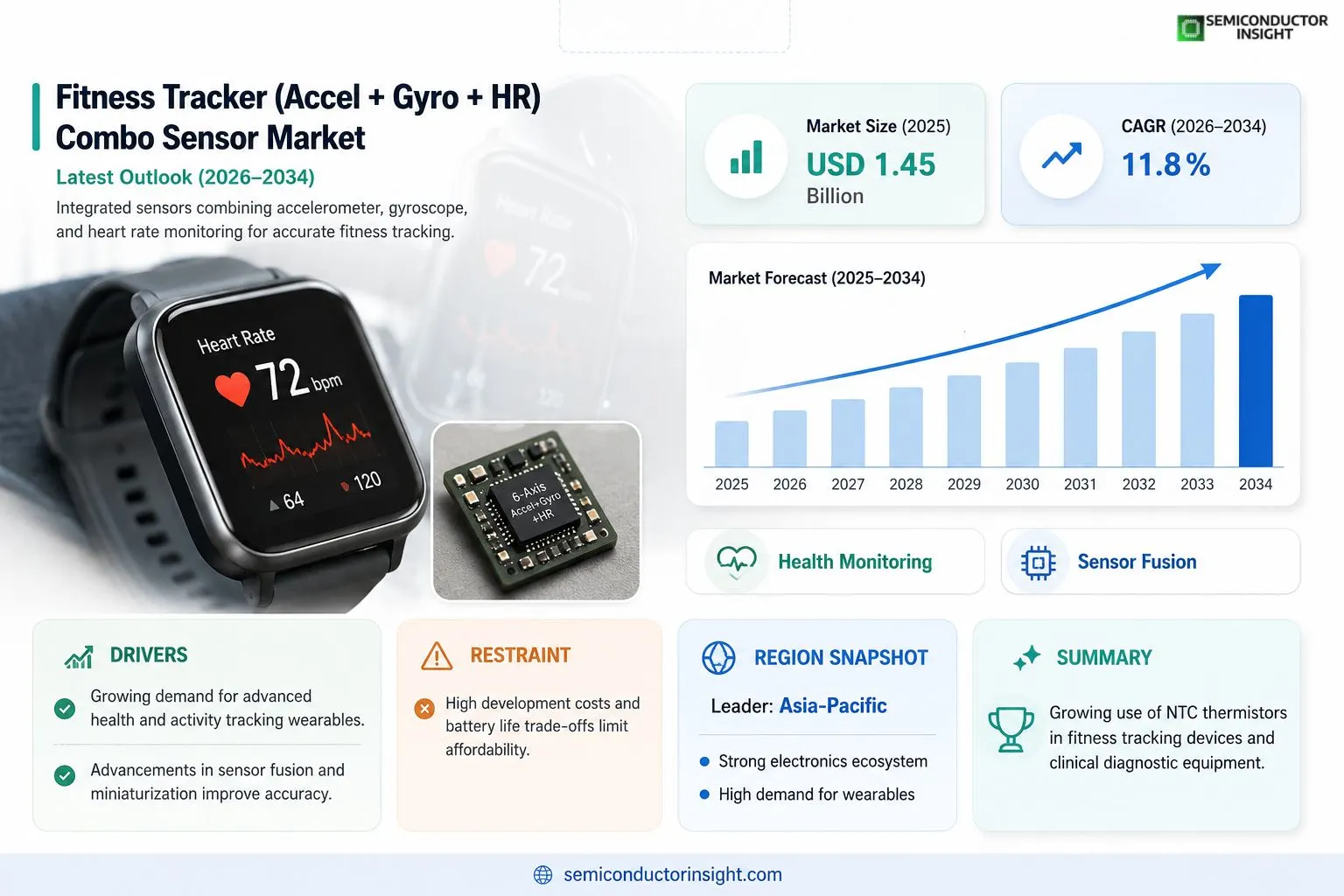
Global Fitness Tracker (Accel + Gyro + HR) Combo Sensor Market size was valued at USD 1.45 billion in 2025. The market is projected to grow from USD 1.58 billion in 2026 to USD 3.85 billion by 2034, exhibiting a CAGR of 11.8% during the forecast period.
Fitness Tracker (Accel + Gyro + HR) Combo Sensors are integrated semiconductor solutions that combine accelerometer, gyroscope, and heart rate monitoring capabilities into a single compact module. These sensors enable precise motion tracking, orientation detection, and continuous vital signs monitoring essential for modern wearable fitness devices. By fusing data from multiple sensing elements, they deliver accurate activity recognition, step counting, gesture detection, sleep analysis, and real-time heart rate variability measurements while optimizing power consumption and device footprint.
The market is experiencing robust growth driven by rising consumer demand for advanced health and fitness monitoring wearables, increasing awareness of preventive healthcare, and rapid technological advancements in sensor miniaturization and AI-powered data analytics. Furthermore, the proliferation of smartwatches and fitness bands among health-conscious populations, coupled with expanding applications in clinical monitoring and elderly care, continues to propel expansion. Key players are investing in enhanced integration and accuracy improvements to meet evolving performance requirements. Major companies operating in this space include Bosch Sensortec, STMicroelectronics, Analog Devices, and Texas Instruments, which maintain broad portfolios of motion and biometric sensing solutions tailored for wearable applications.
MARKET DRIVERS
Rising Health Consciousness and Demand for Advanced Activity Tracking
Fitness Tracker (Accel + Gyro + HR) Combo Sensor Market is experiencing robust growth driven by increasing global awareness of preventive healthcare and personal fitness. Consumers are seeking devices that provide precise motion tracking through accelerometers and gyroscopes combined with continuous heart rate monitoring, enabling comprehensive activity analysis, sleep tracking, and calorie expenditure calculations. This integration supports more accurate fitness insights compared to single-sensor solutions.
Technological Advancements in Sensor Fusion and Miniaturization
Improvements in MEMS technology have led to lower-power, higher-accuracy combo sensors that enhance battery life and device performance in wearables. Sensor fusion algorithms combining accelerometer, gyroscope, and heart rate data deliver superior gesture recognition, fall detection, and real-time activity classification, making these combo solutions essential for modern fitness trackers. [[3]](https://www.gminsights.com/industry-analysis/gyro-sensors-market)
➤ The proliferation of 6-axis and higher IMUs in wearables is projected to expand at a strong CAGR, fueled by demand in consumer electronics and healthcare applications.
Corporate wellness programs and integration with digital health platforms further accelerate adoption, as employers and insurers encourage the use of accurate tracking devices for employee health management and remote monitoring.
MARKET CHALLENGES
Accuracy Limitations in Real-World Conditions
Despite advancements, Fitness Tracker (Accel + Gyro + HR) Combo Sensor performance can be affected by motion artifacts, skin tone variations in optical HR sensing, and placement inconsistencies, leading to potential inaccuracies in data during intense or varied activities.
Other Challenges
Sensor Integration Complexity
Combining multiple sensors increases design complexity, power consumption management challenges, and the need for sophisticated algorithms to ensure reliable data fusion without compromising device compactness or affordability.
Data Privacy and Security Concerns
Continuous collection of sensitive health and motion data raises issues around user privacy, data breaches, and regulatory compliance, potentially slowing consumer trust and broader market penetration.
MARKET RESTRAINTS
High Development Costs and Battery Life Trade-offs
The integration of advanced accelerometer, gyroscope, and heart rate sensors in compact fitness trackers involves significant R&D investment and manufacturing costs, which can limit affordability and slow adoption in price-sensitive emerging markets. Additionally, running multiple sensors simultaneously poses challenges to achieving extended battery life desired by users.
Regulatory and Accuracy Validation Hurdles
Stringent medical-grade validation requirements for health-related claims and variations in sensor performance across diverse user populations create barriers for manufacturers aiming to position combo sensors as reliable clinical tools.
MARKET OPPORTUNITIES
Expansion into Medical and Enterprise Applications
Fitness Tracker (Accel + Gyro + HR) Combo Sensor Market presents significant opportunities in remote patient monitoring, elderly care, and clinical research, where precise motion and vital sign tracking can support rehabilitation, chronic disease management, and predictive health analytics. Growing integration with AI platforms enhances personalized insights and opens new revenue streams.
Emerging Markets and Next-Gen Wearable Innovations
Rising disposable incomes in Asia-Pacific and Latin America, coupled with demand for affordable smart wearables, create expansion potential. Innovations in low-power sensors, flexible electronics, and multi-sensor fusion position combo solutions for growth in sports performance, AR/VR integration, and lifestyle devices.
Fitness Tracker (Accel + Gyro + HR) Combo Sensor Market Trends
Rising Integration of Multi-Sensing Capabilities in Wearable Devices
Fitness Tracker (Accel + Gyro + HR) Combo Sensor Market continues to evolve as manufacturers prioritize compact, power-efficient solutions that combine accelerometer, gyroscope, and heart rate monitoring in single modules. These integrated sensors deliver accurate motion tracking, orientation detection, and continuous vital signs monitoring, which are essential for activity recognition, step counting, gesture detection, sleep analysis, and real-time heart rate variability measurements in modern fitness trackers and smartwatches.
Other Trends
Advancements in Sensor Fusion and AI Analytics
Industry leaders are focusing on enhanced data fusion techniques that merge inputs from multiple sensing elements to improve overall accuracy while optimizing power consumption and reducing device footprint. This trend supports more sophisticated feature sets in wearables, meeting consumer expectations for reliable performance in health and fitness applications.
Expansion into Clinical and Elderly Care Applications
Beyond consumer fitness trackers, combo sensors are finding increased adoption in clinical monitoring and elderly care solutions. Their ability to provide precise activity data alongside heart rate insights enables better preventive healthcare tools and remote patient monitoring systems, broadening the addressable market for these technologies.
Competitive Innovations by Leading Semiconductor Providers
Major companies such as Bosch Sensortec, STMicroelectronics, Analog Devices, and Texas Instruments are actively investing in improved integration and accuracy enhancements for motion and biometric sensing solutions tailored specifically for wearable applications. These developments respond to growing consumer demand for advanced health monitoring wearables and support the rapid technological progress in sensor miniaturization. As health-conscious populations continue to adopt smart fitness devices, Fitness Tracker (Accel + Gyro + HR) Combo Sensor Market is positioned for sustained expansion driven by ongoing performance improvements and new use cases across consumer and medical domains.
COMPETITIVE LANDSCAPE
Key Industry Players
Consolidated Market Led by Specialized MEMS Sensor Innovators Driving Integration and Performance Advancements
Fitness Tracker (Accel + Gyro + HR) Combo Sensor Market is characterized by a competitive landscape dominated by established semiconductor manufacturers with strong expertise in MEMS technology and biometric integration. Bosch Sensortec and STMicroelectronics emerge as leading players, offering highly integrated combo sensors that combine accelerometers, gyroscopes, and support for heart rate monitoring solutions optimized for low-power wearable applications. These companies maintain significant market share through continuous innovation in sensor fusion algorithms, miniaturization, and power efficiency, enabling precise activity tracking, gesture recognition, and vital signs monitoring in compact form factors demanded by fitness tracker OEMs.
Other significant players include Analog Devices, Texas Instruments, and Infineon Technologies, which provide robust portfolios of motion and biometric sensors tailored for the wearable ecosystem. Niche competitors and emerging entrants focus on specialized AI-enhanced sensor fusion and multi-modal integration to differentiate in this rapidly evolving market. Strategic partnerships with wearable device manufacturers and investments in advanced process nodes further intensify competition as demand for accurate, power-efficient combo sensors accelerates.
List of Key Fitness Tracker Combo Sensor Companies Profiled
- Bosch Sensortec
- STMicroelectronics
- Analog Devices
- Texas Instruments
- Infineon Technologies
- NXP Semiconductors
- InvenSense (TDK)
- Qualcomm Incorporated
- Panasonic Corporation
- Maxim Integrated (Analog Devices)
- ams-OSRAM
- TE Connectivity
- Murata Manufacturing
- Goertek Inc.
- Knowles Electronics
Segment Analysis:
| Segment Category | Sub-Segments | Key Insights |
| By Type |
|
High-Precision Fusion Sensors represent the leading category due to their ability to deliver seamless data fusion from accelerometer, gyroscope, and heart rate components. These sensors excel in providing accurate activity recognition and orientation detection even during complex movements. They support advanced features like gesture control and real-time posture analysis, making them ideal for sophisticated fitness ecosystems. Manufacturers prioritize these for premium devices where reliability and comprehensive motion tracking are essential for user satisfaction and long-term engagement. |
| By Application |
|
Heart Rate and Recovery Tracking stands out as the dominant application segment. This is driven by the critical role of continuous vital signs monitoring in delivering personalized health insights. Combo sensors enable precise heart rate variability measurements alongside motion data, allowing users to optimize training intensity and monitor stress levels effectively. The integration facilitates holistic wellness tracking that goes beyond basic activity logging, appealing strongly to users focused on preventive health and performance optimization in dynamic fitness routines. |
| By End User |
|
Individual Fitness Enthusiasts emerge as the primary end user group. These users seek compact, reliable sensors that empower everyday health management through accurate tracking of daily movements, calories, and biometric signals. The combination of motion and heart rate sensing supports motivational features and progress visualization that resonate with this demographic. Demand is further strengthened by growing emphasis on lifestyle integration, where seamless performance in smart bands and watches enhances user adherence to fitness goals and overall well-being. |
| By Technology |
|
AI-Enhanced Data Processing leads this segment by enabling sophisticated sensor fusion algorithms that interpret combined inputs from accelerometer, gyroscope, and heart rate monitors. This technology delivers context-aware insights such as automatic workout detection and anomaly identification in user behavior. It reduces false readings through intelligent filtering and supports battery-efficient operation by processing data locally. The approach transforms raw sensor outputs into actionable wellness intelligence, setting a new standard for intelligent wearable performance. |
| By Form Factor |
|
Compact Chipscale Modules dominate due to their seamless fit into slim wearable designs without compromising functionality. These modules optimize space utilization while maintaining robust performance across multiple sensing axes and biometric channels. Their small footprint supports stylish device aesthetics preferred by consumers and facilitates easier integration during manufacturing. This form factor also contributes to improved wearing comfort during extended use, encouraging consistent adoption across diverse fitness and daily monitoring scenarios. |
Regional Analysis: Fitness Tracker (Accel + Gyro + HR) Combo Sensor Market
Asia-Pacific
The region hosts sophisticated component fabrication clusters that excel in producing high-precision Fitness Tracker (Accel + Gyro + HR) Combo Sensors. Integrated assembly lines ensure tight quality control for multi-axis motion sensing combined with optical heart rate modules, resulting in cost-effective yet reliable solutions that support rapid product iterations for global markets.
Technology centers focus on enhancing sensor fusion algorithms that merge accelerometer, gyroscope, and heart rate data for more accurate activity recognition. This environment nurtures specialized R&D that improves battery efficiency and signal accuracy, addressing the unique demands of fitness tracking in varied climates and lifestyles.
Health-conscious populations increasingly adopt wearable devices featuring these combo sensors for comprehensive fitness insights. Cultural emphasis on wellness and preventive care translates into strong preference for trackers that deliver real-time, reliable motion and heart monitoring during daily activities and structured exercise.
Collaborations between sensor specialists, device manufacturers, and fitness platforms accelerate market growth. These partnerships enable tailored solutions that optimize the performance of Accel + Gyro + HR combinations for specific regional sports and health monitoring needs.
North America
North America maintains a significant position in Fitness Tracker (Accel + Gyro + HR) Combo Sensor Market through its focus on cutting-edge innovation and premium product development. The region excels in advanced sensor fusion software that enhances the accuracy of combined accelerometer, gyroscope, and heart rate data for sophisticated fitness applications. Strong emphasis on health technology integration drives demand for high-performance combo sensors in premium wearable devices targeting serious athletes and wellness-focused consumers. Research institutions and technology companies continuously refine sensor capabilities to deliver more precise motion tracking and biometric measurements. Regulatory frameworks supporting digital health tools encourage adoption of reliable fitness monitoring solutions. The market benefits from high consumer awareness regarding data privacy and accuracy, pushing manufacturers toward superior sensor quality and seamless ecosystem integration.
Europe
Europe demonstrates steady growth in Fitness Tracker (Accel + Gyro + HR) Combo Sensor Market, characterized by rigorous quality standards and a focus on sustainable technology. The region prioritizes energy-efficient sensors suitable for extended use in diverse environmental conditions across countries. Consumer preference for stylish yet functional wearables encourages integration of compact combo sensors that maintain high accuracy in activity and heart rate monitoring. Collaborative efforts between academic institutions and industry players advance sensor algorithms tailored for European lifestyles and sports. Emphasis on data security and ethical health technology supports market expansion. Growing corporate wellness programs further stimulate demand for professional-grade fitness trackers utilizing advanced Accel + Gyro + HR combinations.
South America
South America shows emerging potential in Fitness Tracker (Accel + Gyro + HR) Combo Sensor Market as fitness awareness spreads across urban centers. The region benefits from increasing availability of affordable devices featuring reliable combo sensors for everyday health monitoring. Local distributors and manufacturers adapt international technologies to meet regional climate challenges and activity patterns. Rising middle-class interest in personal wellness creates opportunities for sensors that deliver accurate tracking during popular outdoor and group fitness activities. Infrastructure development in digital connectivity supports greater adoption of smart fitness solutions. The market evolves through strategic localization efforts that balance cost-effectiveness with essential sensor performance for motion and heart rate insights.
Middle East & Africa
The Middle East and Africa region presents developing opportunities in Fitness Tracker (Accel + Gyro + HR) Combo Sensor Market driven by growing health consciousness and government initiatives promoting active lifestyles. Urban populations increasingly seek wearable solutions with dependable combo sensors for fitness tracking in challenging environmental conditions. The market expands through importation of advanced technologies and gradual development of local assembly capabilities. Focus on preventive healthcare creates demand for accurate activity and vital signs monitoring tools. Strategic partnerships with global sensor providers help address specific regional needs while maintaining quality standards. Rising smartphone penetration facilitates better integration with fitness applications that leverage Accel + Gyro + HR data effectively.
Report Scope
This market research report provides a comprehensive analysis of the Fitness Tracker (Accel + Gyro + HR) Combo Sensor Market , covering the forecast period 2026–2034. It offers detailed insights into market dynamics, technological advancements, competitive landscape, and key trends shaping the industry.
Key focus areas of the report include:
- Market Overview: The report begins with an overview outlining its current market scenario, key growth indicators, and industry transformation drivers. It discusses macroeconomic factors, demand–supply balance, regulatory landscape, and the strategic role of semiconductors in powering advancements across industries such as automotive, telecommunications, consumer electronics, and industrial automation.
- Market Size & Forecast: Historical data and future projections for revenue, unit shipments, and market value across major regions and segments.
- Segmentation Analysis: Detailed breakdown by product type, technology, application, and end-user industry to identify high-growth segments and investment opportunities.
- Regional Insights: Insights into market performance across North America, Europe, Asia-Pacific, Latin America, and the Middle East & Africa, including country-level analysis where relevant.
- Competitive Landscape: Profiles of leading market participants, including their product offerings, R&D focus, manufacturing capacity, pricing strategies, and recent developments such as mergers, acquisitions, and partnerships.
- Technology Trends & Innovation: Assessment of emerging technologies, integration of AI/IoT, semiconductor design trends, fabrication techniques, and evolving industry standards.
- Market Drivers & Restraints: Evaluation of factors driving market growth along with challenges, supply chain constraints, regulatory issues, and market-entry barriers.
- Stakeholder Insights: Insights for component suppliers, OEMs, system integrators, investors, and policymakers regarding the evolving ecosystem and strategic opportunities.
Primary and secondary research methods are employed, including interviews with industry experts, data from verified sources, and real-time market intelligence to ensure the accuracy and reliability of the insights presented.
FREQUENTLY ASKED QUESTIONS:
What is the current market size of Fitness Tracker (Accel + Gyro + HR) Combo Sensor Market?
-> Fitness Tracker (Accel + Gyro + HR) Combo Sensor Market was valued at USD 1.45 billion in 2025 and is expected to reach USD 3.85 billion by 2034.
Which key companies operate in Fitness Tracker (Accel + Gyro + HR) Combo Sensor Market?
-> Key players include Bosch Sensortec, STMicroelectronics, Analog Devices, and Texas Instruments, among others.
What are the key growth drivers?
-> Key growth drivers include rising consumer demand for advanced health and fitness monitoring wearables, increasing awareness of preventive healthcare, and rapid technological advancements in sensor miniaturization and AI-powered data analytics.
Which region dominates the market?
-> Asia-Pacific is the fastest-growing region with strong demand for wearables, while North America remains a dominant market.
What are the emerging trends?
-> Emerging trends include sensor miniaturization, AI-powered data analytics, enhanced integration for power optimization, and expanding applications in clinical monitoring and elderly care.

Get Sample Report PDF for Exclusive Insights
Report Sample Includes
- Table of Contents
- List of Tables & Figures
- Charts, Research Methodology, and more...
 Download Sample Report PDF