Key Statistics
Key Takeaways
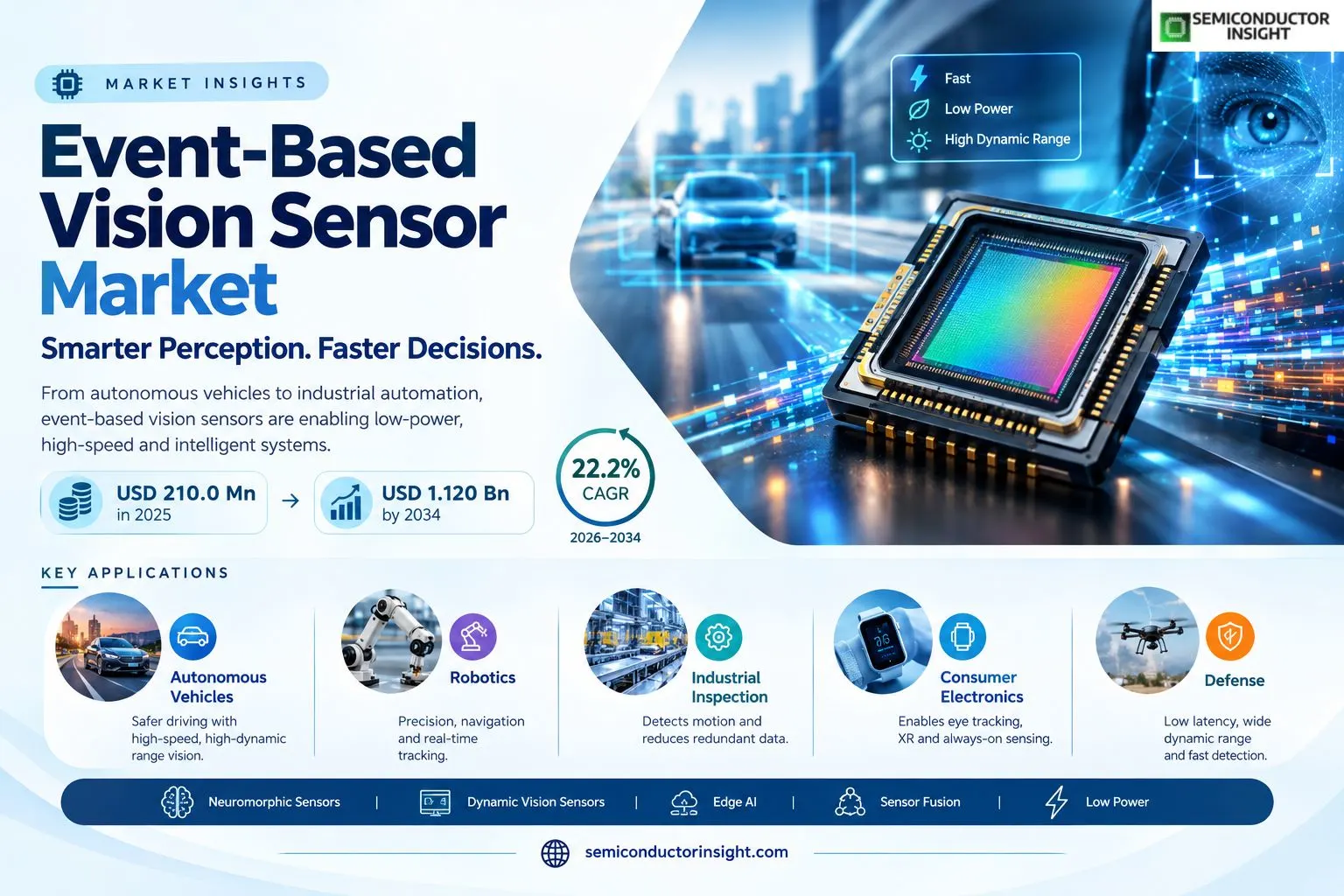
- Market size and growth: the market is valued at USD 210.0 million in 2025 and is projected to reach USD 1.120 billion by 2034, representing a 22.2% CAGR over 2026–2034.
- Neuromorphic Sensors leads by type because asynchronous pixel operation, sparse output and very high temporal resolution align directly with low-latency edge perception workloads.
- Autonomous Vehicles leads application demand because high dynamic range, sparse event output and microsecond-scale timing can improve perception around fast motion, glare and rapidly changing scenes.
- North America is the largest regional market, while Asia Pacific has the strongest incremental growth profile.
- Primary driver: autonomous systems, robotics and edge AI increasingly need visual sensing with lower latency, lower data volume and stronger high-dynamic-range behavior
- Principal restraint: event streams require specialized calibration, software and algorithm expertise, slowing adoption where conventional frame-camera stacks are already mature
Market Overview
The event-based vision sensor market was valued at USD 210.0 million in 2025 and is projected to reach USD 1.120 billion by 2034, expanding at a 22.2% CAGR over 2026–2034. North America leads in 2025, while the market is being reshaped by stacked CMOS event sensors, ultra-low-power GenX320-class devices, industrial camera launches, edge-AI software and automotive driver-monitoring applications.. For Event-Based Vision Sensor suppliers, the commercial implication is that product performance must translate into a measurable system benefit, not only a stronger component specification.
Sony’s current event-based vision portfolio includes IMX636 and IMX637 devices developed with Prophesee, using asynchronous per-pixel luminance-change detection rather than conventional fixed-rate frames. Sony’s 2021 launch described 4.86 μm pixels, 1280×720 resolution for IMX636 and stacked Cu-Cu interconnect, while its 2025 product updates added newer IMX646 and IMX647 variants. This product continuity shows that event sensing has moved from laboratory prototypes toward a repeatable commercial CMOS image-sensor platform for industrial and embedded applications.
Prophesee’s GenX320 broadens the technology toward battery-constrained edge devices. The 320×320 sensor is specified with ultra-low-power operation down to 36 μW, more than 140 dB dynamic range and embedded filtering functions such as anti-flicker control, event-rate regulation and spatio-temporal filtering. These features matter because raw event streams can otherwise overwhelm small processors in textured or flickering scenes. By handling part of the data reduction at sensor level, the architecture makes eye tracking, always-on sensing, wearables and smart-home monitoring more practical.
Research continues to expand the application envelope. Nature Photonics demonstrated event-based sensing for fast single-molecule localization microscopy, Nature Machine Intelligence reported event-camera visual odometry using neuromorphic resonator networks, and Frontiers research has shown low-latency robotic line tracking. These studies reinforce the technology’s advantages in fast motion and sparse temporal information, but they also highlight software complexity. Commercial growth therefore depends on better calibration, event-native algorithms, standard interfaces and development tools that allow OEMs to integrate sensors without rebuilding their entire perception stack.
Segment Analysis: By Type
By type, the market is segmented into Neuromorphic Sensors, Dynamic Vision Sensors. Neuromorphic Sensors holds the leading position because asynchronous pixel operation, sparse output and very high temporal resolution align directly with low-latency edge perception workloads. Procurement decisions in the Event-Based Vision Sensor market therefore increasingly consider qualification evidence, integration effort, lifecycle support and supply continuity alongside unit price. As adoption broadens, vendors that combine repeatable manufacturing with application engineering and documented reliability should be better positioned for long production programs.
| Type | Function / role | Market position |
|---|---|---|
| Neuromorphic Sensors | Retina-inspired asynchronous pixels report local contrast changes as timestamped events. | Leading category because sparse event generation directly supports low-latency and low-power perception. |
| Dynamic Vision Sensors | Commercial event-camera implementations optimized for motion, high dynamic range and fast scene changes. | Strong installed category across industrial, research and robotics systems. |
Commercial implications by type
The terminology overlaps because many dynamic vision sensors are themselves neuromorphic devices, but commercial differentiation increasingly comes from pixel design, event filtering, latency, resolution and software support rather than the label alone. Sony’s stacked sensors prioritize HD-class resolution and industrial deployment, while Prophesee’s GenX320 emphasizes embedded power efficiency and sensor-side processing. Buyers therefore compare system-level metrics such as usable event rate, low-light cutoff, calibration quality, interface support and SDK maturity in addition to pixel count or nominal temporal resolution.
Segment Analysis: By Application
By application, the market includes Autonomous Vehicles, Robotics, Industrial Inspection, Consumer Electronics, Defense. Autonomous Vehicles leads demand because high dynamic range, sparse event output and microsecond-scale timing can improve perception around fast motion, glare and rapidly changing scenes. As adoption broadens, vendors that combine repeatable manufacturing with application engineering and documented reliability should be better positioned for long production programs. This makes design support and field-proven integration increasingly important because the cost of requalification can exceed the incremental saving from a lower-priced component.
| Application | Demand characteristics |
|---|---|
| Autonomous Vehicles | Event cameras can complement frame cameras, radar and lidar for rapid motion, glare, driver monitoring and short-latency perception. |
| Robotics | Sparse data and fast timing support visual odometry, manipulation, navigation and high-speed tracking. |
| Industrial Inspection | Fast moving production lines benefit from motion-sensitive sensing without recording redundant static backgrounds. |
| Consumer Electronics | XR, eye tracking, gesture recognition and always-on cameras benefit from lower sensor power and compact modules. |
| Defense | Drone detection, high-speed tracking and power-constrained platforms value low latency and wide dynamic range. |
By End User
| End User | Commercial relevance |
|---|---|
| Automotive OEMs | Require automotive qualification, multi-sensor fusion and safety-oriented software integration. |
| Robotics Manufacturers | Value fast feedback, compact modules and low processing load. |
| Industrial Machine-Vision Integrators | Need production-ready cameras, trigger synchronization and reliable SDK support. |
| Consumer / XR Device Makers | Prioritize tiny form factors, eye tracking and always-on power budgets. |
By Technology Integration
| Technology Integration | Commercial relevance |
|---|---|
| Edge-AI Accelerators | Process sparse event streams close to the sensor for low-latency inference. |
| Sensor-Fusion Frameworks | Combine events with frames, IMUs, radar or lidar to improve robustness. |
| Event-Driven Algorithms | Use asynchronous data directly rather than converting events back into frames. |
| Hybrid Frame + Event Systems | Preserve conventional imagery while adding high-speed temporal information. |
By Resolution Class
| Resolution Class | Commercial relevance |
|---|---|
| QVGA / Embedded | Low-power sensors target always-on and wearable applications. |
| VGA | Balanced resolution and event rate for robotics and industrial vision. |
| HD | 1280×720-class sensors target richer machine-vision and high-speed applications. |
Regional Analysis
North America leads the market because U.S. robotics, autonomous-system, industrial-vision and defense programs create a strong early-adopter base, while the region also concentrates edge-AI software and system-integration activity. Asia Pacific has the strongest growth profile through Japan, China, South Korea and Southeast Asia combine image-sensor manufacturing, robotics, consumer electronics and automotive production that can accelerate volume adoption. This makes design support and field-proven integration increasingly important because the cost of requalification can exceed the incremental saving from a lower-priced component.
How does regional demand differ across this market?
North America leads current high-value adoption through autonomous systems, robotics, industrial automation and defense, while Europe contributes a strong Prophesee-centered software and research ecosystem. Asia Pacific has the strongest scaling potential because Sony and regional electronics manufacturers can integrate event sensing into industrial, automotive and consumer products at volume. South America and the Middle East & Africa remain earlier-stage markets, where adoption is likely to enter through imported robotics, security or industrial systems rather than local sensor fabrication.
| Region | Position | Growth outlook | Demand profile | Supplier selection |
|---|---|---|---|---|
| North America | Largest | Strong | Autonomy, robotics and defense | Latency, software, qualification |
| Europe | Second | Strong | Research, automotive and industrial vision | Algorithm maturity, privacy, interoperability |
| Asia Pacific | Third | Fastest | Sensor manufacturing and electronics scale | Cost, integration, volume supply |
| South America | Smaller | Selective | Industrial automation and robotics | Cost, local support, integration |
| Middle East & Africa | Emerging | Project-led | Security, drones and smart infrastructure | Reliability, support, power efficiency |
Competitive Landscape
Competition is centered on sensor architecture, pixel-level event processing, development software and camera-module ecosystems rather than only raw CMOS manufacturing scale. For Event-Based Vision Sensor suppliers, the commercial implication is that product performance must translate into a measurable system benefit, not only a stronger component specification. Procurement decisions in the Event-Based Vision Sensor market therefore increasingly consider qualification evidence, integration effort, lifecycle support and supply continuity alongside unit price. As adoption broadens, vendors that combine repeatable manufacturing with application engineering and documented reliability should be better positioned for long production programs.
Sony and Prophesee form the most visible commercial partnership at the sensor level. Sony contributes stacked CMOS image-sensor manufacturing and high-resolution devices such as IMX636, while Prophesee contributes event-pixel architecture, filtering concepts and the Metavision software environment. This combination addresses a central commercialization challenge: customers need both production-grade silicon and event-native software. Prophesee’s GenX320 extends the portfolio toward much smaller and lower-power edge devices, broadening competition from industrial cameras into XR, wearables, smart home and always-on sensing.
iniVation and research-origin event-camera vendors helped establish the developer market, while Prophesee’s 2025 partner-camera activity shows the ecosystem moving toward industrial productization. IDS introduced event-based industrial camera families using the Sony-Prophesee IMX636, and CenturyArks announced compact camera modules with MIPI interfaces. These launches are strategically important because OEMs often buy a tested camera module rather than a bare sensor. Module partners can therefore accelerate adoption by solving optics, synchronization, thermal, enclosure and interface problems that would otherwise fall on every system developer.
Academic research remains a meaningful competitive force because event-based perception algorithms are still evolving quickly. Recent IEEE and Nature work covers calibration, visual odometry, microscopy and recognition, showing both expanding use cases and unresolved limitations such as sparse static-scene information, noise and model generalization. Sensor vendors that maintain strong developer tools, datasets and research partnerships can translate algorithm progress into product value faster than vendors focused only on hardware. The competitive moat increasingly includes software, documentation and a community capable of turning asynchronous data into reliable application performance.
| Competitive tier | Representative participants | Competitive focus |
|---|---|---|
| Sensor platform vendors | Sony Semiconductor Solutions, Prophesee | Stacked CMOS event sensors, embedded filtering and software |
| Camera / module ecosystem | IDS, CenturyArks, iniVation and other integrators | Industrial and research-ready event-camera products |
| Neuromorphic processing ecosystem | SynSense, edge-AI and research platforms | Event-native processing, fusion and low-power inference |
Companies Profiled
Sony Semiconductor Solutions, Prophesee, iniVation, SynSense, IDS Imaging, CenturyArks, Xperi / DTS, Terranet. The set reflects companies directly active in products, process technology, manufacturing or the supporting application ecosystem rather than an evaluative ranking. Procurement decisions in the Event-Based Vision Sensor market therefore increasingly consider qualification evidence, integration effort, lifecycle support and supply continuity alongside unit price. As adoption broadens, vendors that combine repeatable manufacturing with application engineering and documented reliability should be better positioned for long production programs.
Production Capacity Analysis
Production capacity depends on specialized event-pixel CMOS design, stacked image-sensor fabrication, high-speed readout, wafer-level test, camera-module assembly and enough event-specific calibration capability to characterize sensors consistently. For Event-Based Vision Sensor suppliers, the commercial implication is that product performance must translate into a measurable system benefit, not only a stronger component specification. Procurement decisions in the Event-Based Vision Sensor market therefore increasingly consider qualification evidence, integration effort, lifecycle support and supply continuity alongside unit price. As adoption broadens, vendors that combine repeatable manufacturing with application engineering and documented reliability should be better positioned for long production programs.
Sony’s stacked event-sensor architecture demonstrates that commercial manufacturing can leverage advanced CMOS image-sensor infrastructure rather than relying on a completely separate fabrication model. The challenge is that event pixels require contrast-threshold uniformity, very low latency and robust behavior across light levels, so conventional image-sensor metrics are not sufficient. Prophesee publishes event-specific characterization guidance for contrast sensitivity, background activity and latency, indicating that test capacity must measure asynchronous behavior at scale. This calibration burden can become a manufacturing bottleneck as volumes rise.
Module capacity is also important because event sensors are rarely sold as complete end solutions. Industrial and robotics customers need optics, synchronization, MIPI or USB interfaces, enclosure design and SDK validation before deployment. The 2025 expansion of partner cameras around IMX636 and GenX320 shows that the ecosystem is beginning to industrialize this layer. Higher module availability reduces engineering effort for end users, but vendors still need reliable firmware and software release processes because performance depends on sensor configuration and event filtering as much as on optical assembly.
Market Dynamics
The market is moving from research cameras toward differentiated commercial platforms for industrial, automotive and ultra-low-power edge applications, with software maturity becoming as important as pixel technology. For Event-Based Vision Sensor suppliers, the commercial implication is that product performance must translate into a measurable system benefit, not only a stronger component specification. Procurement decisions in the Event-Based Vision Sensor market therefore increasingly consider qualification evidence, integration effort, lifecycle support and supply continuity alongside unit price.
Event-based sensing creates the most value when an application contains fast changes and large amounts of redundant static information, because asynchronous pixels can reduce data movement and processing. That advantage weakens in slowly changing scenes where conventional cameras already provide simple, information-rich frames. The market is therefore developing as a complementary sensing category rather than a universal replacement for frame cameras. Hybrid systems that combine events, conventional images and inertial data are likely to expand because they preserve scene context while adding high-speed temporal information and wider dynamic range.
Market Drivers
Drivers Impact Analysis
| Driver | Impact | Commercial mechanism |
|---|---|---|
| Autonomous mobility | High | Autonomous vehicles and mobile robots need perception that remains responsive during rapid motion, glare and transitions between bright and dark areas. Prophesee’s automotive materials position event sensing for collision avoidance, driver monitoring and assisted-driving use cases, while research shows that asynchronous data can support low-latency tracking. The strongest opportunity is complementary sensing: events can flag rapid temporal changes while conventional cameras provide texture and color. This can reduce processing load and improve responsiveness without forcing an entire vehicle perception stack to abandon frame-based inputs. |
| Edge-AI power efficiency | High | Always-on vision is increasingly constrained by sensor and processing power rather than raw image quality. Prophesee’s GenX320 is designed specifically for embedded edge systems and supports ultra-low-power modes, event-rate control and on-sensor filtering. Sparse output can reduce downstream memory traffic and processor wake time when little in the scene changes. This creates a clear route into wearables, smart-home devices and XR systems, where battery life and heat matter as much as sensing accuracy and where continuous full-frame video can be impractical. |
| Industrial high-speed inspection | High | Production lines, counting systems and motion-analysis applications often need very high temporal resolution but do not require full images at every instant. Sony’s event sensors and the 2025 IDS camera announcements target this space directly. By reporting only changing pixels, event cameras can observe fast edges and trajectories without the bandwidth of a multi-kilohertz frame camera. Commercial adoption is most compelling where existing machine vision struggles with motion blur, strobing requirements or the cost of moving and processing large volumes of redundant image data. |
| XR and eye tracking | Medium | Eye movements occur on millisecond time scales, making event sensing attractive for foveated rendering, gaze interaction and low-power wearable interfaces. Prophesee positions GenX320 for eye tracking and XR, while partner demonstrations target kilohertz-class tracking with low total system power. The economic opportunity depends on compact modules, reliable low-light operation and software that converts sparse eye events into stable gaze vectors. If these requirements are met, event sensors can reduce thermal load in headsets while improving responsiveness compared with conventional always-on cameras. |
Autonomous mobility
Autonomous vehicles and mobile robots need perception that remains responsive during rapid motion, glare and transitions between bright and dark areas. Prophesee’s automotive materials position event sensing for collision avoidance, driver monitoring and assisted-driving use cases, while research shows that asynchronous data can support low-latency tracking. The strongest opportunity is complementary sensing: events can flag rapid temporal changes while conventional cameras provide texture and color. This can reduce processing load and improve responsiveness without forcing an entire vehicle perception stack to abandon frame-based inputs.
Edge-AI power efficiency
Always-on vision is increasingly constrained by sensor and processing power rather than raw image quality. Prophesee’s GenX320 is designed specifically for embedded edge systems and supports ultra-low-power modes, event-rate control and on-sensor filtering. Sparse output can reduce downstream memory traffic and processor wake time when little in the scene changes. This creates a clear route into wearables, smart-home devices and XR systems, where battery life and heat matter as much as sensing accuracy and where continuous full-frame video can be impractical.
Industrial high-speed inspection
Production lines, counting systems and motion-analysis applications often need very high temporal resolution but do not require full images at every instant. Sony’s event sensors and the 2025 IDS camera announcements target this space directly. By reporting only changing pixels, event cameras can observe fast edges and trajectories without the bandwidth of a multi-kilohertz frame camera. Commercial adoption is most compelling where existing machine vision struggles with motion blur, strobing requirements or the cost of moving and processing large volumes of redundant image data.
XR and eye tracking
Eye movements occur on millisecond time scales, making event sensing attractive for foveated rendering, gaze interaction and low-power wearable interfaces. Prophesee positions GenX320 for eye tracking and XR, while partner demonstrations target kilohertz-class tracking with low total system power. The economic opportunity depends on compact modules, reliable low-light operation and software that converts sparse eye events into stable gaze vectors. If these requirements are met, event sensors can reduce thermal load in headsets while improving responsiveness compared with conventional always-on cameras.
Market Restraints
Restraints Impact Analysis
| Restraint | Impact | Commercial mechanism |
|---|---|---|
| Software integration complexity | High | Most production computer-vision stacks assume frame-based tensors, established calibration methods and mature image-processing libraries. Event streams require different representations, timing models and algorithms, so OEMs may need new data pipelines, training datasets and validation procedures. Recent IEEE reviews continue to identify representation, calibration and generalization as active research topics. This slows adoption in automotive and industrial markets where software has already undergone extensive qualification. Vendors must therefore provide strong SDKs, conversion tools and reference algorithms to reduce the integration burden. |
| Sparse static-scene information | Medium | Event cameras respond to temporal contrast changes rather than measuring absolute intensity in every pixel at a fixed interval. This is highly efficient for motion but can be a limitation when an application needs texture, color or information from static objects. Many practical systems therefore use event sensing alongside frame cameras or IMUs rather than as the only visual input. The need for fusion increases hardware and software complexity, which can offset some of the bandwidth and power savings that motivate adoption in the first place. |
| Noise and calibration | Medium | Event generation depends on pixel-level contrast thresholds, background activity and lighting conditions, creating calibration challenges that differ from conventional image sensors. Prophesee’s own characterization guidance defines event-specific KPIs for sensitivity, latency and noise because standard camera metrics are not enough. Inconsistent thresholds can increase false events or suppress meaningful motion, particularly under flicker or low light. Industrial and automotive customers need repeatable calibration across temperature and production lots before they can trust event sensors in high-volume systems. |
| Cost and ecosystem maturity | Medium | Event sensors and cameras remain lower-volume than mainstream CMOS image sensors, so module prices, tooling and engineering support can be higher. Although Sony and Prophesee have expanded product lines and partner cameras, the supplier ecosystem is still narrower than the conventional machine-vision market. Smaller OEMs may hesitate if they depend on specialized software or a limited set of sensor sources. Broader competition, standardized interfaces and sustained commercial deployments are needed to reduce procurement risk and make event sensing easier to qualify across multiple product generations. |
Software integration complexity
Most production computer-vision stacks assume frame-based tensors, established calibration methods and mature image-processing libraries. Event streams require different representations, timing models and algorithms, so OEMs may need new data pipelines, training datasets and validation procedures. Recent IEEE reviews continue to identify representation, calibration and generalization as active research topics. This slows adoption in automotive and industrial markets where software has already undergone extensive qualification. Vendors must therefore provide strong SDKs, conversion tools and reference algorithms to reduce the integration burden.
Sparse static-scene information
Event cameras respond to temporal contrast changes rather than measuring absolute intensity in every pixel at a fixed interval. This is highly efficient for motion but can be a limitation when an application needs texture, color or information from static objects. Many practical systems therefore use event sensing alongside frame cameras or IMUs rather than as the only visual input. The need for fusion increases hardware and software complexity, which can offset some of the bandwidth and power savings that motivate adoption in the first place.
Noise and calibration
Event generation depends on pixel-level contrast thresholds, background activity and lighting conditions, creating calibration challenges that differ from conventional image sensors. Prophesee’s own characterization guidance defines event-specific KPIs for sensitivity, latency and noise because standard camera metrics are not enough. Inconsistent thresholds can increase false events or suppress meaningful motion, particularly under flicker or low light. Industrial and automotive customers need repeatable calibration across temperature and production lots before they can trust event sensors in high-volume systems.
Cost and ecosystem maturity
Event sensors and cameras remain lower-volume than mainstream CMOS image sensors, so module prices, tooling and engineering support can be higher. Although Sony and Prophesee have expanded product lines and partner cameras, the supplier ecosystem is still narrower than the conventional machine-vision market. Smaller OEMs may hesitate if they depend on specialized software or a limited set of sensor sources. Broader competition, standardized interfaces and sustained commercial deployments are needed to reduce procurement risk and make event sensing easier to qualify across multiple product generations.
Market Opportunities
Industrial machine vision
Event cameras can address inspection tasks where objects move too fast for conventional exposure times or where full-frame data creates unnecessary bandwidth. The 2025 IDS launch using IMX636 shows that industrial camera vendors are converting event sensors into standard machine-vision form factors. Future opportunity lies in combining event data with conventional triggers, encoders and edge inference so integrators can deploy the technology without rebuilding factory software. Counting, vibration analysis, motion measurement and high-speed sorting are especially strong candidates because temporal information carries most of the useful signal.
Automotive in-cabin sensing
Driver monitoring and occupant sensing can benefit from low-light capability, eye-motion timing and privacy-oriented sparse outputs. Prophesee and Xperi have demonstrated neuromorphic in-cabin sensing for blink, saccade and micro-expression analysis, while the sensor’s event format can reduce continuous image capture in selected use cases. Commercial success will depend on automotive qualification, infrared compatibility, fusion with conventional cameras and robust behavior across driver demographics. If these hurdles are addressed, event sensing could become a differentiated auxiliary channel for safety and human-machine interaction.
XR and wearables
The GenX320 class opens an opportunity that older event cameras could not address because power, package size and interface complexity were too high for head-worn products. Prophesee specifies very low sensor power and compact optical modules, and its XR materials emphasize eye, hand and controller tracking. The strongest value proposition is not simply faster sensing but lower end-to-end system power because sparse events can reduce processor workload. This is important for smart glasses, where thermal limits, battery size and user comfort constrain every always-on sensing function.
Scientific and medical imaging
Nature Photonics demonstrated event-based sensing in fast single-molecule localization microscopy, illustrating that the technology can capture sparse, fast optical changes beyond robotics and industrial vision. Scientific instruments value temporal precision and may tolerate higher component cost when an event sensor reveals dynamics that frame cameras miss. Additional opportunities include particle tracking, microscopy, motion analysis and laboratory instrumentation. These markets are smaller in unit volume but can support premium pricing, accelerate algorithm development and generate technically credible references that later improve confidence in broader commercial applications.
Supply Chain Analysis
Event pixels, stacked CMOS logic and on-chip filtering
Image-sensor processes, Cu-Cu stacking and wafer test
Optics, interfaces, synchronization and calibration
SDKs, event algorithms, fusion and application integration
Sensor design
Event pixels must convert local contrast changes into timestamped events while controlling background activity, latency and dynamic range. Sony and Prophesee combine stacked CMOS manufacturing with event-specific pixel architecture, while GenX320 adds on-sensor filters and power modes. Design trade-offs differ from frame cameras because more intelligence is embedded at pixel or sensor level. Suppliers therefore need mixed-signal design, asynchronous logic and image-sensor expertise together, plus characterization methods that quantify event threshold, latency and noise instead of relying only on conventional imaging metrics.
Wafer fabrication
Commercial event sensors use advanced CMOS image-sensor processes and, in Sony’s case, stacked Cu-Cu interconnect between pixel and logic layers. This allows the pixel array and processing circuitry to be optimized separately, but it adds bonding, yield and test complexity. Event-specific screening must identify pixels with abnormal contrast thresholds or background activity. As volumes increase, manufacturing economics should improve, but only if wafer-level test can evaluate asynchronous behavior efficiently enough to prevent expensive defective dies from reaching module assembly.
Camera modules
A usable event camera requires more than the sensor die. Optics, mechanical alignment, synchronization, power regulation, MIPI or USB interfaces and firmware must be integrated and validated. Prophesee’s expanding partner-camera ecosystem and 2025 IDS launch show that this layer is becoming more mature. Module suppliers can accelerate adoption by offering standard form factors and known calibration behavior, particularly for industrial and robotics customers that prefer tested cameras over bare sensors and need integration support across temperature, lighting and motion conditions.
Software & systems
Metavision, event-camera research libraries and application-specific algorithms convert sparse events into tracks, optical flow, object detections or fused perception outputs. This software layer is critical because event data are not directly compatible with most frame-based computer-vision pipelines. Developers need calibration tools, visualization, filtering and AI models that preserve temporal advantages rather than reconstructing conventional frames unnecessarily. Companies that combine hardware with robust SDKs, datasets and partner algorithms can capture more system value and reduce the engineering risk that currently slows mainstream adoption.
Recent Developments
March 2025 — IDS launches industrial event-based camera series using IMX636
The launch moves Sony-Prophesee event sensing into production-oriented industrial machine-vision cameras. Source
February 2025 — Sony adds updated EVS product material for IMX636/637/646/647
Sony’s 2025 product-information updates show continued support and expansion of the event-based vision portfolio. Source
Current — Prophesee GenX320 targets ultra-low-power edge vision
The sensor supports 320×320 resolution, very low-power modes, high dynamic range and embedded event filtering for XR, IoT and wearables. Source
Report Scope & Segmentation
| Attribute | Coverage |
|---|---|
| Market | Event-Based Vision Sensor |
| Base Year | 2025 |
| Estimated Year | 2026 |
| Forecast Period | 2026–2034 |
| 2025 Market Size | USD 210.0 million |
| 2026 Estimated Size | USD 225.0 million |
| 2034 Forecast Size | USD 1.120 billion |
| CAGR | 22.2% (2026–2034) |
| By Type | Neuromorphic Sensors, Dynamic Vision Sensors |
| By Application | Autonomous Vehicles, Robotics, Industrial Inspection, Consumer Electronics, Defense |
| By End User | Automotive OEMs, Robotics Manufacturers, Industrial Machine-Vision Integrators, Consumer / XR Device Makers |
| By Technology Integration | Edge-AI Accelerators, Sensor-Fusion Frameworks, Event-Driven Algorithms, Hybrid Frame + Event Systems |
| By Resolution Class | QVGA / Embedded, VGA, HD |
| Regions | North America, Europe, Asia Pacific, South America, Middle East & Africa |
| Companies Profiled | Sony Semiconductor Solutions, Prophesee, iniVation, SynSense, IDS Imaging, CenturyArks, Xperi / DTS, Terranet |
Frequently Asked Questions
What is the event-based vision sensor market size in 2025?
The market is valued at USD 210.0 million in 2025.
What is the projected market size by 2034?
The market is projected to reach USD 1.120 billion by 2034.
What is the CAGR from 2026 to 2034?
The market is expected to expand at a 22.2% CAGR.
Which region leads the market?
North America is the largest regional market in 2025.
Which type leads the market?
Neuromorphic Sensors is the leading type.
Which application leads demand?
Autonomous Vehicles is the leading application.
What is the main growth driver?
autonomous systems, robotics and edge AI increasingly need visual sensing with lower latency, lower data volume and stronger high-dynamic-range behavior.
What is the principal restraint?
event streams require specialized calibration, software and algorithm expertise, slowing adoption where conventional frame-camera stacks are already mature.
Where are the strongest opportunities?
automotive driver monitoring, industrial machine vision, XR eye tracking, robotics and ultra-low-power always-on sensing.
Which companies are active in the market?
Sony Semiconductor Solutions, Prophesee, iniVation, SynSense, IDS Imaging, CenturyArks, Xperi / DTS, Terranet.
Research Sources & Evidence Base
View primary, official and technical evidence used in this overview
- Sony Semiconductor Solutions: Event-based Vision Sensor Product Line — Current IMX636, IMX637, IMX646 and IMX647 portfolio and sensor specifications.
- Sony Semiconductor Solutions: IMX636 and IMX637 Launch — Stacked 4.86 μm event-pixel architecture, Cu-Cu connection and collaboration with Prophesee.
- Sony Semiconductor Solutions: Event Sensor Development Feature — Commercialization history, software collaboration and industrial-use rationale.
- Sony Semiconductor Solutions: 2025 Product Information Updates — Current EVS product support and 2025 portfolio updates.
- Prophesee: GenX320 Event-Based Sensor — Ultra-low-power operation, dynamic range, embedded filtering and edge applications.
- Prophesee: Metavision Sensor Portfolio — Resolution, latency, power and application positioning across sensor generations.
- Prophesee: Automotive Applications — ADAS, driver monitoring, low-light and high-dynamic-range use cases.
- Prophesee: Partner Camera Ecosystem — Industrial camera and module ecosystem around Sony-Prophesee and GenX320 sensors.
- IEEE: Review on Event-Based Vision — Current review of data representation, calibration, recognition and remaining technical limitations.
- Nature Photonics: Event-Based Vision for Single-Molecule Localization Microscopy — Scientific-imaging application demonstrating high temporal resolution beyond robotics.
- Nature Machine Intelligence: Visual Odometry with Neuromorphic Resonator Networks — Event-camera visual odometry and robotic validation.
- Frontiers in Neurorobotics: Low-Latency Line Tracking Using Dynamic Vision Sensors — Robotics evidence for asynchronous low-latency tracking.

Get Sample Report PDF for Exclusive Insights
Report Sample Includes
- Table of Contents
- List of Tables & Figures
- Charts, Research Methodology, and more...
 Download Sample Report PDF