MARKET INSIGHTS
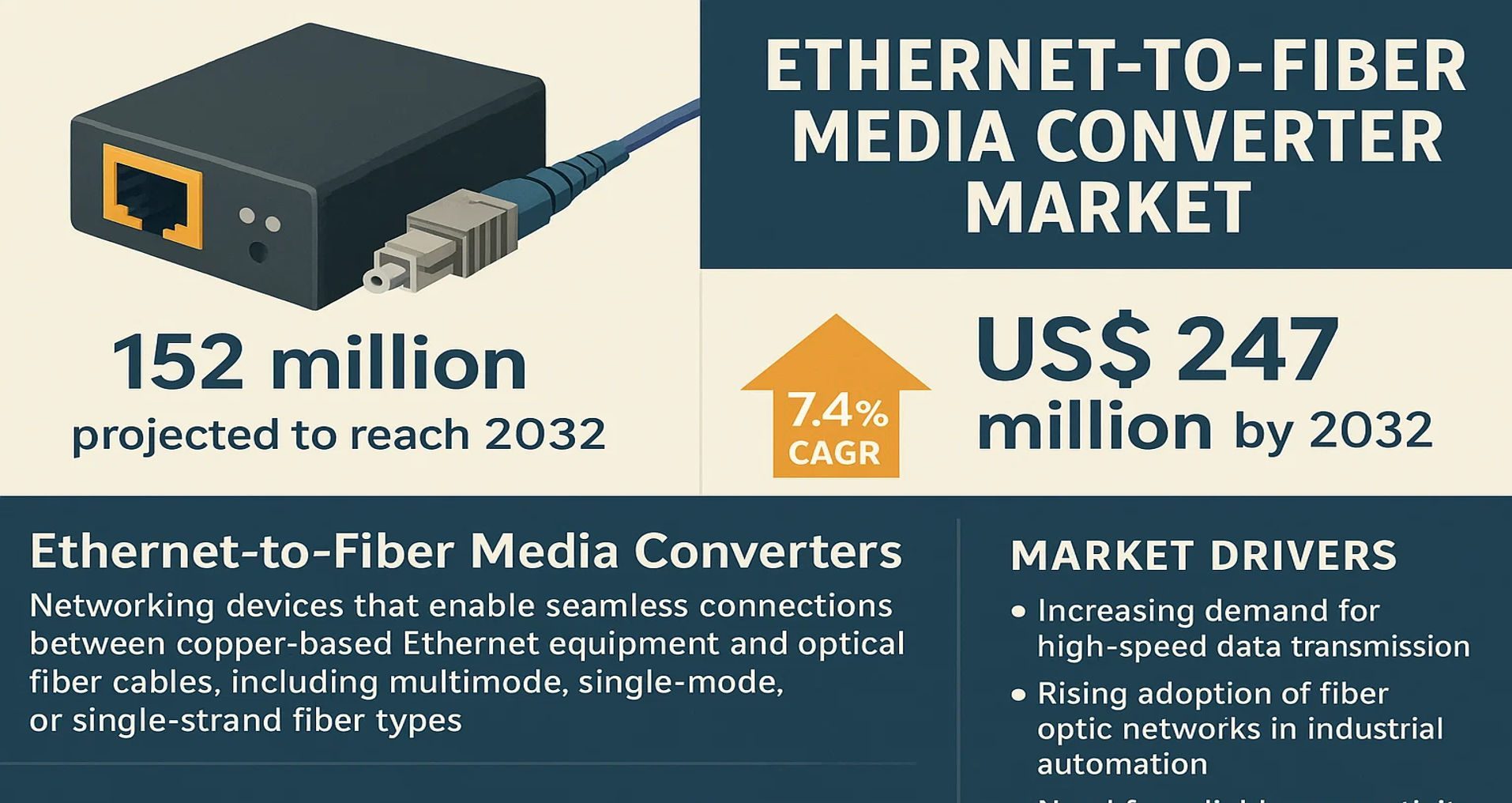
The global Ethernet-to-Fiber Media Converter Market was valued at 152 million in 2024 and is projected to reach US$ 247 million by 2032, at a CAGR of 7.4% during the forecast period.
Ethernet-to-Fiber Media Converters are networking devices that enable seamless connections between copper-based Ethernet equipment and optical fiber cables, including multimode, single-mode, or single-strand fiber types. These converters play a critical role in extending network distances, improving signal quality, and enhancing data transmission speeds across various industries.
The market growth is driven by increasing demand for high-speed data transmission, rising adoption of fiber optic networks in industrial automation, and the need for reliable connectivity solutions in harsh environments. The 100 Mbps segment is expected to show significant growth potential, while North America and Asia-Pacific remain key regional markets. Leading players such as TP-Link, Siemens, and Belden dominate the competitive landscape, offering a wide range of converter solutions for diverse applications including factory automation and transportation systems.
MARKET DYNAMICS
MARKET DRIVERS
Growing Demand for High-Speed Communication Networks to Drive Market Expansion
The Ethernet-to-Fiber Media Converter market is experiencing robust growth due to the escalating demand for high-speed data transmission across industries. With enterprises increasingly adopting cloud computing and IoT solutions, the need for reliable network infrastructure has intensified. Fiber optic networks offer significantly higher bandwidth compared to traditional copper Ethernet, with modern fiber solutions supporting up to 400 Gbps speeds. This performance advantage is driving enterprises to upgrade their networks, creating substantial demand for media converters that bridge existing copper infrastructure with fiber optic systems. The transition to high-speed networks is particularly evident in data centers, where fiber adoption grew by approximately 28% in 2023 compared to previous years.
Industrial Automation and Smart Factory Initiatives Accelerate Adoption
The rapid advancement of Industry 4.0 technologies is another key driver for the media converter market. Modern manufacturing facilities require real-time data transmission between machines, sensors, and control systems, often across large physical areas where copper Ethernet suffers from distance limitations. Fiber optic solutions can transmit data across several kilometers without signal degradation, making media converters essential for factory automation. The global smart manufacturing market is projected to grow at a CAGR of 12.4% through 2030, further fueling demand for reliable network conversion solutions. For instance, automotive plants implementing robotic assembly lines are deploying media converters to integrate legacy PLC systems with new fiber backbone networks.
Government Investments in Broadband Infrastructure Create New Growth Avenues
National broadband initiatives worldwide are creating significant opportunities for media converter providers. Many governments have allocated substantial funds to expand fiber optic networks to rural and underserved areas. These projects often require media converters to interface between existing copper infrastructure and new fiber deployments. In the last two years, over 50 countries have announced fiber expansion programs with combined investments exceeding $180 billion. Additionally, 5G rollout projects frequently utilize media converters to connect radio units with centralized baseband units, further driving market adoption.
MARKET RESTRAINTS
High Initial Deployment Costs Limit Adoption in Price-Sensitive Markets
While fiber optic solutions offer long-term benefits, their higher upfront costs compared to pure copper networks present a significant adoption barrier. A complete fiber deployment including media converters can cost 2-3 times more than copper-based alternatives. This cost differential stems from specialized equipment requirements including optical transceivers and more expensive installation processes. Many small and medium enterprises, particularly in developing regions, delay upgrades due to budget constraints. Recent market surveys indicate that nearly 40% of IT decision-makers cite cost as their primary concern when considering fiber network transitions.
Other Restraints
Compatibility Issues with Legacy Systems
Many organizations face technical challenges integrating media converters with existing network equipment. Older switches and routers may not support modern media converter features like auto-negotiation or power over Ethernet, necessitating additional hardware upgrades. These compatibility issues can escalate project costs and complexity, discouraging some potential adopters.
Limited Technical Expertise in Emerging Markets
Proper configuration and maintenance of fiber networks require specialized skills that remain scarce in many regions. The global telecom industry faces a projected shortfall of over 1.2 million skilled fiber technicians by 2025, potentially slowing deployment timelines and increasing operational costs for network operators.
MARKET CHALLENGES
Rapid Technological Evolution Creates Product Lifecycle Pressures
The networking industry’s fast-paced innovation presents constant challenges for media converter manufacturers. New standards like 25GbE and 400GbE require frequent product refreshes, compressing development cycles and increasing R&D expenditures. Many enterprises hesitate to invest in current-generation solutions due to concerns about premature obsolescence. This “wait-and-see” approach among buyers can suppress short-term market growth despite long-term infrastructure needs.
Supply Chain Disruptions Impact Component Availability
The global semiconductor shortage has significantly affected media converter production, with lead times for key components like optical transceivers extending to 52 weeks in some cases. These disruptions have constrained market supply while increasing manufacturing costs. Industry analysis suggests that component shortages have delayed approximately 15% of planned network upgrades in the past two years, representing a substantial opportunity cost for the market.
MARKET OPPORTUNITIES
5G Backhaul Deployments Create New Application Scenarios
The ongoing global 5G rollout represents a significant growth opportunity for media converter providers. Mobile network operators require extensive fiber backhaul networks to support 5G’s high bandwidth and low latency requirements. Many cell sites utilize media converters to connect wireless equipment with fiber infrastructure, particularly in urban deployments where space constraints favor compact conversion solutions. The 5G infrastructure market is projected to exceed $47 billion by 2026, with a substantial portion allocated to transport network components including media converters.
Smart City Initiatives Drive Network Infrastructure Investments
Municipalities worldwide are investing in intelligent traffic systems, public safety networks, and smart grid technologies that rely on robust fiber optic connectivity. These deployments frequently require media converters to interface between various legacy and modern systems. Over 200 major cities have announced smart city programs with projected technology investments exceeding $300 billion through 2030. Media converter manufacturers are developing specialized solutions for harsh outdoor environments to capitalize on this growing application segment.
Energy Sector Modernization Presents Specialized Requirements
The transition to smart grids and renewable energy systems is creating demand for media converters with enhanced reliability and cybersecurity features. Power utilities require solutions capable of operating in electrically noisy environments while meeting stringent regulatory standards. Several manufacturers have introduced media converters with extended temperature ranges and surge protection specifically designed for substation applications. The global smart grid market is expected to grow at 9.8% CAGR through 2028, offering substantial opportunities for specialized networking solutions.
ETHERNET-TO-FIBER MEDIA CONVERTER MARKET TRENDS
Rising Demand for High-Speed Data Transmission to Drive Market Growth
The Ethernet-to-Fiber Media Converter market is experiencing significant growth due to the increasing need for high-speed and reliable data transmission across industries. With the global market valued at $152 million in 2024 and projected to reach $247 million by 2032, the demand for seamless connectivity solutions is accelerating. Businesses and organizations are rapidly adopting fiber optic networks to replace traditional copper-based systems, primarily because of their superior bandwidth, lower latency, and immunity to electromagnetic interference. Industrial sectors such as manufacturing, transportation, and energy are deploying these converters to enhance operational efficiency and cybersecurity. The transition to Industry 4.0 and smart factory automation is further fueling this growth, as real-time data transfer becomes critical for IoT-enabled devices and automation systems.
Other Trends
Expansion of Smart Infrastructure Projects
The proliferation of smart cities and intelligent transportation systems is amplifying the adoption of Ethernet-to-Fiber Media Converters. Governments and private enterprises worldwide are investing heavily in smart infrastructure, where fiber-based networks are essential for managing traffic control systems, surveillance, and utility grids. The 100 Mbps segment is expected to witness substantial growth due to its balance between cost and performance, particularly in mid-tier industrial applications. Moreover, emerging economies in Asia and Latin America are increasing their investments in upgrading telecom and utility networks, creating new opportunities for converter manufacturers.
Technological Advancements and Gigabit Adoption
Technological innovations in Ethernet-to-Fiber Media Converters are reshaping the competitive landscape. The emergence of Gigabit and 10 Gigabit converters is gaining traction, especially in data centers, cloud computing, and enterprise networks where high-speed data transfer is non-negotiable. Leading manufacturers like Siemens, Belden, and Moxa are focusing on developing ruggedized, low-power, and compact converters for harsh industrial environments. Additionally, advancements in PoE (Power over Ethernet)-enabled fiber converters are streamlining deployments in remote surveillance and IoT applications by reducing cable complexity. While cost remains a barrier for some enterprises, the long-term benefits of scalability, future-proofing, and reduced maintenance are making fiber conversion solutions increasingly indispensable.
The market is also witnessing a shift toward plug-and-play and managed media converters, allowing network administrators greater control and monitoring capabilities. As cybersecurity threats rise, vendors are embedding enhanced encryption and network segmentation features to safeguard critical infrastructure. With a CAGR of 7.4%, the Ethernet-to-Fiber Media Converter market remains on a growth trajectory, driven by industrial digitization, 5G backhaul requirements, and expanding broadband penetration.
COMPETITIVE LANDSCAPE
Key Industry Players
Market Leaders Innovate to Capture Growth in Expanding Fiber Connectivity Market
The global Ethernet-to-Fiber Media Converter market demonstrates a moderately fragmented competitive structure, with established technology providers competing alongside specialized networking solution vendors. TP-Link and Siemens currently lead the market through their comprehensive product portfolios spanning industrial, commercial and residential applications. These players maintain their dominance through continuous upgrades to converter speed capabilities and expansion into emerging fiber infrastructure projects.
Belden and Moxa have strengthened their positions significantly by focusing on ruggedized media converters for mission-critical applications in transportation and energy sectors. Their competitive advantage stems from robust designs certified for harsh environments, coupled with strong technical support networks across key regions. Both companies are actively developing converters with advanced management features to address growing smart infrastructure demands.
The market has seen increasing competition from Transition Networks and Phoenix Contact, who are differentiating their offerings through enhanced security protocols and intelligent monitoring capabilities. These players are targeting the enterprise segment where network visibility and cyber protection features command premium pricing. Recent product launches incorporating AI-driven analytics suggest this technological arms race will intensify through the forecast period.
Meanwhile, Asian manufacturers including Kyland Technology and Planet Technology are gaining traction through competitively priced solutions for volume applications. Their strategy focuses on optimizing production efficiencies while meeting international certification standards, enabling aggressive pricing that pressures margins across the industry.
List of Key Ethernet-to-Fiber Media Converter Companies
- TP-Link (China)
- Siemens (Germany)
- Belden (U.S.)
- Moxa (Taiwan)
- Advantech (Taiwan)
- Allied Telesis (Japan)
- Phoenix Contact (Germany)
- Transition Networks (U.S.)
- Kyland Technology (China)
- Planet Technology (Taiwan)
- Korenix Technology (Taiwan)
- Spectris (U.K.)
Segment Analysis:
By Type
Gigabit Segment Dominates Due to High-Speed Network Infrastructure Demands
The market is segmented based on type into:
- 100 Mbps
- Gigabit
- 10 Gigabit
- Above 10 Gigabit
- Others
By Application
Factory Automation Leads Due to Industrial IoT Adoption
The market is segmented based on application into:
- Factory Automation
- Transportation Systems
- Electric Utility
- Others
By End User
Industrial Sector Dominates with Growing Smart Manufacturing Needs
The market is segmented based on end user into:
- Industrial
- Manufacturing
- Oil & Gas
- Mining
- Commercial
- Telecom
- Government
Regional Analysis: Ethernet-to-Fiber Media Converter Market
North America
North America dominates the Ethernet-to-Fiber Media Converter market, driven by rapid industrialization and high demand for reliable networking solutions. The U.S., with its advanced telecommunications infrastructure, accounts for the majority of regional revenue, supported by growing investments in smart factories and enterprise IT modernization. The push toward Industry 4.0 and widespread adoption of IoT solutions in manufacturing further accelerates demand for high-speed fiber converters. Key players like Belden and Transition Networks are actively expanding their portfolios to cater to sectors such as factory automation and electric utilities, where fiber reliability is critical. However, cost sensitivity in small and medium enterprises limits full-scale adoption of high-end converters.
Asia-Pacific
The Asia-Pacific region is witnessing exponential growth, with China leading due to massive infrastructure development and government initiatives like “Made in China 2025.” India and Southeast Asian nations are also emerging as key markets, driven by expanding data centers and telecom networks. Local manufacturers such as Kyland Technology and Huahuan are gaining traction by offering cost-effective solutions, though competition with global brands remains intense. The proliferation of smart cities and 5G deployments is creating new opportunities, but inconsistencies in standardization across countries present a challenge for seamless integration.
Europe
Europe’s market is characterized by stringent regulatory standards and a strong emphasis on energy-efficient networking solutions. The adoption of fiber converters is notably high in Germany and the U.K., where industrial automation and renewable energy projects demand robust communication backbones. Companies like Siemens and Phoenix Contact are innovating with environmentally compliant products to align with EU directives. While Western Europe demonstrates mature adoption, Eastern Europe shows slower uptake due to legacy copper infrastructure. Nonetheless, the region’s focus on sustainability and Industry 4.0 ensures steady long-term demand.
South America
South America’s market is nascent but growing, primarily fueled by Brazil’s industrial sector and Argentina’s telecom expansions. Economic instability and budget constraints hinder large-scale investments in advanced fiber solutions, making affordability a key purchasing criterion. Local players compete with imported products, often prioritizing basic 100 Mbps or Gigabit models over high-capacity converters. Despite these challenges, increasing digitization in mining and utilities offers potential for future growth, provided infrastructure investments stabilize.
Middle East & Africa
The MEA region shows uneven growth, with Gulf nations like the UAE and Saudi Arabia leading due to smart city initiatives and oil & gas sector demands. Fiber converter adoption is rising in transportation and utility projects, but political and economic volatility in other parts of the region slows progress. Limited local manufacturing forces reliance on imports, though partnerships with global suppliers are gradually improving accessibility. While the market remains fragmented, expanding broadband penetration and data center construction signal long-term opportunities.
Report Scope
This market research report provides a comprehensive analysis of the Global Ethernet-to-Fiber Media Converter Market, covering the forecast period 2024–2032. It offers detailed insights into market dynamics, technological advancements, competitive landscape, and key trends shaping the industry.
Key focus areas of the report include:
- Market Size & Forecast: Historical data and future projections for revenue, unit shipments, and market value across major regions and segments. The market was valued at USD 152 million in 2024 and is projected to reach USD 247 million by 2032, growing at a CAGR of 7.4%.
- Segmentation Analysis: Detailed breakdown by product type (100 Mbps, Gigabit, 10 Gigabit, Above 10 Gigabit), application (Factory Automation, Transportation Systems, Electric Utility, Others), and end-user industry to identify high-growth segments.
- Regional Outlook: Insights into market performance across North America, Europe, Asia-Pacific, Latin America, and the Middle East & Africa. The U.S. and China are key markets with significant growth potential.
- Competitive Landscape: Profiles of leading market participants including TP-Link, Siemens, Belden, Moxa, Advantech, Allied Telesis, and Phoenix Contact, covering their product portfolios, market share, and strategic initiatives.
- Technology Trends & Innovation: Assessment of emerging technologies in fiber optic communication, industrial Ethernet, and high-speed data transmission solutions.
- Market Drivers & Restraints: Evaluation of factors driving market growth such as increasing demand for high-speed networks and challenges including supply chain constraints.
- Stakeholder Analysis: Strategic insights for network equipment providers, system integrators, and enterprise IT decision-makers regarding market opportunities.
The research employs both primary and secondary methodologies, including interviews with industry leaders and analysis of verified market data to ensure accuracy and reliability.
FREQUENTLY ASKED QUESTIONS:
What is the current market size of Global Ethernet-to-Fiber Media Converter Market?
-> Ethernet-to-Fiber Media Converter Market was valued at 152 million in 2024 and is projected to reach US$ 247 million by 2032, at a CAGR of 7.4% during the forecast period.
Which key companies operate in this market?
-> Key players include TP-Link, Siemens, Belden, Moxa, Advantech, Allied Telesis, Phoenix Contact, Transition Networks, and Kyland Technology.
What are the key growth drivers?
-> Growth is driven by increasing demand for high-speed networks, industrial automation, and smart infrastructure development.
Which region dominates the market?
-> Asia-Pacific shows the fastest growth, while North America currently holds significant market share.
What are the emerging trends?
-> Emerging trends include adoption of 10G+ converters, PoE-enabled solutions, and compact form factors for industrial applications.

Get Sample Report PDF for Exclusive Insights
Report Sample Includes
- Table of Contents
- List of Tables & Figures
- Charts, Research Methodology, and more...
 Download Sample Report PDF